
Pentagon Calculator
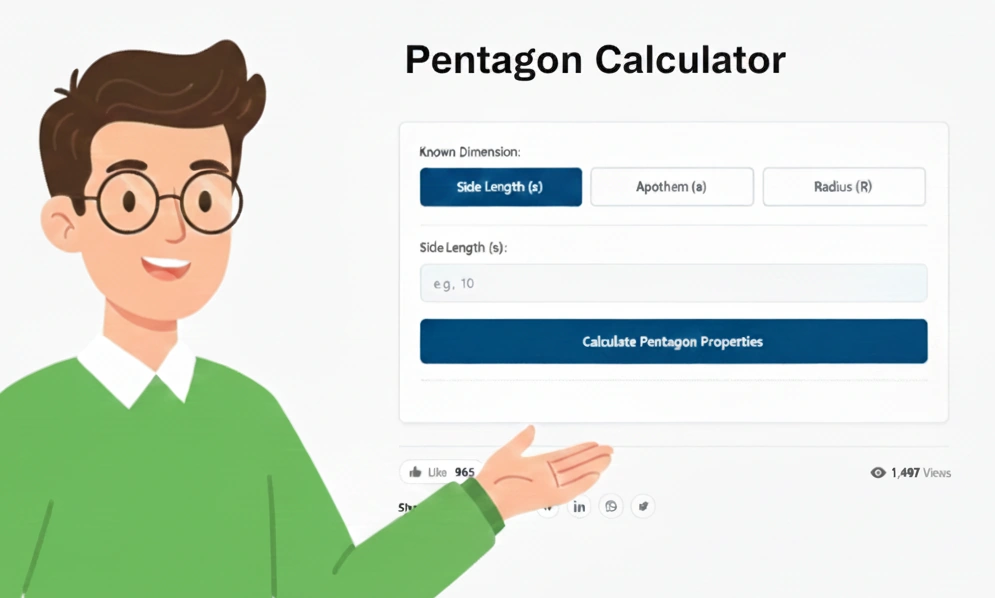
The Pentagon Calculator computes the exact properties of a regular pentagon. The tool accepts Side Length, Apothem, or Radius as inputs. Most calculators require you to know the side length first. However, our advanced engine solves for all missing dimensions instantly. You can use it for geometry homework or construction projects requiring five-sided precision.
Calculating the area of a pentagon requires complex trigonometry. You must typically divide the shape into five triangles. Our calculator automates this entire process. It uses the specific geometric constants for a regular polygon. Therefore, you get accurate results for Area and Perimeter immediately. Architects and students rely on this tool for fast geometric proofs.
- Updated Feb 10, 2026
Pentagon Calculator: Find Area, Side & Radius
Select Side (s), Apothem (a), or Radius (R). The numeric length of your known dimension. Area, Perimeter, Recalculated Side, Apothem, and Radius.
What Your Geometry Results Mean
The result displays the total 2D space inside the shape. The “Area” represents the surface coverage in square units. We calculate this value using the specific input you provided. Architects and builders use this number frequently. It determines material needs for flooring, tiling, or painting projects.
Perimeter represents the total distance around the outside edge. The calculator multiplies the side length by five to find this total. We also provide the missing dimensions automatically. For example, if you enter the Side length, we calculate the Apothem and Radius for you. Seeing all properties helps you construct the shape accurately on paper or in CAD software.
Regular polygons possess specific mathematical ratios. The area of a pentagon is always larger than that of a square with the same side length. In fact, it covers about 72% more space. Therefore, using the correct formula prevents material shortages during construction.
Quick example to check the math
- Input: You select Side Length and enter 10.
- Calculated Output: Area 172.05 Units².
- Analysis: A pentagon with a side of 10 covers more space than a square. Specifically, it is roughly 1.72 times larger than a square of the same Side. Consequently, the area exceeds 100 significantly.
Explore More Calculators
Use our Hexagon Calculator to find the area, perimeter, and diagonals of any six-sided shape. Get 100% accurate results for your construction or geometry…
Try calculatorUse our Right Triangle Calculator to find the hypotenuse, area, and angles. Get 100% accurate results for your construction or trigonometry project today.
Try calculatorHow to Use the Pentagon Calculator
You can get precise results by following these three steps. Our tool adapts to the specific dimension you know. Follow the instructions below to calculate your shape.
Identify Your Dimension
First, check your geometry problem or diagram. Determine which length you actually know. Is it the flat Side, the center-to-edge Apothem, or the center-to-corner Radius? Identifying this correctly prevents wrong answers.
Select Calculation Method
Next, click the correct radio button. Choose "Side Length," "Apothem," or "Radius" from the list. The calculator will instantly update the input field to match your selection.
Input the Number
Then, enter your known value. Type the length into the active box. Ensure you use positive numbers only. Geometry formulas fail with negative values.
Verify Units (Optional)
Check your units. While the calculator uses generic "units," you should note if you are working in inches, meters, or feet. The output will match whatever unit you input.
Calculate Properties
Finally, solve the equation. Click the "Calculate Pentagon Properties" button. You will see the Area and Perimeter instantly. Review the "Dimensions" section to see the other calculated lengths.
Example for testing
Try these sample numbers:
- Method: Side Length
- Input: 10
Result → Area is approx. 172.0477.
How the Pentagon Formula Works (Complete Breakdown)
Understanding the math helps you pass your geometry exams. The formula divides the pentagon into five equal isosceles triangles. We calculate the area of one triangle and multiply it by five to get the total.
The Area Formulas
We believe in complete transparency. Our calculator uses specific trigonometry based on the input type.
Formula:
					1. Given Side Length:
Area = 5 x s² / 4 x tan(36°)
Simplified: s² x 1.72048
2. Given Apothem (a²):
Area = 5 x a² x tan(36°)
3. Given Radius (R):
Area = 5 x R² x sin(72°)2
4. Perimeter (p):
P = 5 x s
Example:
					If you have a regular pentagon with a Side Length of 10:10² = 100

100 x 1.72048 = 172.048
Your total Area is 172.05 Units². Architects use this number to determine material needs for flooring or tiling.
Micro Note:
The number 5 represents the count of sides. The angle 36° comes from dividing the circle (360°) by 10. Trigonometry relies on these fixed angles for all regular polygons.
Key Inputs Used in the Attendance Calculator
Every geometry calculation depends on specific dimensions. These inputs help you measure your shape accurately. You can plan your construction effectively by entering real numbers for the side, apothem, or radius.
Side Length (s)
The side length acts as the flat edge of the pentagon. It serves as the base for the perimeter calculation. Increasing the side length increases the area exponentially.
Apothem (a)
The Apothem measures the distance from the center to the midpoint of a side. It acts as the “height” of the internal triangles. Builders often use the Apothem to find the exact center point of a room.
Radius (R)
The Radius connects the center to a vertex corner. It determines the size of the circle that would surround the pentagon. You use the Radius when inscribing a pentagon inside a circle.
Another Example Calculation (Step-by-Step)
Let’s see how the calculation works using a side length of 10. The breakdown shows the constant multiplier in action.
Given:
- Side (s): 10 units
Calculation:
Calculation:
					First, square the Side.

10² = 100
Next, apply the pentagon area constant.
100 x 1.7204774 = 172.04774
Finally, calculate the perimeter.
10 x 5 = 50
Result:
- Area: 172.05 Units²
- Perimeter: 50 Units
Meaning:
The shape covers 172 square units. The boundary measures 50 units. Therefore, you have the exact dimensions needed for drawing or building.
Geometric Properties of a Regular Pentagon
A regular pentagon possesses unique symmetry. Mathematicians define it by specific angles and ratios. The table below lists the constants you need to memorize.
| Property | Value | Definition |
|---|---|---|
| Internal Angle | 108° | Corner angle inside the shape. |
| Sum of Angles | 540° | Total sum of all 5 corners. |
| Central Angle | 72° | Center angle per triangle. |
| Diagonals | 5 | Lines connecting non-adjacent corners. |
Note: These properties apply strictly to regular pentagons where all sides and angles are equal.
Interpretation
The result confirms the geometric integrity of your shape. A regular pentagon must have equal sides and equal angles. Our tool uses trigonometric constants (like Tan 36°) to ensure the relationships between Side, Radius, and Apothem remain mathematically perfect.
Pro Tip:
Always distinguish between Apothem and Radius. The Radius connects the center to a corner vertex. The Apothem connects the center to the flat middle of a side. Confusing these two lines leads to massive calculation errors in construction.
Tips & Planning Based on Your Result
You can find pentagons in nature and architecture. Understanding the shape helps you recognize these structures in daily life.
The Pentagon Building
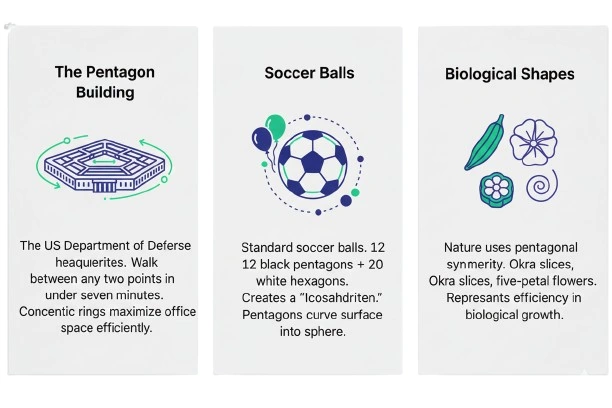
The US Department of Defense headquarters relies on this specific shape. Its design facilitates rapid movement. Employees can walk between any two points in under seven minutes. Concentric rings maximize office space efficiently.
Soccer Balls
Standard soccer balls utilize pentagons. Makers stitch 12 black pentagons to 20 white hexagons. Such a pattern creates a Truncated Icosahedron. Pentagons curve the flat leather into a round sphere.
Biological Shapes
Nature favors pentagonal symmetry. Okra slices reveal a perfect five-sided shape. Flowers like the Morning Glory have five petals arranged precisely. Plants use this geometry to optimize biological growth.
You Might Also Find These Helpful
Math 2
No tools published here yet.
Common Mistakes to Avoid When Calculating
You can get the most accurate results by avoiding these errors. Small details often change the calculation significantly. Pay attention to the following points.
- Confusing Radius and Apothem: Radius hits the corner. Apothem hits the flat side. Mixing these up changes the result drastically.
- Using Diameter: Pentagons do not have a standard "diameter" like a circle. You must use the diagonal or radius.
- Assuming Irregular Shapes: This calculator works for regular pentagons only. All sides must be equal. Irregular shapes require complex coordinate geometry.
- Forgetting Units: Area is always squared (ft²). Perimeter is linear (ft). Mixing these up leads to ordering the wrong amount of material.

Frequently Asked Questions (FAQs)
How to calculate a 5-sided area?
Calculate the area by squaring the side length first. Then, multiply that number by approximately 1.72. Alternatively, multiply the perimeter by the apothem and divide by two. Our calculator handles this math instantly.
What is the formula for calculating a pentagon?
The most common formula relies on the side length (s). You use the equation Area = 1.72048 x s². Another method uses the apothem (a) and perimeter (P). That formula is Area = 1/2 x P x a.
Is a pentagon 180 or 360?
A pentagon is neither. The sum of its internal angles equals 540°. However, the sum of its exterior angles always equals 360°. A triangle has 180°. Therefore, a pentagon holds three times the angular sum of a triangle.
How to find the area of a pentagon calculator?
You can find the area using the tool on this page. Our area of a pentagon calculator automates the math instantly. Simply enter the side length.
What is the perimeter formula for a pentagon?
Finding the perimeter of a pentagon is simple. Multiply the side length (s) by 5. For example, a pentagon with a side of 10 has a perimeter of 50.
How many diagonals are in a pentagon?
A regular pentagon has exactly 5 diagonals. You draw them by connecting every non-adjacent corner. Connecting all five diagonals creates a perfect five-pointed star, or pentagram, inside the shape.
Questions?
We had love to hear from you! Whether you are reporting an issue, suggesting a new calculator, or exploring collaboration opportunities — we are here to help. Every message helps us make 100calc smarter, faster, and more helpful for everyone.
Why People Trust 100calc
At 100calc.com, we focus on accuracy, speed, and trust. Every calculator we create is designed to give reliable, instant, and easy-to-understand results you can truly depend on.