
Gold Jewelry Calculator
Know the real value of your rings and chains
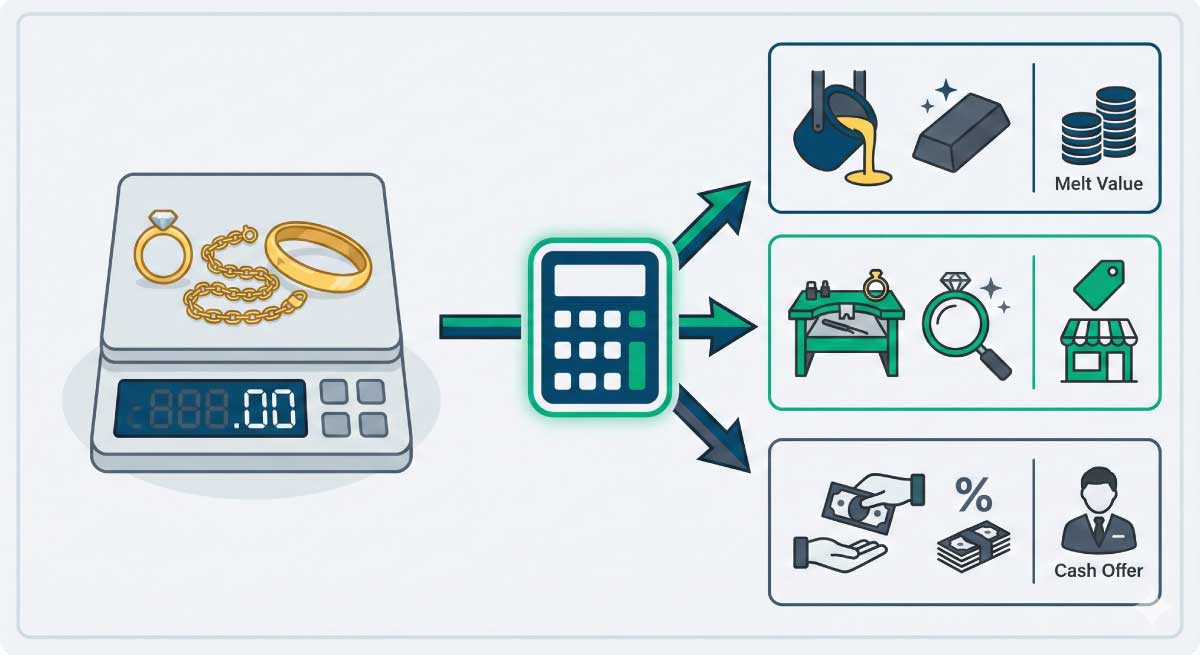
Use this gold jewelry calculator to estimate what your item is worth based on weight, karat purity, and the spot price of gold. You will see three key numbers. Melt value shows the raw gold value if you sell for scrap. Retail value adds common jewelry costs like making charges and optional wastage.
Cash offer estimates what a buyer may pay after a payout rate. If your jewelry has stones, you can subtract stone weight to get a cleaner gold-only estimate. It works for grams, ozt, dwt, and tola. You can check 10K, 14K, 18K, 22K, and 24K items instantly. Enter your details, click calculate, and compare results before you sell, insure, or buy.
According to today’s rates, gold in the USA is trading near $2,650.00 per ounce.
- Updated Jun 25, 2026
- Reviewed by: Imad Rehman
Live Gold Price Today by Weight and Karat
Gold prices change every day. Sometimes they change every minute. This live gold price shows the current spot rate so you can calculate with real numbers. You can check the gold price per gram, per troy ounce, or per tola. This helps when you value 14K, 18K, 21K, or 22K gold. Always start with the current price before you calculate gold value, melt value, or scrap payout.
This works for the USA market and global users. Prices update automatically. You do not need to refresh the page.
These rates are based on international spot gold prices converted to your selected currency. Retail jewellery prices may include making charges, shop margins, and taxes.
Calculate Your Gold Jewelry Value Now
See exactly what your gold is worth—whether you are selling to a dealer or buying from a shop.
Enter your jewelry details below to instantly generate three distinct values: the raw melt value (pure gold only), the estimated retail price (including labor), and a realistic cash offer you might receive from a pawn shop or refinery.
Gold Jewelry Calculator
Today’s 24K international spot-equivalent in USA is USD 134.00 per 1g (current verified rate). Verified Oct 16, 2026, 4:26 pm.Calculate gold jewelry value using weight, karat, and spot price. Compare melt value (for selling) vs. retail value (for buying/insurance).
Enter your inputs to see a detailed breakdown here.
How Do I Read the Gold Jewelry Calculator Results?
You might see three different numbers. Do not get confused. Each number tells a distinct story about your gold value. It depends on your goal. You might want to sell scrap. Or you might want to insure a ring. We explain each result below so you can make the right choice.
What Is Melt Value?
Melt value is the actual market worth of the pure gold in your item. It excludes labor costs and gemstones. It uses only the weight and spot price. Use this number when selling scrap to a dealer. It is the raw metal price. However, store prices are often higher.
What Is Estimated Retail Value?
Retail value is a rough estimate of the store price. It adds making charges and wastage to the gold cost. Use this for insurance notes or buying comparisons.
Shops charge for labor. This is the making charge. They also cover material wastage. You cannot sell used items for this price. It is only for buying. Now, see what a dealer will pay.
What Is the Estimated Cash Offer?
This is a realistic payout estimate from a buyer. It is a percentage of the melt value. Dealers usually pay 60% to 75%. They need a profit margin. Do not expect the full spot price. This helps you judge real offers. See the examples below to understand better.
Test the Calculator With Real Examples
Use the examples below to test the calculator. Enter the values exactly as shown. You can change them later to match your own jewelry.
Example 1: Selling a Gold Ring
Use this to check melt value vs cash offer.
- Item: Ring
- Weight: 10 grams
- Purity: 14K
- Spot Price: 2400 USD per ozt
- Payout: 75%
What you should see:
- Melt Value: $451.39 (Pure gold value)
- Cash Offer: $338.54 (Dealer payout)
Example 2: Chain With Stones
Use this to test stone subtraction.
- Item: Chain
- Total Weight: 25 grams
- Has Stones: Yes
- Stone Weight: 3 grams
- Purity: 18K
What you should see:
- Net Weight: 22.00 g (Stones removed)
- Pure Gold: 16.50 g
Example 3: Retail Price Check
Use this to estimate shop prices.
- Item: Bangle
- Weight: 30 grams
- Purity: 22K
- Making Charge: 15%
What you should see:
- Retail Value is higher than Melt Value.
- It includes labor and wastage costs.
Want to sell your gold or check jewelry value? Try these calculators.
Calculate gold value instantly using live prices. Check melt value, jewelry worth, scrap payouts, purity, weight, and karat with our gold calculator.
Try calculatorCalculate 14K gold chain weight in grams instantly. Enter length and width to estimate solid or hollow chain mass before you buy or sell.
Try calculatorUse our 18K Gold Price Calculator to find true jewelry value instantly. Get live rates per gram, ounce, and total melt value in seconds.
Try calculatorUse our 22K Gold Price Calculator to find jewelry value instantly. Get live rates per gram, total melt value, and scrap estimates in seconds.
Try calculatorUse this Gold Chain Value Calculator to find your jewelry's worth. Check live melt value, scrap payouts, and 14K/18K retail prices instantly.
Try calculatorFree Gold Karat Calculator: Convert karat to fineness stamps like 585 & 750. Check purity % and gold weight fast.
Try calculatorHow the Gold Jewelry Calculator Works Step by Step
This section explains how we value your item. It helps you trust the result. Follow these steps to get an accurate number.
Select Your Jewelry Details
First, choose your item type, such as a ring or chain. Then select the karat purity. This tells the calculator how much pure gold is inside. For example, 14K contains less gold than 24K.
Enter the Total Weight
Next, type in the weight of your item. You can use grams, troy ounces, pennyweights, or tolas. The tool converts everything into grams automatically. This ensures the math is correct.
Set the Gold Price
Enter the current market price for gold. You can find this on financial news sites. Make sure you match the unit correctly, usually "per ounce" or "per gram."
Subtract Stone Weight
If your jewelry has gems or beads, use the "Has Stones" toggle. Enter the approximate weight of the stones. We subtract this weight first. This leaves only the net gold weight for calculation.
Add Fees and Calculate
Finally, add making charges or wastage percentages if you want a retail estimate. Open the Advanced tab to set a dealer payout rate. This shows a realistic cash offer. Click calculate to see your values.
Quick Formula Used
Melt Value = (Total Weight − Stone Weight) × Purity % × Gold Price
Why This Process Is Accurate
- Stones are removed first: We subtract gem weight before calculating gold value.
- Units are standardized: Grams, tolas, and ounces all convert to a single base unit.
- Purity is precise: We use exact decimals (e.g., 0.585 for 14K) not rounded numbers.
- Real-world logic: We calculate melt value and retail value separately.
This method matches how professional buyers evaluate jewelry. It reflects the difference between the gold inside the ring and the price on the tag.
Try It Yourself
- Set the spot price to today’s rate.
- Enter your weight and select your karat.
- Toggle “Has Stones” to see how value drops when gems are removed.
- Check the “Cash Offer” to see a realistic selling price.
Gold Jewelry Calculator Formula (Complete Breakdown)
This section explains exactly how we calculate your result. We use the standard math used by professional jewelers and gold refiners. You see the exact formula behind melt value, retail pricing, and cash payouts. Each calculation uses the inputs you enter. This helps you trust the numbers and verify the value before you sell or insure your item.
Jewelry Value Formula Explained
The calculator follows a strict order. First, it standardizes weight. Second, it removes stones. Third, it applies purity. Finally, it adds or subtracts fees.
The Step-by-Step Math:
					1:Find Net Weight:
NetWeight = TotalWeight-StoneWeight
2:Find Pure Gold:
PureGold = NetWeight × PurityFactor
3:Calculate Melt Value: MeltValue=PureGold×SpotPricePerGram
4:Calculate Retail Value:
RetailValue = (MeltValue × (1 + Wastage%)) +MakingCharges
5:Calculate Cash Offer:
CashOffer = MeltValue × Payout%
Understanding the Variables
Here is what each variable means in the calculation.
Variable 1: Net Weight (The Real Weight)
This is the most critical step. If your ring weighs 10g but has a 2g diamond, you only have 8g of gold. We subtract the StoneWeight_g from the TotalWeight_g to ensure we do not value gemstones as gold.
Variable 2: Purity Factor (Karat)
This number represents the percentage of actual gold in your alloy. We use industry-standard decimals:
24K: 0.999 (99.9% Gold)
22K: 0.916 (91.6% Gold)
18K: 0.750 (75.0% Gold)
14K: 0.585 (58.5% Gold)
10K: 0.417 (41.7% Gold)
Variable 3: Modifiers (Retail vs. Cash)
- Wastage & Making: These are costs added by shops. Wastage covers gold lost during polishing. Making charges cover the labor of the goldsmith.
- Payout %: This is the percentage a dealer is willing to pay. A 75% payout means the dealer keeps 25% of the gold’s value as profit.
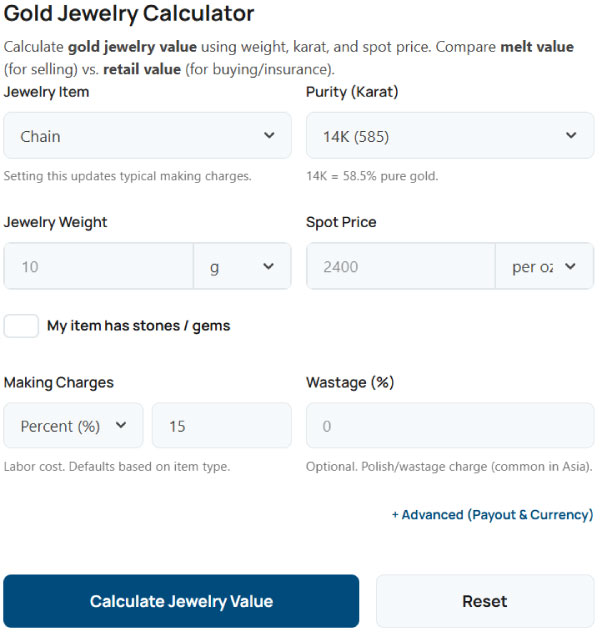
Example Calculation You Can Test
Use this exact input to test the calculator.
Given:
- Spot price: 2400 USD per troy ounce
- Item: Gold Ring (No Stones)
- Weight: 10 grams
- Purity: 14K (58.5%)
Calculation:
					Price per gram = $2400÷31.1035 = $77.16
Pure gold weight = 10g×0.585=5.85 grams
Melt Value = 5.85 g × $77.16
Result:
- Total Melt Value = $451.40
You should see this exact number in the “Melt Value” result field.
Why This Formula Matters
This formula shows the real market value of the gold inside your jewelry. It is the “Anchor Price.” It does not include the jeweler’s labor (making charges) or the dealer’s profit margin. It reflects gold content only. Because of this, the result will be lower than what you paid at the store, but higher than what a pawn shop will offer you today. You now know the baseline value before negotiating.
Result Benchmarks and Ranges
Your gold value is not just a single number. It changes based on who you sell to. A store adds labor costs. A pawn shop pays less for quick cash. You need to know where you stand. Use this breakdown to evaluate offers. It helps you see if a deal is fair or if you should walk away.
| Result Range | Category | Meaning | Typical Context | Notes |
|---|---|---|---|---|
| Melt Value << Retail | Normal | Retail adds labor, wastage, and shop margins. | Buying & Insurance | You pay more than gold value. |
| Cash Offer 60–75% | Typical Pawn | Standard offer for fast cash payouts. | Selling to Shop | Dealer covers overhead costs. |
| Cash Offer 85–98% | High Payout | Strong offer from refiners or competitive buyers. | Selling Scrap | Harder to find for small items. |
| Net Weight Near 0 | Needs Review | Stone weight estimate is too high. | Input Error | Subtracts too much from total. |
Important: Actual payouts vary by dealer, location, and market demand. Always compare offers before selling gold.
How to Read This Table With the Calculator
First, run the calculator with your jewelry details. Then look at the results panel. Now compare:
Now compare:
- Melt Value vs. Retail Value: See how much extra you pay for labor.
- Melt Value vs. Cash Offer: See how much profit the dealer keeps.
- Net Weight: Check if removing stones changed your value.
This shows where value is lost. It also shows where negotiation matters.
What This Means For You
If your cash offer is close to melt value (85%+), the deal is excellent. If it is far lower (below 60%), you should find another buyer. If you are valuing jewelry for insurance, use the Retail Value. If you are selling old broken chains, focus on the Cash Offer. This table turns raw numbers into smart decisions.
Quick Example Using the Gold Value Module
Inputs:
- Item: Gold Ring
- Weight: 10 grams
- Purity: 14K
- Spot Price: $2400 per troy ounce
Results you will see:
- Melt Value: ~$451 (Pure gold worth)
- Retail Value: ~$519 (Store price estimate)
- Cash Offer: ~$338 (Pawn shop payout)
Now check the table above. You can instantly see that a $338 offer falls into the “Typical Pawn” range.
Insights and Smart Recommendations
Getting a number is easy. Knowing what to do with it is harder. Use these expert tips to get the best deal for your jewelry.
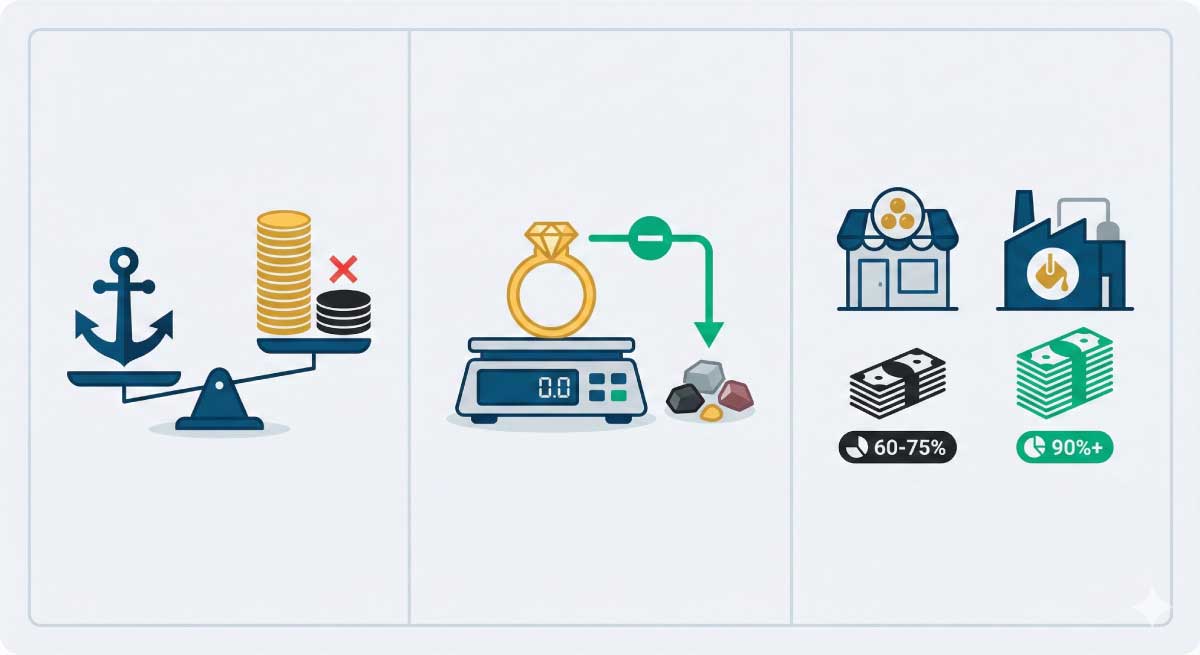
Use Melt Value as Your Anchor
Melt value is your most important number. It represents the “floor price” of your item. Use it to compare offers. If a buyer offers you $300, but the calculator shows a melt value of $450, you know they are keeping $150 as profit. This helps you negotiate better.
Handle Stone Weight Carefully
Gemstones can mislead you. They add weight but often have zero scrap value. If you do not know the exact stone weight, try this method:
Run the calculation with 0g stone weight (Maximum Gold Value).
Run it again with a small estimate, like 0.5g or 1.0g. The real value usually lies somewhere in between.
Be Realistic About Payouts
Not all buyers pay the same.
- Pawn Shops: They have high overhead costs. Set the payout slider to 60–75% to see a realistic offer from them.
- Refiners: They process gold in bulk. Set the slider to 90–95% if you plan to sell to a professional refiner.
Knowing the right percentage prevents disappointment when you walk into a store.
Use these tools to double-check your numbers before selling or buying.
Gold 11
Calculate precise scrap worth with the Gold Melt Value Calculator. Supports 24K-10K, refining fees, and live spot prices. Get your net payout result now.
Try calculatorUse the Gold Price Calculator by Weight to find the true value of your jewelry or scrap. Supports grams, tola, ozt, and all purities.…
Try calculatorUse our free Gold Price Per Gram Calculator for live values. Check 14K, 18K, 22K & 24K rates instantly based on real-time spot prices.…
Try calculatorConvert gold weight instantly. Accurate grams, troy ounces (ozt), and tola calculator for jewelry and scrap dealers.
Try calculatorGet an instant cash estimate with our free Scrap Gold Calculator. See real dealer payouts, deduct fees, and value 10K, 14K, or 18K gold…
Try calculatorCommon Mistakes When Calculating Gold Value
Small errors in your inputs can lead to massive differences in value. Watch out for these five common traps to ensure your estimate is accurate.
- Mixing Up Price Units: Do not enter a price per gram if the unit dropdown is set to "per ozt." This is the most frequent error and ruins the calculation.
- Ignoring Stone Weight: Gemstones add weight but have zero gold value. If you forget to subtract them using the toggle, you will severely overestimate the price.
- Guessing the Purity: Most jewelry is 14K or 18K, not 24K. 24K is too soft for most rings and chains. Always check the stamp on your item.
- Confusing Retail with Scrap: Retail value includes labor and design costs. Never expect to sell a used item for the retail price. Dealers only pay for the metal.
- Unrealistic Payouts: Do not set the payout slider to 100%. No dealer pays the full spot price. Expecting that cash offer will lead to disappointment when you try to sell.

Frequently Asked Questions (FAQs)
How do I calculate gold jewelry value?
To calculate the value, first subtract any stone weight to get the net gold weight. Then, multiply the net weight by the purity percentage (e.g., 0.585 for 14K). Finally, multiply that pure weight by the current gold spot price per gram.
This formula gives you the melt value, which is the baseline for selling scrap. For insurance or retail value, you must add labor costs (making charges) and dealer premiums.
What is the difference between melt value and retail value?
Melt value is the worth of the raw gold metal itself, excluding craftsmanship or stones. This is the price used when selling scrap or broken items to a refiner. Retail value is the price to buy the item new in a store, which adds labor costs (making charges), design fees, and shop profits on top of the gold cost.
Use melt value to estimate what you can sell an item for. Use retail value only for insurance appraisals or when checking if a store price is fair.
How much do pawn shops pay for gold jewelry?
Pawn shops typically pay between 50% and 75% of the gold’s melt value. They do not pay for the design or labor, only the raw metal content. The offer depends on the shop’s overhead, location, and whether they plan to resell the item or melt it down.
To maximize your payout, check the “Cash Offer” in our calculator first. If the shop’s offer is too low, consider selling to a specialized gold refiner or an online gold buyer, who may pay 90% or more.
How do stones affect gold jewelry value?
Stones increase the total weight but often add little to the cash value. When selling for scrap, buyers calculate the net weight by subtracting the weight of gemstones from the total. Most semi-precious stones and small diamonds are ignored or discarded during the melting process.
If you have large or high-quality diamonds, you should get a separate appraisal. For standard stones, like cubic zirconia, simply subtracting their estimated weight ensures your gold value calculation is accurate.
What are the making charges in gold jewelry?
Making charges are the fees for the labor involved in designing, molding, and polishing the jewelry. They are added on top of the raw gold cost. These charges vary based on the intricacy of the design; simple machine-made chains have lower charges (e.g., 5-10%), while complex, handcrafted bridal jewelry can have charges of 20-30% or more.
When selling old jewelry, you generally lose this value. Buyers pay for the gold content (melt value), not the labor that went into making it, unless the piece is a vintage or luxury brand item.
How do I convert spot price per ounce to per gram?
To convert the spot price, simply divide the live price per troy ounce by 31.1035. For example, if the spot price is $2,400, the math is $2,400 ÷ 31.1035 = $77.16 per gram. This converts the bulk trading price into a unit suitable for weighing jewelry.
Most financial news sites quote gold in Troy Ounces (ozt), not regular kitchen ounces. Using this specific divisor ensures your price per gram matches the international standard used by jewelers and refiners.
Is 14K gold worth more than 10K gold?
Yes, 14K gold is worth significantly more than 10K gold. 14K gold contains 58.5% pure gold, while 10K gold contains only 41.7% pure gold. Because gold value is based entirely on the weight of the pure metal, a 14K ring will always have a higher melt value than a 10K ring of the same total weight.
Specifically, 14K gold has about 40% more gold content than 10K. This makes it more valuable for resale and scrap, though 10K is often harder and more durable for daily wear.
Can I use this for insurance value?
Yes, you can use the Retail Value estimate as a baseline for insurance purposes. Insurance policies cover the replacement cost of an item, which means the amount it would cost to buy a new one today. This includes the raw gold cost plus making charges, labor, and taxes.
Do not use the Melt Value or Cash Offer for insurance, as these only reflect the scrap metal price. If your jewelry has expensive gemstones or is an antique, we recommend getting a professional appraisal document for the most accurate coverage.
Questions?
We had love to hear from you! Whether you are reporting an issue, suggesting a new calculator, or exploring collaboration opportunities — we are here to help. Every message helps us make 100calc smarter, faster, and more helpful for everyone.
Why People Trust 100calc
At 100calc.com, we focus on accuracy, speed, and trust. Every calculator we create is designed to give reliable, instant, and easy-to-understand results you can truly depend on.