
Pipe Weight Calculator
A Pipe Weight Calculator measures the exact mass of hollow cylinders based on material density and dimensions. Engineers and contractors in the USA use this tool to plan shipping and structural support. Specifically, it calculates the weight of steel, aluminum, and copper pipes based on their outer diameter and wall thickness. You can find your structural loads instantly today.
You can stop guessing about your material costs now. This engine provides a professional estimate for various metal and plastic piping. First, you will select your specific material from our professional list. Second, you will provide the diameter and wall thickness. Finally, you click calculate to see the total weight. Therefore, you can manage your logistics with total confidence. Use our tool to plan your construction project with accurate data.
- Updated Jun 18, 2026
Pipe Weight Calculator: Find Your Ideal Match
You can find the exact mass of your materials by using the tool below. Please enter the physical dimensions of your pipe to receive a professional report. Our engine processes your data against standard material density charts used in the USA. You should have your manufacturer’s spec sheets ready before you start the calculation.
RESULT INTERPRETATION
Your report highlights the precise mass of your structural components. These figures help you understand the physical demands of your project. Specifically, you should look at the total weight first. The weight value represents the full load your support system must hold. For instance, knowing the mass prevents structural failure during installation. You can use the weight data to confirm your shipping logistics for the coming weeks. Therefore, you can plan your crane lifts with total safety.
Understanding Unit Weight and Volume
Unit weight provides a stable metric for your material inventory. Specifically, it shows how many pounds or kilograms of pipe weigh per foot. A higher unit weight suggests a thicker wall or a denser material. Consequently, you can compare different materials to find the lightest option for your design. Therefore, you can reduce costs by picking the most efficient material. You should also check the inner diameter to ensure your fluids can flow properly. Proper flow ensures your plumbing system works at peak efficiency.
Using Your Results for Better Logistics
You can manage your construction site more effectively with these precise figures. Accurate tracking helps you avoid the common trap of overloading transport vehicles. For example, many contractors exceed truck limits by failing to account for material weight. Therefore, you should rely on the facts to balance your shipping loads. Also, remember that accurate volume data helps with coating and painting estimates. You should check your results for every pipe size on your list. Specifically, the data ensures you stay within legal weight limits for every haul.

Quick example to check the math
You can easily verify your result with a simple calculation. First, calculate the volume of the material in your pipe. For a steel pipe with a 100 mm diameter and 5 mm wall, the average diameter is 95 mm. Second, multiply the average circumference by the thickness and length. A 6-meter pipe reaches a total volume of 0.00895 cubic meters.
After that, you calculate the final mass. Your starting point is the material density of steel at 7,850 kilograms per cubic meter. Finally, you multiply the volume by this density. This step brings your total weight to 70.28 kilograms. Therefore, you are successfully finding the exact load for your structural plan.
Calculation Summary:
- Average Diameter: 95 mm (0.095 m)
- Total Volume: 0.00895 m³
- Total Weight: 0.00895 x 7850 = 70.28 kg
Explore More Calculators
Use our Acres Per Hour Calculator to find your field capacity. Get precise mowing time and productivity estimates for farm equipment today.
Try calculatorYou can use our free copper power calculator to find your exact quarantine dose. First, enter your net water volume. Next, discover your total…
Try calculatorUse our Glass Weight Calculator to find the exact mass of any pane. Get 100% accurate weight for tempered, float, and laminated glass in…
Try calculatorUse our Paver Sand Calculator to find the exact bags needed for your patio. Get precise weight and volume estimates for your landscaping project…
Try calculatorYou can use our free well volume calculator to find your exact water capacity. First, enter your pipe depth and diameter. Next, discover your…
Try calculatorHow to Use the Pipe Weight Calculator
You can estimate your material weight in just a few seconds. Our tool follows a professional sequence to ensure your data is accurate. Please follow these five simple steps to calculate your specific load.
Select Your Preferred Units
First, you must choose between the Metric and Imperial systems. You should use Metric for millimeters and meters. Alternatively, you should pick Imperial for inches and feet. Setting the correct units ensures the math stays precise for your project requirements. Therefore, you should verify your blueprint units before you start.
Choose Your Pipe Material
Second, you will select the material type for your pipe. You can choose from standard options like Steel, Aluminum, or PVC. Specifically, the tool uses the density of these materials to find the total mass. You should enter a custom density if you use a rare alloy. Consequently, the calculation remains accurate for any specialized industrial material.
Enter Pipe Dimensions
Third, you must provide the outer diameter and wall thickness. You can find these numbers on the manufacturer's spec sheet. Specifically, these two values determine the material's volume. Therefore, you must be very accurate with these measurements to get a correct result. Even a small error in thickness can significantly change the final weight.
Input the Total Length
Next, you will enter the total length of the pipe sections. You should enter the full amount of material you plan to move or install. The tool multiplies the unit weight by this length to find the final result. Consequently, you will know the exact weight for your entire order. This data helps you avoid multiple shipping trips.
Process Your Structural Data
Finally, you will click the blue button to view your results instantly. The engine analyzes your dimensions against professional material benchmarks. You can use these facts to plan your crane lifts and shipping costs today. Therefore, you can build safely and with precision. Accurate results ensure your support structures remain stable under the total load.
Example for testing
You can try these sample numbers to see how the tool works. First, select Steel as your material and set the units to Metric. Second, enter an outer diameter of 100 mm and a wall thickness of 5 mm. Finally, input a total length of 6 meters. These inputs represent a standard industrial steel pipe.
Result →Your total weight hits 70.28 kg. Your physical stats and material goals work together here. This score provides a balanced fit for general structural use. It equals a reliable and stable material load for most construction conditions. Now, enter your own numbers and check how close you are to your goal.
Now, enter your own numbers and check how close you are to your goal.
How the Pipe Weight Calculator Formula Works (Complete Breakdown)
You should understand how the math determines your structural loads. This formula provides a realistic estimate for your material mass. It is based on standard geometric rules for hollow cylinders. The logic separates physical dimensions from material density. This ensures the result is accurate for your specific project needs. Specifically, you can rely on these figures for shipping and installation plans.
The Pipe Sizing Formula
The calculator starts with the pipe’s cross-sectional area. Then it applies multipliers based on the length and material density. This method identifies the perfect balance between volume and mass. Weight represents the total matter within the solid pipe walls. Specifically, the calculation ignores the space in the center.
Formula:
Weight = π x (OD - WT) x WT x L x ρ
The formula begins by finding the average diameter of the pipe wall. It then identifies the total volume of the solid material. Finally, the tool multiplies that volume by the specific density of your material. This calculates your personalized structural load. Therefore, you get a single number for your logistics report.
Example:
					Imagine a steel pipe with a 100mm diameter. It has a 5mm wall and is 6 meters long.
1: Average Diameter: 95mm
2: Total Volume: 0.00895 m³
3: Material Density: 7850 kg/m³
4: Total Weight: 70.28 kg
The final result shows the pipe weighs roughly 70 kilograms. Specifically, this weight accounts for a standard carbon steel alloy. You should use this number to plan your transport needs.
Micro Note:
This calculator predicts the weight of standard hollow pipes. Custom fittings or valves are a different category. Those parts require separate weights for a complete system report. Most contractors should use standard weights for basic logistics planning. Therefore, you should check specific manufacturer data for complex assemblies.
Key Inputs Used in the Calculator
Every calculation depends on specific physical inputs. These inputs affect how the material responds to structural stress. By entering your real details, you get a custom report instantly. Professionals use these same factors to build bridges and pipelines. For instance, engineers verify these traits before starting any heavy construction.
Pipe Material (Density)
This is a powerful factor for the final weight. Density determines how heavy the metal is for every cubic inch. A denser material like copper requires more support than aluminum. Consequently, the tool adjusts the total mass based on your selection. Therefore, choosing the right material is essential for your weight limits.
Wall Thickness
Your pipe thickness affects the cylinder’s structural strength. Thicker walls indicate a more durable, heavier pipe. This factor helps the tool find the exact volume of the solid material. For instance, heavy-duty pipes need thicker walls to handle high pressure. You should verify your thickness against the project specifications.
Pipe Length
Your total length determines the full load for your transport. A long section requires more physical space and better support. Specifically, adding more length increases the weight in a linear pattern. For example, a 20-foot pipe weighs twice as much as a 10-foot pipe. Consequently, length is a major predictor of your shipping costs.
Another Example Calculation (Step-by-Step)
Let’s see how the pipe calculator works for a different material. This will help you understand how each factor affects your final load. The calculation follows the same logic used by engineering firms worldwide. Specifically, this enables you to compare aluminum and steel options.
Given:
- Material: Aluminum
- Length: 10 feet
- Outer Diameter: 4 inches
- Wall Thickness: 0.25 inches
Calculation:
					Calculation:
We first calculate the volume of the aluminum wall.
Volume Factor: 0.2045 ft³
Density Factor: 168.5 lb/ft³
Result:
Unit Weight: 3.45 lb/ft
Total Weight: 34.50 lbs
Status: Light structural use
Meaning:
Your total weight is about 34.5 pounds. This confirms a focus on lightweight construction. Pro builders often see this pattern for handrails and frames. A result of 34.5 lbs is straightforward to move by hand. Most steel pipes of this size would weigh nearly 100 pounds.
MATERIAL DENSITY BENCHMARKS (TABLE)
Most engineers use these density benchmarks to track material weights. Therefore, you can trust these numbers for your structural planning. You should use these values to evaluate your current design. Also, these figures help you choose the right material for your specific weight limits. Specifically, you can see how different metals impact your total load. Consequently, your tracking becomes more effective when you know the facts. Similarly, you can compare different materials to see how they affect your shipping costs.
| Material | Density (kg/m³) | Category | Typical Use |
|---|---|---|---|
| Carbon Steel | 7,850 | Heavy | Structural and oil pipelines. |
| Aluminum | 2,700 | Light | Aerospace and handrails. |
| Copper | 8,960 | Dense | Plumbing and electrical. |
| PVC Plastic | 1,400 | Ultra-Light | Water and drainage systems. |
Heads-up: Material densities can vary slightly between different alloy grades. Always confirm your specific material specs with your supplier before making final structural decisions.
Interpretation
A unit weight between 2 and 10 kilograms per meter is typical for average residential pipes. Therefore, this range provides a balanced feel for general construction and plumbing use. However, weights above 50 kilograms per meter are much heavier to handle manually. You should prepare for a project that requires heavy machinery to avoid workplace injuries. Conversely, smaller projects should stay within the lower ranges to maintain total control over installation costs. Specifically, these levels help you build strong structures without risking exceeding your transport weight limits.
Pro Tip:
You can check our load rating of your transport vehicle before every shipment. For example, a stable truck bed indicates your logistics team is handling the material’s weight effectively. Confirming your total tonnage ensures your plan matches your actual shipping capacity. You should always prioritize your calculated weight over your visual estimates for the best experience. Furthermore, this consistency helps you identify your actual material costs without any guesswork during the build phase.
Tips & Planning Based on Your Result
You can improve your construction safety by following these expert tips. Finding the right pipe weight is just the first step to a successful project. You should apply these insights to choose the best materials for your specific needs. Specifically, focus on the consistency of your measurements and support structures to achieve the best results.
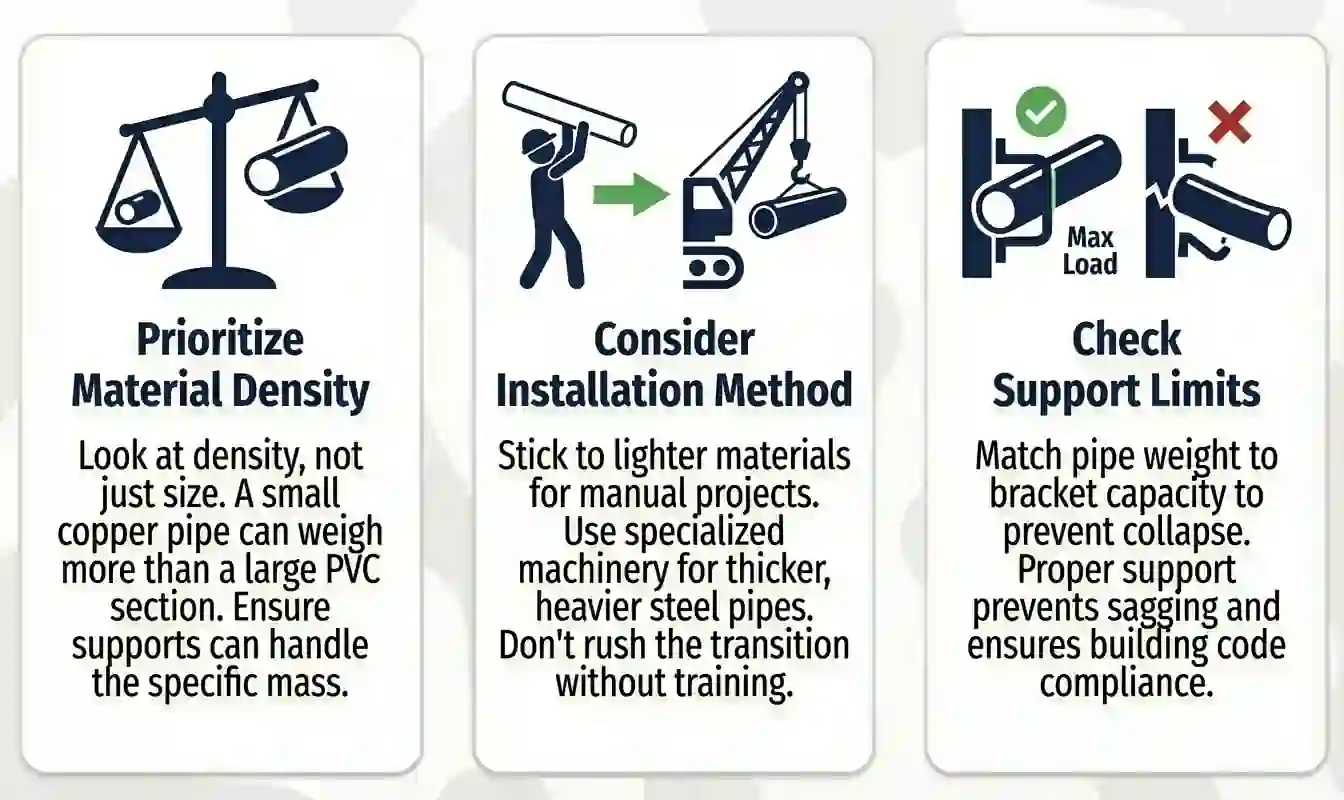
Prioritize Material Density Over Visual Size
You must look at material density before checking the physical size of the pipe. This is the most essential rule in structural engineering. Your support system must safely handle the mass of the metal or plastic. For example, a small copper pipe can weigh more than a large PVC section. A structure that is too weak will fail under heavy material loads. Consequently, you will maintain site safety while planning your construction project.
Consider Your Installation Method
Beginners should always stick to lighter materials for manual installation projects. Smaller pipe weights are much easier for your team to handle by hand. Therefore, you can learn how to fit joints without fighting heavy equipment. You can move to thicker steel as you gain more specialized machinery. A higher weight provides better durability for industrial pipelines. However, you should not rush this transition without proper training.
Check Your Support Limits First
You must match your pipe weight to your bracket capacity for your safety. This step is mandatory for contractors who want to avoid structural collapse. Most industrial hangers have specific load limits for every foot of material. Proper support levels prevent your pipes from sagging over time. Sagging can significantly reduce the efficiency of your plumbing system. Also, a strong support plan ensures your project meets all local building codes.
You Might Also Find These Helpful
Construction 5
No tools published here yet.
Common Mistakes to Avoid When Calculating Pipe Weight
You can avoid many errors by learning from experienced contractors. Specifically, simple mistakes often lead to poor structural results. You should review these three common errors before you start your project. Accurate tracking helps you reach your engineering goals much faster. Consequently, you will maintain site safety while managing your material costs.
- Confusing the Radius and Diameter: Many users enter the radius instead of the full diameter. This mistake results in a weight that is 4 times too small. You should always measure across the widest part of the pipe. Specifically, the diameter spans from one outer edge to the other. Therefore, you must verify this measurement before you click calculate. Accurate diameter data ensures your support beams can handle the actual mass.
- Ignoring Your Measurement Units: You must check that your diameter and thickness units match perfectly. Specifically, mixing inches and millimeters will ruin your calculation instantly. Consistency is the most important factor for industrial success. You should use the same unit system for every dimension in the tool. Consequently, the math will provide a professional result for your material log. Therefore, you should double-check your inputs against your project blueprints.
- Using Liquid Weight for Your Calculations:This tool calculates the weight of the empty pipe only. Specifically, it does not include the weight of water or oil inside. This error leads to a total load that is much too light. You should add the fluid weight separately for full structural planning. Therefore, you should consider the density of the liquid your pipes will carry. Consequently, your structural supports will stay stable under the real-world pressure of a complete system.

Frequently Asked Questions (FAQs)
How do I find the wall thickness of a pipe?
You can find the wall thickness by subtracting the inner diameter from the outer diameter. Then you must divide that number by two. Alternatively, you can look for the “Schedule” number on steel pipes. Specifically, Schedule 40 and Schedule 80 are the most common in the USA. Therefore, you should check the stamp on the pipe wall for this data.
Does the pipe weight include the air inside?
No, the pipe weight calculation only accounts for the solid material. Specifically, air has almost no mass compared to steel or copper. Therefore, you do not need to worry about the hollow center. The tool focuses solely on the pipe wall volume. Consequently, you get a precise weight for the metal or plastic itself.
Why is the steel pipe's weight different from that of aluminum?
Steel is nearly three times as dense as aluminum. Specifically, steel atoms are packed much more tightly together. Therefore, a steel pipe will always be significantly heavier than an aluminum pipe of the same size. Consequently, aluminum is better for projects where weight is a significant concern. You should pick the material that best fits your structural load limits.
Can I calculate the weight of a square pipe?
This specific tool is designed for round pipes and cylinders only. Specifically, the math uses Pi to find the area of a circle. Square or rectangular tubing requires a different geometric formula. You should use a dedicated tubing calculator for those specific shapes. Therefore, you ensure the math matches the physical profile of your material.
What is the density of standard carbon steel?
The standard density of carbon steel is approximately 7,850 kg/m³. This value is the benchmark for most industrial pipes in the USA. However, stainless steel or galvanized steel might have slightly different densities. You should verify your specific alloy grade for the most accurate result. Consequently, your shipping estimates will remain professional and precise.
Does the calculator work for PVC and plastic pipes?
Yes, you can calculate the weight for PVC and other plastic materials. Specifically, you need to select the correct density from the material menu. PVC is much lighter than metal and is common in residential plumbing. Therefore, you can plan your drainage systems using the same professional tool. Accurate plastic weights help you choose the right hangers for your installation.
How accurate is the calculated pipe weight?
The calculated weight is very accurate based on the dimensions you provide. Specifically, it follows the laws of physics and material science. However, physical pipes can have small manufacturing tolerances. For example, a pipe wall might be slightly thicker or thinner in certain spots. Therefore, you should treat the result as a very close professional estimate.
Questions?
We had love to hear from you! Whether you are reporting an issue, suggesting a new calculator, or exploring collaboration opportunities — we are here to help. Every message helps us make 100calc smarter, faster, and more helpful for everyone.
Why People Trust 100calc
At 100calc.com, we focus on accuracy, speed, and trust. Every calculator we create is designed to give reliable, instant, and easy-to-understand results you can truly depend on.