
Acres Per Hour Calculator
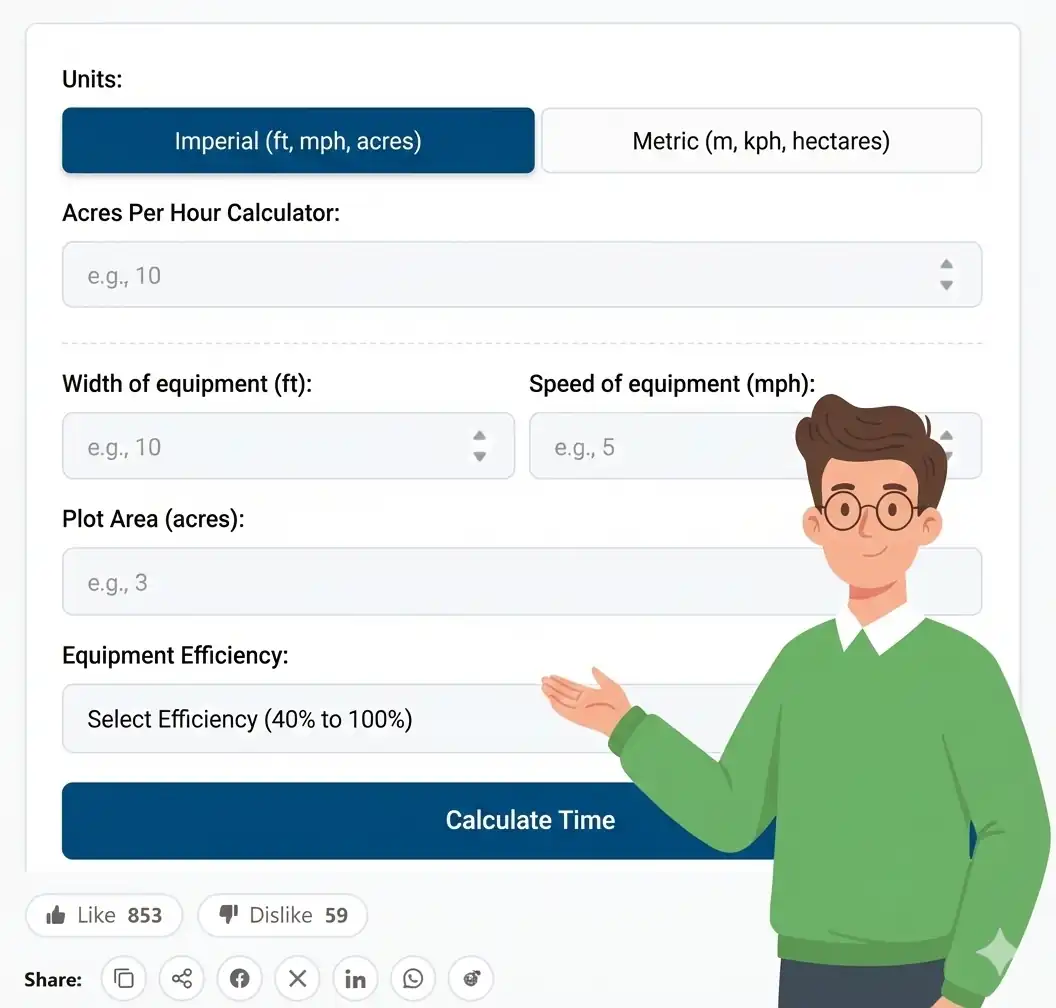
An Acres Per Hour Calculator measures the total field productivity of your farm equipment based on width and speed. Farmers and landscapers in the USA use this tool to determine how much land they can cover in a single shift. Specifically, it calculates the estimated time to complete a specific plot area. You can find your field capacity instantly today.
You can stop guessing about your daily farming schedule now. This engine provides a professional estimate for various tractors, mowers, and spreaders. First, you will select your preferred units from our interactive list. Second, you will give the equipment width and travel speed. Finally, you click calculate to see the total hours and field capacity. Therefore, you can manage your agricultural tasks with total confidence. Use our tool to plan your field work with accurate data.
- Updated Jun 18, 2026
Acres Per Hour Calculator: Estimate Mowing Time and Field Productivity Instantly
You can find the exact time to finish your field by using the tool below. Specifically, please enter the dimensions of your mower or tractor to get a professional report. Our engine processes your data against field capacity formulas. These methods match standards used by agricultural experts in the USA. You should have your equipment specs ready before you start the calculation.
RESULT INTERPRETATION
Your report highlights the precise time needed to finish your land. These figures help you understand your machine’s potential. Also, you learn the specific time demands of your work. Specifically, you should look at the Estimated Time to Complete first. This value represents the full hours required to finish the entire plot area. For instance, knowing this number prevents you from overworking your staff. You can use these data points to schedule your tasks. Therefore, you can keep your farm operations organized.
Understanding Field Capacity
The Field Capacity provides a stable metric for your machine’s productivity. Specifically, it shows exactly how many acres or hectares you finish in one hour. A higher capacity allows for faster completion of large fields. Consequently, you can follow these metrics to optimize your travel speed. You should also check the total plot area to ensure your inputs are correct. For example, a typo in the area can lead to a wrong time estimate. Therefore, your preparation supports a professional workflow.
Using Your Results for Better Planning
You can manage your farm resources more effectively with these precise figures. Accurate tracking helps you avoid the common trap of underestimating job times. For example, many landscapers lose money because they guess their mowing speed. Therefore, you should rely on these facts to balance your labor costs. Also, accurate capacity data helps with calculating fuel consumption. You should check your results every time you change your equipment. Consequently, your land management will remain an efficient and profitable business.
Quick example to check the math
You can see how different dimensions change your field productivity. Specifically, these real-world examples show how width and speed work together. You should compare these profiles to your own equipment measurements. Following this method helps you set realistic goals for your seasonal farming projects.
Example 1: Standard Mowing Task
Imagine a user who measures their mower deck in the afternoon. They have an equipment width of 15 feet. Also, their average travel speed is 4 mph in a rectangular field. Our tool shows a field capacity of 5.82 Acres Per Hour for these dimensions. A rate of roughly 6 acres per hour indicates a healthy speed for a medium-sized tractor. Therefore, this person can successfully finish a 30-acre plot in just over 5 hours of work.
Explore More Calculators
Use our Pipe Weight Calculator to find the exact mass of steel, aluminum, and PVC pipes. Get precise structural data for shipping and installation…
Try calculatorYou can use our free copper power calculator to find your exact quarantine dose. First, enter your net water volume. Next, discover your total…
Try calculatorUse our Glass Weight Calculator to find the exact mass of any pane. Get 100% accurate weight for tempered, float, and laminated glass in…
Try calculatorUse our Paver Sand Calculator to find the exact bags needed for your patio. Get precise weight and volume estimates for your landscaping project…
Try calculatorYou can use our free well volume calculator to find your exact water capacity. First, enter your pipe depth and diameter. Next, discover your…
Try calculatorHow to Use the Acres Per Hour Calculator
You can estimate your material weight in just a few seconds. Our tool follows a professional sequence to ensure your data is accurate. Please follow these five simple steps to calculate your specific load.
Select Your Preferred Units
First, you must pick between the Imperial and Metric systems. You should use Imperial for feet, mph, and acres. Also, you can pick Metric for meters, kph, and hectares. Using the correct units keeps your math precise in your land records. Therefore, you should check your equipment manual before you start.
Enter Equipment Width
Next, you will enter the actual working width of your machine. You can find this number in your equipment specifications. Use the mower deck width or the sprayer boom width. Selecting the correct width is essential for a real estimate. Consequently, a proper width leads to an accurate time report.
Input Travel Speed
Third, you must provide your average speed during work. You can find this number on your tractor speedometer. Also, you can check your GPS data. This value determines how fast you cover the distance of the plot. You should be very accurate with this measurement. Your result will reflect your actual pace in the field.
Choose Field Efficiency
After that, you will select the efficiency based on your field conditions. You should consider the shape of your plot. Also, look for obstacles like trees or fences. Excellent efficiency works well for large, open squares—conversely, lower efficiency works for odd shapes with many turns. Choosing the correct level ensures a safe time estimate. You should evaluate your terrain before selecting a value.
Process Your Field Data
Finally, you will click the blue button to view your results. The engine analyzes your dimensions against agricultural standards. You can use these facts to plan your fuel needs today. Also, use them to set your labor schedule. Accurate data ensures your plan remains realistic. You will avoid unexpected delays in your farming routine.
Example for testing
You can try these sample numbers to see how the tool works. First, select the Imperial unit system. Second, enter a width of 15 feet, a speed of 3 mph, and a plot area of 20 acres. Select Average Efficiency (80%) from the list. These inputs represent a standard working environment for a typical farm machine in the USA.
Result →Your field capacity hits 4.36 Acres Per Hour. Your equipment width and travel speed levels work together here. This score provides a balanced view of your machine’s potential. It equals a reliable and stable work rate under normal field conditions. Now, enter your own numbers and check how close you are to your goal.
Now, enter your own numbers and check how close you are to your goal.
How the Acres Per Hour Formula Works (Complete Breakdown)
You should understand how the math determines your field productivity. This formula provides a realistic estimate of your land coverage rate. It is based on standard agricultural rules for machine performance. The logic separates physical machine dimensions from your specific farming goals. This ensures the result is accurate for your particular equipment. Specifically, you can rely on these figures to plan your daily work shifts.
The Field Capacity Calculation Formula
The calculator starts with your raw machine measurements and travel speed. Then it applies a conversion factor to standardize the units. This method identifies the perfect balance between implement width and velocity. Balance is the total area your machine covers in one hour. Specifically, the math identifies the impact of turns and overlaps on your progress.
Formula:
Capacity = Width (ft) x Speed (mph) x Efficiency ÷ 8.25
The formula begins by calculating a base number for your theoretical productivity. It multiplies the width of your machine by your travel speed. This step finds the total square footage covered per hour at a constant pace. Finally, it multiplies that area by your field efficiency and divides by 8.25. This calculates your personalized acres per hour. Therefore, you get a single number for your operational log.
Example:
					Imagine a farmer with a mower that is 15 feet wide. He travels at 3 mph in an average field with 80% efficiency.
1: Raw Product: 15ft x 3mph x 0.80 = 36
2: Standard Constant: 36 / 8.25 = 4.36
3: Field Capacity: 4.36 Acres/Hour
The final result is 4.36 acres per hour. This score represents a standard medium-sized mowing project. Use this number to plan your fuel and labor needs.
Micro Note:
This calculator estimates field capacity based solely on constant work speeds. Sloped terrains or fields with many obstacles are a different category. Those features do not provide the exact dimensions needed for a simple geometric score. Most users should stick to average speed measurements for their first few months of tracking. Therefore, you should use your GPS data to find the best average speed.
Key Inputs Used in the Calculator
Every calculation depends on specific physical inputs. These inputs change how your machine handles large-scale land coverage. By entering your real details, you get an instant custom agricultural report. Professionals use these same factors to build large-scale farming schedules. For instance, managers verify these traits before starting any heavy harvesting.
Equipment Width
This is the most potent factor for your score. Working width determines whether your machine covers a few acres or dozens of acres per shift. A wider implement requires more power to maintain a reasonable speed. Consequently, your total productivity stays high when the width is large. Therefore, you should measure the actual cutting or spraying path.
Travel Speed
Your speed affects the quality and safety of your field work. High-speed signals that your machine can finish large plots quickly. This factor helps the tool find your natural ground-holding capacity. For instance, a fast tractor can offset a small implement width reading. You should measure your speed in a straight line to find a reliable average.
Field Efficiency Selection
Your choice of efficiency overrides the raw speed you enter. Open fields often allow for 90% efficiency. Conversely, small or irregular plots usually drop to 60%. Selecting the correct efficiency is the most significant predictor of an accurate result. For example, picking the wrong level can change your finish time by several hours. Therefore, you should evaluate your field shape before selecting a value.
Another Example Calculation (Step-by-Step)
Let’s see how the mower calculator works for someone else. This will help you understand how each factor affects your final capacity. The calculation follows the same logic used by farm equipment designers worldwide. Specifically, this enables you to compare different machines.
Given:
- Unit System: Metric
- Equipment Width: 4 meters
- Travel Speed: 6 kph
- Field Efficiency: 0.85 (85%)
Calculation:
					We multiply the width by the speed and efficiency. Then we divide by the metric constant of 10.
(4m x 6kph x 0.85)  10 = 2.04 Hectares/Hour
Result:
Recommended Goal: Optimize Travel Path
Field Capacity: 2.04 Hectares/Hour
Status: Standard Metric Productivity
Meaning:
Your productivity score is exactly 2.04 hectares per hour. This confirms a focus on optimal machine use and labor timing. Pro farmers often see this pattern during their planting phases. A result of 2.04 is very efficient for standard medium-sized tractors. Most people starting a farm would typically see a capacity below 1.0 hectare during their first project.
FIELD EFFICIENCY BENCHMARKS (TABLE)
Most land managers use these efficiency benchmarks to track work quality. Therefore, you can trust these numbers for your task planning. You should use these values to evaluate your current machine setup. Also, these figures help you choose the right speed for your specific terrain. Specifically, knowing your efficiency level prevents you from making unrealistic promises for job completion. Consequently, your projects will finish on time without wasting expensive fuel. Similarly, you can compare different field patterns to find the best fit for your equipment.
| Field Condition | Efficiency Range | Category | Typical Use Case |
|---|---|---|---|
| Excellent | 90% – 100% | Optimal | Large square fields with no trees. |
| Average | 70% – 90% | Standard | Rectangular fields with few turns. |
| Poor | 50% – 70% | Difficult | Odd shapes and small residential lots. |
Heads-up: Actual field capacity can vary based on soil moisture, operator skill, and turn diameter. Always add about 15% to your total time estimate to account for transport and equipment maintenance.
Interpretation
An efficiency between 70% and 90% is standard for most rectangular farm plots. Therefore, this range provides a balanced feel for general land management. However, efficiencies below 50% are much more labor-intensive. You should prepare for a project that requires many turns and slow movements. Conversely, open plains allow you to stay within the higher ranges to maximize your machine’s potential. Specifically, these levels help you build a profitable business without the risk of high labor costs.
Pro Tip:
You can check your tractor’s actual speed on a flat run before every job. For example, a constant pace helps your GPS reach an accurate capacity reading. Confirming your travel speed ensures your plan matches your actual fuel tank size. You should always prioritize your calculated time over your visual guesses for the best experience. Furthermore, this consistency helps you identify your actual operational costs without any guesswork during the harvest phase.
Tips & Planning Based on Your Result
You can improve your farming results by following these expert tips. Finding your acres per hour is just the first step for a healthy land management lifestyle. You should apply these insights to maximize the benefits of every calculation. Specifically, focus on your work routine and your machine quality to see the best results.
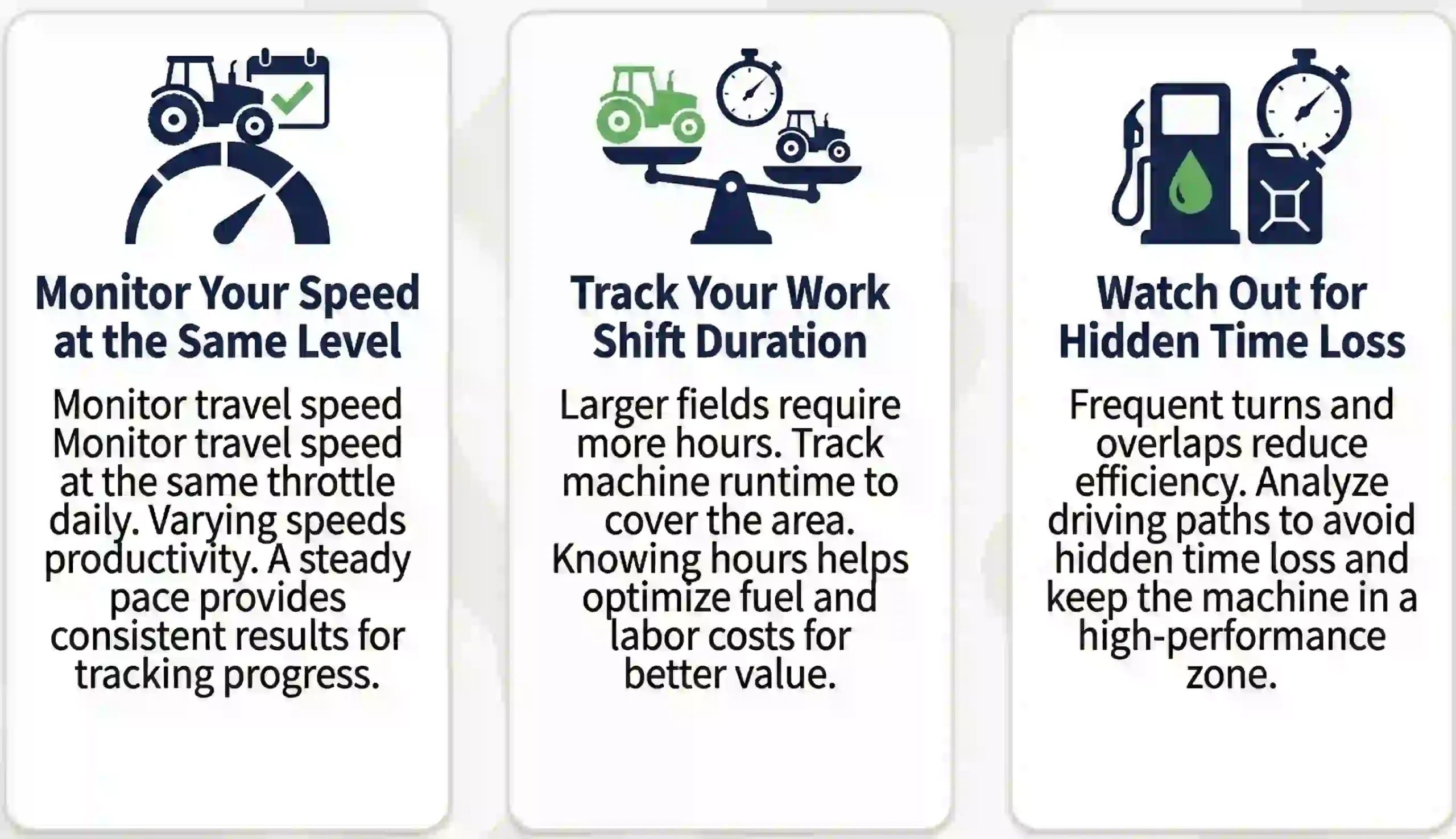
Monitor Your Speed at the Same Level
You should monitor your travel speed at the same throttle level every day. Specifically, varying gears and engine speeds affect your overall productivity throughout the season. You will get the most consistent results by keeping a steady pace in the field. Therefore, a fixed speed is the best tool for your weekly time assessment. A constant schedule helps you track your progress without any confusing data spikes. Consequently, you will know precisely when to refuel your equipment or swap operators.
Track Your Work Shift Duration
You should track how long your machine runs to cover the entire area of your plot. Larger fields usually require more hours of work to stay on schedule. Furthermore, you can use our tool to see the direct impact on your labor costs. Consequently, you will understand how many hours of work your field needs to reach completion. Such data allows you to optimize your fuel use for better value. Therefore, you can maintain a productive farm while saving on operational costs.
Watch Out for Hidden Time Loss
You must watch out for hidden time loss during your field turns. Actually, making frequent turns or long overlaps will instantly reduce your acres per hour. You should analyze your driving path if your project takes longer than expected. Clearly, tracking your row patterns helps you maintain a high state of field efficiency. Reliable capacity data ensures your machine remains in a high-performance zone. Specifically, accurate facts help you avoid over-scheduling your staff during a busy season.
Use these tools to double-check your numbers before selling or buying.
Construction 5
No tools published here yet.
Common Mistakes to Avoid When Calculating Field Capacity
You can avoid many errors by learning from experienced land managers. Specifically, simple mistakes often lead to late finishes or fuel shortages. You should review these three common errors before you start your work. Accurate tracking helps you reach your farming goals much faster. Consequently, you will maintain a clean schedule while managing your labor costs.
- Ignoring Turning Time: Many users forget that machines must slow down to turn. This mistake leads to a time estimate that is much too low. Specifically, odd-shaped fields require more turns than open squares. You must select the correct efficiency level to account for this lost time. Our tool is designed to be efficient, providing realistic results. Accurate planning ensures you finish the job before sunset.
- Using Max Speed Instead of Average: You might travel at a high speed on flat ground. However, you will slow down for hills or rough soil. Using your top speed ruins the accuracy of the calculation. You should always use your average speed for the entire plot. Consequently, your result will reflect the actual conditions of your terrain. Your schedule will remain reliable throughout the day.
- Mixing Metric and Imperial Units:You must verify that your measurements match the unit system you selected. Specifically, mixing meters and feet will ruin your calculation instantly. Consistency is the most critical factor for success. You should use the same unit system for every dimension in the tool. Consequently, the math will provide a professional result for your work log. You should double-check your equipment manual against your digital inputs.

Frequently Asked Questions (FAQs)
How do you calculate acres per hour?
You can calculate your capacity by multiplying equipment width by travel speed and efficiency. Specifically, you then divide that total by 8.25 to find the final acreage. This formula standardizes your measurements into a single hourly rate. Consequently, you can predict exactly how much ground you will cover in one shift. Therefore, you can manage your fuel and labor with total precision.
How many acres can I cut per hour?
The number of acres you cut depends on your mower width and speed. For instance, a standard 60-inch zero-turn mower traveling at 6 mph covers about 2.9 acres per hour. However, this number drops if your field has many trees or sharp turns. Use our tool to find the exact rate for your specific machine. Consequently, you will have a realistic plan for your mowing day.
How many acres per hour with a 6-row planter?
A 6-row planter usually covers 5-8 acres per hour, depending on row spacing. Specifically, a 15-foot working width at 5 mph with 80% efficiency results in 7.2 acres per hour. You must include your seed and fertilizer refill times in your final plan. Therefore, your total shift capacity might be lower than the raw machine speed. Accurate data helps you finish your planting season on time.
How long does it take to mow 20 acres?
Mowing 20 acres takes about 5 hours if you use a 15-foot wide mower at 4 mph. Specifically, this estimate assumes an average field efficiency of 80%. You should use our calculator to adjust for your specific machine width and travel speed. Consequently, you will know precisely when to start your work so you can finish before dark. Therefore, you can keep your farm operations running smoothly.
Does equipment overlap change my calculation?
Yes, equipment overlap reduces your effective working width. Specifically, if you overlap each pass by six inches, your machine covers less new ground. You should subtract the overlap from your total width before entering the data. Consequently, your time estimate will be much more accurate for real-world conditions. Accurate width data prevents you from underestimating your total work hours.
What is the most efficient speed for field work?
The most efficient speed balances fuel economy with land coverage. Specifically, most farmers find that 4 to 6 mph is the best range for most implements. You should avoid high speeds that cause the equipment to bounce or skip. Consequently, your work quality will remain high while you maximize your acres per hour. Reliable speed data ensures your machine lasts longer and works better.
Why do I need to include efficiency in the math?
You need efficiency to account for the time spent turning at the ends of the field. Specifically, no machine operates at 100% capacity due to stops and turns. You should use a lower efficiency for small or odd-shaped plots with many obstacles. Therefore, your final report will reflect the actual challenges of your terrain. Consequently, your schedule will remain realistic for your entire team.
Questions?
We had love to hear from you! Whether you are reporting an issue, suggesting a new calculator, or exploring collaboration opportunities — we are here to help. Every message helps us make 100calc smarter, faster, and more helpful for everyone.
Why People Trust 100calc
At 100calc.com, we focus on accuracy, speed, and trust. Every calculator we create is designed to give reliable, instant, and easy-to-understand results you can truly depend on.