
Paver Sand Calculator
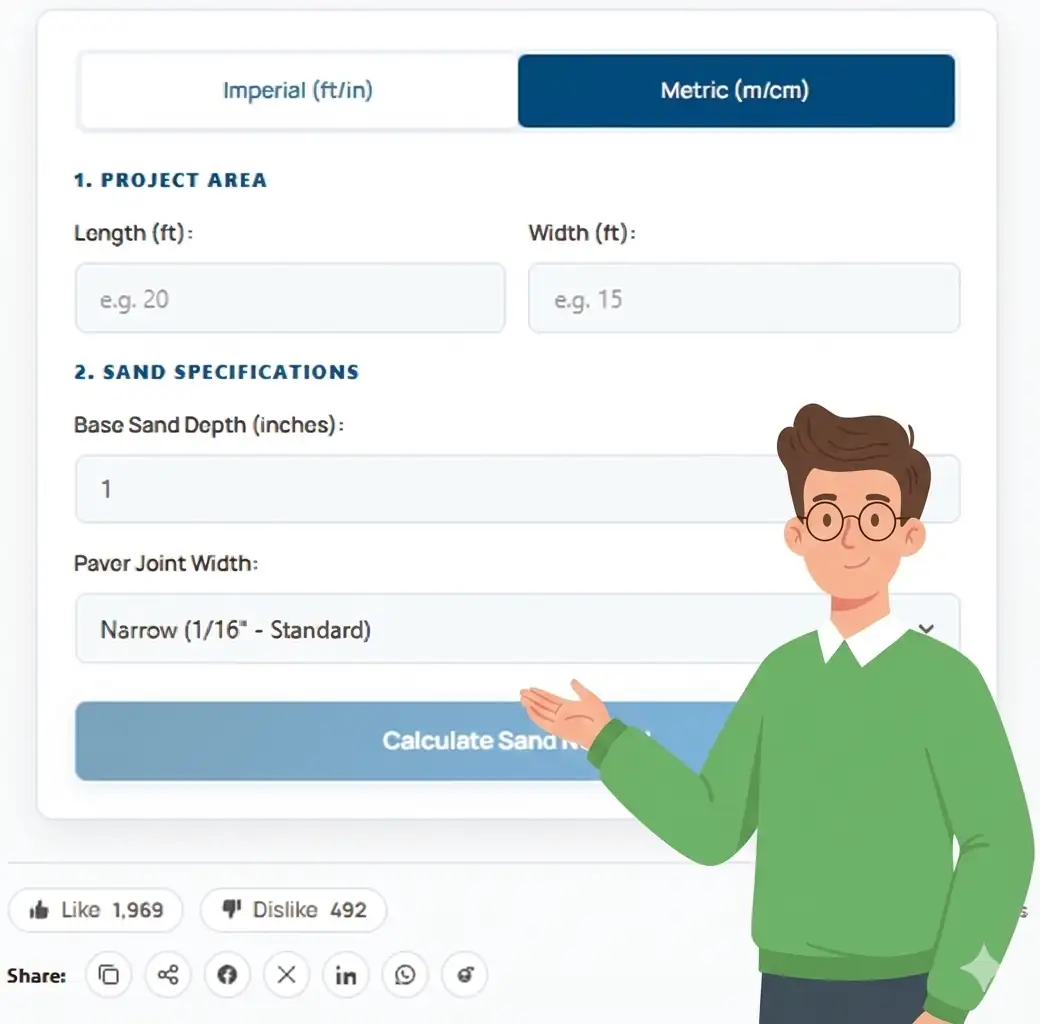
A Paver Sand Calculator measures the total amount of sand required for your patio or walkway base and joints. Homeowners and contractors in the USA use this tool to find the exact number of bags needed for a stable surface. Specifically, it estimates weight and volume based on your area and depth. You can calculate your material requirements instantly today.
You should avoid buying too much or too little material for your home improvement project. This engine provides a professional estimate for various patio sizes and sidewalk designs. First, you will select your unit system from our list. Second, you will give the length and width. Finally, you click calculate to see the total in 50-lb or 25-kg bags. Therefore, you can manage your budget with total confidence. Use our tool to plan your next outdoor feature with accurate data.
- Updated Jul 24, 2026
Paver Sand Calculator: Estimate Your Project Needs
You can find the exact number of sandbags for your project by using the tool below. Please enter the physical dimensions of your patio to receive a professional report. Our engine processes your data against density formulas. These methods match standards used by landscaping experts in the USA. You should have your project measurements ready before you start the calculation.
RESULT INTERPRETATION
Your report specifies the exact weight and number of bags of sand needed for your work. These figures help you understand the cost of your project. Also, you learn the specific physical demands of the job. Specifically, you should look at the Total Sand Required first. This value represents the number of standard bags needed to finish the entire area. For instance, knowing this number helps you arrange transportation. You can use these data points to organize your labor. Therefore, you can keep your job site efficient.
Total Weight and Volume
The Total Weight provides a stable metric for your material purchase. Specifically, it shows exactly how many pounds or kilograms of sand you must move. A higher weight requires a stronger vehicle for hauling. Consequently, you can follow these metrics to plan your logistics. You should also check the Volume to ensure your space is ready for the fill. For example, a cubic-foot estimate helps you compare bulk-delivery costs. Therefore, your preparation supports a professional workflow.
Joint Sand vs. Base Sand
You must understand the difference between these two material needs. Base sand creates the foundation for your pavers. It ensures the surface remains level and flat. Conversely, joint sand fills the gaps between the stones. This sand locks the pavers in place. It prevents the stones from shifting under the weight. Our tool separates these amounts for you. Therefore, you can buy the correct type of sand for each layer. Using the right sand ensures a long-lasting and beautiful patio.
Quick example to check the math
You can see how different project dimensions change your material requirements. Specifically, these real-world examples show how surface area and depth work together. You should compare these profiles to your own patio measurements. Following this method helps you set realistic goals for your landscaping project.
Example 1: Standard Backyard Patio
Imagine a homeowner who measures their rectangular site in the afternoon. They have a surface area of 200 square feet. Also, their desired base depth is 1 inch. Our tool shows a total requirement of 34 bags for these dimensions. A count of 34 standard 50lb bags indicates a healthy amount for a medium-sized patio. Therefore, this person can successfully build a stable foundation for their stone pavers.
Explore More Calculators
Use our Pipe Weight Calculator to find the exact mass of steel, aluminum, and PVC pipes. Get precise structural data for shipping and installation…
Try calculatorUse our Acres Per Hour Calculator to find your field capacity. Get precise mowing time and productivity estimates for farm equipment today.
Try calculatorYou can use our free copper power calculator to find your exact quarantine dose. First, enter your net water volume. Next, discover your total…
Try calculatorUse our Glass Weight Calculator to find the exact mass of any pane. Get 100% accurate weight for tempered, float, and laminated glass in…
Try calculatorYou can use our free well volume calculator to find your exact water capacity. First, enter your pipe depth and diameter. Next, discover your…
Try calculatorHOW TO CALCULATE PAVER SAND
You can estimate your sand needs in just a few seconds. Our tool follows a professional sequence. These steps ensure your data is accurate. Please follow these five simple steps to calculate the volume of your specific material. These steps help you avoid common project errors. Specifically, they ensure your budget stays on track.
Select Your Preferred Units
First, you must pick between the Imperial and Metric systems. You should use Imperial for feet, inches, and pounds. Also, you can pick Metric for meters, centimeters, and kilograms. Using the correct units keeps your math precise for your local materials. Therefore, you should check your tape measure before you start the calculation.
Enter Project Dimensions
Next, you will enter the actual length and width of your patio or walkway. You can find these numbers by measuring the perimeter of your prepared site. Measure the inside dimensions of your border or edging. Selecting the right area is essential for a real estimate. Consequently, a proper area leads to an accurate material report.
Input Base Sand Depth
Third, you must provide the depth of the sand leveling bed. Most professionals recommend a depth of one inch for a standard base. This value determines the volume of the foundation layer. You should be very accurate with this measurement. Your result will reflect the actual depth needed for stability.
Choose Joint Width
After that, you will select the joint type based on your paver design. You should consider the space between each stone or brick. Narrow joints work for interlocking pavers. Wide joints work for large natural stones. Choosing the correct width ensures a safe sand estimate. You should check your paver specifications before selecting a value.
Process Your Material Data
Finally, you will click the blue button to view your results. The engine analyzes your dimensions against material density standards. You can use these facts to buy your 50lb or 25kg bags today. Therefore, you can finish your project with total precision. Accurate data ensures your patio stays level. You will avoid sinking or shifting stones in your landscape.
Example for testing
You can try these sample numbers to see how the tool works. First, select the Imperial unit system. Second, enter a length of 10 feet, a width of 10 feet, and a base depth of 1 inch. These inputs represent a standard small walkway project for a home.
Result → Your total requirement hits 17 bags. Your surface area and sand depth work together here. This score provides a balanced view of your material needs. It equals a reliable and stable foundation under normal ground conditions. Now, enter your own numbers and check how close you are to your goal.
Now, enter your own numbers and check how close you are to your goal.
How the Paver Sand Calculator Formula Works (Complete Breakdown)
You should understand how the math determines your material needs. This formula provides a realistic estimate of your sand volume. It is based on standard geometric rules for physical spaces. The logic separates the surface dimensions from your specific project goals. This ensures the result is accurate for your particular patio or walkway. Specifically, you can rely on these figures to buy the correct number of bags.
The Paver Sand Calculation Formula
The calculator starts with your raw surface measurements. Then it applies a conversion factor to standardize the units. This method identifies the perfect balance between area and depth. Balance is when the tool finds the total cubic space within your project boundaries. Specifically, the math identifies how much sand occupies that space.
Formula:
Volume = Area x (Depth ÷ 12)
The formula begins by calculating a base number for your surface area. It multiplies the length of your project by the width. This step finds the total square footage or square meters. Finally, it multiplies that area by your base depth. This calculates your personalized sand capacity. Therefore, you get a single number for your material log.
Example:
					Imagine a homeowner with a rectangular patio. It is 20 feet long and 10 feet wide. He also maintains a base depth of 1 inch for his stone pavers.
1: Area Factor: 20ft x10ft = 200 ft²
2: Volume Factor: 200ft² x (1 ÷ 12) = 16.67 ft³
3: Total Weight: 16.67 x 100 = 1,667 lbs
The final result is 1,667 pounds. This score represents a standard medium-sized backyard patio. Use this number to plan your transport and bag needs.
Micro Note:
This calculator estimates sand requirements based solely on standard geometric shapes. Irregular landscapes with sloped edges or deep pits are a different category. Those features do not provide the precise values needed for a simple geometric score. Most users should stick to average measurements for their first few months of tracking. Therefore, you should measure multiple points to find the best average.
Key Inputs Used in the Calculator
Every calculation depends on specific physical inputs. These inputs change how your foundation handles weight and drainage. By entering your real details, you get a custom material report instantly. Professionals use these same factors to build durable outdoor living spaces.
Surface Dimensions
This is the most potent factor for your score. Length and width determine whether your project holds a few bags or several pallets of sand. A larger surface requires more depth to maintain a stable base. Consequently, your total volume stays high when the surface area is large.
Base Sand Depth
Your depth affects the long-term level and safety of your stones. High depth signals that your foundation can support heavy traffic without shifting. This factor helps the tool find your natural material-holding capacity. For instance, a deep base can offset a smaller surface area reading. You should measure the depth in at least three places to find the mean.
Joint Width Selection
Your choice of joint width overrides the raw base volume you enter. Interlocking pavers often use narrow joints for a tight fit. Conversely, natural stones often use wide joints for a rustic look. Selecting the correct width is the most significant predictor of an accurate result. For example, picking the wrong joint type can change your bag count by ten percent.
Another Example Calculation (Step-by-Step)
Let’s see how the paver calculator works for someone else. This will help you understand how each factor affects your final weight. The calculation follows the same logic used by hardscape designers worldwide.
Given:
- Testing Style: Imperial Units
- Area: 100 square feet
- Depth: 1 inch
- Joint Type: None (Base Only)
Calculation:
					We divide the depth by twelve to find the cubic feet. Then we multiply by the area and the weight constant.
100 x (1 ÷ 12) x 100 = 833 lbs
833 ÷ 50 = 17 bags
Result:
Recommended Goal: Buy 19 Bags (10% Buffer)
Total Weight: 833 lbs
Status: Small Walkway Project
Meaning:
Your material score is exactly 833 pounds. This confirms a focus on optimal stability and cost control. Pro landscapers often see this pattern during their design phases. A result of 17 bags is very efficient for standard garden paths. Most people starting a project would typically see a count of more than 30 bags during their first week.
PAVER SAND PROJECT BENCHMARKS (TABLE)
Most homeowners use these project benchmarks to track material costs. Therefore, you can trust these numbers for your initial planning. Use these values to evaluate the scale of your current project. Also, these figures help you choose between bag purchases and bulk delivery. Specifically, knowing your category enables you to negotiate better prices with local suppliers. Consequently, your projects will finish on time without wasting expensive resources. Similarly, you can compare different patio designs to find the best fit for your budget.
| Project Type | Common Area | Category | Estimated 50lb Bags |
|---|---|---|---|
| Small Walkway | 50 sq ft | Minor | 9 – 10 Bags |
| Medium Patio | 150 sq ft | Standard | 26 – 28 Bags |
| Large Driveway | 500 sq ft | Major | 85 – 90 Bags |
Heads-up: Actual sand volume can vary based on the texture of your sub-base and the thickness of your pavers. Always add about 10% to your total bag count to account for compaction and spills.
Interpretation
A sand requirement between 20 and 40 bags is standard for most medium backyard patios. Therefore, this range provides a balanced feel for general home landscaping. However, projects requiring over 80 bags are much more labor-intensive. You should prepare for a project that requires heavy lifting or professional hauling. Conversely, smaller walkways let you stay within the lower range, maintaining total control over your project. Specifically, these levels help you build beautiful outdoor spaces without the risk of high material costs.
Pro Tip:
You should prioritize coarse, angular sand over smooth play sand for every project. For example, sharp grains lock together better to create a stable leveling bed. Confirming your sand type ensures your foundation matches the weight of your heavy pavers. You should always prioritize structural integrity over the lower cost of fine sand for the best experience. Furthermore, this consistency helps you avoid sinking stones without any guesswork during the settling phase.
Tips & Planning Based on Your Result
You can improve your landscaping results by following these expert tips. Finding your paver sand volume is just the first step for a healthy outdoor project. You should apply these insights to maximize the benefits of every calculation. Specifically, focus on your installation routine and your material quality to see the best results.
Measure Your Area at the Same Points
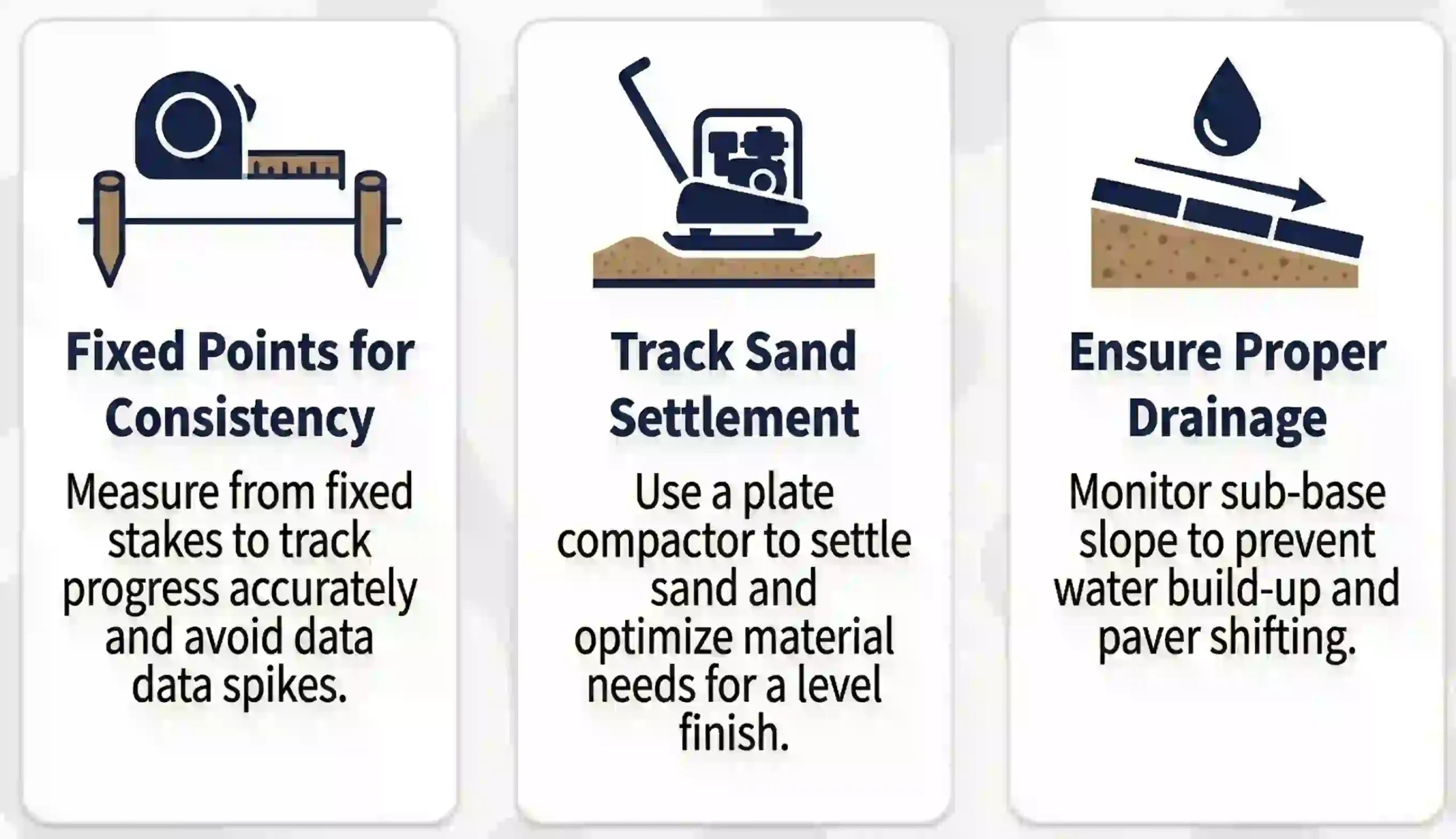
You should measure your project dimensions at the same reference points every time. Specifically, your site boundaries can shift slightly during the digging process. You will get the most consistent results by marking your corners with fixed stakes. Therefore, a stable perimeter is the best tool for your initial volume assessment. Consistent measurements help you track your progress without being confused by data spikes. Consequently, you will know precisely when to order more sand or base gravel.
Track Your Compaction Progress
You should track how deep the sand settles after you use a plate compactor. More intense vibration usually significantly lowers your total sand height. Furthermore, you can use our tool to see the direct impact on your material needs. Consequently, you will understand how many extra bags your project needs to reach a level finish. Such data allows you to optimize your labor for better value. Therefore, you can maintain a flat patio while saving money on your material bills.
Watch Out for Hidden Drainage Issues
You must watch out for hidden drainage issues in your sub-base. Actually, a sudden build-up of water will ruin your leveling bed instantly. You should analyze your slope choices if your pavers shift after a heavy rain. Clearly, tracking your site pitch helps you maintain a safe state of structural balance. Reliable volume data ensures your foundation remains in a high-performance zone. Specifically, accurate facts prevent you from overfilling your joints in a wet environment.
You Might Also Find These Helpful
Construction 5
No tools published here yet.
Common Mistakes to Avoid When Calculating
You can avoid many errors by learning from experienced contractors. Simple mistakes often lead to uneven pavers or sinking stones. You should review these three common errors before you start your work. Accurate tracking helps you reach your landscape goals much faster. Consequently, you will maintain a clean site while managing your material costs.
- Forgetting Sand Compaction: Many users forget that sand settles after you pack it down—sand density changes when you apply pressure with a machine. Therefore, loose sand takes up more space than a solid base. You should always buy 10% more sand than the raw math suggests. A small surplus ensures you reach the correct height for your stones. Specifically, a firm foundation keeps your patio level after the first rain.
- Using the Wrong Sand Type: You could use smooth play sand for your project base. Smooth grains do not lock together well under heavy weight. Specifically, round pieces slide easily underfoot on the pavers. Coarse sand has sharp and angular edges. Sharp edges provide a stable, firm foundation for your masonry. Consequently, using the right material prevents your stones from shifting over time.
- Mixing Unit Systems:You must verify that your dimensions match the unit system you selected. Specifically, mixing meters and feet will ruin your calculation instantly. Consistency is the most critical factor for success. You should use the same unit system for every entry in the tool. Therefore, the engine will provide a professional result for your material records. Accurate data prevents you from wasting money on the wrong orders.

Frequently Asked Questions (FAQs)
How do I calculate how much paver sand I need?
You can calculate your sand needs by finding the volume of your project area. First, you must multiply the length by the width to find the square footage. Second, you multiply that area by the thickness of your sand bed. Specifically, divide the depth in inches by 12 to get the cubic feet. Therefore, you can find the total weight by multiplying the volume by 100 pounds.
How much does one bag of paver sand cover?
One standard 50-lb bag of sand covers about 6 square feet at a depth of 1 inch. Specifically, a 50lb bag holds roughly 0.5 cubic feet of material. Divide your total cubic feet by 0.5 to find your bag count. Consequently, you will know exactly how many trips to the store you need. Accurate coverage data helps you avoid under-ordering for your foundation.
How many square feet does a 50 lb bag of polymeric sand cover?
A 50lb bag of polymeric sand usually covers 50 to 75 square feet of pavers. Specifically, this estimate applies to standard stones with narrow 1/8-inch joints. Wider joints will require more material to fill the gaps. You should check your stone specifications before buying your joint sand. Therefore, you can maintain a consistent color across your entire patio.
How many 50lb bags of sand equal 1 yard?
It takes roughly 54 to 60 bags of 50lb sand to equal one cubic yard. Specifically, one cubic yard of dry sand weighs about 2,700 to 3,000 pounds. You can save money by ordering a bulk delivery if your project is significant. Therefore, you should compare the cost of 60 bags against a local bulk delivery fee. Consequently, you will find the best value for your landscaping budget.
Should I use sand or gravel for my paver base?
You should use both materials to create a long-lasting foundation. Specifically, you must install a thick layer of crushed gravel first for drainage. You then add a one-inch layer of sand to level the stones. This system provides the best stability for heavy foot traffic. Therefore, your pavers will not sink or tilt during the winter.
Can I use regular sand for paver joints?
You can use regular sand, but it may wash away during heavy rain. Specifically, regular sand does not harden or bond like polymeric sand. You should consider polymeric sand if you want to prevent weed growth and ants. Consequently, your outdoor space will require much less maintenance over time. Using the right joint filler protects your investment for many years.
Questions?
We had love to hear from you! Whether you are reporting an issue, suggesting a new calculator, or exploring collaboration opportunities — we are here to help. Every message helps us make 100calc smarter, faster, and more helpful for everyone.
Why People Trust 100calc
At 100calc.com, we focus on accuracy, speed, and trust. Every calculator we create is designed to give reliable, instant, and easy-to-understand results you can truly depend on.