
Well Volume Calculator
Knowing your exact water storage helps you manage your household supply perfectly. Many rural American homeowners wonder how much reserve water sits inside their underground casing. Now, you can use our free well volume calculator to solve that exact problem instantly. Furthermore, the tool accurately calculates your available US gallons.
First, the system uses standard cylinder math to measure your water column. You simply enter your total shaft depth and casing diameter. Next, you can add your static water level for ultimate precision. Consequently, the system clearly shows your available storage. You also instantly discover the total water weight. Therefore, you can properly size your well pump and avoid running dry.
- Updated Jul 24, 2026
Well Volume Calculator: Find Your Water Capacity
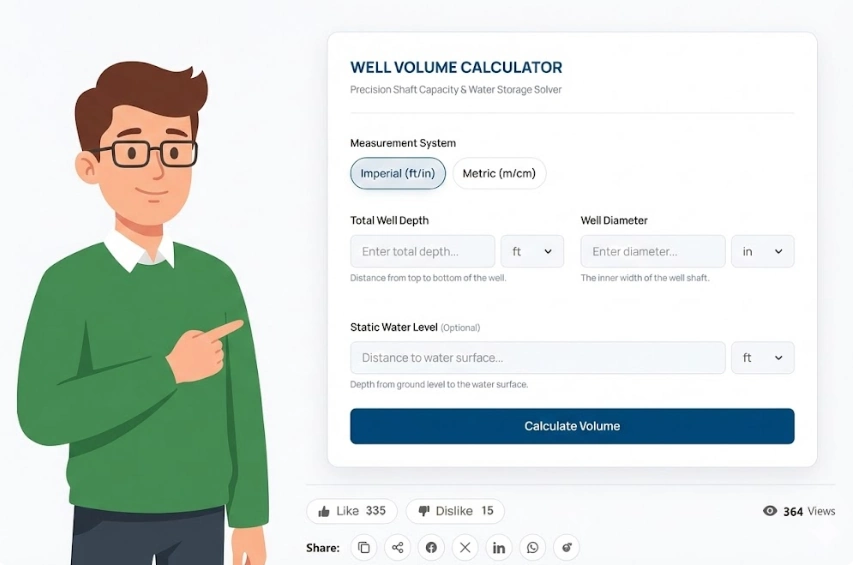
You can use the calculator easily. First, you must select your preferred measurement units at the top. Next, the tool processes your pipe dimensions instantly. Furthermore, you will receive a detailed breakdown of water storage. The system generates accurate volume results right on your screen.
AVAILABLE WATER
TOTAL CAPACITY
📊 Well Statistics
Calculations are based on the volume of a cylinder ($\pi \times r^2 \times h$). Always allow for a 5-10% variance due to shaft irregularities.
Explore More Calculators
Use our Pipe Weight Calculator to find the exact mass of steel, aluminum, and PVC pipes. Get precise structural data for shipping and installation…
Try calculatorUse our Acres Per Hour Calculator to find your field capacity. Get precise mowing time and productivity estimates for farm equipment today.
Try calculatorYou can use our free copper power calculator to find your exact quarantine dose. First, enter your net water volume. Next, discover your total…
Try calculatorUse our Glass Weight Calculator to find the exact mass of any pane. Get 100% accurate weight for tempered, float, and laminated glass in…
Try calculatorUse our Paver Sand Calculator to find the exact bags needed for your patio. Get precise weight and volume estimates for your landscaping project…
Try calculatorUnderstanding Your Water Storage Results
The well volume calculator provides a complete capacity analysis. Therefore, you need to carefully review the specific data points. Ultimately, the output highlights your exact water security. You can clearly visualize your underground water supply.
Analyzing Your Available Storage
First, the system displays the specific number of usable gallons inside your casing. The final number accurately reflects your instant water reserve. Consequently, you know exactly how much water you hold today. Therefore, you can plan your daily household usage safely.
Tracking Storage Density and Water Weight
Next, the tool reveals the exact gallon count per foot of pipe. Plumbers actively use the density number to set pump depths correctly. Furthermore, we calculate the physical heaviness of the standing water. Consequently, you understand the exact physical load on your pumping equipment. Thus, you can easily choose the correct motor size.
Result Breakdown:
- Available Storage: We display the specific number of usable gallons inside your casing. The number reveals your instant water reserve.
- Storage Density: The tool shows how many gallons are present per foot of pipe. Plumbers use that number to set pump depths.
- Water Weight: We calculate the physical heaviness of the standing water. Consequently, you understand the load on your pumping equipment.
How to Use the Well Capacity Calculator
Our well volume calculator is incredibly easy to use. First, gather your basic pipe dimensions. Then, you simply follow a short five-step process. Ultimately, the system reveals your exact water storage capacity. Let us explore the exact steps to find out how many gallons you have today.
Select Your Units
First, find the main toggle buttons at the top of the screen. You must choose between Imperial and metric measurements. Therefore, the system automatically sets the math to feet or meters.
Enter the Depth and Diameter
Next, type your total shaft depth carefully. Then, input the exact width of your well casing. Consequently, the tool knows the physical size of your pipe.
Add the Static Level
After that, input the exact distance from the ground surface down to the resting water. The system automatically subtracts the dry pipe section. Thus, you only measure the actual standing water.
Calculate the Capacity
Next, press the main calculate button directly below the form. The system immediately processes your pipe dimensions. The tool runs the complex cylinder math instantly.
View the Total Volume
Finally, look at the main hero card. The tool displays your total available gallons and water weight instantly. Furthermore, you can review the specific storage density in the grid below.
Example for testing
Try these sample numbers to see how the tool works. First, you can verify the result instantly:
- Total Well Depth: 100 feet.
- Well Diameter: 6 inches.
- Static Water Level: 20 feet.
Result → The calculator shows 117.50 Gallons of available water storage. The math perfectly measures the 80-foot column of standing water.
Now, enter your own numbers and check how close you are to your goal.
How the Well Volume Formula Works (Complete Breakdown)
Understanding the math helps you manage your water supply perfectly. The formula gives you a clear picture of your underground storage. First, it relies entirely on standard cylinder geometry. Next, the logic makes the final capacity result highly accurate for everyone.
Well Volume Formula
The well volume calculator tracks a specific amount of standing water. It measures the exact volume of the cylindrical space inside your pipe. The math remains incredibly simple. It uses basic geometry for ultimate precision.
Formula:
					Volume (Cubic Feet) = π × r² × h
Gallons = Cubic Feet × 7.48
First, the tool converts your casing diameter into a radius. Next, it subtracts your static water level from the total depth. Consequently, it finds your active water height to be perfectly accurate. Finally, the system multiplies that active height by the circular casing area. The calculation ensures a precise gallon count for your household.
Example:
Let us assume your well measures 100 feet deep with a static water level of 20 feet. First, you subtract 20 from 100 to get an 80-foot active water column. Next, you take your 6-inch diameter and find the 0.25-foot radius. Then, you calculate the cylinder volume using the math formula. Specifically, the math equals 15.7 cubic feet. Finally, you multiply 15.7 by 7.48 to get exactly 117.4 gallons.
Micro Note:
The term “Static Water Level” references the natural resting point of your underground water. Consequently, the empty space above the static line remains completely dry. Furthermore, a deeper static level means significantly less available water storage.
Key Inputs Used in the Calculator
Every capacity calculation depends on three simple variables. These specific inputs help you find the exact water volume perfectly.
Well Diameter
Your casing diameter determines the exact width of the storage cylinder. Furthermore, it sets the base circular area for the geometric math. The tool uses the specified width to calculate the radius. Accurate width measurements guarantee a precise gallon score.
Active Height (Depth minus Static Level)
Your active height sets the actual amount of standing water. Additionally, it shows the exact length of the wet pipe. The calculator subtracts the dry upper section to find the true wet height. Consequently, accurate depth readings yield final capacity results that are perfectly accurate.
Another Example Calculation (Step-by-Step)
Let us look at a real example. The scenario matches the geometric logic inside our tool. You can use it to verify your own manual math. The process follows a simple multiplication rule.
Given:
- Total Well Depth: 100 feet
- Well Diameter: 6 inches
- Static Water Level: 20 feet
Calculation:
					1: Find Active Water Height: We subtract the dry upper pipe from the total depth. Specifically, we subtract 20 from 100. The active standing water column equals 80 feet.
2: Calculate the Radius: Convert the 6-inch diameter to feet. First, 6 inches equals 0.5 feet. Next, we divide 0.5 by 2. The radius equals 0.25 feet.
3: Determine Cubic Feet: We multiply the circular area by the 80-foot active height. Specifically, the cylinder volume equals 15.7 cubic feet.
4: Convert to Gallons: We multiply the cubic feet by the US liquid gallon conversion factor. Therefore, we multiply 15.7 by 7.48. The final capacity equals 117.4 gallons.
Result:
The well volume calculator outputs an available water storage of 117.4 US gallons.
Meaning:
First, with a clear gallon count, you can plan your daily usage perfectly. For example, identifying a low yield moves your mindset from wasteful to highly conservative. Consequently, the well volume calculator strictly requires accurate measurements for home safety. Generally, a standard American household needs at least 100 gallons of reserve storage. However, agricultural setups require significantly larger water capacities for irrigation.
Well Storage Capacity Benchmarks
The well volume calculator places your total capacity into three distinct household categories. Therefore, you can easily understand your specific water security. The table below explains each unique capacity status clearly. Furthermore, the chart reveals your exact action plan.
| Capacity Range (Gallons) | Status Label | Meaning / Action | Focus |
|---|---|---|---|
| Under 50 Gallons | Low Storage | You have minimal reserve water. | Conservation |
| 50 to 150 Gallons | Average Storage | You meet standard household needs. | Maintenance |
| Over 150 Gallons | High Storage | You hold excellent water reserves. | Abundance |
Note: A low storage status requires careful daily water management to protect your pump.
Interpretation
First, the final gallon count accurately reflects your water reserve. Additionally, holding over 100 gallons provides a significant buffer for daily household tasks. Therefore, homeowners can safely run their washing machines without fear. You do not have a massive agricultural supply. However, you definitely possess a very healthy residential water capacity.
Pro Tip:
- Check Your Measurements: Always verify your manual tape measurements. One wrong digit can completely change the water capacity result.
- Focus on Units: You must carefully select the correct unit (inch or foot) from the dropdown. Understanding these specific units helps you communicate better with your local plumber.
- Test Different Levels: Enter different static water depths to see the total volume change. Consequently, you can easily understand how summer droughts affect your available supply.
Tips for Managing Your Well Water
Knowing your exact well volume helps you protect your expensive plumbing system. Therefore, you should follow basic home maintenance rules. Consequently, you will prevent major mechanical failures perfectly. You can use your new data to manage your household supply safely.
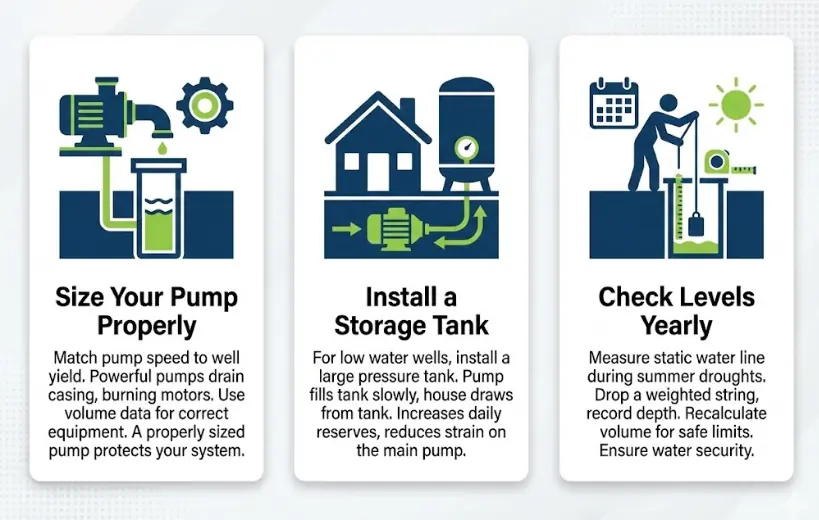
Size Your Pump Properly
First, you must match your pump speed to your specific well yield. A powerful pump pulling water too fast drains the casing completely. Consequently, the dry motor burns out very quickly. Therefore, you must use your volume data to buy the correct equipment. Ultimately, a properly sized pump protects your entire water system.
Install a Storage Tank
Sometimes a residential well holds very little standing water. However, you can easily install a large external pressure tank. First, your well pump slowly fills the big tank. Next, your house draws water directly from that tank. As a result, you instantly increase your total daily reserves safely. Furthermore, you reduce the strain on your main underground pump.
Check Levels Yearly
Groundwater levels fluctuate significantly during hot, dry summers. Therefore, you should measure your exact static water line every single summer. First, you drop a weighted string down the shaft. Next, you record the new resting depth carefully. Finally, you recalculate your total volume to ensure safe water limits. Consequently, you always know your exact water security status.
You Might Also Find These Helpful
Construction 5
No tools published here yet.
Common Mistakes to Avoid When Calculating
People often misunderstand basic pipe geometry calculations. Therefore, you must avoid these common measurement traps. First, you should recognize exactly how cylinder math works. Consequently, you will correctly interpret your well volume.
- Confusing Diameter with Radius:First, you must enter the full width directly across the pipe opening. Specifically, you measure from one inside edge to the other. Our well volume calculator automatically divides your total diameter into a working radius for the math. Therefore, entering a radius instead of a full diameter ruins the entire result.
- Ignoring the Static Water Level: You cannot count the completely dry upper section of the pipe. Instead, you must subtract the distance from the ground surface down to the resting water line. Consequently, the tool accurately calculates the actual standing water. Ignoring the dry static level artificially inflates your true gallon count completely.
- Mixing Measurement Units: Finally, you must keep your measurement units perfectly consistent. Often, homeowners mix inches and feet incorrectly during manual math. Fortunately, our calculator uses separate dropdown menus to handle both units perfectly. Thus, you always receive the strictly correct volume capacity without any mathematical stress.

Frequently Asked Questions (FAQs)
How to calculate the volume of a well?
First, you measure the total depth and diameter of your casing. Next, you subtract the dry static water level from the total depth. Then, you multiply the active water height by the circular area of the pipe. Finally, you convert the cubic feet directly into US gallons. You can also use our free well volume calculator for instant math.
How much water does a 100-foot well hold?
The exact amount depends entirely on your specific casing diameter. For example, a six-inch casing holds about 1.5 gallons per foot. Therefore, a completely full one-hundred-foot shaft holds approximately one hundred and forty-seven gallons. However, you must always subtract the dry top section for true accuracy.
How many gallons of water are in a well?
A standard residential well usually holds between fifty and two hundred gallons of standing water. First, deeper shafts naturally contain a much larger water column. Next, wider casings drastically increase the total physical volume. Consequently, every property has a unique water capacity.
How much water is in a 500-foot well?
A standard six-inch diameter casing holds roughly seven hundred and thirty-five gallons at five hundred feet. First, we assume the entire pipe sits completely full of water. However, a deep static water level drastically reduces that total number. Therefore, you should always measure your specific resting water line carefully.
How many gallons are in a 6-inch well per foot?
A standard six-inch pipe holds exactly one point four seven gallons of water in every single foot. Plumbers frequently round that number up to 1.5 for quick mental math. Consequently, you can easily multiply your wet pipe length by 1.5. As a result, you get a fast estimation of your total volume.
How do I find my static water level?
You simply drop a weighted string down your main casing. First, you lower the line until you hear a distinct splash. Next, you pull the string back up to the surface. Finally, you measure the completely dry portion of the string with a tape measure. The dry length represents your exact static level.
What is a good well volume for a house?
A standard American household requires at least one hundred gallons of daily reserve storage. First, you need enough water to run modern appliances safely. Furthermore, a family of four uses roughly four hundred gallons daily. Therefore, a strong well rapidly replaces the water you pump out during peak morning hours.
Questions?
We had love to hear from you! Whether you are reporting an issue, suggesting a new calculator, or exploring collaboration opportunities — we are here to help. Every message helps us make 100calc smarter, faster, and more helpful for everyone.
Why People Trust 100calc
At 100calc.com, we focus on accuracy, speed, and trust. Every calculator we create is designed to give reliable, instant, and easy-to-understand results you can truly depend on.