
Cycling Calorie Calculator
Tracking your energy burn helps you reach your fitness goals faster. A Cycling Calorie Calculator estimates the energy you use during every ride. Most cyclists want to know how many calories they burn while riding. However, your speed and body weight significantly affect the final number. For example, a brisk ride burns more fuel than a casual cruise. Our tool uses the Metabolic Equivalent of Task method for the best accuracy. You can get your custom result today.
You can stop guessing about your workout intensity now. This tool provides a professional estimate in just seconds. First, you will enter your current body weight. Second, you will choose the duration of your trip. Finally, you will select your average speed and bike type. Accurate tracking helps prevent overeating after a long day in the saddle. Therefore, you can better manage your weight and health. Use our engine to plan your post-ride meals with confidence.
- Updated Feb 10, 2026
Cycling Calorie Calculator: Find Your Ideal Match
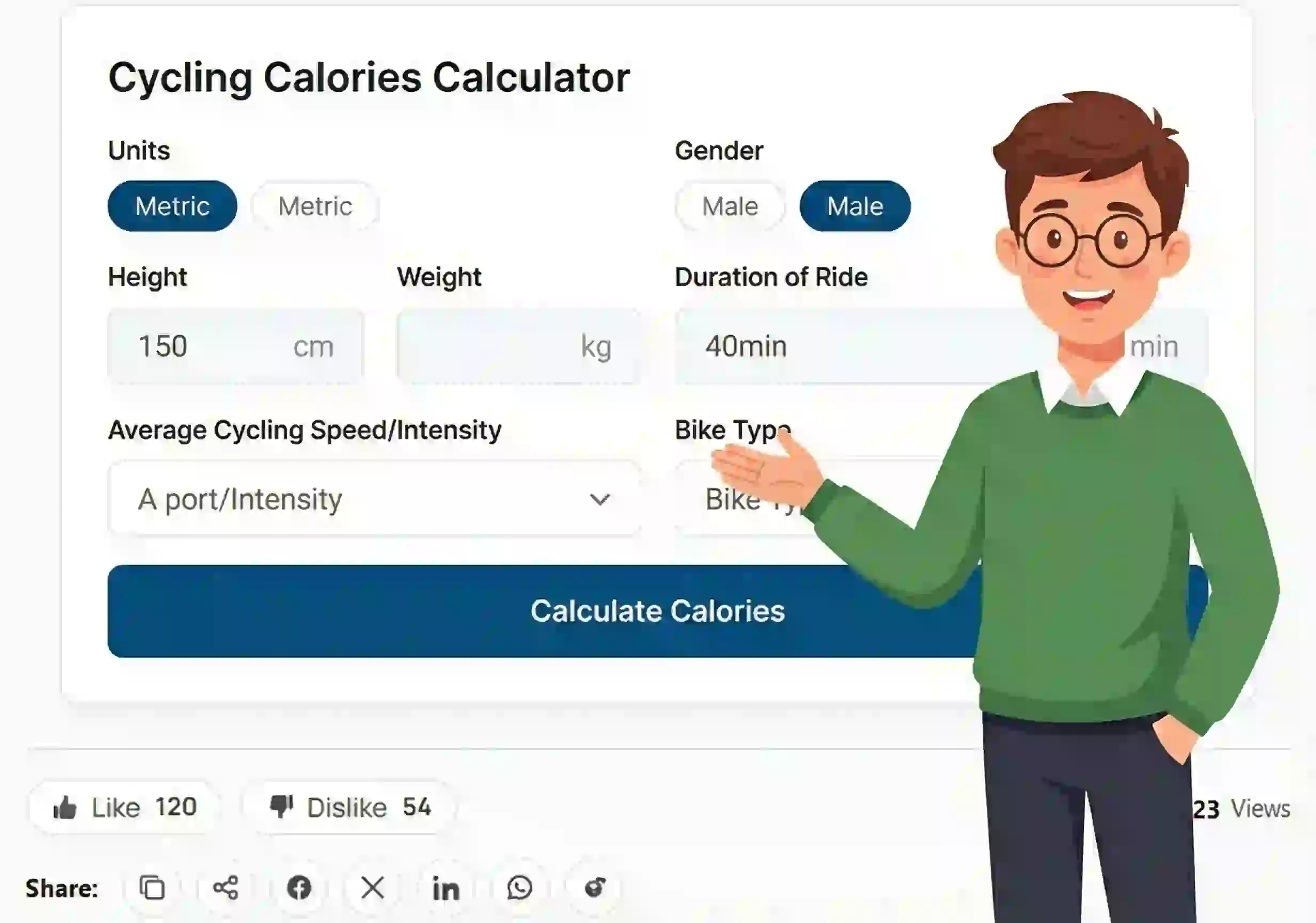
You can find your exercise intensity by using the tool below. Please enter your accurate physical measurements to get the best results. Our engine processes your data against professional sports science standards. You should have your weight and ride time ready before starting.
RESULT INTERPRETATION
Your report highlights the total energy your body used during the ride. These numbers help you understand the impact of your workout. You should look at the calorie count first. This value represents the fuel your muscles burn. For instance, a high number suggests an intense training session. You can use this data to plan your nutrition for the day.
What the MET Value Means for You
The MET value represents the specific intensity of your effort. A higher number means your heart and lungs worked much harder. Therefore, your metabolism stays elevated for hours after you stop pedaling. This event helps you burn even more fat during your recovery. You should track this value to see how your fitness improves over time.
Using Your Results for Better Health
You can manage your weight more effectively with these precise figures. Accurate tracking helps you avoid overeating after a long trip. For example, many cyclists overestimate their burn and gain weight. Therefore, you should rely on these facts to balance your diet. Also, remember that consistent rides lead to the best long-term health benefits. You should check your results every week to maintain your motivation.
Quick example to check the math
Imagine a male rider who weighs 180 lbs. He cycles to work for 45 minutes at a moderate speed. The calculator recommends a burn of 490 kcal for this specific effort. This result happens because the pace is steady but not intense.
Therefore, he can use this data to effectively balance his breakfast calories.
Explore More Calculators
Use our Steps to Calories Calculator to convert steps to calories instantly. This walking calorie calculator adjusts for height and speed to ensure accuracy.
Try calculatorUse our Rucking Calories Calculator for 100% accurate results. Track your burn based on weight, pack load, and pace. Plan your fitness hike now.
Try calculatorUse our expert Snowboard Size Calculator to find your ideal board length and waist width. Get custom results based on weight and boot size…
Try calculatorConvert steps to miles instantly with our calculator. This steps to distance converter uses your height and gender for precise walking distance results.
Try calculatorHow to Use the Cycling Calorie Calculator
You can estimate your workout intensity in just a few seconds. Our tool follows a professional sequence to ensure your data is accurate. Please follow these five simple steps to calculate your total energy burn.
Select Your Preferred Units
First, you must choose the unit system you prefer. You can select Metric for kilograms and centimeters. Alternatively, you should pick Imperial if you use pounds and feet. Setting the correct units ensures the math stays precise for your body type.
Input Your Current Weight
Second, enter your current body weight in the box. You should be very accurate with this number. Your weight is a primary factor in the energy calculation. For instance, moving a heavier mass requires more fuel from your muscles.
Enter the Ride Duration
Third, you must provide the total time you spent on the bike. You should enter the exact hours and minutes of your session. The duration determines the total volume of your energy output. Longer rides allow your body to burn more fat for fuel.
Choose Speed and Bike Type
Next, you will select your average pace and the type of bike you used. You should pick a higher speed if the ride feels very difficult. Also, you must choose your bike because different frames require different effort. For example, a mountain bike has more resistance than a road bike.
Generate Your Calorie Report
Finally, you will click the blue button to see your results. The engine instantly analyzes your data against professional sports science benchmarks. You will see your total calories burned and your adjusted intensity score. You can use these facts to plan your fitness and nutrition goals today.
Example for testing
You can try these sample numbers to see how the tool works. First, select the Moderate cycling intensity. Second, enter a weight of 80 kg and a duration of 1 hour. These inputs represent a standard adult male profile.
Result → Your total burn hits 640 kcal. Your physical stats and workout goals work together here. This score provides a balanced view of your energy output. It equals a reliable estimate for a steady fitness ride under normal conditions.
Now, enter your own numbers and check how close you are to your goal.
How the Cycling Calorie Calculator Formula Works (Complete Breakdown)
You should understand how our tool measures your physical effort. Specifically, the logic uses the standard MET formula for human movement. The math balances your weight against the time spent on the bike. Actually, most health experts use this method to track the efficiency of exercise. Therefore, the result provides a professional estimate for your fitness diary.
The Cycling Calorie Formula
The system starts with a base intensity value. Next, it applies multipliers for your weight and bike type. Clearly, the method measures the total energy your metabolism consumes.
Formula:
Total Calories = MET x Weight (kg) x Duration (hrs)
The calculation begins with a specific MET value for your speed. It multiplies the number by your weight in kilograms. Finally, the tool multiplies that result by the total number of hours for your ride.
Example:
					Imagine a rider who weighs 70 kilograms. He cycles for one hour at a brisk pace.
1: MET Value: 10.0 (Brisk)
2: Weight Factor: 70 kg
3: Time Factor: 1 hour
4: Calculation: 10.0 x 70 x 1 = 700
The final result shows 700 calories burned during the session. Additionally, wind resistance and hills change your actual burn. Most riders should add 10 percent if they cycle in hilly areas.
Micro Note:
This calculator predicts the calorie burn for standard human-powered bicycles. Electric bikes (e-bikes) belong to a different category because the motor reduces your physical effort. Therefore, you should subtract about 30% from the result if you use motor assistance. Most riders should focus on traditional bikes to get the most accurate fitness data.
Key Inputs for Your Result
Every calculation depends on three main biological inputs. Accurately, the inputs change how much energy your cells consume. You get a custom health assessment by entering real details. Similarly, doctors use these same factors to prescribe exercise plans.
Body Weight
Weight is the most powerful factor for calorie burn. Specifically, moving a larger mass requires more energy from your muscles. Higher weight leads to a higher burn rate for the same distance. Consequently, heavy riders use more fuel than light riders.
Ride Duration
The time spent on the bike determines your total volume. Longer rides allow your body to tap into fat stores for energy. Furthermore, the duration helps the tool find your energy output. For example, a two-hour ride burns twice as many calories as a one-hour ride at the same pace.
Speed and Intensity
Your pace determines the MET value used in the math. Brisk riding increases your heart rate and oxygen needs. Clearly, the pace is the most significant predictor of your hourly burn rate. For instance, training for a race burns much more than a trip to the store.
Another Example Calculation (Step-by-Step)
You can see how the cycling calculator works for a different type of rider. This helps you understand how each factor affects your final calorie count. The calculation follows the same logic used by sports scientists across the USA.
Given:
Intensity: Moderate (MET 8.0)
Rider Weight: 70 kg
Ride Duration: 1.5 Hours
Calculation:
					First, we identify the MET value for a moderate pace. We then apply the weight and time factors to the formula.
(8.0 x 70 kg x 1.5 hours) = 840
Result:
Total Burn: 840 kcal
Status: Active Workout
Intensity: Moderate Pace
Meaning:
Your total burn is about 840 calories for this specific session. This confirms a focus on steady aerobic fitness. Pro riders often see this pattern during their base training phases. A result of 840 kcal shows a high level of efficiency. Most riders of this weight would normally burn about 560 calories if they only rode for one hour. Therefore, your extra thirty minutes added a significant boost to your daily health goals.
Result Benchmarks and Ranges
Most fitness experts use these benchmarks to track athlete performance. Therefore, you can trust these numbers for your workout planning. You should use these values to evaluate your current intensity. Also, these figures help you set new goals for the next month. Specifically, you can see how faster speeds burn more fuel per hour. Consequently, your training becomes more effective when you know the facts. Similarly, you can compare different effort levels to see the impact on your health.
| Intensity | Speed (mph) | Category | Avg. Burn | Effort Type |
|---|---|---|---|---|
| Casual | Under 10 mph | Light | 250–350 kcal | Easy social riding or commuting. |
| Moderate | 10–14 mph | Active | 450–600 kcal | Steady pace for fitness. |
| Brisk | 14–16 mph | Hard | 700–850 kcal | Vigorous training or fast commuting. |
| Training | 16–20 mph | Pro | 900–1100 kcal | Competitive racing or HIIT. |
Heads-up: Individual calorie burn varies by terrain and wind. Always use a heart rate monitor for the most accurate fitness results.
Interpretation
A calorie burn of 400-600 kcal per hour is typical for average adults. Therefore, this range provides a balanced intensity for general fitness and heart health. However, results above 900 kcal represent a much higher physical demand. You should prepare for a session that requires significant leg strength and stamina. Conversely, beginner riders should stay within the lower ranges to maintain control and avoid fatigue.
Pro Tip:
You can check your average heart rate during rides to confirm your intensity. For example, a higher heart rate indicates that you are burning more fuel per minute. Confirming your effort level ensures your nutrition matches your actual physical needs. You should always prioritize your actual effort over your perceived speed for the most accurate experience.
Tips & Planning Based on Your Result
You can improve your fitness results by following these expert tips. Finding your calorie burn is just the first step for a healthy lifestyle. You should apply these insights to maximize the benefits of every ride. Specifically, focus on your intensity and your equipment to see the best results.
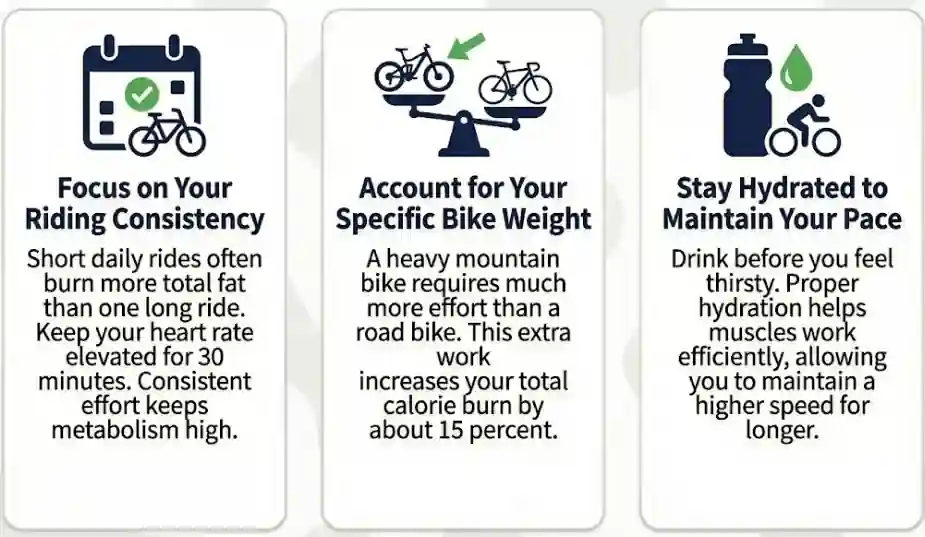
Focus on Your Riding Consistency
Short daily rides often burn more total fat than one long ride. Specifically, you should keep your heart rate elevated for at least 30 minutes. Consistent effort helps your metabolism stay high throughout the day. Thus, you can reach your weight loss goals faster. You should ride at least four times every week for the best health benefits.
Account for Your Specific Bike Weight
Riding a heavy mountain bike requires much more effort than riding a road bike. Specifically, you must push against more rolling resistance on the tires. This extra work increases your total calorie burn by about 15 percent. Therefore, you should always select the correct bike type in our tool. Using the right category ensures your fitness data stays accurate.
Stay Hydrated to Maintain Your Pace
High calorie burn leads to significant water loss through your sweat. Specifically, you should drink fluids before you start to feel thirsty. Proper hydration helps your muscles work efficiently during long trips. Consequently, you can maintain a higher speed for a longer duration. You should carry a water bottle on every ride to protect your performance.
You Might Also Find These Helpful
Fitness 4
No tools published here yet.
Common Mistakes to Avoid When Tracking Cycling Calories
You can avoid many errors by learning from experienced cyclists. Specifically, simple mistakes often lead to incorrect calorie tracking. You should review these three common errors before you plan your diet. Accurate tracking helps you reach your fitness goals much faster.
- Overestimating Your Average Speed: Many riders believe they cycle faster than they actually do. For instance, they might only remember their highest speed on a downhill stretch. However, your average speed determines your total fuel burn. You should use a GPS app to find your true pace for every trip. Accurate data helps you avoid overeating after your training session.
- Ignoring the Impact of Steep Terrain: Riding up steep hills burns significantly more energy than riding on flat roads. Actually, your muscles work much harder to fight against gravity. Many people forget to adjust their effort level for hilly routes. Consequently, they underestimate their total calorie output. You should select a higher intensity level if your route includes many climbs.
- Underestimating Your Total Gear Weight: You must include the weight of your gear and backpack in your calculation. Specifically, extra weight increases the force needed to pedal the bike. Every additional pound requires more fuel from your body. Therefore, carrying a heavy pack increases calorie burn. You should weigh yourself with your gear to get the most professional result.

Frequently Asked Questions (FAQs)
How many calories do you burn cycling for 30 minutes a day?
You usually burn between 200 and 300 calories during a 30-minute ride. However, your intensity level significantly changes this number. For instance, a brisk pace burns much more fuel than a slow cruise. Consequently, you can reach your weight-loss goals faster by increasing your pace.
Is cycling good for losing weight?
Yes, cycling is a good way to lose weight and burn fat. It increases your heart rate and strengthens your cardiovascular system. Also, it is very gentle on your joints compared to running. Therefore, you can ride for more extended periods without feeling pain. Consistent cycling helps you create the calorie deficit needed for weight loss.
How much biking equals 10,000 steps?
Most fitness experts say five miles of cycling equals about 10,000 steps. Specifically, you use different muscle groups for each of these activities. But both methods help you reach your daily movement goals effectively. You should use a fitness tracker to see your specific energy output during the day.
How long on a bike to burn 100 calories?
You can burn 100 calories in about 10 to 15 minutes of moderate riding. For example, a heavy rider will reach this goal faster than a light rider. Consequently, your body weight is a key factor in this calculation. You should maintain a steady pace to see consistent results every time you ride.
Does a stationary bike burn as many calories as riding outside?
A stationary bike burns the same number of calories at the same effort level. However, riding outside involves wind resistance and changing terrain. These factors often make outdoor cycling feel much more difficult. Therefore, you might burn more fuel on the road than in the gym.
How does wind affect my cycling calorie burn?
Riding into a strong headwind significantly increases your physical effort. Specifically, your body must work harder to push through the air. This resistance acts like a steep hill for your muscles. Consequently, your calorie burn rate goes up when the weather is windy. You should account for this extra work in your fitness log.
Should I count calories burned if I ride an e-bike?
You should count those calories, but the total will be lower than that of a standard bike. The motor assists your pedaling throughout the entire trip. Actually, you burn about 30 percent fewer calories on an e-bike for the same distance. You should select a lower assist mode to maximize your workout.
Questions?
We had love to hear from you! Whether you are reporting an issue, suggesting a new calculator, or exploring collaboration opportunities — we are here to help. Every message helps us make 100calc smarter, faster, and more helpful for everyone.
Why People Trust 100calc
At 100calc.com, we focus on accuracy, speed, and trust. Every calculator we create is designed to give reliable, instant, and easy-to-understand results you can truly depend on.