
Gold Melt Value Calculator
Find the real value of your scrap gold instantly
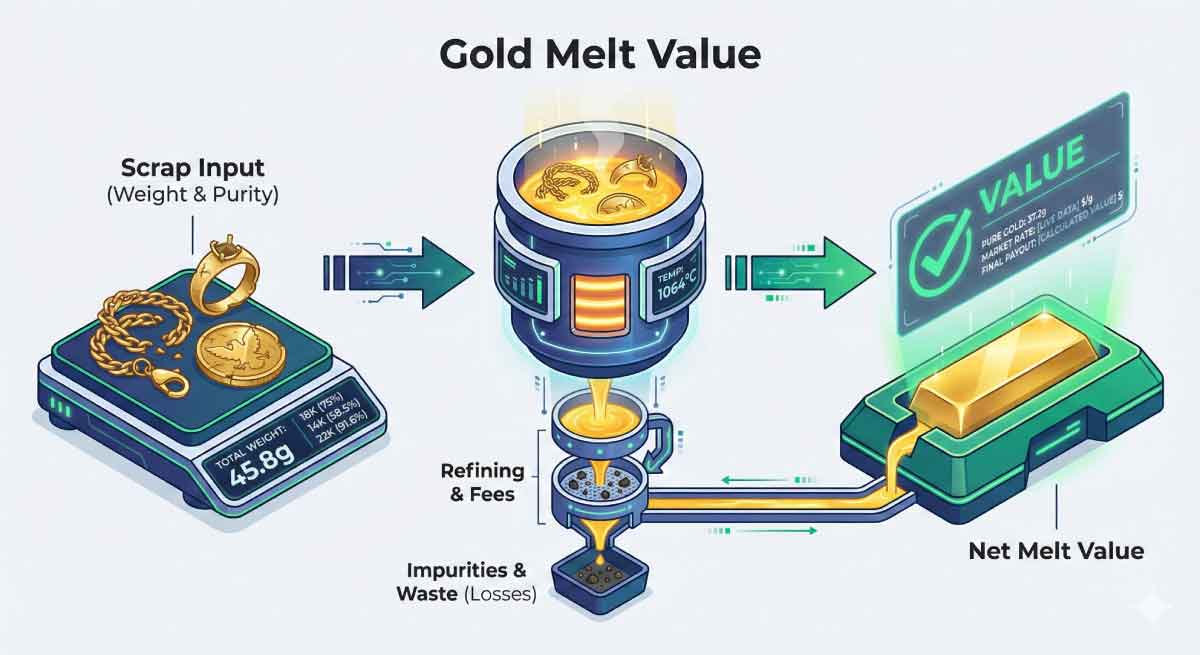
Use this gold melt value calculator to see what your metal is worth. You enter the weight and purity. Then you add the current spot price. It calculates the gross melt value first. It handles grams, tola, and troy ounces easily. You get a precise number for jewelry, coins, or scrap.
Next, you can find the net melt value. You can subtract optional costs like refining fees and assay charges. This helps you compare buyer offers accurately. You can use Karat, Fineness, or percentage modes. Scroll down to the tool. Then calculate your scrap gold value now.
According to standard refining terms, most buyers pay a percentage of the total melt value.
- Updated Jan 31, 2026
Live Gold Price Today by Weight and Karat
Gold prices change every day. Sometimes they change every minute. This live gold price shows the current spot rate so you can calculate with real numbers. You can check the gold price per gram, per troy ounce, or per tola. This helps when you value 14K, 18K, 21K, or 22K gold. Always start with the current price before you calculate gold value, melt value, or scrap payout.
This works for the USA market and global users. Prices update automatically. You do not need to refresh the page.
These rates are based on international spot gold prices converted to your selected currency. Retail jewellery prices may include making charges, shop margins, and taxes.
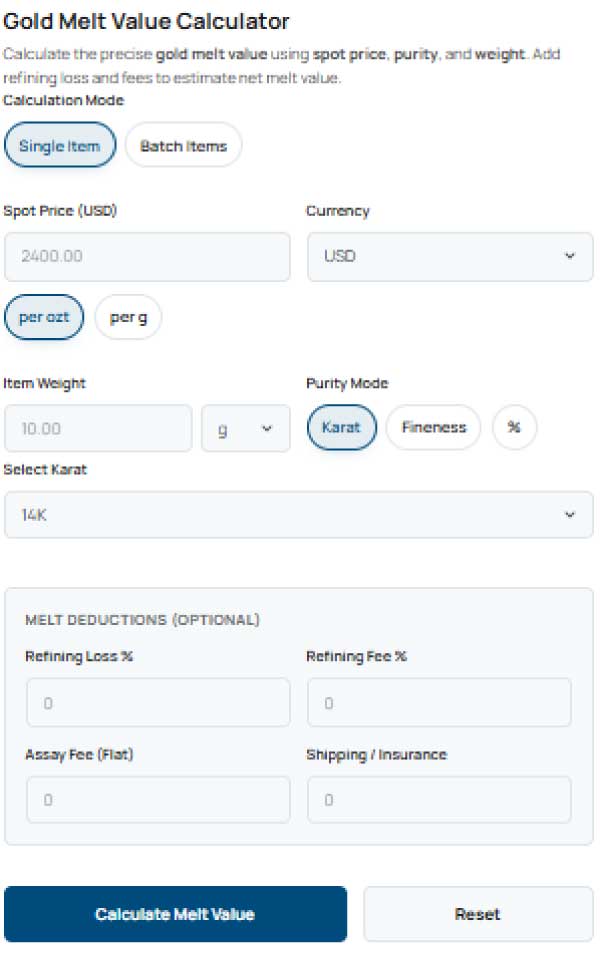
Gold Melt Value Calculator
Calculate the precise gold melt value using spot price, purity, and weight. Add refining loss and fees to estimate net melt value.
Melt Deductions (Optional)
Result details will appear here.
Understanding Your Melt Value Results
Your calculation gives you precise data. You see exactly what your gold is worth in raw metal. This section explains gross value, net value, and your final payout rate. Use these numbers to negotiate better deals with buyers or refineries.
What Gross Melt Value Means
Gross melt value represents the total market price of your gold content. It ignores fees or refining losses. The calculator finds the pure gold weight first. Then it multiplies that weight by the live spot price. This is your baseline number before any deductions apply.
What Net Melt Value Means
Net melt value is your estimated payout. It subtracts refining losses and dealer fees from the gross value. Refineries often keep a small percentage of metal during processing. They also charge assay fees. This result shows the actual cash amount you might receive.
Why Effective Net Per Gram Matters
Effective net per gram helps you compare different offers. It shows the final price you get for every gram of item weight. You can use this number to check fairness. If two buyers offer different total amounts, compare this rate. The higher rate wins.
Quick Result Checks
Watch the difference between gross and net values. If the net value is much lower than the gross value, your fees are too heavy. You should check the refining loss percentage. Also, ensure the assay fees fit the batch size. High fees reduce your profit quickly.
Test the Calculator With Real Scenarios
Use the examples below to test the calculator logic. Enter the values exactly as shown here. You can change them later to match your own gold items.
Example 1: Single 14K Gold Ring
Use this to test:Single Item mode
- Spot Price: 2600.00 USD
- Unit: per ozt
- Weight: 8.00
- Weight Unit: g (grams)
- Purity Mode: Karat
- Select Karat: 14K
- Refining / Fees: 0 (Leave empty)
What you should see:
- Net Melt Value matches Gross Melt Value
- Pure Gold Weight around 4.67 g
Example 2: Batch Scrap Gold Lot
Use this to test: Batch Items mode
- Spot Price: 2600.00 USD
- Item 1: 20.00 g at 18K
- Item 2: 35.00 g at 10K
- Refining Loss: 5%
- Assay Fee: 25.00
- Shipping: 15.00
What you should see:
- Gross Melt Value reflects total metal price
- Net Melt Value is lower due to fees
- Total Deductions breakdown confirms costs
Want to sell your gold or check jewelry value? Try these calculators.
Calculate gold value instantly using live prices. Check melt value, jewelry worth, scrap payouts, purity, weight, and karat with our gold calculator.
Try calculatorCalculate 14K gold chain weight in grams instantly. Enter length and width to estimate solid or hollow chain mass before you buy or sell.
Try calculatorUse our 18K Gold Price Calculator to find true jewelry value instantly. Get live rates per gram, ounce, and total melt value in seconds.
Try calculatorUse our 22K Gold Price Calculator to find jewelry value instantly. Get live rates per gram, total melt value, and scrap estimates in seconds.
Try calculatorUse this Gold Chain Value Calculator to find your jewelry's worth. Check live melt value, scrap payouts, and 14K/18K retail prices instantly.
Try calculatorCalculate melt value and retail price instantly. Our free Gold Jewelry Calculator shows real dealer cash offers for 10K, 14K, & 24K items.
Try calculatorHow to Use the Gold Melt Value Calculator
Follow these five simple steps to find your gold’s true market price.
Enter Spot Price
Find the current live gold price. Enter this number in the "Spot Price" field. Then check the unit toggle below it. You must select whether your price is per troy ounce (ozt) or per gram (g).
Pick Currency and Rate
Select your currency from the list. The tool uses USD by default. If you choose a local currency like PKR or INR, a new field appears. Enter the current exchange rate against the US Dollar in that field.
Choose Mode and Weight
Select "Single Item" if you have one piece. Select "Batch Items" if you have a mix of different gold types. Enter the weight of your item. You can choose grams, tola, pennyweight, or ounces from the menu.
Select Purity Type
Tell the gold melt value calculator the purity of your metal. You can select standard Karats like 10K, 14K, or 24K. You can also use Fineness (e.g., 916) or a simple percentage.
Add Deductions
Fill in the deduction fields if you plan to sell scrap. You can add a refining loss percentage or a flat assay fee. Click "Calculate Melt Value." The tool displays your net payout and pure gold weight instantly.
Quick Formula Used
Net Value = (Weight × Purity % × Spot Price) − Deductions
Why This Process Is Accurate
- It standardizes all weights The calculator converts every input into grams first. It uses the exact gold standard where 1 troy ounce equals 31.103 grams.
- It isolates pure gold A 14K ring is not 100% gold. This tool multiplies your total weight by the purity factor (like 0.585 for 14K). This reveals the actual fine gold content.
- It separates Gross vs. Net Most calculators only show the gross market value. This tool calculates the gross value first. Then it subtracts your entered refining fees. This matches real payouts from refineries and scrap buyers.
Try It Yourself
- Set the spot price Enter the live price at the top. Use the “per gram” or “per ozt” toggle.
- Enter your item details Choose “Single Item” mode. Enter a weight like 10 grams. Select a purity like 18K.
- Add deduction fees Enter a 10% refining loss. See how the “Net Melt Value” drops below the “Gross Melt Value.” This shows your real profit.
Gold Melt Value Calculator Formula and Variables
This section explains how your gold melt value calculator works. You see the exact math behind your gross value and net payout. Each step uses the real inputs you enter. This helps you trust the numbers. You can understand what your scrap is worth before you sell it.
The process starts with your weight. First, the tool converts it to grams. Next, it finds the pure gold content. Then it multiplies that weight by the current spot price. Finally, it subtracts your refining fees.
The Core Formula
This formula powers the calculation. It finds the “Net Melt Value.”
					Net Melt Value =
(Gross Value × (1 − Loss %)) − Fees
To get there, we use this logical flow:
Pure Grams = Total Grams × Purity Factor
Gross Value = Pure Grams × Spot Price (per 24K gram)
After Loss = Gross Value × (1 − Loss %)
Net Value = After Loss − Assay Fee − Shipping
Variable 1: Unit Conversion
The calculator converts every weight input into grams. This removes confusion between units.
- 1 Troy Ounce (ozt) becomes 31.103 grams.
- 1 Tola becomes 11.66 grams. This ensures accuracy for every batch.
Variable 2: Purity Factor
Purity determines how much real gold you have. The tool converts your input into a decimal factor.
- Karat: It divides your karat by 24 (e.g., 18K / 24 = 0.750).
- Fineness: It divides by 1000.
- Percent: It divides by 100. This factor isolates the pure metal from the alloy.
Variable 3: Spot Price
You usually enter the spot price per troy ounce. However, the math requires a price per gram. The tool divides your spot price by 31.1034768. This gives the precise value of one gram of 24K gold.
Variable 4: Deductions (Gross vs. Net)
Gross Value is the price of pure gold with no fees. Net Value is your actual payout.
- Refining Loss: This is a percentage of metal lost during melting.
- Fees: These are fixed costs like assay or shipping. The calculator subtracts these costs from the gross total to find your final cash value.
Example Calculation You Can Test
Use this exact input to test the calculator.
Given:
- Spot price: 2600 USD per troy ounce
- Weight: 20 grams
- Purity: 18K (75%)
- Refining Loss: 10%
Calculation:
					Price per gram =
2600 ÷ 31.1034768 = 83.59 USD
Pure gold weight =
20 × 0.75 = 15.00 grams
Gross Value =
15.00 × 83.59 = 1253.85 USD
Net Value =
1253.85 × 0.90 = 1128.47 USD
Result:
- Net Melt Value = $1,128.47
- Pure Gold Weight = 15.00 g
You should see these exact numbers in the calculator result panel.
Why This Formula Matters
This formula proves the accuracy of your result. It shows how refining fees impact your total. The calculator removes the guesswork. It calculates the gross market value first. Then it applies your specific deductions. This reveals the actual cash you can expect. You can now approach gold buyers with confidence.
Analyze Your Melt Value Results
Use this guide to understand the difference between your “Net” and “Gross” numbers. The Gross Value is the full market price of your metal. The Net Value is the cash amount you actually keep. If these numbers are far apart, your fees might be too high. Compare your specific result to these benchmarks to see if your deal is fair.
| Result Range | Category | What It Represents | Typical Use | Notes |
|---|---|---|---|---|
| Gross Melt Value | Market Price | Raw metal value before fees. | Starting Point | Ignores refining costs. |
| Net ≈ Gross | Low Deductions | Minimal fees applied. | Strong Baseline | Cleaner value estimate. |
| Net < Gross | High Deductions | Fees/loss are eating value. | Cost Warning | Re-check fee inputs. |
| Net Negative | Overloaded | Costs exceed gold value. | Input Error | Fees too high for lot. |
| Effective Net/g | Comparison | Final payout per gram. | Buyer Comparison | Best metric for offers. |
Important: If your Net Value is negative, your shipping or assay fees are too high for the weight of the batch.
How to Read This Table With the Calculator
First, set your spot price at the top. Then enter your weight and purity details.
Now compare these numbers:
- Gross Melt Value vs. Net Melt Value
- Net Melt Value vs. Dealer Offer
- Effective Net per Gram vs. Competitor Rates
This comparison shows where you lose money. It highlights the exact cost of refining and fees.
What This Means For You
If your Net Value is close to the Gross Value, your fees are fair. If it is much lower, you are paying too much for refining. If you have a negative result, your flat fees are too high for the batch weight. Use the “Effective Net per Gram” to find the best buyer. This table turns raw data into a clear decision.
Quick Example Using the Gold Value Module
Inputs:
- Spot Price: 2600 per troy ounce
- Weight: 20 grams
- Purity: 18K
- Refining Loss: 10%
Results you will see:
- Gross Melt Value: The full market price of your metal.
- Net Melt Value: The value after the 10% deduction.
- Pure Gold Weight: The actual fine gold content.
Now check the table above. You can instantly see if that 10% loss is a standard fee or a heavy cost.
Smart Gold Selling Insights
Use these tips to get the best deal. The calculator gives you the data. These strategies help you use it.

Compare Offers With Net Per Gram
Do not focus only on the total payout. Focus on the effective net per gram. This number reveals the true buying rate. Some buyers hide high fees behind a confusing total. This metric exposes them. If Buyer A offers a lower total but a higher net per gram, their terms are actually better. Always negotiate based on this rate.
Watch Fees on Small Lots
Flat fees hurt small sellers. A $30 assay fee is acceptable for a heavy gold chain. It is terrible for a single light ring. It eats up a huge part of your profit. For small items, find buyers who charge percentage fees only. Avoid high flat costs for light batches.
Verify Purity First
Accuracy starts with purity. You cannot calculate value if the karat is wrong. Check the stamp on your jewelry. If the stamp is worn or missing, use our Gold Karat Calculator first. It helps you determine the correct purity factor. Then come back here for the precise melt value.
Know What to Melt
Do not melt everything. Some jewelry is worth more as a finished piece. This is called “resale value.” Only use the gold melt value for broken, damaged, or unwanted items. If a ring is in good condition or is a vintage brand, try selling it privately first. You will likely get more cash than the scrap price.
Use these tools to double-check your numbers before selling or buying.
Gold 11
Free Gold Karat Calculator: Convert karat to fineness stamps like 585 & 750. Check purity % and gold weight fast.
Try calculatorUse the Gold Price Calculator by Weight to find the true value of your jewelry or scrap. Supports grams, tola, ozt, and all purities.…
Try calculatorUse our free Gold Price Per Gram Calculator for live values. Check 14K, 18K, 22K & 24K rates instantly based on real-time spot prices.…
Try calculatorConvert gold weight instantly. Accurate grams, troy ounces (ozt), and tola calculator for jewelry and scrap dealers.
Try calculatorGet an instant cash estimate with our free Scrap Gold Calculator. See real dealer payouts, deduct fees, and value 10K, 14K, or 18K gold…
Try calculatorAvoid These Gold Calculation Errors
Small input mistakes cause big value differences. Avoid these common errors to ensure your gold melt value calculator results are accurate.
- Wrong Spot Price Unit Do not confuse units. A common mistake is entering the price per troy ounce (ozt) while the calculator is set to "per gram." This makes your result huge and incorrect. Always match your input number to the unit toggle.
- Confusing Ounces Gold is weighed in troy ounces (31.1g). Regular kitchen ounces are lighter (28.3g). If you select the wrong ounce type, your total weight will be wrong. Use "ozt" for gold.
- Mixed Purity Weights Do not weigh a mixed batch together. You cannot put 14K and 18K items on the scale at the same time. Separate them first. Enter their weights individually in Batch Mode for an accurate total.
- Ignoring Exchange Rates If you select a non-USD currency, you must update the exchange rate. The calculator needs the current rate to convert the USD spot price correctly.
- High Fees on Small Batches Be careful with flat fees. Adding a large assay fee to a tiny scrap lot can result in a negative net value. Ensure your fees match the batch size.

Frequently Asked Questions (FAQs)
What is gold melt value?
Gold melt value is the market price of the pure gold contained within a jewelry piece, coin, or bar. It is calculated by multiplying the item’s total weight by its purity percentage and the current spot price. This figure excludes craftsmanship, brand value, gemstones, and retail markups.
Refineries and scrap buyers use this value as a baseline. It represents the worth of the raw metal alone before any refining fees or dealer profit margins are deducted.
Is melt value the same as pawn payout?
No, melt value is not the same as a pawn payout. Melt value represents the full market price of the raw gold content. A pawn payout is the cash offer you receive from a dealer, which is typically 50% to 80% of the melt value to cover their profit and costs.
Dealers must pay for refining, overhead, and resale risk. Therefore, they never pay the full spot price. Always compare the dealer’s offer percentage against your calculated melt value to ensure a fair deal.
How do I calculate melt value from spot price?
To calculate melt value, first convert your item’s weight to grams. Next, multiply the weight by its purity factor (like 0.585 for 14K gold). Finally, multiply that pure weight by the current spot price per gram. The result is the gross melt value before any fees.
The formula is: Value = (Weight × Purity %) × Spot Price. Remember that spot prices are often listed per troy ounce, so divide that price by 31.103 to get the correct price per gram.
What is refining loss and how much is normal?
Refining loss is the small percentage of gold weight lost during the melting and purification process. This occurs due to vaporization or metal adhering to the crucible. A normal loss rate is typically between 1% and 2% for clean gold jewelry, though dirty scrap may incur higher losses.
Refineries deduct this percentage from your total weight before calculating your final payout. It is a standard physical loss, separate from the financial service fees or assay charges the refiner applies.
What is the difference between gross melt value and net melt value?
Gross melt value is the total market price of the pure gold in your item, assuming zero fees. Net melt value is the actual amount you receive after subtracting refining losses, dealer fees, and shipping costs from the gross total.
Think of gross value as the “perfect world” price and net value as the “real world” cash payout. Since sellers always pay processing fees, the net value is the only number that matters for your actual profit.
Can I calculate melt value for mixed gold items?
Yes, but you must separate the items by purity first. You cannot weigh 14K and 18K gold together because they contain different amounts of gold. Sort your items into groups by karat. Calculate the melt value for each group individually, then add the totals together for the final value.
Our calculator’s Batch Mode makes this easy. It allows you to enter multiple items with different weights and purities at once, giving you a single combined net melt value instantly.
Should I use spot price per gram or per troy ounce?
You should use the unit that matches the price source you found. Most global market charts list the spot price per troy ounce (ozt). However, calculating per gram (g) is often easier for small jewelry items. The calculator handles both units and converts them automatically for you.
If you enter a price per troy ounce, ensure you select the “per ozt” option. If you mix these units (e.g., entering an ounce price as a gram price), your result will be incorrect. Always double-check the unit label on your price source.
Why is my net melt value so low?
Your net melt value is likely low due to high deduction fees relative to the gold weight. If you apply a large flat fee (like a $30 assay charge) to a small ring, it consumes most of the value. Also, verify that your refining loss percentage is realistic (usually under 2%).
Check your inputs carefully. Ensure you haven’t accidentally entered a high shipping cost or selected a lower karat than intended. For small scrap lots, flat fees often make selling unprofitable.
Questions?
We had love to hear from you! Whether you are reporting an issue, suggesting a new calculator, or exploring collaboration opportunities — we are here to help. Every message helps us make 100calc smarter, faster, and more helpful for everyone.
Why People Trust 100calc
At 100calc.com, we focus on accuracy, speed, and trust. Every calculator we create is designed to give reliable, instant, and easy-to-understand results you can truly depend on.