
Hexagon Calculator
A Hexagon Calculator finds the area, perimeter, and diagonal lengths of a regular six-sided polygon. Most people in the USA use this tool for tiling, flooring, or mechanical engineering projects. Specifically, you can solve for all missing properties using just one known dimension. You can plan your structural designs with total confidence today.
You should avoid doing complex square root math by hand for your construction tasks. This tool provides a professional geometric report based on your specific physical inputs. First, you will enter a value, such as the side length or area. Second, you will see the exact width from flat to flat. Finally, you click calculate to find the point-to-point distance. Therefore, you can save time while ensuring your geometry is perfect. Use our engine to master your six-sided shapes instantly.
- Updated Feb 10, 2026
Hexagon Calculator: 100% Accurate Area & Diagonal Tool
You can find the exact properties of your six-sided shape by using the tool below. Specifically, please enter one known dimension to get a professional geometric report. Our engine processes your data against standard square root constants. These methods match standards used by engineering experts in the USA. You should have your measurements ready before you start the calculation.
RESULT INTERPRETATION
You should understand what your geometric report means for your project. Specifically, these numbers help you manage your construction or design tasks. A clear report allows you to purchase the right amount of material. You will gain a better sense of your shape’s spatial requirements. Therefore, you can complete your layout with total accuracy. Use these insights to build a stronger structural plan today.
Total Surface Area
Your total surface area represents the 2D space inside the hexagonal boundary. Specifically, this number tells you how much material you need for coverage. You should use the square units to order your floor tiles or paint. Most builders in the USA rely on this figure to avoid wasting money. Consequently, knowing your area helps you manage your budget effectively. Therefore, you can decide if the hexagon size fits your available workspace.
Long vs. Short Diagonals
You must know the difference between point-to-point and flat-to-flat measurements. Specifically, the long diagonal connects two opposite corners of the shape. This distance represents the widest part of the hexagon. Conversely, the short diagonal measures the width between two opposite flat edges. You will use the short diagonal to find the “width across flats” for mechanical parts. Therefore, these dimensions ensure your shape fits perfectly into a specific frame or socket.
The Equilateral Relationship
You should understand why a regular hexagon is actually made of six perfect triangles. Specifically, these six equilateral triangles meet at the center point. Every side of these triangles matches the hexagon’s side length. This relationship makes the hexagon one of the most stable shapes in geometry. Consequently, the math used to find the area depends on these internal triangular properties. Therefore, you can trust the geometric integrity of your six-sided design. Specifically, this balance provides maximum strength for structural honeycomb patterns.
Quick example to check the math
You can see how your side measurements change your total geometric report. Specifically, these real-world examples show how distance and square root constants work together. You should compare these profiles to your own architectural data. Following this method helps you set realistic goals for your construction project.
Example 1: Standard Paving Goal
Imagine a builder who plans a hexagonal patio route. They want to use stones with a side length of exactly 10 feet. Our tool shows a total surface area of 259.81 square feet. A area of 259.81 square feet indicates a healthy amount of space for a standard outdoor lounge. Therefore, that person can successfully reach their landscaping targets with ease.
Explore More Calculators
Calculate area, perimeter, and side length of a regular pentagon. Enter any dimension (side, radius, apothem) for precise results in our pentagon calculator.
Try calculatorUse our Right Triangle Calculator to find the hypotenuse, area, and angles. Get 100% accurate results for your construction or trigonometry project today.
Try calculatorHOW TO CALCULATE HEXAGON PROPERTIES
You can find the properties of any six-sided shape by following a professional process. This method ensures your geometric results stay accurate for your construction or school project. Most architects in the USA use these specific steps to analyze hexagonal layouts. You will learn the exact measurements for your design today. Specifically, you should use your known physical details to get the best results.
Identify Your Known Dimension
You should determine which part of the hexagon you can measure accurately. Specifically, you should choose from the side length, total area, or perimeter. You can also use the long or short diagonal measurement. This choice tells the calculator which mathematical path to take. Consequently, you will avoid wrong answers in your geometric report.
Input Your Numerical Measurement
Enter your specific physical length in the calculation field. For instance, type 12.0 for a 12-inch tile. This number acts as the primary variable for the square root formulas. You should ensure the value is positive to avoid math errors. Specifically, accurate inputs lead to perfect results for your drafting project.
Run the Geometric Analysis
You should click the calculate button to process your physical data. The engine then runs the specialized formulas for six-sided polygons. Specifically, it uses square root constants to find every missing length. You will see your report appear on the screen instantly. Therefore, you can finalize your material orders with reliable figures.
Review the Surface Area
You will analyze the total 2D space covered by the six internal triangles. Specifically, this number represents the flat surface area in square units. Use this figure to calculate the amount of paint or tile needed. Consequently, you will avoid material shortages during your home renovation. Therefore, your project stays on budget and on schedule.
Check the Diagonal Lengths
You should identify the flat-to-flat width and the point-to-point length. Specifically, the long diagonal represents the widest part of the shape. The short diagonal shows the width across the flat edges. You will use these numbers to ensure your hexagon fits into its designated space. Consequently, your mechanical or structural designs will work perfectly.
Example for testing
You can try these sample numbers to see how the tool works. First, enter a side length of 5. Second, select the Side Length input method. Finally, check the results for a standard six-sided shape. These inputs represent a basic geometry check for any student or DIY builder.
Result →Your total area hits 64.95. Your boundary length and diagonal sizes work together here. The total perimeter hits 30 units. The score provides a balanced view of your structural needs. It equals a reliable and stable count under normal geometric standards. Now, enter your own numbers and check how close you are to your goal.
How the Hexagon Formula Works (Complete Breakdown)
You should understand how the math determines the measurements of your hexagon. This formula provides a realistic estimate of your project area. It is based on standard physical rules for regular polygons. The logic separates the actual side length from your specific geometric goals. This ensures the result is accurate for your particular design. Specifically, you can rely on these figures to buy the correct hardware for your project.
The Hexagon Calculation Logic
The calculator starts with your raw side measurements. Then it applies a geometric constant to standardize the dimensions. This method identifies the perfect balance between the side length and the interior space. Balance occurs when the tool finds the total area within your six-sided boundary. Specifically, the math identifies how the $\sqrt{3}$ constant determines the ratio of every part.
Formula:
					Total Perimeter (P):
P = 6 x s
Long Diagonal (d):
d = 2 x s
Short Diagonal (w):
w = s x √3
Total Surface Area (Area):
Area = 3√3 / 2 x s²
The formula begins by calculating a base number for your surface area. It multiplies the square of your side by the constant 2.598. This step finds the total square inches or square feet. Finally, it adds the diagonal and perimeter values. This calculates your personalized geometric report. Therefore, you get a single set of numbers for your structural planning.
Example:
					Imagine a mechanic who has a large hexagonal bolt head. The side length of the bolt is exactly 1 inch.
Perimeter: 1 inch x 6 = 6 inches
Long Diagonal: 1 inch x 2 = 2 inches
Short Diagonal: 1 inch x 1.732 = 1.732 inches
Total Area: 2.598 x 1² = 2.598 sq in
The final result is 2.598 square inches. This score represents a standard hardware project. Use this number to plan your wrench size and torque requirements.
Micro Note:
This calculator predicts hexagon properties based solely on standard regular shapes. Irregular six-sided polygons belong to a different category. Those features do not provide the simple dimensions needed for a basic area score. Most users should stick to standard measurements for their primary designs. Therefore, you should check with a specialist for complex asymmetrical shapes.
Key Inputs Used in the Hexagon Calculator
Every geometry calculation depends on specific physical inputs. These inputs change how your project handles structural load and space. By entering your real details, you get a custom geometric report instantly. Professionals use these same factors to build accurate blueprints for clients.
Side Length (s)
The length of a single flat edge is the most potent factor for your score. Side length determines whether your project requires a small bolt or a large paving stone. A larger side requires more material to fill the space. Consequently, your total area stays high when the side length is considerable.
Long Diagonal (d)
The long diagonal measures the distance between the points across the center. This selection overrides the raw side length you enter. Heavy mechanical parts often have a very wide, long diagonal. Conversely, small jewelry pieces are usually much tighter. Therefore, selecting the correct diagonal is a significant predictor of fit.
Short Diagonal (w)
The short diagonal measures the width from flat to flat across the shape. Specifically, this is the most common measurement for wrenches and sockets in the USA. You should enter this value to find the required side length for a bolt. Therefore, you can ensure your tools match your hardware perfectly.
Another Example Calculation (Step-by-Step)
Let’s see how the hexagon calculator works for a paving project. This will help you understand how each factor affects your final layout. The calculation follows the same logic used by landscape architects worldwide.
Given:
- Paving Stone Side: 10 centimeters
- Quantity: 1 Stone
Calculation:
					We first find the area by squaring the side length. Then we multiply by the hexagon area constant.
10 cm x 10 cm = 100 cm²
100 x 2.598 = 259.8 cm²
Result:
- Recommended Goal: Cover 259.8 Square Centimeters
- Total Area: 259.8 cm² (Single Stone)
- Status: Small Landscaping Project
Meaning:
Your material coverage is exactly 259.8 square centimeters. This confirms a focus on spatial efficiency and tiling patterns. Pro masons often see this pattern during their planning phases. A 259.8 result is typical for standard patio pavers. Most people starting a backyard project would typically see a weight of more than 20 stones.
GEOMETRIC BENCHMARKS (TABLE)
You should understand the unique physical characteristics of a six-sided shape. A regular hexagon possesses perfect symmetry and specific mathematical constants. Specifically, these properties define how the shape fits into a larger geometric pattern. You can use these values to verify the accuracy of your technical drawings. Most engineers in the USA memorize these angles to ensure structural stability. Knowing these counts prevents errors during the early design phase.
| Property | Value | Definition |
|---|---|---|
| Internal Angle | 120° | Corner angle inside the shape. |
| Sum of Angles | 720° | Total sum of all 6 corners. |
| Central Angle | 60° | Center angle per triangle. |
| Diagonals | 9 | Lines connecting non-adjacent corners. |
Note: These properties apply strictly to regular hexagons where all sides and angles are equal.
Interpretation
The result confirms the geometric integrity of your six-sided shape. Specifically, every regular hexagon must maintain these exact angular values. Use an internal angle of 120° to set your cutting tools correctly. This precision ensures that your pieces fit together without gaps. Consequently, your tiling or mechanical projects will look professional and stay strong. Therefore, you can rely on these constants for any regular polygon task.
Pro Tip:
You should always distinguish between the central angle and the internal angle. The central angle determines the shape of the six internal equilateral triangles. Specifically, these triangles create the firm foundation of the hexagon. You can use the number of diagonals to verify your CAD wireframes. A correct count of nine diagonals confirms that your digital model is a perfect regular hexagon. Consequently, your structural analysis will be much more reliable.
Tips & Planning Based on Your Result
You can use your hexagon results to improve your design and building plans. Specifically, these numbers help you pick the best materials for any six-sided project. You should consider how the shape impacts the strength and cost of your work. Furthermore, these planning tips ensure your final layout looks professional and stays durable. You will achieve better results by applying these expert geometry insights today. Therefore, you should integrate these facts into your next construction task.
Honeycomb Construction
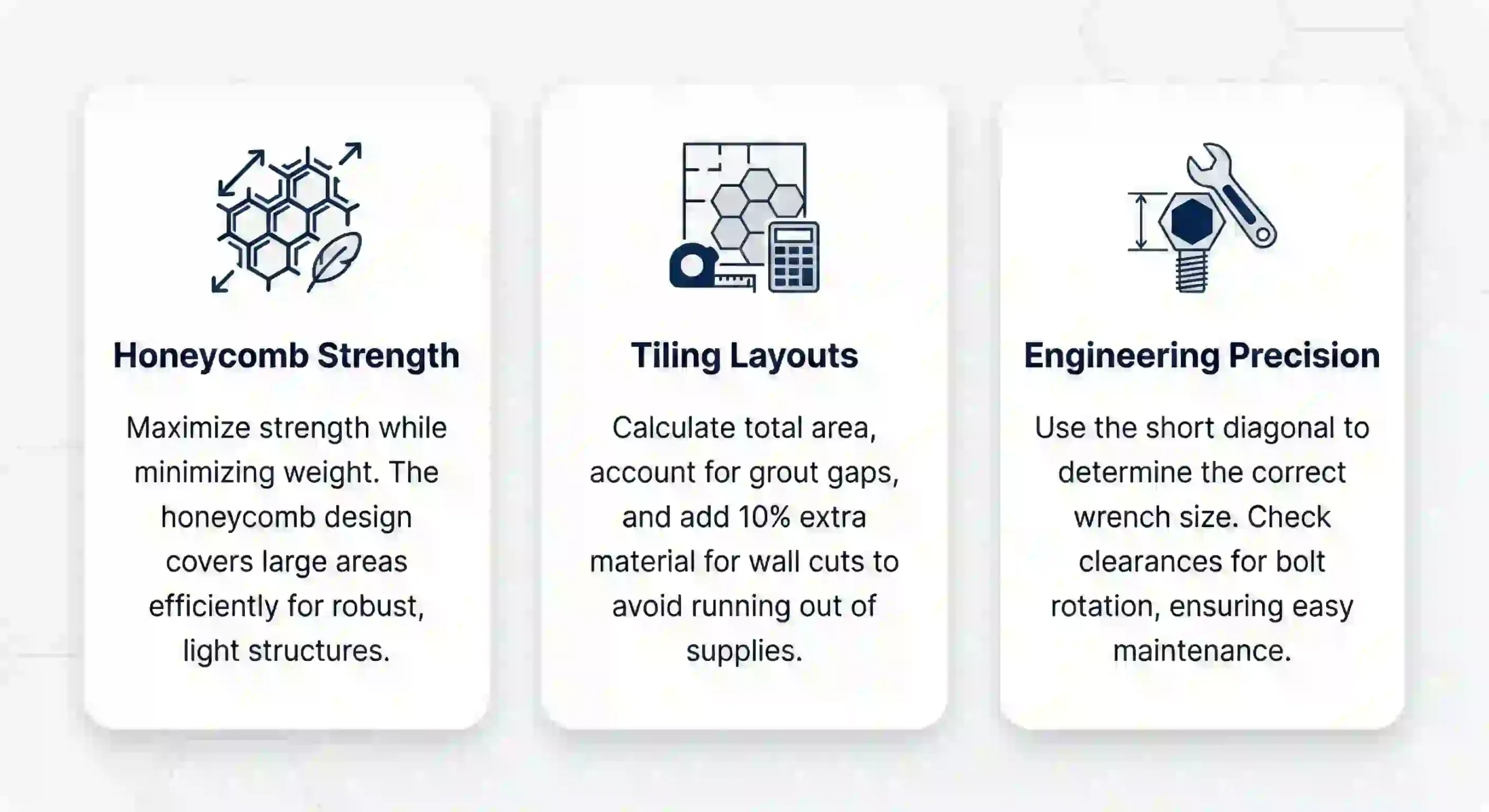
You should use hexagonal patterns to maximize strength while minimizing material weight. Specifically, the honeycomb design is one of the most efficient structures in engineering. You can cover a large area with very little material by using this shape. This efficiency is why the aerospace industry uses hexagonal cores in airplane wings. Consequently, your projects will remain incredibly strong but also very light. Therefore, you should choose a honeycomb layout for your structural framing needs.
Tiling Layouts
You should carefully calculate the number of hexagonal tiles needed for your bathroom floor. First, find the total area of your room in square inches. Next, use our calculator to find the surface area of a single hexagonal tile. Specifically, you must account for the gaps between tiles for the grout lines. You should add about 10% more material to cover the cuts along the walls. Consequently, you will avoid running out of supplies during the middle of your renovation. Accurate planning ensures a smooth and beautiful floor finish.
Engineering Applications
You must understand hex-head bolt clearances and wrench sizes for your mechanical work. Specifically, the short diagonal of a hexagon determines which wrench size you should use. You can find the exact “width across flats” by using our short diagonal result. Therefore, you will never pick the wrong tool for your hardware. You should also check the corner-to-corner distance to ensure enough space for the bolt to turn. Consequently, your machinery will be easier to maintain and repair. High precision in your measurements leads to better long-term mechanical performance.
You Might Also Find These Helpful
Math 2
No tools published here yet.
COMMON MISTAKES YOU SHOULD AVOID
You can prevent many geometry errors by learning from common building mistakes. Simple errors often lead to wrong material orders or poor structural fits. You should review these three mistakes before you start your next design. Accurate tracking helps you reach your project goals much faster. Consequently, you will maintain a steady schedule while managing your construction budget. Therefore, you can trust your data for better long-term success.
- Confusing Long and Short Diagonals:You should not confuse the long diagonal with the short diagonal. Specifically, measuring across the flat sides is very different from measuring across the corner points. The long diagonal represents the widest part of the shape. Conversely, the short diagonal measures the narrowest width between flat edges. You will get an incorrect area if you use the wrong dimension in the tool. Therefore, you must carefully verify your measuring points on the hexagon. Specifically, using the "across the points" length for a "width across flats" calculation will ruin your mechanical fit.
- Mixing Units:You must maintain consistency in your units throughout the entire calculation. Specifically, you should choose either inches or centimeters for your whole project. Mixing different measurement units results in significant errors in the final area report. You will find that geometry formulas require a single unit type for mathematical accuracy. Consequently, you should double-check your numbers before entering them into the fields. Therefore, your results will match your physical materials perfectly. For instance, a small error in units can lead to ordering the wrong size of paving stones.
- Assuming Irregularity:You should understand that this calculator works only for regular hexagons. Specifically, a regular shape has equal sides and equal internal angles of 120 degrees. Irregular six-sided polygons do not follow these same simple mathematical rules. You will receive wrong data if you try to calculate an uneven or lopsided shape. Consequently, the standard formulas for area and diagonals will not apply correctly. Therefore, you should confirm your shape is perfectly symmetrical before you begin your math. Specifically, check that every flat edge measures the same length.

Frequently Asked Questions (FAQs)
What is the formula for the area of a hexagon?
The most common formula for the area of a regular hexagon uses the side length (s). Specifically, you use the equation Area = 2.598 x s². You can also find the area by multiplying the perimeter by the apothem and dividing by two. Our calculator handles this complex square root math instantly. Therefore, you get an accurate result without manual calculation errors.
How many triangles are in a hexagon?
A regular hexagon contains exactly six equilateral triangles. Specifically, these triangles meet at a single center point to form the shape. Every triangle has the same side length as the outer boundary of the hexagon. This relationship is why the hexagon is so physically stable and strong. Consequently, you can calculate the total area by finding the size of just one internal triangle.
What is the sum of the interior angles in a hexagon?
The sum of all interior angles in a regular hexagon is precisely 720 degrees. Specifically, each corner angle measures 120 degrees. You can find this total by using the formula (n – 2) x 180. In this case, n represents the six sides of the polygon. Knowing this sum helps you verify the symmetry of your physical build.
How do you find the side length from the perimeter?
Finding the side length from the perimeter is a straightforward division task. Specifically, divide the total perimeter by 6. Since a regular hexagon has six similar sides, this math provides the exact length of one edge. For example, a 60-inch perimeter means each side is exactly 10 inches long. Therefore, you can quickly reverse the calculation to check your measurements.
What is the difference between a regular and an irregular hexagon?
A regular hexagon has sides of equal length and angles of equal measure. Specifically, every interior angle must be 120 degrees for perfect symmetry. An irregular hexagon has sides and angles of varying lengths and angles. You should only use our calculator for regular shapes to ensure mathematical accuracy. Consequently, irregular shapes require more complex coordinate geometry to solve.
How do you calculate the short diagonal?
You calculate the short diagonal by multiplying the side length by the square root of three. Specifically, the formula is w = s x 1.732. This measurement represents the distance between two opposite flat sides. Most mechanics in the USA call this the “width across flats.” Therefore, you can use this number to pick the correct wrench for a hexagonal bolt.
Questions?
We had love to hear from you! Whether you are reporting an issue, suggesting a new calculator, or exploring collaboration opportunities — we are here to help. Every message helps us make 100calc smarter, faster, and more helpful for everyone.
Why People Trust 100calc
At 100calc.com, we focus on accuracy, speed, and trust. Every calculator we create is designed to give reliable, instant, and easy-to-understand results you can truly depend on.