
Snowboard Size Calculator
Finding the right gear starts with your measurements. You need a snowboard that matches your weight and height. For example, a board that is too long is hard to control. Conversely, a short board lacks stability at high speeds. Our Snowboard Size Calculator uses your physical stats to find the perfect fit. You can choose from top US brands with confidence today.
Most riders measure boards from their chin to their nose. However, your weight is the most important factor for safety. Also, your riding style changes the required length. Park riders usually prefer shorter boards for easier spins. Therefore, you must enter your details for a custom recommendation. Our tool prevents boot drag by calculating your ideal waist width as well.
- Updated Feb 10, 2026
Snowboard Size Calculator: Find Your Ideal Match
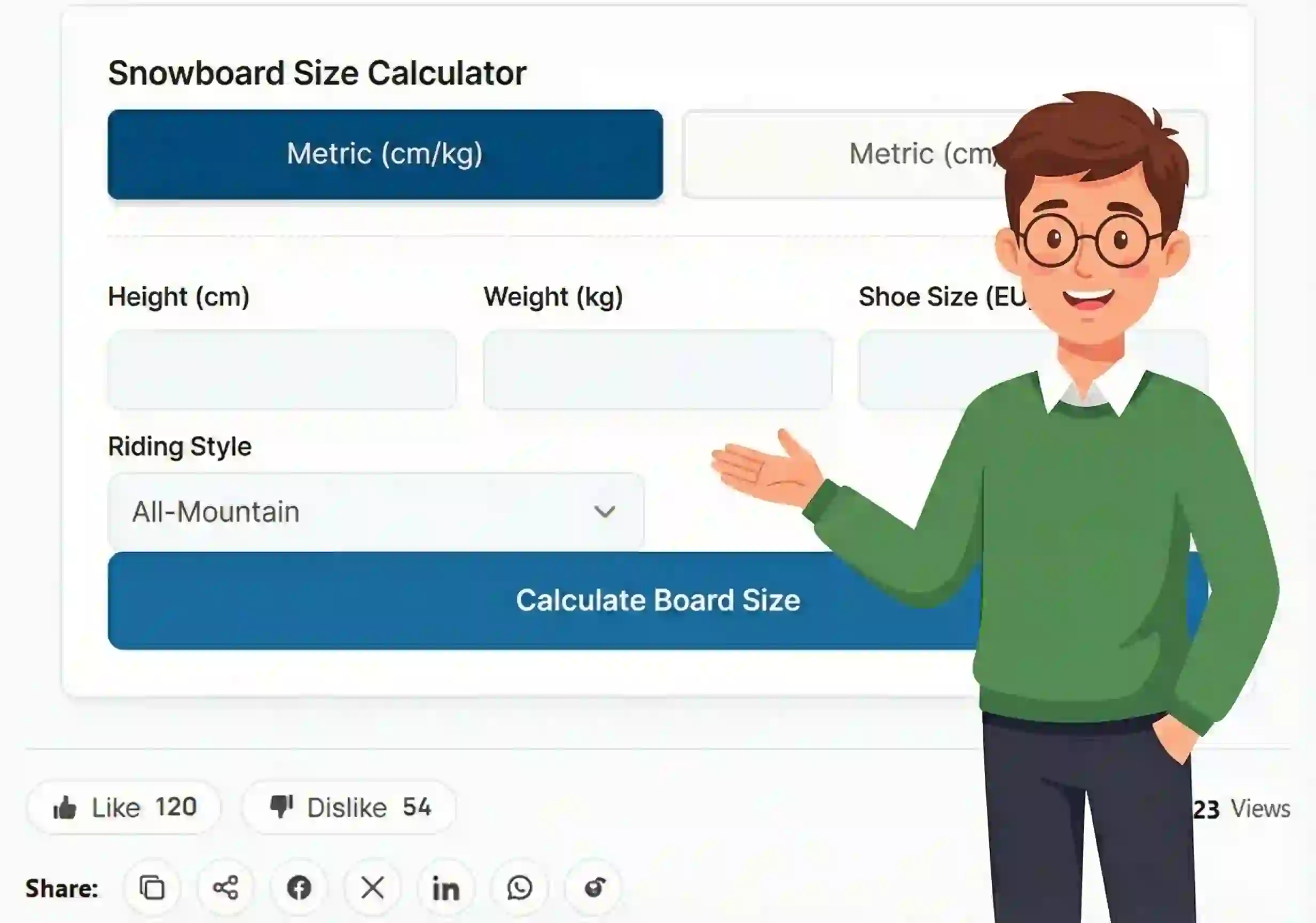
You can find your ideal gear dimensions by using the tool below. Please enter your accurate physical measurements to get the best results. Our engine processes your data against professional industry standards. You should have your height and current weight ready before starting.
What Your Snowboard Size Means
Your report highlights two vital numbers for your setup. These metrics ensure you have a safe experience on the mountain. You should look at the length first. The board length determines how much control you have over the snow. For instance, beginners often struggle with boards that are too long. A shorter board allows you to initiate turns with less effort.
Why Your Waist Width Matters
The waist width is the second most important number. This measurement protects you from falling during a turn. You must ensure your boots do not overhang the edges too much. A narrow board causes your toes or heels to come into contact with the snow. This event is known as “drag.” Consequently, drag can cause you to lose your balance and crash.
Understanding Your Custom Range
You should use your result to filter boards at the shop. Most manufacturers list the waist width in millimeters. Therefore, you can compare your result directly to the product specs. A perfect match prevents toe drag while keeping the board responsive. Also, remember that your skill level might change your needs over time. You should check your measurements every season to maintain peak performance.
Quick example to check the math
You can easily verify your result with a simple calculation. First, multiply your height in cm by 0.88 to get your height factor. For a 175 cm rider, this equals 154. Second, multiply your weight in kg by 0.25 to find your weight factor. A 70 kg rider reaches a score of 17.5.
After that, you add these two numbers together. Your interim score is (154 + 17.5) = 171.5. Finally, multiply this by 0.95 for a park-riding style. This step brings your total to 162.9 cm. Therefore, your ideal board size is roughly 163 cm.
Calculation Summary:
- Base Calculation: (175 x 0.88) + (70 x 0.25) = 171.5
- Style Multiplier: 171.5 x 0.95 = 162.9
- Final Result: 163 cm
Explore More Calculators
Use our Steps to Calories Calculator to convert steps to calories instantly. This walking calorie calculator adjusts for height and speed to ensure accuracy.
Try calculatorUse our Cycling Calorie Calculator to estimate your energy burn. Get accurate results based on weight, speed, and bike type for your fitness goals.
Try calculatorUse our Rucking Calories Calculator for 100% accurate results. Track your burn based on weight, pack load, and pace. Plan your fitness hike now.
Try calculatorConvert steps to miles instantly with our calculator. This steps to distance converter uses your height and gender for precise walking distance results.
Try calculatorHow to Use the Snowboard Size Calculator
Finding your perfect board size is quick and easy. Follow these five steps to get your professional recommendation. Each step ensures your gear matches your physical stats for the best mountain experience.
Select Your Unit System
First, you must choose between Metric or Imperial units. You should select Metric for centimeters and kilograms. Alternatively, you can pick Imperial for feet and pounds. This choice ensures the calculator processes your data correctly.
Input Your Height and Weight
Second, you will enter your current height and weight. You should be as accurate as possible with these numbers. Weight is a critical factor because it determines how the board will bend. A proper flex allows you to turn the board with less effort.
Select Your Riding Style
Third, you must choose a style that aligns with your goals. You should pick "Park" if you want a shorter board for easy spins. Conversely, you should select "Powder" if you need a longer board for deep snow. The All-Mountain option provides a balanced fit for most riders.
Provide Your Boot Size
Fourth, enter your shoe size in US or EU units. This step is essential for your safety. Our tool uses your boot size to calculate the necessary board width. An accurate width prevents your toes or heels from hitting the snow.
Generate Your Custom Report
Finally, you will click the calculate button to see your results. The engine provides a length range in centimeters. It also suggests a waist width in millimeters. You can use these numbers to choose the right gear at any shop.
Example for testing
You can try these sample numbers to see how the tool works. First, select the All-Mountain riding style. Second, enter a height of 180 cm and a weight of 80 kg. These inputs represent a standard adult male profile.
Result → Your recommended size hits 158 – 164 cm. Your physical stats and riding goals work together here. This score provides a balanced fit for the entire mountain. It equals a reliable and stable ride for most conditions.
Now, enter your own numbers and check how close you are to your goal.
How the Snowboard Size Calculator Formula Works (Complete Breakdown)
You should understand how the math determines your gear size. This formula provides a realistic estimate for your board length. It is based on equipment standards from top US manufacturers. The logic separates physical traits from your personal riding goals. This ensures the result is accurate for your specific body type.
The Snowboard Sizing Formula
The calculator starts with a standard base length. Then it applies multipliers based on your unique profile. This method identifies the perfect balance between stability and control. Stability is when the board stays smooth at high speeds.
Formula:
Total Length = Base Length x Style Multiplier x Gender Factor
The formula begins by calculating a base number from your height and weight. It multiplies your height by 0.88. Then it adds your weight multiplied by 0.25. This calculates your personalized base size.
Example:
					Imagine a male rider who is 180 centimeters tall. He weighs 80 kilograms and enjoys all-mountain riding.
1: Height Factor: 180 cm × 0.88 = 158.4
2: Weight Factor: 80 kg × 0.25 = 20
3: Base Length: 158.4 + 20 = 178.4
However, we must scale this for real-world snowboarding. The final result usually falls between 158 cm and 164 cm.
Micro Note:
This calculator predicts the length of standard snowboards. Custom “volume-shifted” boards are a different category. Those boards are wider and much shorter than normal gear. Most riders should stick to standard lengths for their first few seasons.
Key Inputs Used in the Calculator
Every calculation depends on specific physical inputs. These inputs change how the board handles the snow. By entering your real details, you get a custom setup instantly. Professionals use these same factors to build custom boards for athletes.
Rider Weight
This is the most powerful factor for performance. Weight determines how the board will flex during a turn. A heavier weight requires a longer board to prevent excessive bending. Consequently, the board remains stable on steep terrain.
Rider Height
Your height affects your center of gravity. Taller riders have more leverage over the board. This factor helps the tool find your natural balance point. For instance, tall riders need a board that reaches their chin for proper control.
Riding Style
Your goals on the mountain override natural physical odds. Park riding needs a shorter board for easy spins. Conversely, powder riding needs a longer board for float. The number of centimeters added or removed is the most significant predictor of speed. For example, a powder board is often 5 percent longer than an all-mountain board.
Another Example Calculation (Step-by-Step)
Let’s see how the snowboard calculator works for a different rider. This will help you understand how each factor affects your final size. The calculation follows the same logic used by ski shops worldwide.
Given:
- Riding Style: Park (Freestyle)
- Rider Height: 175 cm
- Rider Weight: 70 kg
Calculation:
					We apply the park multiplier to the base result.
(175 x 0.88) + (70 x 0.25) = 171.5
. We then apply the 0.95 park multiplier.
Result:
Recommended Size: 150 – 154 cm
Width: 250 mm
Status: Shorter (Flexible)
Meaning:
Your recommended size is about 152 centimeters. This confirms a focus on maneuverability. Pro riders often see this pattern for freestyle setups. A result of 152 cm is very agile for tricks. Most riders of this height would normally use a 157 cm board for general trails.
Result Benchmarks and Ranges
Most US manufacturers use these benchmarks to ensure your safety. Therefore, you can trust these numbers for your equipment choices. You should use these values to evaluate your current setup. Also, these figures help you plan your next purchase. Accurate measurements lead to better control. For instance, a proper fit prevents unnecessary falls. Consequently, your performance on the mountain will improve.
| Weight (lbs) | Height (ft/in) | Category | Board Size | Rider Profile |
|---|---|---|---|---|
| 100–120 lbs | 5'0"–5'4" | Small | 140–145 cm | Ideal for youth or petite riders. |
| 120–150 lbs | 5'4"–5'8" | Standard | 145–152 cm | Fits most average-sized adults. |
| 150–180 lbs | 5'8"–6'0" | Large | 152–158 cm | Best for taller or heavier riders. |
| 180–210 lbs | 5'10"–6'2" | XL | 158–162 cm | Requires a stiff and stable board. |
| 210+ lbs | 6'0"+ | Wide | 162 cm+ | Often requires a "Wide" model. |
Heads-up: Gear policies vary by manufacturer. Always confirm the specific weight rating on the back of the board.
Interpretation
A length between 145 and 152 centimeters is common for average adults. Therefore, this range provides a balanced feel for general mountain use. However, sizes above 160 centimeters are much heavier. You should prepare for a board that requires more leg strength to turn. Conversely, lighter riders should stay within the lower ranges to maintain control.
Pro Tip:
You can check the weight rating for specific models before buying. For example, stiffer boards handle more weight but are harder to flex. Confirming the flex rating ensures your gear matches your actual skill level. You should always prioritize your weight over your height for the best experience.
Tips & Planning Based on Your Result
You can improve your riding experience by following these expert tips. Finding the right board size is just the first step to a great day on the mountain. You should apply these insights to choose the best gear for your specific needs.
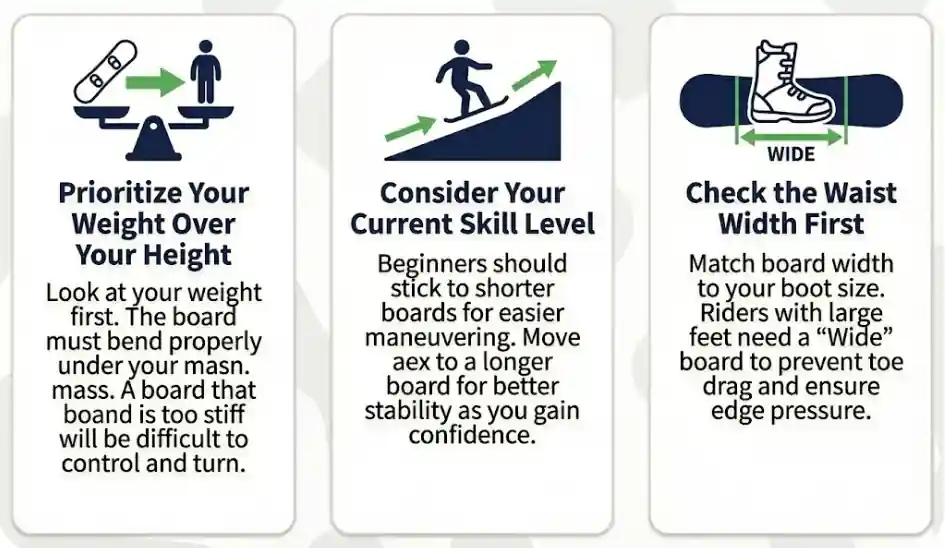
Prioritize Your Weight Over Your Height
You must look at your weight before checking your height. This is the most important rule in modern snowboarding. The board must bend properly under your mass to initiate a turn. For example, a tall but very light rider should choose a shorter board. A board that is too stiff will be difficult to control. Consequently, you will struggle to make sharp turns on steep terrain.
Consider Your Current Skill Level
Beginners should always stick to the shorter end of their recommended range. Shorter boards are much easier to maneuver at low speeds. Therefore, you can learn basic turns without fighting the equipment. You can move to a longer board as you gain more confidence. A longer board provides better stability when you start riding faster. However, you should not rush this transition.
Check the Waist Width First
You must match the board width to your boot size for your safety. This step is mandatory for riders with large feet. Most people with a US shoe size 11 or larger need a “Wide” board. A wide board prevents your toes from dragging in the snow. Dragging your boots can cause an immediate fall during a carve. Also, a proper width ensures you can put maximum pressure on your edges.
You Might Also Find These Helpful
Fitness 4
No tools published here yet.
Common Mistakes to Avoid When Sizing a Snowboard.
You can avoid many frustrations by learning from other riders. Many people make simple mistakes when buying their first board. These mistakes can lead to a poor experience or even an injury. You should review these three common errors before you finalize your purchase.
- Ignoring Your Body Weight: Many people only look at their height when choosing a board. However, your weight is the primary factor for board safety. Your weight determines how much pressure you apply to the wood core. For instance, a light rider on a long board cannot make it flex. This mistake makes the board feel like a stiff plank. Consequently, you will have a very hard time steering through the snow.
- Choosing Based on Graphics: You should never pick a board size just because you like the artwork. An incorrect size will ruin your riding experience, regardless of how it looks. Manufacturers often use the same graphics for several different lengths. Therefore, you must check the specific dimensions first. A beautiful board that is too big will sit in your garage instead of on the mountain. You should prioritize your physical stats over the visual design every time.
- Forgetting About Boot Overhang: A narrow board is dangerous for riders with large feet. Therefore, checking the waist width is mandatory before you spend your money. You must ensure your boots do not stick out too far over the edges. If your boots hit the snow during a turn, you will lose your edge. This event leads to an immediate and painful crash. Also, remember that different boot brands have different outer lengths. You should always measure your actual boots against the board width.

Frequently Asked Questions (FAQs)
Should a snowboard reach my chin or my nose?
Most boards should reach the area between your chin and your nose. However, this old rule is only a starting point for beginners. Your weight is a much more accurate factor for modern equipment. Therefore, you should always check the manufacturer’s weight chart before you buy.
Does my height really matter for snowboard size?
Your height matters for your overall balance and leverage. Taller riders have a wider stance and need more board to stay stable. But your weight is what actually makes the board bend and turn. For example, a heavy rider needs more surface area regardless of their height.
What happens if my snowboard is too long?
A board that is too long will be very difficult to turn. You will feel like you are fighting the equipment all day. Consequently, your legs will get tired much faster than usual. Also, a long board is hard to control in tight spaces, such as trees or narrow trails.
Do I need a wide snowboard if I have big feet?
You definitely need a wide board if your boot size is US 11 or larger. A wide waist prevents your toes and heels from touching the snow. This protection is vital for safety during sharp turns. Most brands label these specific models with a “W” next to the size.
Is a shorter board better for learning as a beginner?
Yes, a shorter board is much easier for a beginner to handle. You can initiate turns with less physical effort at low speeds. Therefore, you will gain confidence faster on the bunny slopes. You can upgrade to a longer and stiffer board once you start riding faster.
Can a woman ride a man’s snowboard?
A woman can certainly ride a man’s board if the size matches her weight. However, men’s boards are usually broader and stiffer. Women’s specific boards account for a lower center of gravity and smaller feet. Therefore, a woman might find a female-specific model more comfortable to steer.
How do I know if my board is the right width?
You should strap your boots into your bindings and check the edges. Your boots should be flush with the edges or have a very slight overhang. If your boots stick out more than an inch, the board is too narrow. This setup will cause drag and make you fall during deep carves.
Questions?
We had love to hear from you! Whether you are reporting an issue, suggesting a new calculator, or exploring collaboration opportunities — we are here to help. Every message helps us make 100calc smarter, faster, and more helpful for everyone.
Why People Trust 100calc
At 100calc.com, we focus on accuracy, speed, and trust. Every calculator we create is designed to give reliable, instant, and easy-to-understand results you can truly depend on.