
Steps to Calories Calculator
The Steps to Calories Calculator converts your daily step count into total energy burned accurately. It uses your specific height and weight metrics. Most tools guess your stride length. Consequently, they often provide incorrect data. Our tool calculates your exact stride based on your anatomy. You can use this walking calorie calculator to track your weight loss progress precisely.
Walking is the simplest form of exercise. You burn calories with every single step. However, a tall person burns energy differently than a short person. Our calculator adjusts for these biological differences. It also factors in your walking speed. Therefore, you get a personalized result. Use this tool to verify your pedometer or fitness tracker data instantly.
- Updated Feb 10, 2026
Steps to Calories Calculator: Convert Steps to Calories Fast
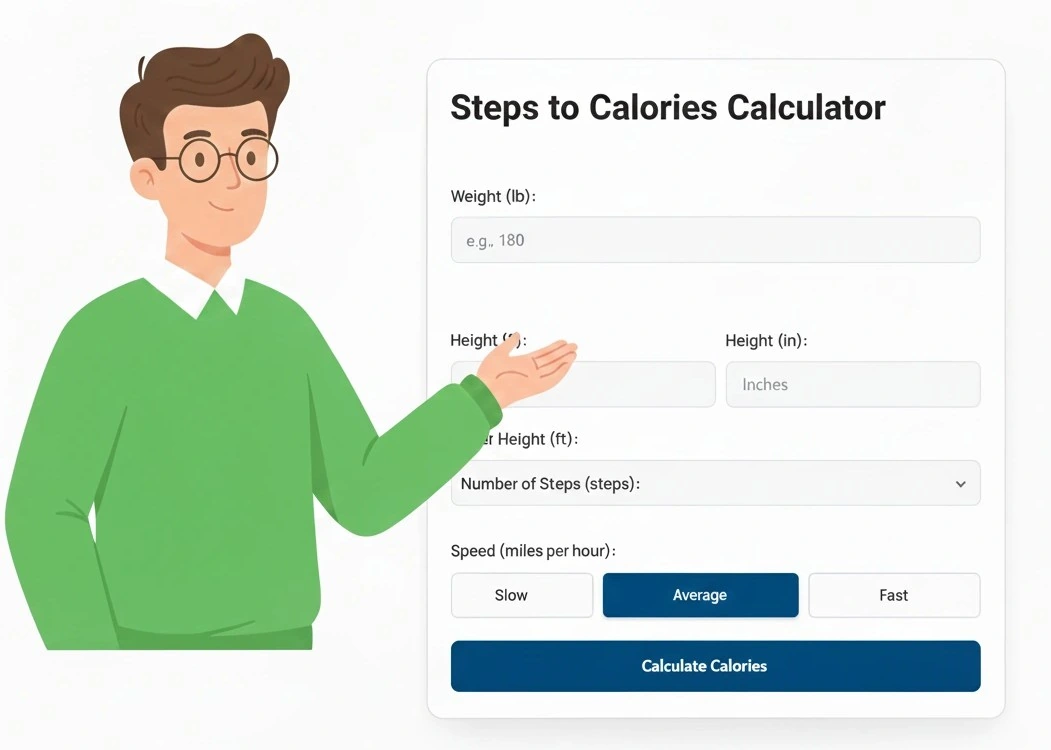
Your current body weight. Used to calculate accurate stride length. The total count from your pedometer. Select Slow (2.0 mph), Average (3.0 mph), or Fast (4.0 mph). Estimated Calories Burned, Distance Traveled, Stride Length Used.
Estimated Calories Burned:
Activity Details:
- Distance Traveled:
- Stride Length Used:
- Speed Multiplier:
⚠️ **NOTE:** Slower paces sometimes appear to burn more calories over the same distance when calculated over a longer period of time, as it includes your basal metabolic calorie burn. This calculator uses speed to adjust the intensity factor.
What Your Step Calorie Result Means
Your result displays total energy expenditure. The number represents fuel burned to move your weight. We measure this output in Kilocalories (Kcal). Nutrition labels use Kcal to measure food energy. Therefore, compare your workout stats against your daily meals easily.
Height plays a massive role in math. Taller people possess longer stride lengths naturally. Consequently, they cover more distance with fewer steps. The calculator determines your exact distance in miles. Next, it applies a metabolic formula to the data. Speed also increases the workout intensity. Therefore, walking at a “Fast” pace burns calories rapidly compared to a “Slow” stroll.
Quick example to check the math
Input: You weigh 180 lbs and stand 6’0 tall. You walk 10,000 steps at an Average pace.
Calculated Output: You burn approximately 472 Calories.
Analysis: Height creates a longer walking stride. You cover roughly 5 miles. Consequently, the calorie burn is higher than that of a shorter person taking the same steps.
Explore More Calculators
Use our Cycling Calorie Calculator to estimate your energy burn. Get accurate results based on weight, speed, and bike type for your fitness goals.
Try calculatorUse our Rucking Calories Calculator for 100% accurate results. Track your burn based on weight, pack load, and pace. Plan your fitness hike now.
Try calculatorUse our expert Snowboard Size Calculator to find your ideal board length and waist width. Get custom results based on weight and boot size…
Try calculatorConvert steps to miles instantly with our calculator. This steps to distance converter uses your height and gender for precise walking distance results.
Try calculatorHow to Use the Step To Calories Calculator
You can get precise results by following these five steps. Our tool uses advanced logic to calculate your burn. Follow the instructions below to ensure accuracy.
Input Body Weight
First, enter your body weight. Locate the field labeled "Weight (lb)". Type your current weight in pounds. Moving a heavier body requires more energy. Therefore, accuracy is critical for the final count.
Enter Your Height
Next, provide your height stats. Use the "Height (ft)" and "Height (in)" fields. Our engine uses these numbers to find your stride length. Standard converters often guess this metric. However, we calculate it mathematically for better precision.
Add Step Count
Then, input your activity data. Enter your total "Number of Steps" from your device. You can verify a daily total or a single walk. For example, enter 10,000 to check a full daily target.
Select Speed
Finally, choose your walking pace. Use the "Speed" radio buttons. Select Slow (2.0 mph), Average (3.0 mph), or Fast (4.0 mph). Walking faster increases your heart rate. Consequently, the tool adjusts the multiplier for high speeds. Click "Calculate Calories" to see the output.
Calculate
Finally, click on Calculator button and check result box.
Example for testing
Try these sample numbers:
- Weight: 150 lbs.
- Height: 5 ft 9 in
- Steps: 5,000
- Speed: Average
Result → You burned approximately 188 Kcal.
Now, enter your own numbers and check how close you are to your goal.
How the Step To Calories Calculator Formula Works (Complete Breakdown)
Understanding the math helps you control your fitness progress. The formula connects your height to your energy output. You can see how anatomy affects distance. We use the Metabolic Equivalent of Task (MET) method. Therefore, the results match clinical standards used by doctors.
The Calorie Formula
We believe in complete transparency. Our calculator uses a multi-step process. First, the tool finds your distance. Next, the algorithm calculates the energy cost.
Formula:
					Stride length = Height in meters × 0.414
Distance walked = Number of steps × Stride length
Walking time = Distance walked ÷ Walking speed
Calories burned = (Weight in kg × MET value × 3.5 × Walking time in minutes) ÷ 200
The equation multiplies workout intensity by your weight. We derive the time variable by dividing your total distance by your speed.
Example:
					If you weigh 180 lbs (81.6 kg) and walk 10,000 steps at an average pace,
(81.6 kg x 3.5 MET x 3.5 x 95 min)200 = 475 Kcal
Your total burn is 546 Calories. Fitness experts consider this a high-intensity output for a low-impact exercise.
Micro Note:
Walking 10,000 steps burns roughly 300 to 500 calories. The CDC recommends 150 minutes of activity weekly. Reaching this daily step count helps you meet that goal effectively.
Key Inputs Used in the Steps to Calories Calculator
Every calorie calculation depends on three specific inputs. These inputs help you measure your intensity accurately. You can plan your walking routine effectively by entering real numbers for weight, height, and speed.
Stride Length (Height-Based)
Stride length determines your total distance. We multiply your height in inches by 0.415 to find it. For example, a 6-foot person has a stride of roughly 30 inches. Consequently, they walk farther per step than someone who is 5 ft. Most simple tools ignore this variable completely.
Speed Multiplier (MET)
Speed determines the workout intensity. Walking fast demands more oxygen and fuel. We assign a specific MET value to your pace. “Slow” walking uses 2.8 METs. “Fast” walking uses 5.0 METs. Therefore, increasing your speed nearly doubles your calorie burn per minute.
Body Weight
Body weight acts as the mass variable. Gravity acts on the total weight you move. A 200 lb person burns more energy than a 130 lb person taking the same steps. The formula converts your pounds into kilograms for scientific accuracy. Heavier loads force your muscles to generate more power.
Another Example Calculation (Step-by-Step)
Let’s see how the calculator works using a real example. The breakdown shows how your height changes the final math.
Given:
- Body Weight: 180
- Steps: 10,000
- Height: 5’10” (1.78 meters)
- Speed: Average (3.0 mph)
Calculation:
					1.78m x 0.414 = 0.74 meters
10,000 steps x 0.74 m = 7,400 meters
7,400m ÷ 80 m/min = 92.5 minutes
Result:
Total Time: 92.5 minutes
Calories Burned: approximately 459 Kcal
Meaning:
You walked for over 90 minutes. The calorie burn equals a small meal. Therefore, consistent walking contributes significantly to a weekly calorie deficit.
Result Benchmarks and Ranges
our step count tells a story about your activity level. Health experts categorize activity based on daily steps. The table below helps you evaluate your status.
| Step Count | Activity Level | Avg Calories (160 lbs) | Why It Matters |
|---|---|---|---|
| < 5,000 | Sedentary | < 200 Kcal | Limited movement slows metabolism. |
| 5,000 – 7,499 | Low Active | 200 – 300 Kcal | Meets basic movement needs. |
| 7,500 – 9,999 | Somewhat Active | 300 – 400 Kcal | Improves heart health significantly. |
| > 10,000 | Active | > 400 Kcal | Supports weight loss goals. |
Note: Calorie estimates assume an average weight of 160 lbs. Heavier individuals will burn more energy for the same step count.
Interpretation
The result displays the total energy expenditure of your walk. The number represents the fuel your body burned to move your weight over that specific distance. We calculate the result in Kilocalories (Kcal). Nutrition labels use Kcal to measure food energy. Therefore, you can easily compare your workout burn against your daily meal intake.
Pro Tip:
Speed matters more than distance for calorie burn. Switch from a “Slow” pace to a “Brisk” pace immediately. Such a change increases your energy expenditure by 50%. You do not need to walk longer. You need to walk with more purpose to maximize fat loss.
Tips & Planning Based on Your Result
You can increase your daily burn easily. Follow these tips to get the best results from your walking routine. Small changes add up quickly.
Increase Your Pace
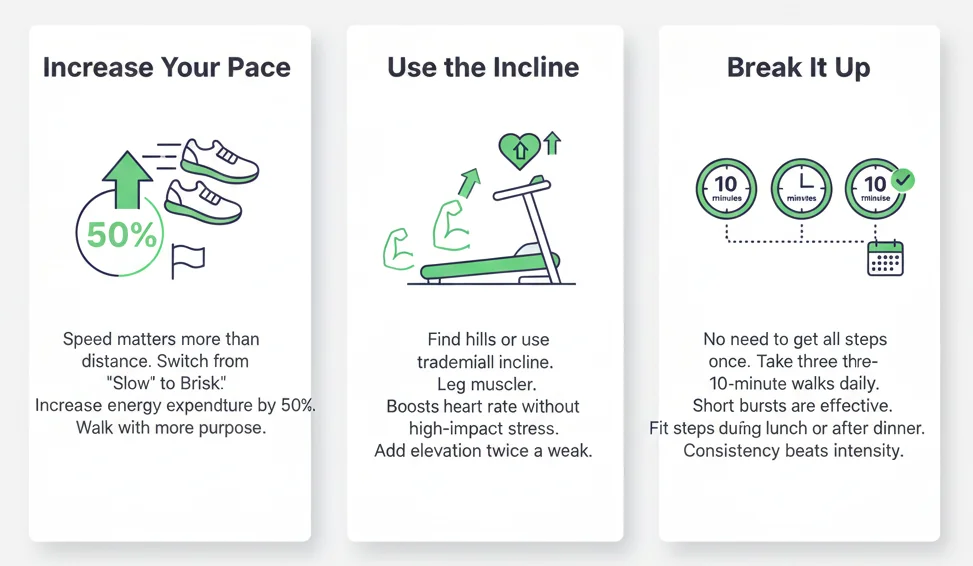
Speed matters more than distance for calorie burn. Switch from a “Slow” pace to a “Brisk” pace immediately. Such a change increases your energy expenditure by 50%. You do not need to walk longer. You need to walk with more purpose.
Use the Incline
Find hills or use the treadmill incline. Walking uphill requires significantly more force. Consequently, your leg muscles work harder against gravity. We recommend adding elevation to your route twice a week. Elevation boosts your heart rate without high-impact stress.
Break It Up
You do not need to get all the steps at once. Take three separate 10-minute walks daily. Research shows short bursts of activity remain highly effective. Therefore, fit steps in during lunch or after dinner. Consistency beats intensity over the long term.
You Might Also Find These Helpful
Fitness 4
No tools published here yet.
Related Tools People Use Next
Common Mistakes to Avoid When Calculating
You can get the most accurate results by avoiding these errors. Small details often change the calculation significantly. Pay attention to the following points.
- Do not guess your height. Stride length depends entirely on accurate height data. Measure yourself without shoes for the best precision.
- Relying on generic stride averages reduces accuracy. Every person walks differently based on leg length. Our tool calculates your unique stride mathematically.
- Never overlook the speed variable. Fast walking burns significantly more energy than slow walking. Always select the correct pace option in the calculator.
- Thinking every step burns the same calories is incorrect. Uphill steps require more force than flat steps. Intensity changes the energy cost per step drastically.
- Forgetting to reset your pedometer ruins the daily count. Old steps mix with new data. Clear your device every morning for exact tracking.

Frequently Asked Questions (FAQs)
How many calories do 10,000 steps burn?
Walking 10,000 steps burns roughly 300 to 500 calories. Your weight impacts this number directly. Heavier people burn more energy per step. Therefore, the 10000 steps calories count varies significantly by individual. Speed also changes the final count.
What is 20,000 steps equal to?
Walking 20,000 steps equals approximately 10 miles (16 km). You burn roughly 800 to 1,000 calories covering this distance. Consequently, health experts classify this as a “Highly Active” day. Athletes often reach this target during endurance training.
How much is 5000 steps in calories?
5,000 steps burn about 150 to 250 calories. Many professionals consider this the baseline for a “Sedentary” lifestyle. You should aim for a higher count for weight loss. However, hitting 5,000 steps still supports basic heart health.
How do you convert steps to calories?
You calculate it using a metabolic formula. Multiply your weight by the MET intensity and duration. Our tool acts as an instant pedometer calorie converter. It automates the complex math using your height and weight data.
Does walking speed affect calories?
Yes, speed serves as a significant factor. Walking at a brisk 4.0 mph pace burns nearly double the energy of a slow stroll. Consequently, increasing your pace is the fastest way to boost your daily burn. Intensity matters more than just distance.
Can walking help lose belly fat?
Yes, consistent walking creates a calorie deficit. Combining a daily walk with a balanced diet leads to fat loss. Walking lowers cortisol levels effectively. Therefore, it helps reduce belly fat storage over time.
Questions?
We had love to hear from you! Whether you are reporting an issue, suggesting a new calculator, or exploring collaboration opportunities — we are here to help. Every message helps us make 100calc smarter, faster, and more helpful for everyone.
Why People Trust 100calc
At 100calc.com, we focus on accuracy, speed, and trust. Every calculator we create is designed to give reliable, instant, and easy-to-understand results you can truly depend on.