
Pregnancy Due Date Calculator (Accurate EDD Estimator)
A pregnancy due date calculator estimates your expected delivery date using your last period, conception date, ovulation, IVF transfer, or ultrasound. It also shows your gestational age, pregnancy week, and trimester. This tool helps you track your pregnancy timeline and understand when your baby may arrive based on medical dating methods.
Most pregnancy calculators use Naegele’s rule, which adds 280 days to your last menstrual period. However, more accurate methods adjust based on ovulation timing, IVF transfer, or ultrasound measurements like crown-rump length. This calculator supports all major methods, including pregnancy due date calculator IVF, conception-based due date, ovulation tracking, and ultrasound dating. You will see your estimated due date, weeks pregnant today, trimester stage, and full-term window in seconds.
This tool also works as a pregnancy week calculator by due date and helps you follow your pregnancy week by week with better clarity and accuracy.
Quick Facts
- Standard pregnancy length: 40 weeks
- Full-term pregnancy: 37 to 42 weeks
- Most accurate methods: IVF and ultrasound dating
- Only 5% of babies are born on the exact due date
- Updated Apr 1, 2026
- Reviewed by Medical Content Team
Pregnancy & Fertility Calculator
Pregnancy Due Date Calculator
Estimate your due date using your last period, conception date, ovulation or IUI date, IVF transfer, or ultrasound timing. See your pregnancy week, trimester, and key milestone dates in one place.
Use Last Period if you know the first day of your last menstrual period.
What you need to enter first
Pick the method that matches the date you know best. Most people start with their last period, while IVF and ultrasound are useful if those details are already known.
Estimated due date
Your pregnancy due date estimate will appear here.
Your pregnancy progress
Your personalized pregnancy progress will appear here after calculation.
How this was calculated
A plain-language explanation based on your selected method will appear here.
Dating note
Your due date is an estimate. The dating note will explain the basis used for this result.
Pregnancy timeline
Full-term arrival window
Your full-term pregnancy window will appear here after calculation.
Short answer
A direct answer based on your inputs will appear here.
What does this result mean?
Your first dynamic answer will appear here after calculation.
How far along am I today?
Your second dynamic answer will appear here after calculation.
How to Use the Pregnancy Due Date Calculator (Real Examples)
Not sure how to calculate your pregnancy due date? Use these real examples. Enter the same values into the calculator. You will see the same results instantly.
This helps you understand your estimated due date (EDD), gestational age, trimester, and full pregnancy timeline. Once you try one example, the tool becomes very easy to use.
What is my due date if my last period started on January 7, 2026?
This is the most common method. It uses your last menstrual period (LMP) and cycle length.
Enter these values
- Method: Last Period
- First day of last period: January 7, 2026
- Cycle length: 30 days
You will see this result
- Estimated due date: October 16, 2026
- Weeks pregnant: 11 weeks 4 days
- Trimester: First trimester
- Estimated conception date: January 23, 2026
You can click Add Course to include more subjects. This also works as a semester GPA calculator or subject GPA calculator.
What this means
Your due date is calculated using Naegele’s rule, which adds 280 days to your last period. Since your cycle is longer than 28 days, ovulation likely happened later. This shifts your due date slightly forward.
This method is widely used in clinics and tools like American Pregnancy and BabyCenter.
Why this matters
This helps you check if your pregnancy timeline is normal and aligned with standard medical estimates.
What is my due date based on conception date?
If you know your conception date, this gives a more direct and often more accurate estimate.
Enter these values
- Method: Conception
- Conception date: January 21, 2026
You will see this result
- Estimated due date: October 14, 2026
- Weeks pregnant: 11 weeks 6 days
- Trimester: First trimester
What this means
This method adds 266 days from fertilization. It removes cycle assumptions and gives a clearer pregnancy timeline.
Why this matters
This is useful for users searching:
- pregnancy due date calculator from conception
- conception due date calculator
- accurate pregnancy calculator
Can I calculate my due date using ovulation or IUI?
Yes. This method is very accurate if you tracked ovulation or had an IUI procedure.
Enter these values
- Method: Ovulation / IUI
- Date: January 20, 2026
You will see this result
- Estimated due date: October 13, 2026
- Weeks pregnant: 12 weeks
- Trimester: First trimester
What this means
Ovulation marks the fertility window when pregnancy can begin. This method closely matches conception timing.
Why this matters
This method is ideal if you used:
- ovulation predictor kits (OPK)
- fertility tracking apps
- IUI treatment
It matches searches like:
- pregnancy due date calculator based on ovulation
- IUI due date calculator
How does an IVF pregnancy due date calculation work?
IVF dating is one of the most accurate methods because fertilization timing is known.
Enter these values
- Method: IVF Transfer
- Transfer date: February 3, 2026
- Embryo: Day 5
You will see this result
- Estimated due date: October 22, 2026
- Weeks pregnant: 10 weeks 5 days
- Estimated conception: January 29, 2026
What this means
The calculator adjusts for embryo age before transfer. A Day 5 embryo means development started earlier, so the timeline shifts.
Why this matters
This is commonly used in:
- IVF pregnancy tracking
- fertility clinics
- assisted reproduction cases
It matches searches like:
- IVF pregnancy due date calculator
- pregnancy due date calculator IVF
What if my due date is based on ultrasound?
Ultrasound dating is often used when cycle dates are unknown or irregular.
Enter these values
- Method: Ultrasound
- Scan date: March 18, 2026
- Gestational age: 8 weeks 4 days
You will see this result
- Estimated due date: October 24, 2026
- Weeks pregnant: 10 weeks 3 days
- Trimester: First trimester
What this means
Ultrasound uses fetal measurements, such as crown-rump length (CRL), to estimate gestational age. This is one of the most reliable methods early in pregnancy.
Why this matters
Doctors rely on this method when:
- LMP is unknown
- cycles are irregular
- early scan data is available
Why do different methods give different due dates?
Each method uses a different starting point:
- LMP uses cycle assumptions
- Conception uses fertilization timing
- Ovulation tracks fertility window
- IVF uses embryo transfer timing
- Ultrasound measures fetal growth
Because of this, your estimated due date (EDD) may shift by a few days. This is normal. Pregnancy due dates are estimates, not exact delivery dates.
How accurate is a pregnancy due date calculator?
Most calculators are accurate within a few days.
- Only about 5% of babies are born on the exact due date
- Most births happen between 37 and 42 weeks (full-term pregnancy)
Your calculator helps you track:
- gestational age
- trimester stage
- pregnancy week by week
- key milestone dates
Quick answer most users are looking for
Your pregnancy due date depends on how your pregnancy is measured. Most tools use your last period. More accurate methods include conception date, ovulation tracking, IVF transfer, or ultrasound dating. Each method may slightly change your due date and pregnancy timeline.
Which method should I use? (Simple guide)
- Use Last Period (LMP) if you know your cycle
- Use Conception date if you tracked fertilization
- Use Ovulation / IUI if you tracked fertility
- Use IVF if you had embryo transfer
- Use Ultrasound if your doctor gave gestational age
Start with what you know. The calculator will adjust the rest.
Try your own details
Now enter your own values in the calculator.
You will instantly see:
- your pregnancy due date
- your current pregnancy week
- your trimester
- your full pregnancy timeline
This tool is built to give you a clear, fast, and personalized answer based on your real data.
Explore More Calculators
Use the Chinese Gender Calculator for a traditional boy-or-girl prediction from lunar age and conception month. Enter conception date, due date, or LMP.
Try calculatorUse this fetal growth calculator to check baby weight percentile from ultrasound data in grams, kg, or cm and see what the result means…
Try calculatorEnter gestational sac measurements in mm or cm to calculate mean sac diameter, estimate early gestational age, compare week-by-week milestones, and see when follow-up…
Try calculatorMissed a birth control pill? Check pregnancy risk, protection status, backup contraception needs, and what to do next with our missed pill calculator.
Try calculatorUse our Pregnancy Chance Calculator to estimate your odds. Enter your cycle day, age, and method. Find out if you are in the high-risk…
Try calculatorUse this Pregnancy Risk Calculator to check age, BMI, health history, bleeding, and twins. See if closer prenatal monitoring may be worth asking about.
Try calculatorWhich pregnancy due date method should you use?
Your pregnancy due date depends on the date you know with the most confidence. Some methods estimate ovulation from your last period, while others use exact timing like IVF transfer or ultrasound. Choosing the right method gives a more accurate due date and a clearer pregnancy timeline.
| Method | Best For | Accuracy Level | How It Works | Notes |
|---|---|---|---|---|
| Last Period (LMP) | Regular menstrual cycles | Moderate | Uses first day of last period + cycle length adjustment | Most common method. Accuracy depends on cycle regularity. |
| Conception Date | Known fertilization timing | High | Adds 266 days from conception | Removes cycle assumptions. More direct pregnancy dating. |
| Ovulation / IUI | Tracked ovulation or insemination | High | Uses ovulation or IUI date as starting point | Works well with OPK tracking or fertility treatments. |
| IVF Transfer | Assisted reproduction (IVF) | Very High | Adjusts transfer date using embryo age | One of the most precise due date calculations available. |
| Ultrasound Dating | Medical scan with gestational age | Very High | Uses scan date and measured fetal age | Doctors use this when LMP is unknown or cycles are irregular. |
Smart tip: If your cycle is irregular or you are unsure about your last period, use ovulation tracking, IVF transfer details, or ultrasound dating for a more accurate pregnancy due date and gestational age estimate.
What Your Pregnancy Due Date Result Means
Your pregnancy due date result shows your estimated delivery date based on the method you selected. It also explains your gestational age, trimester stage, and pregnancy timeline. This helps you understand how far along you are and what to expect next in your pregnancy.
Your due date is an estimate, not an exact day
Your estimated due date is not the exact day your baby will be born. It is a medical estimate based on a 40-week pregnancy timeline. Most babies do not arrive on the exact due date. Many births happen a few days before or after. This is normal and expected.
Your due date helps you plan your pregnancy care. It also helps doctors track fetal development and schedule important checkups.
Weeks pregnant shows your gestational age
Your weeks pregnant result tells you your current gestational age. This is the number of weeks and days since your pregnancy started.
Gestational age is used in medical care. Doctors use it to track baby growth, development stages, and test timing.
For example:
- 6 to 12 weeks = early pregnancy
- 13 to 26 weeks = middle stage
- 27 to 40 weeks = late pregnancy
This number updates your pregnancy timeline and shows how close you are to your due date.
Trimester helps you track your pregnancy stage
Your trimester result shows which stage of pregnancy you are in right now.
There are three stages:
- First trimester. Early development and hormone changes
- Second trimester. Baby growth and more stable symptoms
- Third trimester. Final growth and preparation for birth
Each trimester has different milestones. Knowing your stage helps you prepare for symptoms, tests, and doctor visits.
Full-term window shows your safe delivery range
Your full-term window shows when your baby is most likely to be born safely. A full-term pregnancy usually falls between 37 and 42 weeks. This means your baby can arrive before or after your due date and still be considered full-term.
This window is more realistic than a single date. It helps reduce stress and gives you a better expectation of delivery timing.
How your calculation method affects your result
Your due date changes depending on the method you use.
- Last period uses cycle assumptions
- Conception uses known fertilization timing
- Ovulation tracks your fertile window
- IVF uses embryo transfer and embryo age
- Ultrasound uses measured fetal growth
Because each method starts from a different point, your estimated due date may shift by a few days. This is normal. Doctors often adjust due dates using ultrasound for better accuracy.
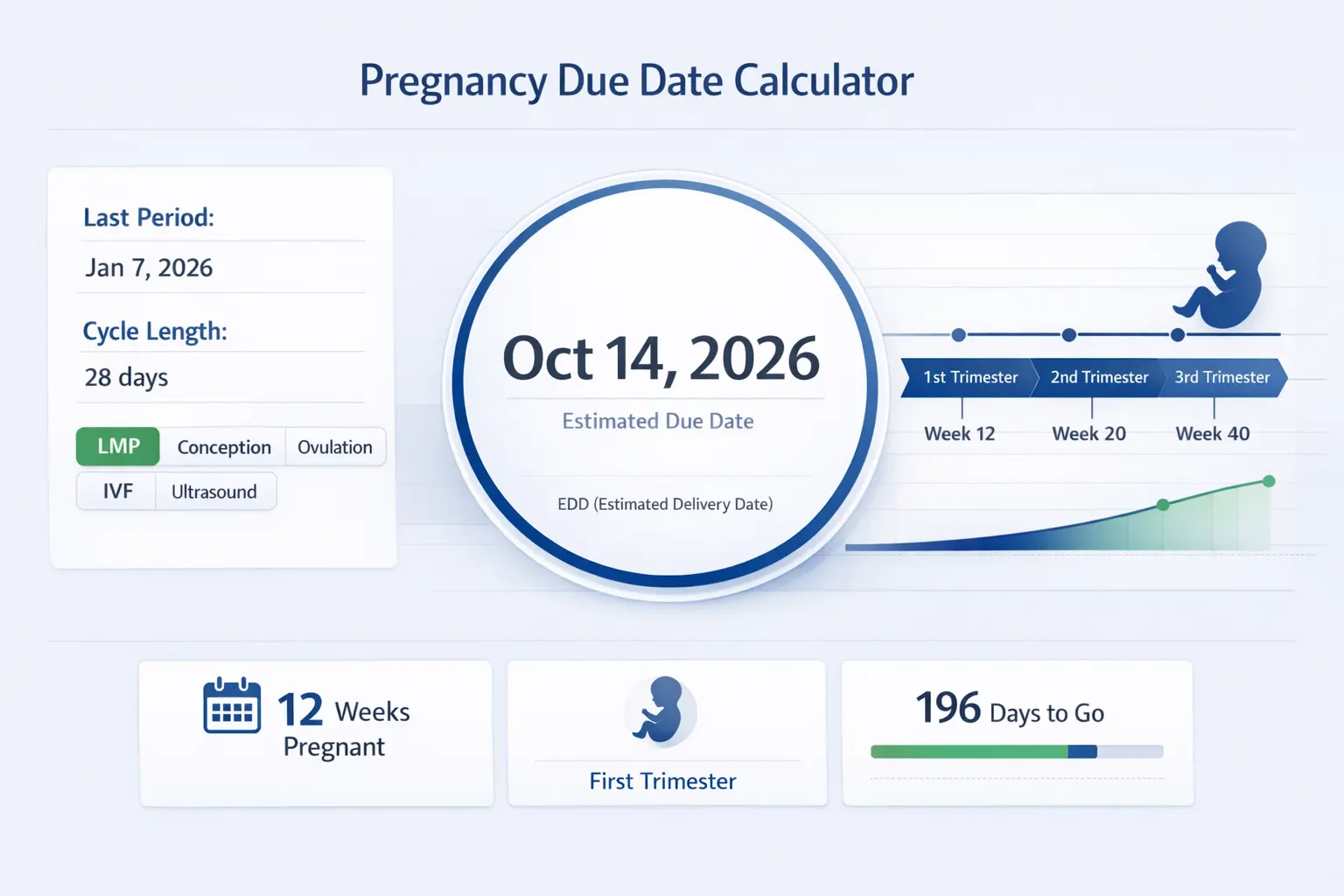
Quick example to understand your result
Let’s say you entered your last period as February 10, 2026 with a 28-day cycle.
Here is what your result may look like:
- Estimated due date: November 17, 2026
- Weeks pregnant today: 7 weeks 2 days
- Trimester: First trimester
- Estimated conception date: February 24, 2026
What this means
Your pregnancy timeline started from your last menstrual period. The calculator added 280 days to estimate your delivery date. Since your cycle is standard, no adjustment was needed. Your gestational age shows you are in early pregnancy.
Why this matters
This result helps you track your pregnancy week by week. It also helps you understand your current stage, plan doctor visits, and follow your baby’s development timeline with confidence.
What to do after getting your result
Once you see your pregnancy due date, focus on the next steps:
- Track your pregnancy week by week
- Schedule your first prenatal visit
- Follow your trimester milestones
- Monitor symptoms and changes
- Use your due date as a guide, not a fixed deadline
Your result gives you a clear starting point. Now you can follow your pregnancy with better clarity and confidence.
How to Use the Pregnancy Due Date Calculator
You can calculate your pregnancy due date in seconds. This tool works with multiple methods like last period, conception date, ovulation, IVF transfer, and ultrasound dating. Follow these steps to get your estimated due date, gestational age, and full pregnancy timeline.
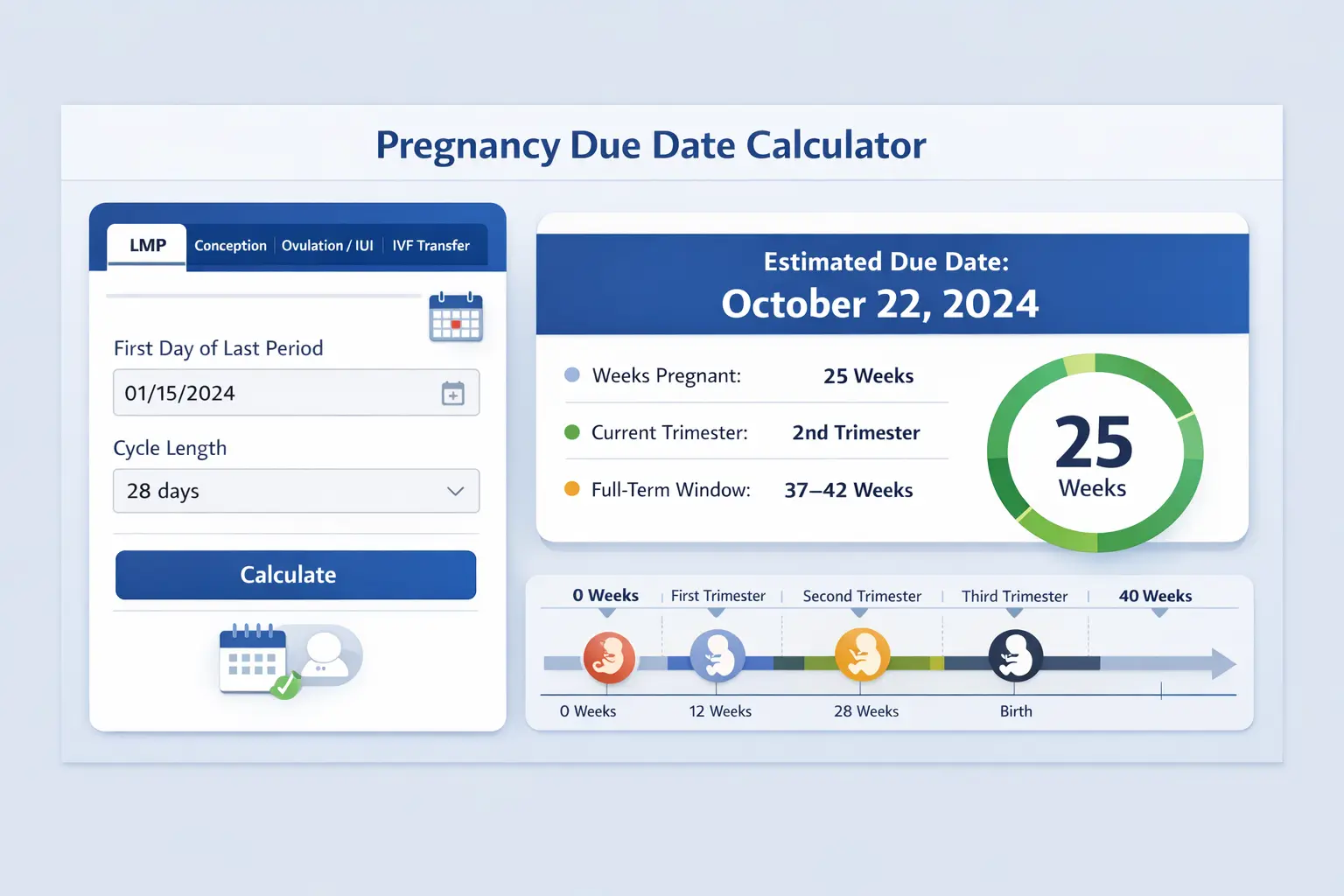
Choose your calculation method
Start by selecting the method that matches your situation. You can choose last menstrual period, conception date, ovulation or IUI, IVF transfer, or ultrasound dating. Pick the option based on the date you know with the most confidence.
Enter your pregnancy date
Now enter the required date for your selected method. This could be your last period, conception date, ovulation day, embryo transfer date, or ultrasound scan date. Make sure the date is correct because it directly affects your estimated due date.
Add cycle length or medical details if needed
Some methods need extra details. If you use last period, enter your average cycle length. If you choose IVF, select embryo age. For ultrasound, enter gestational weeks and days from your scan report. These details improve accuracy.
Click the calculate button
Once you enter your details, click the calculate button. The pregnancy due date calculator processes your data instantly. It applies medical formulas like Naegele’s rule or IVF dating adjustments to generate your result.
View your pregnancy due date and timeline
You will see your estimated due date, weeks pregnant, trimester stage, and pregnancy month. The tool also shows your conception estimate, full-term window, and key pregnancy milestones so you can track your progress week by week.
Example for testing
Try this example to understand how the tool works. Enter these values:
- Method: Last Period
- First day of last period: March 3, 2026
- Cycle length: 27 days
Result you will see:
- Estimated due date: December 8, 2026
- Weeks pregnant today: around 4 weeks
- Trimester: First trimester
- Estimated conception date: March 16, 2026
What this shows
The calculator adds 280 days to your last period and adjusts for your cycle length. Since your cycle is slightly shorter than average, ovulation happens earlier. This shifts your due date slightly forward.
Why this matters
This example shows how small changes in cycle length affect your pregnancy timeline. It helps you understand how your estimated due date and gestational age are calculated.
How the Pregnancy Due Date Calculator Formula Works (Complete Breakdown)
This pregnancy due date calculator uses standard medical formulas to estimate your expected delivery date. Each method starts from a different point such as last period, conception, ovulation, IVF transfer, or ultrasound dating. These formulas help calculate your gestational age and full pregnancy timeline with better accuracy.
How the last period formula calculates your due date
The most common method is based on your last menstrual period. Doctors use a standard rule called Naegele’s rule.
Formula:
EDD = LMP + 280 days
This formula assumes a 28-day cycle and ovulation around day 14. If your cycle is longer or shorter, the calculator adjusts the due date forward or backward. This is why entering the correct cycle length matters for an accurate pregnancy due date.
How the conception date formula works
					When you know the exact conception date, the calculation becomes more direct.

EDD = Conception date + 266 days
This method starts from fertilization instead of the last period. It removes cycle assumptions and gives a clearer estimate of your pregnancy timeline. It is often used when conception timing is known or tracked.
How ovulation or IUI dating is calculated
Ovulation marks the time when pregnancy can begin. This method works the same way as conception-based dating.
EDD = Ovulation or IUI date + 266 days
Since ovulation closely matches fertilization timing, this method gives a reliable due date estimate. It is useful for users who track ovulation with kits or fertility apps.
How IVF due date calculation works
IVF dating is more precise because embryo development is known.
EDD = Transfer date + (266 − embryo age)
A day 5 embryo means development started five days before transfer. The calculator subtracts those days from the total pregnancy length. This creates a more accurate IVF pregnancy due date and gestational timeline.
How ultrasound dating estimates your due date
Ultrasound dating uses fetal measurements instead of cycle data.
EDD = Ultrasound date + (280 − gestational age at scan)
The scan shows how far along the pregnancy is at that moment. The calculator uses that measurement to project the due date. This method is often used when the last period is unknown or cycles are irregular.
Example calculation to understand the formula
Let’s see how the pregnancy due date calculator works with a real example. This helps you understand how the estimated due date and gestational age are calculated. The calculation follows standard medical dating rules used in pregnancy tracking.
Given:
- Method: Last Period (LMP)
- First day of last period: April 2, 2026
- Cycle length: 29 days
Calculation:
					The calculator uses Naegele’s rule and adjusts for cycle length.

Step 1: Start with LMP date
April 2, 2026

Step 2: Add 280 days
Base due date = January 7, 2027

Step 3: Adjust for cycle length
Cycle difference = +1 day (29 instead of 28)

Final estimated due date = January 8, 2027
Result:
- Estimated due date: January 8, 2027
- Estimated conception date: April 17, 2026
- Gestational age today: around 3 weeks
- Trimester: First trimester
Meaning:
Your due date is based on your last menstrual period and adjusted for your cycle length. Since your cycle is slightly longer than average, ovulation likely happened later. This shifts your pregnancy timeline forward by one day.
Why this matters
This example shows how small changes in cycle length can affect your pregnancy due date. It helps you understand how gestational age, ovulation timing, and estimated delivery date are connected. This makes your result easier to trust and follow.
Pregnancy Weeks, Trimester Stages, and What They Mean
Result Benchmarks and Ranges
Your pregnancy weeks tell you more than just time. They show your current stage, baby development phase, and what to expect next. This quick reference helps you understand your gestational age, trimester, and how your pregnancy timeline progresses from early development to full-term delivery.
| Weeks | Stage | Development Phase | Medical Focus | What It Means |
|---|---|---|---|---|
| 1–12 | First Trimester | Early development | Initial scans and hormone changes | Baby organs begin forming. Pregnancy symptoms may be strong. |
| 13–26 | Second Trimester | Growth stage | Growth scans and movement tracking | Baby grows rapidly. Energy levels often improve. |
| 27–40 | Third Trimester | Final stage | Monitoring and delivery preparation | Baby gains weight and prepares for birth. |
Important: A full-term pregnancy usually falls between 37 and 42 weeks. Your due date is a guide, but your baby can arrive anytime within this window.
How to read your pregnancy stage from the result
Your calculator result shows your current week and trimester. This helps you understand your pregnancy stage without guessing. In the first trimester, pregnancy is still in early development. Hormones change quickly. Many people notice symptoms like fatigue or nausea.
During the second trimester, the baby grows fast. Energy levels often improve. You may also begin to feel movement for the first time. By the third trimester, the body prepares for delivery. Baby weight increases steadily. Movement shifts as the baby gets into position for birth.
Why pregnancy weeks matter more than the due date
Most people focus only on the due date. In medical practice, gestational age matters more.
Each pregnancy week helps track:
baby growth
test timing
ultrasound milestones
delivery readiness
For this reason, the calculator shows weeks pregnant along with your due date. This gives a clearer view of your pregnancy progress.
What is considered full-term pregnancy
A full-term pregnancy is not limited to one exact day. In most cases, birth happens between 37 and 42 weeks. This range is known as the full-term window. Birth before the exact due date can still be normal. Going slightly past the due date can also be normal. Because of this, the pregnancy due date calculator shows a range instead of a fixed expectation.
Quick answer for common question
A common question is, “How many weeks pregnant am I and what stage am I in?”
Your result already gives a clear answer. It shows gestational age and trimester together. This helps you understand your exact stage in the pregnancy timeline and what comes next.
Insights and Recommendations Based on Your Due Date Result
Your pregnancy due date calculator gives more than just a date. It helps you understand timing, accuracy, and next steps. These insights help you improve prediction, track your pregnancy timeline better, and make informed decisions based on your gestational age and method used.
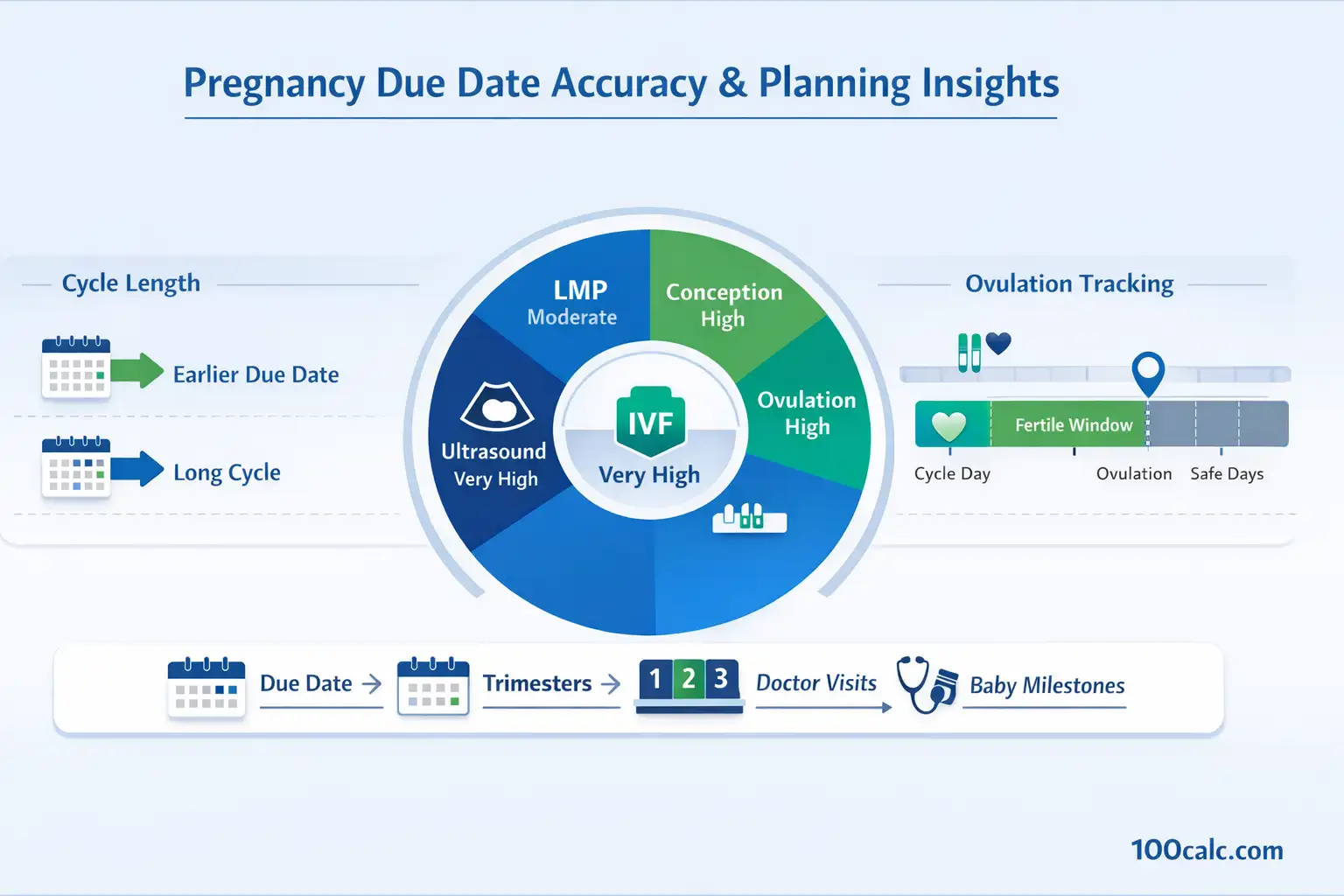
Use IVF or ultrasound for the most accurate due date
Some methods give a more precise pregnancy due date. IVF and ultrasound dating are the most reliable options. IVF works with known fertilization timing. Embryo age is already tracked. This removes guesswork from the calculation. Ultrasound uses real fetal measurements. Early scans measure crown-rump length to estimate gestational age. Doctors often adjust the due date using this method. If accuracy is your goal, these two methods give the strongest estimate.
Longer cycles can shift your due date forward
Cycle length plays an important role in pregnancy dating. Many calculators assume a 28-day cycle. However, not everyone follows this pattern. A longer cycle usually means ovulation happens later. This pushes your estimated conception date forward. As a result, your due date shifts later. Shorter cycles do the opposite. Ovulation happens earlier, so the due date moves slightly earlier. Entering the correct cycle length improves your pregnancy timeline and makes your result more realistic.
Do not rely on one method if your dates are uncertain
Sometimes your last period date may not be accurate. Cycles can vary. Ovulation can shift. In such cases, comparing multiple methods gives a better picture. Try entering ultrasound data or ovulation timing if available. Doctors often confirm the due date using early ultrasound. This helps refine your pregnancy timeline and avoid errors.
Tracking ovulation improves prediction accuracy
Ovulation is the key point when pregnancy begins. Tracking this timing gives a more accurate starting point than using only the last period. Many users rely on ovulation predictor kits or fertility apps. These tools help identify the fertile window more clearly. When ovulation timing is known, the pregnancy due date calculator can estimate your delivery date with better precision. This also improves your gestational age tracking and weekly progress.
Use your due date to plan your pregnancy timeline
Your estimated due date helps guide your entire pregnancy journey. It is not just a number. It sets the structure for your medical care and milestones. Use your result to plan your first prenatal visit. Follow your trimester schedule and track baby development week by week. Doctors use gestational age to schedule scans and tests. Staying aligned with your timeline helps you avoid delays and confusion.
You Might Also Find These Helpful
Pregnancy & Fertility 45
One Time Pregnancy Calculator estimates pregnancy odds from one encounter, plus fertile window timing, test date, due date, and 21-day testing guidance.
Try calculatorUse the AMH Calculator to convert ng/mL or pmol/L, compare your result with age-based data, and see what it may mean for IVF, fertility,…
Try calculatorUse the Baby Eye Color Calculator with parents, grandparents, or sibling context to compare Brown, Green/Hazel, and Blue/Grey model estimates instantly.
Try calculatorBasal Body Temperature Calculator checks reading conditions and analyzes your temperature pattern for a sustained shift that may be consistent with ovulation.
Try calculatorBPD gestational age calculator: estimate fetal age from BPD, compare your week, check normal BPD ranges, and understand ahead or behind results.
Try calculatorCalculate odds with the Chance of Twins Calculator. Enter maternal age and history. Find your probability instantly. See if you will conceive multiples now.
Try calculatorFind out exactly when you conceived. Our free Conception Calculator uses your Due Date, LMP, or Ultrasound to estimate your fertilization date and fertile…
Try calculatorUse our Conception Date Due Date Calculator to find your baby's arrival date. Enter your conception or intercourse date for clinical 40-week results.
Try calculatorContraceptive effectiveness calculator to compare birth control methods, typical vs perfect use, backup protection, and 5-year pregnancy risk.
Try calculatorUse this CRL calculator to estimate gestational age and due date from crown-rump length in mm or cm. Compare CRL, LMP, and IVF dating…
Try calculatorEstimate your monthly and 12-month pregnancy odds by age, partner age, and cycle dates. See your fertile window and when to seek fertility help.
Try calculatorUse this fundal height calculator to compare your cm measurement by week, check growth range, estimate baby weight, and know when to ask about…
Try calculatorSources and Methodology
This pregnancy due date calculator follows standard medical methods used in obstetrics. It combines clinical formulas with real pregnancy timing models to estimate your expected delivery date, gestational age, and full pregnancy timeline with consistent accuracy.
Naegele’s Rule in pregnancy dating
Naegele’s rule is the most widely used method to calculate due date. It adds 280 days to the first day of your last menstrual period. This forms the base of most pregnancy due date calculations.
The calculator also adjusts this rule using cycle length. This improves accuracy for users with shorter or longer cycles.
Conception and ovulation-based dating
Conception-based dating starts from the actual fertilization date. Ovulation-based dating uses the fertile window as the starting point. Both methods reduce assumptions linked to cycle patterns.
These approaches are commonly used in fertility tracking and provide a more direct estimate of gestational age.
IVF and assisted reproduction dating
IVF dating uses embryo transfer date and embryo age. This method is highly precise because fertilization timing is known.
Clinics use this method to track pregnancy progress and calculate the estimated delivery date with greater accuracy than standard LMP calculations.
Ultrasound and clinical measurement methods
Ultrasound dating uses fetal measurements such as crown-rump length to estimate gestational age. Early pregnancy scans provide the most reliable results.
Doctors often adjust the due date based on ultrasound findings. This helps align the pregnancy timeline with actual fetal development.
Medical data and guideline alignment
This calculator follows established pregnancy dating practices used in clinical settings. It aligns with widely accepted guidelines for gestational age tracking, trimester classification, and full-term pregnancy ranges.
The goal is to give you a result that reflects how pregnancy is measured in real medical care.
Common Mistakes When Using a Pregnancy Due Date Calculator
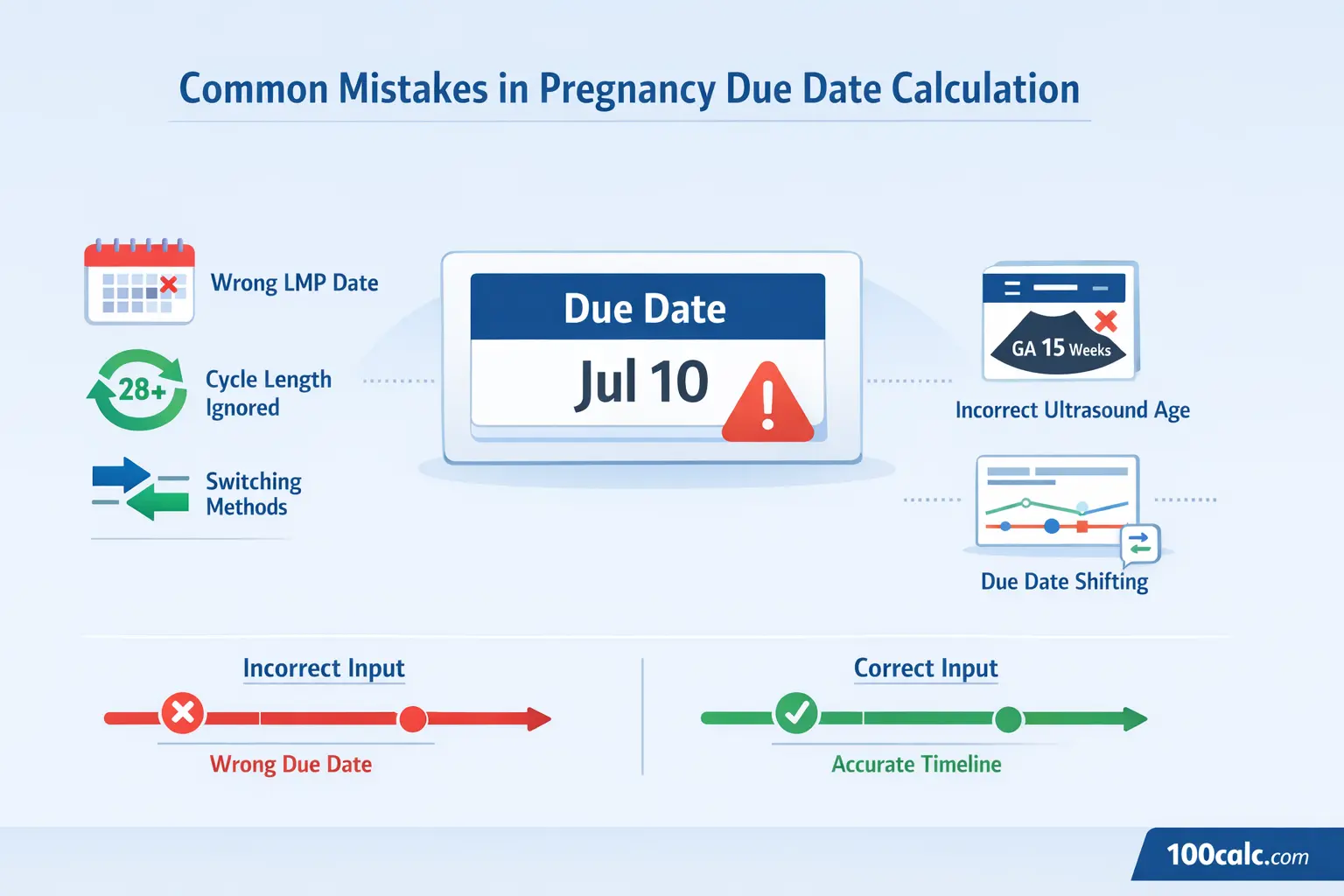
- Entering the wrong last menstrual period date. Even a small date error can shift your estimated due date and gestational age.
- Ignoring your cycle length. Using the default 28 days when your cycle differs can move your pregnancy timeline forward or backward.
- Mixing calculation methods. Switching between LMP, conception, ovulation, IVF, or ultrasound can change results and create confusion.
- Entering incorrect gestational age for ultrasound. Wrong weeks or days from a scan leads to an inaccurate due date estimate.
- Assuming the due date is exact. The estimated delivery date is a guide. Most births occur within the full-term window, not on one fixed day.
Frequently Asked Questions (FAQs)
What is the most accurate pregnancy due date calculator?
The most accurate pregnancy due date calculator uses IVF transfer date or early ultrasound data. These methods rely on known fertilization timing or measured fetal growth. They reduce guesswork and improve gestational age accuracy. LMP-based calculators are useful but depend on regular cycles. IVF and ultrasound are often used in clinics. They provide the most reliable estimated delivery date.
How is due date calculated in pregnancy?
A pregnancy due date is calculated by adding 280 days to the first day of your last menstrual period. This method is called Naegele’s rule. Other methods use conception date, ovulation timing, IVF transfer, or ultrasound measurements. Each method calculates gestational age differently. The pregnancy due date calculator adjusts based on your input.
Can due date change after ultrasound?
Yes, a due date can change after an ultrasound. Early scans measure fetal size to estimate gestational age more accurately. If the scan shows a difference from your last period calculation, doctors may adjust your due date. This is common in early pregnancy. Ultrasound dating is often more reliable than LMP.
How many weeks pregnant am I today?
Your weeks pregnant today depends on your gestational age. This is calculated from your last menstrual period or a confirmed conception date. A pregnancy due date calculator shows this instantly along with your trimester and timeline. Gestational age helps track baby growth and medical milestones week by week.
Is IVF due date more accurate than LMP?
Yes, IVF due date is more accurate than LMP. IVF uses a known embryo transfer date and embryo age. This removes uncertainty about ovulation timing. LMP assumes a standard cycle. IVF provides exact timing, which improves estimated due date accuracy and pregnancy tracking.
Why is my due date different from doctor?
Your due date may differ because doctors use ultrasound data instead of only your last period. They also consider cycle length, ovulation timing, and fetal measurements. Different methods can produce slightly different results. A pregnancy due date calculator shows estimates, while doctors refine them with clinical data.
How to calculate pregnancy month from weeks?
Pregnancy months are estimated from gestational weeks. Each month covers about four to five weeks. For example, 1 to 4 weeks is month one, while 9 to 13 weeks is month three. A pregnancy due date calculator often shows both weeks and months to make tracking easier.
Questions?
We had love to hear from you! Whether you are reporting an issue, suggesting a new calculator, or exploring collaboration opportunities — we are here to help. Every message helps us make 100calc smarter, faster, and more helpful for everyone.
Why People Trust 100calc
At 100calc.com, we focus on accuracy, speed, and trust. Every calculator we create is designed to give reliable, instant, and easy-to-understand results you can truly depend on.