
Miscarriage Risk Calculator by Week & Day
The Miscarriage Risk Calculator estimates remaining miscarriage risk from your current pregnancy week and day using published population data. It also shows separate evidence for maternal age, confirmed fetal cardiac activity (heartbeat), and previous miscarriage history.
Your result is a population-based reference, not a prediction of your individual pregnancy or your chance of live birth.
- Updated Sep 21, 2026
Miscarriage Risk Calculator
Estimate risk by week, day, age & heartbeat
See a population-based estimate for your current pregnancy stage, then view the same result as miscarriage risk or reassurance. Published age, heartbeat and pregnancy-history evidence is shown separately so the calculator does not pretend one study validates every factor together.
What this measures:
remaining miscarriage risk from your current stage until 20 weeks within the reference data used by the tool.
It is educational context, not a diagnosis or a prediction of your individual pregnancy.
Your result
Your miscarriage risk estimate
—
miscarriage risk
Miscarriage risk
Not miscarrying in the model window
—
—
—
—
How age changes the context
Heartbeat & pregnancy history
Week-by-week view
Reference values over the next weeks
The trend stays within the same evidence layer as your displayed result. It does not switch between unrelated study populations.
| Stage | Risk reference | Reassurance view |
|---|
Important:
this calculator deliberately keeps different evidence layers separate. The stage curve is derived by 100Calc from
published week-specific miscarriage probabilities and estimates risk remaining before 20 weeks. Maternal-age data,
the heartbeat cohort and miscarriage-history associations come from different study populations. They are not multiplied
together and should not be read as a validated individualized prediction.
Result ready
View your miscarriage risk estimate
What Your Miscarriage Risk Result Means
Your result is a population-based miscarriage risk reference for the pregnancy stage and evidence available in the calculator. It does not predict exactly what will happen in your pregnancy. The percentage should be read as statistical context, not as a diagnosis or a guarantee of outcome.
Risk and Reassurance Are Two Views of the Same Estimate
The calculator lets you view the same result in two ways: Risk and Reassurance. If the miscarriage risk reference is 10%, the reassurance view is 90%, which is simply 100% minus the same risk estimate. It does not represent a 90% chance of live birth, a healthy baby, or a guaranteed pregnancy outcome.
What “1 in X” Means
The displayed percentage is the miscarriage probability reference. The calculator can also show the same result as approximate miscarriage odds in a “1 in X” format. For example, a 12.5% risk is mathematically equivalent to about 1 in 8. This is only another way to express the same statistical reference; it does not mean exactly one out of every eight pregnancies with the same details will miscarry.

Example: 8 weeks with a confirmed heartbeat
Suppose you are 28 years old, 8 weeks pregnant, and fetal cardiac activity has been confirmed on ultrasound.
In a prospective study of asymptomatic singleton pregnancies with confirmed fetal cardiac activity, the observed subsequent miscarriage risk at completed week 8 was 1.5%. The calculator can therefore use that study as the leading heartbeat reference for this example.
The reassurance view would be 98.5%, which is simply the mathematical complement of the same 1.5% miscarriage reference. It does not mean a 98.5% chance of live birth or guarantee the outcome of an individual pregnancy.
Maternal age is shown separately. In the Magnus et al. registry, women aged 25–29 had an overall miscarriage rate of about 9.7%, but that age-group figure is not multiplied by the week-8 heartbeat estimate.
Explore More Calculators
Chinese Gender Calculator Featured
Use the Chinese Gender Calculator for a traditional boy-or-girl prediction from lunar age and conception month. Enter conception date, due date, or LMP.
Try calculatorFetal Growth Calculator Featured
Use this fetal growth calculator to check baby weight percentile from ultrasound data in grams, kg, or cm and see what the result means…
Try calculatorMean Sac Diameter Calculator Featured
Enter gestational sac measurements in mm or cm to calculate mean sac diameter, estimate early gestational age, compare week-by-week milestones, and see when follow-up…
Try calculatorMissed Pill Calculator Featured
Missed a birth control pill? Check pregnancy risk, protection status, backup contraception needs, and what to do next with our missed pill calculator.
Try calculatorPregnancy Chance Calculator Featured
Use our Pregnancy Chance Calculator to estimate your odds. Enter your cycle day, age, and method. Find out if you are in the high-risk…
Try calculatorPregnancy Due Date Calculator Featured
Use our pregnancy due date calculator to find your exact Baby Due date. IVF, conception, ovulation, and ultrasound methods with weeks and timeline.
Try calculatorHow to Use the Miscarriage Risk Calculator
The calculator uses a short three-step flow. Enter your pregnancy stage and age, then add ultrasound and pregnancy-history details to see the most relevant risk reference and context.
Enter Your Pregnancy Stage
Select your current pregnancy week and day. The calculator uses gestational stage as the main reference for the week-by-week risk view.
Enter Your Maternal Age
Enter your age at conception. Maternal age is shown as a separate evidence layer because miscarriage rates differ across age groups.
Add Ultrasound & Pregnancy History
Tell the calculator whether fetal cardiac activity has been confirmed and whether you have had previous miscarriages. These details help show the most relevant published context.
Review Your Risk or Reassurance View
Your result shows the same reference as miscarriage risk or reassurance. The reassurance view is the complement of the same model result, not a live-birth prediction.
Check the Week-by-Week Trend
Use the result table and chart to see how the same evidence layer as your displayed result changes across the next available weeks. These values are population references, not a forecast of your individual pregnancy.
Advertisement
Advertisement
How the Miscarriage Risk Calculator Formula Works
The Miscarriage Risk Calculator uses published week-specific miscarriage probabilities to estimate the risk remaining from your current pregnancy stage until 20 weeks. 100Calc derives the weekly stage references from those probabilities, then estimates extra days between adjacent week values. When directly applicable post-heartbeat data is available, that separate evidence becomes the displayed reference. Maternal age and previous miscarriage history remain separate context rather than risk multipliers.
The Formula Used by This Calculator
					Stage Reference at Week W =
[1 - (1 - P(W)) × (1 - P(W+1)) × ... × (1 - P(19))] × 100

Stage Risk =
Stage Reference(W)
+ (Day / 7) × [Stage Reference(W+1) - Stage Reference(W)]

Heartbeat Risk =
Interpolate between adjacent post-heartbeat week references when both are available

Displayed Risk =
Heartbeat Risk when applicable; otherwise Stage Risk

Reassurance =
100% - Displayed Risk

Approximate Odds =
1 in round(100 / Displayed Risk)
For the stage-based result, P(W) is the published probability of miscarriage during a particular gestational week. 100Calc combines the probabilities from the selected week through Week 19 to estimate how much miscarriage risk remains before the 20-week endpoint.
Extra pregnancy days are then estimated between adjacent weekly stage references. If fetal cardiac activity has been confirmed and an applicable post-heartbeat reference exists, that evidence becomes the displayed result instead. Maternal age and previous miscarriage history are not multiplied into either percentage.
What Each Part of the Formula Means
Pregnancy Week
Pregnancy week selects where the remaining-risk calculation begins. The calculator accepts 4 weeks 0 days through 19 weeks 6 days and estimates miscarriage risk remaining before 20 weeks. The stage curve is derived by 100Calc from published week-specific miscarriage probabilities rather than copied from the study’s separate remaining-probability column.
Pregnancy Day
Pregnancy day means the extra days after a completed week, from 0 to 6. The calculator estimates that point between two adjacent 100Calc-derived weekly stage references. A day-level result is an interpolation for display, not a miscarriage probability measured separately for that exact day.
Stage Reference and Next Week Reference
Stage Reference is the miscarriage risk remaining before 20 weeks from the selected completed week. Next Week Reference is the same calculation beginning one week later. Both are derived from the published week-specific probabilities; neither represents the probability of miscarrying during that single week.
Confirmed Heartbeat
A confirmed heartbeat means fetal cardiac activity has been seen on ultrasound. The calculator does not reduce risk with a fixed heartbeat multiplier. For completed weeks where published post-heartbeat data is available, it uses that evidence as the more relevant reference for the displayed result.
Maternal Age
Maternal age provides a separate comparison with miscarriage rates reported across age groups. It does not multiply the week-based result. Keeping age separate prevents an overall age-group rate from being treated as if it were a week-specific personal probability.
Previous Miscarriage History
Previous miscarriages provide another evidence layer. Research shows that prior losses are associated with the chance of another miscarriage, but the published association is not the same as an absolute personal percentage. The calculator therefore shows this history as context instead of applying an automatic risk multiplier.
Reassurance
Reassurance is the mathematical complement of the displayed miscarriage risk. A 12% risk reference produces an 88% reassurance view because 100 minus 12 equals 88. It expresses the same estimate from the opposite direction and is not a separate prediction of live birth.
Approximate “1 in X” Odds
The calculator can also express the risk as an approximate “1 in X” figure. It divides 100 by the displayed percentage and rounds the result to a whole number. This changes only how the estimate is presented. It does not create a different risk calculation.
Example Calculation: 7 Weeks and 3 Days
Here is a simple example using the week-and-day formula. No heartbeat reference is applied in this example, so the calculation uses the stage-based values only.
Given:
- Pregnancy Week = 7
- Pregnancy Day = 3
- Week 7 Stage Reference = 11.64%
- Week 8 Stage Reference = 11.02%
Calculation:
					Stage Risk =
11.64 + (3 / 7) × (11.02 - 11.64)

Stage Risk ≈ 11.37%

Displayed Risk ≈ 11.4%

Reassurance =
100 - 11.4 = 88.6%

Approximate Odds =
1 in 9
Result:
- Miscarriage risk reference: about 11.4%
- Reassurance view: about 88.6%
- Approximate odds: about 1 in 9
Meaning:
The extra three days place the result between 100Calc’s derived Week 7 and Week 8 stage references. Those references estimate miscarriage risk remaining before 20 weeks from published week-specific probabilities. The calculator rounds the displayed result to 11.4%. Maternal age and previous miscarriage history remain separate context rather than changing this percentage through a multiplier.
Research Behind the Calculator
The stage-based curve is calculated by 100Calc from the week-specific miscarriage probabilities reported by Dellicour et al. for gestational weeks 4 through 19. These values are combined to estimate the miscarriage risk remaining before the calculator’s 20-week endpoint. Post-heartbeat references come from Tong et al., while maternal-age and previous-miscarriage context comes from Magnus et al.
These studies used different populations and methods. Their values are kept separate where combining them would require assumptions not validated by the original research.
Dellicour et al., BMJ Open, 2016
Weekly miscarriage rates in a community-based prospective cohort study
Tong et al., Obstetrics & Gynecology, 2008
Miscarriage risk for asymptomatic women after a normal first-trimester prenatal visit
Magnus et al., BMJ, 2019
Role of maternal age and pregnancy history in risk of miscarriage
Population note: The underlying weekly data was measured in a prospective cohort in rural western Kenya. It should be treated as a population reference, not a universal miscarriage rate for every country or individual pregnancy.
Country terminology note: This calculator estimates pregnancy loss before 20 weeks. U.S., Canadian and Australian guidance commonly uses a 20-week boundary for miscarriage, while NHS guidance in the UK defines miscarriage as pregnancy loss before 24 weeks. If you are in the UK and are 20 to 23 weeks + 6 days pregnant, this calculator does not estimate that period.
Miscarriage Risk by Week: Week-by-Week Chart
Miscarriage risk generally becomes lower as pregnancy advances. The chart below shows the 100Calc stage references for completed weeks 4 through 19, estimating the miscarriage risk remaining before the 20-week model endpoint. These values are derived from published week-specific probabilities and provide population-level context rather than an individual prediction.
| Pregnancy Week | Remaining Miscarriage Risk | Reassurance View |
|---|---|---|
| Week 4 | 17.7% | 82.3% |
| Week 5 | 15.2% | 84.8% |
| Week 6 | 13.9% | 86.1% |
| Week 7 | 11.6% | 88.4% |
| Week 8 | 11% | 89% |
| Week 9 | 10.2% | 89.8% |
| Week 10 | 8.8% | 91.2% |
| Week 11 | 7.5% | 92.5% |
| Week 12 | 6.3% | 93.7% |
| Week 13 | 4.2% | 95.8% |
| Week 14 | 3.7% | 96.3% |
| Week 15 | 3.2% | 96.8% |
| Week 16 | 1.9% | 98.1% |
| Week 17 | 1.6% | 98.4% |
| Week 18 | 0.9% | 99.1% |
| Week 19 | 0.3% | 99.7% |
How these values are calculated: 100Calc derives each stage reference from the week-specific miscarriage probabilities reported in the source study, combining the remaining weeks through Week 19 to estimate miscarriage risk before the 20-week endpoint. Week 20 is the model endpoint, so it is not shown as another input week.
How to read the chart: The reassurance view is 100% minus the remaining miscarriage-risk reference. It describes the opposite side of the same estimate and is not a live-birth probability.
Advertisement
How Heartbeat, Previous Miscarriages & Age Affect Miscarriage Risk
Miscarriage risk is not determined by pregnancy week alone. Confirmed fetal cardiac activity, maternal age, and previous pregnancy losses can provide additional context. The studies below show how these factors were associated with miscarriage in specific populations, rather than treating them as fixed multipliers for every pregnancy.
Miscarriage Risk After a Heartbeat Is Detected
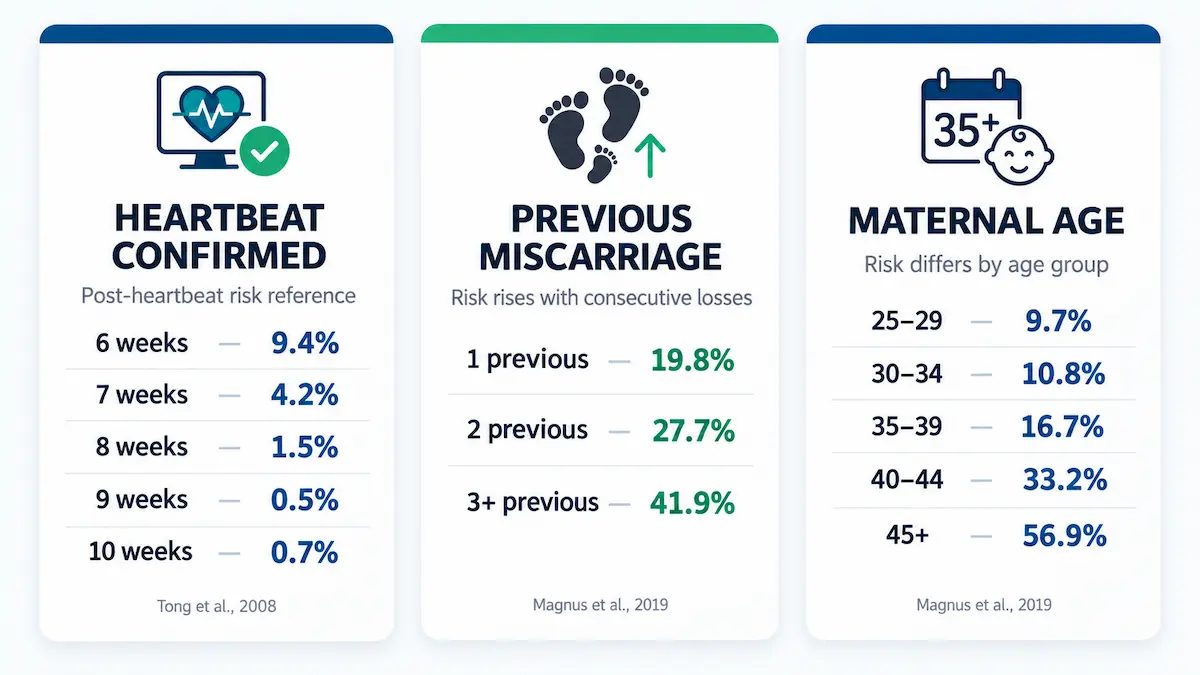
Confirmed fetal cardiac activity can provide useful information about miscarriage risk in early pregnancy. In a prospective study of 697 asymptomatic women with singleton pregnancies and a heartbeat seen on ultrasound, subsequent miscarriage risk was 9.4% at 6 completed weeks, 4.2% at 7 weeks, 1.5% at 8 weeks, 0.5% at 9 weeks, and 0.7% at 10 weeks.
These percentages describe that specific study population. A detected heartbeat is an encouraging ultrasound finding, but it does not guarantee the outcome of an individual pregnancy.
How Previous Miscarriages Affect Future Risk
A previous miscarriage is associated with a higher risk of miscarriage in a later pregnancy, but the increase is not the same for every person. In the Norwegian registry study, miscarriage occurred in 19.8% of pregnancies after one previous consecutive miscarriage, 27.7% after two, and 41.9% after three or more within the study’s recurrence analysis.
After adjustment for maternal age, the odds of another miscarriage also increased as the number of consecutive previous losses increased. These population findings provide context, not an individual prediction.
Source: Magnus et al., BMJ, 2019
How Maternal Age Affects Miscarriage Risk
Maternal age is strongly associated with miscarriage risk, but the pattern is not a simple straight-line increase. In the Norwegian study, miscarriage occurred in 9.7% of pregnancies at ages 25–29, 10.8% at 30–34, 16.7% at 35–39, 33.2% at 40–44, and 56.9% at age 45 or older when induced abortions were excluded from the denominator.
These are overall age-group rates across the study population. They are not week-specific probabilities and should not be applied as a multiplier to an individual pregnancy result.
Source: Magnus et al., BMJ, 2019
You Might Also Find These Helpful
Pregnancy & Fertility 45
Pregnancy Risk Calculator Featured
Use this Pregnancy Risk Calculator to check age, BMI, health history, bleeding, and twins. See if closer prenatal monitoring may be worth asking about.
Try calculatorOne Time Pregnancy Calculator
One Time Pregnancy Calculator estimates pregnancy odds from one encounter, plus fertile window timing, test date, due date, and 21-day testing guidance.
Try calculatorAMH Calculator
Use the AMH Calculator to convert ng/mL or pmol/L, compare your result with age-based data, and see what it may mean for IVF, fertility,…
Try calculatorBaby Eye Color Calculator
Use the Baby Eye Color Calculator with parents, grandparents, or sibling context to compare Brown, Green/Hazel, and Blue/Grey model estimates instantly.
Try calculatorBasal Body Temperature Calculator
Basal Body Temperature Calculator checks reading conditions and analyzes your temperature pattern for a sustained shift that may be consistent with ovulation.
Try calculatorBPD Gestational Age Calculator
BPD gestational age calculator: estimate fetal age from BPD, compare your week, check normal BPD ranges, and understand ahead or behind results.
Try calculatorChance of Twins Calculator
Calculate odds with the Chance of Twins Calculator. Enter maternal age and history. Find your probability instantly. See if you will conceive multiples now.
Try calculatorConception Calculator
Find out exactly when you conceived. Our free Conception Calculator uses your Due Date, LMP, or Ultrasound to estimate your fertilization date and fertile…
Try calculatorConception Date Due Date Calculator
Use our Conception Date Due Date Calculator to find your baby's arrival date. Enter your conception or intercourse date for clinical 40-week results.
Try calculatorContraceptive Effectiveness Calculator
Contraceptive effectiveness calculator to compare birth control methods, typical vs perfect use, backup protection, and 5-year pregnancy risk.
Try calculatorCRL Calculator
Use this CRL calculator to estimate gestational age and due date from crown-rump length in mm or cm. Compare CRL, LMP, and IVF dating…
Try calculatorFertility Calculator by Age
Estimate your monthly and 12-month pregnancy odds by age, partner age, and cycle dates. See your fertile window and when to seek fertility help.
Try calculatorCommon Mistakes When Using a Miscarriage Risk Calculator
Small input or interpretation errors can make a population estimate seem more precise or personal than it is. Keep these points in mind when using the calculator.
- Treating the Result as a Diagnosis: A miscarriage risk percentage cannot confirm or rule out a pregnancy loss. It describes risk in a study population. If you have symptoms or concerns about your pregnancy, the calculator result should not replace an ultrasound, hCG testing, or assessment by a healthcare professional.
- Treating a Day-Level Estimate as an Exact Measurement: Most of the underlying stage data is reported by completed pregnancy week, not by every individual day. When you enter extra days, the calculator estimates the point between adjacent weekly values. Small day-to-day differences should not be read as separately measured clinical risks.
- Combining Separate Risk Factors Yourself: Do not multiply the displayed risk by the maternal-age rate, previous-miscarriage figures, or another percentage shown on this page. Those values come from different analyses and populations. They provide useful context, but combining them manually would create a new risk estimate that the original studies did not validate.
Advertisement
Miscarriage Risk Calculator FAQs
What week has the highest risk of miscarriage?
Miscarriage risk is generally highest in the earliest weeks of recognized pregnancy and decreases as gestation advances. There is no single week that is the universal “highest-risk week” for every pregnancy. Many very early losses happen before a pregnancy is clinically recognized. ACOG reports that about 80% of early pregnancy losses occur during the first trimester.
When can I stop worrying about miscarriage?
There is no pregnancy week when miscarriage risk becomes zero. Statistically, the risk becomes lower as pregnancy advances, and most early pregnancy losses occur in the first trimester. A reassuring ultrasound can provide additional context, but no week or scan can guarantee the outcome of an individual pregnancy.
Can this calculator estimate miscarriage risk for IVF, twins, PCOS or hCG results?
This calculator does not adjust the displayed percentage for IVF treatment, twins, PCOS, serial hCG results, bleeding or pain. These factors may change how pregnancy risk is assessed and can require ultrasound findings, laboratory trends or individual medical history. Use the calculator as general population context and discuss situation-specific factors with your healthcare professional.
What is the miscarriage risk after a heartbeat is detected?
In a prospective study of asymptomatic singleton pregnancies with confirmed fetal cardiac activity, subsequent miscarriage risk was 9.4% at 6 completed weeks, 4.2% at 7 weeks, 1.5% at 8 weeks, 0.5% at 9 weeks, and 0.7% at 10 weeks. These figures apply to that study population and are not personal predictions.
How does maternal age affect miscarriage risk?
Miscarriage risk varies with maternal age. In the Norwegian registry study, the rate was lowest around ages 25–29 and rose more sharply at older ages. Using the denominator that excludes induced abortions, the study reported 9.7% at ages 25–29, 16.7% at 35–39, 33.2% at 40–44, and 56.9% at age 45 or older.
Does a previous miscarriage increase the risk of another miscarriage?
Yes, previous miscarriage is associated with a higher population-level risk of another miscarriage, but one prior loss does not mean another loss will occur. In the Norwegian study, the age-adjusted odds of miscarriage were 1.54 times higher after one previous miscarriage and increased further after consecutive losses. An odds ratio is not the same as an individual probability.
What causes most early miscarriages?
Chromosomal abnormalities are a major cause of early pregnancy loss. ACOG estimates that about half of early pregnancy losses occur because the embryo has an abnormal number of chromosomes. Other medical and pregnancy-related factors can also contribute, so the cause of an individual miscarriage cannot usually be determined from a risk calculator alone.
Can a miscarriage risk calculator tell if I am having a miscarriage?
No. A miscarriage risk calculator estimates population-level risk; it cannot diagnose pregnancy loss or confirm whether a pregnancy is developing normally. Diagnosis may require clinical assessment, ultrasound, and sometimes serial beta-hCG testing. Bleeding or cramping can occur with miscarriage, but these symptoms can also occur in other pregnancy situations.
Questions?
We had love to hear from you! Whether you are reporting an issue, suggesting a new calculator, or exploring collaboration opportunities — we are here to help. Every message helps us make 100calc smarter, faster, and more helpful for everyone.
Why People Trust 100calc
At 100calc.com, we focus on accuracy, speed, and trust. 100Calc shows the data sources, calculation logic and limits behind this calculator so you can see what the result represents. Health calculators are informational and do not replace diagnosis or medical care.