
Miscarriage Risk Calculator
The Miscarriage Risk Calculator estimates your probability of pregnancy loss. It uses your specific maternal age and pregnancy week. Most pregnancies progress safely. However, seeing the data often brings comfort. Our tool calculates your “Chance of Continuing” instantly. It helps you focus on the positive numbers.
You might feel anxious about symptoms. Perhaps you simply want reassurance. Statistics prove that risk drops fast after week eight. Detecting a heartbeat further reduces the risk. Enter your details to get your personal assessment. The results help you track your progress week by week.
- Updated Jun 13, 2026
Miscarriage Risk Calculator: Week-by-Week Data
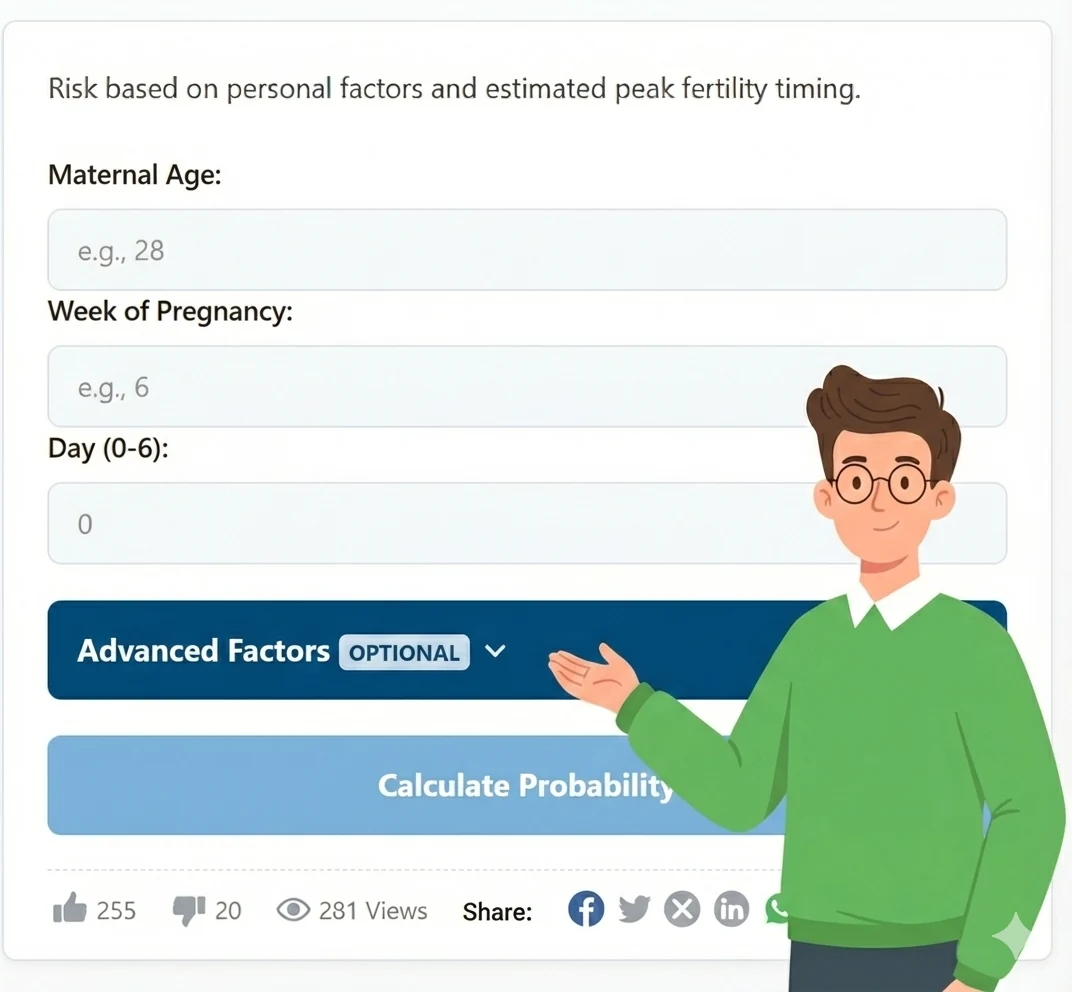
How to Enter Your Details You must enter accurate data to get a correct estimate. Follow these simple steps. (Maternal Age, Pregnancy Stage (Week & Day), Advanced Factors (Optional), Ultrasound Status)
MISCARRIAGE RISK
CHANCE OF CONTINUING
--
Your Input Details:
- Age: --
- Stage: --
- History: --
- Ultrasound: --
- BMI Factor: --
*Statistics based on Nybo Andersen et al. & Magnussen et al. epidemiological studies. Not medical advice.
What Your Attendance Result Means
You must understand that these numbers are statistics. They come from large population studies. They are averages. They do not predict your specific pregnancy outcome. Most pregnancies fall on the “success” side of the probability.
Focus on the Positive Number
Our calculator highlights the “Chance of Continuing.” This is the green number on your screen. It represents the probability of a live birth. For example, a 10 percent risk might sound scary. However, it also means you have a 90 percent chance of meeting your baby. We encourage you to focus on that higher number.
The "1 in X" Rule
Percentages can sometimes feel abstract. We convert that number into a simple fraction for you. Seeing “1 in 8” is often easier to understand than “12.5%”. It helps you visualize the real risk. Imagine a room with 8 people. In this scenario, 7 of them will likely have a successful pregnancy. Only 1 faces a statistical risk.
Quick example to check the math
Say you are 28 years old. You are in Week 8 of your pregnancy. You confirmed a heartbeat on the ultrasound.
- The base risk for Week 8 is roughly 5%.
- The heartbeat reduces that risk significantly.
- The calculation is roughly: 5% × 0.2 (Heartbeat Factor) = 1%.
Your final risk is 1%. The heartbeat lowered your risk from Moderate (5%) to Very Low (1%). This means your Chance of Continuing is 99%.
Now, enter your own numbers and check your result.
Explore More Calculators
Use this fetal growth calculator to check baby weight percentile from ultrasound data in grams, kg, or cm and see what the result means…
Try calculatorEnter gestational sac measurements in mm or cm to calculate mean sac diameter, estimate early gestational age, compare week-by-week milestones, and see when follow-up…
Try calculatorMissed a birth control pill? Check pregnancy risk, protection status, backup contraception needs, and what to do next with our missed pill calculator.
Try calculatorUse our Pregnancy Chance Calculator to estimate your odds. Enter your cycle day, age, and method. Find out if you are in the high-risk…
Try calculatorUse our pregnancy due date calculator to find your exact Baby Due date. IVF, conception, ovulation, and ultrasound methods with weeks and timeline.
Try calculatorUse this Pregnancy Risk Calculator to check age, BMI, health history, bleeding, and twins. See if closer prenatal monitoring may be worth asking about.
Try calculatorHow to Use the Attendance Calculator
Checking your probability takes only a few seconds. Follow these five steps to get an accurate result.
Enter Maternal Age
Type your age at the time of conception. Age is a primary factor. Chromosomal changes often increase the risk as you grow older.
Set Your Pregnancy Stage
Select your current pregnancy week. You can also add the exact day. The statistical risk drops significantly with every passing week.
Add Advanced Factors
Click the toggle button to see more options. You can add your previous history here. You can also enter your height and weight. These details help refine the math.
Select Ultrasound Status
Mark "Yes" if a doctor detected a heartbeat. Seeing a heartbeat is a vital milestone. It lowers the calculated risk more than any other factor.
Click the Calculate Button
Press the button to process your data. The tool runs the formula instantly. You can read your probability score and the professional note below.
Example for testing
Try these sample numbers:
Maternal Age: 28
Pregnancy Week: 8
Ultrasound Status: Heartbeat Detected (Yes)
Result → Your estimated risk is 1.0%. The calculator shows that the heartbeat lowered the risk significantly. Without the heartbeat, the risk at Week 8 would be 5%. The positive ultrasound dropped the score to 1.0%.
Now, enter your own numbers and check your result.
How the Attendance Calculator Formula Works (Complete Breakdown)
Understanding your pregnancy stats helps you reduce anxiety. This formula gives you a clear picture of the data. It uses real medical statistics to estimate your probability. The logic combines the “Nebo Andersen” population study with clinical health multipliers. It is accurate and practical for expecting parents.
Miscarriage Probability Formula
The miscarriage percentage shows your statistical chance of pregnancy loss. It compares your current week to your age. The formula is complex but effective.
Formula:
Total Risk = (Base Week Risk x Age Factor x Heartbeat Bonus x Health Factors) x 100
The formula starts with the average risk of your specific pregnancy week. It multiplies that number by your age modifier. Then it applies a massive bonus if a heartbeat is detected. Finally, we multiply by 100 to get a percentage.
Example:
					If the base risk for Week 8 is 0.05 (5%), and you found a heartbeat.
(0.05 x 0.2) x 100 = 1%
Your miscarriage risk drops to 1%. That means you have a 99% chance of a successful pregnancy.
Micro Note:
The risk drops every single day. Week 8 Day 0 has a slightly higher risk than Week 8 Day 6. Our calculator “smooths” the data between weeks to give you the most precise daily estimate possible.
Key Inputs Used in the Miscarriage Risk Calculator
Every calculation depends on simple inputs. These inputs help us measure your personal risk profile. Enter real numbers to get accurate results instantly. Doctors use these same factors to monitor pregnancy health.
Pregnancy Week (Base Risk)
Your week sets the baseline risk. It counts from the start of your last period. Risk is naturally highest in the very early weeks. For example, Week 4 has a base risk of roughly 24%. However, this drops rapidly. By Week 12, the base risk falls below 2% for most women. Time is your biggest ally.
Maternal Age
Age plays a major role in chromosomal stability. Women under 30 have the lowest statistical risk. The calculator uses an age multiplier to adjust the final score. It increases the probability slightly for women over 35. It increases it more significantly for women over 40. This ensures the result matches biological reality regarding egg quality.
Ultrasound Status (The Heartbeat)
This input defines your viability level. Detecting a heartbeat is the most important milestone. Selecting “Yes” reduces the calculated risk by roughly 80%. Our formula applies a 0.2x multiplier here. Even if other factors are high, a heartbeat drastically improves the outlook.
Health History & BMI
We use these optional inputs to fine-tune the score. Previous losses can slightly increase the statistical risk factor. Extreme weights can also impact hormonal support. The calculator adjusts for BMI (Underweight or Obese) and reproductive history to give a complete picture.
Another Example Calculation (Step-by-Step)
Let’s see how the calculator works using a real example. This will help you understand how each number affects your final percentage. The calculation follows the same statistical logic used by doctors worldwide.
Given:
- Maternal Age: 41 (Factor 2.4)
- Pregnancy Week: 6 (Base Risk 14%)
- Ultrasound Status: No Heartbeat Yet (Factor 1.0)
Calculation:
					(14% Base Risk x 2.4 Age Factor) = 33.6%

Your calculated risk is 33.6%. The age factor significantly increased the baseline risk.
Result:
- Miscarriage Risk: 33.6%
- Chance of Continuing: 66.4%
- Status: Elevated Risk
Meaning:
Age plays a major role here. The base risk for Week 6 is only 14%. However, the age multiplier raised it to 33.6%. The good news is that the majority of outcomes (66.4%) are still healthy pregnancies. Seeing a heartbeat in the coming weeks would drastically reduce this risk.
Result Benchmarks and Ranges
Your risk percentage is not just a number. It helps you understand where you stand. It shows how your pregnancy compares to general medical data. Doctors use these timelines to track safety milestones. Every week brings a lower risk. Here is a quick breakdown to help you evaluate your score.
| Week Range | Average Risk | Chance of Success |
|---|---|---|
| Weeks 3–5 | 20% – 30% |
70% – 80%
Chemical pregnancy risk. |
| Weeks 6–9 | 5% – 15% |
85% – 95%
The risk drops fast. |
| Weeks 10–13 | 2% – 5% |
95% – 98%
End of 1st Trimester. |
| Weeks 14+ | < 1% |
> 99%
Welcome to the Second Trimester. |
Note: Statistics vary by age. Detecting a heartbeat always improves these odds significantly.
Interpretation
A risk below 5 percent is the goal for most weeks. However, higher risks are normal in the very early stages. Week 4 always starts with a higher number. This simply means the pregnancy is still establishing itself. Seeing a heartbeat is the turning point. It confirms the pregnancy is viable and strong.
Pro Tip:
Focus on your daily health habits. Take your folic acid every morning. Schedule an early ultrasound scan to check for a heartbeat. These small actions help you feel more in control of the journey. They also ensure you are doing everything possible for a healthy outcome.
Tips & Planning Based on Your Result
The numbers provide a snapshot of the data. However, you should keep these three important facts in mind.
The Heartbeat Milestone
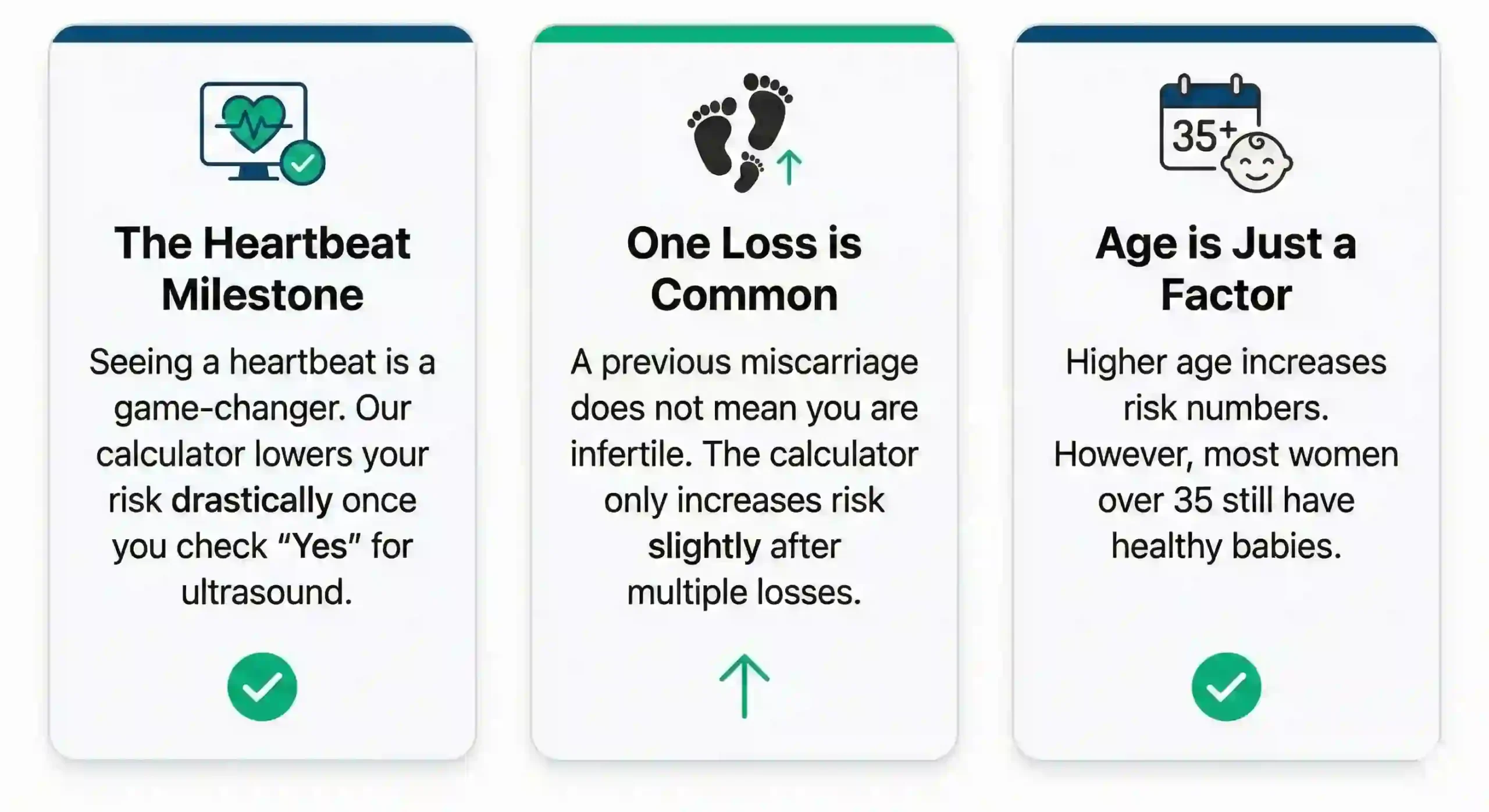
Detecting a heartbeat changes everything. It is a major safety milestone. Our calculator significantly lowers your risk score. This happens the moment you select “Yes” for the ultrasound option. A strong heartbeat confirms the pregnancy is viable.
One Loss is Common
Many women experience one previous loss. This does not mean you are infertile. It is often a random genetic event. Our calculator only slightly increases the risk. We typically adjust the score only if you have had multiple recurrent losses.
Age is Just a Factor
Age is only one part of the puzzle. Higher age does increase the statistical risk numbers. However, statistics are not destiny. Most women over age 35 still have perfectly healthy babies. Do not let the numbers cause unnecessary stress.
You Might Also Find These Helpful
Pregnancy & Fertility 31
BPD gestational age calculator: estimate fetal age from BPD, compare your week, check normal BPD ranges, and understand ahead or behind results.
Try calculatorCalculate odds with the Chance of Twins Calculator. Enter maternal age and history. Find your probability instantly. See if you will conceive multiples now.
Try calculatorFind out exactly when you conceived. Our free Conception Calculator uses your Due Date, LMP, or Ultrasound to estimate your fertilization date and fertile…
Try calculatorUse our Conception Date Due Date Calculator to find your baby's arrival date. Enter your conception or intercourse date for clinical 40-week results.
Try calculatorContraceptive effectiveness calculator to compare birth control methods, typical vs perfect use, backup protection, and 5-year pregnancy risk.
Try calculatorUse this CRL calculator to estimate gestational age and due date from crown-rump length in mm or cm. Compare CRL, LMP, and IVF dating…
Try calculatorEstimate your monthly and 12-month pregnancy odds by age, partner age, and cycle dates. See your fertile window and when to seek fertility help.
Try calculatorUse this fundal height calculator to compare your cm measurement by week, check growth range, estimate baby weight, and know when to ask about…
Try calculatorPanicking over your hCG levels? Use our hCG 48-Hour Calculator to compare your exact beta rise against the ACOG 35% minimum viability benchmark instantly.
Try calculatorCalculate hCG doubling time instantly. Enter two test results. See if your levels are rising normally. Check pregnancy progress now in the hCG Calculator.
Try calculatorCheck your beta hCG rise with this hCG doubling time calculator. Enter two blood tests to see doubling time, 48-hour increase, and early trend…
Try calculatorConfused by your beta hCG levels? Use our hcg gestational age calculator to estimate your pregnancy weeks, verify IVF dates, and check ultrasound milestones.
Try calculatorCommon Mistakes to Avoid When Calculating Attendance
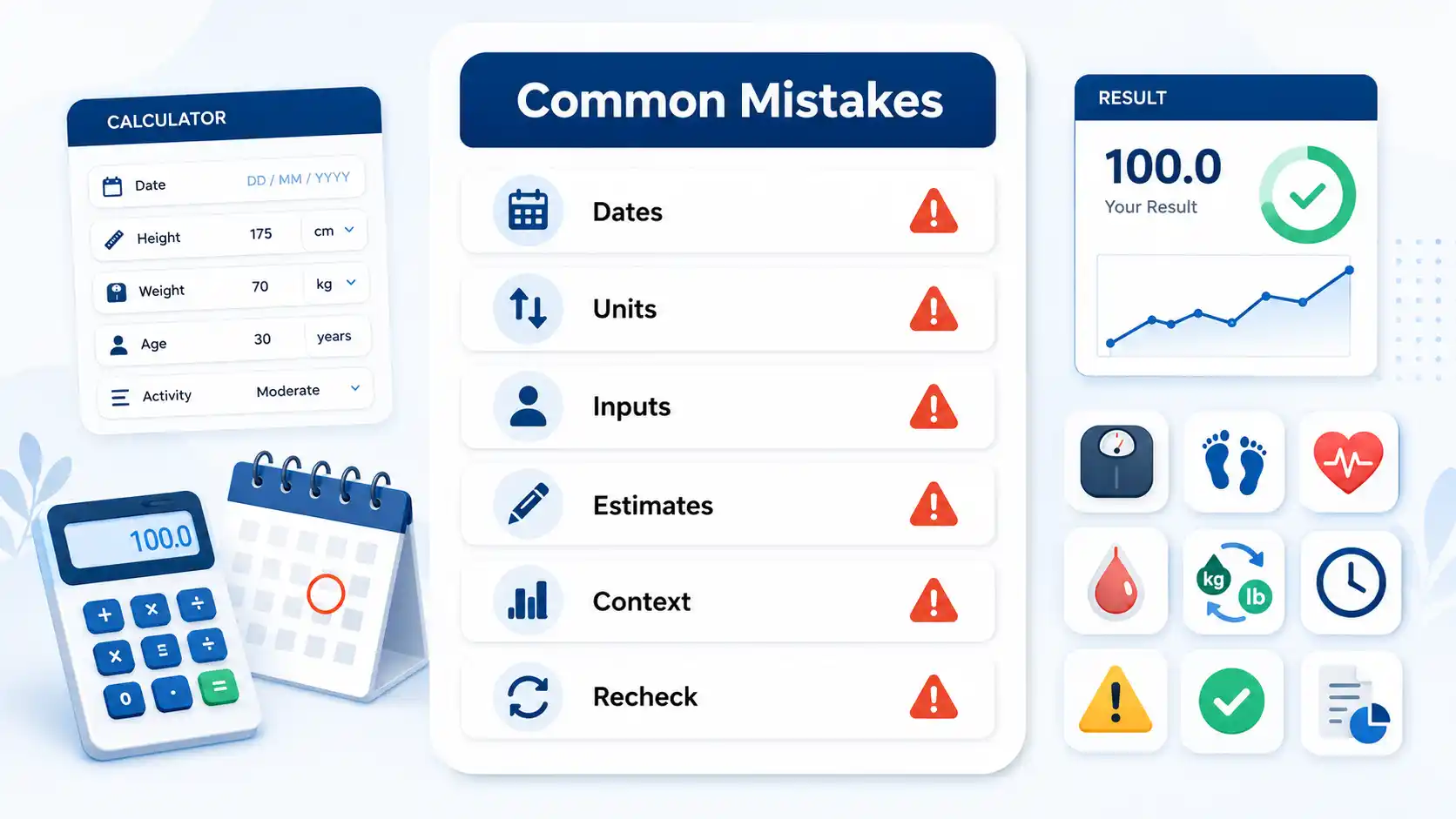
Small errors can lead to unnecessary worry. Watch out for these three common pitfalls when using the calculator.
- Confusing Spotting with Loss, do not panic over light bleeding. Spotting is very common. It occurs in many healthy pregnancies. It does not always mean your risk is increasing. Call your doctor for advice instead of guessing.
- Obsessing Over Single Days: Do not focus too hard on the exact day. The risk difference between Day 1 and Day 2 is tiny. Focus on the weekly trend instead. The drop in risk becomes much clearer week by week.
- Ignoring Measurement Units: Check your unit settings. The tool calculates Body Mass Index (BMI). You must select the correct option. Choose "Imperial" if you use pounds. Choose "Metric" if you use kilograms. Mixing them up leads to wrong results.
Frequently Asked Questions (FAQs)
What week is the risk of miscarriage highest?
The risk is highest during the first trimester. Most losses occur before the 12th week of pregnancy. The peak risk often happens between weeks 4 and 6. This period is when the embryo implants and develops vital organs. The risk drops significantly once you hear a heartbeat. It falls below 2 percent after you finish the first trimester.
How can I reduce the risk of miscarriage?
You can improve your odds with smart health choices. Start a daily vitamin routine immediately. Ensure your diet contains plenty of nutrients. Keep existing medical issues under control. Stay away from harmful habits like smoking. Do not drink alcohol at all. See your doctor early and often. These steps protect your growing baby.
What should I avoid during pregnancy to stay safe?
You should avoid harmful substances entirely. Stay away from alcohol, tobacco, and illicit drugs. Cap your daily caffeine at 200mg. Avoid raw or undercooked meats to prevent infections. Skip unpasteurized dairy products, such as soft cheeses. Avoid cleaning cat litter boxes to prevent toxoplasmosis. These simple changes reduce the risk of infections that can harm the pregnancy.
What does a miscarriage at 6 weeks look like?
A miscarriage at 6 weeks often resembles a heavy period. You may experience strong cramping in your lower abdomen. The bleeding is usually heavier than normal menstruation. You might notice small blood clots passing. Some tissue may look grey or pink. Call your medical provider right away if the pain gets intense or the bleeding increases.They can provide the necessary medical support.
Does seeing a heartbeat guarantee a successful pregnancy?
It does not guarantee success 100 percent. However, it is the most encouraging sign. Detecting a heartbeat usually lowers the risk of loss to under 5 percent. The exact risk depends on your age and symptoms. Most pregnancies with a confirmed heartbeat progress to a healthy birth.
Can stress cause a miscarriage?
Every day stress does not cause miscarriage. Work deadlines or traffic jams are safe. Chromosomal abnormalities cause the vast majority of early losses. These are random genetic events. However, chronic and severe stress can affect your overall health. Try to manage stress for your own well-being.
What is a chemical pregnancy?
Doctors use this term for a loss that happens very soon after conception. It typically occurs around the fourth or fifth week. The loss happens shortly after the egg implants. You might test positive briefly. However, the pregnancy ends before an ultrasound can confirm it. This type of loss is very common.
Questions?
We had love to hear from you! Whether you are reporting an issue, suggesting a new calculator, or exploring collaboration opportunities — we are here to help. Every message helps us make 100calc smarter, faster, and more helpful for everyone.
Why People Trust 100calc
At 100calc.com, we focus on accuracy, speed, and trust. Every calculator we create is designed to give reliable, instant, and easy-to-understand results you can truly depend on.