
Chance of Twins Calculator
The Chance of Twins Calculator estimates your specific probability of conceiving multiples. The average rate for a natural twin pregnancy is about 1 in 33. This equals roughly 3 percent of all births. However, your personal odds change drastically based on your history. Our tool analyzes your unique profile. It compares biological factors against fertility treatments instantly.
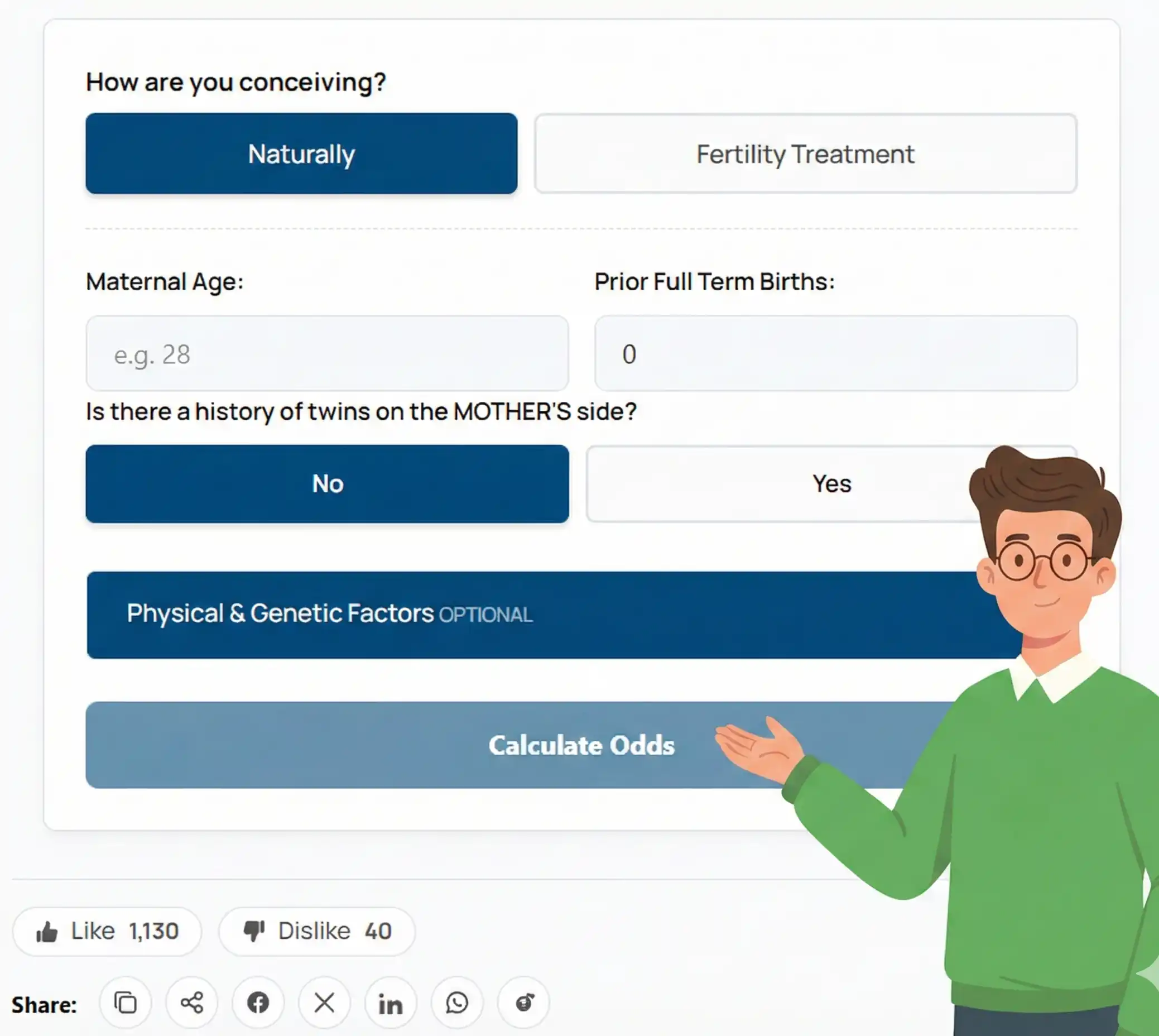
Select your conception method below to get started. Choose “Naturally” to check biological factors like maternal age and family genetics. Choose “Fertility Treatment” to see how IVF or oral medications affect your score. The calculator provides a precise percentage. It also gives you a clear “1 in X” ratio. Use this data to understand your reproductive potential today.
- Updated Jun 11, 2026
Chance of Twins Calculator: Check Your Odds
How to Enter Your Details: You need precise details for an accurate result. Follow these steps to generate your personalized probability score.
Genetic & Biological Predictor
My Chance of Twins Calculator
Calculate your exact percentage chance of conceiving multiples naturally or via fertility treatments. Discover how your age, pregnancy history, and genetics biologically alter your baseline odds.
Overall Probability
Zygosity Breakdown
Driven by maternal hyperovulation. Influenced by age, genetics, and parity.
A completely random biological event (egg splitting). Not affected by family history.
Your Biological Profile Report
Analysis generating...
Science vs. Fiction
- Chinese Predictors: No scientific evidence supports using lunar calendars or Chinese charts to calculate twin probabilities. It is purely an internet myth.
- Ovulation Timing: While tracking ovulation dictates exactly *when* you conceive, it does not dictate *how many* eggs you drop. You cannot time intercourse to force hyperovulation.
- Week by Week Checks: Your chance of carrying multiples is locked at the moment of conception. The odds do not change week by week, but ultrasound detection rates improve dramatically between weeks 6 and 8.
Who is more likely to conceive twins?
Generating personalized response...
What is the first indicator of twins?
Generating medical response...
How to figure out the odds of having twins?
Generating mathematical response...
Which parent passes on the twin gene?
Generating genetic response...
What Your Chance of Twins Means
You need to understand three key numbers when reading your report. These metrics help you see the full picture of your pregnancy odds.
Understanding the Percentage
The percentage score shows your raw probability. The average woman has a 3 percent chance of having twins naturally. A 5 percent result might seem low. However, it is nearly double the national average. A result above 30 percent is extremely high. This high score is typically seen only with fertility treatments like IVF.
The "1 in X" Ratio
This number puts your odds into a practical perspective. A ratio of “1 in 80” represents a low chance. It means that only 1 out of 80 women with your profile will conceive twins. A ratio of “1 in 3” represents a very high chance. A lower second number always indicates higher odds.
Singleton vs. Multiples
The “Singleton Chance” is often the most important number. It represents the likelihood of carrying just one baby. Even with high twin odds, a singleton pregnancy is usually the most likely outcome. For example, a 25 percent twin chance still means there is a 75 percent chance of a single baby. Always keep this context in mind.
Quick example to check the math
Say the average baseline for twins is 3.3 percent. You are 37 years old, so we multiply by 1.5. Your interim score is (3.3 × 1.5) = 4.95%.
If your mother has twins, we multiply by 2. After this step, you reach a 9.9% total chance. This equals roughly 1 in 10.
Explore More Calculators
Use the Chinese Gender Calculator for a traditional boy-or-girl prediction from lunar age and conception month. Enter conception date, due date, or LMP.
Try calculatorUse this fetal growth calculator to check baby weight percentile from ultrasound data in grams, kg, or cm and see what the result means…
Try calculatorEnter gestational sac measurements in mm or cm to calculate mean sac diameter, estimate early gestational age, compare week-by-week milestones, and see when follow-up…
Try calculatorMissed a birth control pill? Check pregnancy risk, protection status, backup contraception needs, and what to do next with our missed pill calculator.
Try calculatorUse our Pregnancy Chance Calculator to estimate your odds. Enter your cycle day, age, and method. Find out if you are in the high-risk…
Try calculatorUse our pregnancy due date calculator to find your exact Baby Due date. IVF, conception, ovulation, and ultrasound methods with weeks and timeline.
Try calculatorHow to Use the Chance of Twins Calculator
Estimating your odds takes less than a minute. Follow these five steps to get an accurate probability score.
Select Your Method
Choose the option that matches your situation. Click "Naturally" if you are conceiving without medical help. Click "Fertility Treatment" if you are using medications or IVF.
Enter Maternal Age
Type in the mother's current age. Age is a major factor. Women over thirty often release more than one egg. This naturally increases the chance of twins.
Add Physical Traits
Enter the mother's height and weight. These factors matter for natural conception. Research shows that taller women have slightly higher twinning rates.
Check Family History
Select "Yes" only if the mother has twins in her immediate family. Do not count the father's side. The father's genetics do not affect ovulation in this specific pregnancy.
Click the Calculate Button
Press the blue button to see your results. The tool analyzes your data instantly. It displays your percentage chance and a visual risk bar. You can change the numbers and test again until you find a plan that works for you.
Example for testing
Try these sample numbers:
Conception Method: Natural
Maternal Age: 36
Family History: Yes (Mother’s Side)
Result → Your probability hits 9.9 percent. Your age and family history work together here. This score is three times higher than average. It equals a 1 in 10 chance.
Now, enter your own numbers and check how close you are to your goal.
How the Chance of Twins Calculator Formula Works (Complete Breakdown)
Understanding your odds helps you prepare for your future family. This formula gives you a realistic estimate of your probability. It is based on medical statistics from the CDC and ASRM. The logic separates natural biological factors from fertility treatments. This ensures the result is accurate for your specific situation.
Twin Probability Formula
The calculator starts with a standard baseline number. Then it applies multipliers based on your unique profile. This method identifies women with a higher likelihood of “Hyperovulation.” Hyperovulation is when the ovaries release two eggs instead of one.
Formula:
Total Odds = Baseline Rate x Age Factor x History Factor
The formula begins with the general population rate of about 3.3 percent. It multiplies this number by your age factor. Then it multiplies the result by your family history factor. This calculates your personalized percentage.
Example:
					Imagine a 36-year-old woman with a history of twins on her mother's side.
Baseline: 3.3%
Age Factor (35-39): 1.5x multiplier
History Factor: 2.0x multiplier

3.3% x 1.5 x 2.0 = 9.9%
Her chance of twins is 9.9%. This is three times higher than the average.
Micro Note:
This calculator predicts Fraternal Twins (two separate eggs). Identical Twins (one egg splitting) are a random event. Identical twins happen in about 1 out of every 250 births, regardless of genetics.
Key Inputs Used in the Twins Calculator
Every calculation depends on specific biological inputs. These inputs change the likelihood of releasing multiple eggs. By entering your real details, you get a custom risk assessment instantly. Doctors use these same factors to identify high-risk pregnancies.
Maternal Age
This is the most powerful natural factor. Hormonal changes occur as women get older. Levels of the hormone FSH rise significantly in your 30s. This hormone stimulates the ovaries. Higher levels often cause the ovaries to drop two eggs at once. Women between 35 and 39 have the highest natural twin rates.
Family History (Mother's Side)
Genetics plays a huge role in hyperovulation. This trait runs in families. However, it only matters on the mother’s side. If your mother or sister has fraternal twins, you are more likely to have them too. Our calculator doubles your odds if this factor is present.
Fertility Treatment Type
Medical intervention overrides natural odds. Treatments like Clomid stimulate the ovaries directly. Procedures like IVF involve transferring embryos manually. The number of embryos transferred is the biggest predictor of twins. For example, transferring two embryos increases the chance of twins to nearly 30 percent.
Another Example Calculation (Step-by-Step)
Let’s see how the twins calculator works using a real example. This will help you understand how each factor affects your final odds. The calculation follows the same medical data used by fertility clinics worldwide.
Given:
- Conception Method: Natural
- Maternal Age: 36
- Family History: Yes (Mother’s Side)
Calculation:
					We apply the natural multipliers to the baseline rate. 3.3% (Baseline) × 1.5 (Age Factor) × 2.0 (History Factor) = 9.9%

Your result is 9.9%. This is significantly higher than the average. It happens because both age and genetics are boosting ovulation at the same time.
Result:
Chance of Twins: 9.9%
Ratio: 1 in 10
Status: High
Meaning:
Your probability is nearly 10 percent. This confirms a strong genetic influence. Doctors often see this pattern in women over thirty with a family history. A result of “1 in 10” is very high for natural conception. Most women have a chance of only “1 in 33.”
Result Benchmarks and Ranges
Your attendance percentage isn’t just a number. It helps you understand where you stand and what actions you should take to maintain eligibility. Institutions in the U.S. and India follow similar rules, but the acceptable range often varies. Here’s a quick breakdown to help you evaluate your score and make a plan.
| Conception Scenario | Chance of Twins | Status |
|---|---|---|
| Natural (Avg) | 1% – 3% | Average |
| Natural (High Factors) | 4% – 8% | Elevated |
| Clomid / Oral Meds | ~ 8% – 10% | High |
| Gonadotropins (IUI) | ~ 15% – 20% | Very High |
| IVF (Single Embryo) | < 2% | Low (Safe) |
| IVF (2 Embryos) | ~ 25% – 30% | Highest Risk |
Interpretation
A probability between 1 and 3 percent is the standard baseline. This range indicates a typical singleton pregnancy. However, odds above 10 percent are significant. This often happens with fertility medication or a strong family history. A score over 25 percent is very high. Prepare mentally for the possibility of multiples. Remember that a single baby is still the most likely result.
Pro Tip:
Ask your mother about specific details of her family tree. Focus only on fraternal twins. Identical twins do not count towards your genetic score. Confirming this history ensures your input is accurate. It prevents false high scores based on random events.
Tips & Planning Based on Your Result
Getting your number is just the start. You also need to understand the biology behind the score. These three facts explain why your odds might be higher or lower. Use this information to interpret your probability correctly.
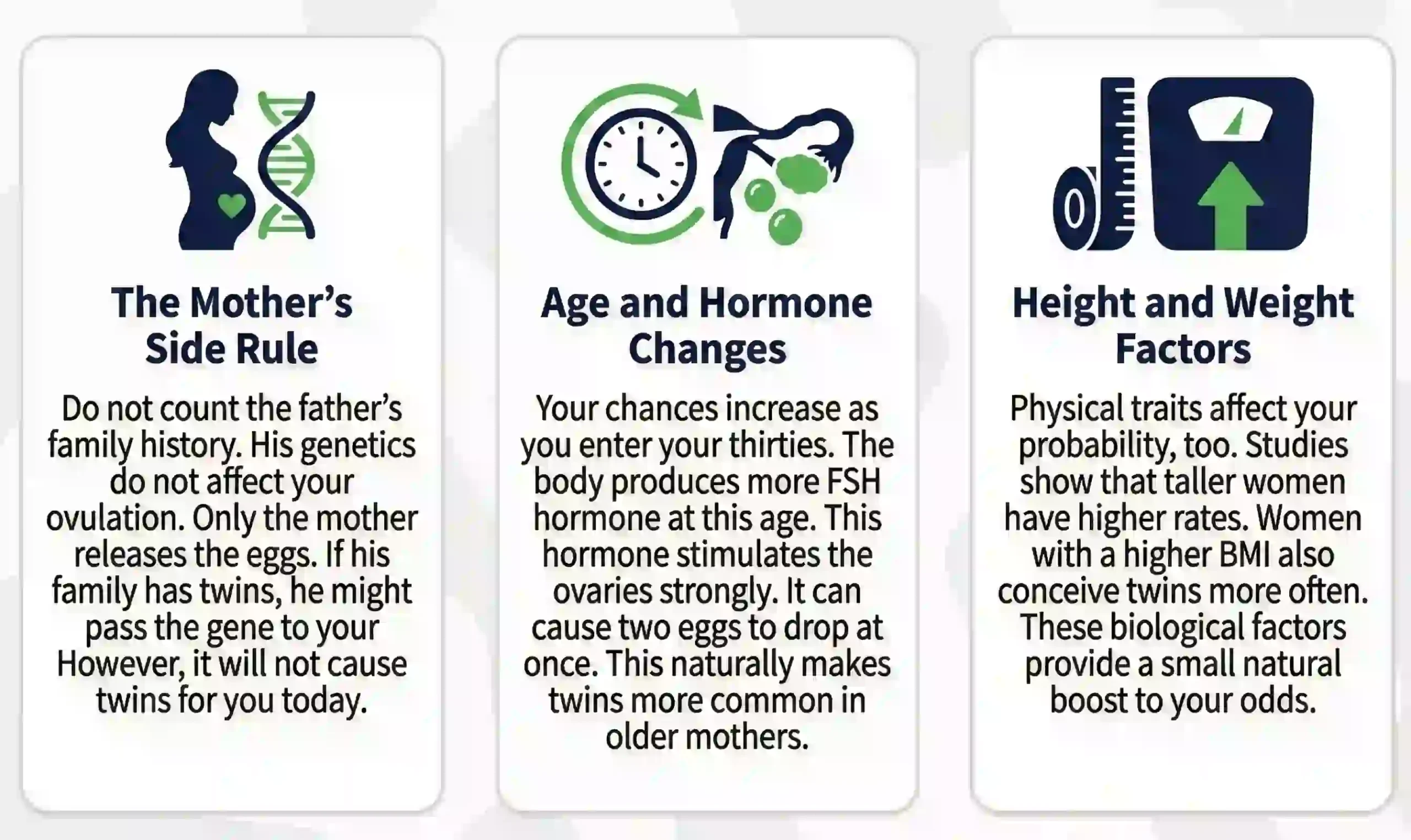
The Mother’s Side Rule
Do not count the father’s family history. His genetics do not affect your ovulation. Only the mother releases the eggs. If his family has twins, he might pass the gene to your daughter. However, it will not cause twins for you today.
Age and Hormone Changes
Your chances increase as you enter your thirties. The body produces more FSH hormone at this age. This hormone stimulates the ovaries strongly. It can cause two eggs to drop at once. This naturally makes twins more common in older mothers.
Height and Weight Factors
Physical traits affect your probability, too. Studies show that taller women have higher rates. Women with a higher BMI also conceive twins more often. These biological factors provide a small natural boost to your odds.
You Might Also Find These Helpful
Pregnancy & Fertility 45
Use this Pregnancy Risk Calculator to check age, BMI, health history, bleeding, and twins. See if closer prenatal monitoring may be worth asking about.
Try calculatorOne Time Pregnancy Calculator estimates pregnancy odds from one encounter, plus fertile window timing, test date, due date, and 21-day testing guidance.
Try calculatorUse the AMH Calculator to convert ng/mL or pmol/L, compare your result with age-based data, and see what it may mean for IVF, fertility,…
Try calculatorUse the Baby Eye Color Calculator with parents, grandparents, or sibling context to compare Brown, Green/Hazel, and Blue/Grey model estimates instantly.
Try calculatorBasal Body Temperature Calculator checks reading conditions and analyzes your temperature pattern for a sustained shift that may be consistent with ovulation.
Try calculatorBPD gestational age calculator: estimate fetal age from BPD, compare your week, check normal BPD ranges, and understand ahead or behind results.
Try calculatorFind out exactly when you conceived. Our free Conception Calculator uses your Due Date, LMP, or Ultrasound to estimate your fertilization date and fertile…
Try calculatorUse our Conception Date Due Date Calculator to find your baby's arrival date. Enter your conception or intercourse date for clinical 40-week results.
Try calculatorContraceptive effectiveness calculator to compare birth control methods, typical vs perfect use, backup protection, and 5-year pregnancy risk.
Try calculatorUse this CRL calculator to estimate gestational age and due date from crown-rump length in mm or cm. Compare CRL, LMP, and IVF dating…
Try calculatorEstimate your monthly and 12-month pregnancy odds by age, partner age, and cycle dates. See your fertile window and when to seek fertility help.
Try calculatorUse this fundal height calculator to compare your cm measurement by week, check growth range, estimate baby weight, and know when to ask about…
Try calculatorCommon Mistakes to Avoid When Calculating Chance of twin
Misinformation often leads to false hope. Avoid these common errors to get a realistic result. Accurate data ensures a better prediction.
- Counting the Father's Side: Do not look at the father's family tree. His genes cannot affect your ovulation. He cannot force your ovaries to release two eggs. He passes the gene to his daughter instead.
- Confusing Identical with Fraternal Identical twins are a random event. They happen by chance in 1 out of 250 births. Genetics does not cause them. This calculator predicts fraternal twins only.
- Believing the "Skip a Generation" Myth. Ignore the old folk tale about skipping generations. Genetics does not work that way. The hyperovulation gene is either present or absent.
- Ignoring the Age Factor: Do not assume young age guarantees low odds. Fertility treatments override age. Conversely, being over 40 lowers fertility overall.
Frequently Asked Questions (FAQs)
What is my probability of having twins?
The average probability for a natural pregnancy is about 3.3 percent. This equals roughly 1 in 33 births. However, your personal odds depend on your profile. Factors like age and family history change this number significantly. Our calculator provides your specific percentage.
What increases my chances of having twins?
Several factors boost your likelihood. A family history on the mother’s side is the strongest natural predictor. Being over age 30 also increases the rate. Taller women conceive twins more often than shorter women. Finally, fertility treatments like IVF raise the odds the most.
What is the best age to conceive twins?
Women between 35 and 39 have the highest natural twin rates. The body produces more follicle-stimulating hormone (FSH) during this time. This hormone can cause the ovaries to release two eggs at once. Rates drop after age 40 as overall fertility declines.
What is the beta hCG level for twins?
Twin pregnancies usually produce higher hCG levels. Levels are often 30 to 50 percent higher than those in singleton pregnancies. However, the ranges overlap significantly. A high number does not guarantee twins. Only an ultrasound can confirm it for sure.
Do twins run on the father's side?
No, they do not impact the current pregnancy. The father’s sperm does not control the mother’s ovulation. He cannot make her release two eggs. However, he can pass the “hyperovulation gene” to his daughter. She may have twins when she grows up.
Can eating yams increase my odds?
Some studies suggest a link. A specific tribe in Nigeria eats wild yams and has high twin rates. These yams contain a chemical similar to estrogen. However, eating regular grocery store yams likely has little effect. Genetics plays a much larger role.
How common are identical twins?
Identical twins are very rare. They happen in only 0.45 percent of births. That is about 1 in 250. This event is random and does not run in families. Our calculator focuses on fraternal twins instead.
Questions?
We had love to hear from you! Whether you are reporting an issue, suggesting a new calculator, or exploring collaboration opportunities — we are here to help. Every message helps us make 100calc smarter, faster, and more helpful for everyone.
Why People Trust 100calc
At 100calc.com, we focus on accuracy, speed, and trust. Every calculator we create is designed to give reliable, instant, and easy-to-understand results you can truly depend on.