
Flooring Calculator
A Flooring Calculator measures the total square footage and cost for your home renovation project. Homeowners and contractors in the USA use this tool to find the exact amount of hardwood, laminate, or tile needed for any room. Specifically, it calculates the total area plus a waste allowance to prevent material shortages. You can find your project budget instantly today.
You should avoid guessing your material needs for your next interior upgrade. This engine provides a professional estimate for various floor types and room shapes. First, you will select your unit system from our list. Second, you will give the room length and width. Finally, you click calculate to see the total cost and area. Therefore, you can manage your renovation budget with total confidence. Use our tool to plan your next flooring project with accurate data.
- Updated Jun 17, 2026
Flooring Calculator
You can find the exact cost and area for your new floor by using the tool below. Please enter your room’s physical dimensions to receive a professional report. Our engine processes your data against standard area formulas. These methods align with the standards used by interior designers in the USA. You should have your room measurements ready before you start the calculation.
RESULT INTERPRETATION
Your report highlights the precise area and budget needed for your renovation. These figures help you understand the scale of your project. Also, you learn the specific financial demands of your work. Specifically, you should look at the Total Area with Waste first. This value represents the full amount of material you must purchase at the store. For instance, knowing this number helps you calculate the exact number of boxes to buy. You can use these data points to schedule your delivery. Therefore, you can keep your home project organized.
Total Flooring Cost
The Total Flooring Cost provides a stable metric for your financial planning. Specifically, it shows precisely how much you will spend on the raw materials. A higher price per square foot requires a larger initial budget. Consequently, you can follow these metrics to compare different wood or tile options. You should also check your total budget to ensure your project is affordable. For example, a slight change in material quality can save you hundreds of dollars. Therefore, your preparation supports a professional financial workflow.
Material Breakdown
You must understand the difference between your room size and your final order. The Net Area is the actual floor space inside your walls. Conversely, the Gross Material Need is the net area plus your waste allowance. Our tool separates these figures for your project log. Therefore, you can see exactly how much extra material you are buying for corner cuts. Specifically, this breakdown prevents you from running out of planks during the final row. Reliable data ensures your installation remains a smooth process.
Quick example to check the math
You can see how different room dimensions change your material requirements. Specifically, these real-world examples show how surface area and waste percentages work together. You should compare these profiles to your own floor measurements. Following this method helps you set realistic goals for your home renovation project.
Example 1: Standard Master Bedroom
Imagine a homeowner who measures their rectangular bedroom in the morning. They have a surface area of 180 square feet. Also, their desired waste allowance is 10 percent. Our tool shows a total requirement of 198 square feet for these dimensions. A count of 198 square feet indicates a healthy amount for a standard master suite. Therefore, this person can successfully purchase enough planks to cover every corner.
Explore More Calculators
Use our Pipe Weight Calculator to find the exact mass of steel, aluminum, and PVC pipes. Get precise structural data for shipping and installation…
Try calculatorUse our Acres Per Hour Calculator to find your field capacity. Get precise mowing time and productivity estimates for farm equipment today.
Try calculatorYou can use our free copper power calculator to find your exact quarantine dose. First, enter your net water volume. Next, discover your total…
Try calculatorUse our Glass Weight Calculator to find the exact mass of any pane. Get 100% accurate weight for tempered, float, and laminated glass in…
Try calculatorUse our Paver Sand Calculator to find the exact bags needed for your patio. Get precise weight and volume estimates for your landscaping project…
Try calculatorUse our Pond Volume Calculator to find the exact water capacity of your garden feature. Get custom data for pumps, filters, and liners today.
Try calculatorHow to Use the Steps To Miles Calculator
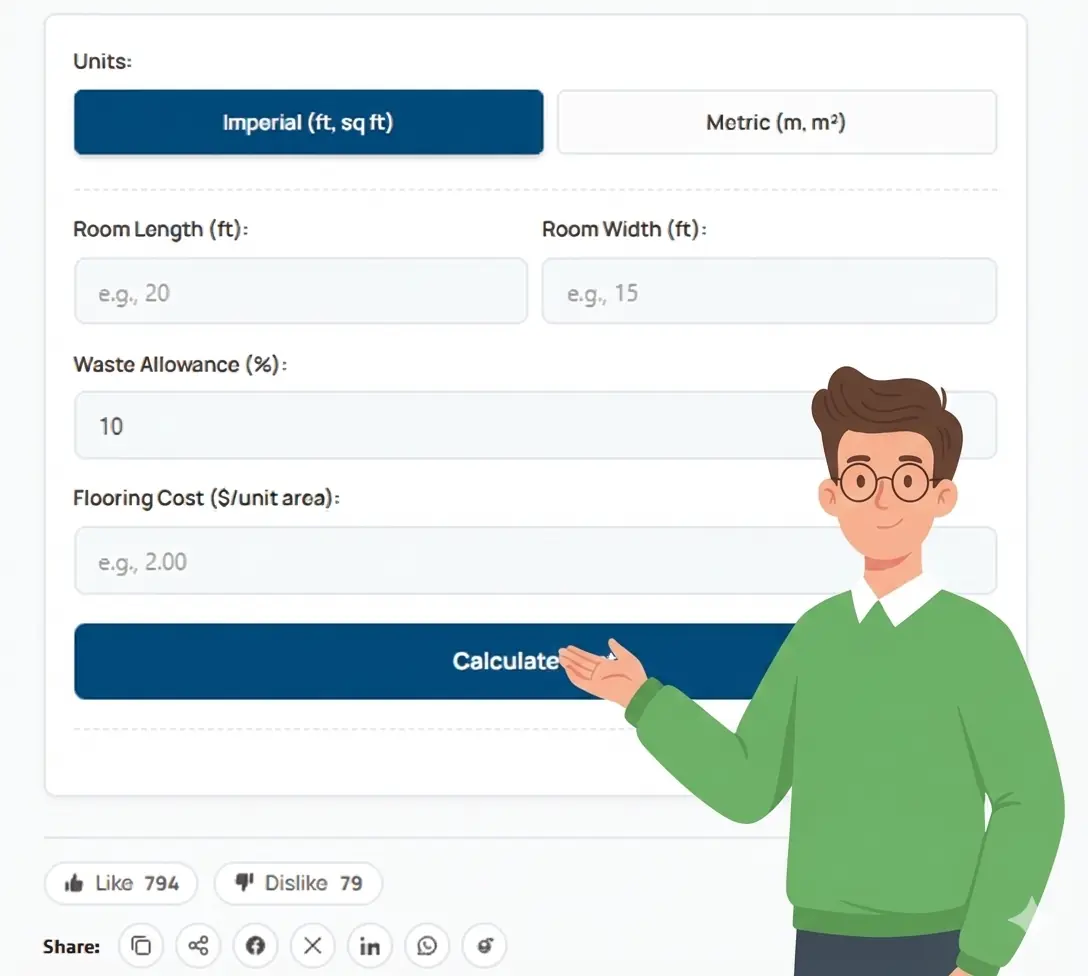
You can estimate your flooring costs in just a few seconds. Our tool follows a professional sequence. These steps ensure your data is accurate. Please follow these five simple steps to calculate the area of your specific material. These steps help you avoid common renovation errors. Specifically, they ensure your project budget stays on track.
Select Your Preferred Units
First, you must pick between the Imperial and Metric systems. You should use Imperial for feet, inches, and square feet. Also, you can pick Metric for meters, centimeters, and square meters. Using the correct units keeps your math precise for your local suppliers. Therefore, you should check your tape measure before you start the calculation.
Measure Room Dimensions
Next, you will enter the actual length and width of your room. You can find these numbers by measuring the longest and widest points of your floor. Specifically, measure into closets or alcoves to capture all floor space. Selecting the right area is essential for a real estimate. Consequently, a proper area leads to an accurate material report.
Determine Waste Allowance
Third, you must provide a percentage for your waste allowance. Most professionals recommend a 10% buffer for standard rooms. This value accounts for the wood or tile you lose during corner cuts. You should be very accurate with this choice. Consequently, your result will reflect the actual number of boxes needed for the job.
Input Material Cost
After that, you will enter the price per unit area for your chosen flooring. You should find the cost per square foot or square meter. This value allows the tool to build your total financial budget. Selecting the correct price ensures a safe spending estimate. Therefore, you should check your product labels before entering a value.
Process Your Cost Estimate
Finally, you will click the blue button to view your results. The engine analyzes your dimensions against your waste percentage. You can use these facts to buy your planks or tiles today. Therefore, you can finish your renovation with total precision. Accurate data ensures your floor stays consistent. You will avoid running out of materials during your installation.
Example for testing
You can try these sample numbers to see how the tool works. First, select the Imperial unit system. Second, enter a length of 10 feet, a width of 10 feet, and a waste allowance of 10 percent. Finally, enter a material cost of $5.00. These inputs represent a standard small office project for a home.
Result →Your total requirement hits 110 square feet. Your surface area and waste buffer work together here. The total material cost hits $550.00. This score provides a balanced view of your financial needs. It equals a reliable and stable budget under normal market conditions. Now, enter your own numbers and check how close you are to your goal.
Now, enter your own numbers and check how far you went today.
How the Flooring Calculation Formula Works (Complete Breakdown)
You should understand how the math determines your material needs. This formula provides a realistic estimate of your project area. It is based on standard geometric rules for rectangular spaces. The logic separates the actual floor space from your specific installation goals. This ensures the result is accurate for your particular room. Specifically, you can rely on these figures to buy the correct number of flooring boxes.
The Flooring Calculation Formula
The calculator starts with your raw room measurements. Then it applies a waste factor to standardize the order. This method identifies the perfect balance between room size and extra material. Balance is when the tool finds the total surface area within your walls. Specifically, the math identifies how much flooring covers that space.
Formula:
					Net Area:
Area = Length x Width
Total Material:
Total = Area x (1 + Waste ÷ 100)
The formula begins by calculating a base number for your surface area. It multiplies the length of your room by the width. This step finds the total square footage or square meters. Finally, it adds your chosen waste allowance. This calculates your personalized material capacity. Therefore, you get a single number for your shopping list.
Example:
					Imagine a homeowner who has a rectangular bedroom. It is 15 feet long and 12 feet wide. He also chooses a 10% waste allowance for his hardwood planks.
1: Room Area: $15ft \times 12ft = 180 ft^2$
2: Waste Factor: $180 \times 1.10 = 198 ft^2$
3: Total Order: 198 Square Feet
The final result is 198 square feet. This score represents a standard medium-sized bedroom project. Use this number to plan your budget and transport needs.
Micro Note:
This calculator predicts flooring needs based on standard rectangular rooms only. Circular rooms or spaces with complex curves are a different category. Those features do not provide the precise dimensions needed for a simple geometric score. Most users should stick to average measurements for their first few rooms. Therefore, you should measure multiple points in irregular rooms to find the best average.
Key Inputs Used in the Calculator
Every calculation depends on specific physical inputs. These inputs change how your project handles cost and material volume. By entering your real details, you get a custom renovation report instantly. Professionals use these same factors to build accurate quotes for clients.
Room Dimensions
This is the most potent factor for your score. Length and width determine whether your project requires a few boxes or several pallets of wood. A larger surface requires more material to maintain a seamless look. Consequently, your total cost stays high when the room area is large.
Waste Allowance
Your waste percentage affects the completion of your project. High waste signals that your room has many corners or complex cuts. This factor helps the tool find your natural material-holding capacity. For instance, a high waste buffer can offset mistakes during installation. You should use 10% for standard rooms and 15% for diagonal patterns.
Material Cost per Unit
Your cost selection overrides the raw area you enter. Luxury hardwood often has a high price per square foot. Conversely, basic laminate is usually much less expensive. Selecting the correct price is the most significant predictor of an accurate budget. For example, picking the wrong price can change your total estimate by hundreds of dollars.
Another Example Calculation (Step-by-Step)
Let’s see how the flooring calculator works for someone else. This will help you understand how each factor affects your final budget. The calculation follows the same logic used by interior designers worldwide.
Given:
- Unit System: Metric
- Room Length: 5 meters
- Room Width: 4 meters
- Waste Allowance: 15%
Calculation:
					We first find the area by multiplying length and width. Then we apply the 15% waste factor to see the final order.
5m x 4m = 20 m²
20m² x 1.15 = 23 m²
Result:
Recommended Goal: Buy 23 Square Meters
Total Cost: Based on Local Price
Status: Large Living Room Project
Meaning:
Your material score is exactly 23 square meters. This confirms a focus on optimal coverage and mistake prevention. Pro installers often see this pattern during their planning phases. A result of 23 is very efficient for standard European-style rooms. Most people starting a renovation would typically see an area of more than 10 square meters in their first project.
FLOORING MATERIAL BENCHMARKS (TABLE)
Most homeowners use these material benchmarks to track work quality. Therefore, you can trust these numbers for your task planning. You should use these values to evaluate your current renovation setup. Also, these figures help you choose the proper budget for your specific room. Specifically, knowing your project size prevents you from making unrealistic promises for job completion. Consequently, your projects will finish on time without wasting expensive materials. Similarly, you can compare different room patterns to find the best fit for your budget.
| Room Type | Common Area | Category | Estimated Waste (10%) |
|---|---|---|---|
| Half Bathroom | 20 – 30 sq ft | Minor | 2 – 3 sq ft |
| Standard Bedroom | 150 – 200 sq ft | Standard | 15 – 20 sq ft |
| Living Room | 300+ sq ft | Major | 30+ sq ft |
Heads-up: Actual flooring needs can vary based on room angles, closet space, and pattern complexity. Always add at least 10% to your total area estimate to account for cuts and damaged planks.
Interpretation
A standard material requirement is 150 to 200 square feet for most bedrooms. Therefore, the range provides a balanced feel for general home management. However, requirements above 300 square feet are much more labor-intensive. You should prepare for a project that requires many cuts and long shifts. Conversely, small bathrooms let you stay within the lower price range to maintain total control over your budget. Specifically, these levels help you build a beautiful home without the risk of high renovation costs.
Pro Tip:
You should prioritize subfloor preparation before you lay any new material. For example, a flat surface helps your planks click together with total precision. Confirming your floor is level ensures your new surface lasts for many years. You should always prioritize a clean subfloor over a fast installation for the best experience. Furthermore, the consistency helps you identify your actual project costs without any guesswork during the final phase. Accurate preparation prevents the edges of your flooring from peeling or breaking.
Tips & Planning Based on Your Result
You can improve your renovation results by following these expert tips. Finding your flooring area is just the first step for a healthy home project. You should apply these insights to maximize the benefits of every calculation. Specifically, focus on your measurement routine and your material quality to see the best results.
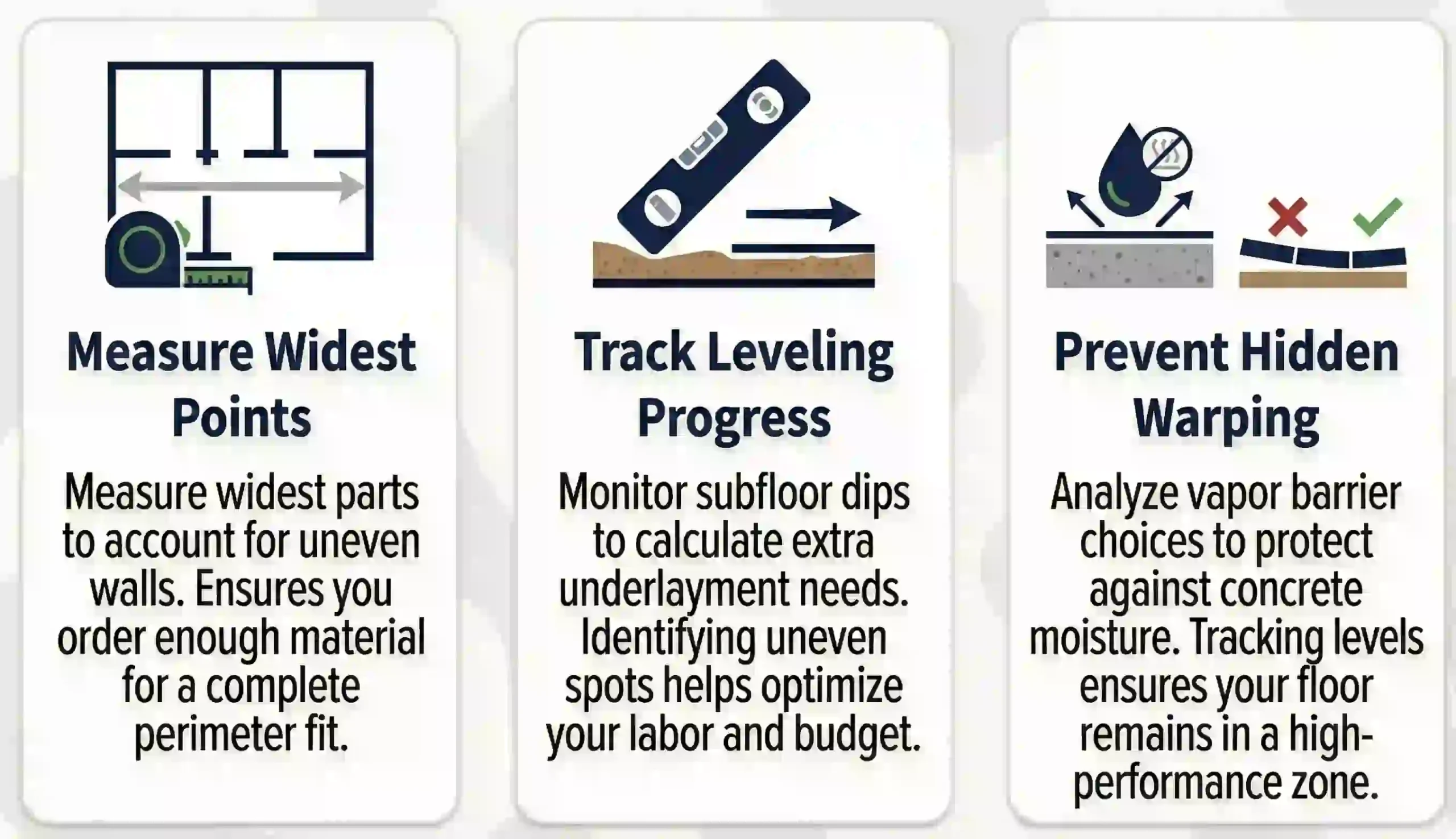
Measure Your Room at the Widest Points
You should measure your project dimensions at the same reference points every time. Specifically, the walls in older homes can be slightly uneven. You will get the most consistent results by measuring the widest and longest parts of the floor. Therefore, a complete perimeter check is the best tool for your initial area assessment. Consistent measurements help you track your progress without being confused by data gaps. Consequently, you will know precisely when to order more boxes of wood or tile.
Track Your Subfloor Leveling Progress
You should track how flat the subfloor remains before you lay your new material. More intense dips in the wood or concrete usually significantly increase your underlayment needs. Furthermore, you can use our tool to see the direct impact of your room size on your total budget. Consequently, you will understand how many extra planks your project needs for a level finish. Such data allows you to optimize your labor for better value. Therefore, you can maintain a flat floor while saving money on your material bills.
Watch Out for Hidden Moisture Issues
You must watch out for hidden moisture issues in your concrete slab. Actually, a sudden build-up of water will ruin your laminate or hardwood instantly. You should analyze your vapor barrier choices if you live in a humid environment. Clearly, tracking your moisture levels helps you maintain a safe state of structural balance. Reliable area data ensures your installation remains in a high-performance zone. Specifically, accurate facts prevent you from wasting money on materials that might warp or buckle.
You Might Also Find These Helpful
Home 8
Use our Resin Calculator to find the exact epoxy volume for your project. Get precise Part A and Part B mixing ratios for river…
Try calculatorYou can use our free well volume calculator to find your exact water capacity. First, enter your pipe depth and diameter. Next, discover your…
Try calculatorCommon Mistakes to Avoid When Calculating
You can avoid many errors by learning from experienced contractors. Simple mistakes often lead to late finishes or material shortages. You should review these three common errors before you start your work. Accurate tracking helps you reach your renovation goals much faster. Consequently, you will maintain a clean schedule while managing your project costs.
- Forgetting the Waste Buffer:Forgetting the waste buffer is a dangerous choice. You might run out of planks right in the middle of your project. Specifically, you lose time waiting for new deliveries. You should always include a 10% buffer for standard rooms. Therefore, you will have enough material for every corner cut. Extra pieces also help if a plank breaks during installation. The buffer ensures you have a backup for every mistake.
- Measuring Only the CenterMany homeowners measure only the center of the room. However, most walls are not perfectly straight or square. You should measure the widest and longest points of your floor instead. Specifically, these dimensions accurately reflect the space's scale. Therefore, your material count will cover every inch of the subfloor. Accurate numbers prevent gaps along your baseboards. The strategy ensures you buy enough boards for uneven walls.
- Ignoring TransitionsYou should always account for doorways and closets in your total area. These small transitions require more material than you expect. Specifically, you must cut pieces to fit into thresholds and door frames. You should add the square footage of every closet to your main calculation. Consequently, your budget will stay accurate for the entire floor plan. Therefore, you will finish the job without any missing parts. The count covers every hidden inch of your floor.

Frequently Asked Questions (FAQs)
How do I calculate how much flooring I need?
You can calculate your flooring needs by finding the total area of your room. First, you must multiply the length by the width to find the square footage. Second, you should add a waste allowance of at least ten percent. This extra amount covers cuts and errors. Therefore, you can find the final material order by combining these two numbers.
How do I calculate how many flooring packs I need?
You can find the number of packs by dividing your total area by the box’s square footage. Specifically, you should check the product label for the box coverage. Every brand has a different amount of material per pack. You must always round your result up to the following whole number. Consequently, you will have enough full boxes to finish the installation.
How much does it cost to install 1000 square feet of flooring?
The cost to install 1000 square feet usually ranges from 3,000 to 10,000 in the USA. Specifically, this price includes the material cost and professional labor. Basic laminate is much cheaper than high-end hardwood. You should also account for removing your old floor. Therefore, you can use our tool to estimate your raw material costs first.
How much vinyl flooring do I need for a 12x12 room?
You need 158.4 square feet of vinyl flooring for a 12×12-foot room. Specifically, the room’s net area is exactly 144 square feet. You must add a 10% waste allowance to this base number. Adding 14.4 square feet ensures you have enough for the edges. Therefore, you can buy your materials with total confidence in your budget.
Can I install flooring over my old tiles?
You can install many types of flooring over old tiles if the surface is level. Specifically, luxury vinyl and laminate work well for this method. You should make sure the old tiles are stable and clean. Use a thin underlayment to smooth out any grout lines. Consequently, you can save time and money on demolition costs.
How do I measure a room with closets?
Measure the main room first, then each closet separately. Specifically, calculate the area of the closet by multiplying its length and width. You then add the closet area to your main room total. This strategy ensures you buy enough planks for the hidden spaces. Therefore, you will maintain a consistent look throughout the entire suite.
Questions?
We had love to hear from you! Whether you are reporting an issue, suggesting a new calculator, or exploring collaboration opportunities — we are here to help. Every message helps us make 100calc smarter, faster, and more helpful for everyone.
Why People Trust 100calc
At 100calc.com, we focus on accuracy, speed, and trust. Every calculator we create is designed to give reliable, instant, and easy-to-understand results you can truly depend on.