
AP Chemistry Score Calculator
Welcome to the most accurate AP Chemistry score calculator available online. Preparing for the Advanced Placement Chemistry test is stressful. However, predicting your results should not be hard. Therefore, this interactive tool helps you convert your raw practice exam points into a scaled 1 to 5 score. Furthermore, you might want to know exactly how many multiple choice questions you need to pass.
Alternatively, you could be aiming for a perfect 5. In either case, our AP chem exam score calculator uses the latest College Board grading curves. This gives you highly accurate and real-time predictions. Simply plug in your raw test points. As a result, you will instantly see exactly where you stand. Finally, you can identify your weakest links and study smarter.
AP Chemistry Score Calculator
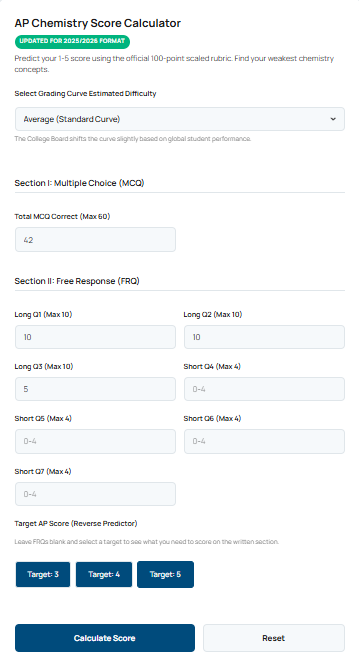
Updated for 2025/2026 FormatPredict your 1-5 score using the official 100-point scaled rubric. Find your weakest chemistry concepts.
The College Board shifts the curve slightly based on global student performance.
Section I: Multiple Choice (MCQ)
Section II: Free Response (FRQ)
Leave FRQs blank and select a target to see what you need to score on the written section.
- Scaled MCQ Score (Max 50)
- 0.0
- Scaled FRQ Score (Max 50)
- 0.0
Fill out your practice exam scores to see your predicted AP Chemistry score.
What Your AP Chemistry Score Calculator Results Mean
Your AP Chem score calculator results explain more than just a simple number. They show exactly how your raw test points convert into a final college credit grade.
This section helps you understand your total composite score and grading curves. Therefore, you can use this data to plan your next study session.
How Your Total Composite Score Works
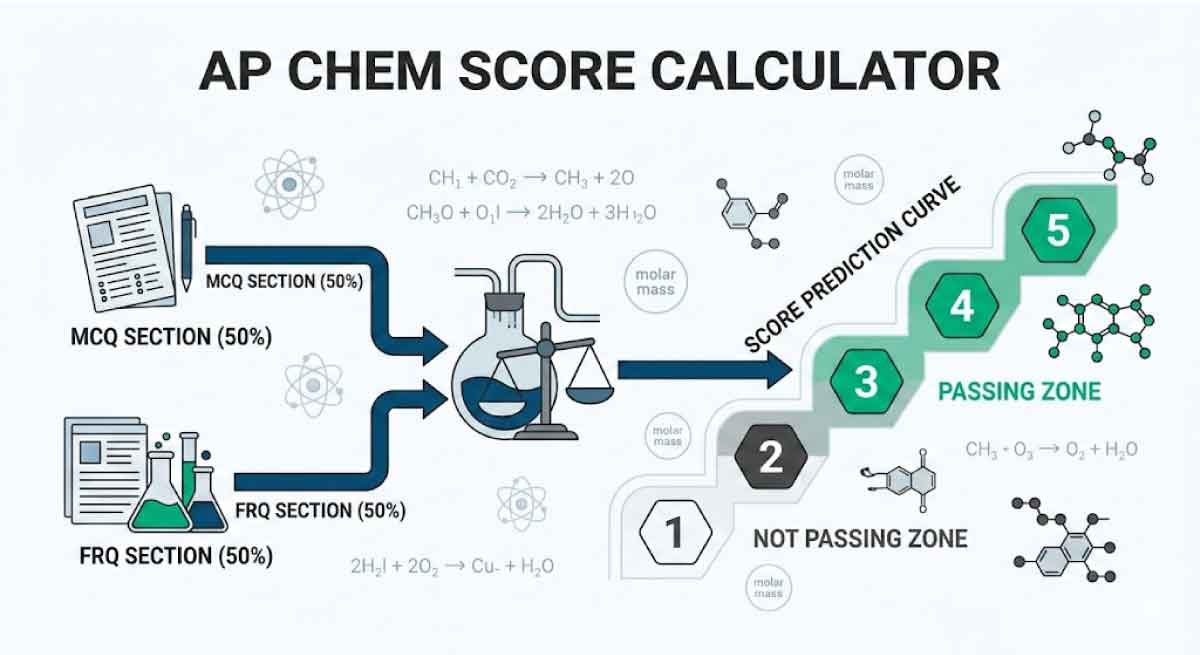
First, your total composite score determines your final 1 to 5 scaled grade. The test offers a maximum of 100 points. The multiple choice section provides half of these points.
Meanwhile, the free response section provides the other half. Consequently, the AP Chemistry score calculator combines both sections to find your true standing.
The Importance of the Grading Curve
Next, you must consider the grading curve. The College Board shifts this curve slightly every single year. They do this based on global student performance.
As a result, our AP chem test score calculator provides a specific safety margin. This margin tells you exactly how many points you can lose before dropping a grade level.
Sample Output for a Top Score
For example, imagine you earn a composite score of 75 out of 100. In this case, you scored a perfect 5. Furthermore, this means you have a strong grasp of stoichiometry and conceptual chemistry.
However, you only have a 1-point safety margin before dropping to a 4.
Sample Output for a Passing Score
Alternatively, consider a composite score of 41 out of 100. This result means you scored a 3. You successfully passed the exam. However, your free response section is likely dragging your score down.
Therefore, you should review your multi-step ICE table calculations to improve.
Test the Calculator With Real Examples
First, use the examples below to test the AP Chemistry score calculator. You should enter the values exactly as shown.
Next, you can change them later to match your own practice exam. Therefore, this process helps you understand how the grading curve works.
Example 1: Aiming for a Perfect Score
Use this to test:Top score calculation and safety margins.
Curve Type: Average
Multiple Choice Correct: 45
Total Free Response Points: 34
What you should see:
Composite Score: 74 out of 100.
Final Grade: 5.
Analysis: You scored a 5. Furthermore, you have a strong grasp of both stoichiometry and conceptual chemistry. However, you only have a 1-point safety margin before dropping to a 4. As a result, every single point matters.
Example 2: Earning a Passing Grade
Use this to test: Minimum passing score calculation.
Curve Type: Average
Multiple Choice Correct: 25
Total Free Response Points: 19
What you should see:
Composite Score: 41 out of 100.
Final Grade: 3.
Analysis: You scored a 3. Consequently, you passed the exam successfully. However, your free response section is dragging your score down. Therefore, you must review your multi-step ICE table calculations. Finally, extra practice will help you reach a 4.
Explore More Calculators
Predict your 1-5 score with our universal AP Score Calculator. Find your "Wiggle Room" safety net, adjust MCQ/FRQ weights, and estimate college credit value…
Try calculatorStop guessing your grade! Use our free Final Exam Calculator to instantly find out exactly what score you need to pass or hit your…
Try calculatorPredict your grade with our accurate AP Biology Score Calculator. Enter your multiple choice and free response points to see your exact 1 to…
Try calculatorWorried about your free response answers? Use our AP Calculus AB score calculator to find your exact 1-5 grade. Check your wiggle room and…
Try calculatorWondering what you will score? Use our AP Calculus BC Score Calculator to find out! Input your practice MCQ and FRQ points to get…
Try calculatorUse our accurate AP Environmental Science Score Calculator to predict your 1-5 apes grade. Enter your MCQ and FRQ practice test points instantly!
Try calculatorHow to Use the AP Chem Score Calculator
Using this tool is very simple. First, you only need your practice test results. The AP Chemistry score calculator uses your raw points. Then, it estimates your final grade based on official College Board data. Therefore, follow these five steps to get your result instantly.
Select Your Grading Curve
To begin, choose your preferred grading curve difficulty. You can select Generous, Average, or Strict. This step is important because the College Board adjusts the scale every single year.
Enter Your Multiple Choice Score
Next, type in the number of multiple choice questions you answered correctly. The maximum limit is 60 points. Furthermore, do not subtract points for wrong answers. There is absolutely no guessing penalty on this exam.
Enter Your Free Response Points
After that, input your written points into the AP Chemistry test score calculator. You must enter scores for the three long questions first. Each long question is worth up to 10 points. Then, enter scores for the four short questions. Each short question has a maximum of 4 points.
Review Your Final Prediction
Consequently, the results panel will instantly display your score. You will see a dynamic ring chart. This chart reveals your final 1 to 5 prediction. In addition, the tool highlights your weakest subjects automatically.
Use the Target Planner
Finally, you can use the reverse calculation feature. First, leave the free response fields blank. Next, select the "Target 5" button. As a result, the tool calculates your required written points. It bases this number entirely on your current multiple choice performance.
Quick Formula Used
Composite Score = (MCQ × 0.8333) + (Total FRQ × 1.0870)
Why This Process Is Accurate
This AP Chemistry grade calculator method perfectly matches the official grading rubrics. It calculates your weighted composite score accurately.
First, it scales your multiple choice points to exactly 50 percent of the total. Then, it scales your written points to the remaining 50 percent. Therefore, your estimate reflects a true and realistic exam scenario.
Try It Yourself
First, enter 45 correct multiple choice questions. Next, select the “Target 5” button. Then, watch how the required written score changes. It shifts immediately when you change the curve from Generous to Strict. Consequently, you will instantly understand how the annual curve affects your final grade.
The AP Chemistry Score Calculator Formula Explained
This section explains exactly how our tool estimates your final grade. It reveals the math behind the scaled points. Because the College Board uses a weighted grading system, we calculate your total composite score using specific multipliers. Therefore, this breakdown helps you understand where the numbers come from.
First, we start by calculating the weight of your multiple choice section. Then, we apply the weight for your free response section. Finally, we combine them to find your final score.
The Scoring Formula
This formula powers the AP Chemistry score calculator. It converts your raw practice points into a final composite score out of 100.
The Formula:
Composite Score = (Multiple Choice × 0.8333) + (Free Response × 1.0870)
This formula relies on two key variables. Each variable comes directly from your exam results.
Variable 1: Multiple Choice Points
First, we determine your points from the first half of the test. We take your total number of correct answers.
Maximum Points: The test has 60 multiple choice questions.
The Multiplier: We multiply your correct answers by 0.8333.
The Result: Consequently, this step scales your 60 possible points down to exactly 50 weighted points.
Variable 2: Free Response Points
Next, we calculate your points from the written section. We take the sum of all points earned on the seven written questions.
- Maximum Points: This section offers a maximum of 46 raw points.
- The Multiplier: We multiply your total earned points by 1.0870.
- The Result: Therefore, this step scales your 46 possible points up to exactly 50 weighted points.
AP Chemistry Score Calculator Example Scenarios
Use these exact inputs to test the calculator logic. We show the math step by step. As a result, you can see how raw points turn into a final college credit grade.
Example 1: Earning a Strong 4
Sarah wants to test her recent practice exam. She gets 42 correct answers on her multiple choice section. Furthermore, she earns 25 points on her free response questions.
Given:
Curve Type: Average
Multiple Choice Correct: 42
Total Free Response Points: 25
Calculation:
- Scale Multiple Choice: Multiply 42 by 0.8333. This equals exactly 35 scaled points.
- Scale Free Response: Next, multiply 25 by 1.0870. This equals exactly 27.17 scaled points.
- Combine: Finally, add 35 and 27.17 together. This creates a total of 62.17.
Result:
Estimated Composite Score: 62
Final Predicted Grade: 4
Therefore, you should see this exact number in the results panel.
Why This Formula Matters
This formula shows the true potential of your exam performance. First, it does not include teacher biases. Second, it does not include standard classroom grading curves. Instead, it reflects your raw test points only. Because of this, your calculated result may differ from your actual high school class grade. However, the AP Chem score calculator gives you a highly accurate estimate for the official College Board scale. Finally, you now have a reliable baseline before you take the real test.
Understanding Your AP Chem Results
Your AP Chemistry score calculator results show more than just a simple number. First, they help you understand the true value of your practice exam. Colleges and high schools use specific grading benchmarks for different reasons. Therefore, you need to know exactly what your grade means. Here is a quick breakdown. Finally, this section helps you read your results and understand the official College Board standards.
| Range (Average Curve) | Category | Meaning |
|---|---|---|
| 74 to 100 | 5 | Extremely Well Qualified (College credit usually granted) |
| 58 to 73 | 4 | Well Qualified (College credit usually granted) |
| 40 to 57 | 3 | Qualified (Passing, some colleges grant credit) |
| 28 to 39 | 2 | Possibly Qualified (Usually no credit) |
| 0 to 27 | 1 | No Recommendation (No credit) |
Important: These point ranges represent an Average Curve. The College Board shifts this curve slightly every single year based on global student performance. Therefore, you should always aim a few points higher to secure your target grade.
How to Read This Table With the Calculator
First, enter your practice test points into the AP Chemistry score calculator above. Next, note your estimated composite score out of 100. Then, compare your calculated result with the point ranges in the table. Consequently, this comparison acts as a safety check. Finally, it tells you immediately if your grade is secure or if you might drop a level.
What This Means For You
If your result falls right in the middle of a range, your predicted grade is very safe. However, if your result from the AP Chem score calculator is at the very bottom, you must be careful. For instance, earning 59 points gives you a 4. But, a strict exam curve could easily drop that 59 down to a 3.
Therefore, this table helps you avoid overestimating your safety margin. Furthermore, if you are studying, you know exactly how many more points you need to reach the next tier.
Quick Example Using the Table
Inputs:
Curve Type: Average
Multiple Choice Correct: 45
Total Free Response Points: 25
Results you will see:
Calculator Result: 65 composite points (Grade of 4)
Table Range: 58 to 73 points
Since 65 fits perfectly inside the 58 to 73 range, you can be highly confident. You have a solid 4. Alternatively, imagine your practice test only gave you 59 points. In this case, you must study much harder. Ultimately, you need a bigger safety net to protect your final college credit.
Insights and Smart Recommendations
First, use your AP Chemistry score calculator estimate to make smarter study decisions. Next, understanding your strengths helps you spot weak areas quickly. Then, compare your multiple choice performance with your written scores.
Consequently, this helps you confirm where you need the most practice. Finally, these insights help you act with confidence when taking the real exam.
Why You Must Prioritize the Multiple Choice
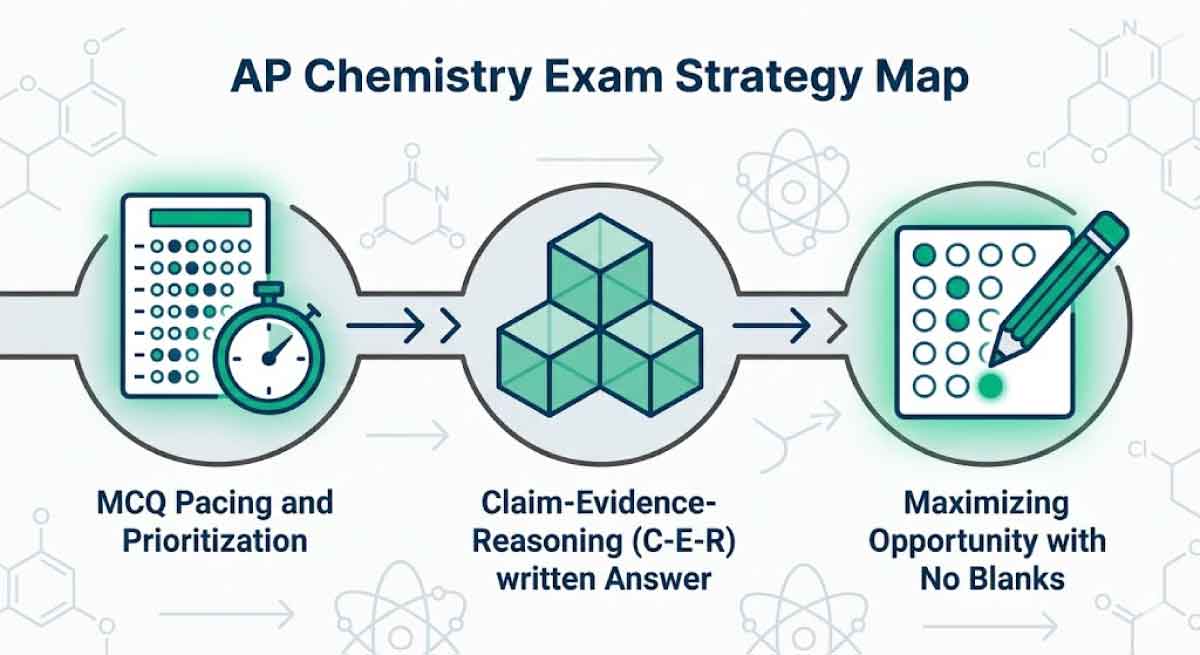
First, the multiple choice questions account for exactly half of your total grade. Furthermore, they require absolutely no writing. Therefore, mastering your pacing here takes massive pressure off the difficult written section.
Consequently, if you secure high points early, you can relax later. Ultimately, a strong start makes passing much easier. You should always check the calculator to see how a high multiple choice score protects your final grade.
How to Use Claim, Evidence, and Reasoning
First, short written questions demand very specific answers. Specifically, graders look for a clear Claim, Evidence, and Reasoning format. Consequently, this C-E-R method guarantees full points on justification questions.
Because of this, you should never write long, rambling paragraphs. Instead, state your answer clearly. Next, provide your data. Finally, explain why the science supports your claim. This simple structure saves time and maximizes your score.
Why You Should Never Leave Blanks
First, the College Board changed its scoring rules a few years ago. Specifically, they do not penalize you for wrong answers anymore. Therefore, an empty bubble is simply a wasted opportunity.
Because of this, you must guess on every single multiple choice question. However, if time runs out, pick your favorite letter and fill in the remaining circles quickly. Ultimately, a random guess might give you the exact point you need to reach the next tier. Use this strategy to protect your hard work.
You Might Also Find These Helpful
Exams 15
Use our AP Human Geography score calculator to predict your final 1 to 5 exam grade. Enter your practice MCQ and FRQ points for…
Try calculatorPredict your final test grade instantly. Use our AP Lang Score Calculator to convert your practice points into a 1 to 5 score. Plan…
Try calculatorUse our AP Physics 1 score calculator to predict your final grade. Enter your practice test results today. See your total composite points instantly.
Try calculatorPredict your final 1 to 5 grade with our AP Physics C score calculator. It covers both Mechanics and E&M. Therefore, you can plan…
Try calculatorPredict your final 1-5 grade with our real-time AP Precalculus Score Calculator. Enter your MCQ and FRQ points to find your exact college credit…
Try calculatorUse our accurate AP Spanish Score Calculator to predict your final 1-5 exam grade. Input your MCQ and FRQ points to see your composite…
Try calculatorPredict your final 1 to 5 exam grade instantly with our accurate AP stats score calculator. Enter your MCQ and FRQ points to calculate…
Try calculatorStressing over your apush exam? Use our free AP US History Score Calculator to predict your final 1 to 5 grade. Enter your practice…
Try calculatorUse the Exam Eligibility Calculator to check age, cutoff date, attempts, and education rules. See instantly if you are eligible, not eligible, or eligible…
Try calculatorCommon Mistakes When Predicting Your AP Score
Calculating your predicted score requires precise inputs. Small errors in your data often lead to large differences in your final grade. This tool relies on your exact raw points to apply the correct College Board curves. Below are the most common mistakes students make. Reading this helps you get the most accurate result possible from the AP chem grade calculator.
- Entering Percentages Instead of Raw Scores First, entering a percentage is a massive error. The AP chem grade calculator requires the exact number of questions you answered correctly. For example, you must enter 45 correct answers. You must never enter 75 percent. The tool uses raw points to find your final composite score. Therefore, your prediction will fail completely if you enter a percentage.
- Ignoring the AP Chemistry Calculator Policy Next, students often practice without a device at home. They do not realize the official rules actually changed. Specifically, the current AP chem calculator policy now allows a scientific or graphing calculator on both sections of the exam. Therefore, you should always practice with your calculator.
- Assuming All Scores Are Equal Finally, assuming all passing grades are identical is a dangerous mistake. For instance, earning 58 points gives you a 4. However, earning 73 points also gives you a 4. Because of this, you must always check your safety margin in the results panel. You need to see exactly how close you are to the next grade bracket.

Frequently Asked Questions (FAQs)
Can you use a calculator on the AP Chemistry exam?
Yes. You can use a scientific or graphing calculator on the exam. Specifically, the College Board allows calculators on both the multiple choice and free response sections. Therefore, you should always practice with your device to save time.
Consequently, you can store important formulas. However, you must ensure your specific calculator model is fully approved before test day.
How many questions do you need to get a 5 on AP Chem?
You need roughly 75 out of 100 total composite points to secure a 5. For example, you could answer 45 multiple choice questions correctly and earn 30 written points. Because the curve changes annually, you should always aim slightly higher.
Therefore, our AP Chem score calculator provides a helpful safety margin. Ultimately, this tool helps you plan your required points perfectly.
What percentage is a 4 on the AP Chemistry exam?
You generally need to earn between 58 percent and 73 percent of the total available points. First, this translates to roughly 58 to 73 composite points out of 100. Furthermore, earning a 4 shows you are well qualified for college credit.
As a result, many top universities will accept this score. However, you should always check the specific credit policies of your target colleges.
How is the AP Chemistry score calculated?
The College Board uses a weighted mathematical system. First, they multiply your correct multiple choice answers by 0.8333. Next, they multiply your total written points by 1.0870. Finally, they add these two scaled numbers together to find your composite score.
Because of this, each section accounts for exactly half of your final grade. Therefore, our AP Chem score calculator mimics this exact official process.
Is the AP Chemistry exam curved?
Yes. The College Board curves the exam every single year. First, they analyze global student performance and overall test difficulty. Then, they adjust the final grading brackets slightly. As a result, a 72 might earn a 5 one year, but only a 4 the next.
Consequently, you must never rely on old raw score charts alone. Instead, use a dynamic calculator to see different curve scenarios.
Are the long and short free response questions weighted differently?
Yes. Long free response questions are worth a maximum of 10 raw points. Meanwhile, short free response questions are worth a maximum of 4 raw points. However, the graders add all of these raw points together into one total sum.
Then, they multiply that final sum by 1.0870. Therefore, every single written point holds the exact same scaled weight in the end.
Questions?
We had love to hear from you! Whether you are reporting an issue, suggesting a new calculator, or exploring collaboration opportunities — we are here to help. Every message helps us make 100calc smarter, faster, and more helpful for everyone.
Why People Trust 100calc
At 100calc.com, we focus on accuracy, speed, and trust. Every calculator we create is designed to give reliable, instant, and easy-to-understand results you can truly depend on.