
AP Score Calculator
Waiting for your AP scores can cause a lot of stress. You can use our universal AP score calculator to predict your final 1 to 5 score early. This tool works perfectly before the College Board releases official results.
Many students ask when do ap scores come out 2025. Usually, they arrive in July. However, you do not have to wait until summer. You might need an ap english language and composition predictor. Perhaps you want an ap score calculator computer science principles tool. Sometimes, you just need a custom ap curve calculator for an exam with no dedicated page. In all these cases, AP score calculators give you highly accurate answers.
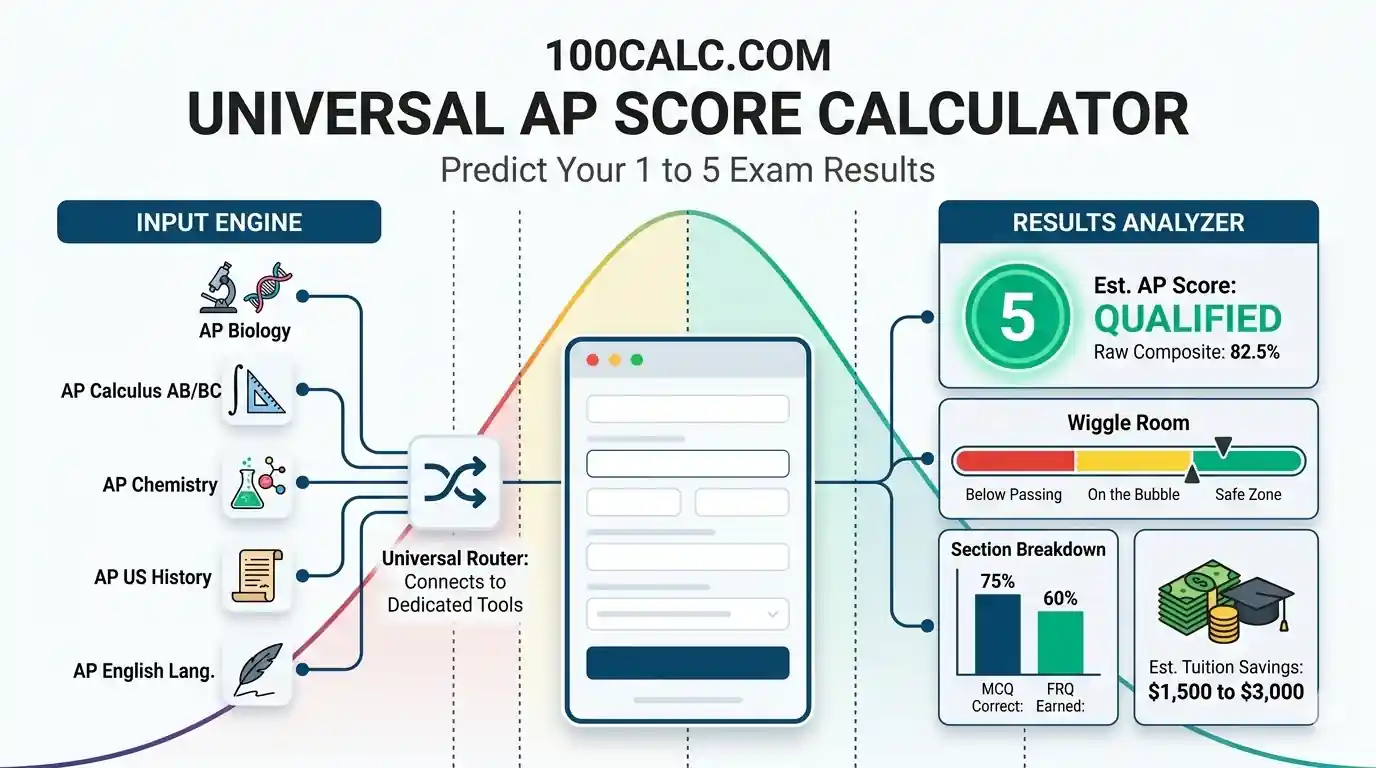
First, you enter your Multiple Choice (MCQ) and Free Response (FRQ) estimates. Next, you adjust the exam weighting. Then, you set the curve strictness. After that, our engine calculates your raw composite score instantly. Furthermore, it reveals your exact ap score meaning. Finally, it analyzes your “Wiggle Room” safety net. As a result, you know exactly how close you are to the next tier.
- Updated Jun 19, 2026
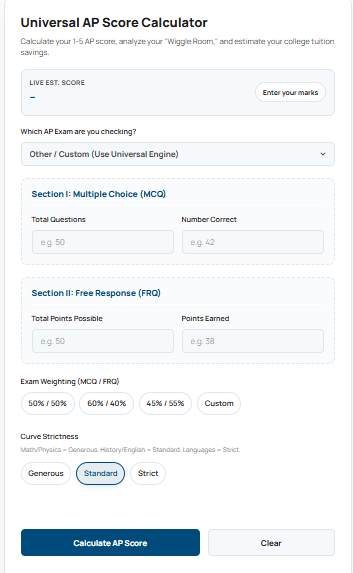
Universal AP Score Calculator
Calculate your 1-5 AP score, analyze your "Wiggle Room," and estimate your college tuition savings.
We have a highly specialized calculator for this subject with exact historical cutoffs.
Take me there →Section I: Multiple Choice (MCQ)
Section II: Free Response (FRQ)
Math/Physics = Generous. History/English = Standard. Languages = Strict.
Estimated AP Score
You have a strong safety net before dropping to the next score tier.
🎓 Real-World Value
--
1. What is my AP Score and what does it mean?
Use the calculator above to generate your personalized AP score report.
2. How do universal AP exam calculators weigh MCQ vs FRQ?
Whether you are using an ap lang score calculator, an ap gov score calculator, or predicting an ap psych score calculator result, the College Board does not use straight high school percentages. Your Multiple Choice (MCQ) and Free Response (FRQ) sections are weighted—often 50/50 or 60/40—to create a composite score. That raw composite is then mapped to the 1-5 curve. Because curves vary so wildly (a 60% on the ap physics 1 score calculator might be a 5, while a 60% on the ap spanish score calculator is a 3), our ap exam score calculator allows you to adjust the curve strictness manually. This makes it the most accurate ap precalc score calculator and universal tool on the web for subjects that don't have a dedicated page yet.
What Your AP Score Calculator Result Means
Your AP score calculator results show more than just a final number. In fact, they explain your exact performance level. This section helps you understand your raw score and curve placement.
Understanding Your Composite Score
First, the calculator produces a raw composite percentage. It builds this percentage from your Multiple Choice and Free Response scores. Specifically, it calculates each section independently. Then, it combines them based on your chosen exam weighting. As a result, you see your true raw performance before any curve applies.
How The Wiggle Room Works
Next, the tool applies your selected curve. It maps your raw percentage to a final 1 to 5 score. For instance, an AP Physics C score calculator requires a generous curve. Meanwhile, other exams use standard or strict curves. Therefore, your final number depends heavily on this setting. Finally, you must check your Bubble Analyzer. This feature tells you your exact safety net. It shows how many percentage points you can lose before dropping down a tier. Also, it reveals how many points you need to reach the next level. Use this data to plan your studies smartly.
Test the Calculator With Real Examples
Use the examples below to test the calculator. First, enter the values exactly as shown. Then, you can change them later to match your own exam needs.
Example 1: The Pushing Up Scenario
Use this to test: Standard Curve and Wiggle Room
- Exam: Custom
- MCQ Correct: 40 out of 50
- FRQ Earned: 28 out of 50
- Weighting: 50 percent / 50 percent
- Curve: Standard
What you should see:
Final AP Score of 4.
Raw Composite Score around 68.0 percent.
Wiggle Room Analyzer shows Pushing Up.
Results indicate you need 2.0 percent for a 5.
Example 2: The Safe 3 Scenario
Use this to test: Custom Weights and Strict Curve
Exam: Custom
MCQ Correct: 35 out of 50
FRQ Earned: 25 out of 50
Weighting: Custom at 70 percent MCQ
Curve: Strict
What you should see:
Final AP Score of 3.
Raw Composite Score around 64.0 percent.
Wiggle Room Analyzer shows Safe Zone.
Results give you a 9.0 percent safety net.
Want to sell your gold or check jewelry value? Try these calculators.
Stop guessing your grade! Use our free Final Exam Calculator to instantly find out exactly what score you need to pass or hit your…
Try calculatorPredict your grade with our accurate AP Biology Score Calculator. Enter your multiple choice and free response points to see your exact 1 to…
Try calculatorWorried about your free response answers? Use our AP Calculus AB score calculator to find your exact 1-5 grade. Check your wiggle room and…
Try calculatorWondering what you will score? Use our AP Calculus BC Score Calculator to find out! Input your practice MCQ and FRQ points to get…
Try calculatorUse our accurate AP Chemistry score calculator to predict your final 1 to 5 grade. Convert your raw multiple choice and written points instantly.…
Try calculatorUse our accurate AP Environmental Science Score Calculator to predict your 1-5 apes grade. Enter your MCQ and FRQ practice test points instantly!
Try calculatorHow to Use the Universal AP Score Calculator
Using this tool is very simple. You only need your practice test results. The calculator uses your estimated marks to predict your final grade. Follow these five steps to get your result instantly.
Check the Smart Router
First, select your subject from the dropdown menu. We have dedicated tools for many exams. For example, you can select the apush score calculator. Alternatively, you can pick the ap score calculator chem. The system will automatically route you to the correct page.
Enter Your Multiple Choice Performance
Next, input your Multiple Choice details. You must enter the total number of questions first. Then, type how many questions you answered correctly.
Enter Your Free Response Performance
After that, enter your Free Response details. You need to input the total points possible. Then, type the exact points you confidently earned.
Set Exam Weighting and Curve
Now, select your specific test ratio. You also need to choose a curve strictness. Math and Physics exams usually use a Generous curve. History and English exams use a Standard curve. Language exams require a Strict curve.
Calculate and Analyze Results
Finally, click the calculate button. You will instantly see your estimated 1 to 5 score. The tool also provides your ap score conversion chart breakdown. Plus, it reveals your potential college credit value.
Quick Formula Used
Raw Composite Score = (MCQ Correct Percent times MCQ Weight) plus (FRQ Earned Percent times FRQ Weight)
Why This Process Is Accurate:
We weigh sections precisely. We apply exact percentages to your inputs.
We use dynamic curves. We adjust the passing thresholds based on your subject difficulty.
We find raw composites. We find your true baseline score before any curve applies.
We reflect reality. The tool mimics actual exam grading patterns.
Try It Yourself:
- Enter 40 correct Multiple Choice questions out of 50.
- Enter 28 earned Free Response points out of 50.
- Select the Standard curve and click calculate.
You will instantly see your predicted score. Also, you will see your exact distance to the next tier.
AP Calculator Score Formula Explained (Complete Breakdown)
This section explains exactly how AP score calculators estimate your final grade. It reveals the math behind raw composites, section weights, and curve strictness. We do not have your actual graded test sheet. Therefore, we calculate your theoretical score using your estimates. This helps you understand where the numbers come from. Also, it shows why accuracy depends on precise inputs.
First, we calculate your raw success rate for each section. Then, we apply the specific exam weight. Finally, we compare your total to historical curve thresholds.
The Final Score Formula
This formula powers our calculator. It converts your raw marks into a final percentage.
Formula:
Raw Composite Score = (MCQ Percent Correct × MCQ Weight) + (FRQ Percent Earned × FRQ Weight)
This formula relies on three key variables. Each variable comes directly from your input or historical exam standards.
Variable 1: MCQ and FRQ Percentages
First, we determine your raw success rate on each section. We take your total questions and correct answers. Then, we convert them into a simple percentage.
MCQ Percent: Your correct multiple choice answers divided by the total questions.
FRQ Percent: Your earned free response points divided by the total possible points.
Variable 2: Section Weights
Not all exams treat multiple choice and free response equally. Some tests split them evenly. Others heavily favor one section.
The weight is a percentage. We use it to multiply your raw scores. For example, a 50/50 weight means each section counts for half your grade. Alternatively, a 60/40 weight means the MCQ section controls 60 percent of your final score.
Variable 3: Curve Strictness Thresholds
This is the most critical adjustment. Finally, we map your composite score to a 1 to 5 scale. Pure percentages do not work for these tests. The College Board lowers the passing bar for very hard exams.
Generous Curve: You need about 55 percent for a 5. You need 40 percent for a 4. You need 25 percent for a 3. You need 15 percent for a 2.
Standard Curve: You need about 70 percent for a 5. You need 55 percent for a 4. You need 40 percent for a 3. You need 25 percent for a 2.
Strict Curve: You need about 85 percent for a 5. You need 70 percent for a 4. You need 55 percent for a 3. You need 40 percent for a 2.
Example Calculations You Can Test
Use these exact inputs to test the calculator logic. We show the math step by step. As a result, you can see how raw points turn into a final grade.
Example 1: The Danger Zone Scenario
Use this to test our ap score calculator physics 1 setting. It shows a student struggling on a hard science exam with a generous curve.
Given:
Exam: Custom
MCQ Correct: 7 out of 50
FRQ Earned: 7 out of 50
Weighting: 60 percent / 40 percent
Curve Strictness: Generous
Calculation:
					Convert to Percentages: 7 divided by 50 equals 14 percent for both sections.

Apply Weights: (14 percent times 0.60) plus (14 percent times 0.40).

Find Composite: 8.4 plus 5.6 equals 14.0 percent.

Apply Curve: The Generous threshold for a 2 is 15 percent.
Result:
Estimated Score: 1.
The analyzer shows Below Passing. It indicates you need 1.0 percent more to reach a 2.
Meaning:
This formula calculates your final grade using exact section weights. It does not use simple high school grading scales. Instead, it reflects the theoretical curve. Because of this, you get a highly realistic estimate. AP score calculators rely on this exact math. Therefore, you now have a reliable baseline to guide your study sessions.
Understanding Your AP Score Results
Your calculator results show more than just a passing grade. They help you understand the real value of your exam for different colleges. Universities and high schools use specific score thresholds for different needs. Here is a quick breakdown. It will help you read your results and understand college credit standards.
| Score | Category | AP Score Meaning & College Value |
|---|---|---|
| 5 | Extremely Well Qualified | Top tier. Usually grants 3–6 college credits, saving $1,500–$3,000 in tuition. |
| 4 | Well Qualified | Very strong. Accepted for credit at the vast majority of universities. |
| 3 | Qualified | Passing score. Often accepted for credit at public and state universities. |
| 2 | Possibly Qualified | Below passing. Rarely accepted for college credit. |
| 1 | No Recommendation | Below passing. Does not grant college credit. |
Important: College credit policies vary by institution. Always check your target university's specific AP credit policy, as elite schools often require a 4 or 5.
How to Read This Table With the Calculator
First, enter your practice test marks into the calculator above. Note your estimated 1 to 5 score. Now compare your calculated result against the Score column. Then, check the College Value row. This comparison acts as a reality check. It tells you immediately if your result earns college credit. Also, it shows if you need to study more.
What This Means For You
If your calculator result lands in the top tiers, you are likely earning credit. If your result is far lower, you almost certainly need more practice. This helps you avoid bad surprises in July. If you are applying to elite schools, you know they expect top marks. If you are looking at state schools, you can see if a passing grade is enough. AP score calculators make these goals very clear.
Actionable Insights and Smart Recommendations
Use your estimated test results to make smarter study decisions. Understanding how section weights and curves affect your final grade helps you spot weak areas. Compare your calculator result with your target college requirements. This helps you confirm if you need more practice. These insights help you act with confidence when preparing for test day. Ultimately, AP score calculators give you the exact data you need to succeed.

Why You Must Audit Your FRQs
You must audit your free response answers carefully. Students frequently overestimate their earned points on practice tests. They often assume partial credit that graders do not actually give.
Therefore, you should grade yourself 10 to 15 percent harsher on this section. Do not give yourself the benefit of the doubt. This strict grading gives you a realistic safety net. As a result, you avoid bad surprises when July arrives.
How to Use the Bubble Analyzer
Pay close attention to the Wiggle Room metric in the results panel. You might land exactly “On the Bubble” between a passing 3 and a failing 2.
If this happens, you should focus your final study sessions strictly on high-yield topics. Do not waste time on rare trivia. A few extra multiple choice points can easily push you into the next tier. AP score calculators help you target these exact score boundaries.
Why Knowing Your Specific Curve Matters
Always remember your specific curve strictness. The College Board scales different subjects in very different ways.
For example, an ap score calculator apes (Environmental Science) curve looks vastly different from an ap score calculator physics c curve. You must select the correct strictness level from our dropdown menu. Otherwise, your predictions will be completely inaccurate. Always match the tool to your exact test subject. This ensures you get the most reliable baseline possible.
You Might Also Find These Helpful
Exams 15
Use our AP Human Geography score calculator to predict your final 1 to 5 exam grade. Enter your practice MCQ and FRQ points for…
Try calculatorPredict your final test grade instantly. Use our AP Lang Score Calculator to convert your practice points into a 1 to 5 score. Plan…
Try calculatorUse our AP Physics 1 score calculator to predict your final grade. Enter your practice test results today. See your total composite points instantly.
Try calculatorPredict your final 1 to 5 grade with our AP Physics C score calculator. It covers both Mechanics and E&M. Therefore, you can plan…
Try calculatorPredict your final 1-5 grade with our real-time AP Precalculus Score Calculator. Enter your MCQ and FRQ points to find your exact college credit…
Try calculatorUse our accurate AP Spanish Score Calculator to predict your final 1-5 exam grade. Input your MCQ and FRQ points to see your composite…
Try calculatorPredict your final 1 to 5 exam grade instantly with our accurate AP stats score calculator. Enter your MCQ and FRQ points to calculate…
Try calculatorStressing over your apush exam? Use our free AP US History Score Calculator to predict your final 1 to 5 grade. Enter your practice…
Try calculatorUse the Exam Eligibility Calculator to check age, cutoff date, attempts, and education rules. See instantly if you are eligible, not eligible, or eligible…
Try calculatorCommon Mistakes When Calculating AP Scores
Small errors in your inputs create bad predictions. Avoid these common mistakes for the most accurate estimate.
- Ignoring the Section Weights: First, students often treat multiple choice and free response points equally. However, many exams use a 60 to 40 weight. Therefore, you must set the exact ratio for your test.
- Using Straight Percentages: Second, students assume a 65 percent raw score is failing. Actually, this percentage often earns a solid 4 or 5 on generous curves. Thus, never judge your score without applying the curve.
- Using the Wrong Tool: Finally, students use generic tools for highly specific exams. Instead, you must use our Smart Router. For instance, it connects directly to the ap score calculator calc bc or ap score calculator lang.

Frequently Asked Questions (FAQs)
Are AP score calculators accurate?
Yes, AP score calculators are very accurate. They use historical data and official grading rubrics. Our universal tool maps your exact raw points to the correct curve. Therefore, you get a highly reliable estimate of your final grade.
However, the College Board slightly changes the curve every year. You should always aim a few points higher to stay safe.
When do AP scores come out 2026?
The College Board releases the official test results in early July 2026. They usually post them online during the first or second week of the month. You can access them directly through your official student web portal. However, you do not have to wait blindly. You can use our AP score calculators to predict your results months in advance.
What is a good AP score for college?
A final score of 4 or 5 is excellent for most colleges. Elite universities usually require a 5 for college credit. State schools often accept a solid 3. You should always check the specific credit policy of your target school.
A higher grade saves you tuition money. It also allows you to skip entry-level college classes during your freshman year.
Do colleges accept a 3 on an AP exam?
Yes, many public universities accept a 3 for college credit. This grade proves you understand the subject well enough to pass. However, highly competitive private schools rarely accept a 3. They usually demand top marks to grant course exemptions.
Use our Wiggle Room analyzer. It helps you see how close your practice test is to a safer tier.
How does the College Board curve the AP exams?
The College Board does not grade on a traditional curve. Instead, they use a standard-setting process. They adjust the passing threshold based on exam difficulty. For example, a hard physics test requires fewer correct answers to earn a 5.
This system keeps grades fair across different years. Our calculator mimics this process using three dynamic strictness levels.
How many multiple choice questions do I need for a 5?
You usually need about 70 percent correct for a standard exam. This equals exactly 35 out of 50 questions. Generous science exams require much less. Strict language exams require almost 85 percent correct to reach the top tier safely.
Your free response points also matter greatly. A strong written section can save a weak multiple choice performance.
When do AP scores come out every year?
The College Board releases the official test results in early July every single year. They usually post them online during the first or second week of the month. You can access them directly through your official student web portal.
You do not have to wait blindly. You can use AP score calculators to predict your results months in advance.
Questions?
We had love to hear from you! Whether you are reporting an issue, suggesting a new calculator, or exploring collaboration opportunities — we are here to help. Every message helps us make 100calc smarter, faster, and more helpful for everyone.
Why People Trust 100calc
At 100calc.com, we focus on accuracy, speed, and trust. Every calculator we create is designed to give reliable, instant, and easy-to-understand results you can truly depend on.