
AP US History Score Calculator
Are you stressing over your upcoming Advanced Placement US History test? You can relax now. Our free AP US history score calculator is the fastest way to predict your final grade. First, this tool takes your practice test results. Then, it instantly converts them into a 1 to 5 scale. It uses the official APUSH exam weighting to give you accurate results. Many students want to know what percent is a 5 on the APUSH exam.
Also, they often need a reliable AP US history grade calculator. We have you covered on both fronts. Plus, we fully updated this tool to match the latest College Board rubrics. Therefore, it is completely accurate for your current school year. Simply enter your multiple choice and essay scores below. After that, you will see exactly where you stand.
- Updated Jun 22, 2026
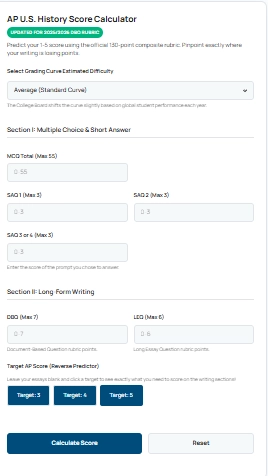
AP U.S. History Score Calculator
Updated for 2025/2026 DBQ RubricPredict your 1-5 score using the official 130-point composite rubric. Pinpoint exactly where your writing is losing points.
The College Board shifts the curve slightly based on global student performance each year.
Section I: Multiple Choice & Short Answer
Enter the score of the prompt you chose to answer.
Section II: Long-Form Writing
Document-Based Question rubric points.
Long Essay Question rubric points.
Leave your essays blank and click a target to see exactly what you need to score on the writing sections!
- Scaled MCQ (Max 52)
- 0.0
- Scaled SAQ (Max 26)
- 0.0
- Scaled DBQ (Max 32.5)
- 0.0
- Scaled LEQ (Max 19.5)
- 0.0
Fill out your practice exam scores to see your predicted APUSH score.
What Your AP US History Score Calculator Result Means
Your APUSH score calculator results show more than just a basic number. They explain exactly where you stand before test day. This section helps you understand your total composite points. Use it to make smarter study choices.
How the College Board Scales Your Grade
Your final grade is never a simple percentage. Instead, the College Board converts your raw points into a scaled number from 1 to 5. First, they look at how well you performed across all sections. Then, they curve the exam slightly every year. They do this to ensure total fairness. Therefore, your total composite score determines your final tier.
What a Score of 5 Means for You
However, this result shows the raw melt value only. It does not include making charges, taxes, or design fees. Jewelry shops always add these labor costs to the final retail price. Also, scrap dealers often pay less than this rate to cover their margins. You should treat this number as a baseline reference for negotiations.
What a Score of 3 Means for You
Earning a 3 means you officially passed the test. Usually, you need around 66 out of 130 composite points. This passing grade may earn you college credit at many schools. However, you might want to aim higher.
To push this grade to a 4, you should focus on your essays. For example, earning just one or two more points on your document based question will boost your overall number.
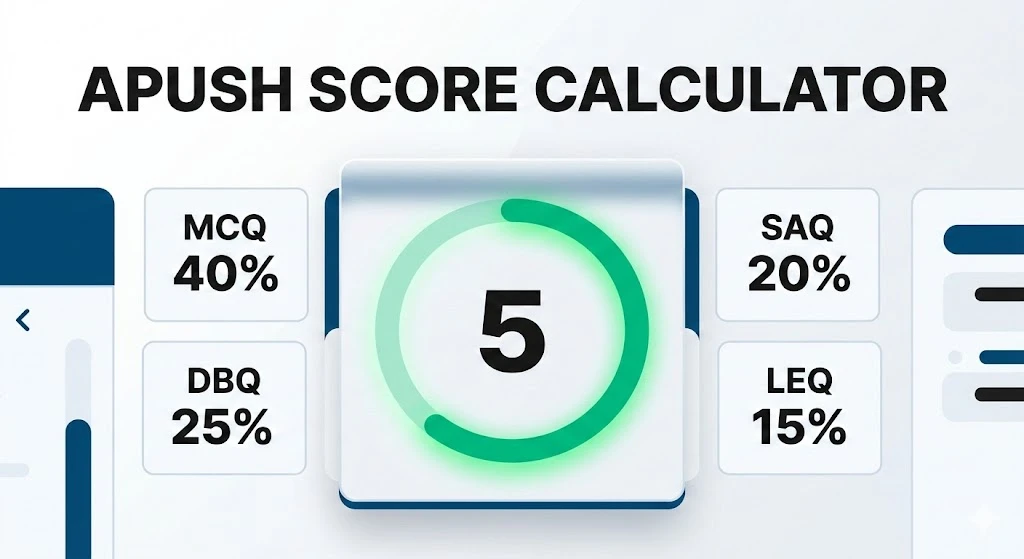
Test the Calculator With Real Examples
Use the examples below to test your AP US history score calculator. Enter the numbers exactly as shown. Then, you can change them later to match your own practice test.
Example 1: The Top Scorer
Use this to test:Earning a maximum grade.
Multiple Choice: 48 points
Short Answer: 7 points
Document Based Essay: 6 points
Long Essay: 5 points
What you should see:
Predicted Grade: 5
Composite Points: Around 110 out of 130
Meaning: You have clearly mastered historical thinking skills. Furthermore, your evidence based writing is excellent. As a result, you are fully prepared for the real test.
Example 2: The Passing Student
Use this to test: Earning a basic passing grade.
Multiple Choice: 30 points
Short Answer: 4 points
Document Based Essay: 3 points
Long Essay: 3 points
What you should see:
Predicted Grade: 2
Composite Points: Around 64 out of 130
Meaning: You officially passed the exam. However, you might want a higher grade. Therefore, to push this to a 4, you must focus on your essays. Specifically, try earning just one or two more points on your document based question.
Explore More Calculators
Predict your 1-5 score with our universal AP Score Calculator. Find your "Wiggle Room" safety net, adjust MCQ/FRQ weights, and estimate college credit value…
Try calculatorStop guessing your grade! Use our free Final Exam Calculator to instantly find out exactly what score you need to pass or hit your…
Try calculatorPredict your grade with our accurate AP Biology Score Calculator. Enter your multiple choice and free response points to see your exact 1 to…
Try calculatorWorried about your free response answers? Use our AP Calculus AB score calculator to find your exact 1-5 grade. Check your wiggle room and…
Try calculatorWondering what you will score? Use our AP Calculus BC Score Calculator to find out! Input your practice MCQ and FRQ points to get…
Try calculatorUse our accurate AP Chemistry score calculator to predict your final 1 to 5 grade. Convert your raw multiple choice and written points instantly.…
Try calculatorHow to Use the AP US History Score Calculator
Using this tool is very simple. First, you only need your practice test results. Then, the APUSH score calculator uses your raw points to estimate your final grade. Therefore, follow these six steps to get your prediction instantly.
Grade Your Multiple Choice
First, check your answers for the first section. Then, count your correct responses out of 55 total questions. Remember, there is no guessing penalty. As a result, you should count every correct bubble.
Score Your Short Answer Questions
Next, read through your three short answer responses. After that, grade each one on a scale of zero to three points. Overall, try to be very strict with your grading.
Grade Your Long Essays
Now, use the latest official rubrics to score your writing. First, grade your document based question out of seven points. Next, grade your long essay question out of six points.
Enter Your Points
Then, type all your raw scores into the AP US history score calculator. Additionally, you can select the curve difficulty. For example, choose between generous, average, or strict grading curves.
Review Your Prediction
Finally, the results panel will instantly display your estimated grade. Specifically, you will see a number from one to five. Consequently, you can now use this information to plan your study sessions.
Quick Formula Used
Composite Score = (Multiple Choice × 0.94) + (Short Answer × 2.88) + (Document Essay × 4.64) + (Long Essay × 3.25)
Why This Process Is Accurate
Weights Are Exact: We multiply your raw points by the official College Board decimals.
Curves Are Historical: We use real equating data from past years.
Math Is Instant: The tool handles all the heavy lifting for you.
This method matches the actual scoring system. Furthermore, it calculates your true composite number. Ultimately, this ensures your estimate reflects your real test performance.
Try It Yourself
First, leave your essay sections completely blank.
Then, click the “Target 5” button in our tool.
You will instantly see the exact essay scores you need to reach your goal.
APUSH Score Calculator Formula Explained
This section explains exactly how our tool estimates your final grade. It reveals the math behind the official College Board grading system. Because we do not have your actual test grader here, we calculate your composite score using strict decimal multipliers. This helps you understand where the numbers come from. Therefore, you will see why accuracy depends on entering your precise practice test points.
We start by taking your raw points from each test section. Then, we apply specific weight percentages to each category. Finally, we add them together to find your final score out of 130 possible points.
The Weight Formula
This specific math powers the AP US history score calculator. It converts your raw practice points into a final scaled number.
The Formula:
Composite Score = (Multiple Choice × 0.9454) + (Short Answer Total × 2.8889) + (Document Essay × 4.6428) + (Long Essay × 3.25)
This formula relies on four key variables. Each variable comes directly from the official exam structure.
Variable 1: Multiple Choice (40 Percent Weight)
First, we look at your performance on the first part of the test. You will answer 55 total questions. These questions assess your historical context knowledge. Furthermore, they test your stimulus interpretation skills.
- Calculation: We multiply your correct answers by 0.9454. Consequently, this scales your score to fit the 40 percent weight.
Variable 2: Short Answer (20 Percent Weight)
Next, we evaluate your written short responses. The test requires you to answer three separate questions. You must provide direct and concise answers. Specifically, many students use the answer, cite, and explain method to succeed here.
- Calculation: We add your points together. Then, we multiply your total by 2.8889.
Variable 3: Document Based Essay (25 Percent Weight)
This is the most critical written section on the test. You must write one complete essay analyzing provided historical documents. You earn points for your thesis, context, evidence, and analysis.
- Calculation: We take your raw points out of seven. Next, we multiply that number by 4.6428.
Variable 4: Long Essay (15 Percent Weight)
Finally, we factor in your last essay. You must write one long essay using your own outside historical evidence.
- Calculation: We take your points out of six. After that, we multiply them by 3.25.
Example Calculation You Can Test
Use these exact inputs to test the calculator logic. We show the math step by step. As a result, you can easily see how raw points turn into a final grade.
Example 1: The Strong Writer
Use this example to see how great essays boost your grade.
Given:
Multiple Choice: 35 out of 55
Short Answer Total: 7 out of 9
Document Essay: 6 out of 7
Long Essay: 5 out of 6
Calculation:
					Convert Multiple Choice: 35 × 0.9454 = 33.09

Convert Short Answer: 7 × 2.8889 = 20.22

Convert Document Essay: 6 × 4.6428 = 27.86

Convert Long Essay: 5 × 3.25 = 16.25

Add Totals: 33.09 + 20.22 + 27.86 + 16.25 = 97.42 points.
Result:
Composite Score: Around 97 out of 130.
Final Grade: 4.
Takeaway: Even with a lower multiple choice score, strong essay writing easily secures a 4.
Why This Formula Matters
This exact math reveals your true test performance. It never simply guesses your score. Instead, it uses exact College Board weighting. Because of this, your APUSH score calculator results give you a highly reliable baseline. Ultimately, you now have a clear target before test day arrives.
Understanding Your AP US history Score Results
Your AP US history score calculator results show more than just a simple number. Specifically, they help you understand your true readiness for the real exam. Colleges and high schools use these specific scoring tiers for different reasons.
Therefore, we provided a quick breakdown below. Ultimately, this table will help you read your results and understand the official College Board standards.
| Composite Range (Approx.) | AP Score | Category | Meaning |
|---|---|---|---|
| 102 – 130 | Score: 5 | Extremely Well Qualified | Top tier! Almost guaranteed college credit. |
| 85 – 101 | Score: 4 | Well Qualified | Excellent score. Likely to earn college credit. |
| 66 – 84 | Score: 3 | Qualified | Passing score. May earn college credit. |
| 45 – 65 | Score: 2 | Possibly Qualified | Below passing. Usually does not earn credit. |
| 0 – 44 | Score: 1 | No Recommendation | Needs significant review of historical concepts. |
Important: The exact APUSH grading scale shifts slightly each year. These composite benchmarks represent standard historical averages published by the College Board.
How to Read This Table With the Calculator
First, enter your practice test points into the AP US history score calculator above. Next, note your estimated composite score out of 130 possible points. Now, compare your calculated result against the composite range column.
Additionally, check your final grade against the official score column. This comparison acts as a great reality check. Ultimately, it tells you immediately if you are on track to pass the real test.
What This Means For You
If your result falls inside the top tiers, you will likely earn college credit. However, if your result is much lower, you almost certainly need more study time. Therefore, this table helps you avoid bad surprises on test day.
For example, if you are aiming for top colleges, you know exactly what total you need. Alternatively, if your grade is currently too low, you can spot exactly how many points you need to pass.
Quick Example Using the Table
Inputs:
Multiple Choice: 40 points
Short Answer: 6 points
Document Essay: 4 points
Long Essay: 4 points
Results you will see:
Calculator Result: Around 86 composite points
Table Range: 85 to 101 points
Since 86 fits perfectly inside the 85 to 101 range, you can confidently expect a 4. However, you might want a higher grade.
Consequently, if your actual goal is a 5, you must find 16 more composite points to reach the top tier.
Insights and Smart Recommendations
Use your APUSH score calculator results to make smarter study plans. Understanding how each test section affects your total points helps you spot easy wins. First, compare your current practice grades with your goal score.
This step helps you confirm if you need more study time. Ultimately, these insights help you act with total confidence when taking the real exam.

Why You Must Master the Document Essay
This single section boosts your grade very quickly. The document based essay makes up 25 percent of your total score. Therefore, mastering it is absolutely critical for your success. Earning the contextualization and thesis points is the fastest way to increase your grade.
This happens because those first two rubric points are relatively easy to secure. Always practice writing strong introductions. A clear thesis statement sets you up for a high score every time.
Why You Should Never Leave Multiple Choice Blank
The multiple choice section contains 55 total questions. Fortunately, the College Board does not use a guessing penalty anymore. This means you never lose points for wrong answers. Because of this, you should always fill in a bubble on your answer sheet.
If you run out of time, pick one letter and bubble the remaining questions. Ultimately, even a blind guess gives you a 25 percent chance of earning a raw point.
How to Use the Reverse Predictor Tool
Knowing exactly what you need protects you from testing anxiety. Our tool features a built in reverse predictor. First, enter your practice multiple choice score. Next, leave all your essay sections completely blank. Then, click the target five button in our calculator.
Instantly, the tool tells you the exact minimum writing score you need to reach your goal. This baseline knowledge gives you great power during your final study sessions.
You Might Also Find These Helpful
Exams 15
Use our accurate AP Environmental Science Score Calculator to predict your 1-5 apes grade. Enter your MCQ and FRQ practice test points instantly!
Try calculatorUse our AP Human Geography score calculator to predict your final 1 to 5 exam grade. Enter your practice MCQ and FRQ points for…
Try calculatorPredict your final test grade instantly. Use our AP Lang Score Calculator to convert your practice points into a 1 to 5 score. Plan…
Try calculatorUse our AP Physics 1 score calculator to predict your final grade. Enter your practice test results today. See your total composite points instantly.
Try calculatorPredict your final 1 to 5 grade with our AP Physics C score calculator. It covers both Mechanics and E&M. Therefore, you can plan…
Try calculatorPredict your final 1-5 grade with our real-time AP Precalculus Score Calculator. Enter your MCQ and FRQ points to find your exact college credit…
Try calculatorUse our accurate AP Spanish Score Calculator to predict your final 1-5 exam grade. Input your MCQ and FRQ points to see your composite…
Try calculatorPredict your final 1 to 5 exam grade instantly with our accurate AP stats score calculator. Enter your MCQ and FRQ points to calculate…
Try calculatorUse the Exam Eligibility Calculator to check age, cutoff date, attempts, and education rules. See instantly if you are eligible, not eligible, or eligible…
Try calculatorCommon Mistakes When Predicting Your Grade
Using our AP US history score calculator requires honest inputs. Small errors in your practice grading lead to bad predictions. Below are the most common mistakes students make. Reading this helps you get the most accurate estimate possible.
- Students often write way too much for these questions. Instead, you should stick strictly to the answer, cite, and explain method. This simple strategy guarantees your points. Therefore, you avoid wasting valuable test time.
- On the document essay, you must include outside facts. Specifically, you need evidence not found in the provided texts. For example, you might mention Bleeding Kansas if the texts only discuss the Compromise of 1850. Otherwise, you lose a critical rubric point.
- Focusing too heavily on the long essay is a huge error. That specific section is only worth 15 percent of your total grade. Meanwhile, students often ignore the much heavier document essay. The document essay is actually worth 25 percent. Always prioritize the heavier sections in your study strategy.

Frequently Asked Questions (FAQs)
Is a 70% a 5 on the AP exam?
A 70 percent raw score does not guarantee a 5 on every AP exam. The exact percentage required changes based on the specific subject and the annual grading curve. For some difficult exams, a 70 percent easily earns a 5. For easier subjects, you need higher accuracy.
Always check the historical scoring data for your specific class. A 75 to 80 percent target is usually much safer if you want to secure top college credit.
What is a 70% on the APUSH exam?
A 70 percent raw score usually equals a 4 on this test. Specifically, earning 70 percent means you scored around 91 out of 130 composite points. This total places you solidly in the passing tier. Therefore, you will likely earn college credit at most universities.
However, this percentage is not quite enough for a 5. You usually need around 75 to 80 percent to reach the highest grade level.
Is a 5 on APUSH impressive?
Yes, earning a 5 on this exam is highly impressive. Specifically, only about 10 to 11 percent of all students achieve this top grade each year. It shows you have deeply mastered historical thinking skills. Furthermore, it proves you can write excellent evidence based essays.
Top universities look closely at this top grade. Next, you can use our APUSH score calculator to check your current progress. As a result, you can easily earn maximum college credit.
Is APUSH the hardest AP class?
Many students consider APUSH one of the hardest classes available. Specifically, it requires massive amounts of reading and memorization. Furthermore, the writing sections demand highly specific historical evidence. Therefore, you must manage your study time perfectly to succeed in this difficult course.
However, classes like AP Physics C or AP Chemistry often rank higher in overall difficulty. Ultimately, your personal reading and writing skills determine your actual struggle.
Do AP scores boost your GPA?
First, your actual test number from one to five does not directly boost your high school GPA. However, simply taking the class and passing it will often boost your weighted grade. Ultimately, your high school teacher determines your final class grade for your official transcript.
Additionally, most high schools add a full extra point to your weighted GPA for taking an advanced class. Therefore, earning a B usually counts exactly like an A.
What is the easiest AP ever?
AP Computer Science Principles and AP Psychology are universally considered the easiest exams. Specifically, AP Psychology requires mostly basic vocabulary memorization. Meanwhile, Computer Science Principles focuses on simple projects instead of hard math. Therefore, these classes have incredibly high pass rates every single year.
Additionally, AP Human Geography is a great choice for beginners. However, remember that your own personal skills always determine how easy a test actually feels.
Questions?
We had love to hear from you! Whether you are reporting an issue, suggesting a new calculator, or exploring collaboration opportunities — we are here to help. Every message helps us make 100calc smarter, faster, and more helpful for everyone.
Why People Trust 100calc
At 100calc.com, we focus on accuracy, speed, and trust. Every calculator we create is designed to give reliable, instant, and easy-to-understand results you can truly depend on.