
AP Environmental Science Score Calculator
Are you preparing for the apes exam? Do you wonder what it takes to get a 5? Our accurate AP environmental science score calculator takes the guesswork out of your study plan. First, you input your practice test results. Next, this tool instantly converts your raw scores into a predicted 1 to 5 scaled score. It calculates both your multiple choice and free response points. You might be aiming for college credit.
Alternatively, you just want to make sure you pass. Therefore, using this tool helps you find your exact safety margin. Furthermore, it uses the latest College Board exam rubrics. As a result, it provides reliable feedback. This feedback will actively guide your study sessions.
- Updated Jun 22, 2026
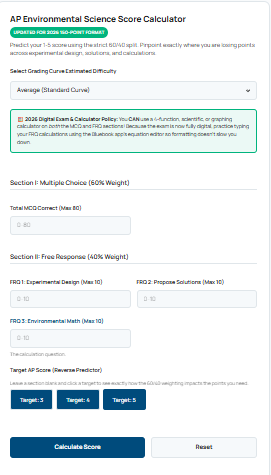
AP Environmental Science Score Calculator
Updated for 2026 150-Point FormatPredict your 1-5 score using the strict 60/40 split. Pinpoint exactly where you are losing points across experimental design, solutions, and calculations.
Section I: Multiple Choice (60% Weight)
Section II: Free Response (40% Weight)
The calculation question.
Leave a section blank and click a target to see exactly how the 60/40 weighting impacts the points you need.
- Scaled MCQ (Max 90)
- 0.0
- Scaled FRQ (Max 60)
- 0.0
Fill out your practice exam scores to see your predicted APES score.
Understanding Your AP Environmental Science Score Calculator Result
Your ap environmental science score calculator results show more than just a number. They explain exactly how well you understand the course material. This section helps you understand your final predicted score. Use it to find your weak spots. Then you can plan your final study sessions.
What a Score of 5 Means
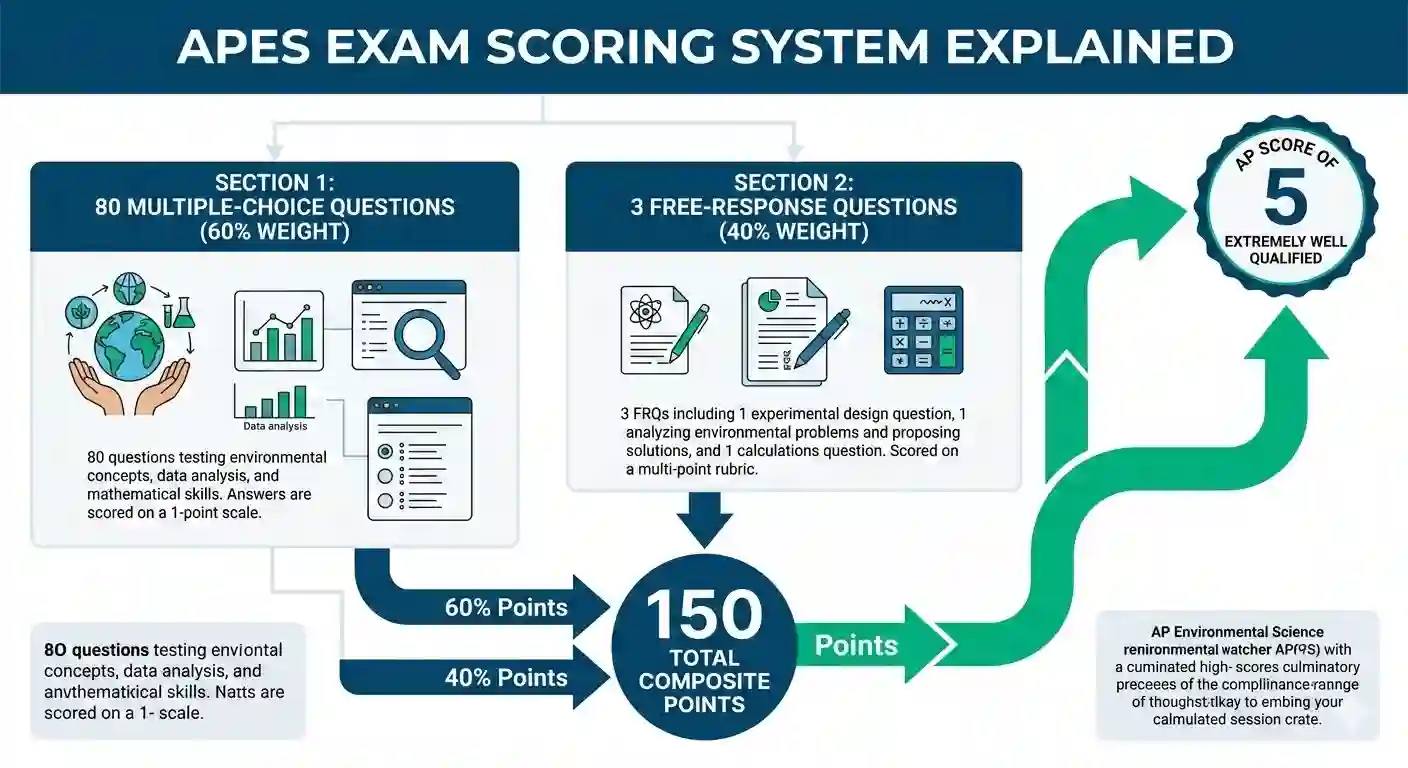
A score of 5 means you are extremely well qualified. You have truly mastered the environmental science material. Therefore, you are almost guaranteed college credit at most universities. You usually need a total composite score of 104 or higher out of 150 points. This shows excellent performance on both multiple choice and free response questions.
What a Score of 4 Means
A score of 4 means you are well qualified. You put in a very strong performance on your practice test. You likely understand the core concepts well. However, you only need to fix a few minor conceptual gaps. Focus on your weakest section to push your score up to a 5.
What a Score of 3 Means
A score of 3 means you are qualified. Most importantly, it means you passed the exam. You successfully demonstrated foundational knowledge. Many public colleges will grant you course credit for a 3. You should review your free response answers to see where you lost points.
What Scores of 1 or 2 Mean
Scores of 1 or 2 mean you did not pass. You might be struggling with the math calculations or the experimental design concepts. First, do not panic. Next, review the scoring rubrics carefully. Finally, practice writing out full dimensional analysis steps for the math questions to earn partial credit.
Test the Calculator With Real Examples
Use the examples below to test our apes score calculator. First, enter the values exactly as shown. Next, review the final output. Then, you can change them later to match your own practice scores.
Example 1: The High Achiever
Use this to test:Securing a top score of 5.
Multiple Choice: 65 correct.
FRQ 1 (Experimental Design): 8.
FRQ 2 (Propose Solutions): 7.
FRQ 3 (Environmental Math): 8.
What you should see:
Composite Score: 119 out of 150.
Predicted Score: 5.
Explanation: You easily cleared the standard cutoff. Therefore, you are in a safe zone for college credit.
Example 2: The Balanced Passer
Use this to test: Achieving a passing score of 3
Multiple Choice: 45 correct.
FRQ 1 (Experimental Design): 5.
FRQ 2 (ProposeSolutions): 4.
FRQ 3 (Environmental Math): 5.
What you should see:
- Composite Score: 79 out of 150.
- Predicted Score: 3.
- Explanation: You successfully passed the test. In addition, you showed solid balance across all sections. As a result, you built a reliable safety margin.
Explore More Calculators
Predict your 1-5 score with our universal AP Score Calculator. Find your "Wiggle Room" safety net, adjust MCQ/FRQ weights, and estimate college credit value…
Try calculatorStop guessing your grade! Use our free Final Exam Calculator to instantly find out exactly what score you need to pass or hit your…
Try calculatorPredict your grade with our accurate AP Biology Score Calculator. Enter your multiple choice and free response points to see your exact 1 to…
Try calculatorWorried about your free response answers? Use our AP Calculus AB score calculator to find your exact 1-5 grade. Check your wiggle room and…
Try calculatorWondering what you will score? Use our AP Calculus BC Score Calculator to find out! Input your practice MCQ and FRQ points to get…
Try calculatorUse our accurate AP Chemistry score calculator to predict your final 1 to 5 grade. Convert your raw multiple choice and written points instantly.…
Try calculatorHow to Use the AP Environmental Science Score Calculator
Using this tool is simple. You only need your practice test results. It uses the official exam scoring formulas. First, follow these five steps to get your prediction instantly.
Select Your Grading Curve
First, choose your preferred grading curve difficulty. The standard curve is recommended. It relies on historical averages. Therefore, this choice sets an accurate baseline for your final score.
Enter Your Multiple Choice Score
Next, enter the number of multiple choice questions you answered correctly. The maximum is 80 points. You should only count your correct answers. The exam does not penalize you for guessing.
Enter Your Free Response Scores
Then, enter your points for the three free response questions. Each essay is worth a maximum of 10 points. As a result, you will type a number between 0 and 10 for each specific section.
View Your Predicted Score
After that, the tool automatically calculates your results. You will view your predicted AP score instantly. Furthermore, you will see your overall composite total out of 150 possible points.
Use the Reverse Predictor (Optional)
Finally, you can plan your exact target score. You simply leave the input fields blank. Next, you click on a target score chip like a 4 or 5. Consequently, the tool reverse-calculates exactly how many points you need to reach your specific goal.
Quick Formula Used
Composite Score = (Multiple Choice correct answers multiplied by 1.125) + (Total Free Response points multiplied by 2.0).
Why This Process Is Accurate
We use the exact exam weightings. First, the 80 multiple choice questions scale up to 90 total points. Second, the 30 essay points scale up to 60 total points. Finally, the two sections combine to create a 150 point composite scale. Therefore, this method perfectly matches the official grading rubrics.
Try It Yourself
First, enter a perfect score for the multiple choice section. Next, leave the free response sections totally blank. You will instantly see how much the multiple choice section carries your final grade.
The APES Score Calculator Formula Explained
This section explains exactly how our apes score calculator estimates your final grade. It reveals the math behind the points. You can understand where your score comes from. Therefore, you will know exactly how to improve it. First, we multiply your correct multiple choice answers. Then, we add your weighted free response scores.
The Core Scoring Formula
Composite Score = (Multiple Choice Correct multiplied by 1.125) + (Total Free Response multiplied by 2.0)
This formula relies on three key variables. Each variable comes directly from the official College Board rubrics.
Variable 1: Multiple Choice Multiplier (1.125)
First, we adjust your raw multiple choice points. The exam has 80 total questions. However, this section is worth 60 percent of your total grade. Therefore, we multiply your correct answers by 1.125. This scales your maximum possible score up to 90 points.
Variable 2: Free Response Multiplier (2.0)
Next, we adjust your essay points. You answer three free response questions. Each question gives you a maximum of 10 points. This gives you 30 raw points total. However, this section is worth 40 percent of the exam. Therefore, we multiply your raw score by 2.0. This scales your maximum possible score up to 60 points.
Variable 3: Total Composite Scale
Finally, we combine both sections. Both sections merge for a maximum of 150 points. We use historical cutoffs to determine the final 1 to 5 score.
Example Calculation You Can Test
Use these exact inputs to test our ap environmental science score calculator logic. We show the math step by step. You can see exactly how raw points turn into a final grade.
Example 1: The High Achiever (Targeting a 5)
Given:
Multiple Choice: 65 correct.
FRQ 1 (Experimental Design): 8 out of 10.
FRQ 2 (Propose Solutions): 7 out of 10.
FRQ 3 (Calculations): 8 out of 10.
Calculation:
					First, calculate the multiple choice points. Multiply 65 by 1.125. This gives 73.125 points.

Next, add the free response points. The total is 23 points. Multiply 23 by 2.0. This gives 46 points.

Then, add both totals together. 73.125 plus 46 equals roughly 119.
Result:
Composite Score: 119 out of 150.
Prediction: 5.
Explanation: The student safely cleared the standard 104 point cutoff.
Example 2: The Balanced Passer (Targeting a 3)
Given:
- Multiple Choice: 45 correct.
- FRQ 1 (Experimental Design): 5 out of 10.
- FRQ 2 (Propose Solutions): 4 out of 10.
- FRQ 3 (Calculations): 5 out of 10.
Calculation
					First, calculate the multiple choice points. Multiply 45 by 1.125. This gives 50.625 points.

Next, add the free response points. The total is 14 points. Multiply 14 by 2.0. This gives 28 points.

Then, add both totals together. 50.625 plus 28 equals roughly 79.
Result:
- Composite Score: 79 out of 150.
- Prediction: 3.
- Explanation: The student successfully passed. They focused on consistent and moderate performance across both sections.
Why This Formula Matters
This formula shows the true academic value of your practice test. It does not include subjective teacher grading. It reflects your actual exam readiness only. Because of this, your results might differ from your class grades. Therefore, you now know your exact baseline score before taking the real exam. Finally, you can use this apes score calculator to plan your ultimate study strategy.
Understanding Your AP Environmental Science Score Benchmarks
Your ap environmental science score calculator results show more than just a final number. First, they help you understand the value of your practice test in the real academic world. College admission boards use specific tiers for different credit requirements. Therefore, here is a quick breakdown. It will help you read your results. Furthermore, you will easily understand the official exam standards before test day.
| Composite Range (/150) | AP Score | Category | Meaning |
|---|---|---|---|
| ~ 104 – 150 | 5 | Extremely Well Qualified | Top tier; easily earns college credit. |
| ~ 89 – 103 | 4 | Well Qualified | Very strong; earns credit at most universities. |
| ~ 75 – 88 | 3 | Qualified | Passing score; earns credit at many public colleges. |
| ~ 59 – 74 | 2 | Possibly Qualified | Below passing; usually does not earn credit. |
| ~ 0 – 58 | 1 | No Recommendation | Did not pass. |
Note: These ranges are approximate averages. This keeps our apes score calculator year-proof regardless of minor annual College Board curve shifts.
How to Read This Table With the Calculator
First, enter your practice scores into the apes score calculator above. Note your total composite score out of 150 points. Next, find that number in the Composite Range column. Then, look across the row to find your category. You will immediately see your official 1 to 5 grade. This comparison acts as a reality check. It tells you exactly where you stand before exam day.
What This Means For You
Your final score might sit right on the edge of a range. For example, a 104 earns a 5. However, it is the absolute lowest possible 5. Therefore, you do not have a safe margin for error. Just one missed multiple choice question drops you to a 4. This table helps you avoid overconfidence. You know exactly how many extra points you need to safely secure your target grade.
Quick Example Using the Table
Inputs:
Multiple Choice: 55 correct.
Free Response: 6 out of 10 on all three essays.
Results you will see:
Calculator Result: 98 composite points.
Table Range: 89 to 103 points (Score 4)
Since 98 fits perfectly inside the 89 to 103 range, you confidently earn a 4. Furthermore, you only need 6 more composite points to reach a 5. Therefore, you can focus your final study hours on earning just a few more points on the multiple choice section.
Insights and Smart Recommendations
Use your ap environmental science score calculator results to make smarter study decisions. First, understanding how different sections affect your total points helps you spot weak areas. Next, compare your practice results with your target score. This helps you confirm if you need more math practice. Finally, these insights help you act with confidence when taking the official exam.
Why You Must Show Your Math
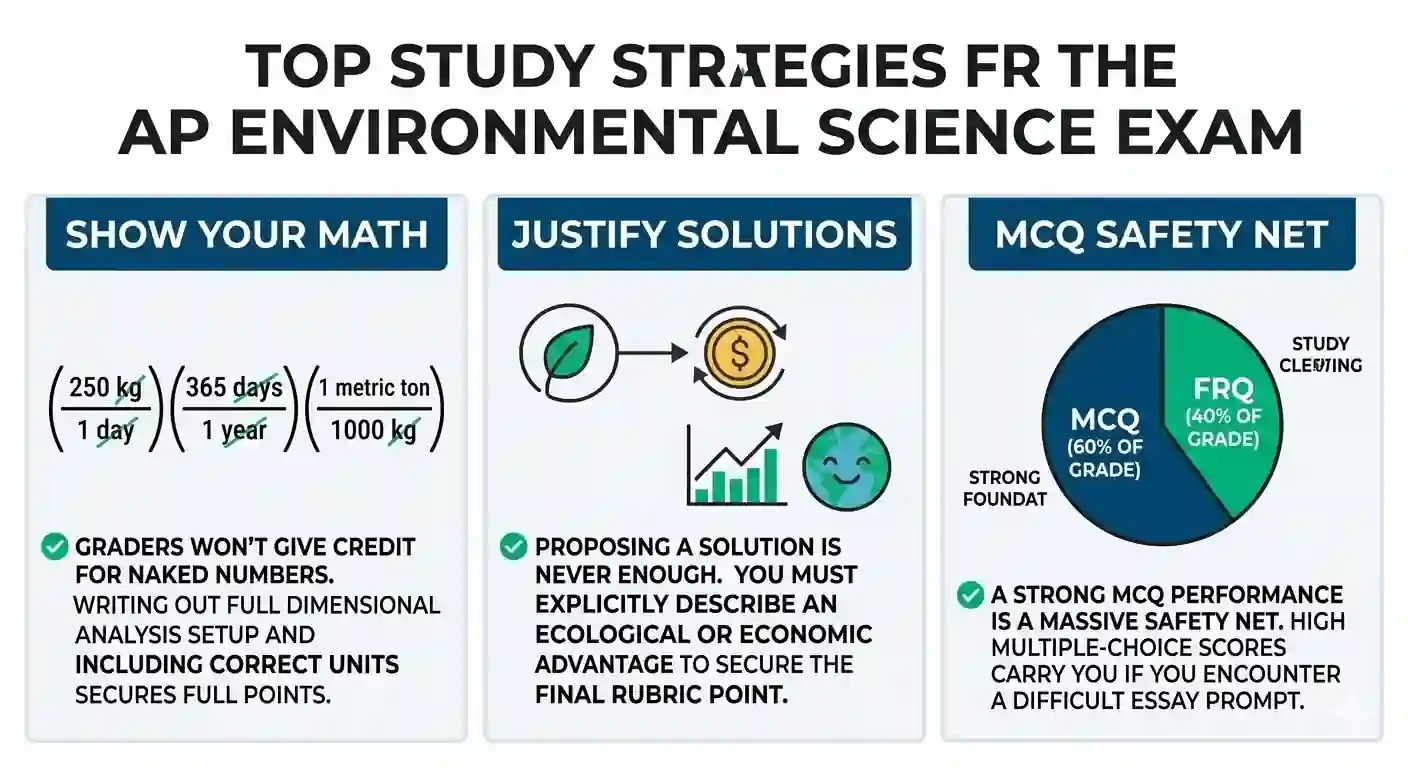
You must always show your math on the third free response question. Graders will not give you credit for naked numbers. Therefore, you must write out your full dimensional analysis setup. Furthermore, you must include the correct units in every single step. This proves you understand the actual calculation process. As a result, you earn full points.
Why You Must Justify Your Solutions
Proposing a simple solution is never enough. For the second free response question, you must do more than just state a fix. You must explicitly describe an economic or ecological advantage. For example, do not just say you will build a dam. Instead, you must explain how the dam provides renewable energy. Consequently, this extra justification secures your final rubric point.
Why You Should Master the Multiple Choice
The multiple choice section makes up 60 percent of your total grade. Consequently, a strong performance here acts as a massive safety net. You might encounter a very difficult essay prompt. However, high multiple choice scores can easily carry you to a passing grade. Therefore, you should always prioritize these objective questions during your final review.
Why Estimates Help Before Test Day
Knowing your estimated score protects you from test day surprises. If your practice tests show low free response points, you can shift your study focus immediately. Use this tool as a reliable reality check. If your current composite does not match your target grade, ask your teacher for help. Ultimately, this baseline knowledge gives you power and confidence during your final preparations.
You Might Also Find These Helpful
Exams 15
Use our AP Human Geography score calculator to predict your final 1 to 5 exam grade. Enter your practice MCQ and FRQ points for…
Try calculatorPredict your final test grade instantly. Use our AP Lang Score Calculator to convert your practice points into a 1 to 5 score. Plan…
Try calculatorUse our AP Physics 1 score calculator to predict your final grade. Enter your practice test results today. See your total composite points instantly.
Try calculatorPredict your final 1 to 5 grade with our AP Physics C score calculator. It covers both Mechanics and E&M. Therefore, you can plan…
Try calculatorPredict your final 1-5 grade with our real-time AP Precalculus Score Calculator. Enter your MCQ and FRQ points to find your exact college credit…
Try calculatorUse our accurate AP Spanish Score Calculator to predict your final 1-5 exam grade. Input your MCQ and FRQ points to see your composite…
Try calculatorPredict your final 1 to 5 exam grade instantly with our accurate AP stats score calculator. Enter your MCQ and FRQ points to calculate…
Try calculatorStressing over your apush exam? Use our free AP US History Score Calculator to predict your final 1 to 5 grade. Enter your practice…
Try calculatorUse the Exam Eligibility Calculator to check age, cutoff date, attempts, and education rules. See instantly if you are eligible, not eligible, or eligible…
Try calculatorCommon Mistakes That Ruin Your Final Score
Your apes score calculator predicts your best possible grade. However, simple test day errors can easily ruin your final score. Therefore, you must avoid these common mistakes. Reading this helps you protect your hard-earned points.
- Leaving Questions Blank First, there is no guessing penalty on this exam. Consequently, you must never leave a multiple choice question blank. Always guess if you run out of time.
- Ignoring the Prompt Verbs Next, you must read the action verbs carefully. For example, the word "Identify" requires a very simple answer. In contrast, the word "Explain" requires a detailed justification. Do not mix them up.
- Rushing the Free Response Furthermore, you have limited time for the essays. You should allocate exactly 22 minutes per question. Otherwise, you will rush the end. As a result, you will leave your final math calculations incomplete.
- Forgetting Your Units Finally, the third essay requires extensive math. You will easily lose points if you drop your units. Therefore, always write them clearly during your intermediate calculation steps.

Frequently Asked Questions (FAQs)
What is a passing score on the AP Environmental Science exam?
A passing score on the AP Environmental Science exam is a 3 or higher. Most colleges require a 3 to grant course credit. However, top tier universities often demand a 4 or a 5. You should always check your specific college requirements first.
Using our apes score calculator helps you track your progress. Therefore, you can easily secure your required passing grade.
Is AP Environmental Science a hard class?
AP Environmental Science is generally considered a moderately difficult class. The passing rate usually hovers around 50 percent. The concepts are very accessible. However, the exam requires strict mathematical skills. Furthermore, the free response rubrics are notoriously strict.
You must master dimensional analysis to succeed. Next, you must memorize key environmental laws to maximize your total points.
How many questions do you need to get a 5 on APES?
You generally need to answer 60 to 65 multiple choice questions correctly to get a 5. This assumes you score an average of 6 or 7 points on each free response essay. The exact cutoff changes slightly every single year.
You need roughly 104 total composite points out of 150. Therefore, strong essay scores reduce the pressure on your multiple choice section.
What percentage is a 4 on the APES exam?
A score of 4 usually requires a total composite percentage of about 60 percent. This equals roughly 89 out of 150 possible points. This grade shows you are well qualified. As a result, many colleges will quickly award you credit.
You can use the apes score calculator to find your exact percentage. Then, you can adjust your study plan accordingly.
Is there a guessing penalty on the APES exam?
No, there is absolutely no guessing penalty on the AP Environmental Science exam. The College Board only counts your correct answers. They do not subtract points for incorrect bubbles. Therefore, you must answer every single multiple choice question.
You should always fill in a random bubble if you run out of time. Consequently, you might earn a few extra free points.
How is the AP Environmental Science exam graded?
The exam is graded using a 150 point composite scale. The multiple choice section provides 60 percent of your grade. Next, the three free response essays provide the remaining 40 percent. Finally, these points merge into a final score.
Human readers grade the essays using strict rubrics. Meanwhile, a computer scans and scores your multiple choice bubble sheet.
Questions?
We had love to hear from you! Whether you are reporting an issue, suggesting a new calculator, or exploring collaboration opportunities — we are here to help. Every message helps us make 100calc smarter, faster, and more helpful for everyone.
Why People Trust 100calc
At 100calc.com, we focus on accuracy, speed, and trust. Every calculator we create is designed to give reliable, instant, and easy-to-understand results you can truly depend on.