
AP Physics C Score Calculator
Predict your final test score instantly with our AP Physics C score calculator. First, choose between the Mechanics and Electricity and Magnetism exams. Next, enter your practice points. This tool uses the new 80-point grading system. You will input scores from the multiple-choice section.
Then, you will add points from your four written questions. As a result, you will see your expected performance. Are you aiming for a passing grade or a perfect 5? Either way, this AP curve calculator gives you real-time insights.
Furthermore, it reveals your weakest subject areas. Finally, the tool helps you find the exact score you need to succeed on test day.
- Updated Jun 22, 2026
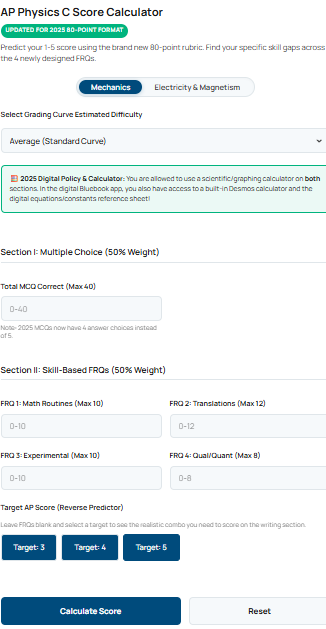
AP Physics C Score Calculator
Updated for 2025 80-Point FormatPredict your 1-5 score using the brand new 80-point rubric. Find your specific skill gaps across the 4 newly designed FRQs.
Section I: Multiple Choice (50% Weight)
Note: 2025 MCQs now have 4 answer choices instead of 5.
Section II: Skill-Based FRQs (50% Weight)
Leave FRQs blank and select a target to see the realistic combo you need to score on the writing section.
- Total MCQ Score (Max 40)
- 0
- Total FRQ Score (Max 40)
- 0
Fill out your practice exam scores to see your predicted AP Physics C score.
What Your Score Result Means
Your results show more than just a number. They explain your predicted exam performance. This section helps you understand your final scale. Furthermore, it breaks down your total points. Use this information to guide your study plan.
Understanding Your Scaled Score
Your final output is a scaled score between 1 and 5. Colleges use this number to award credit. For instance, a 5 means you are extremely well qualified. Meanwhile, a 3 means you passed the exam. Therefore, higher scores give you better chances for university credit.
How We Find the Composite Score
The tool generates a composite score first. It adds your multiple-choice points and your written response points together. Next, it caps the total at 80 points. This total number determines your final scale. As a result, every single point matters for your final grade.
Why Historical Grading Curves Matter
The College Board changes the grading curve every year. Our tool uses historical grading curves to predict your score accurately. Some years have a strict curve. Other years offer a generous curve. Consequently, your required composite score will shift slightly based on the test difficulty.

Test the Calculator With Real Examples
Use the examples below to test the calculator. Enter the values exactly as shown. You can change them later to match your own AP Physics C score calculator needs.
Example 1: Aiming for a Perfect Score
Use this to test: Average Curve Score Prediction
Curve Difficulty: Average
Total MCQ Correct: 30
Total FRQ Points: 25
What you should see:
A composite score of 55 out of 80 points.
A final scaled score of 5.
This means you are extremely well qualified for college credit.
Example 2: Passing the Physics Exam
Use this to test: Minimum Passing Threshold
Curve Difficulty: Average
Total MCQ Correct: 20
Total FRQ Points: 15
What you should see:
A composite score of 35 out of 80 points.
A final scaled score of 3.
This means you passed the exam and met the physics prerequisite.
Explore More Calculators
Predict your 1-5 score with our universal AP Score Calculator. Find your "Wiggle Room" safety net, adjust MCQ/FRQ weights, and estimate college credit value…
Try calculatorStop guessing your grade! Use our free Final Exam Calculator to instantly find out exactly what score you need to pass or hit your…
Try calculatorPredict your grade with our accurate AP Biology Score Calculator. Enter your multiple choice and free response points to see your exact 1 to…
Try calculatorWorried about your free response answers? Use our AP Calculus AB score calculator to find your exact 1-5 grade. Check your wiggle room and…
Try calculatorWondering what you will score? Use our AP Calculus BC Score Calculator to find out! Input your practice MCQ and FRQ points to get…
Try calculatorUse our accurate AP Chemistry score calculator to predict your final 1 to 5 grade. Convert your raw multiple choice and written points instantly.…
Try calculatorHow to Use the AP Physics C Score Calculator
Using this tool is simple. First, you only need your practice test numbers. Indeed, the AP Physics C score calculator uses your exact points to estimate your final grade. It builds this estimate based on historical curves. Now, follow these five steps to get your result instantly.
Select Your Exam
Identify your specific test. Next, select it from the top menu. You can choose Mechanics or Electricity and Magnetism. This step is crucial.
Choose a Curve
Choose your preferred grading strictness. You can pick generous, average, or strict. This choice simulates different test day difficulties. Therefore, it helps you plan for the hardest exams.
Enter MCQ Points
Count the questions you answered correctly on the multiple-choice section. Then, enter this number into the input field. The maximum score is 40 points. Since every point matters, try to be as precise as possible.
Input FRQ Points
Add your scores for the four free-response questions. Alternatively, you can leave them blank. After that, click a target score button to reverse-calculate the points you need. This feature helps you build a custom study plan.
Review Your Insights
Scroll down to view your predicted grade instantly. The results panel will display your safety margin. Furthermore, it reveals your personalized study focus. Consequently, you can use this feedback to improve your weakest skills.
Quick Formula Used
Total Composite Score = Multiple-Choice Points + Free-Response Points
Why This Process Is Accurate
Format is Updated: We use the brand new 80-point total format.
Math is Direct: Multiple-choice questions translate into a direct point ratio.
Curves are Historical: We use past exam data to set the final scale.
Skill Gaps are Found: The tool analyzes your four written answers to pinpoint exact weaknesses.
Ultimately, this method mirrors the actual grading system. Therefore, your result is a precise prediction, not a guess.
Try It Yourself
First, enter your multiple-choice points.
Next, pick a target score of 5.
Then, switch the curve to strict.
Finally, watch the AP Physics C score calculator instantly build your study plan.
AP Physics C Score Formula Explained (Complete Breakdown)
This section explains exactly how our tool estimates your final grade. It reveals the math behind the multiple-choice section. It also shows the free-response weights. Because the College Board updated the test, we calculate your total using the new 80-point format.
This helps you understand where the numbers come from. Furthermore, you will see why accuracy depends on precise inputs.
First, we add your multiple-choice points. Then, we apply your four written scores. Finally, we compare this combined total to the historical grading curve.
The Grading Formula
This simple formula powers the AP Physics C score calculator. It converts your practice test points into a final grade.
The Formula:
Total Composite Score = (MCQ Correct) + (FRQ 1 + FRQ 2 + FRQ 3 + FRQ 4)
This formula relies on six key variables. Each variable comes directly from your input or official testing standards.
Variable 1: MCQ Correct
First, we count your correct multiple-choice answers. The maximum score is 40 points. You do not lose points for wrong answers. Therefore, you should never leave a test bubble blank.
Variable 2: FRQ 1 (Math Routines)
Next, we look at your first written question. This section tests your pure math skills. It is scored out of a maximum of 10 points.
Variable 3: FRQ 2 (Translations)
Then, we add your second written question. This part tests how you translate physics concepts between graphs and text. It is scored out of 12 points.
Variable 4: FRQ 3 (Experimental Design)
After that, we include your third question. This section tests your laboratory skills. It is scored out of 10 points.
Variable 5: FRQ 4 (Qual/Quant Translation)
Next, we add your final question. This tests your paragraph-length explanations. It is scored out of 8 points.
Variable 6: Scaled Score
Ultimately, we combine all these sections. The maximum total is 80 points. We use this composite number to find your final 1 to 5 threshold.
Example Calculation You Can Test
Use these exact inputs to test the calculator logic. We show the math step-by-step. Consequently, you can see how practice points turn into a final score.
Example 1: The Math-Heavy Student (Mechanics)
Given:
Exam: Mechanics
MCQ Correct: 25
FRQ 1: 8
FRQ 2: 6
FRQ 3: 7
FRQ 4: 4
Calculation:
					Step 1: First, count the multiple-choice points (25).

Step 2: Next, add the free-response points (8 + 6 + 7 + 4 = 25).

Step 3: Then, add both totals together (25 + 25 = 50).

Step 4: Finally, compare the 50 points to the average curve.
Result:
Estimated Composite: 50 points
Final Scaled Score: 4
Why This Matters: Notice that Sarah missed 15 multiple-choice questions. However, her strong math skills on the written section saved her grade.
Why This Formula Matters
This formula calculates your exact grade using the official College Board rubric. It does not guess. Instead, it reflects your true performance level. Because of this, the results perfectly match the real test structure. You now have a reliable baseline before taking your actual exam.
Understanding Your Exam Results
Your AP Physics C score calculator results show more than just a simple number. They help you understand the exact value of your practice test. Colleges use specific point thresholds for different credit levels. Therefore, this quick breakdown will help you read your results. Furthermore, it explains the university standards clearly.
| Range (Average Curve) | AP Score | Category Definition | Meaning for College Credit |
|---|---|---|---|
| 54 – 80 | 5 | Extremely well qualified | Maximum college credit awarded at most universities. |
| 42 – 53 | 4 | Well qualified | Highly likely to earn college credit. |
| 31 – 41 | 3 | Qualified | Passing grade; acceptable for credit at many public state universities. |
| 20 – 30 | 2 | Possibly qualified | Generally not accepted for college credit. |
| 0 – 19 | 1 | No recommendation | No college credit awarded. |
Important: These thresholds represent an Average Curve. Strict or generous exams will shift these composite point requirements slightly.
How to Read This Table With the Calculator
First, enter your practice points into the AP Physics C score calculator above. Next, note your estimated composite score out of 80. Then, compare your calculated total against the range column. Finally, compare your predicted grade against the AP score column. Consequently, this comparison acts as a reality check. It tells you immediately if your current skills match your college goals.
What This Means For You
If your tool result falls inside the top range, you are highly prepared. However, if your result is far lower, you almost certainly need more study time. Therefore, this table helps you avoid false confidence. Furthermore, if you want college credit, you know exactly what total points you need. Thus, you can quickly spot your exact performance level during practice tests.
Quick Example Using the Table
Inputs:
Exam Type: Mechanics
MCQ Correct: 30
Total FRQ Points: 15
Results you will see:
Calculator Result: 45 composite points
Table Range: 42 to 53 points
Insights and Smart Recommendations
Use your AP Physics C score calculator results to study smarter. First, compare your practice scores with historical thresholds. Consequently, this confirms if you are ready for the test. Therefore, you can confidently prepare for exam day.
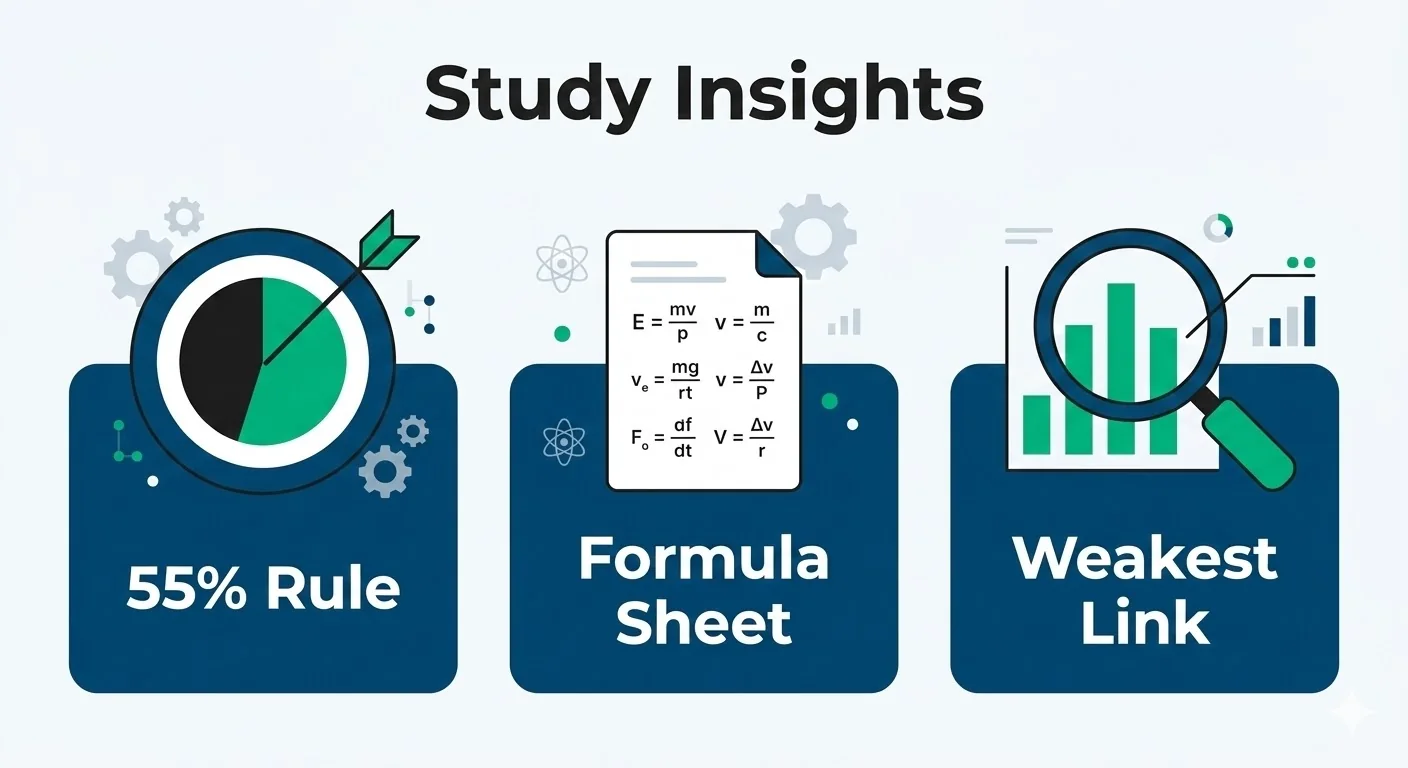
How to Leverage the 55 Percent Rule
The grading curve is very generous. In fact, you only need a 55 to 65 percent raw score to secure a perfect 5. Therefore, do not panic on test day. If you skip a hard question, you can still pass easily. As a result, always answer the easy questions first.
Why You Must Master the Formula Sheet
You must understand the official formula sheet conceptually. Consequently, you will breeze through the written questions. Furthermore, you will save valuable time during the test. Thus, knowing why an equation works is just as important as knowing the math.
How to Identify Your Weakest Link
Knowing your exact weaknesses saves valuable study time. First, review your four written response scores. Next, find your lowest-scoring section. For instance, low experimental design scores mean you must review lab procedures. Ultimately, fixing this specific weak link beats mindlessly drilling more multiple-choice questions.
You Might Also Find These Helpful
Exams 15
Use our accurate AP Environmental Science Score Calculator to predict your 1-5 apes grade. Enter your MCQ and FRQ practice test points instantly!
Try calculatorUse our AP Human Geography score calculator to predict your final 1 to 5 exam grade. Enter your practice MCQ and FRQ points for…
Try calculatorPredict your final test grade instantly. Use our AP Lang Score Calculator to convert your practice points into a 1 to 5 score. Plan…
Try calculatorUse our AP Physics 1 score calculator to predict your final grade. Enter your practice test results today. See your total composite points instantly.
Try calculatorPredict your final 1-5 grade with our real-time AP Precalculus Score Calculator. Enter your MCQ and FRQ points to find your exact college credit…
Try calculatorUse our accurate AP Spanish Score Calculator to predict your final 1-5 exam grade. Input your MCQ and FRQ points to see your composite…
Try calculatorPredict your final 1 to 5 exam grade instantly with our accurate AP stats score calculator. Enter your MCQ and FRQ points to calculate…
Try calculatorStressing over your apush exam? Use our free AP US History Score Calculator to predict your final 1 to 5 grade. Enter your practice…
Try calculatorUse the Exam Eligibility Calculator to check age, cutoff date, attempts, and education rules. See instantly if you are eligible, not eligible, or eligible…
Try calculatorCommon Mistakes When Calculating AP Physics C Value
Using the AP Physics C score calculator helps you set accurate goals. However, simple test errors can easily ruin your final grade. Avoid these three common mistakes. Consequently, you will protect your hard-earned points.
- Leaving Multiple-Choice Blank: The College Board removed the guessing penalty completely. Therefore, you never lose points for incorrect answers. Always fill in every single bubble. Ultimately, a lucky guess might increase your score.
- Skipping Units on Written Questions: Perfect math is simply not enough. Missing units will instantly cost you points. Furthermore, using the wrong significant figures hurts your grade. Always double-check your final written answers.
- Forgetting to Justify Your Work: The translation questions require clear text explanations. Simply writing an equation is a big mistake. Instead, you must explain the physical concept behind it. Otherwise, you will lose valuable credit.

Frequently Asked Questions (FAQs)
What is a good score on the AP Physics C exam?
A good score is typically a 4 or a 5. Most top universities require these high marks for engineering college credit. However, a 3 is still officially considered a passing grade. Therefore, scoring a 3 meets the basic requirement for many state colleges.
Ultimately, your target score depends entirely on your dream university. Always check your specific college policies before taking the test.
How is the AP Physics C score calculated?
The College Board calculates your score using a direct point system. First, they add your multiple-choice points. Next, they add your written response points. This creates a total composite score out of 80 points.
Finally, they compare this total to a historical grading curve. Consequently, this comparison translates your raw points into a final scale of 1 to 5.
Is a 3 on AP Physics C passing?
Yes, a 3 is officially a passing grade. The College Board defines a 3 as qualified. Therefore, it proves you understand the core physics concepts. As a result, many public universities will grant you introductory college credit for this score.
However, highly competitive engineering programs often demand a higher grade. Thus, you should aim for a 4 or a 5 to guarantee maximum university credit.
Is there a guessing penalty on the AP Physics exam?
No, there is absolutely zero guessing penalty. You earn one full point for every correct answer. Furthermore, you lose zero points for incorrect answers. Therefore, you should never leave a multiple-choice question blank on your test sheet.
Consequently, guessing gives you a free chance to increase your final grade. Always fill in every single bubble before the exam timer runs out.
Are Mechanics and E&M graded on the same curve?
No, they do not share the exact same curve. Both exams use the new 80-point format. However, historical data shows the Electricity and Magnetism curve is often slightly more generous. This happens because the material is generally more complex.
As a result, you might need slightly fewer points to secure a 5 on the E&M test. Regardless, you should always prepare equally hard for both sections.
Questions?
We had love to hear from you! Whether you are reporting an issue, suggesting a new calculator, or exploring collaboration opportunities — we are here to help. Every message helps us make 100calc smarter, faster, and more helpful for everyone.
Why People Trust 100calc
At 100calc.com, we focus on accuracy, speed, and trust. Every calculator we create is designed to give reliable, instant, and easy-to-understand results you can truly depend on.