
Average Grade Calculator For All Classes
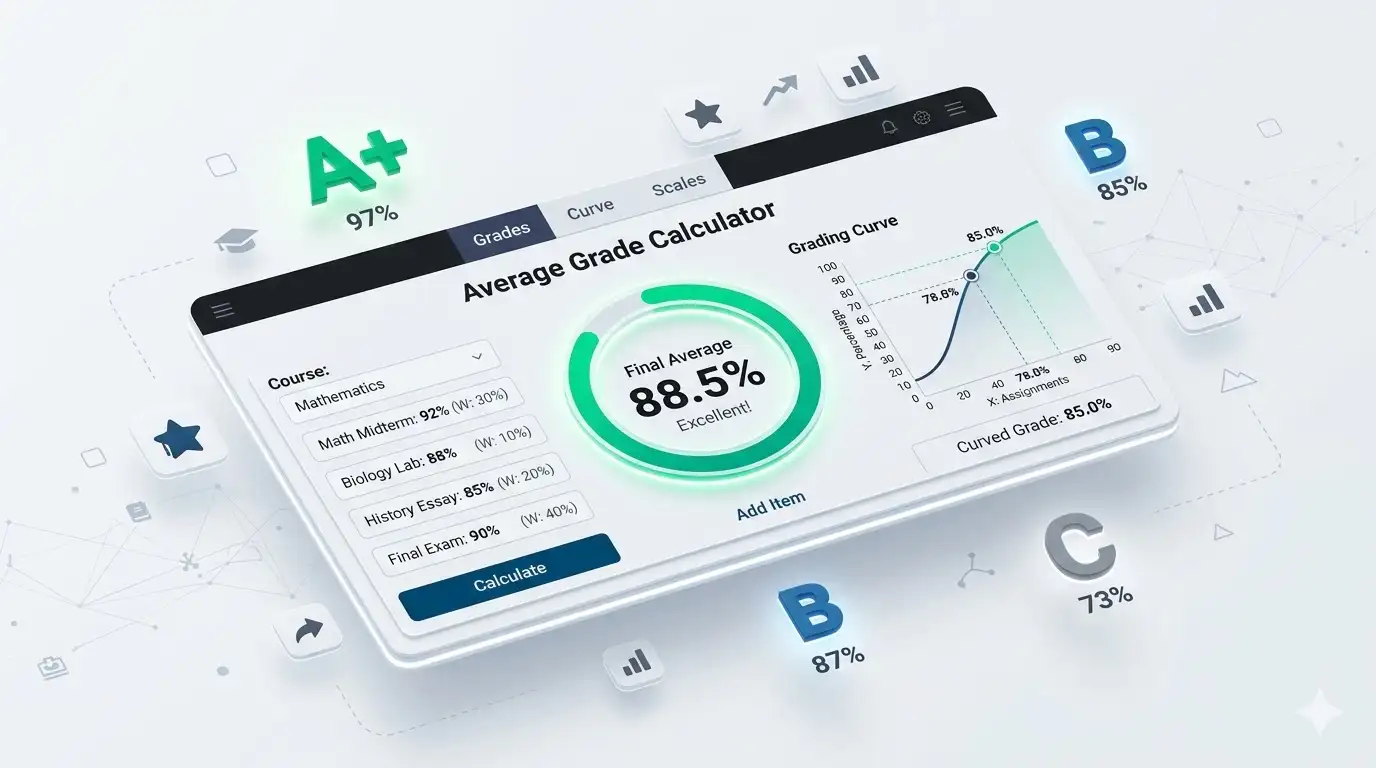
Need a fast and accurate average grade calculator? You can quickly find your exact class score right now. First, enter your assignments. Then, the tool will instantly do the math for you.
You can use an average grade calculator with weight for your college courses. Alternatively, you can use an average grade calculator no weight for basic high school classes. Therefore, you will easily compute your overall course grade. Plus, teachers can quickly apply a grading curve. Also, you can see how your score translates globally in the US, UK, and the Philippines.
Do you want to know your required score for the next test? Simply use our built-in what if grade calculator. This tool includes a helpful future exam simulator. As a result, you take the guesswork out of your current semester.
- Updated Jun 16, 2026
- Reviewed by Academic Grading Systems Editor
Average Grade Calculator
Calculate your straight or weighted average, apply a grade curve, and translate your score to global scales.
Enter the target class average. The engine will shift all grades to meet this curve.
Final Average Grade
Based on your entered assignments.
Global Scale Translations
🎯 Future Exam Simulator
Want to raise your average? Find out what you need on your next test.
- Total Items
- 0
- Highest Grade
- 0%
- Lowest Grade
- 0%
- Total Weight Used
- 0
How do you calculate your average grade?
To calculate an average grade with no weight, you simply add up all your scores and divide by the total number of assignments. To calculate a weighted grade average, you multiply each grade by its weight, add those numbers together, and divide by the total weight. Based on your inputs, your final average grade across all classes/tests is an average score. Whether you are a student calculating a semester grade average, checking an exam grade average calculator, or a teacher using a grade curve calculator based on average, this unified percentage represents your total academic performance.
What Your Easy Grade Calculator Result Means
Your final percentage shows your total academic performance. The easy grade calculator evaluates your entered assignments. First, it adds your scores together. Then, it factors in the exact weights. This final number shows your exact standing in the class. Therefore, you can easily track your semester progress.
Understanding Your College Score
You might need an average grade calculator college score. This total directly dictates your final GPA. A higher percentage brings a better letter grade. Consequently, you must watch this number closely before finals week.
Global Grade Translations
Schools around the world use different grading scales. Your result might equal an 85.5 percent. This specific score translates to a solid B in the US. Meanwhile, it counts as a Distinction in the UK. Furthermore, the University of the Philippines grades this exact score as a 2.00. As a result, you instantly understand your global standing.
Future Exam Simulator Output
A grade percentage calculator also predicts your future tests. The simulator might tell you to get a 92 percent on your final. This output means your current trajectory needs a strong finish. Thus, you must study harder to hit your target class score.
Test the Calculator With Real Examples
Use the examples below to test the calculator. Enter the values exactly as shown. You can change them later to match your own easy grade calculator needs.
Example 1: Checking a Weighted College Grade
Use this to test: Main Calculator Input
- Grade Format: Percentages
- Calculation Mode: Weighted
- Item 1 Grade: 82
- Item 1 Weight: 50
- Item 2 Grade: 89
- Item 2 Weight: 50
What you should see
Final average grade around 85.50 percent
US Translation shows a solid B
Results based on your exact assignment weights
Example 2: Using the Future Exam Simulator
Use this to test: Simulator Feature Inputs
- Target Final Average: 90
- Weight of Next Exam: 20
What you should see:
- Required score to hit your target class grade
- Warning if the target is mathematically impossible
- Results reflect pure algebraic math logic
Explore More Calculators
Stop guessing your semester average today. Use our final grade calculator to find exactly what test score you need to pass. Calculate your safe…
Try calculatorUse our free easy grade calculator to find exact test percentages and letter grades. It perfectly supports half points, custom scales, and teacher charts.
Try calculatorYour grade may be higher than you think. Use this Grade Curve Calculator to test 5 curve methods and see your adjusted score instantly…
Try calculatorStop guessing your exam scores. Use our free Marks Percentage Calculator to find your exact academic grade. Instantly convert your marks to CGPA today.
Try calculatorStop guessing your class grade. Our unweighted grade calculator finds your straight average instantly. Convert percentages to a 4.0 GPA scale. Try it now!
Try calculatorUse the UQ Grade Calculator to find your current mark, the score needed on remaining work, your possible grade range, and UQ GPA before…
Try calculatorHow to Use the Average Grade Calculator
Using this tool is very simple. First, you only need your class syllabus and current scores. The average grade calculator computes your exact standing instantly. Therefore, you can plan your studies much better. Follow these five simple steps to get your result instantly.
Choose Your Format
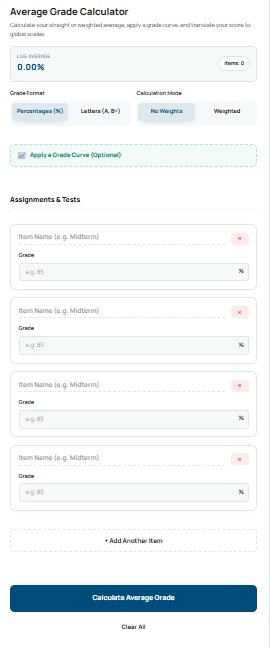
First, select whether you want to enter percentages or letter grades. Then, toggle the calculation mode. You can easily choose an average grade calculator with weight or without.
Enter Your Grades
Next, input your daily assignments, midterms, and finals. If your class is weighted, ensure you add the specific percentage weight. For example, you can enter 20 percent for a major midterm.
Apply a Curve (Optional)
Sometimes, teachers or professors want to adjust the class average grade. They can simply input a target score. As a result, the system automatically shifts all grades up or down to meet this curve.
View Your Average
Now, check the interactive ring chart. This visual instantly shows your overall course grade. Additionally, you will see exactly how your score translates to international global grading scales.
Simulate Future Exams
Finally, use the future exam simulator. You can find out exactly what score you need on your next test. Consequently, you will confidently achieve your desired final course grade without any guessing.
Quick Formulas Used
Unweighted Average: Sum of All Scores ÷ Total Number of Assignments
Weighted Average: (Score 1 × Weight 1) + (Score 2 × Weight 2) ÷ Total Weight
Why This Process Is Accurate
- Scores Become Percentages: The math engine treats all grade entries as raw percentages first.
- Weights Are Factored: We multiply each individual score by its exact syllabus weight.
- Curves Are Precise: The tool finds the exact mathematical difference between the raw average and the target average.
- Simulator Uses Algebra: The simulator subtracts your current earned points from your target goal.
This method matches standard university grading systems perfectly. It computes the true mathematical average. Thus, your estimate always reflects your actual academic standing.
Average Grade Calculator Formula Explained (Complete Breakdown)
This section explains exactly how our tool calculates your academic scores. It reveals the exact math behind unweighted points, percentage weights, and grading curves. Because we do not have your actual syllabus, we calculate your true standing using the numbers you provide. This process helps you understand where the numbers come from. Furthermore, it shows why accuracy depends on precise inputs.
First, we determine your total earned points. Then, we divide that number by your total assignments or weights. Finally, we apply any grading curve adjustments.
The Average Grade Formulas
These formulas power the average grade calculator. They convert your assignment scores into a final percentage.
					Unweighted Formula:
Average = Sum of All Scores ÷ Total Number of Assignments

Weighted Formula:
Average = (Score 1 × Weight 1) + (Score 2 × Weight 2) ÷ Total Weight
This math relies on three key variables. Each variable comes directly from your specific class syllabus.
Variable 1: Score
First, we need your actual grade. You receive this number on an assignment or test.
- Score: The percentage or letter grade you earned.
- Calculation: We convert letter grades into numbers first. For example, an A becomes a 93 percent.
Variable 2: Weight
Next, we look at the assignment value. Not all tests hold the same importance.
- Weight: The specific percentage value that an assignment holds toward your final grade.
- Calculation: We multiply your score by its specific weight. Therefore, a heavy final exam impacts your grade more than a small daily quiz.
Variable 3: Target Curve
Finally, we adjust the entire class average. Teachers use this tool to fix low test scores.
- Target Curve: The desired mean score used to adjust overall performance.
- Calculation: We find the difference between the raw average and the target curve. Then, we shift every student’s score up by that exact amount.
Example Calculations You Can Test
Use these exact inputs to test the calculator logic. We show the math step by step. As a result, you can see exactly how scores turn into final grades.
Example 1: The College Student (Weighted Average)
A student at NYU wants to check their semester grade calculator. They want to maintain an A minus average.
Given:
Midterm Score: 85 percent
Midterm Weight: 30 percent
Essay Score: 90 percent
Essay Weight: 20 percent
Final Exam Weight: 50 percent
Target Average: 87.5 percent
Calculation:
					Find Earned Points: Multiply the midterm by its weight (85 × 0.30 = 25.5).

Add Essay Points: Multiply the essay by its weight (90 × 0.20 = 18.0).

Total Current Points: Add them together (25.5 + 18.0 = 43.5).

Use the Simulator: The student needs 44 more points to hit the 87.5 percent target.

Divide by Final Weight: Divide 44 by the final exam weight of 50 percent (44 ÷ 0.50 = 88 percent).
Result:
Required Final Exam Score: 88 percent.
You should see this exact number in the future exam simulator panel.
Understanding Your Average Grade Results
Your average grade calculator results show more than just a basic percentage. First, they help you understand your academic standing in different countries. Schools and universities use specific grading scales for different programs. Therefore, you must know your exact letter grade. Here is a quick breakdown to help you read your results. As a result, you will easily understand standard global benchmarks.
| Percentage (%) | US / Canada (Letter) | UK / Australia | Philippines | Meaning / Category |
|---|---|---|---|---|
| 93 - 100% | A / A+ | 1st Class | 1.00 - 1.25 | Excellent / High Distinction |
| 83 - 89% | B / B+ | 2:1 (Upper 2nd) | 1.75 - 2.00 | Good / Very Good |
| 73 - 79% | C / C+ | 2:2 (Lower 2nd) | 2.50 - 2.75 | Satisfactory / Average |
| 65 - 69% | D / D+ | Pass / 3rd | 3.00 | Pass / Below Average |
| Below 65% | F | Fail | 5.00 | Fail |
Important: These global translations represent standard international benchmarks. Specific high schools and universities might use slightly different grading scales for their final percentages.
How to Read This Table With the Calculator
First, compute your overall course grade using the average grade calculator above. Note the final percentage on your screen. Next, compare your calculated result against the Percentage column. Then, find your exact US letter grade. Finally, check the global translations for your specific score. This simple comparison acts as a quick sanity check. It tells you immediately where you stand academically.
What This Means For You
If your calculator result falls inside the top tier, you likely have an excellent GPA. For instance, students at Harvard University or UCLA usually aim for a 93 percent or higher. Alternatively, you might wonder what is a 2.75 grade average. The table clearly shows this falls into the C plus range. This breakdown helps you easily track your academic progress.
If you plan to study abroad at the University of Oxford, you know exactly how your US grade translates. Also, if you attend the University of the Philippines, you can quickly find your equivalent numeric score. Therefore, you avoid any confusion regarding international grading standards.
Insights and Smart Recommendations for Your Grades
Use your average grade calculator results to make smarter study decisions. Understanding how assignments affect your total percentage helps you plan your semester better. Compare your current scores with your final academic goals. This step helps you confirm if you need to study harder. These insights help you act with confidence during midterms and finals week.

Why You Must Know Your Syllabus First
You must always read your class syllabus carefully. First, check if your teacher uses a simple points based system. Alternatively, they might use a strict weighted percentage system. This detail changes your math completely.
For example, a heavy final exam can instantly drop your overall score. Therefore, you must select the correct calculation mode before entering your numbers. Always verify your assignment weights with your professor early in the semester.
How to Plan Ahead With the Simulator
You should never wait until finals week to check your grades. Instead, use our what if grade calculator mid-semester. This tool shows you exactly how hard you need to study for upcoming tests.
For instance, you might find out that you only need a 75 percent on the next exam to keep an A minus. Consequently, you can spend less time stressing and more time studying for harder classes. This proactive approach always improves your final course grade.
Why Understanding Global Standards Matters
Educational grading scales vary widely around the world. You might plan to study abroad next year. For example, you could transfer from a US college like UCLA to a UK school like Oxford.
In this case, simply use our global translator box. It shows exactly how your average weighted grade will look internationally. As a result, you will understand foreign admission requirements easily. You can then submit your applications with complete confidence.
You Might Also Find These Helpful
Grades 7
Stop guessing your class average! Use our free weighted grade calculator to instantly factor in extra credit, points, and see exactly what you need…
Try calculatorCommon Mistakes When Calculating Grades
Calculating your academic score requires exact numbers. Small errors will easily create the wrong final percentage. Below are the most common mistakes students make. Read these quick tips carefully. Consequently, you will get the most accurate result possible.
- Ignoring Your Assignment Weights: You must never ignore your syllabus weights. A daily homework quiz might only count for 10 percent. Meanwhile, a major final exam often counts for 40 percent. Treating them equally will completely ruin your overall course grade.
- Math Errors in Total Weight: You must enter your percentage weights correctly. Your total weights should always add up to exactly 100 percent. This specific math step is critical. Otherwise, your average grade calculator percentage will be completely wrong.
- Confusing GPA with Average Grade: You must understand the difference between your percentage and your GPA. A percentage average like 88 percent is just a raw score. You must map this number to a specific academic scale. Therefore, you will need a proper gpa calculator to find your exact 3.3 value.

Frequently Asked Questions (FAQs)
How do you calculate your average grade?
To calculate an unweighted average grade, simply add up all your test scores. Next, divide that total sum by the number of assignments. For a weighted class, you must multiply each score by its specific percentage weight before adding them together.
Our easy average grade calculator does this math instantly. Therefore, you easily avoid any frustrating manual calculation errors.
Is a C plus considered an average grade?
Yes, a C or a C plus usually represents the standard academic average. In most US high schools and colleges, this exact score falls between 73 and 79 percent. Therefore, it shows a completely satisfactory level of academic performance.
However, your specific average grade meaning completely depends on your school. Many highly competitive universities consider a B minus as their true baseline average.
Is a 90 percent average a 4.0 GPA?
No, a 90 percent is rarely a perfect 4.0 GPA. Generally, a 90 percent equals an A minus. This score usually translates to a 3.7 GPA on a standard US college grading scale. Therefore, it falls slightly short of the top mark.
You typically need a 93 percent or higher to earn a perfect 4.0 GPA. Consequently, you should check your student handbook to confirm your exact university grading curve.
What does a 2.75 grade average mean?
A 2.75 GPA typically translates to a high C or a low B minus. This number usually falls right around the 80 to 82 percent mark on a standard grade percentage calculator. As a result, it indicates a solid passing standing.
This score shows you are passing your classes safely. Furthermore, it easily meets the minimum graduation requirement for most standard university degree programs.
How do I calculate a weighted final grade?
First, multiply your current class average by its assigned total weight. Next, multiply your expected final exam score by its specific weight percentage. Finally, simply add those two exact numbers together. This final result quickly gives your true overall course grade.
Alternatively, you can use our built-in future exam simulator. It acts as a perfect final grade calculator. Thus, it removes the confusing algebra completely.
What is the difference between a grade percentage and a GPA?
A grade percentage simply shows how many points you earned out of 100. A GPA converts that exact percentage into a specific universal scale. Most US high schools and colleges use a strict 4.0 scale. Therefore, the two numbers look very different.
You must use an average grade calculator to find your percentage first. Afterward, you can confidently use a GPA calculator to find your final academic standing.
Questions?
We had love to hear from you! Whether you are reporting an issue, suggesting a new calculator, or exploring collaboration opportunities — we are here to help. Every message helps us make 100calc smarter, faster, and more helpful for everyone.
Why People Trust 100calc
At 100calc.com, we focus on accuracy, speed, and trust. Every calculator we create is designed to give reliable, instant, and easy-to-understand results you can truly depend on.