
Cost Per Minute Calculator: Track Your True Financial Velocity
A cost per minute calculator converts any expense or income into a precise 60-second value. To calculate cost per minute, you divide your total cost by the total minutes in a given period. A $30 hourly wage equals exactly $0.50 per minute.
Every unbilled minute costs you real money. Are you earning or burning? Most freelancers and factory managers simply guess their true operational costs. They get it wrong. That mistake eats directly into your profit margins.
This tool handles the complex base-60 math for you. Track your personal wage, industrial garment factory overhead, or household electricity rates. Use the live digital ticker to watch your money move in real time. Stop financial leaks and bill with total accuracy today.
Quick Facts
- Decimal Time Alert: 0.3 hours is exactly 18 minutes, not 30.
- Factory CPM: Combines overhead, operators, and plant efficiency.
- Electricity Draw: Converts standard kilowatts into per-minute energy bills.
- Live Ticker: Visualizes your financial burn rate instantly.
- Updated Jun 17, 2026
- Reviewed by 100Calc Research Team
Time & Value Optimizer
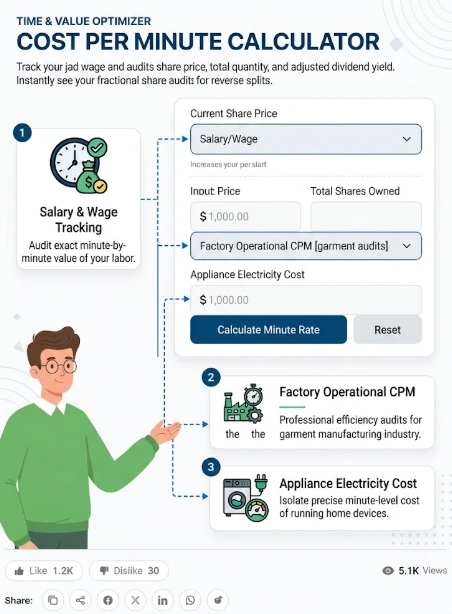
Cost Per Minute Calculator
Instantly convert your time into exact monetary value. Whether you need an electricity cost per minute calculator, want to track your wage, or need precise cost per minute calculation in the garment industry, this tool handles the complex base-60 math for you.
Rate Per Minute
The 60-Minute Scale
How do you calculate cost per minute?
What is the CPM formula?
How do I calculate WPM?
What is 0.3 in minutes?
Explore More Calculators
Wondering where your paycheck vanishes? Use this free Ramsey budget calculator to expose leaks, fund your Four Walls, and force your balance to exactly…
Try calculatorStop underbidding. Use this Heavy Equipment Hourly Rate Calculator to track O&O costs, fix idle time leaks, and set professional 2026 billing rates instantly.
Try calculatorDealerships hide massive lease rates in tiny decimals. Use this money factor calculator to convert MF to APR instantly and expose hidden markups.
Try calculatorBanks round transfers to 1,000 point blocks. Use our calculator to find exact points needed for 2026 award flights and avoid stranded airline miles.
Try calculatorExplore Related Tools
What Your Cost Per Minute Result Means
Your result shows the exact financial weight of a single minute. This number reveals the hidden cost of daily delays and exposes the true earning power of your time.
Understanding Your Result
This metric exposes how fast money moves in your business or personal life. A wage result tells you exactly what sixty seconds of your labor is worth. A factory calculation tracks the operational cash burn on your production floor.
Measuring costs in such small increments makes abstract numbers feel real. It helps garment manufacturers price their Cost of Making accurately per piece. Freelancers use it to justify billing for rapid tasks.
Is Your Result Good or Bad?
Context entirely depends on your chosen calculation mode. A high wage CPM indicates strong earning velocity. This suggests your professional skills are highly leveraged and valuable.
In factory mode, a rising CPM points to a growing efficiency gap. This means your plant efficiency is dropping or your overhead is too heavy. A standard US freelance wage near $0.50 per minute is considered healthy. Factory rates climbing above $0.30 per minute often signal a need for urgent production optimization.
What You Should Do Next
- Track your non-billable hours to stop wasting high-value time on administrative tasks.
- Adjust your factory efficiency slider to see how simple machine downtime destroys your profit margins.
- Use your calculated rate to price freelance contracts or
- manufacturing jobs with total confidence.
A Quick Example to Test
Imagine you charge $45 per hour and want to know your exact per-minute billing rate.
Input:
Enter $45.00 into the “Amount Earned” field. Select “Per Hour” from the time period dropdown menu.
Result:
The system immediately calculates a Rate Per Minute of $0.75.
Meaning:
A quick 15-minute client phone call just cost you $11.25 in potential earnings. You can now use this exact figure to add short consultations to your final invoice without losing money.
Which Calculation Mode Fits Your Goal?
Choosing the right calculation mode ensures your math follows official industry standards. Personal billing relies on a simple base-60 conversion. Manufacturing instead uses efficiency multipliers to account for downtime. Use the comparison below to find the correct system for your specific financial task.
| System Mode | Label | USA Standards (2026) | Global/Industrial Standards | Decision Goal |
|---|---|---|---|---|
| Wage / Salary | Professional | Standard 2,080-hour work year logic. | Standard 48-hour work week logic. | Calculate personal earning velocity. |
| Factory / CPM | Industrial | Focus on overhead and labor reduction. | Garment IE (Cost of Making) focus. | Measure operational floor efficiency. |
| Electricity | Utility | Based on US average 18.05¢ per kWh. | Based on varying state/country unit tariffs. | Track real-time appliance power cost. |
Pro Tip
If you are a freelancer billing short tasks, use the Wage mode. Factory managers should strictly use the CPM mode to ensure labor overhead and operator counts are properly weighted against productive minutes.
What is Cost Per Minute(CPM)?
Cost per minute is a financial metric calculated by dividing a total monetary expense or income by the total number of minutes in that specific period. It breaks down large annual salaries, factory overheads, or utility rates into micro-units. This measurement helps professionals set accurate billing rates and exposes hidden financial leaks inside daily operations.
Our calculator features three specific tracking modes:
Wage Mode: Converts annual or hourly salaries into exact 60-second earnings.
Factory Mode: Divides operational overhead by productive machine minutes to find your true Cost of Making (CM).
Electricity Mode: Calculates appliance power draw against local utility rates (like the May 2026 US national average of 18.05¢/kWh).
In the professional world, this number represents your true earning velocity. Freelancers in 2026 often quote hourly rates, but daily work happens in much smaller increments. Because the modern independent worker only averages about 60% strictly billable time, knowing your exact per-minute value reveals whether a quick “15-minute favor” is actually worth your effort.
Industrial managers use this concept to track manufacturing overhead. They calculate the total cost to run a factory floor every sixty seconds. Every passing minute of machine downtime becomes a direct cash loss to the company, which is why factoring in plant efficiency and operator attendance is critical for survival.

Micro Insight
Time is your only non-renewable asset. Measuring expenses in minutes exposes the true cost of daily delays and inefficient habits. Tracking this exact number empowers you to cut low-value tasks immediately.
How to Use the Cost Per Minute Calculator
This calculator measures the exact financial value of a single minute. It processes wages, manufacturing overhead, or utility rates using a strict base-60 mathematical scale. Follow these steps to find your exact rate and activate the live financial ticker.
Select Your Calculation Category
Choose the setting that matches your specific goal. The system switches internal formulas based on your choice. Wage mode tracks personal income. Factory mode measures operational overhead. Electricity mode calculates direct power consumption.
Enter Your Base Financial Value
Type in your primary monetary figure. This can be your total salary, monthly factory overhead, or utility rate. The calculator uses this core number as the starting point for all underlying division.
Define the Active Time Period
Set the time limit attached to your base amount. You might select a standard work week or input specific factory production shifts. The tool normalizes these diverse timeframes into a universal 60-minute measurement.
Account for Industrial Downtime
Move the efficiency slider to factor in natural machine delays if you operate a factory. Most manufacturing plants never run at 100% capacity (85% is a standard baseline). This action reduces your raw minutes to reveal a realistic operational cost.
Activate the Live Digital Ticker
Press Calculate CPM Now to execute the final math. The system instantly divides your total cost by your total available minutes. Your exact per-minute rate appears alongside a digital counter tracking your real-time cash flow.
How do you calculate factory cost per minute for garment pricing?
Identify your total monthly overhead and find your true productive minutes. To find productive minutes, multiply your available machine time by your plant’s efficiency rate. Then, divide the overhead by those productive minutes. This is one of the biggest sticking points for industrial managers trying to set an accurate “Cost of Making” (CM) per piece.
This classic manufacturing scenario measures operational burn rate. Managers often struggle because they use theoretical capacity instead of actual efficiency.
Use these inputs in the calculator:
Monthly Overhead: $45,000
Working Days: 26
Working Hours: 8
Operators: 120
Plant Efficiency: 75%
Process:
Total Raw Minutes: 26 × 8 × 60 × 120 = 1,497,600
Productive Minutes: 1,497,600 × 0.75 = 1,123,200
Cost Per Minute: $45,000 / 1,123,200 = $0.0400
Final Result:
- Cost Per Minute: $0.04
- Productive Minutes: 1,123,200
Meaning:
The factory spends exactly 4 cents every minute it operates. If a specific garment requires 15 minutes of sewing time, the direct Cost of Making (CM) is $0.60. Factory managers must use this baseline to ensure they never accept buyer contracts that fall below their operational burn rate.
Accuracy and Method Behind the Cost Per Minute System
Our system uses high-precision base-60 logic to eliminate “rounding leaks” common in standard spreadsheets. We account for industrial standards and real-world utility draw to ensure your result is actionable for billing or manufacturing quotes. This precision protects your profit margins by capturing every fraction of a cent.
Key Features & Benefits
- Eliminates billing errors by using high-precision base-60 mathematical logic.
- Calculates real-time financial accumulation through an integrated digital ticker.
- Factors industrial downtime automatically via the adjustable efficiency multiplier.
- Switches instantly between personal wages, factory overhead, and power draw.
- Supports universal currency and unit conversions for global billing accuracy.
Technical Process
Input Validation
Normalizes diverse time periods and units into a unified minute-based scale.
Logic Execution
Applies mode-specific formulas to divide total costs by productive time units.
Dynamic Output
Updates results instantly while triggering the real-time cost accumulation loop.
How the Cost Per Minute Formula Works (Complete Breakdown)
The Cost Per Minute Calculator turn broad financial totals into precise micro-metrics. Measuring value in 60-second chunks reveals exactly where money is earned or lost. It stops the financial leaks that happen when you only track full hours or use generic estimates.
Why Use These Core Formulas?
You should use these core formulas because they normalize inconsistent time scales into a standard 60-second baseline for accurate billing. Most professionals lose money because they ignore the small gaps between billable hours or fail to factor in production downtime. These equations capture those hidden costs to ensure your factory pricing or freelance invoices remain perfectly profitable.
Formula:
					Wage CPM = Salary Amount / Total Minutes in Period

Factory CPM = Monthly Overhead / (Available Minutes * Efficiency %)

Electricity CPM = (Device Kilowatts * Energy Rate) / 60
Variable Definitions for Accurate Tracking
Variable definitions translate your raw financial data into specific, standardized inputs for the calculation engine. These terms ensure that salary periods, overhead totals, and power ratings are processed correctly using base-60 math. Using the correct definition prevents mathematical errors and guarantees your resulting cost per minute is a reliable figure for business decisions.
Salary Amount
This represents your total gross income for a selected period, such as a week or a year. It serves as the primary financial block for finding your personal earning velocity. In 2026, premium freelancers in IT often use this to break down high hourly rates into exact billing for micro-tasks.
Total Overhead
Overhead covers the sum of all monthly operational costs, including rent, labor, and utilities. In garment manufacturing, this figure is essential for finding the “Cost of Making” for a single piece. Dividing this by your productive minutes reveals your true industrial burn rate every sixty seconds.
Efficiency Percentage
Efficiency measures actual production uptime compared to total available capacity. No factory runs at 100% capacity due to maintenance or operator breaks. This variable adjusts the math to reflect real-world delays, ensuring your operational cost per minute is realistic rather than a theoretical guess.
Wattage (kW)
Wattage is the power rating of your appliance, usually listed in Watts or Kilowatts. The calculator converts this to match May 2026 energy standards, such as the US average of 18.05 cents per kWh. It ensures you know the exact cost of running equipment like space heaters or industrial machines.
Another Example Calculation (Step-by-Step)
Let’s calculate the operational cost for a high-volume production line in 2026. This helps you understand how efficiency affects your final pricing.
Given:
- Monthly Overhead: $19,500
- Total Available Minutes: 45,000
- Plant Efficiency: 80%
Calculation:
					45,000 * 0.80 = 36,000 Productive Minutes
$19,500 / 36,000 = $0.5417 per minute
Result:
- Cost Per Minute: $0.5417
- Productive Minutes: 36,000
Meaning:
The factory spends exactly $0.5417 every minute the machines are running. If a garment takes 10 minutes to make, the “Cost of Making” is $5.42. Knowing this number prevents you from underpricing your production contracts. Improving efficiency by only 5% would lower this CPM and increase your total profit.
How do you calculate cost per minute?
Divide your total financial cost by the total minutes in your selected time period. For wages, divide your hourly pay by 60. For factory operations, divide total overhead by the number of productive minutes. This reveals your exact financial burn rate every sixty seconds.
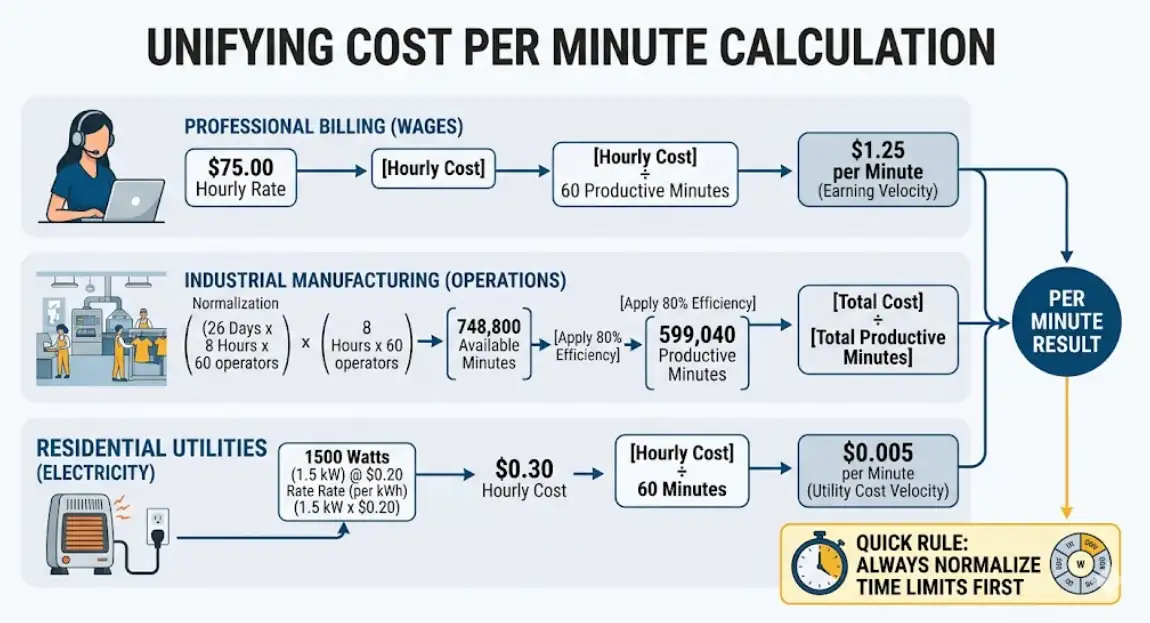
How do you calculate wage per minute for professional billing?
A freelance graphic designer needs to calculate their exact per-minute rate to bill a client for a short consultation call.
Use these inputs in the calculator:
- $75.00 Hourly Rate.
Process:
Divide the $75.00 hourly rate by the 60 minutes in a standard hour.
Result:
- $1.25 per minute.
Meaning:
The designer earns $1.25 every sixty seconds. A quick 12-minute client phone call is worth exactly $15.00 in billable time.
What is the CPM formula in the garment industry?
A factory manager needs to calculate the “Cost of Making” (CM) for a new clothing line, factoring in actual machine uptime.
Use these inputs in the calculator:
$30,000 Monthly Overhead, 26 Working Days, 8 Hours, 60 Operators, 80% Plant Efficiency.
Process:
Multiply factory capacity to find 748,800 available minutes. Apply 80% efficiency to get 599,040 productive minutes. Divide the $30,000 overhead by 599,040.
Result:
- $0.0500 per minute.
Meaning:
It costs exactly 5 cents per minute to run the factory floor. If a shirt takes 15 minutes to sew, the direct Cost of Making is $0.75.
How to calculate electricity cost per minute for appliances?
A homeowner wants to track the exact real-time cost of running a high-draw space heater during the winter months.
Use these inputs in the calculator:
1500 Watts (1.5 kW) Power Rating, $0.20 Electricity Rate (per kWh).
Process:
Multiply 1.5 kW by the $0.20 rate to find a total hourly cost of $0.30. Divide that $0.30 by 60 minutes.
Result:
- $0.005 per minute.
Meaning:
The heater costs half a cent every minute it runs. Leaving it on for 90 minutes adds $0.45 to the monthly utility bill.
How much is $10,000 per minute in a day?
This is a common curiosity question for understanding extreme wealth or massive corporate revenue.
Use these inputs in the calculator:
- $10,000 per minute.
Process:
There are 1,440 minutes in a standard 24-hour day. Multiply $10,000 by 1,440.
Result:
- $14,400,000 per day.
Meaning:
An entity earning ten thousand dollars every sixty seconds generates over fourteen million dollars in a single day.
Quick rule to remember
Always normalize your time limits first. Convert days, weeks, or decimal hours into pure minutes before dividing your total financial cost. Once you understand this base-60 math, enter your own numbers into the calculator above to track your exact earning velocity or operational burn rate.
Cost Per Minute Result Benchmarks Explained
Your cost per minute reveals your true financial velocity. Compare your calculated rate against these global benchmarks to see if your freelance wages are competitive or if your factory overhead is dangerously high.
| CPM Range | Label | USA Guideline | India Guideline | Notes |
|---|---|---|---|---|
| $0.01 – $0.15 | Entry / Budget | Basic data entry or extreme budget tasks. | Target CM (Cost of Making) for efficient garment factories. | Great for factory overhead; poor for US wages. |
| $0.16 – $0.75 | Professional | Standard freelance and mid-level wages ($10–$45/hr). | High-end consulting or specialized IT outsourcing rates. | The sweet spot for sustainable independent work. |
| $0.76 – $5.00+ | Specialist | Elite consulting, legal, or luxury manufacturing. | Executive-level consulting or heavy industrial overhead. | High earning velocity; requires specialized skills. |
Heads-up: Factory and wage goals are opposites. A high wage CPM is excellent, while a high factory CPM indicates expensive overhead.
Interpretation
Maintaining a wage CPM above $0.35 is the minimum goal for most independent US contractors. However, in factory mode, an operational CPM above $0.15 often indicates expensive overhead. If your factory number is climbing, you need immediate efficiency optimization to remain globally competitive against overseas manufacturing hubs.
Pro Tip:
Track your daily workflow in 15-minute blocks for one week. This habit exposes hidden time leaks and helps push your personal earning velocity into a higher bracket without forcing you to work longer hours.
What to Do After Using the Cost Per Minute Calculator
Your calculation is the first step toward better time management. Use this result to identify time leaks or production bottlenecks. High-performing individuals and businesses treat every 60 seconds as a micro-transaction. Improving your earning velocity or lowering your operational overhead starts with these practical actions.
For High Result Ranges
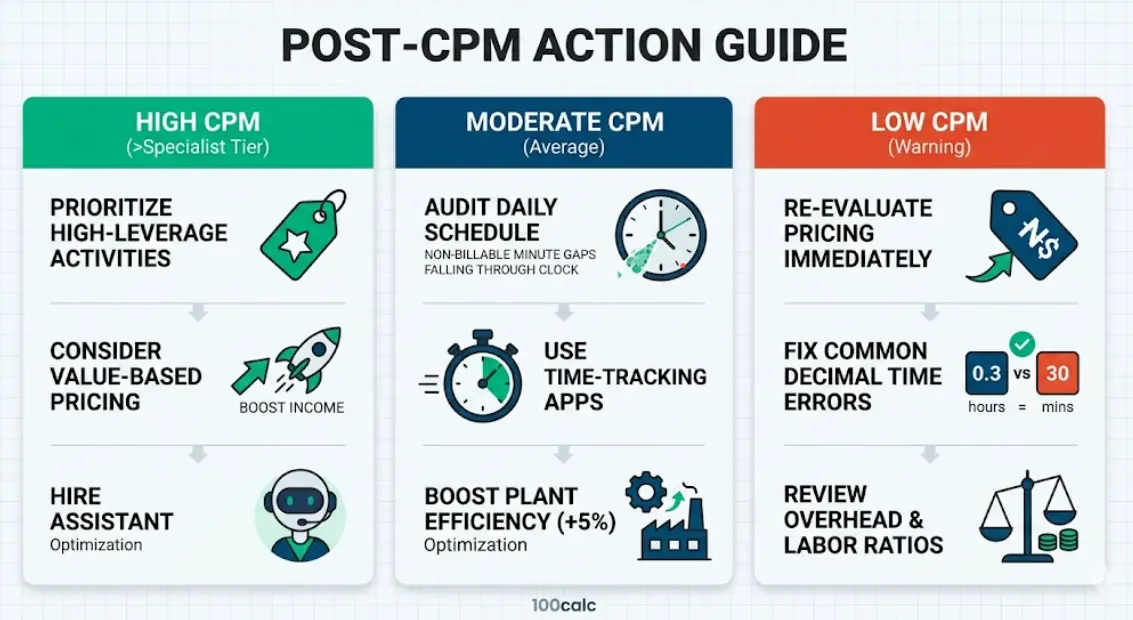
Protect your time from low-value tasks. Spending ten minutes on administrative fluff costs you more than hiring a part-time assistant if your wage CPM is in the specialist tier. Prioritize high-leverage activities that match your calculated minute-rate. You should also consider value-based pricing instead of time-based billing. This allows you to decouple your income from the literal clock while maintaining your high financial velocity.
For Moderate Result Ranges
Audit your daily schedule for non-billable minutes. Small gaps between meetings or distractions can significantly lower your effective hourly rate. You can use time-tracking apps to capture every billable second for short consultations or quick edits. If you are in manufacturing, focus on improving your plant efficiency by just 5%. This small shift can lower your operational CPM enough to win more competitive contracts against global rivals.
For Low Result Ranges
Re-evaluate your pricing structure immediately to avoid professional burnout. You might be undercharging for the complexity of your work or ignoring hidden overhead costs. Check if you are making common decimal time errors where 0.3 hours is confused for 30 minutes. Correcting these billing mistakes often provides an instant income boost. In a factory setting, high overhead relative to production suggests you should review labor ratios or machine maintenance schedules.
You Might Also Find These Helpful
Personal Finance 4
No tools published here yet.
Explore Related Tools
Common Mistakes When Using the Cost Per Minute Calculator
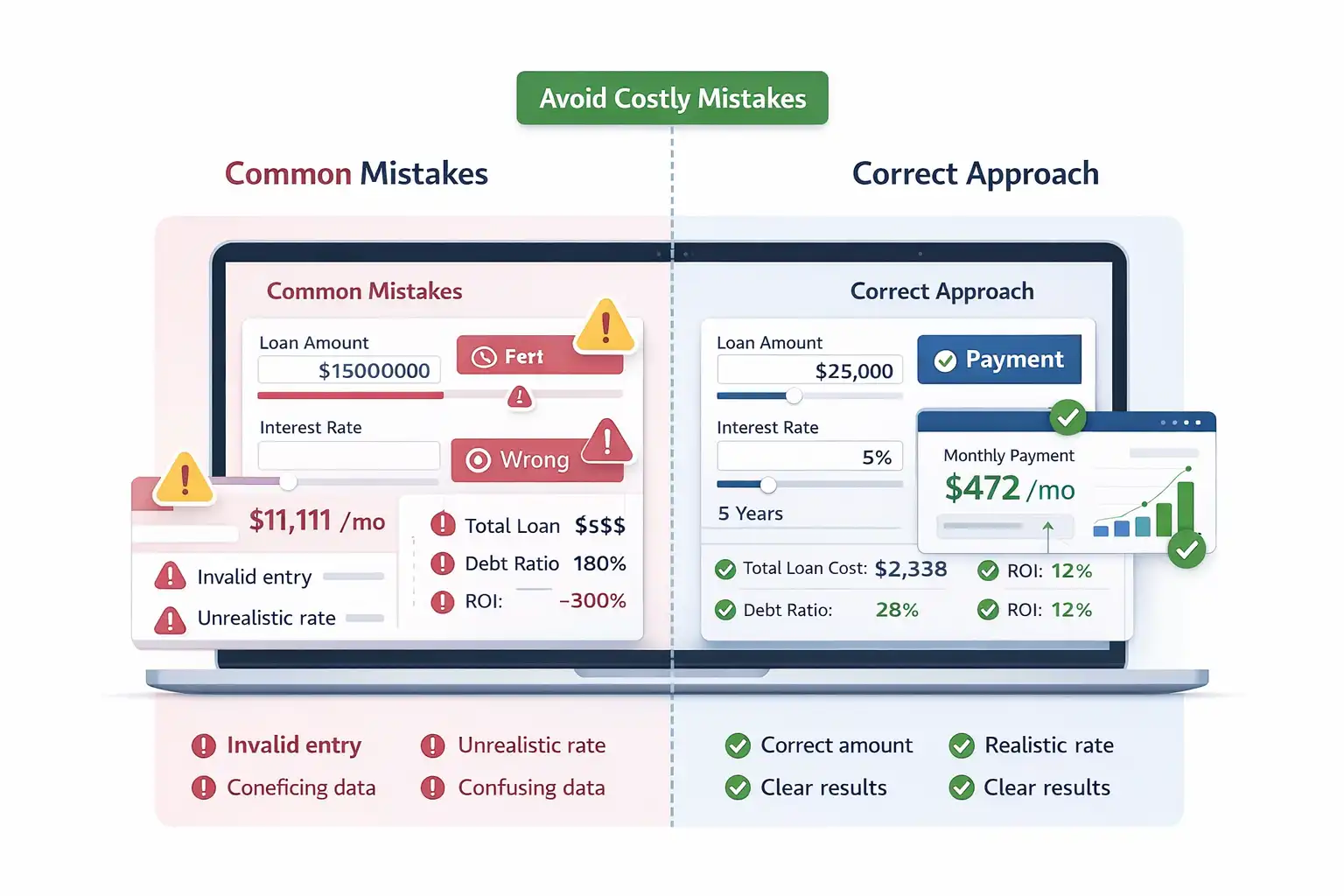
Time-based financial math is notoriously tricky because it relies on base-60 logic rather than standard decimals. Most calculation errors happen due to incorrect unit conversions or overlooking hidden operational downtime. Avoid these specific input errors to ensure your final billing rate remains perfectly accurate.
- Confusing decimal hours with actual minutes instead of multiplying the decimal by sixty.
- Forgetting to include off-line factory floor helpers in your total operator headcount.
- Setting the plant efficiency slider to maximum capacity and ignoring natural mechanical downtime.
- Failing to convert appliance Watts into Kilowatts before applying your local utility rate.
- Entering an annual salary amount while leaving the time period dropdown set to hourly.
Frequently Asked Questions (FAQs)
Does electricity cost per minute include standing charges?
No, the electricity CPM typically only covers the active energy draw of the appliance itself. To get a total household cost, you would need to add your daily standing charge divided by 1,440 minutes. Most people focus only on the appliance rating for usage math.
For high-draw devices like electric showers, the cost per minute is massive. A standard 8.5kW shower in 2026 can cost over 60 cents per ten-minute session.
What is the CPM formula in the garment industry?
The garment industry formula is: Total Monthly Overhead divided by (Total Monthly Available Minutes multiplied by Efficiency). This calculation helps managers find the exact “Cost of Making” for each product style. It accounts for labor, rent, and the actual time machines are running.
Industrial engineers use this result to negotiate prices with buyers. Knowing the true CPM protects factory margins from fluctuating labor costs and material volatility.
How do I calculate salary per minute?
Divide your annual gross pay by 124,800, which is the standard number of minutes in a 2,080-hour work year. If you make $60,000 annually, your cost per minute is roughly $0.48. This conversion helps you understand the monetary value of your working time.
Using your gross pay provides a baseline for your total earning power. You can also use your take-home pay to find your net value per minute.
Why is my factory CPM so high?
A high factory CPM usually stems from low plant efficiency or excessive machine downtime. If your overhead costs remain fixed while your production speed drops, the cost of every active minute increases. It can also happen if your machine-to-operator ratio is poorly managed.
Optimizing your workflow or upgrading old equipment can lower this number. Even a 5% increase in efficiency can significantly reduce your operational CPM.
Is cost per minute better than cost per hour for billing?
Minute-based billing is far more accurate for short tasks like consultation calls, quick edits, or transcription. It ensures you are paid for the exact time spent rather than rounding down to the nearest hour. This method prevents income loss on high-frequency, short-duration projects.
Many high-level consultants in 2026 are shifting to per-minute rates for rapid response services. It creates a fair price for both the expert and the client.
How do I calculate "Cost Per Audio Minute" for transcription?
To find the cost per audio minute, divide your total project fee by the length of the recording in minutes. Charging $60 for a 30-minute interview results in a $2.00 per audio minute rate. This is different from your working minute rate.
Audio minute rates vary in 2026 based on audio quality and the number of speakers. Most professional services range from $0.25 to $5.00 per audio minute.
How do I calculate call rates with "pulse" billing?
In telecom, pulse billing means calls are rounded up to the nearest time block, such as 6 or 60 seconds. To calculate this, divide your call duration by the pulse length and round up to the next whole number. Then, multiply by the pulse rate.
This “60/6” or “1/1” logic means you might pay for more time than you actually used. Always check your carrier’s rounding rules to find the effective per-minute cost.
Questions?
We had love to hear from you! Whether you are reporting an issue, suggesting a new calculator, or exploring collaboration opportunities — we are here to help. Every message helps us make 100calc smarter, faster, and more helpful for everyone.
Why People Trust 100calc
At 100calc.com, we focus on accuracy, speed, and trust. Every calculator we create is designed to give reliable, instant, and easy-to-understand results you can truly depend on.