
Conception Date Due Date Calculator
The Conception Date Due Date Calculator offers a highly accurate way to predict your baby’s arrival. Most standard tools rely on your last period date. However, this calculator uses the exact day of fertilization or intercourse. You can find your official 40-week due date and track your current pregnancy progress instantly. Select your method below to start.
Accuracy remains vital for your pregnancy planning. Standard period dating can vary by several days. Therefore, knowing your conception date provides a more reliable timeline. This tool accounts for the 266-day gestation period. It also identifies your current trimester and your baby’s zodiac sign. You can plan for your delivery with total confidence. Get your clinical results in seconds today.
- Updated Feb 10, 2026
Conception Date Due Date Calculator: Precision Birth Planner
Plan your pregnancy journey with clinical accuracy. You can find your arrival date using the day you conceived. Most doctors use the last period date for records. However, using the conception day is much more precise for your own planning. Therefore, you should use this tool to see your exact baby milestones.
Enter the date of ovulation or egg retrieval.
ESTIMATED DUE DATE
YOU ARE CURRENTLY
Baby Highlights
Clinical Timeline:
- Calculation Method: --
- Theoretical LMP: --
- Conception Date: --
*Based on the standard 266-day fetal gestation period. Actual due date may vary by ±2 weeks.
How to Read Your Conception Results
Reading your results correctly helps you prepare for your baby. The Conception Date Due Date Calculator provides clinical data and fun facts. Understanding these numbers ensures you stay on track with your doctor’s expectations.
Why Conception Dating is Better
Conception dating offers the most accuracy for your timeline. Most people use their last period date to find a due date. However, ovulation cycles often vary between different women. Consequently, using a period date can be off by several days. Fertilization marks the actual biological start of your pregnancy. Therefore, using this specific day creates a much more reliable birth plan.
Understanding Theoretical LMP
Doctors always track pregnancy using the last menstrual period or LMP. Our tool calculates a virtual or theoretical LMP for you. It subtracts exactly 14 days from your conception date. This math aligns your results with standard medical charts. Most clinics use this 40-week scale to monitor fetal growth. Consequently, you can talk to your doctor using the exact numbers they see.
Using Your Baby Highlights
The highlights grid provides fun details about your future arrival. You can see the zodiac sign and the birth season for your baby. These details help you pick out the right clothes and nursery themes. For example, a winter baby will need warmer blankets and gear. Furthermore, the countdown keeps you motivated as you reach each milestone. Knowing the trimester also helps you understand your current physical needs.
Quick example to check the math
Suppose you know your exact conception date is October 1. The calculator adds the standard gestation period to this specific day. You can follow the math to see how the tool reaches your result.
First, the tool uses the 266-day rule for fertilization. Your calculation looks like this: October 1 + 266 Days = June 24
Next, you can find your clinical period date for medical records. You subtract 14 days from October 1 to reach September 17. Doctors will see your due date as exactly 40 weeks from September 17. Consequently, your hospital charts will match the biological age of your baby. Check your own dates now to see your results instantly.
Explore More Calculators
Use our Pregnancy Chance Calculator to estimate your odds. Enter your cycle day, age, and method. Find out if you are in the high-risk…
Try calculatorCalculate odds with the Chance of Twins Calculator. Enter maternal age and history. Find your probability instantly. See if you will conceive multiples now.
Try calculatorFind out exactly when you conceived. Our free Conception Calculator uses your Due Date, LMP, or Ultrasound to estimate your fertilization date and fertile…
Try calculatorCalculate hCG doubling time instantly. Enter two test results. See if your levels are rising normally. Check pregnancy progress now in the hCG Calculator.
Try calculatorCalculate implantation window instantly. Enter last period date. Find peak probability. See when to take a pregnancy test in the Implantation Calculator.
Try calculatorUse our IUI Due Date Calculator to find your exact due date and safe pregnancy test day. Get clinical 40-week results based on your…
Try calculatorHow to Use the Conception Date Due Date Calculator
Using the Conception Date Due Date Calculator is a simple process. You only need one specific date to get your full timeline. Follow these easy steps to find your baby’s arrival date.
Select Your Calculation Method
Choose the option that matches your personal records. You can pick between "Conception / Ovulation" or "Intercourse Date." Select the first option if you tracked your ovulation day. Select the second option if you only know the day you had sex. Each method uses a different medical logic for accuracy.
Input Your Specific Date
Enter the exact calendar day of your event. You should use the date from your tracking app or medical notes. Accuracy is very important for the final result. The tool uses this date as the biological starting point. Consequently, your timeline will align with your baby's actual growth.
Understand the Process Logic
The calculator applies a precise formula once you click the button. It adds exactly 266 days for a direct conception date. However, the tool adds two extra days for an intercourse date. This lag accounts for the time sperm takes to fertilize an egg. Therefore, your result remains medically sound and realistic.
Review Your Pregnancy Timeline
Check your results to see the full countdown. You can find your current trimester and the days left until birth. This data helps you schedule your doctor visits and nursery setup. Furthermore, you can see the birth season and zodiac sign. These highlights make your planning much more personal and exciting.
Example for testing
Try these sample numbers:
Try these sample numbers to understand how the pregnancy timeline shifts. You can use these figures to verify the accuracy of the Conception Date Due Date Calculator.
Calculation Method: Conception / Ovulation
Date: October 1
Year: 2025
Result →Your Estimated Due Date is June 24, 2026. Your Theoretical LMP is September 17, 2025. The tool also identifies your baby as a Cancer born in the Summer season.
Now, enter your own numbers and check how close you are to your goal.
How the Conception Date Formula Works (Complete Breakdown)
Understanding how your arrival date is calculated helps you plan your pregnancy with total confidence. This formula gives you a clear picture of your milestones and what you can expect during your journey. It is based on real-world medical standards used in the U.S. and around the world. Consequently, the results are accurate and practical for every expectant parent.
The Conception Due Date Formula
The due date formula shows when your baby will likely arrive based on the day of fertilization. This calculation is simple and works for anyone who knows their ovulation or conception date. Medical experts use this same method to set precise timelines for birth.
Formula:
Estimated Due Date = Conception Date + 266 Days
This formula adds exactly 266 days to the day you conceived. This number represents the standard 38 weeks of fetal growth in the womb. Next, the tool identifies the specific calendar day that marks your 40-week clinical milestone.
Example:
					If your conception date was August 1,
August 1 + 266 Days = April 24
Your estimated due date is April 24, which most doctors consider full term. This date acts as your target for delivery and hospital preparations.
Micro Note:
Most medical institutions in the U.S. track pregnancy over 40 weeks. This timeline includes the two weeks before conception. Therefore, a 38-week fetal age equals a 40-week gestational age on medical charts.
Key Inputs Used in the Conception Calculator
Every pregnancy calculation depends on a few simple inputs. These inputs help you measure your current progress and plan for your arrival date. By entering real dates for conception or intercourse, you can get accurate results instantly. Many U.S. hospitals and fertility clinics use this same method to track fetal development and health.
Conception Date
The exact day the egg was fertilized. If you tracked your ovulation or had an egg retrieval, this is your primary input. This value sets the base for your entire pregnancy timeline. Many clinics calculate milestones based on this specific biological event.
Intercourse Date
This is the day you had sex. Since sperm can live for several days, fertilization might happen shortly after. The tool adds a small lag to this date to ensure the math remains realistic. This shows your most likely arrival window based on your personal records.
Theoretical LMP
Your theoretical Last Menstrual Period is a virtual date used for medical tracking. Doctors subtract 14 days from your conception date to find this number. It allows your results to match the 40-week growth charts used in every doctor’s office.
Another Example Calculation (Step-by-Step)
Let’s see how the conception calculator works using a real-world example. This will help you understand how each number affects your final timeline and what you can do to prepare. The calculation follows the same logic used by midwives, doctors, and birth centers.
Given:
- Conception Date: October 15
- Method: Direct Ovulation
- Target: 40 Weeks
Calculation:
					October 15 + 266 Days = July 8
Your official due date is July 8, during the summer season. If you want to find your current status, the tool finds your virtual period date. In this case, your theoretical period started on October 1.
Result:
- Estimated Due Date: July 8
- Theoretical LMP: October 1
- Zodiac Sign: Cancer
- Birth Season: Summer
Meaning:
With consistent tracking, you can stay ahead of your pregnancy needs. For example, knowing your summer arrival helps you buy the right clothing and gear for the heat. In the U.S., most doctors expect you to reach the 39-week mark for the healthiest outcomes. Using your conception date ensures your records are more accurate than using a simple period date.
Pregnancy Dating Benchmarks
Pregnancy timelines vary depending on the information you provide. Accuracy is essential for tracking your baby’s growth and planning your medical visits. Some methods offer high precision, while others provide a general window. Use the table below to compare how the <strong>Conception Date Due Date Calculator</strong> performs against traditional methods.
| Dating Method | Precision Level | Margin of Error |
|---|---|---|
| Conception / Ovulation | Gold Standard |
+/- 3 Days
The most reliable biological start date. |
| Intercourse Date | High Accuracy |
+/- 5 Days
Adjusted for sperm survival window. |
| Period Date (LMP) | Variable |
+/- 10 to 14 Days
Often inaccurate due to cycle shifts. |
Note: Most medical providers start with the period date for convenience. However, they usually adjust this date once you have an early ultrasound scan.
Interpretation
Knowing your conception date gives you a significant advantage. It allows you to track fetal milestones with much higher confidence. Consequently, your home preparations will better align with your baby’s actual arrival. Reliable data reduces the stress of “due date anxiety” during the final weeks.
Pro Tip:
Share your conception records with your healthcare provider during your first visit. They can use this data to confirm your ultrasound measurements. Furthermore, accurate dating helps prevent unnecessary medical inductions based on an incorrect period-based timeline.
Tips & Planning Based on Your Result
Planning for your baby involves more than just picking a date. You should use your results to prepare for the physical and fun parts of pregnancy. These insights help you stay organized as you move toward your delivery day.
The Plus and Minus Rule
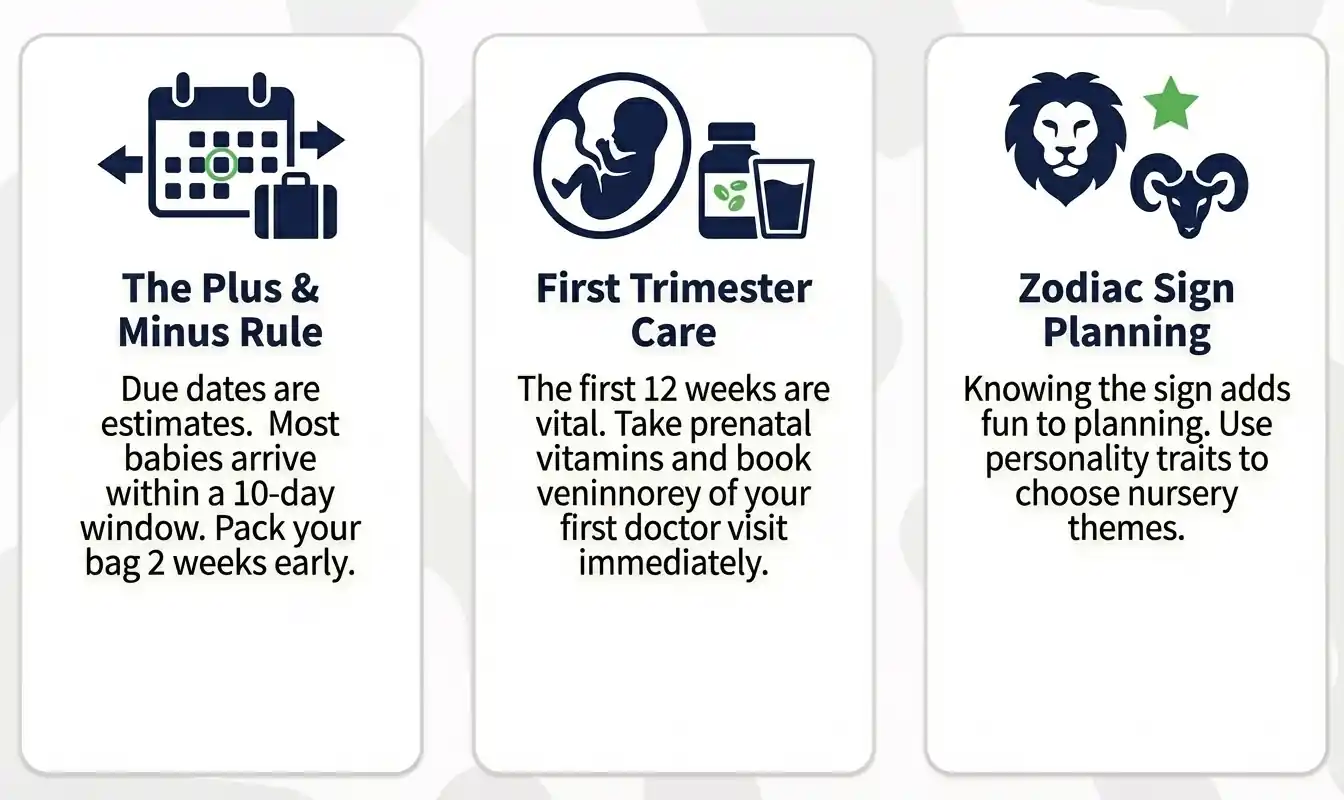
You should remember that a due date is an estimate. Studies show that 80% of babies arrive within 10 days of their calculated date. Very few infants actually arrive on their exact day. Therefore, you should prepare your hospital bag at least 2 weeks in advance. Having your supplies ready will reduce your stress if the baby arrives sooner.
Focus on First Trimester Care
The first 12 weeks of your pregnancy are vital for your baby. During this time, the major organs and body systems begin to form. Consequently, you should focus on healthy habits immediately. Take your prenatal vitamins and stay hydrated every day. You should also schedule your first prenatal visit as soon as you confirm your results. Early medical care ensures the best start for your growing little one.
Planning with Zodiac Signs
Knowing your baby’s zodiac sign adds a fun layer to your planning. You can see if your child might be a bold Aries or a loyal Leo. Many parents use this data to choose nursery themes or colors. For example, an earth sign like Taurus might inspire a nature-themed room. Use the results from the Conception Date Due Date Calculator to explore these personality traits. It is a great way to bond with your baby before they even arrive.
You Might Also Find These Helpful
Pregnancy & Fertility 9
Use our IVF Due Date Calculator to find your exact twin pregnancy timeline. Enter your transfer date to get 40-week and 37-week dates instantly.
Try calculatorEstimate loss probability instantly. Enter age and week. See how a heartbeat lowers risk. Check your success rate now in the Miscarriage Risk Calculator.
Try calculatorFind your conception date with our Reverse Due Date Calculator. Enter your due date to reconstruct your pregnancy timeline and fertile window instantly.
Try calculatorCommon Mistakes to Avoid When Calculating
Calculating your birth date using conception requires exact details. You should avoid these common errors to keep your timeline accurate. Small mistakes can lead to confusion during your final weeks of pregnancy.
- Confusing Intercourse with Conception: Many people assume fertilization happens on the same day as sex. However, sperm can live for several days inside the body. Consequently, your actual conception date might be later than your intercourse date. You should select the "Intercourse" method if you are unsure of your exact ovulation. The tool will then apply a standard lag for a more realistic result.
- Using the Wrong Year: Entering the current year instead of the following year is a very common error. For example, you might type 2025 when the delivery will happen in 2026. This mistake will cause the countdown to show negative days. You should always double-check the year before you click the calculate button. Accurate years ensure your calendar milestones match your hospital records perfectly.
- Ignoring Your Cycle Length: Standard period-based calculators assume every woman has a 28-day cycle. Many women have cycles that are much longer or shorter. Consequently, those standard tools often provide the wrong due date. This Conception Date Due Date Calculator is better because it bypasses the cycle length entirely. Using the fertilization day directly ensures your results remain clinical and precise regardless of your cycle history.

Frequently Asked Questions (FAQs)
When is my due date based on conception?
Your birth date occurs exactly 266 days after fertilization. This standard calculation represents 38 weeks of fetal development. However, doctors add 2 weeks to this number to align with the standard 40-week medical scale. You can find this precise date instantly by using the Conception Date Due Date Calculator.
Are you already 2 weeks pregnant at conception?
Yes. Medical professionals count pregnancy from the first day of your last period. Most women ovulate and conceive about two weeks after their period starts. Therefore, you are technically considered two weeks pregnant on the day you conceive. This method ensures all clinical growth charts remain consistent for every patient.
What is the Nigel rule?
The Naegele rule is a standard way to estimate a due date. You start on the first day of your last period. Next, you subtract three months and add seven days. Finally, you add one year to reach the final result. While popular, this rule assumes you have a perfect 28-day cycle.
How do I count the day I conceived?
You can identify your conception day by tracking your ovulation. Many people use basal body temperature or ovulation test strips. If you know the day you ovulated, that is your biological conception date. You should count that specific day as the start of your 38-week fetal journey.
Is conception dating more accurate than an ultrasound?
Conception dating is extremely reliable if you know your exact ovulation day. However, an early ultrasound remains the gold standard for medical verification. Doctors use the scan to measure the actual size of the embryo. Consequently, they may adjust your due date slightly based on those physical measurements.
Can I conceive five days after intercourse?
Yes. Healthy sperm can survive inside the reproductive tract for up to five days. Therefore, you might conceive several days after you have sex. This is why our tool offers an “Intercourse” option with a built-in lag. It helps account for the time between the act and actual fertilization.
Why did my doctor give me a different date?
Doctors usually base their first estimate on your last period date. They do this because many patients do not know their exact conception day. If your cycle is long or short, their date might differ from yours. You should share your conception-tracking data with your medical team to improve accuracy.
Questions?
We had love to hear from you! Whether you are reporting an issue, suggesting a new calculator, or exploring collaboration opportunities — we are here to help. Every message helps us make 100calc smarter, faster, and more helpful for everyone.
Why People Trust 100calc
At 100calc.com, we focus on accuracy, speed, and trust. Every calculator we create is designed to give reliable, instant, and easy-to-understand results you can truly depend on.