Grams to Calories Calculator for Food Weight, Macros, and Labels
Grams do not convert to one fixed calorie number. It depends on the food. 100g of oil is about 884 calories, 100g of cooked rice is about 130, and 100g of cucumber is about 15. Calories come from food makeup, not weight alone. Here is what trips people up.
You weigh your food, see the grams, and still cannot tell the calories. The same 100g can mean a light snack or a high-calorie serving. Weight gives you the amount. It does not give you the energy.
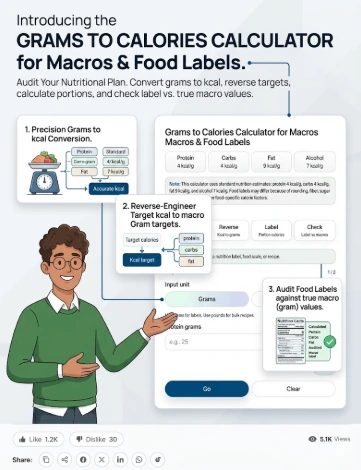
This grams to calories calculator fixes that. Pick a food and enter grams to estimate calories. Or use macro mode for protein, carbs, fat, and alcohol. You can also convert calories back into grams, scale a food label to your real portion, or check why label calories do not match macro math.
Quick Facts
- 1g protein = 4 calories
- 1g carbs = 4 calories
- 1g fat = 9 calories
- 1g alcohol = about 7 calories
- 100g of food can range from about 15 to 900 calories
- 100 calories = 25g protein, 25g carbs, 11.1g fat, or 14.3g alcohol
- Updated May 26, 2026
Run the Grams to Calories Calculator in Seconds
Start with the Food mode if you know the food and weight. Pick rice, chicken, banana, oil, or another common food. Add grams and tap Go. Use Macros for protein, carbs, fat, and alcohol. Use Reverse for calorie targets. Use Label for package portions. Use the check when the food label’s calorie count looks wrong.
Pick your food. Add grams. See the calories.
Try a quick example
Use grams for labels. Use pounds for bulk recipes.
Add alcohol, optional
Alcohol has about 7 calories per gram.
Examples
Examples
Examples
Add alcohol, optional
Your calorie result
How Many Calories Are in 100 Grams of Food?
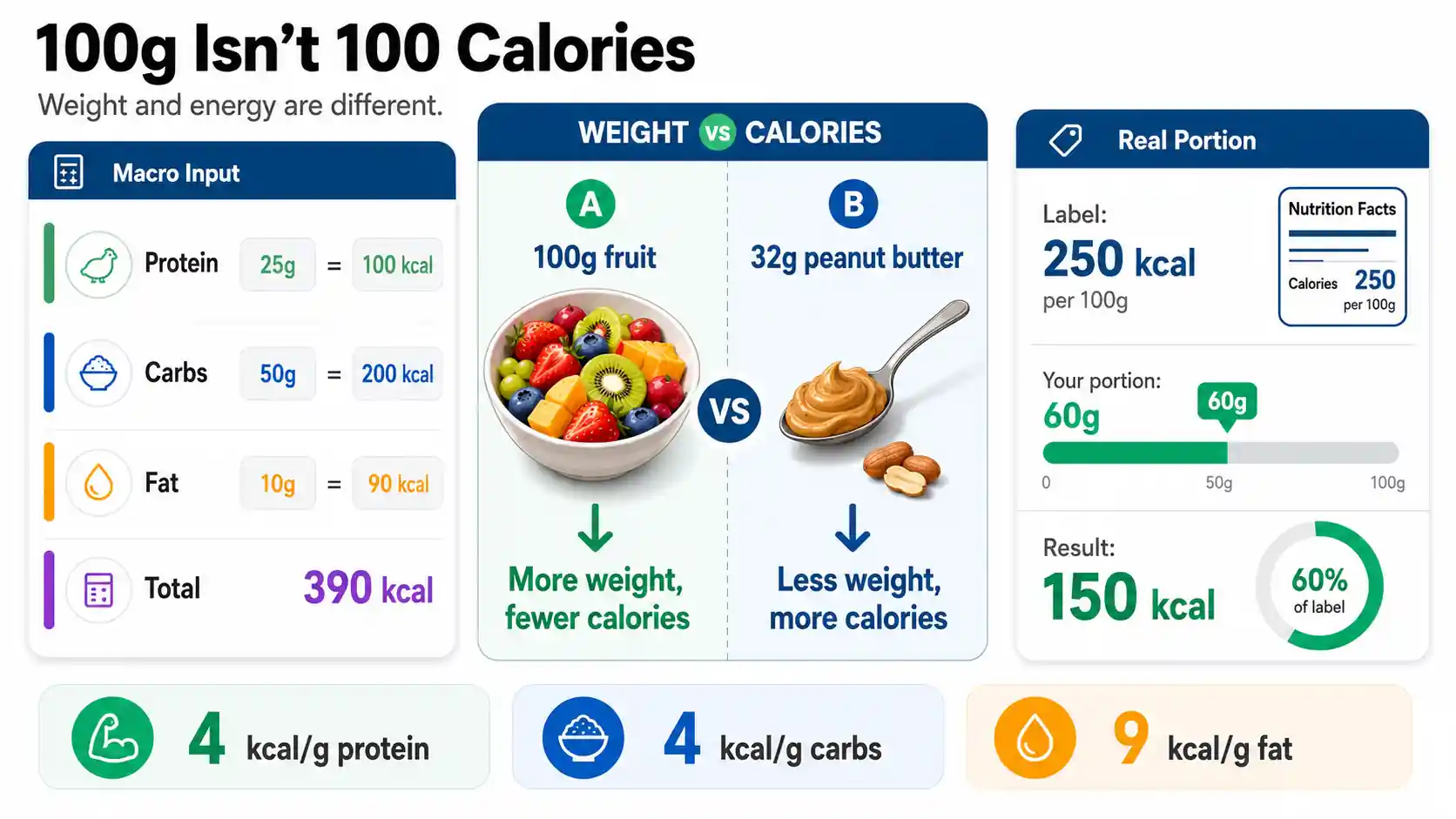
100 grams of food does not equal 100 calories. The calorie count depends on the food. 100g of oil has about 884 calories, 100g of rice has about 130, and 100g of cucumber has about 15. Calories come from fat, carbs, protein, and alcohol, not from weight.
Fat-heavy foods pack the most calories per gram. Water-heavy foods like vegetables pack the least. To get the exact number for your food, pick it in the Food mode above and enter your grams.

| Food (100g) | Calories | Main Macro | Why |
|---|---|---|---|
| Oil | ~884 kcal | Fat | Pure fat at 9 calories per gram. |
| Butter | ~717 kcal | Fat | Almost all fat, very little water. |
| Peanut butter | ~588 kcal | Fat | High fat and protein, low water. |
| Nuts / almonds | ~579 kcal | Fat | Dense in fat and low in water. |
| Chocolate | ~546 kcal | Fat | Fat and sugar combined. |
| Sugar | ~387 kcal | Carbs | Pure carbs at 4 calories per gram. |
| Bread (white) | ~265 kcal | Carbs | Starchy carbs with little water. |
| Ground beef | ~250 kcal | Fat & Protein | Protein plus a high fat share. |
| Chicken breast | ~165 kcal | Protein | Lean protein with little fat. |
| Egg | ~143 kcal | Protein | Protein and some fat. |
| Rice (cooked) | ~130 kcal | Carbs | Carbs plus absorbed cooking water. |
| Banana | ~89 kcal | Carbs | Natural sugars with high water. |
| Potato (boiled) | ~87 kcal | Carbs | Starch with high water content. |
| Apple | ~52 kcal | Carbs | Mostly water and natural sugar. |
| Broccoli | ~34 kcal | Carbs | High fiber and water, low energy. |
| Cucumber | ~15 kcal | Carbs | Almost all water, very few calories. |
Why Calorie Density Matters
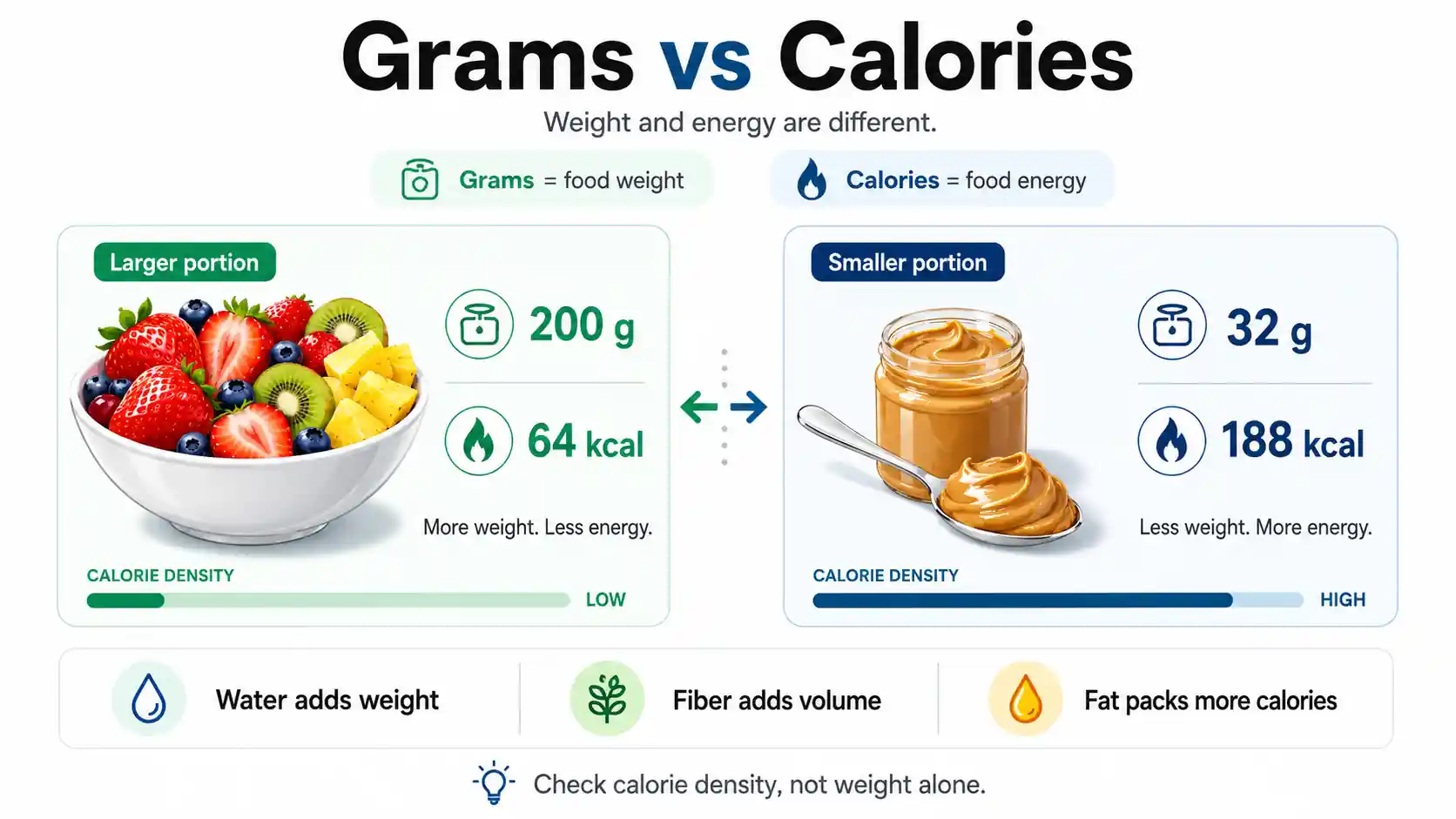
Calorie density shows how many calories a food has for its weight. Foods with more water or fiber usually have fewer calories per gram. Foods with more fat usually have more calories per gram. That is why 100g of cucumber feels very different from 100g of oil.
Heads-up: These are typical reference values per 100g. Real foods vary by brand, recipe, and cooking method. Use your food label for exact numbers.
What Is the Difference Between Grams and Calories?
Grams show how much food weighs. Calories show how much energy that food gives you. They are connected, but they are not the same thing. A food with more water usually has fewer calories per gram. A food with more fat usually has more calories per gram. That is why 100g of cucumber is very low in calories, while 100g of oil is very high.
How many calories are in 200 grams of food?
200 grams has double the calories of 100 grams of the same food. 200g of rice is about 260 calories, 200g of chicken is about 330, and 200g of oil is about 1,768. Multiply the calories per 100g by two.
How many calories are in 50 grams of food?
50 grams has half the calories of 100 grams of the same food. 50g of sugar is about 194 calories, 50g of nuts is about 290, and 50g of rice is about 65. Divide the calories per 100g in half.
Why doesn't 100g equal 100 calories?
Grams measure weight and calories measure energy. They are not the same. A food’s calories depend on its fat, carbs, protein, alcohol, and water content. Fat carries 9 calories per gram, so oily foods are calorie-dense. Water carries zero, so watery foods like cucumber stay very low.
Explore More Calculators
Use our Steps to Calories Calculator to convert steps to calories instantly. This walking calorie calculator adjusts for height and speed to ensure accuracy.
Try calculatorUse our Cycling Calorie Calculator to estimate your energy burn. Get accurate results based on weight, speed, and bike type for your fitness goals.
Try calculatorUse our Rucking Calories Calculator for 100% accurate results. Track your burn based on weight, pack load, and pace. Plan your fitness hike now.
Try calculatorHow Do You Calculate Grams to Calories?
Multiply each macro by its calorie value per gram. Protein and carbs use 4 calories per gram. Fat uses 9 calories per gram. Alcohol uses 7 calories per gram. Add the results to get total calories. For food labels, divide serving calories by serving grams, then multiply by your portion.
How many calories are in a 35g protein shake?
A 35g protein shake with 6g carbs and 3g fat has about 191 calories. Most of that energy comes from protein, not fat or carbs.
Input
- Protein: 35g
- Carbs: 6g
- Fat: 3g
- Alcohol: 0g
Process
- Protein: 35 × 4 = 140 calories
- Carbs: 6 × 4 = 24 calories
- Fat: 3 × 9 = 27 calories
Result 140 + 24 + 27 = 191 calories
Meaning
This is a protein-heavy drink. Most calories come from protein, which supports fullness and muscle tracking.
How many calories are in 10g of fat?
10g of fat has 90 calories. Fat has 9 calories per gram, so 10 × 9 = 90. This is why oils, butter, and dressings raise a food log fast.
Input
- Fat: 10g
- Protein: 0g
- Carbs: 0g
- Alcohol: 0g
Process
- Fat: 10 × 9 = 90 calories
Result 10g fat = 90 calories
Meaning
Fat adds calories quickly. This is why oil, butter, nut butter, and dressings can change a food log in small amounts.
If 100g is 147 calories, how many calories are in 180g?
180g is about 265 calories when 100g equals 147 calories. You scale the label by weight: 147 ÷ 100 × 180 = 265.
Input
- Label calories: 147 calories
- Serving size: 100g
- Your portion: 180g
Process
- Calories per gram: 147 ÷ 100 = 1.47 calories
- Portion calories: 1.47 × 180 = 264.6 calories
Result 180g = 265 calories
Meaning
Your portion is larger than the label serving. Log about 265 calories, not 147.
Why do my macro calories not match the food label?
Macro math here gives 254 calories while the label says 230, a 24-calorie gap. Gaps like this come from rounding, fiber, or serving-size differences.
Input
- Food label calories: 230
- Protein: 20g
- Carbs: 30g
- Fat: 6g
- Alcohol: 0g
Process
Protein: 20 × 4 = 80 calories
Carbs: 30 × 4 = 120 calories
Fat: 6 × 9 = 54 calories
Macro total: 80 + 120 + 54 = 254 calories
Difference: 254 − 230 = 24 calories
Result 24 calorie difference
Meaning
A 24-calorie gap is on the larger side. Check serving size, fiber, sugar alcohols, or label entries when the difference grows.
What is the 4-4-9 rule?
The 4-4-9 rule is the standard method for converting macros into calories. Protein has 4 calories per gram, carbs have 4 calories per gram, and fat has 9 calories per gram. Multiply each macro by its value, then add the results for total calories.
Some versions extend it to 4-4-9-7, adding alcohol at 7 calories per gram. The calculator above uses the full 4-4-9-7 set so drinks are covered too.
Quick rule to remember
Use Macros for protein, carbs, fat, and alcohol. Use Label when your portion differs from the package serving. Use Check when the label and macro math do not line up.
What Does Your Grams to Calories Result Mean?
Your grams to calories result shows the estimated energy in your food, portion, macros, or label entry. It does not judge the food as good or bad. It simply shows how many calories your entered grams may add to your food log.
Your Result Shows Food Energy
Calories measure energy, not food size. A large portion can still be low in calories if it has more water or fiber. A small portion can be high in calories if it has more fat, sugar, or alcohol. This is why the number matters more than weight alone. It helps you compare foods, log meals, and understand what actually drives the calorie total.
Food Mode Estimates Calories by Food Weight
Food mode is best when you know the food and the grams. It uses typical calories per 100g, then scales the result to your portion.
For example, 100g of cooked rice has about 130 calories. If you enter 200g, the result doubles to about 260 calories.
Macro, Label, and Check Modes Give Deeper Tracking Detail
Macro mode shows calories from protein, carbs, fat, and alcohol. Label mode adjusts package calories to the amount you actually ate. Check mode compares label calories with macro math when the numbers look wrong.
Use the result as a tracking guide. Then check the next section to decide what to adjust.

How many calories are in a 95g portion if the label says 210 per 140g?
A 95g portion is about 143 calories when the label lists 210 calories per 140g. Because you ate less than the full serving, the calorie count drops with the smaller weight.
Inputs
- Calories per serving: 210
- Serving size: 140g
- Your portion: 95g
Result
- Calories per gram: 210 ÷ 140 = 1.5
- Portion calories: 1.5 × 95 = 142.5
- Total: 143 calories
Meaning
Eating less than the listed serving means fewer calories than the label shows. This is the mistake that quietly throws food logs off.
Which Grams to Calories Mode Should You Use?
A grams to calories calculator should match the question you have right now. Use Food mode when you know the food and weight. Use Macros for protein, carbs, fat, and alcohol. Pick Reverse for calorie targets. Choose Label for package portions. Use Check when label calories feel off.
| Mode | Best For | Inputs Needed | Result | Notes |
|---|---|---|---|---|
| Food | Foods | Food type and grams. | Estimated calories for your portion. | Best for 100g calorie searches and quick food checks. |
| Macros | Tracking | Protein, carbs, fat, optional alcohol. | Total calories and macro split. | Best for meals, recipes, and macro logs. |
| Reverse | Targets | Calories and macro type. | Grams of protein, carbs, fat, or alcohol. | Use for searches like 100 calories in grams. |
| Label | Portions | Label calories, serving grams, portion grams. | Calories in your actual portion. | Best when your portion differs from the serving size. |
| Check | Mismatch | Label calories and macro grams. | Difference in kcal. | Use when food label calories look wrong. |
Heads-up: Start with Food mode for normal food weight searches. Use grams for nutrition labels. Use pounds only for bulk recipes or large meal prep batches.
How to Use the Grams to Calories Calculator
Use the grams to calories calculator by starting with Food mode when you know the food and weight. Pick a food, enter grams, and check the calories. Use Macros for nutrient grams, Reverse for calorie targets, Label for package portions, and Check when label calories look wrong.
Each mode answers a different food tracking question, so pick the one that matches what you are trying to solve.

Start With Food Mode
Use Food mode for normal food weight searches. Pick rice, chicken, banana, oil, or another food from the list. Add the grams you weighed. The calculator scales the calories from a typical 100g value.
Choose the Right Unit
Use grams for food labels, recipes, and scale weights. Pick pounds only for bulk meal prep or larger batches. If pounds are selected, the calculator converts them into grams before running the calorie math.
Enter Your Food Values
Add the numbers from your food scale, label, app, or recipe. Empty macro fields count as zero. Negative values will not work. For Label mode, add label calories, serving grams, and your portion grams.
Run the Result
Tap Go after adding your values. The calculator shows the output for your selected mode. You may see food calories, macro calories, grams, portion calories, label difference, or a short insight.
Read the Insight
Check the result note before changing your food log. It shows what matters most. Food mode estimates your portion. Macro mode shows the calorie split. Label and Check modes help catch serving-size mistakes.
How many grams of fat is 160 calories?
160 calories of fat is about 17.8 grams. Fat reaches a calorie target in fewer grams because it carries 9 calories per gram, more than double protein or carbs.
Inputs
- Calories: 160
- Macro type: Fat
Result
160 ÷ 9 = 17.8g fat
Meaning
The same 160 calories would take 40g of protein or carbs. Fat hits the target in far fewer grams, which is why oils and butter add up quickly.
How the Grams to Calories Calculator System Works
The grams to calories calculator uses standard macro calorie values, then matches them to the selected mode. It can convert macros, reverse calories into grams, scale food label portions, and compare label calories with macro math. That gives users a clearer answer than a basic grams to calories converter.
Key Features & Benefits
- Converts protein, carbs, fat, and alcohol into calorie totals.
- Supports grams for labels and pounds for bulk meal prep.
- Scales food label calories by the portion actually eaten.
- Compares label calories with macro math to spot gaps.
- Shows a result table, insight, macro split, and sticky result.
Technical Process
Input Capture
The system reads the selected mode, unit, and food values. Empty macro fields count as zero, while negative values get blocked.
Logic Match
Each mode uses its own rule. Macro mode adds calorie totals, Reverse mode divides calories by macro value, Label mode scales serving size, and Check mode compares two calorie totals.
Result Output
The calculator builds the final answer with a clear number, table, macro split, short insight, dynamic answer blocks, and sticky result badge.
How the Grams to Calories Formula Works (Complete Breakdown)
The grams to calories formula multiplies each macro by its calorie value, then adds the results. Protein and carbs use 4 calories per gram, fat uses 9, and alcohol uses 7. Each nutrient carries different energy, so the calculator weights them separately before building the final result.
Formula
Total Calories = (Protein × 4) + (Carbs × 4) + (Fat × 9) + (Alcohol × 7)
If Pounds Are Selected
Grams = Pounds × 453.592
Total Calories = (Protein grams × 4) + (Carbs grams × 4) + (Fat grams × 9) + (Alcohol grams × 7)
Reverse Formula
Grams = Calories ÷ Calories Per Gram
Food Label Formula
Calories Per Gram = Label Calories ÷ Serving Grams
Portion Calories = Calories Per Gram × Portion Grams
Calories Per 100g = Calories Per Gram × 100
Label Check Formula
Macro Calories = (Protein × 4) + (Carbs × 4) + (Fat × 9) + (Alcohol × 7)
Difference = Macro Calories − Food Label Calories
How the Formula Works
The formula gives each nutrient its own calorie value. Protein and carbs use a lower value. Fat uses a higher value. Alcohol sits between them.
For food labels, the calculator works by serving size. It finds calories per gram, then applies that number to the portion you ate.
For label checks, it compares two numbers. One comes from the food label. The other comes from macro math.
What Each Variable Means
Protein
Protein is the amount of protein entered in grams. The calculator multiplies it by 4 because each gram of protein adds 4 calories.
Carbs
Carbs are the carbohydrate grams from your food label, recipe, or macro log. The calculator multiplies carbs by 4 to find carb calories.
Fat
Fat is the fat amount in grams. Each gram adds 9 calories, so even small fat amounts can raise the total quickly.
Alcohol
Alcohol is optional. If added, the calculator multiplies alcohol grams by 7. Leave it empty if your food or drink has no alcohol.
Calories Per Gram
Calories per gram shows how much energy each gram of food carries. This value helps scale food labels to your real portion.
Label Calories
Label calories are the calories printed on the package. They usually apply to one serving, not always the amount you eat.
Serving Grams
Serving grams are the food weight listed on the Nutrition Facts label. This number helps the calculator find calories per gram.
Portion Grams
Portion grams are the amount you actually ate. The calculator uses this to estimate your real portion calories.
Difference
Difference shows the gap between label calories and macro calories. A small gap often comes from rounding or serving-size changes.
What are net carbs?
Net carbs are the carbs your body actually digests for energy. You find them by subtracting fiber and sugar alcohols from total carbs, because those pass through with little or no calorie impact.
Net Carbs = Total Carbs − Fiber − Sugar Alcohols
This calculator uses total carbs at 4 calories per gram, the same as most food labels. Net carbs matter most on keto or low-carb tracking, and they are one reason your macro math can sit slightly above the label calories.
Grams to Calories Benchmark Table
A grams to calories calculator result makes more sense when you compare it with macro values and label gaps. Use the table below to see what your number usually means. Protein and carbs use 4 kcal/g, fat uses 9 kcal/g, and label calories depend on serving size.
| Range | Label | USA Guideline | India Guideline | Notes |
|---|---|---|---|---|
| Protein: 4 kcal/g | Standard | Used for protein grams to calories. | Used for protein grams to kcal. | Good for shakes, meals, and macro logs. |
| Carbs: 4 kcal/g | Standard | Used for carbs, starch, and sugar. | Used for roti, rice, snacks, and sweets. | Carb calories can rise fast with larger portions. |
| Fat: 9 kcal/g | Dense | Common for oils, butter, nuts, and cheese. | Common for ghee, oil, nuts, and fried foods. | Small fat changes can move calories quickly. |
| Alcohol: 7 kcal/g | Extra | Track separately from normal macros. | Track separately when logging drinks. | Alcohol adds energy outside protein, carbs, and fat. |
| 0–5 kcal label gap | Small | Usually normal label rounding. | Usually normal kcal rounding. | Log the label value in most cases. |
| 6–20 kcal label gap | Common | Check serving size and fiber. | Check serving grams and package data. | Fiber, sugar alcohols, or rounding may explain it. |
| 20+ kcal label gap | Review | Recheck label calories and macro entries. | Recheck kcal, grams, and portion size. | A serving or entry mistake is more likely. |
Heads-up: Use these benchmarks for food tracking context. Your calorie target still depends on your body, activity, and goal.
Interpretation
Protein and carbs follow the same calorie value, so their math feels simple. Fat is different. It carries more than double the energy per gram, so oils, sauces, nuts, and cheese can change a food log fast.
For label checks, small gaps are common. Larger gaps usually mean the serving size, portion weight, fiber, sugar alcohols, or macro entry needs a closer look. The FDA Nutrition Facts label guidance confirms calories apply to the listed serving size, not every amount you eat.
Pro Tip:
Use the macro share ranges as context, not a strict rule. Common adult ranges are 45–65% carbs, 20–35% fat, and 10–35% protein. If your result is far outside your goal, adjust the highest calorie source first.
How to Use Your Grams to Calories Calculator Result Wisely
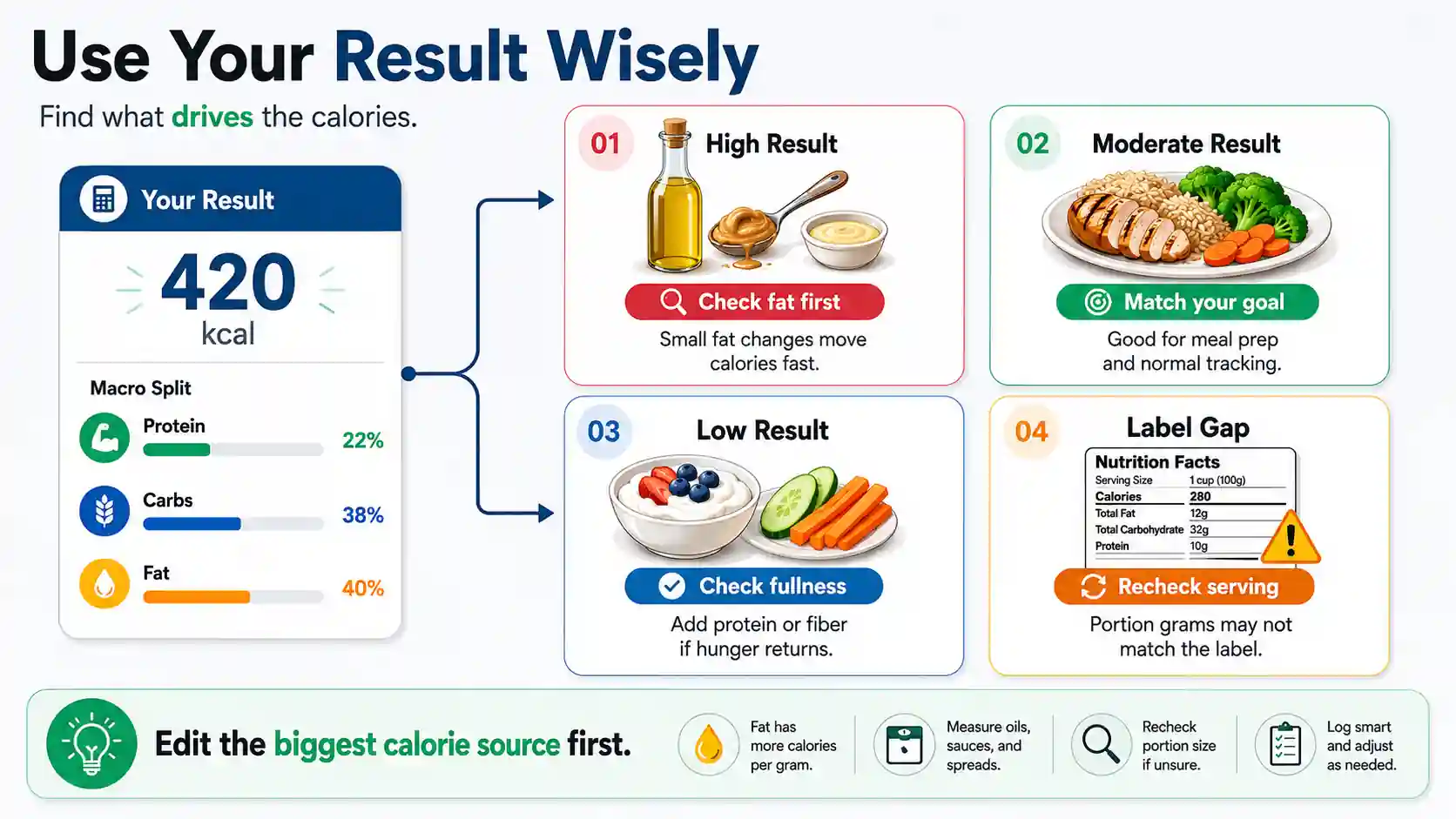
Your gram to calories calculator result should guide your next food choice. Do not stop at the number. Look at what created it. Fat-heavy foods, large portions, and label gaps need different actions. A good result helps you log cleaner and adjust faster.

For High-Calorie Results
A high result usually traces back to fat, oil, nut butter, cheese, fried food, or a portion bigger than planned. Start with the fat grams before touching anything else, since fat carries more calories per gram and a small cut drops the total fast.
Measure oils, sauces, and spreads with a spoon or scale, because these hide calories well. If the meal still runs high, trim the portion slightly and keep protein steady.
For Moderate Calorie Results
Moderate results often work fine when they match your daily target. Look at the macro split before judging the number, because a balanced meal can still feel filling when protein, carbs, and fat each pull their weight.
This is the range that suits meal prep and everyday tracking. Save the entry if you eat the food often. It keeps your log clean and saves time later.
For Low-Calorie Results
Low results suit snacks, light meals, and calorie cuts, but a small number does not always mean a smarter choice. Ask whether the food gives you enough protein, fiber, or volume to actually stay full.
When hunger hits soon after, lean protein or high-volume foods fix it fast. Fruit, vegetables, Greek yogurt, eggs, chicken, or beans add staying power without making the log messy.
For Label Mismatch Results
A small label gap usually traces back to rounding. Bigger gaps deserve a second look at serving size, portion grams, fiber, sugar alcohols, and total carbs before you change your food log.
Trust the label value on packaged foods when the gap is small. If the difference is large, recheck your inputs, because most mistakes come from logging the full package instead of the serving you actually ate.
Pro Tip
Use the highest calorie source as your first edit. If fat drives the result, reduce oil or spreads. If portion size drives it, weigh your serving again. If the label looks wrong, use Check mode before you change your meal plan.
You Might Also Find These Helpful
Fitness 5
Use our expert Snowboard Size Calculator to find your ideal board length and waist width. Get custom results based on weight and boot size…
Try calculatorConvert steps to miles instantly with our calculator. This steps to distance converter uses your height and gender for precise walking distance results.
Try calculatorExplore Related Tools
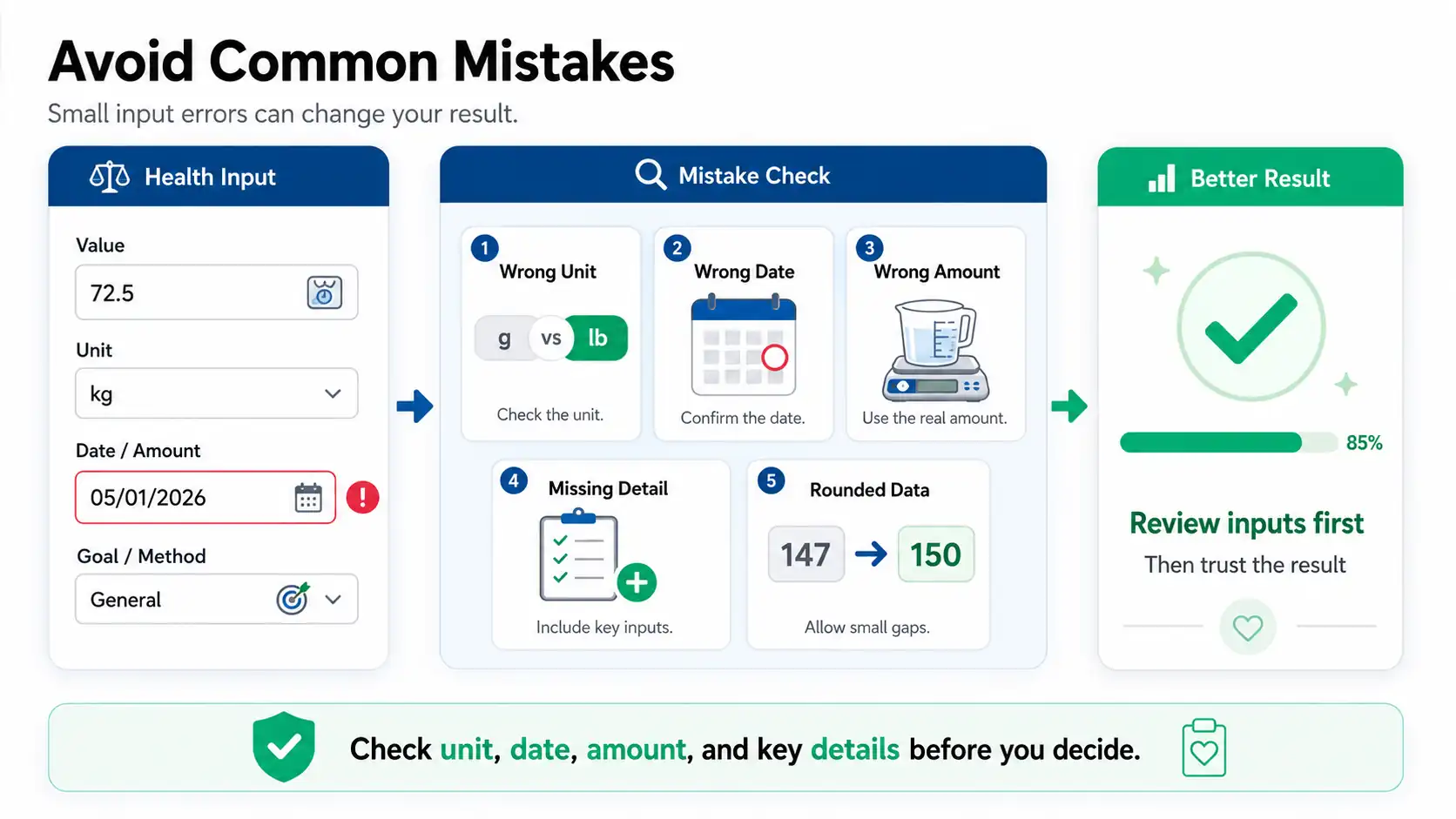
Common Mistakes When Using the Grams to Calories Calculator
Small input errors can change your calorie result fast. Most mistakes happen when users mix grams with portions, forget hidden fat, or compare macro math with a rounded food label. Check these points before trusting your final number.
- Mixing grams and pounds in the same calculation.
- Using the full package calories instead of the serving size.
- Forgetting oils, sauces, nut butter, dressings, or alcohol.
- Treating 100g of any food as 100 calories.
- Expecting macro math to match every food label exactly.

Frequently Asked Questions (FAQs)
How many calories are in 1 gram of fat?
One gram of fat has 9 calories. Fat carries more energy per gram than protein or carbs, which both have 4 calories per gram. This is why butter, oil, nuts, cheese, and sauces can raise calories fast, even in small amounts.
How Many Calories Are in 1 Gram of Protein?
One gram of protein has 4 calories. That means 25 grams of protein equals about 100 calories. Protein calories matter when tracking shakes, chicken, eggs, Greek yogurt, tuna, or meal prep recipes that focus on muscle and fullness.
How many calories are in 1 gram of carbs?
One gram of carbs has 4 calories. This includes many starches and sugars, but food labels can still vary because of fiber, serving size, and rounding. For basic macro math, multiply carbohydrate grams by 4 to estimate carb calories.
Is 100 calories the same as 100 grams?
No. 100 calories and 100 grams measure different things. Calories measure energy. Grams measure weight. A 100g food portion may have 40 calories, 150 calories, or 900 calories depending on water, fiber, protein, carbs, fat, and alcohol.
How many grams is 100 calories?
It depends on the nutrient. 100 calories equals 25g protein, 25g carbs, about 11.1g fat, or about 14.3g alcohol. Use Reverse mode when you know the calorie target but want grams for one macro type.
What is 200 grams of carbs in calories?
200 grams of carbs equals 800 calories because carbs have 4 calories per gram. The math is 200 × 4 = 800. This works for total carbohydrate grams, but packaged food labels may differ slightly because of rounding or fiber.
How Food Mode Helps With 100g Calorie Searches
Food mode answers a simple question: how many calories are in this many grams of a food? It uses common calories-per-100g values, then scales the number by your portion.
Can I use this grams to calories calculator for rice or pasta?
Yes. Use Label mode if the package lists calories per serving or per 100g. Add the label calories, serving grams, and your actual portion. Rice and pasta calories can change a lot between dry weight and cooked weight.
Why do calories from macros not match the food label?
Macro calories may not match a food label because labels use serving sizes, rounding rules, fiber, sugar alcohols, and food-specific values. A small gap is common. A larger gap usually means the serving size or macro entry needs another look.
How Do I Convert Food Grams to Calories?
Divide the food’s calories per 100g by 100, then multiply by your portion grams. If rice has 130 calories per 100g, then 180g has about 234 calories. Food mode does this math for common foods.
Why does 100g of one food have more calories than 100g of another?
Calories depend on food makeup, not weight alone. Foods with more fat or less water usually have more calories per gram. Oil, nuts, cheese, and chocolate are calorie-dense. Cucumber, lettuce, fruit, and cooked rice usually have fewer calories per gram.
Questions?
We had love to hear from you! Whether you are reporting an issue, suggesting a new calculator, or exploring collaboration opportunities — we are here to help. Every message helps us make 100calc smarter, faster, and more helpful for everyone.
Why People Trust 100calc
Every 100calc tool is built around one question: what does this number actually mean for you? We test the math against food labels, nutrition databases, and real tracking apps before anything goes live.