
Implantation Calculator
The Implantation Calculator predicts when a fertilized egg attaches to your uterine lining. This process typically occurs 6 to 12 days after ovulation. Our tool creates a personalized “Implantation Timeline” for you. It pinpoints your specific “Peak Day” when the probability is highest. Most successful pregnancies implant around day nine.
Enter your Last Period Date or your known Ovulation Date. The calculator generates a daily heatmap instantly. It shows if your implantation chance is Low, Rising, or High for each day. It also tells you the exact date to take a pregnancy test for accurate results. Use this timeline to reduce stress during the two-week wait.
- Updated Feb 10, 2026
Implantation Calculator: Find Your Peak Window
How to Enter Your Details. You need precise dates for this calculation. Follow these steps to get your personalized timeline.
MOST LIKELY WINDOW
Implantation Probability Timeline
Implantation typically occurs 6 to 12 days after ovulation. Your Peak Day (Day 9) represents the highest statistical chance of the embryo attaching to the uterine lining.
Your Data:
- Method: --
- Date Used: --
- Ovulation (Est): --
*Timeline based on Wilcox et al. study (NEJM). Actual timing varies by individual.
What Your Implantation Result Means
You need to understand three key concepts when reading your report. These numbers help you visualize the timeline of conception.
Understanding the Window
Implantation is not an instant event. It is a process that happens over several days. The fertilized eggs must travel down the fallopian tube first. Then it finds a spot to attach to the uterine lining. This entire process happens within a specific 6-day window.
Your "Peak Day"
This is the single most important date on your timeline. Medical studies confirm that Day 9 past ovulation is the most common day for success. Our calculator marks this day as “Peak” probability. It represents your highest statistical chance of attachment.
Reading the Timeline Colors
We use a simple color system to show your daily odds. The start and end of the window (Day 6 and Day 12) usually have a Low probability. The middle days (Days 8, 9, and 10) have a High probability. This heatmap shows when the event is most likely to occur.
Quick example to check the math
Say your period started on November 1st and your cycle is 28 days. Your ovulation is (Nov 1 + 14 days) = Nov 15.
If your target is the Peak Day, you need 9 more days. After those 9 days you reach November 24, which equals the highest probability for implantation.
Explore More Calculators
Use our Pregnancy Chance Calculator to estimate your odds. Enter your cycle day, age, and method. Find out if you are in the high-risk…
Try calculatorCalculate odds with the Chance of Twins Calculator. Enter maternal age and history. Find your probability instantly. See if you will conceive multiples now.
Try calculatorFind out exactly when you conceived. Our free Conception Calculator uses your Due Date, LMP, or Ultrasound to estimate your fertilization date and fertile…
Try calculatorUse our Conception Date Due Date Calculator to find your baby's arrival date. Enter your conception or intercourse date for clinical 40-week results.
Try calculatorCalculate hCG doubling time instantly. Enter two test results. See if your levels are rising normally. Check pregnancy progress now in the hCG Calculator.
Try calculatorUse our IUI Due Date Calculator to find your exact due date and safe pregnancy test day. Get clinical 40-week results based on your…
Try calculatorHow to Use the Implantation Calculator
Finding your specific window takes only a few seconds. Follow these five steps to get an accurate probability timeline.
Choose Your Method
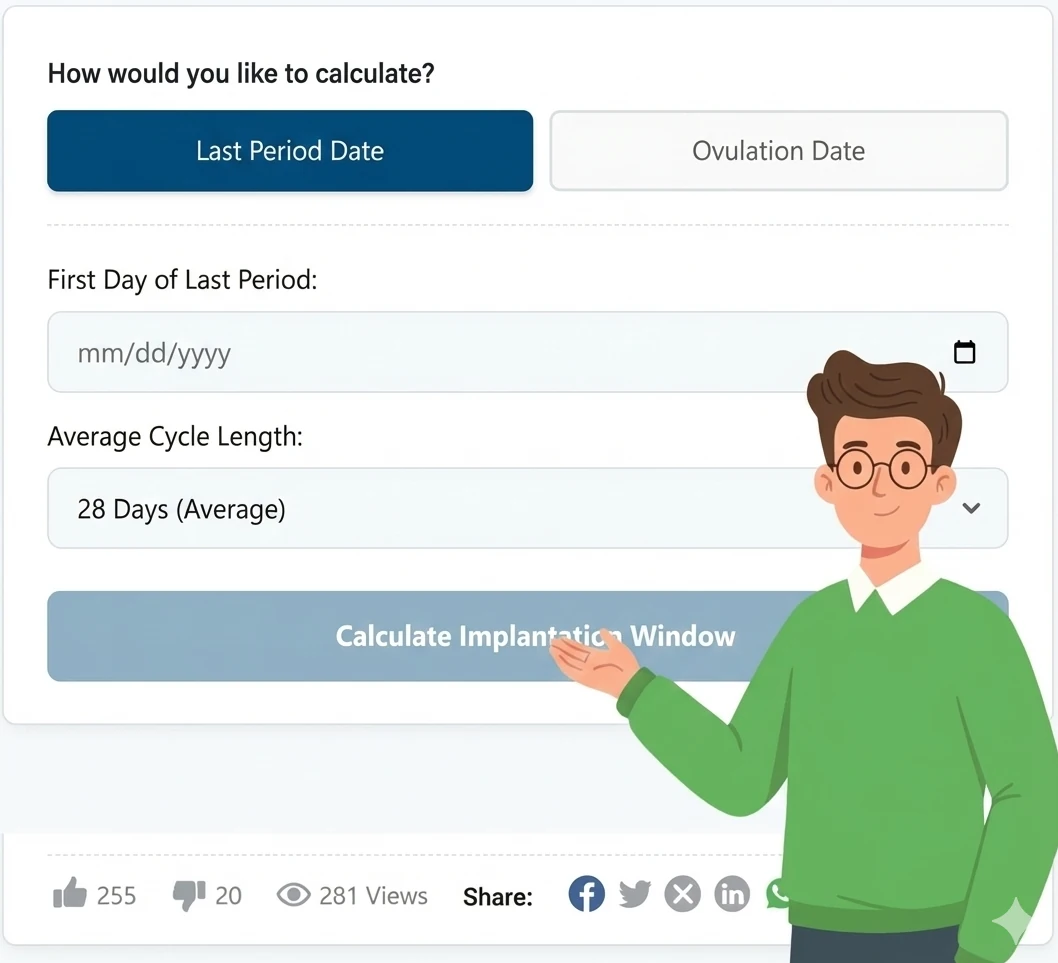
Select the best option for your tracking style. Click "Last Period Date" if you do not track ovulation. Click "Ovulation Date" if you use test strips or temperature tracking.
Enter Your Key Date
Enter the specific calendar date based on your chosen method. Select the first day of your last period. Or select the exact date you ovulated.
Adjust Cycle Length
Select your average cycle length from the dropdown menu. The default is 28 days. Changing this number helps the tool estimate your ovulation timing more accurately.
Click the Calculate Button
Press the blue button to process your data. The tool runs the formula instantly. It calculates your 6-day window and finds your peak day.
Read Your Timeline
Review the colored heatmap below the result. It shows your daily probability. Note the "When to Test" date to avoid taking a pregnancy test too early.
Example for testing
Try these sample numbers:
Last Period Date: November 1st
Cycle Length: 28 Days
Result → Your implantation window is Nov 21 – Nov 27. Your Peak Day is Nov 24. The calculator shows a standard timeline. The window starts exactly 6 days after ovulation. Your odds are highest on Day 9. This confirms a healthy cycle structure.
Now, enter your own numbers and check your specific dates.
How the Implantation Calculator Formula Works (Complete Breakdown)
Understanding your fertile window helps you track your conception timeline. This formula gives you a clear picture of when attachment occurs. It uses standard medical math to estimate your “Implantation Window.” The logic is based on the Wilcox et al. study used by reproductive specialists. It is accurate and practical for trying to conceive.
Implantation Window Formula
The calculator identifies the specific 6-day phase when the uterus is ready. It finds your ovulation day first. Then it adds the biological travel time of the egg. The formula is precise and effective.
Formula:
					Ovulation Date = LMP + (Cycle Length - 14)
Window Start = Ovulation Date + 6 Days
Window End = Ovulation Date + 12 Days
The formula starts with your Last Menstrual Period (LMP). It adds your cycle days minus 14 to find ovulation. Then it adds 6 days to find the start of the window. Finally, it adds 12 days to find the end of the window. This calculates the exact receptive phase.
Example:
					If your Last Period started on November 1st. Your Cycle Length is 28 Days.
Find Ovulation: Nov 1 + (28 - 14) = Nov 15.
Find Start: Nov 15 + 6 Days = November 21st.
Find End: Nov 15 + 12 Days = November 27th.
Your implantation window is November 21st to November 27th. That is the perfect target range for a healthy conception.
Micro Note:
Most healthy embryos implant on Day 9 after ovulation. Implantation before Day 6 or after Day 12 is extremely rare and often results in a chemical pregnancy.
Key Inputs Used in the Implantation Calculator
Every woman has a unique cycle. A short cycle shifts the dates earlier. A long cycle shifts the dates later. The calculator accounts for these expected changes.
Last Period Date (LMP)
This is the exact calendar date your period began. Precision is vital here. It acts as the “Anchor” for the entire calculation. Even a one-day error here will shift your entire timeline by 24 hours. The formula uses this date to start the count.
Cycle Length
This input adjusts the estimated ovulation timing. We need to know if your cycle is 28 days or 35 days. The math assumes the “Luteal Phase” (the time after ovulation) is stable at 14 days. Changing the cycle length changes the time before ovulation. A 30-day cycle adds 2 extra days to the pre-ovulation phase.
Ovulation Date (Direct Input)
This is an optional but powerful input. It defines the exact starting point of the egg’s journey. Using this input skips the “LMP” estimation entirely. It provides the most accurate result possible by removing the guesswork about cycle length.
Implantation Probability (The 6-12 Day Rule)
The math applies a probability curve to the window. We know the chance is low on Day 6. We know the chance peaks on Day 9. We know it drops by Day 12. Our calculator maps these statistical odds to your specific calendar dates.
Another Example Calculation (Step-by-Step)
Let’s look at three common scenarios. These examples show how your cycle length affects your implantation dates. See how the window shifts based on your inputs.
Given:
First Day of Period (LMP): November 1st
Cycle Length: 28 Days
Luteal Phase: 14 Days (Standard)
Calculation:
					Step 1 (Find Ovulation): Nov 1st + (28 - 14) = Nov 15th

Step 2 (Find Window Start): Nov 15th + 6 Days = Nov 21st

Step 3 (Find Window End): Nov 15th + 12 Days = Nov 27th

Your estimated ovulation is November 15th. Your implantation window starts exactly 6 days later.
Result:
Ovulation Date: Nov 15th
Implantation Window: Nov 21st – Nov 27th
Peak Probability: Nov 24th (Day 9)
Meaning:
Your receptive phase aligns perfectly with a standard cycle. This confirms the timing is optimal for conception. Doctors look for implantation between 6 and 12 days after ovulation. Your result falls exactly in this healthy range. It indicates the best days to monitor for symptoms.
Result Benchmarks and Ranges
Your chance of implantation changes every single day. It starts low. It rises to a peak. Then it drops off quickly. Use this table to check your specific day past ovulation (DPO).
| DPO (Days Past Ovulation) | Implantation Probability | Status |
|---|---|---|
| 6 DPO | < 10% | Low |
| 7 DPO | ~ 15% | Rising |
| 8 DPO | ~ 30% | High |
| 9 DPO | ~ 40% |
PEAK
Most common day. |
| 10 DPO | ~ 25% | High |
| 11–12 DPO | < 10% |
Dropping
Window is closing. |
Note: Most successful pregnancies implant by Day 9 or 10. Implantation after Day 12 is extremely rare.
Interpretation
A window between 6 and 12 days past ovulation is the standard goal. This range indicates a healthy timeline. However, the exact day varies from person to person. Implantation on Day 9 is the most common statistical outcome. A wide window is completely normal. Do not panic if you do not feel symptoms immediately.
Pro Tip:
Use ovulation test strips to confirm your exact ovulation day. Relying on your period dates alone can cause small errors. Enter the confirmed date into the “Ovulation Date” field. This ensures the most precise calculation possible. It also eliminates guesswork from the equation.
Tips & Planning Based on Your Result
Getting your result is the first step. The next step is understanding what happens inside your body. This guide helps you interpret physical signs. Follow these tips to reduce anxiety during your waiting period.
Understanding Implantation Bleeding
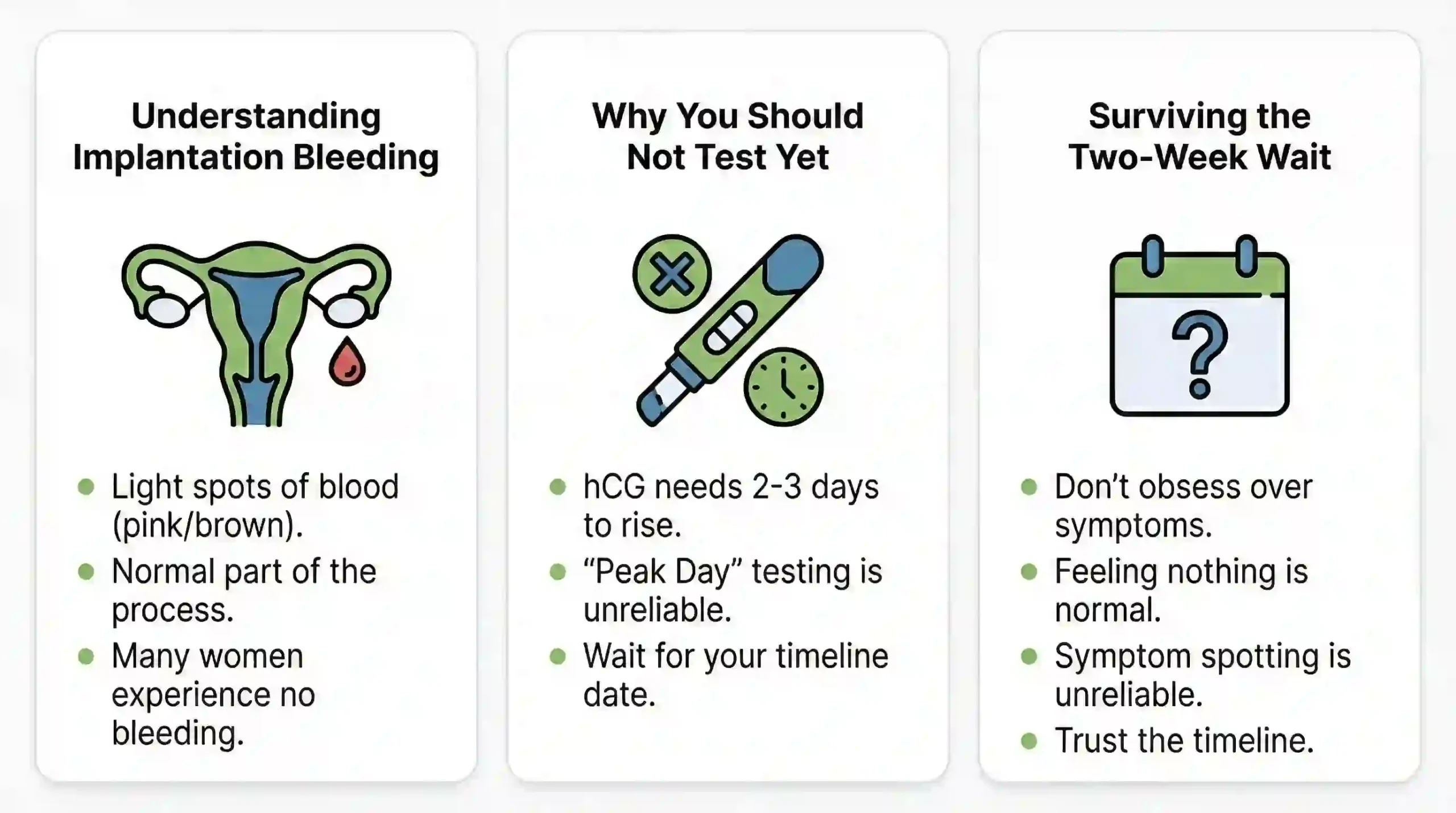
Some women see light spots of blood. This is called implantation bleeding. It happens when the fertilized eggs attaches to the lining. The color is usually pink or light brown. Do not panic if you see this. It is a normal part of the process. However, many women experience no bleeding at all.
Why You Should Not Test Yet
Do not take a pregnancy test during your “Window.” The hormone hCG needs time to rise. It typically takes 2 to 3 days after implantation for a test to show it. Testing on your “Peak Day” usually results in a negative. This causes unnecessary disappointment. Wait until the date shown on your timeline.
Surviving the Two-Week Wait
The time between ovulation and your period feels long. Doctors call this the “Two-Week Wait.” Do not obsess over small symptoms. Feeling nothing is also completely normal. Symptom spotting is unreliable before Day 12. Use the timeline to stay calm until your testing date arrives.
You Might Also Find These Helpful
Pregnancy & Fertility 9
Use our IVF Due Date Calculator to find your exact twin pregnancy timeline. Enter your transfer date to get 40-week and 37-week dates instantly.
Try calculatorEstimate loss probability instantly. Enter age and week. See how a heartbeat lowers risk. Check your success rate now in the Miscarriage Risk Calculator.
Try calculatorFind your conception date with our Reverse Due Date Calculator. Enter your due date to reconstruct your pregnancy timeline and fertile window instantly.
Try calculatorCommon Mistakes to Avoid When Calculating
Small misunderstandings can lead to unnecessary stress. These mistakes often happen when estimating dates. Always trust the timeline instead of guessing. Staying accurate helps you manage your expectations during the Two-Week Wait.
- Testing on Day 9 because it is the "Peak Day."
- Confusing the ovulation date with the implantation date.
- Assuming implantation happens on the day your period is due.
- Thinking that day 14 is the start of implantation.
- Ignoring the fact that hCG needs days to rise after attachment.
- relying on symptoms like spotting to confirm success.

Frequently Asked Questions (FAQs)
How can I calculate my implantation date?
You can calculate this date easily. Add 9 days to your confirmed ovulation date. The result is your peak probability day. Our calculator handles the math for you. It uses your last period date to estimate the full 6-day window.
What is the exact day of implantation?
No single day is exact for everyone. However, statistics show a clear trend. Day 9 past ovulation is the most common time. The full window lasts from day 6 to day 12. Every woman follows a slightly different timeline.
How many weeks pregnant am I when implantation occurs?
You are typically 3 weeks pregnant. Doctors count pregnancy from the start of your last period. Ovulation happens around week 2. Implantation happens about one week later. You technically become pregnant before you miss your period.
How is implantation confirmed?
You cannot confirm it instantly at home. The only proof comes a few days later. A positive pregnancy test confirms that implantation worked. The test detects the hormone hCG. The body produces this hormone only after the egg attaches.
Can I feel implantation cramping?
Some women feel mild cramps. These feel like light period pains. The sensation occurs in the lower abdomen. However, many women feel nothing at all. A lack of pain is also completely normal.
Does implantation bleeding happen to everyone?
Spotting is not universal. Only about 25 percent of women see it. It looks like light pink or brown discharge. Heavy red bleeding usually indicates a period. Do not worry if you stay dry.
Is it too late if implantation happens on day 12?
Implantation after day 12 is rare. It carries a higher risk of early loss. The egg must attach while the lining is receptive. Most healthy pregnancies establish themselves by day 10.
Questions?
We had love to hear from you! Whether you are reporting an issue, suggesting a new calculator, or exploring collaboration opportunities — we are here to help. Every message helps us make 100calc smarter, faster, and more helpful for everyone.
Why People Trust 100calc
At 100calc.com, we focus on accuracy, speed, and trust. Every calculator we create is designed to give reliable, instant, and easy-to-understand results you can truly depend on.