
IUI Due Date Calculator
The IUI Calculator helps you find your exact pregnancy milestones after intrauterine insemination. Most standard tools use your last period date. However, medical procedures require a more specific approach based on your IUI day. You can instantly determine your official due date and your safe pregnancy test date. Use your clinical data to plan your arrival today.
Accuracy remains essential when you undergo fertility treatments. Your procedure date provides the most reliable anchor for your baby’s growth timeline. Therefore, knowing your specific milestones reduces the stress of the waiting period. The tool also adjusts results for trigger shots to avoid false positive tests. Similarly, you can track your progress from the moment of insemination to delivery.
- Updated Feb 10, 2026
IUI Due Date Calculator: Exact Due Date and Testing Timeline
Plan your pregnancy journey with clinical precision using your procedure data. You can determine exactly when to take a home test and when your baby will arrive. Most fertility clinics use the insemination date as the most reliable biological marker. Therefore, you should use this tool to track your specific milestones and avoid the guesswork of standard period trackers.
ESTIMATED DUE DATE
SAFE TEST DATE
🧬 The Two Week Wait Timeline
Baby Highlights
--
How to Read Your IUI Results
Reading your results correctly helps you manage your expectations during the waiting period. The IUI Calculator provides critical medical dates and fun milestones. Understanding these numbers ensures you follow the best timeline for your fertility journey.
The Critical Test Date
You must pay close attention to the safe test date on your screen. Most fertility treatments involve a trigger shot to induce ovulation. This medication contains the HCG hormone, which is the same hormone found in pregnancy. Therefore, testing too early can lead to a false positive result. You should wait at least 14 days after the shot for accurate data. Consequently, waiting ensures the medication has completely left your system before you take a test.
The Implantation Window
The tool identifies the most likely days for the embryo to attach to your uterus. This process usually happens between 6 and 12 days after your IUI procedure. You might notice very light spotting during this specific time. Many people call this “implantation bleeding,” which is a normal sign for some pregnancies. However, many healthy pregnancies occur without any physical signs. Understanding this window helps you stay calm while your body does its work.
Understanding Baby Highlights
The highlights grid gives you a glimpse into your future arrival. You can find your baby’s zodiac sign based on the estimated delivery date. Furthermore, the tool shows the season of birth, which helps you plan for weather-related needs. The status bar tells you exactly where you are in the two-week wait. These details make the process feel more personal and exciting. Use these results to start your hospital bag list or nursery theme ideas.
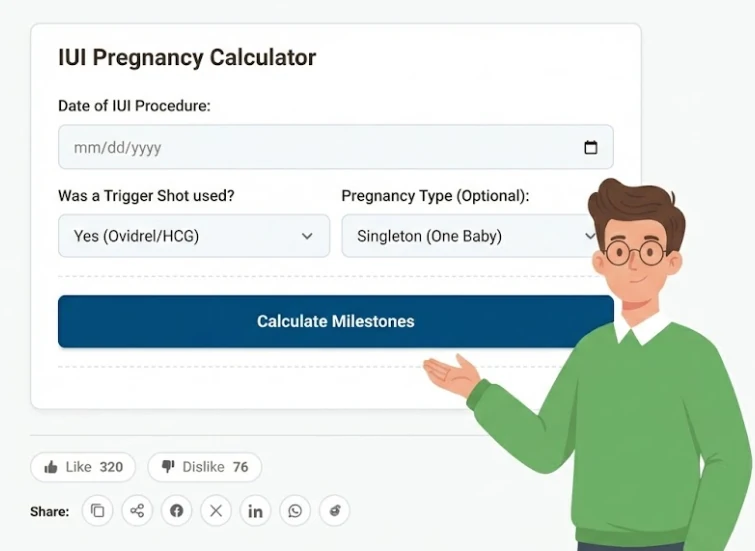
Quick example to check the math
Suppose you know your exact IUI procedure date is October 1. The calculator adds the standard gestation period to this specific day. You can follow the math to see how the tool reaches your final result.
First, the tool uses the 266-day rule for fertilization. Your calculation looks like this: October 1 + 266 Days = June 24
Next, you can find your clinical period date for medical records. You subtract 14 days from October 1 to reach September 17. Doctors will see your due date as exactly 40 weeks from September 17. Consequently, your hospital charts will match the biological age of your baby. Check your own dates now to see your results instantly.
Explore More Calculators
Use our Pregnancy Chance Calculator to estimate your odds. Enter your cycle day, age, and method. Find out if you are in the high-risk…
Try calculatorCalculate odds with the Chance of Twins Calculator. Enter maternal age and history. Find your probability instantly. See if you will conceive multiples now.
Try calculatorFind out exactly when you conceived. Our free Conception Calculator uses your Due Date, LMP, or Ultrasound to estimate your fertilization date and fertile…
Try calculatorUse our Conception Date Due Date Calculator to find your baby's arrival date. Enter your conception or intercourse date for clinical 40-week results.
Try calculatorCalculate hCG doubling time instantly. Enter two test results. See if your levels are rising normally. Check pregnancy progress now in the hCG Calculator.
Try calculatorCalculate implantation window instantly. Enter last period date. Find peak probability. See when to take a pregnancy test in the Implantation Calculator.
Try calculatorHow the IUI Due Date Calculator Works
Using the IUI Calculator is a simple and quick process. You only need a few details from your clinic records to get a full report. Each step ensures your pregnancy timeline matches your medical reality. Follow these instructions to find your milestones today.
Enter Your Procedure Date
Pick the exact day your fertility clinic performed the insemination. This date represents the biological start of your journey. It acts as the anchor for every growth milestone. Therefore, you must use the specific calendar day from your doctor's notes. Accuracy at this stage leads to the most reliable birth date results.
Toggle the Trigger Shot Option
Identify whether your doctor prescribed a medication such as HCG or Ovidrel. This medication helps your body release the egg at the right time. However, the shot can linger in your blood for nearly two weeks. You should select the "Yes" option if you used these drugs. The tool then adjusts your testing window to prevent a false positive result.
Select Your Pregnancy Type
Choose any option that fits your current situation or goals. You can pick between a single baby, twins, or even triplets. Most multiple pregnancies have different clinical term dates. For example, twins are often born several weeks earlier than single infants. Therefore, the calculator changes your due date based on this specific selection.
Review Your Personalized Milestones
Look at your custom results after you click the button. You will see a detailed two-week timeline. This list shows the most likely day for implantation. It also highlights the best day for your official blood test. Use these dates to schedule your follow-up appointments with your medical team.
Example for testing
Try these sample numbers to understand how the IUI pregnancy timeline shifts. You can use these figures to verify the accuracy of the IUI Calculator.
Try these sample numbers:
Calculation Method: IUI Procedure
Date: October 1
Year: 2025
Pregnancy Type: Singleton
Result → Your Estimated Due Date is June 24, 2026. Your Theoretical LMP is September 17, 2025. The tool also identifies your baby as a Cancer born in the Summer season.
After your calculation, you will see a full breakdown in the summary section. Entering these sample numbers shows you how the 266-day rule works. Now, enter your own personal dates and check how close you are to your big day.
How the IUI Calculator Formula Works (Complete Breakdown)
Understanding how your milestones are calculated helps you take control of your fertility journey. This formula gives you a clear picture of where you stand and what you can expect during the coming weeks. It is based on real-world medical standards used in the United States. Consequently, the results are accurate and practical for every patient.
IUI Due Date Formula
The due date shows when your baby is likely to arrive, based on the day of your procedure. The formula is simple and works for anyone who has a documented insemination date. Medical experts use this same method to set precise timelines for birth and fetal development.
Formula:
Estimated Due Date = IUI Date + 266 Days
This formula adds exactly 266 days to the day of your IUI. This number represents the standard 38 weeks of fetal growth from the moment of fertilization. Next, the tool identifies the specific calendar day that marks your 40-week medical milestone.
Example:
					If your IUI procedure was on October 1,
(October 1 + 266 Days) = June 24
Your estimated due date is June 24, which most doctors consider full term. This date acts as your primary target for delivery and hospital preparations.
Micro Note:
Most medical institutions in the U.S. require a 40-week scale for clinical records. This timeline starts two weeks before fertilization actually occurs. Therefore, your 38-week fetal age equals a 40-week gestational age on your official medical charts.
Key Inputs Used in the IUI Calculator
Every IUI calculation depends on three simple inputs. These inputs help you measure your current progress and plan for your testing window. By entering real dates and medication details, you can get accurate results instantly. Many U.S. fertility clinics use this same method to track patient success and fetal health.
Procedure Date
This is the total number of days since your clinic performed the insemination. For example, if your procedure was 10 days ago, then your IUI age is 10 days. This value sets the base for your entire pregnancy percentage. Many clinics in the U.S. calculate success based on these specific academic sessions of the embryo.
Trigger Shot Status
These are the medications you were given to induce ovulation. If you used a shot, your testing window must be longer. This shows your current safety level for taking a home test. Even small choices, like waiting two more days, can quickly raise your accuracy from 70% to 99%. Consequently, this helps you meet institutional medical requirements for a reliable result.
Pregnancy Type
Your target arrival date is the percentage of time you aim to reach full term. Many single pregnancies set 40 weeks as the minimum. However, twin pregnancies often require a goal of 37 weeks or more. By entering a pregnancy type, the calculator can tell you exactly how many additional days you have until your goal.
Another Example Calculation (Step-by-Step)
Let us see how the IUI Calculator works using a real-world example. This will help you understand how each detail affects your final milestones and what actions you can take to plan ahead. The calculation follows the same logic used by fertility clinics and hospitals throughout the United States.
Given:
IUI Procedure Date: October 1, 2025
Trigger Shot: Yes
Pregnancy Type: Singleton
Calculation:
					Birth Date: October 1 + 266 Days = June 24, 2026

Theoretical LMP: October 1 - 14 Days = September 17, 2025

Safe Test Date: October 1 + 14 Days = October 15, 2025
Result:
Estimated Due Date: June 24, 2026
Clinical Age (On Oct 15): 4 Weeks 0 Days
Baby Highlight: Cancer / Summer
Meaning:
With an insemination date of October 1, your biological journey begins immediately. Your baby will likely arrive in the early summer of next year. Furthermore, you should wait until October 15 to take your first home pregnancy test. This delay ensures that the HCG from your trigger shot does not cause a fake result. Most clinics in the U.S. expect patients to reach the 40-week mark for a safe delivery. Consequently, using these exact dates helps you coordinate with your medical team for the best possible care.
Result Benchmarks and Ranges
Your doubling time is not just a number. It helps you understand your pregnancy health. It tells you if the hormone is rising fast enough. Doctors use these same benchmarks to monitor safety. The expected speed changes as your level increases. Here is a quick breakdown to help you evaluate your score.
| Insemination Method | Precision Level | Margin of Error |
|---|---|---|
| IUI Procedure Date | Gold Standard |
Exact Dating
The actual biological start of the pregnancy. |
| Trigger-Timed Cycle | High Accuracy |
+/- 1 Day
Controlled ovulation using medical injections. |
| Natural IUI Surge | Excellent Accuracy |
+/- 2 Days
Based on your body's natural LH hormone peak. |
Note: Most fertility clinics prefer trigger-timed cycles for better predictability. However, a natural surge is still much more accurate than using your last period date. You should always confirm these dates with your clinical team during your first scan.
Interpretation
Knowing your exact insemination day gives you a massive advantage. It allows you to monitor your fetal growth milestones with total confidence. Consequently, your clinical records will stay organized throughout your entire journey. Reliable data reduces the stress of waiting for your first official blood test result.
Pro Tip:
Keep a digital copy of your procedure records for your first OBGYN visit. Your doctor will use these dates to verify the baby’s crown-to-rump length during the ultrasound. Furthermore, accurate dating helps prevent unnecessary interventions later in the pregnancy.
Tips & Planning Based on Your Result
Planning for your baby involves more than just picking a date. You should use your results to prepare for the physical and emotional parts of your expedition. These insights help you stay organized as you move toward your delivery day.
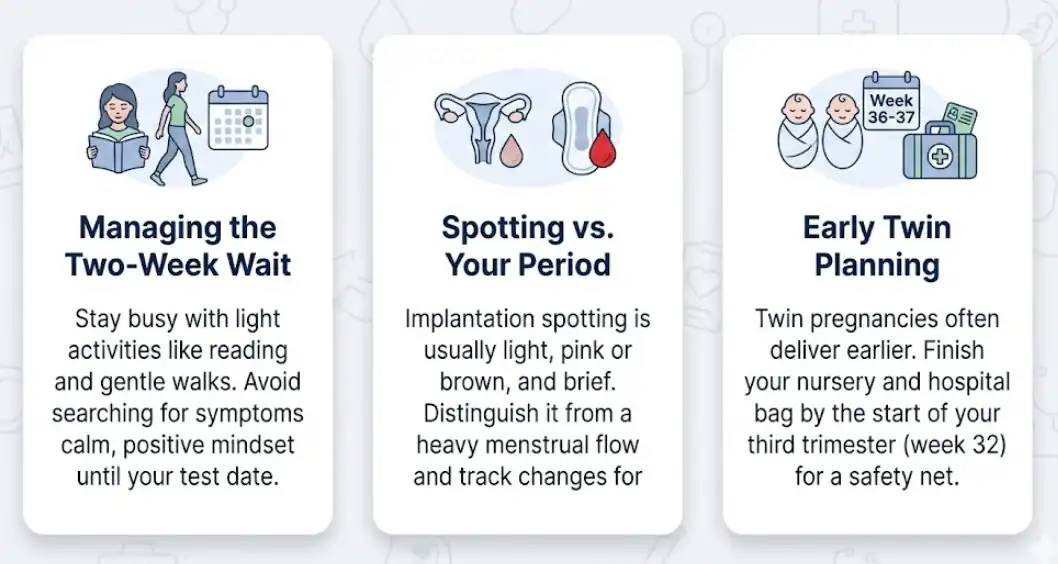
Managing the Two-Week Wait
You should stay busy during the days after your IUI procedure. Many people feel anxious while waiting to take a pregnancy test. Therefore, you should focus on light activities and hobbies to pass the time. Gentle walks and reading can help you maintain a positive mindset. You should also avoid searching for every tiny symptom online. Stress can affect your well-being during this critical window. Consequently, keeping a calm routine will help you stay patient until your test date.
Spotting vs. Your Period
You might notice light spotting about a week after your insemination. This event often happens when the embryo attaches to the uterus. Many experts call this implantation bleeding, which is a normal sign of success. However, you should distinguish this from a regular menstrual period. Implantation spotting is usually pink or light brown and very brief. It does not look like the heavy flow of a normal cycle. Therefore, you should track any changes in your journal to discuss with your clinic.
Early Twin Planning
You must prepare sooner if the IUI Calculator predicts a multiple birth. Twin pregnancies often reach full term much earlier than single babies. Most doctors aim for a delivery window around the 36th or 37th week. Consequently, you should finish your nursery and hospital bag by the start of your third trimester. Having everything ready by 32 weeks provides a great safety net for your family. Furthermore, early planning allows you to rest more during the final month.
You Might Also Find These Helpful
Pregnancy & Fertility 9
Use our IVF Due Date Calculator to find your exact twin pregnancy timeline. Enter your transfer date to get 40-week and 37-week dates instantly.
Try calculatorEstimate loss probability instantly. Enter age and week. See how a heartbeat lowers risk. Check your success rate now in the Miscarriage Risk Calculator.
Try calculatorFind your conception date with our Reverse Due Date Calculator. Enter your due date to reconstruct your pregnancy timeline and fertile window instantly.
Try calculatorCommon Mistakes to Avoid When Calculating
Calculating your birth date after an IUI procedure requires exact details. You should avoid these common errors to keep your timeline accurate. Small mistakes can lead to confusion during your final weeks of pregnancy.
- Testing Too Early: Many people feel the urge to test just a few days after their procedure. However, the trigger shot contains the same hormone that a pregnancy test detects. This medication can take up to 14 days to completely leave your body. Consequently, testing early often results in a fake positive. You should follow the safe test date provided by the IUI Calculator. This patience ensures your result is real and not just a chemical trace from the medication.
- Mixing up IUI and LMP: You might try calculating your last period due date with that calculator. Standard apps often use this method for natural pregnancies. However, an IUI procedure is much more precise for dating. Your doctor knows exactly when the sperm entered the uterus. Therefore, you should use the procedure date as the biological start of your pregnancy. Using a period date can cause a mismatch of several days in your records.
- Ignoring the Pregnancy Type: You must remember that multiples have a different growth timeline. Single babies usually stay in the womb for 40 weeks. However, twins and triplets often arrive much sooner for health and safety reasons. Consequently, a standard due date might be unrealistic for multiple births. You should select the correct pregnancy type in the tool to see your true delivery window. This adjustment helps you prepare your home and nursery well in advance.

Frequently Asked Questions (FAQs)
How is pregnancy calculated in IUI?
Medical professionals calculate your pregnancy by using the date of your insemination. They consider the IUI day as the moment of ovulation. Consequently, they add two weeks of “virtual” time to match standard pregnancy charts. This method ensures your records align with the 40-week scale used in every hospital.
What is my due date based on IUI?
Your birth date occurs exactly 266 days after your IUI procedure. This number represents the 38 weeks of fetal growth inside the womb. However, your doctor will call this your 40-week due date on your official charts. You can find this precise day instantly using the IUI Calculator.
How many rounds of IUI does it take to get pregnant?
Many couples find success within the first three to four cycles of treatment. Success rates often depend on your age and the specific reason for your fertility needs. Most doctors recommend moving to other options if you do not conceive after six rounds. Therefore, you should discuss a long-term plan with your fertility specialist.
Does the day of IUI count as day 1?
No. The day of your IUI procedure counts as Day 0 for your clinical records. The next day is considered 1 Day Past Ovulation (1 DPO). Most clinics use this counting method to accurately track the two-week wait. Consequently, you should start your countdown the morning after your clinic visit.
Can I test 10 days after IUI?
You might see a result at 10 days, but it is often unreliable. The HCG from a trigger shot can linger in your system and cause a false positive. Furthermore, the embryo might still be implanting during this early window. Therefore, you should wait until 14 days have passed for a definitive home result.
Why is my IUI due date different for twins?
Twins naturally arrive earlier than single babies because of limited space in the womb. Doctors consider 37 weeks as full term for a twin pregnancy. Consequently, our tool subtracts about three weeks from a standard 40-week timeline. This adjustment helps you prepare for a safe and timely delivery.
Is IUI dating more accurate than an ultrasound?
IUI dating is extremely precise because the exact hour of insemination is known. However, your doctor will still perform an early ultrasound to confirm the heart rate. They use the scan to measure the embryo’s size and check for multiples. Therefore, both methods work together to ensure your baby is growing on schedule.
Questions?
We had love to hear from you! Whether you are reporting an issue, suggesting a new calculator, or exploring collaboration opportunities — we are here to help. Every message helps us make 100calc smarter, faster, and more helpful for everyone.
Why People Trust 100calc
At 100calc.com, we focus on accuracy, speed, and trust. Every calculator we create is designed to give reliable, instant, and easy-to-understand results you can truly depend on.