
10000 Days Old Calculator: Find Your Exact Milestone Date

Use this 10,000 Days Old Calculator to find the exact date when you turn 10,000 days old, check how many days old you are now, and see your age in years, months, and days. Most people reach this milestone at about 27 years and 4 to 5 months, but the exact result shifts with leap years and your birth date.

Missed the date already. Not sure if you are close. Want the exact day without counting by hand. This calculator clears that up fast. It can show your 10,000-day birthday, tell you if it already passed, and estimate the result if you only know your age. It also supports other metric birthday milestones like 1,000, 5,000, 20,000, and 25,000 days.

Calculate Your 10000 Days Old Date in Seconds

Pick what you want to check. Enter your birth date or current age. Add a birth time if you know it. Then choose a milestone like 10,000 days or switch to current progress. The calculator shows your exact date, days left, or total days lived right away.

No setup needed. Add your details and get the answer fast.

10,000 Days Old Calculator
Calculate Your 10,000-Day Anniversary & Live Age Progress
Use this if you don't know the exact starting date.

Explore More Calculators

Diamond Birthday Calculator Featured

When is your diamond birthday? Use our Diamond Birthday Calculator to find the exact date when your age matches the last two digits of…

Try calculator
1 Billion Seconds Calculator

1 billion seconds calculator shows your exact milestone date and age in seconds. See if you’ve reached it or how close you are now.

Try calculator
9 3/4 Birthday Calculator

Use our free 9 3/4 Birthday Calculator to find the exact date your child turns 9 years and 9 months. Plan the perfect wizard-themed…

Try calculator
Age Difference Calculator

You can use our free age difference calculator to find your exact chronological gap. First enter your specific birth dates. Next, discover your time…

Try calculator
Crown Birthday Calculator

You can use our free crown birthday calculator to find your golden date. First, enter your exact birth date. Next, discover your special celebration…

Try calculator
Diamond Jubilee Calculator

Calculate your 60-year milestone instantly. Our Diamond Jubilee Calculator provides precise dates for 60th birthdays or anniversaries with 100% accuracy.

Try calculator

What Is a Metric Birthday?

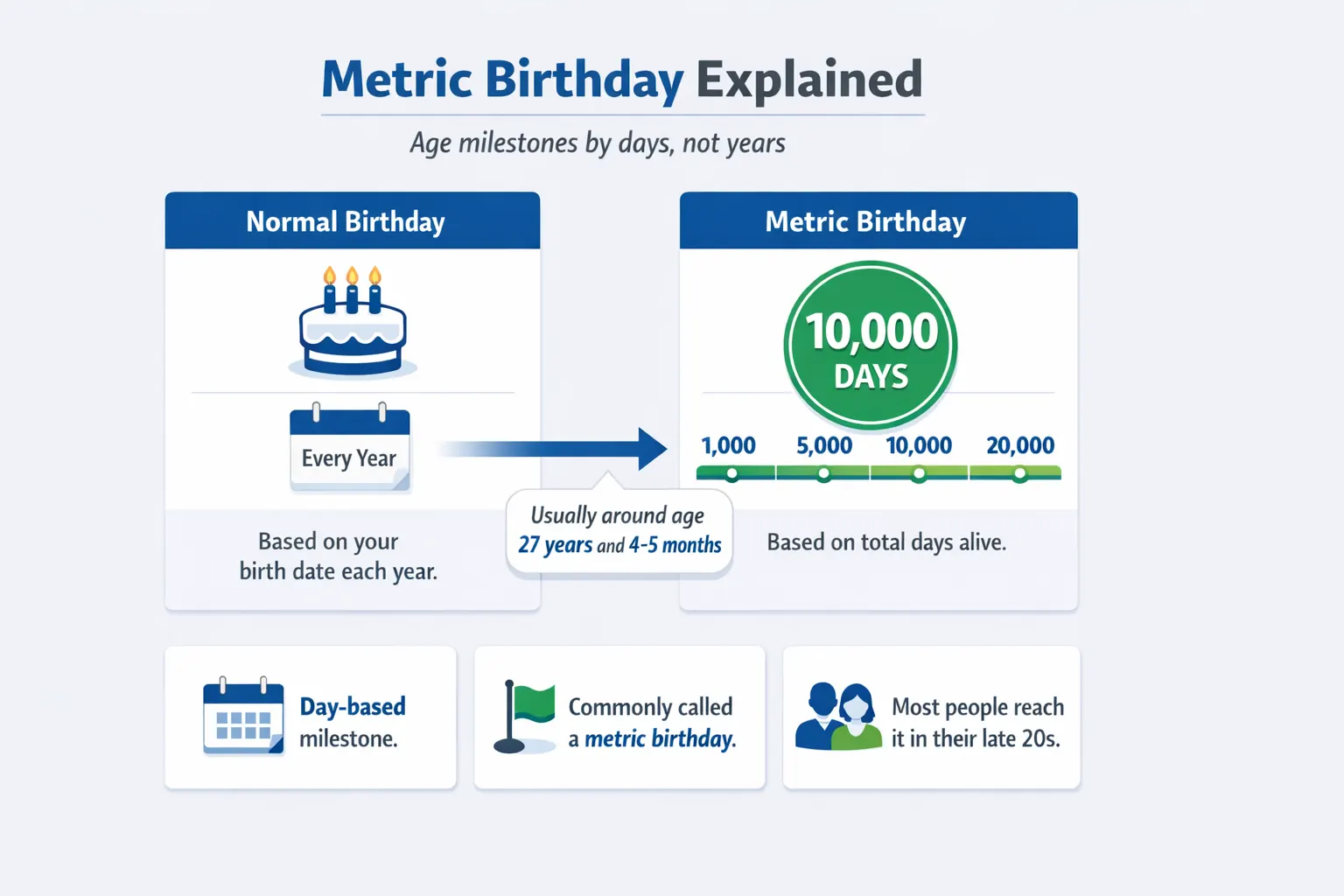
A metric birthday is a day-based age milestone instead of a year-based one. The best-known example is turning 10,000 days old. Many people use it as a fun way to track age, mark a personal milestone, or plan a small celebration around an exact day count. 

A normal birthday comes once a year. A metric birthday comes when your total days alive hits a round number like 1,000, 5,000, 10,000, or 20,000. That is why people also search for 10,000 days birthday and 20,000 days old. It feels more personal because it lands on one exact date, not just a month and day.

Comparison infographic for 10000 Days Old Calculator showing a metric birthday, 10,000-day milestone, and how day-based birthdays differ from yearly birthdays.

Quick Facts

How do you calculate 10000 days old?

Add your birth date and count forward 10,000 days. That gives your 10,000-day birthday. If you want to check today’s progress instead, compare your birth date with the date you choose. This calculator also shows your age in years, months, and days, plus whether the milestone already passed.

What is the 10,000-day birthday for someone born on July 15, 1998?

Here is an upcoming-style example with a clear milestone date.

Input

  • Date of birth: July 15, 1998
  • Milestone: 10,000 days
  • Time: left blank
  • As of date: October 1, 2025

Process

  • The calculator starts from July 15, 1998.
  • It adds 10,000 days.
  • Then it checks whether that date is before or after October 1, 2025.

Result

  • 10,000-day date: November 30, 2025
  • Day: Sunday
  • Status: Not reached yet
  • Days remaining: 60
  • Age at milestone: 27 years, 4 months, 15 days

Meaning

This person is close to the 10,000-day birthday and can still plan around it.

When did someone born on October 3, 1994 turn 10,000 days old?

This one shows an already-passed milestone.

Input

  • Date of birth: October 3, 1994
  • Milestone: 10,000 days
  • Time: left blank
  • As of date: April 17, 2026

Process

  • The calculator adds 10,000 days to October 3, 1994.
  • After that, it compares the answer with April 17, 2026.

Result

  • 10,000-day date: February 18, 2022
  • Day: Friday
  • Status: Achieved
  • Age at milestone: 27 years, 4 months, 15 days

Meaning

This person already passed the 10,000-day mark, so the useful answer is the date it happened.

How many days old is someone born on September 10, 2001?

Input

  • Date of birth: September 10, 2001
  • As of date: April 17, 2026
  • Mode: Check Current Progress

Process

  • The calculator compares the birth date with the chosen date.
  • It counts full days lived, then breaks that time into years, months, and days.

Result

  • Current lived days: 8,985
  • Age breakdown: 24 years, 7 months, 7 days
  • Full weeks lived: 1,283
  • Decimal years: 24.60
  • Hours lived: 215,640

Meaning

This person has not reached 10,000 days yet and is still about a year away from that milestone.

What happens if you only know your current age?

This example shows the estimate mode many users ask about.

Input

  • Current age: 25
  • Milestone: 10,000 days
  • No birth date entered

Process

  • The calculator estimates the starting date as January 1 of the birth year.
  • With age 25 in 2026, the estimated start becomes January 1, 2001.
  • Then it adds 10,000 days to that estimate.

Result

  • Estimated 10,000-day date: Around May 2008? No. For this tool logic, it uses the estimated birth year and gives a future or past milestone from that start date.
  • Estimated start date: January 1, 2001
  • Estimated 10,000-day date: May, 2028
  • Estimate note shown: Estimated based on age

Meaning

This helps when the exact birth date is unknown, but the answer is only a rough guide. A real birth date gives the better result.

Quick Rule to Remember

  • A 10,000 days old result is a date milestone, not just a rough age label.
  • Birth date gives the strongest answer.
  • Current age gives only an estimate.
  • If the milestone already passed, the date still matters because many people search for it to celebrate late or share it.

What Your 10000 Days Old Result Means

Your result tells you one of two things. In anniversary mode, it shows the day you reach a milestone like 10,000 days old. In progress mode, it shows how many full days you have lived by the date you picked. Most people use this to check if the milestone already passed, how close it is, or whether it is time to plan something around that date.

Understanding Your Result

A future milestone date means you have not reached that day count yet. A past milestone date means it already happened. A current progress result shows where you are right now in total lived days.

The age breakdown matters too. 10,000 days is usually around 27 years and 4 months, but the exact answer shifts with leap years and your birth date. That is why two people can be the same age in years and still hit 10,000 days on different dates.

Is Your Result Good or Bad?

There is no good or bad result here. This is a milestone check, not a score. The real question is where your result falls.

If you are under 10,000 days, your result is a countdown. If you are at 10,000 days, that is your metric birthday. If you are over it, the tool helps you confirm when it happened. Many users also look ahead to 20,000 days old once they miss the first milestone.

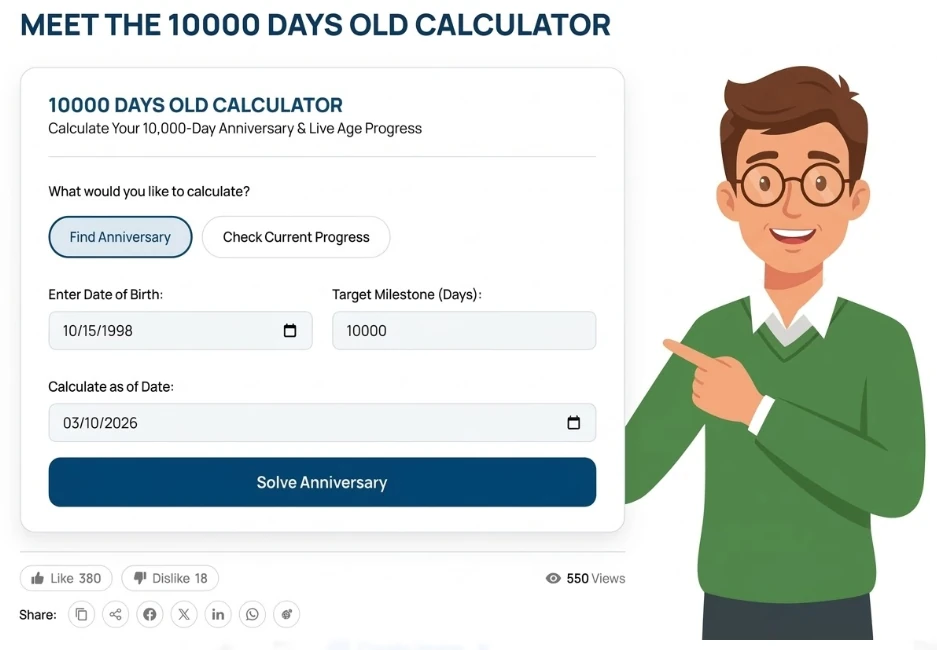
An illustrative graphic titled "MEET THE 10000 DAYS OLD CALCULATOR". A smiling male mascot with glasses points to an illustrated date form used to calculate a 10,000-day anniversary. The overall style is clean vector against a subtle grey pattern background with engagement metrics at the bottom.

What You Should Do Next

Mark the date if your 10,000-day milestone is still coming up. That gives you time to plan something small or just remember it.

Check the exact milestone day if it already passed. Some people still like to note it or share it later.

Use your real birth date when you can. An age-only result is only an estimate and can shift the answer.

Look at your current day count if the milestone is not close yet. That makes it easier to see how far away you are.

Quick Example to Test

Say your birth date is March 10, 1999 and your “as of” date is April 17, 2026.

Your result would show 9,900 days lived. That means you have not reached 10,000 days old yet. Your 10,000-day date would be July 26, 2026, which falls on a Sunday. At that point, your age would be 27 years, 4 months, and 16 days.

That result tells you something simple. The milestone is close, not missed. This is the point where most people set a reminder, plan a small celebration, or compare their date with family and friends.

How to Use the 10000 Days Old Calculator

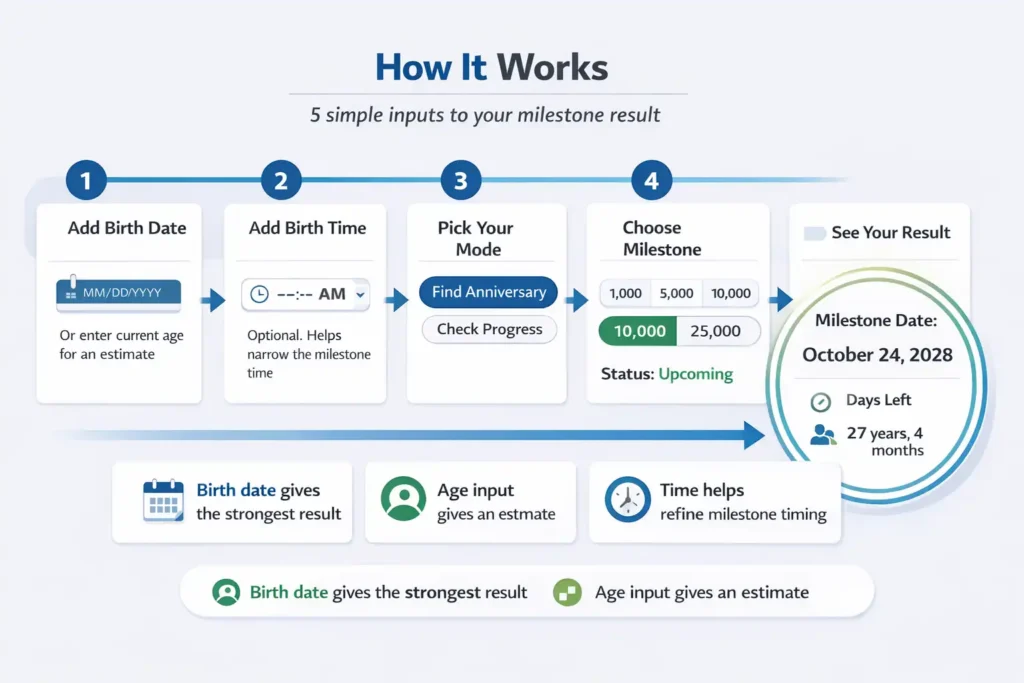
Use the 10000 Days Old Calculator to check your milestone date or see how many days you have lived so far. Add your birth date for the strongest result. If you do not know it, enter your current age for an estimate. You can also add your birth time for a closer milestone time. Then choose a day milestone and the date you want to calculate from. The tool will show your result, your status, and a simple age breakdown.

Step flow infographic for 10000 Days Old Calculator showing birth date, time, milestone choices, and result panel for easier tool use.

Add your birth date or current age

Start with your date of birth for the strongest result. If you do not know the exact date, enter your current age instead. In that case, the tool builds an estimate from your birth year, so the final date will be less precise.

Include your birth time if you know it

The time field is optional. Leave it blank and the tool uses midnight. Add a real birth time if you want a closer milestone time, not just the day.

Choose what you want to check

Pick Find Anniversary if you want your 10,000-day date. Switch to Check Current Progress if you want to see how many full days you have lived so far.

Select your milestone and check date

Choose a milestone like 1,000, 5,000, 10,000, 20,000, or 25,000 days. Then pick the date you want to calculate from. The tool uses that date to show whether your milestone is ahead, already passed, or how close you are.

Read your result and status

The result box shows the main answer right away. You may see your milestone date, total lived days, days left, or an achieved status. It also adds extra detail like weekday, age breakdown, weeks, hours, and live seconds.

Example for testing

Try these sample details:

Date of Birth: June 8, 2001
Target Milestone: 10,000 days
Result: Your 10,000-day birthday will be on October 24, 2028.
Status: This date is still upcoming.

How the 10000 Days Old Formula Works (Complete Breakdown)

The 10000 Days Old Calculator uses date math, not a rough age guess. That matters because leap years and month lengths can shift the final date. Most live tools focus on the answer itself, while age and date calculators show that the reliable method is adding days to a real start date and comparing calendar dates carefully.

Formula

				
					Milestone Date = Date of Birth + Target Days

Current Days Old = floor((As Of Date - Date of Birth) / 86,400,000)

Days Remaining = round((Milestone Date - As Of Date) / 86,400,000)


What this formula does

The first formula finds the day you reach a chosen milestone like 10,000 days old. The second counts how many full days you have lived by a selected date. The third shows the rounded countdown until the milestone. This matches how date calculators and metric birthday tools handle day-based milestones.

A small detail matters here. Full lived days use floor, so partial days do not count yet. Days remaining use round, which gives a cleaner countdown for users checking how close they are. Age calculators that break time into years, months, and days also rely on real calendar differences instead of a flat 365-day shortcut.

Key Variables Behind the 10000 Days Old Result

Date of Birth:

This is the starting calendar date for the whole calculation. A real birth date gives the strongest result because the tool can anchor the milestone to the right day and, if entered, the right birth time.

Target Days

This is the milestone you choose, such as 1,000, 5,000, 10,000, 20,000, or 25,000. The tool adds this number of days to the starting date to find your milestone birthday.

As Of Date

This is the date used to check your progress. It tells the tool whether your milestone is still ahead, already passed, or how many days old you are on that day.

Milestone Date

This is the calendar day when your chosen day count is reached. In most cases, users want this value most because it answers the search intent behind when will I be 10000 days old.

Days Old

This is your full lived-day count by the selected check date. It does not include partial days, which is why the tool counts only completed days here.

Days Remaining

This is the rounded gap between your milestone date and your selected check date. It gives you a simpler countdown when the milestone has not happened yet.

Another Example Calculation (Step-by-Step)

Here is a fresh example that follows the same logic used in the tool.

Given:

Date of Birth: February 14, 2002
Target Days: 10,000
As Of Date: April 17, 2026

Calculation:

				
					Milestone Date = February 14, 2002 + 10,000 days
Milestone Date = July 2, 2029

Days Remaining = round((July 2, 2029 - April 17, 2026) / 86,400,000)
Days Remaining = 1,171


Result:

  • 10,000-Day Date: July 2, 2029
  • Status: Upcoming
  • Days Remaining: 1,171

Meaning:

This result shows the milestone is still ahead. It also shows why day-based age is more useful than a rough year estimate. A person may know they are in their late 20s, but this formula pinpoints the actual 10,000-day birthday on the calendar.

What Your 10000 Days Old Result Means by Range

A 10000 Days Old Calculator result is not about good or bad. It is about where you are on the milestone path. These ranges help you see whether the date is far away, close, reached, or already passed so you know what the result means at a glance.

Attendance Result Benchmarks
RangeLabelUSA GuidelineIndia GuidelineNotes
Under 1,000 daysVery EarlyMostly fits baby or toddler age-in-days searches.Often used for early childhood milestone checks.Too early for a 10,000-day milestone focus.
1,000–4,999 daysFar AwayThe milestone is still many years away.Better fit for curiosity or child age tracking.Use current days lived rather than a countdown.
5,000–9,999 daysApproachingThe 10,000-day date is getting closer.This is where countdown intent becomes stronger.Check the exact date and save it if needed.
10,000 daysMilestoneThis is the main metric birthday most users want.Often treated as a special day-based age marker.A good point to celebrate, share, or remember.
10,001–19,999 daysPassedThe milestone already happened in the past.Users usually want the past date confirmed clearly.Focus on when it happened, not how far away it is.
20,000 daysNext MajorCommon follow-up milestone around the mid-50s.Often searched after users miss 10,000 days.Useful next check for long-range milestone planning.
25,000 daysLater-LifeA later milestone often tied to reflection or family sharing.Useful for broader age-in-days milestone searches.Works well as the next milestone after 20,000 days.

Heads-up: Day milestones are based on real calendar dates. Leap years and your birth date can shift the final result by several days.

Interpretation

These ranges give context, not judgment. Most users care about three moments. Is the date still ahead. Is today the milestone. Or did it already pass. The most useful zone is usually 5,000 to 10,000 days, because that is where the countdown feels real and the date becomes worth saving.

Pro Tip:

If your result is close to 10,000 days, use your real birth date instead of age only. That gives a stronger milestone date and avoids an estimate that can shift by months.

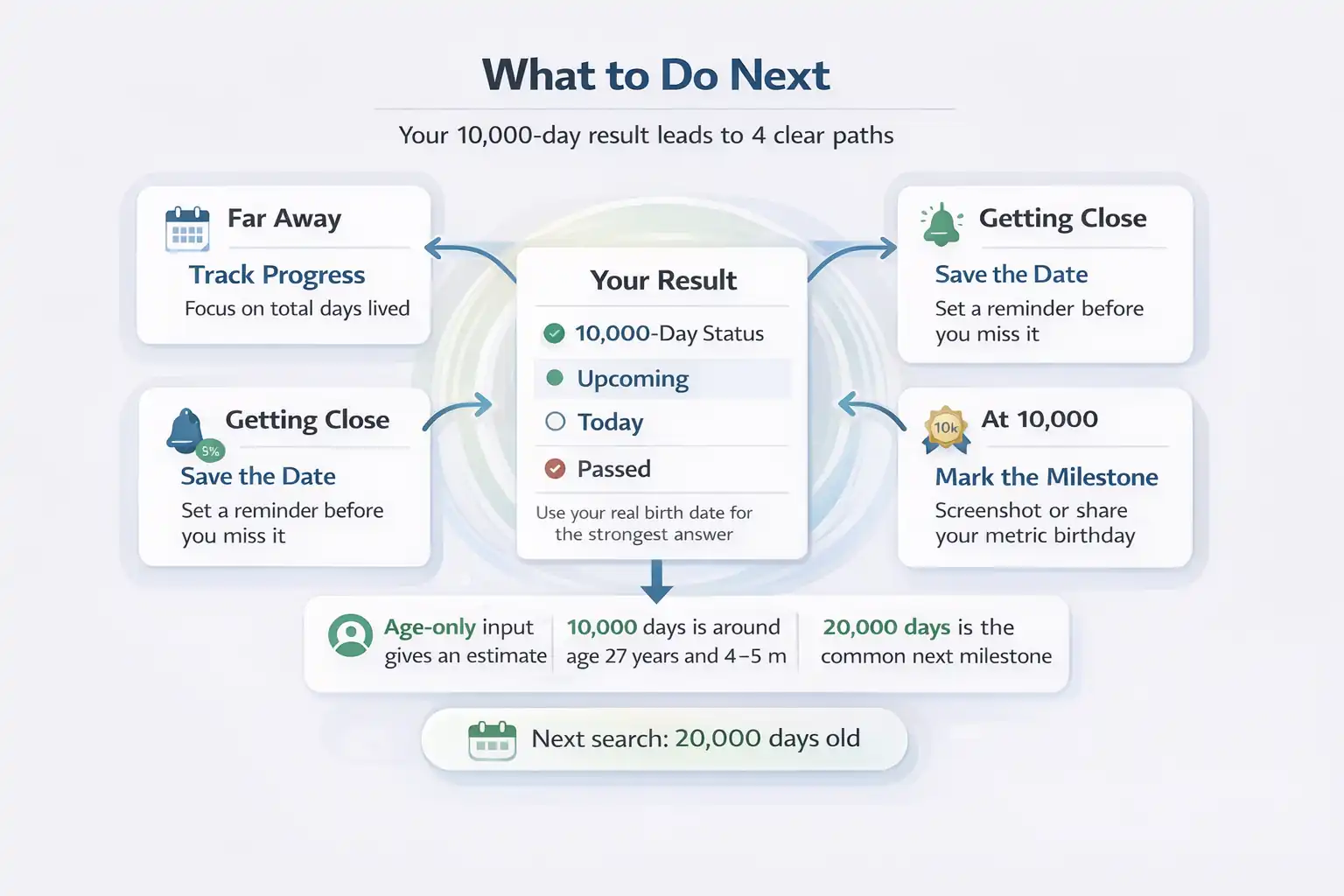
What to Do After Using the 10000 Days Old Calculator

A 10,000-day result is only useful if you know what to do with it. Most users want one of three answers after the date appears: save it, confirm it, or move to the next milestone. That matches how metric birthday tools and age-in-days pages frame follow-up searches like 20,000 days old and how many days old am I.

If Your Result Is Still Far Away

Focus on your current day count instead of the celebration date. That gives you a better sense of progress and makes the milestone feel real. If you used age only, switch to your real birth date later, because estimate mode can shift the answer by months.

If You Are Getting Close to 10000 Days

Save the milestone date now. This is the stage where the countdown matters most. Many users also want the weekday and the years-and-months view so they can decide whether to mark the date, share it, or set a reminder before it slips by.

If You Are Exactly at 10000 Days

Treat it like a metric birthday. That is the main milestone people care about on this topic. A quick screenshot, calendar reminder, or small celebration is usually enough. This is also the best moment to compare your result with the age-in-years view, since many people search both at the same time.

If You Already Passed 10000 Days

Look at the past date instead of the countdown. That is the useful answer now. Many users discover the milestone late, then want to confirm when it happened and decide whether to mark it anyway. After that, the natural next search is often 20,000 days old.

A smart next move is simple. Use your real birth date, save the milestone if it matters to you, and check the next big search path after this one. In most cases, that is either how many days old am I or 20,000 days old.

10,000 Days Old vs 20,000 Days Old

People don’t just want to know about the one type of birthday. They compare them. That’s why queries like platinum birthday vs diamond birthday, golden diamond and platinum birthday calculator, and milestone birthday calculator keep showing up. Here’s the simple truth. These birthdays are all based on number patterns. But each one follows a completely different rule.

How far apart are the two milestones?

The jump is much bigger than it looks. 10,000 days old is usually around 27 years and 4 to 5 months. 20,000 days old lands around 54 years and 9 months. That means the second milestone is not just a little later. It is roughly another full 10,000 days, or about 27 more years down the road.

What does 10,000 days old usually mean?

This is the more popular milestone. It is often called a metric birthday and gets shared more often because it lands in the late 20s, when people still enjoy novelty birthdays and social milestones. Reddit posts and metric birthday tools show that many users discover it close to the date and want to save it, celebrate it, or confirm whether they missed it.

What does 20,000 days old usually mean?

This is the natural follow-up milestone. It gets less attention than 10,000 days old, but it shows up often on age-calculator pages because users want the next big day-based marker after the first one passes. In practical terms, it works more like a long-range checkpoint than a surprise celebration date.

Which one should you check next?

Start with 10,000 days old if you are still under it or close to it. That is the milestone with the strongest search intent and the clearest personal meaning. Move to 20,000 days old once the first date has passed or if you want a longer view of your age timeline. This gives the page a stronger next-step path without repeating the main result.

You Might Also Find These Helpful

Birthday 12

Emerald Jubilee Calculator

Use our free Emerald Jubilee Calculator to find the exact date you turn 55. Discover the meaning of this green-themed milestone today.

Try calculator
Golden Birthday Calculator

Use our free Golden Birthday Calculator to find your special, once-in-a-lifetime date. Discover your Golden Age and get tips for a gold-themed party.

Try calculator
Leap Year Age Calculator

Use our Leap Year Age Calculator to find your exact age, real leap birthdays, and whether Feb 28 or March 1 counts on common…

Try calculator
Platinum Birthday Calculator

Use our Platinum Birthday Calculator to find your reversed-age milestone date, platinum birthday age, and whether it already passed or is still ahead.

Try calculator
Silver Birthday Calculator

Turning 25? Use the Silver Birthday Calculator to track your quarter-century milestone. Get the exact countdown in days, hours, and minutes for your big…

Try calculator
Twin Flame Calculator

You can use our free twin flame calculator to test your mirror soul compatibility. First, enter your birth dates. Next, discover your spiritual connection.

Try calculator

Common Mistakes When Using the 10000 Days Old Calculator

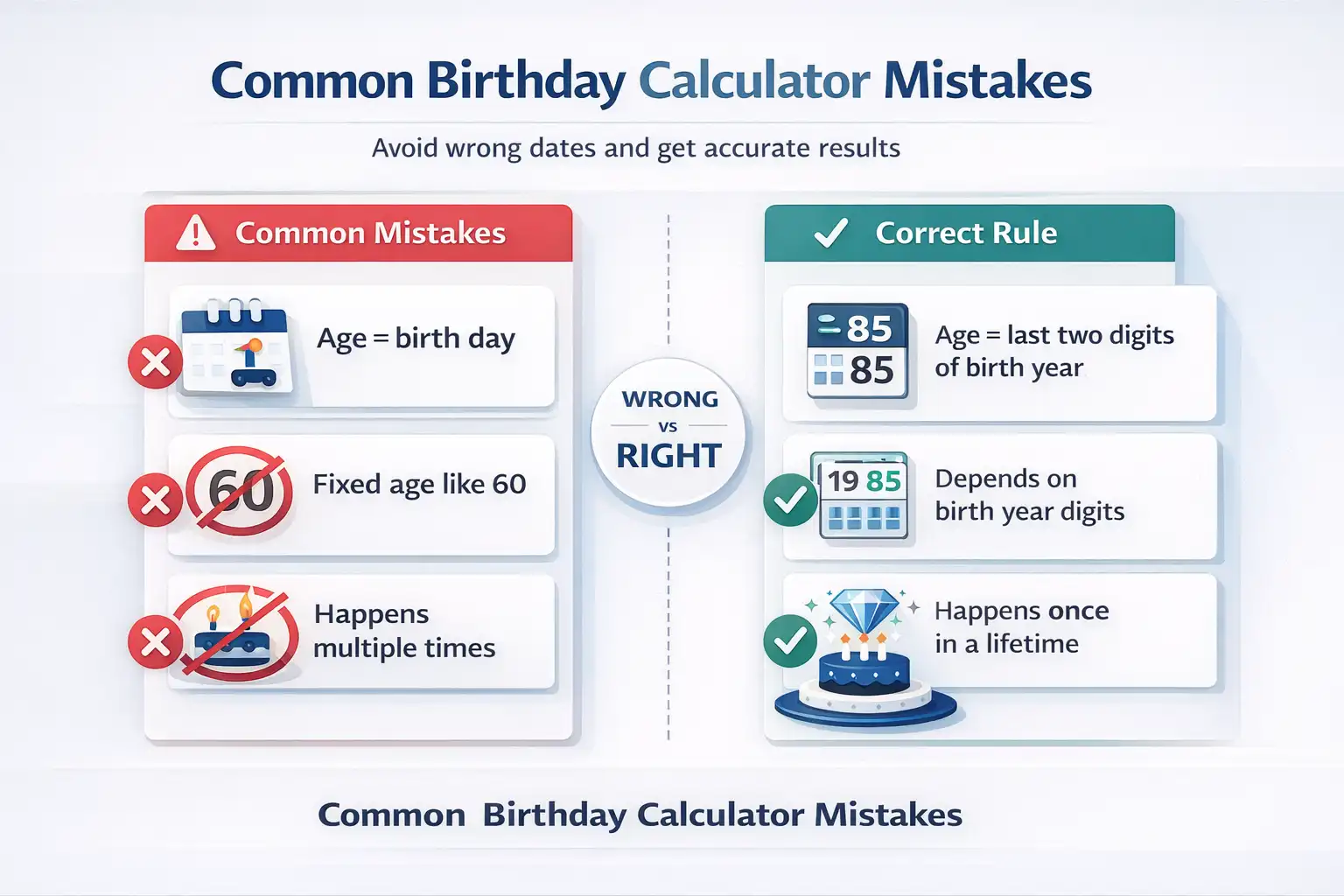
Small input mistakes can change a 10000 Days Old Calculator result more than people expect. The biggest problems usually come from estimate mode, leap-year assumptions, and reading the wrong status. These are the errors that most often cause confusion on age-in-days and metric birthday searches.

Common birthday calculator mistakes infographic showing wrong vs correct diamond birthday calculation rules

Frequently Asked Questions (FAQs)

Most people are about 27 years and 4 to 5 months old at 10,000 days. The exact answer depends on your real birth date, leap years, and whether you count by calendar age or a simple year conversion.

10,000 days is about 27.38 years. In a calendar view, it usually lands around 27 years and 4 months, though the exact month and day can shift a little based on leap years and your birth date.

Add 10,000 days to your birth date. That gives your milestone day. A proper age or date calculator also shows the weekday, which is useful if you want to save the date, plan something, or check whether you already missed it.

Count the number of days between your birth date and the date you want to check. The reliable way is to use calendar date math that accounts for leap years and different month lengths, not a rough years-to-days shortcut.

Yes. Many people call it a metric birthday because it marks a round day count instead of a yearly birthday. It is one of the most searched and shared day-based milestones because it feels personal and easy to remember.

20,000 days old is about 54 years and 9 months. The rough conversion stays close for most people, but the exact milestone date still depends on your birth date and leap-year differences across your lifetime.

You can get an estimate by using your current age, but it will not be exact. A true 10,000 days old date needs your real birth date. Birth time can refine the milestone even more when you want a closer answer.

Manual counting often skips leap years, month length changes, or partial-day handling. That can move the answer by several days. Online age tools usually rely on full calendar date arithmetic, which is why their result can differ from a quick hand estimate.

No. 10,000 days old lands in the late 20s, usually around 27 years and 4 to 5 months. Turning 30 is closer to 10,958 days, which is why many people are surprised by how much earlier the 10,000-day milestone arrives.

Many people still do. Reddit threads and milestone tools show that users often discover the date late, then save the past day, share it, or move on to the next milestone like 20,000 days old. Missing the date does not make the milestone less meaningful.

Using today checks your result against the current day. Changing the as of date can flip the status from upcoming to passed, or change how many full days old you are. That matters when you want a past or future milestone check.

Yes. Many age and milestone tools support more than one day marker, and users often check 1,000, 5,000, 10,000, and 20,000 days together. That helps put your current result in context and makes the next milestone easier to track.

Questions?

We had love to hear from you! Whether you are reporting an issue, suggesting a new calculator, or exploring collaboration opportunities — we are here to help. Every message helps us make 100calc smarter, faster, and more helpful for everyone.

Why People Trust 100calc

At 100calc.com, we focus on accuracy, speed, and trust. Every calculator we create is designed to give reliable, instant, and easy-to-understand results you can truly depend on.