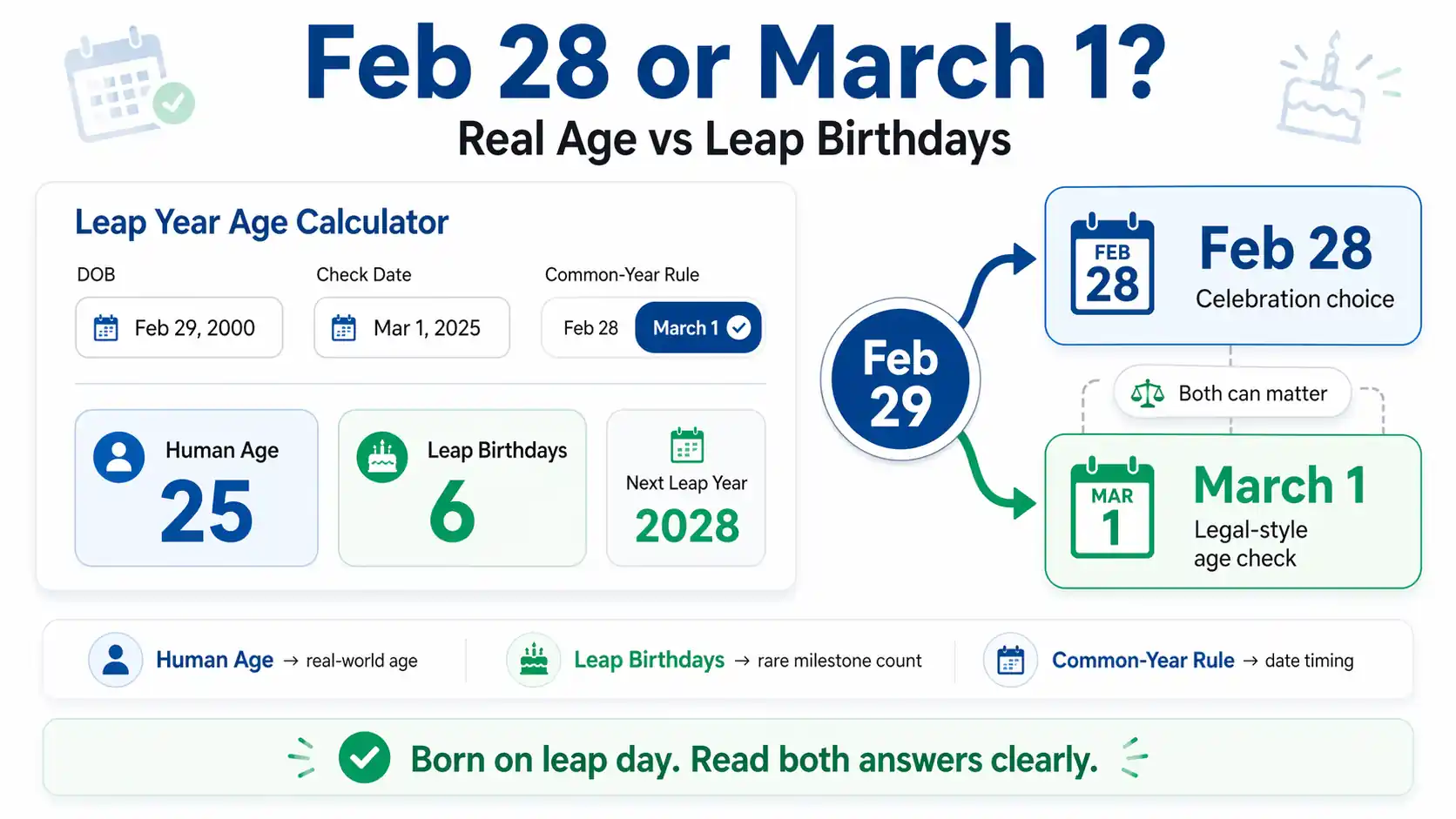

Leap Year Age Calculator for Feb 29 Birthdays

Use this Leap Year Age Calculator to find your exact age if you were born on February 29. It shows your human age, leap cycles lived, total days alive, next leap year, and rough months old. It also works backward to find a birth date from age and forward to project a future milestone date.

This page clears up the part people actually question. Do leap year babies count on February 28 or March 1? You will see the difference between real age and real Feb 29 birthdays, plus how the current calculator handles common years, so the result feels clear instead of confusing.

Calculate with the Leap Year Age Calculator Now

Choose a mode. Add your date of birth, target date, or target age. Pick March 1 or February 28 if you need a common-year rule. The Leap Year Age Calculator returns your human age, leap cycles, total days, or a projected birth or future date in seconds.

No setup needed. Enter your details and get the answer instantly.

Leap Year Life Calculator


Exhaustive Chronological Analysis for February 29th Borns
671 Views

Explore More Calculators

Diamond Birthday Calculator Featured

When is your diamond birthday? Use our Diamond Birthday Calculator to find the exact date when your age matches the last two digits of…

Try calculator
1 Billion Seconds Calculator

1 billion seconds calculator shows your exact milestone date and age in seconds. See if you’ve reached it or how close you are now.

Try calculator
10000 Days Old Calculator

Use our 10000 Days Old Calculator to find your exact 10,000-day birthday, check days old now, and see your age in years and months.

Try calculator
9 3/4 Birthday Calculator

Use our free 9 3/4 Birthday Calculator to find the exact date your child turns 9 years and 9 months. Plan the perfect wizard-themed…

Try calculator
Age Difference Calculator

You can use our free age difference calculator to find your exact chronological gap. First enter your specific birth dates. Next, discover your time…

Try calculator
Crown Birthday Calculator

You can use our free crown birthday calculator to find your golden date. First, enter your exact birth date. Next, discover your special celebration…

Try calculator

How do leap year birthdays work?

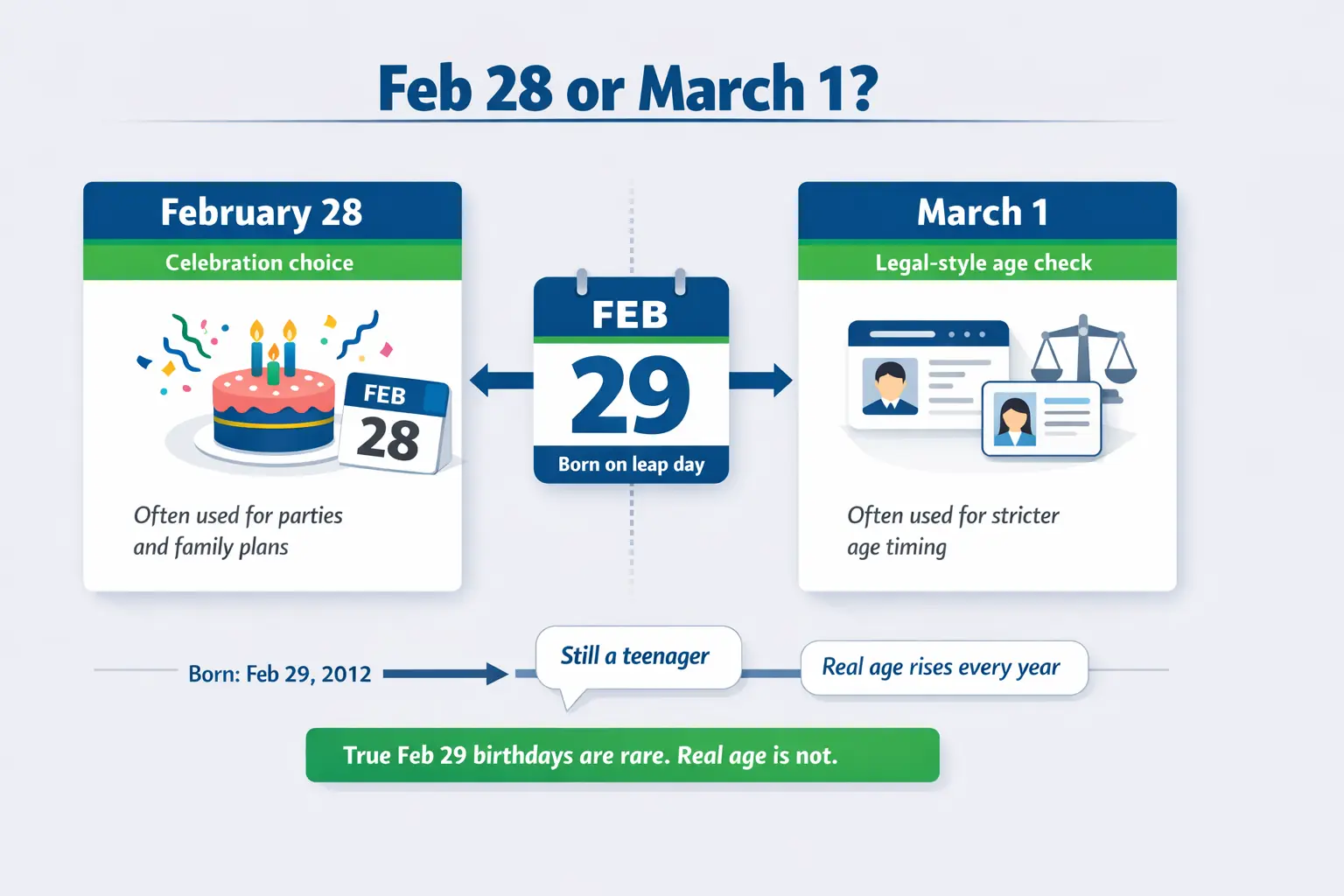
A leap year birthday means someone was born on February 29, a date that appears only in leap years. That person still gets older every year like everyone else. In common years, the birthday is usually observed on February 28 or March 1, depending on family choice, local rules, or context.

Age is based on time lived, not on how many times February 29 shows up on the calendar. That is why a person born on leap day is not “one quarter” of their real age. They may have fewer actual Feb 29 birthdays, but their real age still rises one year at a time.

Think of someone born on February 29, 2012. By February 2025, that person is still a teenager, even though they have only had a few true leap day birthdays. In normal years, some families celebrate on February 28. Others wait for March 1. That split is why leap day birthdays confuse so many people online and in real life.

The legal side can be different from the birthday party side. Some places treat March 1 as the age-change date in common years, while other contexts use February 28. That is why two people can talk about the same leap day birthday and still mean two different things.

Infographic for Leap Year Age Calculator showing Feb 28 vs March 1 birthday rules and why leap day age still increases yearly.

Micro Insight

This matters because the answer changes with the situation. If you care about celebration timing, February 28 may feel right. If you care about strict age wording, March 1 may be the better check. That is the real choice behind this topic.

How do you calculate leap year age?

A leap year age is based on full calendar years lived, not just on how many times February 29 appears. This calculator checks the birth year, target year, birthday checkpoint, and leap years passed. In age mode, a February 29 birthday follows a March 1 checkpoint in common years.

How old is someone born on February 29, 2012 on February 28, 2025?

This is a common leap day question.

Input

  • Mode: Calculate Age
  • Date of Birth: February 29, 2012
  • Calculate at Date: February 28, 2025
  • Logic selected: March 1 or February 28

Process

  • The calculator subtracts 2012 from 2025 and gets 13.
  • Then it checks the birthday checkpoint for 2025.
  • Because 2025 is not a leap year, the code treats February 29 as March 1.
  • February 28 is still before that checkpoint, so it subtracts 1.
  • It also counts leap years already passed: 2016, 2020, and 2024.

Result

  • Human Age: 12
  • Leap Cycles Lived: 3
  • Total Days: 4,748
  • Months Old: 144
  • Born in Leap?: YES

Meaning

This person is still 12 on February 28, 2025 in this calculator’s age logic.

How old are leap year babies born in 1996 on February 29, 2024?

This fits users checking a true leap day milestone.

Input

  • Mode: Calculate Age
  • Date of Birth: February 29, 1996
  • Calculate at Date: February 29, 2024
  • Logic selected: March 1

Process

  • The calculator subtracts 1996 from 2024 and gets 28.
  • The target date lands on a real February 29, so the birthday has been reached.
  • Then it counts every leap year after birth that had already happened by that date: 2000, 2004, 2008, 2012, 2016, 2020, and 2024.

Result

  • Human Age: 28
  • Leap Cycles Lived: 7
  • Total Days: 10,227
  • Months Old: 336
  • Born in Leap?: YES

Meaning

The person is 28 years old and has had 7 true February 29 birthdays.

What birth date matches age 18 on February 28, 2026?

This covers the backward search intent in the tool.

Input

  • Mode: Find Birth Date
  • Target Date: February 28, 2026
  • Target Age: 18
  • Logic selected: February 28

Process

  • The calculator subtracts 18 from 2026 and gets 2008.
  • Since 2008 is a leap year, it uses February 29, 2008, as the projected birth date.
  • The selected rule does not change the date here because the result year already has a leap day.
  • Leap cycles are estimated with 18 ÷ 4, rounded down.

Result

  • Projected Birth Date: February 29, 2008
  • Target Year: 2008
  • Is Leap Year?: YES
  • Leap Cycles: 4
  • Logic Used: Celebration

Meaning

If someone is 18 on that target date, this calculator maps the birth year to a real leap day.

What future date does a leap day baby born in 2008 reach at age 21?

This helps users check milestone ages like 18 or 21.

Input

  • Mode: Project Future Date
  • Date of Birth: February 29, 2008
  • Target Age: 21
  • Logic selected: March 1

Process

  • The calculator adds 21 to 2008 and gets 2029.
  • Since 2029 is not a leap year, it applies the selected common-year rule and returns March 1, 2029.
  • Leap cycles are estimated with 21 ÷ 4, rounded down.

Result

  • Projected Future Date: March 1, 2029
  • Target Year: 2029
  • Is Leap Year?: NO
  • Leap Cycles: 5
  • Logic Used: Legal

Meaning

This shows the future milestone date using the stricter March 1 rule.

Quick Rule to Remember

Real age goes up every year. True February 29 birthdays do not. In this tool, age mode treats common-year leap day birthdays as reaching the checkpoint on March 1. Backward and future-date modes follow the rule you select.

Which common-year rule should you use?

Choose the rule that matches why you are checking age. Pick March 1 for legal-style age checks and milestone timing. Pick February 28 for birthday planning and family use. If you are unsure, compare both. That is the fastest way to avoid leap day confusion.

Leap Year Birthday Rule Comparison
OptionLabelBest ForHow This Tool Treats ItNotes
March 1stLegal StandardLegal-style age checks, forms, milestone comparisons.In Calculate Age mode, Feb 29 birthdays follow a March 1 checkpoint in common years. Projected dates also use March 1 when this option is selected.Best match if you want the strict age checkpoint used by this calculator.
February 28thCelebration StandardBirthday planning, personal use, family reminders.In projected date modes, non-leap results use February 28 when selected. In Calculate Age mode, the age math still follows March 1.Good for celebration use. It does not change the main age formula here.
Compare BothBest if UnsureUsers unsure which date to trust.Run both options if you need a personal answer and a strict age answer. This shows where the difference appears.Useful when the result will be used for both records and birthday planning.

Heads-up: In this calculator, Calculate Age mode uses a March 1 style checkpoint for Feb 29 births. The selector mainly changes projected dates and explanation text.

Use March 1 when you need the stricter age result this calculator already applies in Age mode. Use February 28 when you care more about celebration timing. If the date matters for legal use, check your local rule too.

What Your Leap Year Age Result Means

Your result shows two different things. Human Age is your real calendar age. Leap Cycles Lived shows how many leap years passed after your birth and before the date you checked.

Those numbers are not supposed to match. A leap day baby still gets older every year. They just get fewer true February 29 birthdays.

Understanding Your Result

Human Age tells you how many full years you have lived. That is the age most people mean in daily life.

Leap Cycles Lived tells you how many real leap days have happened since birth. It is closer to the number of true Feb 29 birthdays, but only within the checked time range.

A projected birth date or future date works a little differently. It uses the chosen age and year, then places the result on February 29, February 28, or March 1 based on the calculator logic.

Is Your Result Good or Bad?

This result is not good or bad. It is a date and age answer, not a score.

What matters is how to read it correctly. If Human Age is 25 and Leap Cycles Lived is 6, that does not mean anything is off. It means the person is truly 25 years old and has only had 6 real Feb 29 birthdays.

The only time you need extra care is when you compare February 28 and March 1. In this tool, Calculate Age mode follows a March 1 style checkpoint for Feb 29 births in common years. That can affect how you read the result.

A professional feature graphic for the Leap Year Life Calculator with a mascot in a green sweater. The interface includes options to 'Calculate Age', 'Find Birth Date', and 'Date of Death' for February 29th borns, displayed on a clean white background.

What You Should Do Next

Check Human Age if you want the real age answer.

Look at Leap Cycles Lived if you want to know how many true leap birthdays have passed.

Use March 1 when you want the stricter age checkpoint this tool follows in age mode.

Use the birth date or future date modes when you want to estimate a leap-day birth year or a milestone age date.

Quick Example to Test

Use this input in Calculate Age mode:

  • Date of Birth: February 29, 1988
  • Calculate at Date: March 1, 2024
  • Common-year logic: March 1

Result

  • Human Age: 36
  • Leap Cycles Lived: 9
  • Total Days: 13,150
  • Months Old: 433
  • Born in Leap?: YES

Meaning

This person is 36 years old in real life. They have lived through 9 leap years after birth that had already reached February 29 by the target date. That is why the two numbers are different.

How the Leap Year Age Calculator Works

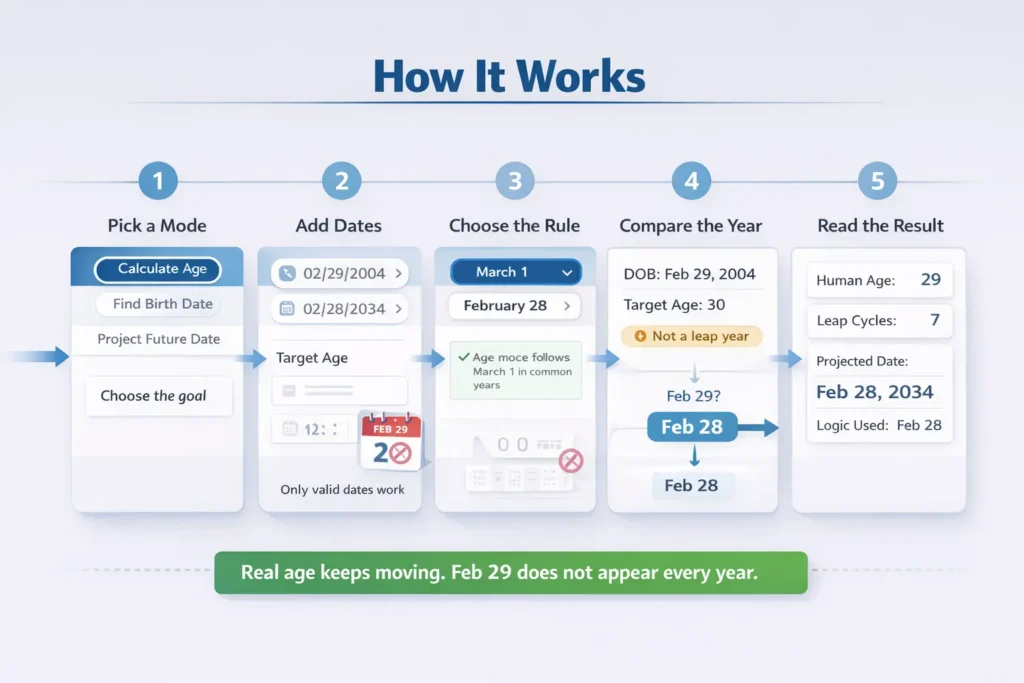
This tool uses three modes. It can check age on a chosen date, work backward from age to a likely birth date, or project a future milestone date. The biggest point it handles is the leap day rule people keep asking about: February 28 or March 1 in common years.

Leap Year Age Calculator process infographic showing mode choice, date inputs, Feb 28 or March 1 rule, and result cards.

Choose the right mode

Pick Calculate Age when you want to know how old someone is on a certain date. Use Find Birth Date when you know the age and target date. Choose Project Future Date when you want to see the date someone reaches a future age. This matches the three tool paths in the calculator logic.

Enter the date the tool needs

Add the birth date if you are checking age or projecting forward. Add the target date if you want age on a certain day or want to work backward. If you use the backward or forward mode, enter the target age too. The tool only accepts valid dates and blocks impossible February 29 entries.

Pick the common-year rule

Choose March 1 if you want the stricter age checkpoint often used in real-world age timing. Choose February 28 if you want the celebration-style option many families use. This matters most in projected date results. In this tool’s age mode, February 29 birthdays still follow a March 1 style checkpoint in common years.

The calculator compares the years and dates

In age mode, the tool subtracts the birth year from the target year. Then it checks whether that year’s birthday has been reached. For leap day births in a common year, the code treats the checkpoint like March 1. It also counts how many leap years have passed and whether February 29 in those years had already arrived by the target date.

Read the result cards

The result cards show the main answer and the extra context. In age mode, you will see Human Age, Leap Cycles Lived, Total Days, Next Leap Year, Months Old, and Born in Leap? In the other modes, you will see a projected birth date or future date, plus the target year, leap-year status, and logic used.

Quick Example to Test

Try this in Project Future Date mode:

  • Date of Birth: February 29, 2004
  • Target Age: 30
  • Common-year logic: February 28
  • Result: Projected Future Date = February 29, 2034? No. Since 2034 is not a leap year, the tool uses your selected rule and returns February 28, 2034. Leap Cycles = 7.

That result shows how the tool handles milestone dates when the future year does not contain a real February 29.

How the Leap Year Age Formula Works (Complete Breakdown)

This Leap Year Age Calculator uses calendar age math, leap-year rules, and date projection logic to handle three different tasks. It does more than a basic age calculator. It checks real age, counts passed leap cycles, and decides whether a projected non-leap result should land on February 28 or March 1. The leap-year rule behind it follows the standard Gregorian method: years divisible by 4 are leap years, except century years unless divisible by 400.

Formula Block

Age Mode

				
					Human Age = Target Year - Birth Year
Subtract 1 if Target Date is earlier than the Birthday Checkpoint in the Target Year

Leap Cycles Lived = Count of leap years after Birth Year
where Feb 29 is on or before the Target Date

Total Days = floor((Target Date - Birth Date) / 86,400,000)


Find Birth Date Mode

				
					Projected Birth Year = Target Year - Target Age

If Projected Birth Year is a leap year:
Projected Birth Date = February 29, Projected Birth Year

If Projected Birth Year is not a leap year:
Projected Birth Date = March 1, Projected Birth Year
or
Projected Birth Date = February 28, Projected Birth Year
based on selected logic


Project Future Date Mode

				
					Projected Future Year = Birth Year + Target Age

If Projected Future Year is a leap year:
Projected Future Date = February 29, Projected Future Year

If Projected Future Year is not a leap year:
Projected Future Date = March 1, Projected Future Year
or
Projected Future Date = February 28, Projected Future Year
based on selected logic


Projection Estimate

				
					Estimated Leap Cycles = floor(Target Age / 4)


What the Formula Is Doing

In Age Mode, the tool checks how many full years have passed between the birth year and the target year. Then it checks whether that year’s birthday has already been reached. For leap day births, the current script treats the common-year checkpoint like March 1 in age mode.

The leap cycle count works separately. It counts leap years after birth only when February 29 in that year has already happened by the date you picked. That is why Human Age and Leap Cycles Lived are different numbers.

The other two modes use age as a shortcut to move backward or forward by year. After that, the tool checks if the new year is a leap year. If it is, the result stays on February 29. If not, it uses the selected common-year rule.

Key Variables Used in the Leap Year Age Calculator

Birth Year

This is the year from the entered birth date. The tool uses it as the base point for every age and projection result. In forward mode, it adds age to this year. In age mode, it compares this year with the selected target year.

Target Year

This is the year from the chosen target date. The calculator uses it to decide how many full years have passed. In backward mode, it subtracts the target age from this year to estimate the birth year.

Target Age

This is the age entered by the user in backward or forward mode. It tells the tool how far to move through the calendar. It also powers the simple leap-cycle estimate used in projected results.

Birthday Checkpoint

This is the date the script uses to decide if the birthday has already happened in the target year. For most birthdays, it matches the same month and day. For February 29 births in age mode, the current code treats the checkpoint like March 1 in common years.

Leap Year

A leap year is a year with February 29. Under the Gregorian rule, a year must be divisible by 4. Century years are skipped unless divisible by 400. That is why 2000 was a leap year but 1900 was not.

Another Example Calculation (Step-by-Step)

Let’s use a fresh example that matches the calculator logic.

Given:

  • Mode: Calculate Age
  • Date of Birth: February 29, 1992
  • Target Date: March 1, 2023
  • Common-Year Logic Selected: March 1

Calculation:

				
					Human Age

2023 - 1992 = 31

The script checks the birthday checkpoint in 2023. Since 2023 is not a leap year, the checkpoint behaves like March 1 in age mode. The target date is March 1, 2023, so the birthday has been reached.

Human Age = 31

Leap Cycles Lived

Leap years after 1992 and on or before March 1, 2023:

1996
2000
2004
2008
2012
2016
2020

Leap Cycles Lived = 7


Result:

  • Human Age: 31
  • Leap Cycles Lived: 7
  • Total Days: 11,323
  • Months Old: 373
  • Born in Leap?: YES

Meaning:

This result shows the split clearly. The person is 31 years old in real life, but only 7 true leap cycles have passed after birth. That is the key idea behind this topic. Real age moves every year. February 29 does not.

Leap Year Age Calculator Result Benchmarks Explained

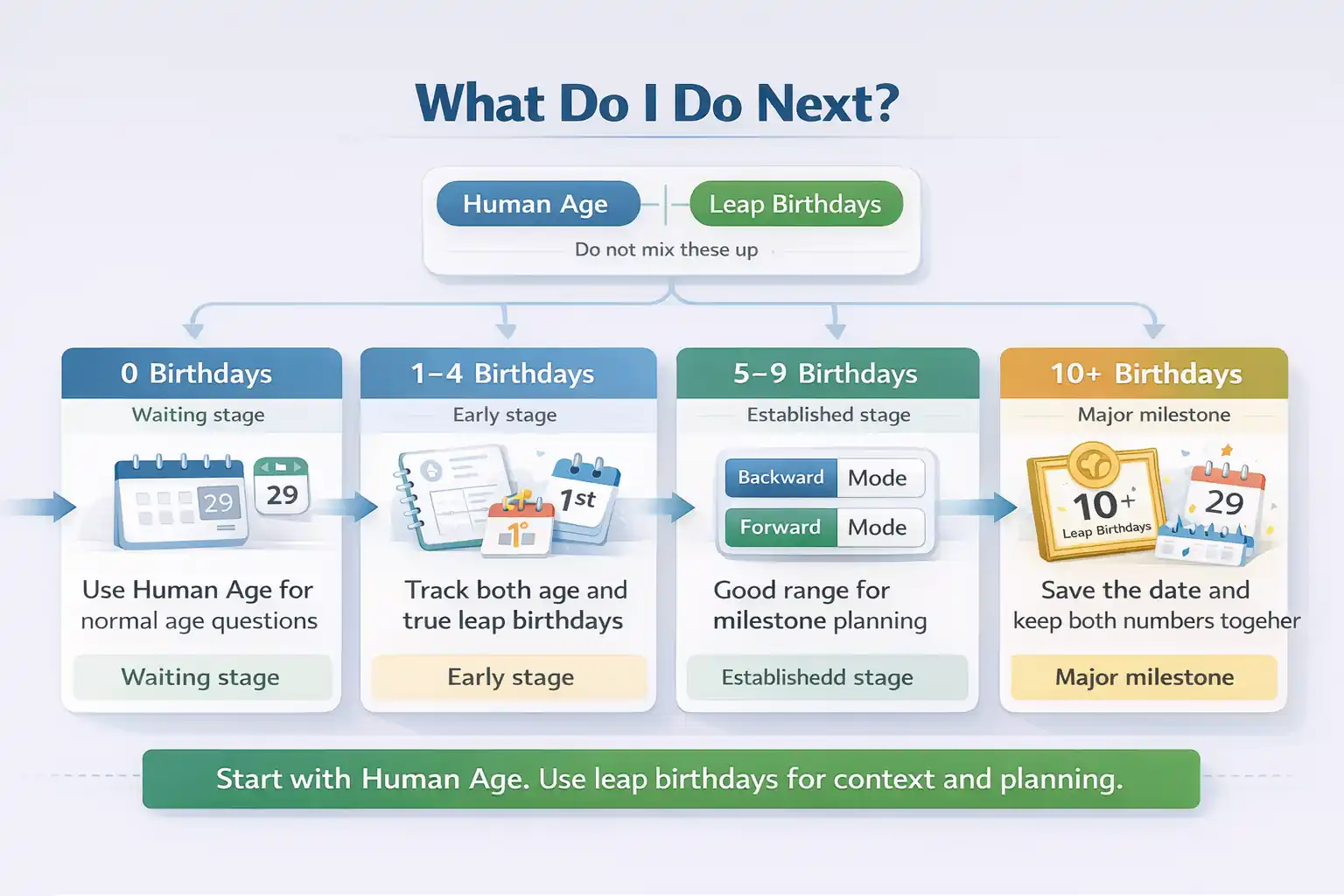
These benchmarks help you read your result without overthinking it. A Leap Year Age Calculator does not give a pass or fail score. It shows where your leap birthday count sits in real life, so you can tell whether you are still waiting, in the early range, or already at a rare milestone.

Attendance Result Benchmarks
RangeLabelUSA GuidelineIndia GuidelineNotes
0 leap birthdaysWaitingReal age still increases each year, even with no true Feb 29 birthday yet.Same reading. The person is aging normally, but the rare date has not returned.Best for children or very young users born on leap day.
1–4 leap birthdaysEarly StageCommon for kids, teens, and younger adults checking a leap birthday count.Usually read as the early leapling years in school, family, or milestone use.Compare this with Human Age, not just the leap count.
5–9 leap birthdaysEstablishedA common adult range for many Feb 29 users who want a milestone check.Often where users start comparing celebration timing with legal-style age timing.This range usually feels familiar but still rare.
10+ leap birthdaysMajor MilestoneRare long-run range, often used for milestone stories, parties, or media interest.Same reading. This usually marks a notable leap day birthday milestone.Worth checking both Human Age and leap count together.

Heads-up: This table interprets leap birthday counts, not legal status. In this calculator, Age mode follows a March 1 style checkpoint for Feb 29 births in common years.

Interpretation

The main thing to remember is this: Human Age and leap birthdays are not meant to match. Someone can be 24 years old and have only 6 true Feb 29 birthdays because leap day appears only in leap years. That is why the most useful comparison is not “good or bad.” It is whether the leap count feels early, established, or rare for that person’s stage of life.

Pro Tip:

Check Human Age first. Then use the leap birthday range as extra context. If the result is near a milestone, compare February 28 and March 1 handling too. That usually clears up the confusion fastest.

What to Do After Using the Leap Year Age Calculator

Most users do not get stuck on the number itself. They get stuck on what to trust next. The real follow-up questions are usually about Human Age vs leap birthdays, February 28 vs March 1, and how to use the result for planning. That is where this section helps.

For Waiting Results

A result with 0 leap birthdays usually means the person is still very young. Real age still moves forward every year, even though no true February 29 birthday has happened yet. In this case, use Human Age for normal age questions and use the leap birthday count only as extra context.

Birthday planning can still get tricky. When the next real Feb 29 is far away, it helps to compare February 28 and March 1 before choosing a celebration date.

For Early Stage Results

The 1 to 4 leap birthdays range is where people often mix up real age and leap birthday count. One number shows how old the person truly is. The other shows how many rare leap day birthdays have passed. Both matter, but they do different jobs.

Use Human Age for school records, forms, and everyday age checks. Keep Leap Cycles Lived for milestone tracking, birthday ideas, or family memories.

For Established Results

Once the result reaches 5 to 9 leap birthdays, the leap birthday count starts to feel more meaningful. This is often the stage where users want to plan ahead, verify dates, or settle the February 28 versus March 1 question with more confidence.

That is a good time to use the forward and backward modes. One helps estimate a birth date from age and year. The other helps plan a future milestone date without guessing.

For Major Milestone Results

A result of 10 or more leap birthdays is rare enough to feel special. At that point, the number becomes more than a fun detail. It can shape milestone planning, keepsake pages, family records, or event ideas tied to a true leap day birthday.

Save both numbers together here. Human Age tells the real-life age. Leap Cycles Lived gives the rare milestone angle that makes the result worth remembering.

One simple rule to follow

Start with Human Age when you need the real answer. Then use Leap Cycles Lived as the rare-birthday layer. When timing matters, check the common-year rule too. That small step clears up most leap day confusion.

Leap Year Age Calculator vs Regular Age Calculator

This section matters because many users do not realize these two tools answer slightly different questions. A regular age calculator gives your calendar age. A Leap Year Age Calculator goes further for February 29 birthdays by handling leap-day rules, counting true leap birthdays, and showing how common years affect the result.

What a regular age calculator does

A standard age calculator measures elapsed time between two dates. It usually returns years, months, days, and sometimes weeks or hours. Many tools handle leap years in the background, but they do not focus on the special case of a February 29 birthday or explain the Feb 28 versus March 1 question clearly.

When to use each one

Use a regular age calculator when you only need the normal age difference between two dates. Pick the leap-year version when the person was born on February 29, when a milestone date matters, or when you need to decide between February 28 and March 1 handling. That is the real split users keep asking about in search and forums.

What a leap year age calculator adds

A leap-focused tool answers the part that causes confusion. It separates Human Age from Leap Cycles Lived, handles projected dates for non-leap years, and helps users compare celebration timing with stricter age timing. That is why it fits people born on February 29 better than a normal age tool.

Quick comparison

A regular age calculator answers, “How old is this person today?” A leap year age calculator answers, “How old is this person today, how many true leap birthdays have passed, and which common-year rule should I use?” That extra layer is the gap most pages still leave open.

You Might Also Find These Helpful

Birthday 12

Diamond Jubilee Calculator

Calculate your 60-year milestone instantly. Our Diamond Jubilee Calculator provides precise dates for 60th birthdays or anniversaries with 100% accuracy.

Try calculator
Emerald Jubilee Calculator

Use our free Emerald Jubilee Calculator to find the exact date you turn 55. Discover the meaning of this green-themed milestone today.

Try calculator
Golden Birthday Calculator

Use our free Golden Birthday Calculator to find your special, once-in-a-lifetime date. Discover your Golden Age and get tips for a gold-themed party.

Try calculator
Platinum Birthday Calculator

Use our Platinum Birthday Calculator to find your reversed-age milestone date, platinum birthday age, and whether it already passed or is still ahead.

Try calculator
Silver Birthday Calculator

Turning 25? Use the Silver Birthday Calculator to track your quarter-century milestone. Get the exact countdown in days, hours, and minutes for your big…

Try calculator
Twin Flame Calculator

You can use our free twin flame calculator to test your mirror soul compatibility. First, enter your birth dates. Next, discover your spiritual connection.

Try calculator

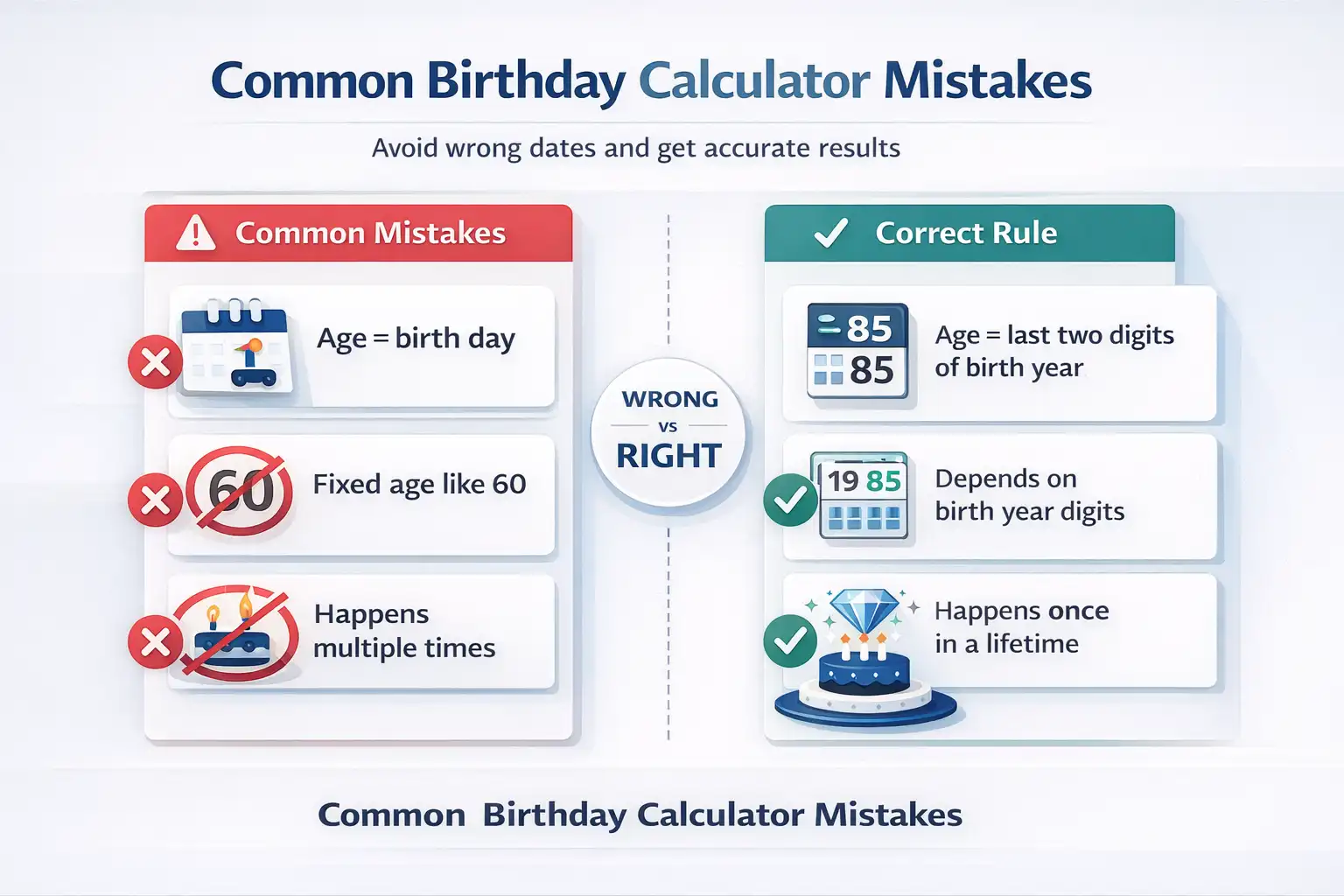
Common Mistakes When Using the Leap Year Age Calculator

Mistakes usually happen when users mix up real age, true Feb 29 birthdays, and the February 28 vs March 1 rule. That confusion is common with leap-day birthdays because one result shows normal calendar age, while another shows how many rare leap birthdays have actually happened.

Common birthday calculator mistakes infographic showing wrong vs correct diamond birthday calculation rules

Frequently Asked Questions (FAQs)

Someone born on February 29 still gets one year older every year. The real age is based on elapsed time, not on how many true leap birthdays have happened. In this calculator’s age mode, the common-year birthday checkpoint follows March 1 behavior for leap-day births.

Both are common. Many families pick February 28 for celebration because it stays in the same month. Others use March 1 because it follows the calendar sequence after February 28. Legal treatment can also differ by place and context, which is why people compare both dates.

It depends on local law and the situation. Some places treat February 28 as the legal age date in common years, while others use March 1. That is why age-gated events, licenses, and records do not always line up the same way for leap-day birthdays.

Count the leap years after the birth year where February 29 has already happened by the date you are checking. That number is much lower than real age. A person can be 24 years old and still have only 6 true February 29 birthdays.

Those two results answer different questions. Human Age shows real calendar age. Leap Cycles Lived shows how many leap years with a passed February 29 occurred after birth. Keeping them separate removes the biggest leap-day confusion and makes milestone planning easier to read.

A non-leap year does not have February 29, so the system must map that birthday to another date. In this calculator’s age mode, the birthday checkpoint behaves like March 1 in common years. In projection modes, the selected rule can place the result on February 28 or March 1.

It is better for February 29 birthdays and leap-day planning. A regular age calculator usually gives elapsed age only. A leap-year age calculator adds the missing context, such as true leap birthdays, common-year handling, and projected dates when a future or past year does not contain February 29.

Yes. The backward mode works from the target date and target age to estimate the birth year. If that year is a leap year, the result stays on February 29. If not, the tool uses the selected common-year rule to place the result on February 28 or March 1.

February 29 appears only in leap years, so it shows up far less often than other calendar dates. That makes leap-day birthdays unusually rare. It is also why many people search for help with age rules, milestone planning, and the difference between real age and true leap birthdays.

Not every year divisible by 4 is a leap year. Century years are skipped unless they are also divisible by 400. That means 2000 was a leap year, but 2100 will not be. This matters when you count future leap birthdays across long time spans.

Questions?

We had love to hear from you! Whether you are reporting an issue, suggesting a new calculator, or exploring collaboration opportunities — we are here to help. Every message helps us make 100calc smarter, faster, and more helpful for everyone.

Why People Trust 100calc

At 100calc.com, we focus on accuracy, speed, and trust. Every calculator we create is designed to give reliable, instant, and easy-to-understand results you can truly depend on.