1 Billion Seconds Calculator – Find Your Exact Date

A 1 billion seconds calculator shows the exact date you reach your billion-second milestone or how many seconds you have lived so far. One billion seconds equals about 31.7 years, which is why many people call it a “second birthday milestone.”

But here’s where most people get it wrong. It’s not just a simple conversion. Your exact result changes based on your birth time, your age, and even whether your milestone already passed. That means two people with the same birth year can get different answers.

So what is your real number? This tool lets you find your 1 billion seconds old date, compare it with 100 million or 2 billion seconds, and even track your life in seconds in real time. Enter your details and see exactly where you stand.

How does the 1 billion seconds calculator find your exact date?

The 1 billion seconds calculator works by adding your selected milestone to your birth date or estimating it from your age. It quickly calculates your exact anniversary or shows your current life in seconds. You get a clear result that tells you your milestone date, progress, and total time lived.

1 Billion Seconds Calculator
Find Your Billion-Second Anniversary & Current Life in Seconds
Use this if you don't know your exact birth date.
893 Views

Explore More Calculators

Diamond Birthday Calculator Featured

When is your diamond birthday? Use our Diamond Birthday Calculator to find the exact date when your age matches the last two digits of…

Try calculator
10000 Days Old Calculator

Use our 10000 Days Old Calculator to find your exact 10,000-day birthday, check days old now, and see your age in years and months.

Try calculator
9 3/4 Birthday Calculator

Use our free 9 3/4 Birthday Calculator to find the exact date your child turns 9 years and 9 months. Plan the perfect wizard-themed…

Try calculator
Age Difference Calculator

You can use our free age difference calculator to find your exact chronological gap. First enter your specific birth dates. Next, discover your time…

Try calculator
Crown Birthday Calculator

You can use our free crown birthday calculator to find your golden date. First, enter your exact birth date. Next, discover your special celebration…

Try calculator
Diamond Jubilee Calculator

Calculate your 60-year milestone instantly. Our Diamond Jubilee Calculator provides precise dates for 60th birthdays or anniversaries with 100% accuracy.

Try calculator

What is a 1 billion seconds birthday?

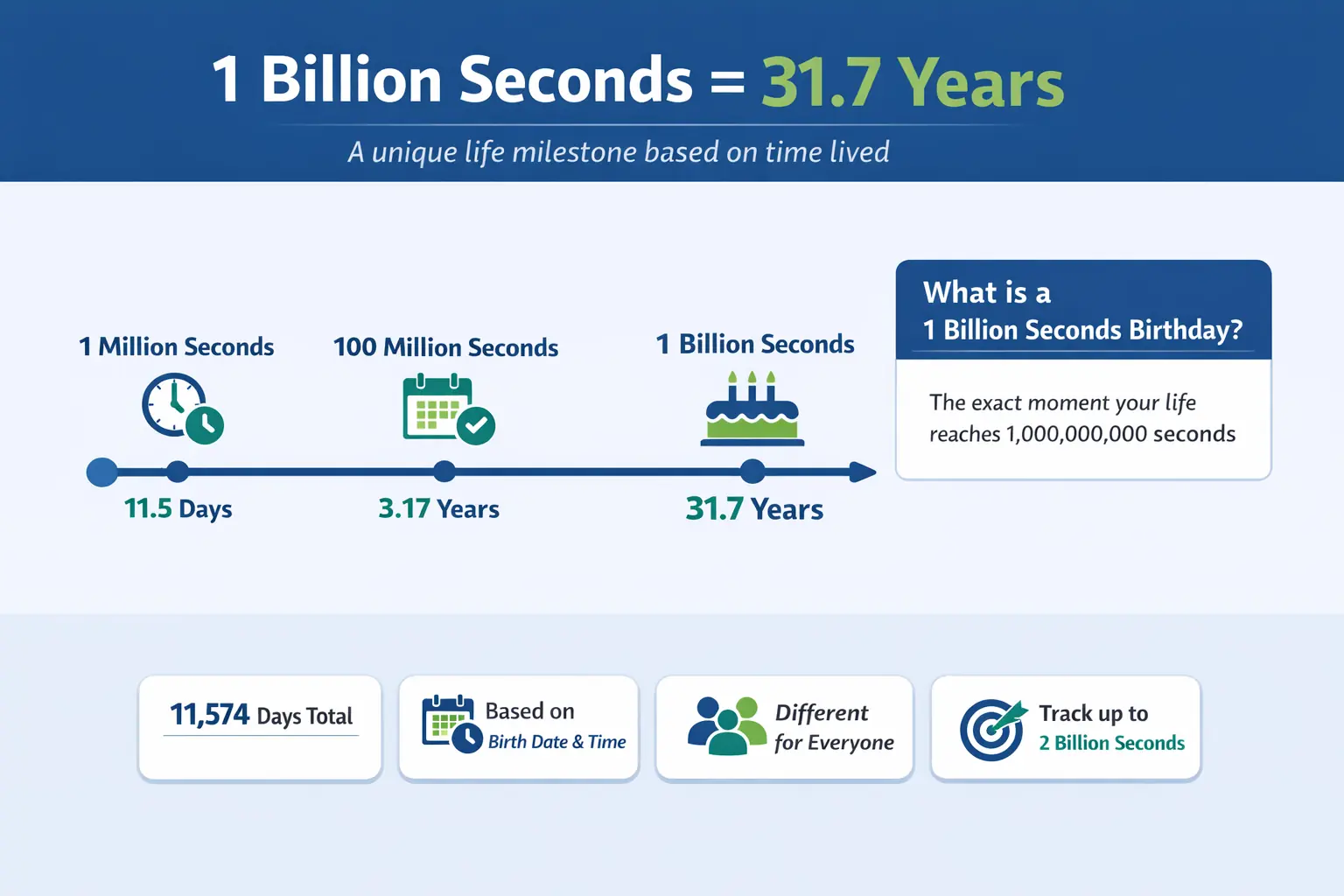
A 1 billion seconds birthday marks the moment your life reaches one billion seconds. It usually falls around age 31.7 years, which makes it a fun and surprising milestone to track.

Unlike a regular birthday, this one is based on total time lived. It shows your age in seconds and helps you understand how long one billion seconds really is in real life.

The exact date is not the same for everyone. Your birth time matters, so even people born on the same day can get slightly different results.

Once you enter your details above, the calculator shows the date you turn 1 billion seconds old, your milestone age, and whether you have already reached it. You can also compare other milestones like 1 million seconds or even 2 billion seconds.

1 billion seconds calculator infographic showing 31.7 years, 11,574 days, and timeline comparison with 1 million and 100 million seconds

Quick Facts

How do you calculate a 1 billion seconds birthday?

To calculate a 1 billion seconds birthday, add 1,000,000,000 seconds to your birth date and birth time. That gives you the exact moment you turn 1 billion seconds old. If you use age instead of birth date, the result becomes an estimate instead of an exact anniversary.

What is the date if you were born on January 1, 1995 at 12:00 PM?

Here is a clean example of an exact milestone result.

Input

  • Birth date: January 1, 1995
  • Birth time: 12:00 PM
  • Milestone: 1 Billion Seconds

Process

The calculator adds 1,000,000,000 seconds to the birth date and time.

Final result

  • September 9, 2026 at 1:46 PM
  • Weekday: Wednesday

Meaning

This is the exact date and time the person turns 1 billion seconds old. It also shows why birth time matters, not just the birth date.

What happens if your 1 billion seconds birthday has already passed?

This example shows how the tool handles a completed milestone.

Input

  • Birth date: March 10, 1980
  • Birth time: 09:45 AM
  • Milestone: 1 Billion Seconds

Process

The calculator adds the full milestone to the birth timestamp and checks it against today.

Final result

  • November 17, 2011 at 11:31 AM
  • Status: Already completed

Meaning

This person already reached the milestone years ago. That helps answer like how old are you when you reach 1 billion seconds and whether your billion-second date is still coming or already gone. The milestone lands at about 31.7 years, or roughly 31 years and 8 months.

What does 500 million seconds look like for someone born on June 15, 2010?

This example proves the calculator can do more than a 1 billion seconds birthday.

Input

  • Birth date: June 15, 2010
  • Birth time: 08:30 AM
  • Milestone: 500 Million Seconds

Process

The tool adds 500,000,000 seconds to the starting point.

Final result

  • April 19, 2026 at 9:23 AM
  • Status: Upcoming or completed based on the current date

Meaning

A 500 million second milestone happens much earlier than 1 billion seconds. It is useful when you want to compare 100 million, 500 million, 1 billion, and 2 billion seconds on one timeline.

What if you only know your current age and not your full birth date?

This example shows the estimate mode.

Input

  • Current age: 25
  • Milestone: 1 Billion Seconds

Process

The calculator estimates a birth year by subtracting your age from the current year. Then it uses January 1 of that year as the starting point.

Final result

You get an estimated milestone year, not an exact birthday result.

Meaning

This option is helpful when you do not know your full birth date or birth time. It gives you a fast estimate, but it will not be as precise as a full birth date entry.

Quick Rule to Remember

Use your full birth date and birth time when you want the most accurate result. Choose age only when you need a rough estimate. Also, keep the scale in mind. 1 million seconds is only about 11.5 days, while 1 billion seconds is about 11,574 days or 31.7 years. That big jump is one reason this topic gets so much hype.


What Your 1 Billion Seconds Result Means

Your result shows the exact point when you reach a major time milestone or how many seconds you have lived so far. It helps you see your life in seconds and understand where you stand on the timeline from 1 million to 2 billion seconds.

Understanding Your Result

The result gives you a clear answer. It shows your milestone date, your age at that moment, and your progress toward it. A future date means you are still working toward it. A past date means you have already reached that milestone.

This also explains how long is 1 billion seconds in real terms. It turns a big number into a real date you can understand.

Is Your Result Good or Bad?

This result is not about good or bad. It is about timing and awareness.

If your milestone is ahead, you can track how close you are. If it is already passed, you now know when it happened. Many people are surprised to learn they crossed this point without noticing.

It also puts things in perspective. 1 million seconds feels short. 1 billion seconds shows how much time has really passed.

How far are you from 1 billion seconds?

Your result shows how close you are to reaching one billion seconds based on your current age or birth date. The progress percentage tells you how much time has already passed and how much is left.

If your number is below 100%, you are still working toward the milestone. If it is already at or above 100%, you have crossed it. This helps you understand your position on the timeline and how long it takes to reach 1 billion seconds in real life.

Check your progress now and see how close you are to this major time milestone.

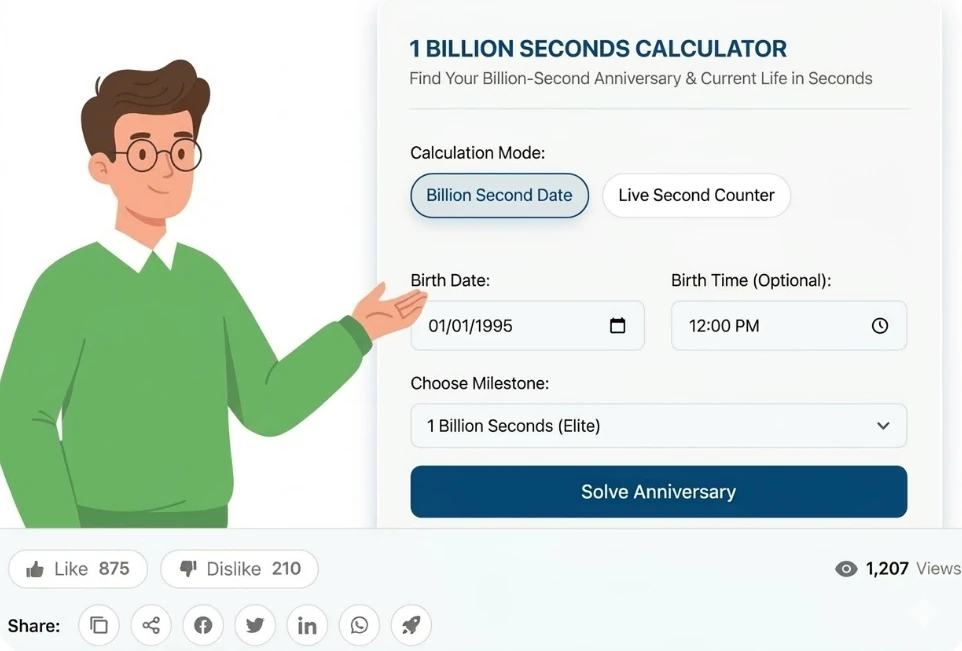
A professional introduction graphic for the 1 Billion Seconds Calculator featuring a mascot in a green sweater. The interface shows options for Billion Second Date and Live Second Counter, with fields for birth date and time on a clean white background.

What You Should Do Next

Use your exact birth date and time for the most accurate result.
Check other milestones like 100 million or 2 billion seconds.
Compare your progress to understand how far along you are.
Use the live counter to track your age in seconds over time.

Quick example you can test

Birth date: July 4, 2000
Birth time: 06:00 AM
Milestone: 1 Billion Seconds

Result: March 12, 2032 at around 7:46 AM

This shows the exact date you turn 1 billion seconds old. It also confirms that the milestone happens at about 31.7 years.

How to use the 1 billion seconds calculator

Finding your milestone date or total seconds lived takes only a few seconds. Follow these steps to get an exact or estimated result based on your input.

Enter your birth date or age

Start by adding your full birth date. This gives the most accurate result. If you do not know the exact date, enter your current age instead. The calculator will estimate your timeline using your birth year.

Add your birth time for better accuracy

Include your birth time if you want a precise result. Even a few hours can shift your milestone date. If you skip this step, the tool uses a default time and still gives a close estimate.

Choose your milestone

Select the milestone you want to track. You can pick from 100 million, 500 million, 1 billion, or 2 billion seconds. Each option shows a different point on your life timeline.

Click “Solve Anniversary”

Press the button to run the calculation. The tool converts your input into total seconds and adds the selected milestone. It then compares your result with the current date.

View your result and progress

Your result shows the exact date you reach the milestone. It also shows your age, total seconds lived, and your progress percentage. If you use live mode, the counter updates every second.

Quick example to test

  • Birth date: August 20, 1998
  • Birth time: 10:15 AM
  • Milestone: 1 Billion Seconds
  • Result: April 28, 2030 at around 11:01 AM

This shows the exact moment you turn 1 billion seconds old and confirms how the calculator uses both date and time to find your milestone.

How the 1 Billion Seconds Calculator Formula Works (Complete Breakdown)

The 1 billion seconds calculator uses a simple time-addition formula to find your exact milestone date or total seconds lived. It converts your life into seconds and maps it against milestones like 100 million or 1 billion seconds. This keeps results clear and easy to verify.

Formula

				
					Time Milestone Date = Birth Date + (Milestone Seconds)

Age at Milestone = Total Seconds ÷ 31,536,000

Seconds Lived = Current Time − Birth Date


How the formula works

The formula adds a fixed number of seconds to your birth date to find your milestone. It also tracks how many seconds have already passed. Then it converts seconds into years to show your age at that moment. This is how the tool answers how long is 1 billion seconds in real terms.

Key variables used in the calculation

Birth Date

This is your starting point. The calculator uses your full date to measure time passed and to find your exact milestone date.

Birth Time

This adds precision. Even small differences in hours can shift your milestone result slightly.

Milestone Seconds

This is the target value. You can select 100 million, 500 million, 1 billion, or 2 billion seconds based on what you want to track.

Current Time

This is the live system time. It helps calculate how many seconds you have already lived right now.

Seconds Lived

This shows your total time lived in seconds. It updates continuously in live mode and helps track your progress toward milestones.

Another example calculation (step by step)

Let’s test a different case to see how the formula works in real use.

Given:

  • Birth date: February 14, 1992
  • Birth time: 08:00 AM
  • Milestone: 1 Billion Seconds

Calculation:

				
					Birth date + 1,000,000,000 seconds = milestone date

Age = 1,000,000,000 ÷ 31,536,000 ≈ 31.7 years


Result:

  • Milestone date: October 23, 2023
  • Age at milestone: about 31.7 years

Meaning:

This shows the exact moment the person reached 1 billion seconds. It also confirms that the milestone happens around 31.7 years, which helps explain 1 billion seconds in years and days in a simple way.

What your 1 billion seconds result range means

Your result is not just a date. It places you on a clear life timeline based on seconds lived. Each milestone shows how long a certain number of seconds actually feels in real life. This helps answer questions like how long is 1 billion seconds and how it compares to smaller values.

Seconds Milestone Benchmarks
SecondsCategoryYearsDaysMeaning
1 MillionShort-Term~0.03 years~11.5 daysVery short period. Easy to understand and compare.
100 MillionEarly Milestone~3.17 years~1,157 daysMarks early life progress. Often used for comparison.
500 MillionMid Milestone~15.8 years~5,787 daysRepresents mid-teen range. Shows how fast time grows.
1 BillionLife Milestone~31.7 years~11,574 daysMajor life point. Answers how long is 1 billion seconds.
2 BillionRare Milestone~63.4 years~23,148 daysLong-term milestone. Reached later in life.

Quick insight: 1 million seconds feels small at just days. 1 billion seconds stretches over decades. This gap shows why people search for 1 million vs 1 billion seconds and why the difference feels so surprising.

How to read your result using this table

Use this table to compare your current position with each milestone. If your result is below 1 billion seconds, you are still building toward that point. If you already passed it, your focus shifts to larger milestones like 2 billion seconds.
This breakdown makes it easier to understand your progress without doing manual conversions.

Tips and planning based on your 1 billion seconds result

Your 1 billion seconds calculator result is more than a date. It gives you a clear point on your life timeline. You can use it to track progress, plan ahead, and understand how time adds up from 1 million to 2 billion seconds.

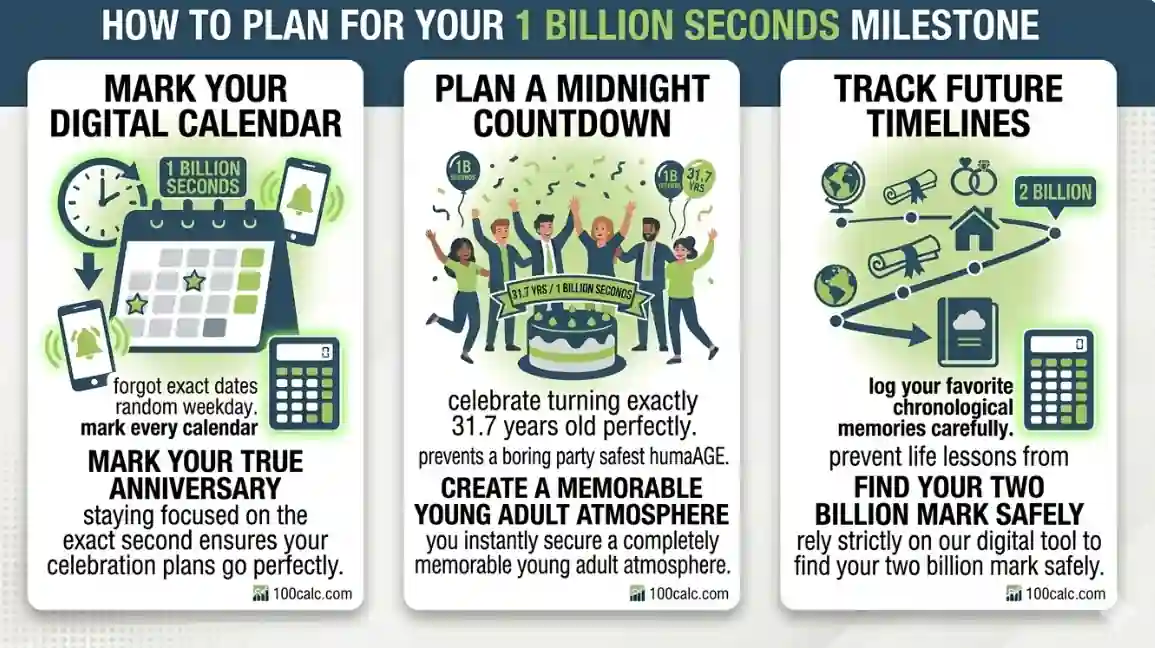
An infographic guide from 100calc.com for planning a 1 Billion Seconds milestone, showing three steps: marking a digital calendar, planning a midnight countdown at 31.7 years old, and tracking future life events.

Use your milestone date as a life checkpoint

Your billion-second date is a rare moment. It happens once and reflects about 31.7 years of life. Treat it as a checkpoint.

Look at where you are right now. Think about your goals, career, or personal plans. Some people mark this day with a small celebration or a personal reset. It gives meaning to how long 1 billion seconds really is.

Track your progress in real time

Your result also shows how far you have come. The progress percentage helps you see how close you are to your next milestone.

Keep checking your live seconds. It updates every second and gives you a clear view of your timeline. This makes it easier to understand your age in seconds instead of years.

Compare milestones to understand time scale

Numbers like 1 million or 1 billion seconds can feel confusing. Seeing them side by side makes it clear.

1 million seconds is only about 11.5 days. 1 billion seconds stretches over decades. This comparison helps you understand why people search how long is 1 billion seconds and why the gap feels so large.

1 Million vs 1 Billion Seconds Explained

Most people think a billion is just a bigger number. In reality, the difference is massive. This section helps you understand how long 1 billion seconds really is by comparing it with smaller and larger time values you can relate to.

How big is the jump from 1 million to 1 billion seconds?

The jump is far bigger than most expect.
1 million seconds is only about 11.5 days. That feels short and easy to imagine.

Now compare that with 1 billion seconds. It stretches to about 31.7 years. That is decades, not days.

This is why people often search 1 million vs 1 billion seconds. The numbers look close, but the real-world difference is huge.

1 Billion vs 1 Trillion Seconds

A trillion sounds like a natural next step. The difference is much bigger than expected.

1 billion seconds is about 31.7 years.
1 trillion seconds reaches over 31,000 years.

This shows how quickly numbers scale. Moving from billion to trillion shifts from human life to thousands of years.

That comparison helps put your 1 billion seconds calculator result into perspective.

How long is 1 billion seconds in real life?

1 billion seconds equals about 31.7 years. That is roughly 31 years and 8 months.

In days, it comes out to about 11,574 days. This is why the milestone feels so significant. It represents a large part of a person’s life, not just a simple number.

Seeing this in years and days helps answer common questions like how long is 1 billion seconds and makes the result easier to understand.

Quick time scale comparison

Time Scale Comparison
SecondsCategoryExampleTime SpanNotes
1 MillionShort-Term11.5 daysLess than 2 weeksEasy to understand. Feels like a short event.
100 MillionEarly Milestone3.17 yearsEarly childhood rangeShows how quickly seconds start to add up.
1 BillionLife Milestone31.7 yearsEarly adulthoodAnswers how long is 1 billion seconds in real life.
2 BillionLong-Term63.4 yearsLater life stageMajor milestone reached over decades.
1 TrillionExtreme Scale31,688 yearsBeyond human lifespanShows the massive jump from billion to trillion.

Quick insight: 1 million seconds feels small at just days, while 1 billion seconds spans decades. This comparison helps you understand how time scales in real life.

You Might Also Find These Helpful

Birthday 12

Emerald Jubilee Calculator

Use our free Emerald Jubilee Calculator to find the exact date you turn 55. Discover the meaning of this green-themed milestone today.

Try calculator
Golden Birthday Calculator

Use our free Golden Birthday Calculator to find your special, once-in-a-lifetime date. Discover your Golden Age and get tips for a gold-themed party.

Try calculator
Leap Year Age Calculator

Use our Leap Year Age Calculator to find your exact age, real leap birthdays, and whether Feb 28 or March 1 counts on common…

Try calculator
Platinum Birthday Calculator

Use our Platinum Birthday Calculator to find your reversed-age milestone date, platinum birthday age, and whether it already passed or is still ahead.

Try calculator
Silver Birthday Calculator

Turning 25? Use the Silver Birthday Calculator to track your quarter-century milestone. Get the exact countdown in days, hours, and minutes for your big…

Try calculator
Twin Flame Calculator

You can use our free twin flame calculator to test your mirror soul compatibility. First, enter your birth dates. Next, discover your spiritual connection.

Try calculator

Common mistakes to avoid when using your result

Small errors can change your final result. These mistakes often lead to wrong milestone dates or confusing outputs. Avoid them so your 1 billion seconds calculator result stays accurate and easy to trust.

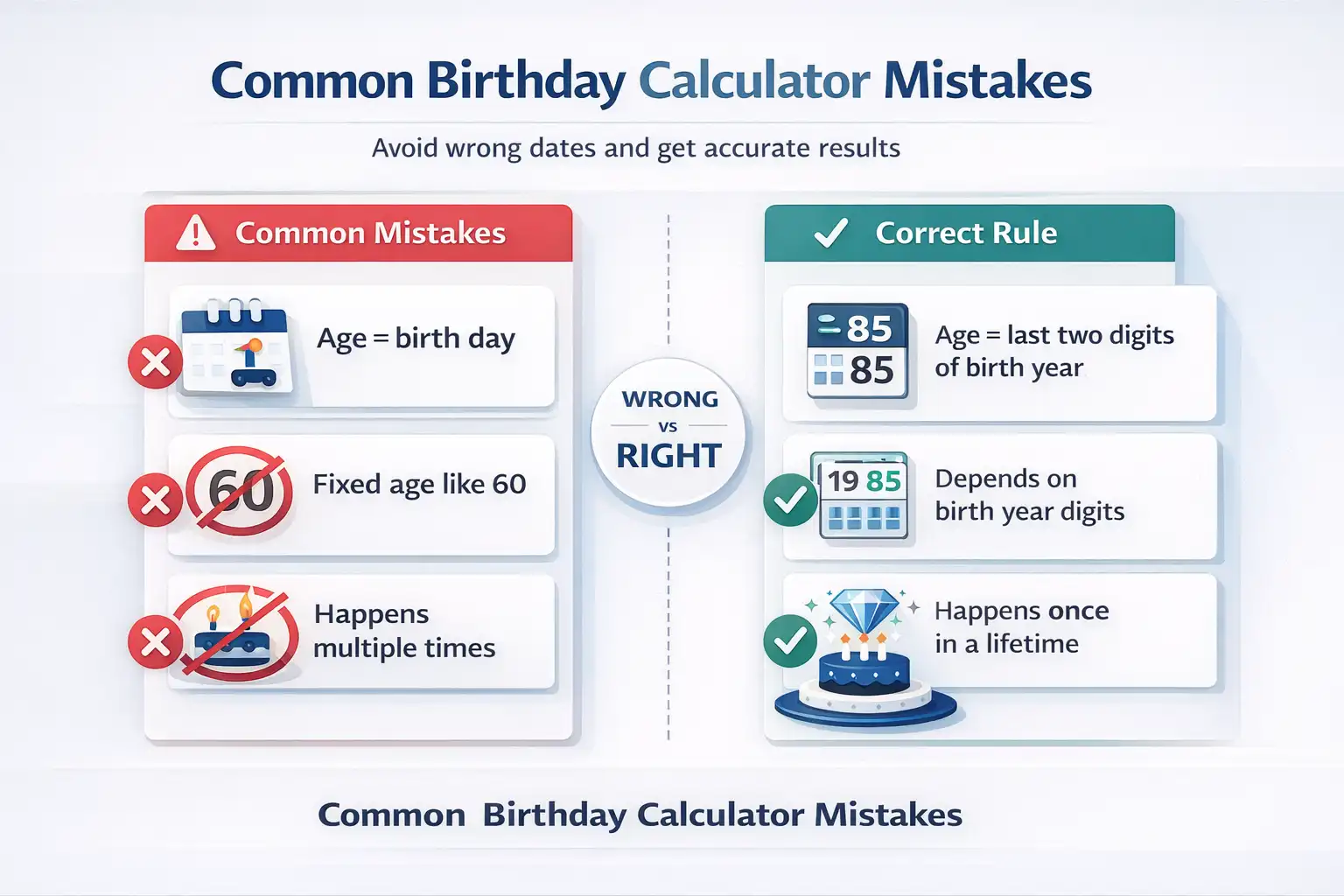
Common birthday calculator mistakes infographic showing wrong vs correct diamond birthday calculation rules

Frequently Asked Questions (FAQs)

1 billion seconds is about 31.7 years. That equals roughly 31 years and 8 months in real life. This helps explain why it is seen as a major life milestone. It converts a large number into a time span you can easily understand and relate to.

This is why many people use a 1 billion seconds calculator to find their exact milestone date instead of guessing.

1 billion seconds is about 11,574 days. This number shows how long that time span really is when broken down into daily life. It helps users compare seconds with something more familiar like days and weeks.

Seeing it in days also makes it easier to understand how long it takes to reach this milestone.

The exact date depends on your birth date and time. A calculator adds 1,000,000,000 seconds to your starting point to find the result. This gives you your precise milestone moment.

Using a 1 billion seconds birthday calculator helps you avoid manual errors and gives a clear answer instantly.

One billion seconds equals 1,000,000,000 seconds. This number is often hard to imagine, which is why people convert it into years or days. Breaking it down helps make sense of its real-world length.

1 million seconds is about 11.5 days, while 1 billion seconds is about 31.7 years. The difference is not just bigger. It is thousands of times larger in real life.

This comparison helps people understand scale and why a billion seconds feels like a lifetime instead of a short period.

2 billion seconds is about 63.4 years. This is almost double the 1 billion seconds milestone and usually falls later in life. It shows how time continues to scale as numbers increase.

Many users track this next milestone after reaching their 1 billion seconds point.

Yes, you can calculate it without your birth time, but the result will be less precise. The calculator uses a default time if none is provided. This gives a close estimate but not an exact moment.

For the most accurate result, adding your birth time is always better.

A 1 billion seconds birthday is the exact moment your life reaches one billion seconds. It is based on total time lived instead of calendar years. This milestone usually happens around age 31.7 years.
Many people use this date as a fun checkpoint to reflect on their life timeline.

Questions?

We had love to hear from you! Whether you are reporting an issue, suggesting a new calculator, or exploring collaboration opportunities — we are here to help. Every message helps us make 100calc smarter, faster, and more helpful for everyone.

Why People Trust 100calc

At 100calc.com, we focus on accuracy, speed, and trust. Every calculator we create is designed to give reliable, instant, and easy-to-understand results you can truly depend on.