
Live Gold Price Today by Country, Karat & Unit
Check the live gold price today by country, currency, weight, and gold purity. Gold is commonly quoted in U.S. dollars per troy ounce in the international market, but you can use 100Calc to see the current rate per gram, 10 grams, tola, troy ounce, or kilogram in your selected currency.
Today’s international 24K gold spot-equivalent is USD 4,164.76 per 1 oz (current verified rate) Verified Oct 16, 2026, 4:43 pm.
International 24K gold price per gram: USD 133.90 per 1g (current verified rate)
Choose a country below, then select the gold weight and karat you want to check. You can compare 24K, 22K, 21K, 18K, 14K, and other gold purities using the latest available market data.
A gold price shown in PKR, INR, AED, GBP, EUR, or another currency is not automatically the price you will pay at a local jewelry shop. It may be the international gold price converted into that currency.
When a separate verified local-market reference is available, 100Calc identifies it separately. Jewelry stores, bullion dealers, and gold buyers may quote different prices because of dealer premiums, making charges, taxes, fees, or buy-and-sell spreads.
Check Live Gold Price Today by Country, Weight & Karat
Use the live gold price tool below to check today’s gold rate by country, currency, weight, and purity. Start with the international spot gold benchmark, commonly quoted in U.S. dollars per troy ounce, then switch between gold price per gram, 10 grams, tola, troy ounce, 100 grams, or kilogram and compare 24K, 22K, 21K, 18K, 14K, and other gold karats.
For supported markets, 100Calc identifies a verified local-market reference separately from an international spot-equivalent rate, so you can see what type of gold price you are viewing before comparing it with jewelry, bullion, or buyback prices.
These rates are based on international spot gold prices converted to your selected currency. Retail jewellery prices may include making charges, shop margins, and taxes.
What Is the Gold Price Today in Different Countries?
The international gold benchmark is commonly quoted in U.S. dollars, but you can compare the same gold value in different currencies. The table below converts the current international gold price into each country’s currency and shows 24K and 22K gold per gram using the same market benchmark, weight, and purity.
These are international spot-equivalent rates, not automatically official local gold-market or jewelry prices. A separate local gold rate can differ because of domestic market conditions, premiums, taxes, duties, making charges, dealer spreads, or other transaction costs.
| Country | Currency | 24K Gold Per Gram | 22K Gold Per Gram | Price Type |
|---|---|---|---|---|
| United States | USD | USD 133.90 per 1g (current verified rate) | USD 122.75 per 1g (current verified rate) | International spot-equivalent |
| Pakistan | PKR | PKR 37,086.60 per 1g (current verified rate) | PKR 33,997.29 per 1g (current verified rate) | International spot-equivalent |
| India | INR | INR 12,733.43 per 1g (current verified rate) | INR 11,672.74 per 1g (current verified rate) | International spot-equivalent |
| United Arab Emirates | AED | AED 491.73 per 1g (current verified rate) | AED 450.77 per 1g (current verified rate) | International spot-equivalent |
| Saudi Arabia | SAR | SAR 502.11 per 1g (current verified rate) | SAR 460.28 per 1g (current verified rate) | International spot-equivalent |
| Qatar | QAR | QAR 487.38 per 1g (current verified rate) | QAR 446.78 per 1g (current verified rate) | International spot-equivalent |
| Kuwait | KWD | KWD 41.57 per 1g (current verified rate) | KWD 38.11 per 1g (current verified rate) | International spot-equivalent |
| Oman | OMR | OMR 51.48 per 1g (current verified rate) | OMR 47.19 per 1g (current verified rate) | International spot-equivalent |
| Bahrain | BHD | BHD 50.34 per 1g (current verified rate) | BHD 46.15 per 1g (current verified rate) | International spot-equivalent |
| Jordan | JOD | JOD 94.93 per 1g (current verified rate) | JOD 87.02 per 1g (current verified rate) | International spot-equivalent |
| Egypt | EGP | EGP 7,158.63 per 1g (current verified rate) | EGP 6,562.32 per 1g (current verified rate) | International spot-equivalent |
| Turkey | TRY | TRY 6,625.17 per 1g (current verified rate) | TRY 6,073.29 per 1g (current verified rate) | International spot-equivalent |
| Bangladesh | BDT | BDT 16,487.29 per 1g (current verified rate) | BDT 15,113.90 per 1g (current verified rate) | International spot-equivalent |
| Sri Lanka | LKR | LKR 44,316.59 per 1g (current verified rate) | LKR 40,625.02 per 1g (current verified rate) | International spot-equivalent |
| Nepal | NPR | NPR 20,372.99 per 1g (current verified rate) | NPR 18,675.92 per 1g (current verified rate) | International spot-equivalent |
| Canada | CAD | CAD 190.02 per 1g (current verified rate) | CAD 174.19 per 1g (current verified rate) | International spot-equivalent |
| Brazil | BRL | BRL 676.77 per 1g (current verified rate) | BRL 620.40 per 1g (current verified rate) | International spot-equivalent |
| Mexico | MXN | MXN 2,471.33 per 1g (current verified rate) | MXN 2,265.47 per 1g (current verified rate) | International spot-equivalent |
| Argentina | ARS | ARS 202,707.77 per 1g (current verified rate) | ARS 185,822.21 per 1g (current verified rate) | International spot-equivalent |
| United Kingdom | GBP | GBP 100.96 per 1g (current verified rate) | GBP 92.55 per 1g (current verified rate) | International spot-equivalent |
| Eurozone | EUR | EUR 119.39 per 1g (current verified rate) | EUR 109.44 per 1g (current verified rate) | International spot-equivalent |
| Switzerland | CHF | CHF 110.90 per 1g (current verified rate) | CHF 101.66 per 1g (current verified rate) | International spot-equivalent |
| Sweden | SEK | SEK 1,333.58 per 1g (current verified rate) | SEK 1,222.49 per 1g (current verified rate) | International spot-equivalent |
| Norway | NOK | NOK 1,269.70 per 1g (current verified rate) | NOK 1,163.93 per 1g (current verified rate) | International spot-equivalent |
| Russia | RUB | RUB 11,230.28 per 1g (current verified rate) | RUB 10,294.80 per 1g (current verified rate) | International spot-equivalent |
| Ukraine | UAH | UAH 6,015.96 per 1g (current verified rate) | UAH 5,514.83 per 1g (current verified rate) | International spot-equivalent |
| China | CNY | CNY 897.50 per 1g (current verified rate) | CNY 822.74 per 1g (current verified rate) | International spot-equivalent |
| Japan | JPY | JPY 21,167.05 per 1g (current verified rate) | JPY 19,403.83 per 1g (current verified rate) | International spot-equivalent |
| South Korea | KRW | KRW 179,786.32 per 1g (current verified rate) | KRW 164,810.12 per 1g (current verified rate) | International spot-equivalent |
| Australia | AUD | AUD 193.61 per 1g (current verified rate) | AUD 177.48 per 1g (current verified rate) | International spot-equivalent |
| Singapore | SGD | SGD 171.70 per 1g (current verified rate) | SGD 157.40 per 1g (current verified rate) | International spot-equivalent |
| Malaysia | MYR | MYR 546.63 per 1g (current verified rate) | MYR 501.10 per 1g (current verified rate) | International spot-equivalent |
| Thailand | THB | THB 4,488.98 per 1g (current verified rate) | THB 4,115.05 per 1g (current verified rate) | International spot-equivalent |
| Indonesia | IDR | IDR 2,403,293.49 per 1g (current verified rate) | IDR 2,203,099.14 per 1g (current verified rate) | International spot-equivalent |
| Philippines | PHP | PHP 8,446.67 per 1g (current verified rate) | PHP 7,743.06 per 1g (current verified rate) | International spot-equivalent |
| Vietnam | VND | VND 3,462,054.51 per 1g (current verified rate) | VND 3,173,665.37 per 1g (current verified rate) | International spot-equivalent |
| South Africa | ZAR | ZAR 2,212.42 per 1g (current verified rate) | ZAR 2,028.13 per 1g (current verified rate) | International spot-equivalent |
| Nigeria | NGN | NGN 178,239.64 per 1g (current verified rate) | NGN 163,392.28 per 1g (current verified rate) | International spot-equivalent |
| Kenya | KES | KES 17,373.07 per 1g (current verified rate) | KES 15,925.89 per 1g (current verified rate) | International spot-equivalent |
| Tanzania | TZS | TZS 352,521.38 per 1g (current verified rate) | TZS 323,156.35 per 1g (current verified rate) | International spot-equivalent |
Price basis: Every row uses the same international gold benchmark, converted into the listed currency for 1 gram of 24K or 22K gold. These values do not rank countries by the price of physical gold and are not guaranteed local jewelry, bullion, or dealer prices.
Is Gold the Same Price in Every Country?
No. Gold follows international market benchmarks, but the price you see or pay can differ from one country to another. Currency exchange rates change the price shown in local money, while regional supply and demand, import duties, taxes, dealer premiums, and other costs can move a local gold rate above or below the international price.
International gold is commonly quoted in U.S. dollars per troy ounce. If you simply convert that benchmark into PKR, INR, AED, GBP, EUR, or another currency, you get a spot-equivalent gold price in that currency. This is the type of country comparison shown in the table above.
A converted international price is not automatically the actual gold market price inside that country.
Why Can Gold Cost More or Less in Another Country?
A local gold market can trade at a premium or discount to the international gold price.
A premium means the local market price is higher than the comparable international benchmark. A discount means it is lower. Local supply and demand can cause this difference, along with import rules, taxes, currency conditions, and the amount of gold available in that market.
This is why the gold rate in India, Pakistan, China, Dubai, the United Kingdom, or another market may not exactly match a simple currency conversion of the international spot price.
The difference can become even larger when you move from a market reference to the price charged by a jewelry shop or bullion dealer. A final retail quote may include GST or VAT, import duty, making charges, dealer premiums, margins, and buy-and-sell spreads.
How Should You Compare Gold Prices Between Countries?
Compare the same weight, purity, currency basis, price type, and update time.
For example, compare:
- 24K with 24K, not 24K with 22K.
- 1 gram with 1 gram, not 1 gram with 1 tola.
- International spot-equivalent with international spot-equivalent.
- Local-market reference with another comparable local-market reference.
The key point: Gold has international benchmark prices, but there is no guarantee that a buyer in every country will pay exactly the same final price for the same amount of gold.
What Does the Gold Price You See Actually Mean?
The gold price you see can represent different things depending on its source and purpose. It may be the current spot price, the LBMA Gold Price benchmark, an international price converted into your currency, a local-market reference, the melt value of an item, a retail price, or a dealer’s buyback offer.
These prices are related, but they are not interchangeable. Before comparing two gold prices, check the price type, currency, weight unit, purity, source, and update time.
What Is the Gold Spot Price?
The gold spot price is the current market reference for gold available for immediate delivery. It is commonly quoted in U.S. dollars per troy ounce and serves as a starting point for valuing physical gold.
Spot price tells you the market value of gold itself. It does not automatically include a bullion premium, jewelry making charge, tax, dealer margin, shipping cost, or buyback discount.
Is the LBMA Gold Price the Same as the Spot Price?
No. The LBMA Gold Price and the live gold spot price are related, but they are not the same price measure.
The LBMA Gold Price is an internationally recognized benchmark set through an auction twice each London business day. The gold spot price can change throughout the trading day as market conditions change.
This distinction matters because a website may show a live market spot reference while a contract, institution, mint, or other market participant may use the LBMA Gold Price as its pricing benchmark.
| Price Type | What It Means | What to Remember |
|---|---|---|
| Gold spot price | Current market reference | The spot price is the current cash-market reference for gold available for immediate delivery, commonly quoted in U.S. dollars per troy ounce. It is a base market value, not a finished jewelry or bullion retail price. |
| LBMA Gold Price | International benchmark | The LBMA Gold Price is an internationally recognized benchmark set through an auction twice each London business day. It should not be treated as identical to a live spot price that can change throughout the trading day. |
| Spot-equivalent currency value | Converted international price | An exchange rate converts the international gold price into PKR, INR, AED, GBP, EUR, or another currency. Currency conversion alone does not make the result a verified local-market gold rate. |
| Verified local-market reference | Separate regional or domestic rate | A supported domestic, exchange, official, or bullion-market source provides this separate reference. Local supply, demand, duties, taxes, currency conditions, and premiums can move it above or below the international price. |
| Gold melt value | Contained gold value | Melt value estimates the value of the pure gold contained in an item using its eligible gold weight, purity, and current market price. It does not include design, brand, gemstones, craftsmanship, or a guaranteed buyer offer. |
| Retail / dealer ask price | Price you pay | This is the price charged to the buyer. It may include a bullion premium, fabrication or making charges, product demand, dealer margin, taxes, shipping, or other costs above the underlying gold value. |
| Buyback / dealer bid price | Price offered to you | This is what a dealer or gold buyer offers when purchasing your gold. Compare the offer with melt value and check any spread, refining charge, assay cost, fee, or other deduction before judging the quote. |
Key point: There is no single gold number that represents every transaction. First identify whether you are looking at spot, the LBMA benchmark, a converted international rate, a local-market reference, melt value, a retail price, or a buyback offer. Only compare prices that measure the same thing.
Why Is a Jewelry or Bullion Price Different From Spot?
A physical gold product can cost more than its underlying gold value because the final selling price may include a premium.
For bullion, that premium can cover minting or fabrication, distribution, insurance, dealer costs, product demand, and margin. Jewelry prices can also include design, craftsmanship, making charges, brand value, gemstones, taxes, and retailer margins.
The reverse can happen when you sell gold. A buyback price is the amount a specific dealer or gold buyer is willing to pay. It is not automatically equal to the spot price or the original retail price.
For this reason, compare a selling offer with the item’s melt value first, then check any stated dealer spread, refining charge, assay cost, fee, or deduction.
Melt value measures only the value of the gold contained in an item based on its weight, purity, and current gold-market reference. It does not include craftsmanship, brand value, gemstones, collector value, or a guaranteed dealer payout.
How Much Is Gold by Weight? Gram, 10g, Tola, Troy Ounce & Kilogram
Gold price by weight is calculated from the same underlying gold rate when the currency, purity, and price type stay the same. If 1 gram has a market value of X, then 10 grams uses 10 × X, 1 tola uses 11.6638 × X, 1 troy ounce uses 31.1034768 × X, and 1 kilogram uses 1,000 × X.
Changing the weight unit does not change the underlying gold benchmark. It changes the amount of gold covered by the quote.
This is why a gold price per gram, 10 grams, tola, troy ounce, 100 grams, 500 grams, or kilogram can all be converted from the same base rate.
Physical gold products can still have different prices per gram. A 1g bar, 10g bar, 1 oz coin, and 1kg bar may carry different fabrication costs, dealer premiums, shipping costs, or product premiums even when they contain gold valued from the same market benchmark.
Changing the unit does not make the gold more or less expensive by itself. It only changes how much gold the quoted price covers. That is why a 10 gram gold price is higher than a gold price per gram, while a price per kilogram is much higher again.
Gold Weight Conversion Table
| Gold Weight Unit | Weight in Grams | Today's International 24K Price | What It Means |
|---|---|---|---|
| 1 gram (g) | 1 g | USD 133.90 per 1g (current verified rate) | The base metric unit commonly used for gold price per gram and small gold weights. |
| 8 grams (8g) | 8 g | USD 1,071.20 per 8g (current verified rate) | Eight grams of gold. This weight is used for some coins, jewelry, and regional gold products. |
| 10 grams (10g) | 10 g | USD 1,339.00 per 10g (current verified rate) | A common metric gold weight. Its underlying gold value is 10 times the equivalent price per gram. |
| 1 tola | 11.6638 g | USD 1,561.78 per 1 tola (current verified rate) | A traditional gold weight widely used in South Asian gold markets, including Pakistan and India. |
| 1 troy ounce (ozt) | 31.1034768 g | USD 4,164.76 per 1 oz (current verified rate) | The standard troy ounce used in international precious-metal markets and gold-price quotations. |
| 100 grams (100g) | 100 g | USD 13,390.00 per 100g (current verified rate) | A common larger metric weight used for gold bars and bullion comparisons. |
| 500 grams (500g) | 500 g | USD 66,950.00 per 500g (current verified rate) | Half a kilogram of gold, equal to about 16.0754 troy ounces. |
| 1 kilogram (kg) | 1,000 g | USD 133,900.00 per 1kg (current verified rate) | One thousand grams of gold, equal to about 32.1507 troy ounces. |
Key point: The price column shows today's international spot-equivalent value in U.S. dollars for 24K gold at each weight. Weight changes how much gold the quote covers, not the underlying market benchmark. Retail bullion or jewelry prices may differ because of premiums, taxes, fees, or dealer spreads.
How Do You Convert Gold Price Between Weight Units?
For the same currency, purity, and price type, start with the gold price per gram.
Gold price for a weight = gold price per gram × weight in grams
For example:
10g gold price = price per gram × 10
1 tola gold price = price per gram × 11.6638
1 troy ounce gold price = price per gram × 31.1034768
100g gold price = price per gram × 100
1 kilogram gold price = price per gram × 1,000
If you start with an international gold price per troy ounce, divide that price by 31.1034768 to calculate the equivalent price per gram before converting to another weight.
These conversions compare the underlying gold value only. Keep the currency, karat or fineness, price source, and price type the same when comparing two values.
Is 1 Ounce of Gold 28.35g or 31.1035g?
One ounce of gold in precious-metal pricing means one troy ounce, which equals exactly 31.1034768 grams. It does not mean the regular avoirdupois ounce of about 28.3495 grams used for many everyday goods.
Using 28.35 grams to convert an international gold price per ounce will produce the wrong gold price per gram.
For example, when a gold market shows a price such as “gold per ounce” or “XAU/USD per oz,” the ounce normally means a troy ounce (ozt).
Key point: Use 31.1034768 grams per troy ounce when converting international gold prices. Use 11.6638 grams for one standard tola and 1,000 grams for one kilogram.
What Is the Difference Between 24K, 22K, 18K and 14K Gold?
The difference between 24K, 22K, 18K and 14K gold is the amount of pure gold each contains. Karat measures gold purity on a 24-part scale. The higher the karat, the greater the share of pure gold in the metal.
24K gold is nearly pure gold. 22K contains about 91.67% gold, 18K contains 75%, and 14K contains about 58.33% by the mathematical karat ratio. The remaining material in lower-karat gold is made from other metals in the alloy.
This also affects the underlying gold value. If two pieces have the same weight and use the same currency and gold-market reference, the higher-karat piece contains more pure gold and therefore has a higher underlying metal value.
How Does Karat Measure Gold Purity?
Gold karat uses 24 parts as the full scale.
Gold purity % = Karat ÷ 24 × 100
For example:
22K = 22 ÷ 24 = about 91.67% gold
18K = 18 ÷ 24 = 75% gold
14K = 14 ÷ 24 = about 58.33% gold
Karat measures purity, not weight. A 24K item does not weigh 24 grams, and an 18K item does not weigh 18 grams. Weight is measured separately in grams, tola, troy ounces, kilograms, or another unit.
In some countries, you may also see the word carat used for gold purity. Do not confuse gold karat or carat with a gemstone carat, which is a unit of weight.
What Do 999, 916, 875, 750, 585 and 417 Mean on Gold?
Numbers such as 999, 916, 875, 750, 585 and 417 describe gold purity using fineness, or parts of gold per 1,000 parts of material.
For example, a 750 fineness mark means about 750 parts out of 1,000 are gold, which corresponds to 18K gold. A 916 mark commonly represents 22K gold.
| Gold Karat | Gold Content | Common Fineness | Today's International Price Per Gram | What It Means |
|---|---|---|---|---|
| 24K | About 99.9%+ | 999 / 999.9 | USD 133.90 per 1g (current verified rate) | Nearly pure gold. In practice, refined gold is commonly expressed as 999 or 999.9 fineness rather than literal 1000. |
| 22K | About 91.67% | 916 | USD 122.75 per 1g (current verified rate) | 22 of 24 parts are gold. The remaining 2 parts are other metals in the alloy. |
| 21K | 87.5% | 875 | USD 117.16 per 1g (current verified rate) | 21 of 24 parts are gold, equal to 875 parts of gold per 1,000. |
| 20K | About 83.33% | 833 | USD 111.58 per 1g (current verified rate) | 20 of 24 parts are gold, with the rest made from other metals in the alloy. |
| 18K | 75% | 750 | USD 100.43 per 1g (current verified rate) | 18 of 24 parts are gold, so three quarters of the alloy is pure gold. |
| 14K | About 58.33% by karat ratio | Commonly 585 | USD 78.10 per 1g (current verified rate) | The mathematical 14/24 ratio is about 58.33%, while 585 is a commonly used jewelry fineness standard. |
| 10K | About 41.67% | 417 | USD 55.80 per 1g (current verified rate) | 10 of 24 parts are gold. The remainder consists of other metals in the alloy. |
Key point: The price column shows today's international spot-equivalent value in U.S. dollars for 1 gram of each gold purity. Karat and fineness describe purity, while the live price shows the underlying gold value for that purity. Retail jewelry or dealer prices may include additional premiums, making charges, taxes, fees, or spreads.
One important detail is that the karat fraction and the common fineness stamp do not always look mathematically identical.
For example, 14 ÷ 24 equals about 58.33%, but 14K jewelry is commonly made and marked at 585 fineness, or 58.5% gold. Likewise, 24K is theoretically the full 24 parts, but refined gold is commonly described with fineness such as 999 or 999.9 rather than a literal 1000.
A fineness number tells you the stated gold content. It does not by itself tell you the item’s weight, retail price, craftsmanship, or whether every other hallmark requirement in a particular country has been met.
Does Higher Karat Mean a Higher Gold Price?
For the same weight, currency and gold-market reference, higher-karat gold has a higher underlying gold value because it contains more pure gold.
A simple way to estimate the underlying value of a karat from a fine-gold price is:
Karat gold value ≈ fine-gold value × (karat ÷ 24)
So, before premiums or other costs, 18K contains 75% of the pure-gold content of the same weight, while 22K contains about 91.67%.
This does not mean every finished 22K or 24K item must sell for more than every 18K or 14K item. A retail price can also include craftsmanship, gemstones, brand value, making charges, dealer premiums, taxes, and other costs.
Key point: Karat tells you how much pure gold is in the metal. Weight tells you how much metal you have. You need both values to calculate the underlying gold value correctly.
Why Does the Gold Price Go Up and Down Today?
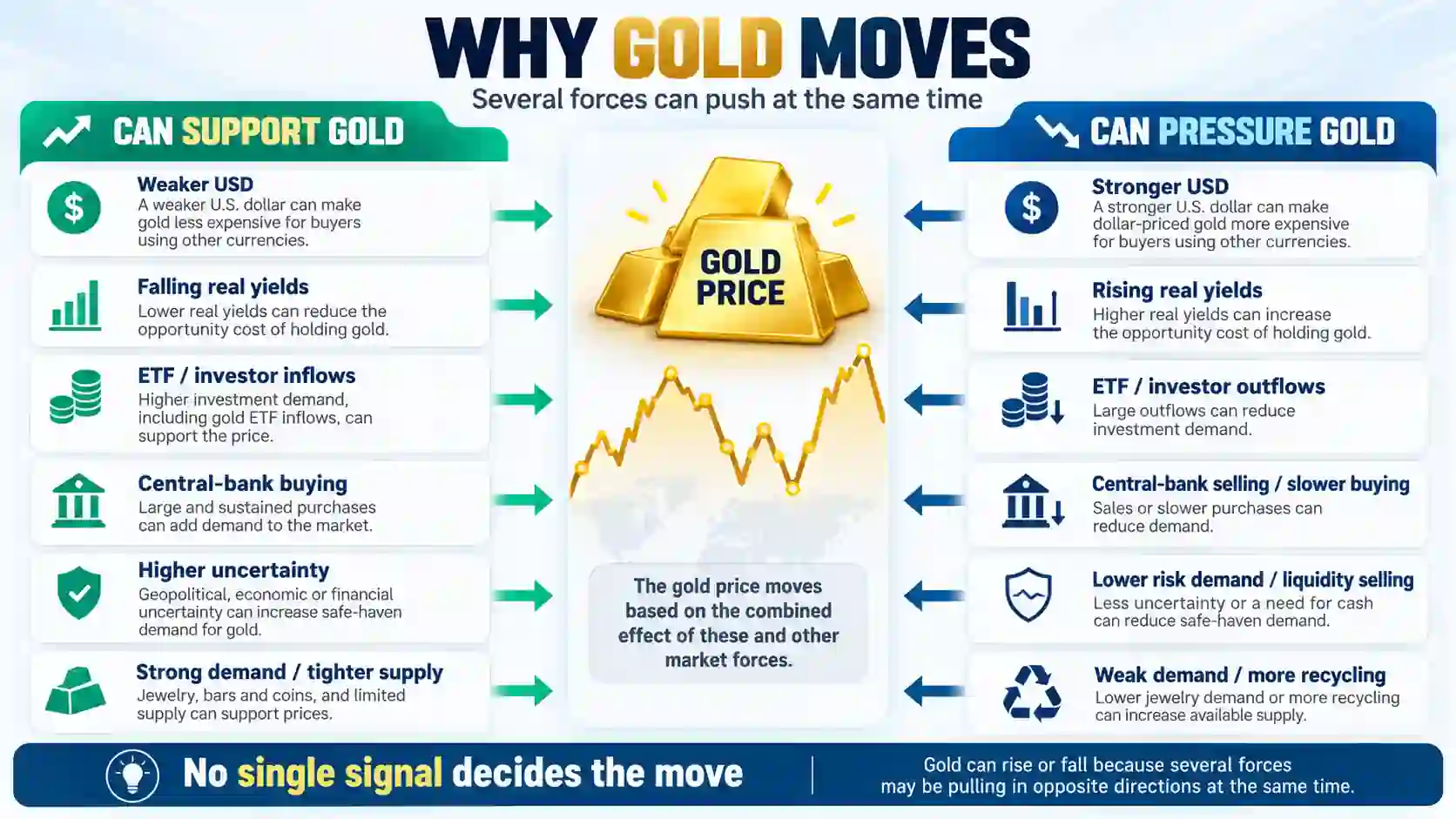
The gold price goes up or down because several market forces affect gold at the same time. The U.S. dollar, real interest rates, expectations for central-bank policy, investor demand, gold ETF flows, central-bank buying, geopolitical risk, and physical supply and demand can all influence the price.
There is no rule that one factor will always move gold in the same direction. A weaker dollar may support gold while rising bond yields work against it. Strong central-bank buying or investment demand may also offset conditions that would normally put pressure on the price.
That is why a gold-price move should be explained by the combination of market drivers active at that time, rather than by one headline alone.
How Does the U.S. Dollar Affect Gold?
Gold is commonly quoted internationally in U.S. dollars per troy ounce, so changes in the dollar can affect both its quoted price and the cost of gold for buyers using other currencies.
A weaker U.S. dollar can make dollar-priced gold less expensive for buyers using other currencies, which may support demand. A stronger dollar can have the opposite effect and may put pressure on the U.S.-dollar gold price.
But gold and the dollar do not always move in opposite directions. Both can attract demand during periods of uncertainty, and other forces such as interest rates, central-bank buying, investment flows, or geopolitical risk can outweigh the currency effect.
For this reason, the U.S. dollar is an important gold-price driver, but it is not a guaranteed signal for what gold will do next.
How Do Interest Rates and Real Yields Affect Gold?
Gold does not pay interest. This makes the return available from interest-bearing assets such as government bonds important when investors compare where to hold money.
Real yields are especially useful because they compare interest rates with inflation. When real yields rise, the opportunity cost of holding non-interest-bearing gold can increase. This can reduce gold’s relative appeal.
When real yields fall, that opportunity cost becomes smaller, which can make gold more attractive.
Markets also react to expectations, not only an interest-rate decision after it happens. Changes in inflation data, economic growth, employment, or central-bank guidance can alter expectations for future rates and move gold before an official policy change occurs.
However, higher rates or real yields do not guarantee that gold will fall. Strong demand from central banks, investors, or other markets can offset the pressure from higher yields.
How Do Investment Demand and Gold ETFs Affect the Price?
Investment flows can have a strong effect on gold, especially over shorter periods.
Gold-backed exchange-traded funds, or gold ETFs, allow investors to gain exposure to gold without buying individual bars or coins. Large inflows can add investment demand, while large outflows can reduce it.
Futures positioning, institutional trading, over-the-counter activity, bars and coins, and other investment flows can also affect demand.
These flows can sometimes reinforce a price move. Rising prices may attract additional buyers, while falling prices or changing market expectations can lead investors to reduce positions.
But ETF flows should not be treated as a standalone price signal. Gold can fall even when ETFs are receiving inflows if other pressures—such as a stronger dollar or sharply higher yields—are stronger at that time.
Do Central Banks Affect Gold Prices?
Yes. Central banks can influence gold demand when they buy or sell gold for their reserves.
Central banks hold gold for reasons that can include reserve diversification, long-term value preservation, and protection against financial or geopolitical uncertainty.
Large and sustained purchases add demand to the global gold market. Sales can have the opposite effect.
Central-bank activity is especially important because reserve decisions can involve large amounts of gold and may continue over long periods instead of reacting only to short-term price movements.
However, central-bank buying does not determine the gold price by itself. It operates alongside investor flows, currencies, interest rates, physical demand, supply, and other market forces.
How Do Wars and Economic Uncertainty Affect Gold?
Gold is often described as a safe-haven asset because investors may increase their demand for it when financial, economic, or geopolitical uncertainty rises.
Wars, banking stress, recession fears, political instability, trade disputes, or concerns about currencies and government debt can increase interest in gold.
But uncertainty does not mean gold must immediately rise.
A crisis can also strengthen the U.S. dollar, raise inflation expectations, push bond yields higher, trigger profit-taking, or force investors to sell liquid assets to raise cash. Those forces can partly or completely offset safe-haven demand.
This is why the simple rule “war means gold goes up” is unreliable. The gold price reflects how investors, currencies, interest rates, liquidity, and demand respond to the event—not just the event itself.
Do Mine Supply, Recycling and Jewelry Demand Affect Gold?
Yes. Physical supply and demand are part of the gold market too.
Newly mined gold adds to supply, while recycled gold returns existing metal to the market. Higher gold prices can encourage more recycling, although the response is not always immediate.
Demand comes from several sources, including jewelry, bars and coins, technology, investors, and central banks.
Jewelry demand can be particularly important in large gold-consuming markets, but high prices can also reduce the amount of gold consumers buy or encourage them to choose lighter-weight products.
Mine production usually changes more slowly than financial-market demand because developing or expanding a gold mine takes time. Investment flows, currencies, yields, and market expectations can therefore move the gold price much faster than mine supply can adjust.
Key point: Gold does not rise or fall because of one indicator. Its price reflects the combined effect of currencies, real yields, monetary-policy expectations, investment flows, central-bank activity, uncertainty, and physical supply and demand.
How Does 100Calc Get and Update Gold Prices?
100Calc starts with the latest available international gold-market reference and then converts that value by weight, purity, and selected currency. Where a supported market has a separate local gold reference, 100Calc identifies it separately instead of presenting a currency conversion as a local-market price.
Each displayed rate also includes price-type and freshness context so you can understand what the number represents before comparing it with another website, bullion dealer, or jewelry shop.
What Gold Price Does 100Calc Use?
The international rate on 100Calc represents an international spot-equivalent gold value.
International gold is commonly quoted in U.S. dollars per troy ounce. 100Calc uses that market reference as the starting point and converts it into the weight and gold purity you select, such as:
- 1 gram of 24K gold
- 10 grams of 22K gold
- 1 tola of 18K gold
- 1 troy ounce of 24K gold
This gives a consistent reference for comparing the same gold value across different currencies, weights, and karats.
It is not automatically a jewelry-shop price, dealer selling price, buyback offer, or separate domestic gold-market rate.
How Does 100Calc Convert Gold Prices Into Other Currencies?
When you select PKR, INR, AED, GBP, EUR, or another supported currency, 100Calc converts the international gold value using the latest available foreign-exchange rate used by the price system.
The basic relationship is:
Gold price in selected currency = international gold value × currency exchange rate
The same weight and purity must be used when comparing two currencies.
For example, converting the international 24K gold price per gram from U.S. dollars into Pakistani rupees gives a PKR spot-equivalent value. It does not automatically turn that number into the gold rate quoted by a Pakistani jeweler or bullion market.
What Is a Verified Local-Market Reference?
A verified local-market reference is different from a currency-converted international price.
For supported markets, 100Calc may show a separate reference from a recognized domestic market, exchange, institution, or bullion-market source when a usable recent rate is available.
100Calc keeps these two price types separate:
International spot-equivalent — the international gold value converted into the selected currency.
Verified local-market reference — a separate rate published for that domestic or regional market.
The local reference may be above or below the converted international value because local supply and demand, taxes, duties, premiums, and other market conditions can affect domestic pricing.
If a supported local reference is not sufficiently current or available, 100Calc does not treat the converted international price as if it were a verified local rate.
How Fresh Is the Gold Price on 100Calc?
100Calc checks for updated gold-market data throughout the day and uses the latest available rate that meets the page’s freshness requirements.
The timestamp and status shown with a rate help explain its freshness:
Current means the latest available rate is within the expected freshness window.
Last verified means a newer usable update is not currently available, so the most recent verified value is shown with its previous update time.
Unavailable means 100Calc does not have a sufficiently recent usable value to display for that price type.
A price does not become newer simply because the page is refreshed. If the underlying market or local source has not published a new usable value, the previous verified rate may remain visible until a newer rate becomes available.
Key point: 100Calc separates international spot-equivalent prices from verified local-market references and shows freshness information so you can tell what type of gold price you are viewing and how current it is.
Gold Calculators and Conversion Tools
These gold calculators help you turn the live gold price today into real numbers you can use. Pick a calculator based on weight, purity, or jewelry type. Each tool updates with the latest market rate. As a result, you get fast and accurate results without manual math.
Gold 12
Calculate gold value instantly using live prices. Check melt value, jewelry worth, scrap payouts, purity, weight, and karat with our gold calculator.
Try calculatorCalculate 14K gold chain weight in grams instantly. Enter length and width to estimate solid or hollow chain mass before you buy or sell.
Try calculatorUse our 18K Gold Price Calculator to find true jewelry value instantly. Get live rates per gram, ounce, and total melt value in seconds.
Try calculatorUse our 22K Gold Price Calculator to find jewelry value instantly. Get live rates per gram, total melt value, and scrap estimates in seconds.
Try calculatorUse this Gold Chain Value Calculator to find your jewelry's worth. Check live melt value, scrap payouts, and 14K/18K retail prices instantly.
Try calculatorCalculate melt value and retail price instantly. Our free Gold Jewelry Calculator shows real dealer cash offers for 10K, 14K, & 24K items.
Try calculatorFree Gold Karat Calculator: Convert karat to fineness stamps like 585 & 750. Check purity % and gold weight fast.
Try calculatorCalculate precise scrap worth with the Gold Melt Value Calculator. Supports 24K-10K, refining fees, and live spot prices. Get your net payout result now.
Try calculatorUse the Gold Price Calculator by Weight to find the true value of your jewelry or scrap. Supports grams, tola, ozt, and all purities.…
Try calculatorUse our free Gold Price Per Gram Calculator for live values. Check 14K, 18K, 22K & 24K rates instantly based on real-time spot prices.…
Try calculatorConvert gold weight instantly. Accurate grams, troy ounces (ozt), and tola calculator for jewelry and scrap dealers.
Try calculatorGet an instant cash estimate with our free Scrap Gold Calculator. See real dealer payouts, deduct fees, and value 10K, 14K, or 18K gold…
Try calculatorCheck Live Gold Price Today by Country
Choose a country below to check today’s gold price in its local currency. Each country page shows the international spot-equivalent gold price for common karats and weight units, including 24K, 22K, 18K and 14K gold. When a separate verified local-market reference is available, 100Calc identifies it clearly so you can distinguish it from the converted international price. Countries are grouped by region to help you find the market you need quickly.
Middle East & Turkey
South Asia
The Americas
Europe
East Asia & Pacific
🇨🇳 China
🇯🇵 Japan
🇰🇷 South Korea
🇦🇺 Australia
🇸🇬 Singapore
🇲🇾 Malaysia
🇹🇭 Thailand
🇮🇩 Indonesia
🇵🇭 Philippines
🇻🇳 Vietnam
Africa
Add live gold prices to your website
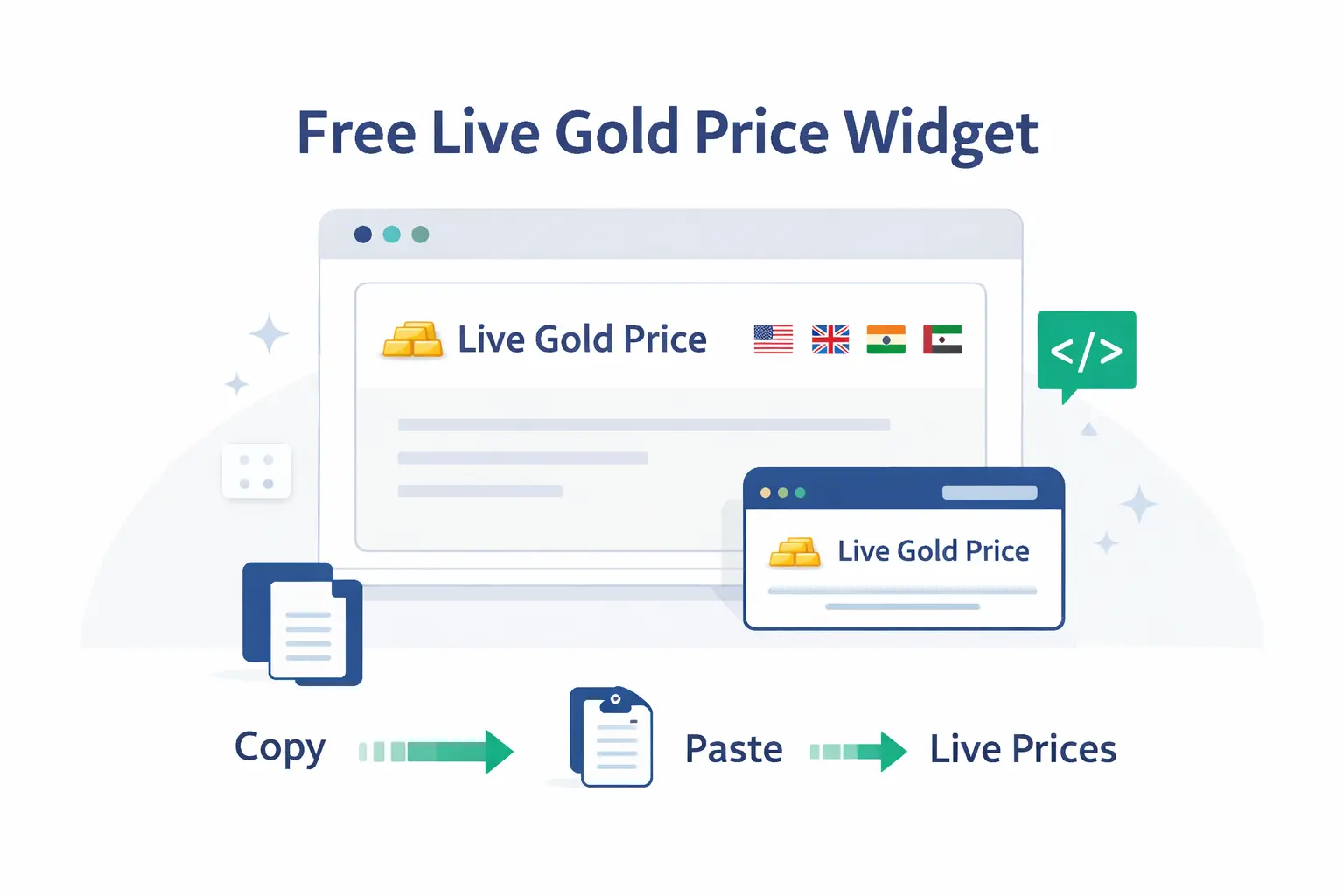
You can also share live gold prices today on your own website. This page uses the same real-time gold price system that updates throughout the day. It works across countries and shows clear price changes without manual updates.
The embeddable gold price tool loads fast and stays accurate. You only add it once. It keeps updating on its own. This makes it ideal for blogs, finance sites, and gold-related pages that need trusted price data.
Why publishers use this gold price tool:
- Shows live gold prices by country
- Updates automatically throughout the day
- Works on any website that supports HTML
- Clean design that fits most layouts
Frequently Asked Questions About Live Gold Prices
What is the international gold price today?
Today’s international 24K gold spot-equivalent is USD 4,164.76 per 1 oz (current verified rate) Verified Oct 16, 2026, 4:43 pm. International gold is commonly quoted in U.S. dollars per troy ounce. This is a market reference for gold itself, not a U.S. jewelry-shop or retail price.
How much is 1 gram of 24K gold today?
One gram of 24K gold currently has an international spot-equivalent value of USD 133.90 per 1g (current verified rate). This represents the underlying international gold value in U.S. dollars before dealer premiums, making charges, taxes, or other retail costs.
How often does the live gold price update?
Gold prices can change frequently while global gold markets are active. 100Calc shows the latest verified market rate available to its price system and displays its verification time. Refreshing the page does not create a newer price by itself. If no newer usable market value is available, the last verified rate may remain until the next valid update.
Why do gold price websites show different prices at the same time?
Two gold websites can show slightly different prices because they may use different market feeds, instruments, bid or ask references, update times, exchange rates, or rounding rules. One site may also display a spot quote while another uses a futures price or dealer-based reference. Always compare the price type, timestamp, currency, weight, and purity before deciding that one quote is wrong.
What does XAU/USD mean in the gold market?
XAU/USD is a market symbol for gold priced in U.S. dollars. XAU represents gold and USD is the quote currency. A quote shows how many U.S. dollars correspond to the quoted amount of gold, commonly expressed around the international troy-ounce gold market. It is a market quote, not a jewelry-shop price.
Is COMEX gold price the same as the spot gold price?
No. COMEX gold commonly refers to gold futures contracts for delivery at a specified future date, while the spot gold price is a current market reference for gold. The two usually move closely together, but they can differ because futures pricing reflects factors such as time to delivery, financing, storage, and market expectations.
Is the gold price the same worldwide?
Gold uses international market benchmarks, but the final price shown or paid is not identical everywhere. Exchange rates change how the international value appears in different currencies, while taxes, duties, local premiums, dealer spreads, supply, and demand can affect domestic and retail prices. Compare the same weight, purity, price type, and update time.
What is the difference between an international spot-equivalent price and a local gold rate?
An international spot-equivalent price starts with an international gold-market reference and converts it into a selected currency, weight, and purity. A local-market rate comes from a separate domestic or regional market source. Local supply, demand, taxes, duties, premiums, and currency conditions can make the local rate different from a simple international conversion.
Why is jewelry or physical gold priced differently from the spot price?
The spot price measures the underlying market value of gold. A jewelry, coin, or bullion price can also include fabrication or making charges, dealer premiums, distribution, insurance, taxes, shipping, brand value, and profit margin. A dealer’s buyback price can also be below the spot-derived metal value because of spreads, fees, or refining costs.
Does a lower gold price in another currency mean gold is cheaper in that country?
No. You cannot compare the size of numbers in different currencies to decide where gold is cheapest. The 100Calc country table converts the same international gold benchmark into different currencies. To compare the real cost of buying physical gold between countries, you would also need comparable exchange rates, taxes, duties, dealer premiums, product costs, and transaction fees.
Questions?
We’d love to hear from you! Whether you are reporting an issue, suggesting a new calculator, or exploring collaboration opportunities — we are here to help. Every message helps us make 100calc smarter, faster, and more helpful for everyone.
Why People Trust 100calc
At 100calc.com, we focus on accuracy, speed, and trust. Every calculator we create is designed to give reliable, instant, and easy-to-understand results you can truly depend on.