
CGPA Calculator
A CGPA calculator helps you find your overall academic average using semester GPA, SGPA, and credit hours. Enter your semester results and the tool calculates your total CGPA in seconds. This page also works as an SGPA to CGPA calculator, CGPA to percentage calculator, and CGPA to 4.0 GPA calculator.
It supports common grading systems used in the USA, India, Pakistan, and the UK. You can choose a 4.0, 5.0, 7.0, or 10.0 scale. You can also use the target CGPA planner to see the GPA you need in your remaining credits. Since many universities use credit-weighted CGPA formulas, this calculator gives you a practical and easy way to check your academic progress.
Quick Facts
- Supports CGPA, SGPA, GPA, and percentage conversions
- Works with 4.0, 5.0, 7.0, and 10.0 scales
- Calculates credit-weighted CGPA
- Includes a Target CGPA Planner
- Supports presets for USA, India, Pakistan, and UK universities
- Updated Mar 21, 2026
- Reviewed by Academic Grading Systems Editor
CGPA Calculator
Calculate CGPA with credits, convert CGPA to percentage or 4.0 GPA, and plan your target CGPA. Built for USA, India, Pakistan, and UK students.
Copy your CGPA result and method used. Great for sharing with friends or saving for later.
What This CGPA Calculator Checks
This CGPA calculator helps you calculate cumulative GPA, convert CGPA to percentage, convert CGPA to a 4.0 GPA scale, and plan your target CGPA for future semesters. The tool works with several grading systems used by universities in the USA, India, Pakistan, and the UK.
Choose the calculation mode first. Then enter your academic data. The calculator processes your inputs and shows your CGPA results instantly.
Expected Inputs
Mode Selector
Choose what you want to calculate.
Calculate CGPA
Use this option to calculate CGPA from semester GPA and credit hours. The calculator applies a weighted formula based on credits.
SGPA to CGPA
Use this option if your university reports semester SGPA. Enter each semester SGPA with credit hours. The calculator converts them into overall CGPA.
CGPA to Percentage
Use this option to convert CGPA into percentage. Enter your CGPA and the conversion factor used by your university. Many institutions use a factor of 9.5.
CGPA to 4.0 GPA
Use this option to convert CGPA into the 4.0 GPA scale used by many universities in the United States and Canada.
Target CGPA Planner
Use this option to estimate the GPA required in your remaining credits to reach a target CGPA.
Preset Selector
You can choose a preset grading system to match your university scale.
Available presets include:
- USA 4.0 scale
- India 10-point CGPA system
- Pakistan university scale
- UK honours grading guidance
- Custom scale
The preset automatically adjusts the CGPA scale and conversion logic.
Other Inputs (Depend on Mode)
Depending on the mode you choose, the calculator may ask for the following values.
Semester GPA or SGPA
Enter the GPA or SGPA for each semester.
Credit Hours
Enter the number of credit hours for each semester or subject. Courses with higher credits affect CGPA more.
CGPA Value
Enter your current CGPA when converting CGPA to percentage or GPA.
Conversion Factor
Enter the multiplier used by your university. Many institutions use 9.5 when converting CGPA to percentage.
Current CGPA
Used in the Target CGPA Planner.
Completed Credits
Total credits you already finished.
Remaining Credits
Credits left in future semesters.
Target CGPA
The CGPA you want to achieve before graduation.
Output Fields
After you click Calculate, the tool displays the following results.
Final CGPA
Your cumulative grade point average based on weighted credits.
Percentage Equivalent
Your CGPA converted into percentage if a conversion factor is used.
4.0 GPA Estimate
Your CGPA converted to the 4.0 GPA scale.
Total Credits Used
The total credit hours included in the calculation.
Required GPA for Target CGPA
The average GPA required in remaining credits to reach your target CGPA.
Calculation Method
Shows the scale used, conversion factor, and calculation method.
Sticky Result Panel
After you click Calculate, a result panel appears at the top of the calculator. The panel shows:
- Final CGPA
- Percentage equivalent
- 4.0 GPA estimate
- Total credits used
- Calculation scale and method
You can copy the results or run another calculation. This helps you test different semester scenarios and plan how to improve your CGPA.
What Your CGPA Result Means
Your CGPA result shows your overall academic performance across all semesters. Universities calculate CGPA using a credit weighted formula. Courses with more credit hours affect your CGPA more. Because of this, high credit courses can raise or lower your average faster.
If your CGPA is high, it usually reflects strong academic performance. Many colleges consider CGPA above 3.5 on a 4.0 scale or above 8.5 on a 10 point scale as excellent. This level often meets scholarship and graduate program requirements.
If your CGPA falls between 3.0 and 3.5, your academic progress is still solid. Many students in college and engineering programs remain in this range. However, you should keep improving grades in future semesters to raise your overall CGPA.
If your CGPA drops below 3.0, you may need to improve performance in upcoming courses. Focus on high credit subjects first. These courses affect your total CGPA calculation more than lower credit courses.
This CGPA calculator also shows two additional results. First, it converts your CGPA to percentage using a conversion factor. Second, it estimates your CGPA on the 4.0 GPA scale. These results help when you apply to universities in the USA, Canada, or other international programs.
Tracking your CGPA regularly helps you understand your academic progress. It also helps you plan future semesters and reach your target CGPA before graduation.
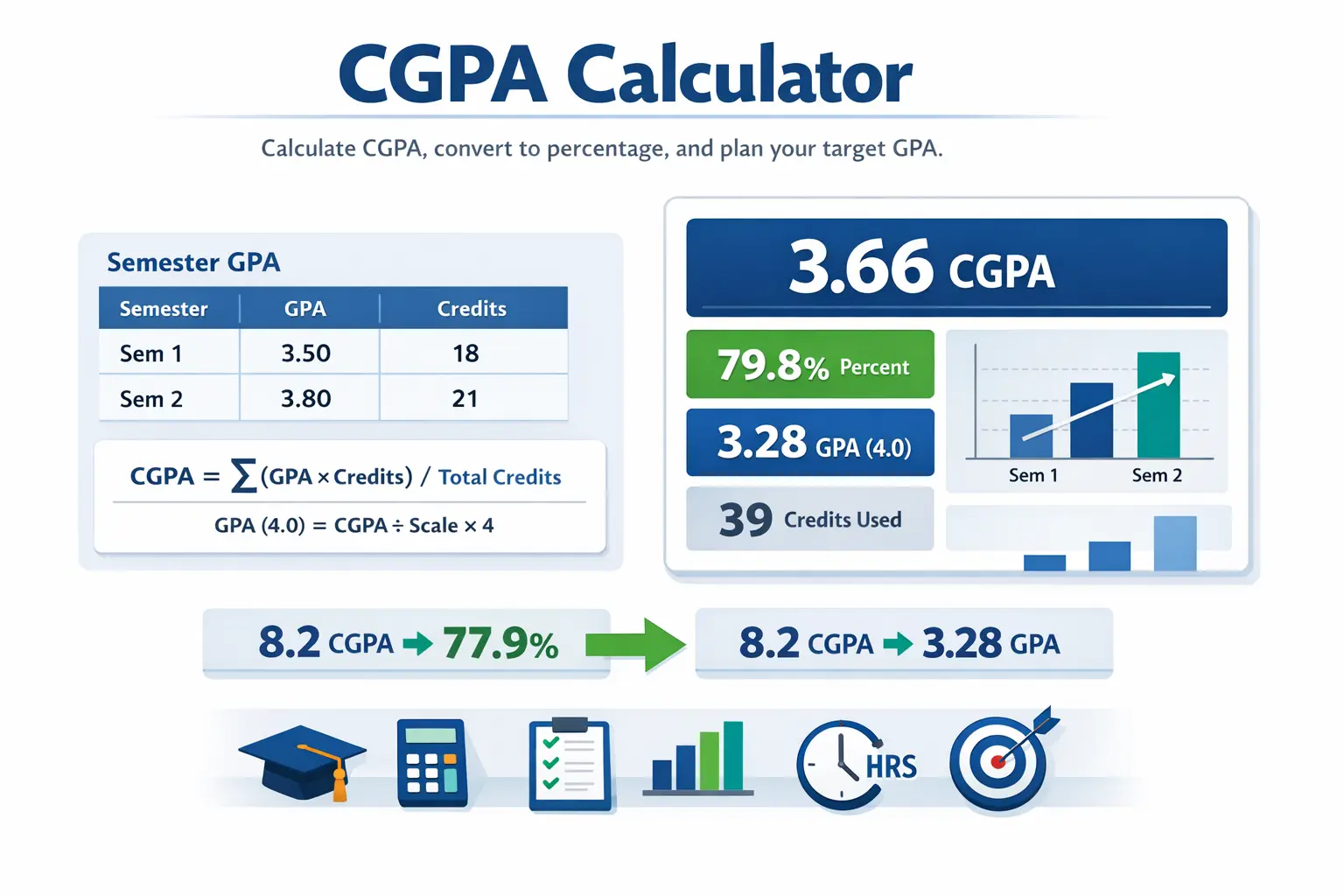
Quick Example to Understand the Result
Suppose you calculated your CGPA using the CGPA calculator with credits.
Semester 1 GPA = 3.50
Credits = 18
Semester 2 GPA = 3.80
Credits = 21
First calculate weighted grade points.
3.50 × 18 = 63
3.80 × 21 = 79.8
Total grade points = 142.8
Total credits = 39
Now calculate CGPA.
142.8 ÷ 39 = 3.66 CGPA.
Result
CGPA: 3.66
Total Credits: 39
Meaning
You completed 39 credit hours with an average GPA of 3.66. This result is considered strong in most 4.0 scale grading systems used by many universities in the USA and international programs.
Explore More Calculators
Calculate your GPA instantly using 4.0, percentage, or university scales. Accurate results with credits, conversions, and global GPA comparison.
Try calculatorApplying to Germany? Use our free CGPA to German Grade Calculator. Convert your 10.0 or 4.0 scale instantly to see if you meet the…
Try calculatorUse this college GPA calculator to check semester, cumulative, and major GPA fast. Add grades, credits, retakes, and pass failed courses in one place.
Try calculatorUse the COMSATS CGPA Calculator to check semester SGPA, updated CGPA, required final marks, and the GPA needed to reach your academic target in…
Try calculatorFAST CGPA Calculator estimates your SGPA, updated CGPA, repeat-course impact, and required next GPA so you can plan your academic recovery.
Try calculatorWill your grades get you into TUM? Use our German GPA Calculator to convert your CGPA or percentage instantly. Find your exact DAAD equivalent…
Try calculatorWhich CGPA system should you choose before calculating?
Your CGPA calculator works best when you choose the correct grading system first. Different countries and universities use different CGPA scales and conversion rules. If you select the wrong system, your CGPA, percentage, and GPA conversion may not match your actual academic results.
| Country / System | Scale | Common Method | Conversion Rule | Notes |
|---|---|---|---|---|
| USA (Universities) | 4.0 | Credit weighted GPA | Direct GPA scale | Used by most colleges and WES evaluations |
| India (Engineering & Universities) | 10.0 | CGPA based on credits | CGPA × 9.5 | Common in VTU, Mumbai, SRM, and other universities |
| Pakistan (HEC / Universities) | 4.0 | Credit weighted GPA | Percentage mapped to GPA | Used by NUST, COMSATS, UAF, Punjab University |
| UK (Honours / Percentage) | Percentage | Module weighted average | Class-based grading | First Class, Upper Second, Lower Second system |
| Custom Scale (Global) | 5.0 / 7.0 / 10.0 | User-defined scale | Manual conversion | Used for international or mixed grading systems |
Heads-up: CGPA rules vary by university. Always check your official grading policy before using conversions.
How to Use the CGPA Calculator
Using this CGPA calculator takes only a minute. You can calculate your overall CGPA, convert SGPA to CGPA, convert CGPA to percentage, or estimate CGPA on a 4.0 scale. Follow these steps and test the calculator with your own semester data.
Choose what you want to calculate
Start by picking the correct mode. You can calculate CGPA, convert SGPA to CGPA, convert CGPA to percentage, convert CGPA to 4.0 GPA, or use the target CGPA planner.
Select your scale or preset
Next, choose your grading scale or university preset. This step sets the correct system for your calculation. You can use a 4.0 scale, 5.0 scale, 7.0 scale, or 10.0 scale.
Enter your grades and credits
Add your semester GPA or SGPA and the credit hours for each semester. If you are using a conversion mode, enter your CGPA value and factor instead. This helps the calculator use the correct formula.
Click the Calculate button
Now click Calculate to run the result. The tool applies the weighted credit formula or conversion method based on the mode you selected. You will see the result right away.
Review your CGPA result
Check your final CGPA, percentage equivalent, 4.0 GPA estimate, and total credits used. If you use the target planner, you will also see the GPA needed in your remaining credits.
Example for testing
Try these sample numbers:
- Semester 1 GPA: 3.20
Credits: 15 - Semester 2 GPA: 3.90
Credits: 18
Result: The calculator finds your weighted CGPA by combining both semesters and their credit hours. Your final CGPA becomes 3.58 out of 4.0. Total credits used become 33.
Now enter your own semester grades and credit hours to check your total CGPA and academic progress.
How the CGPA Calculator Formula Works (Complete Breakdown)
Understanding the CGPA formula helps you see how universities calculate your academic average. Most colleges use a credit weighted system. Courses with higher credit hours affect your CGPA more than smaller courses.
This CGPA calculator with credits follows the same method used by many universities in the USA, India, Pakistan, and other countries. The tool calculates CGPA from semester GPA or SGPA. It can also convert CGPA to percentage or estimate CGPA on the 4.0 GPA scale.
CGPA Calculation Formula
The most common method used by universities is the weighted CGPA formula.
Formula:
CGPA = Σ(GPA × Credits) ÷ Total Credits
This formula multiplies the GPA of each semester by its credit hours. Then it adds all the results together. After that, the calculator divides the total grade points by total credits. This method ensures that courses with more credit hours influence your total CGPA more strongly.
Example:
					Semester 1 GPA = 3.4
Credits = 16

Semester 2 GPA = 3.8
Credits = 20

Step 1
3.4 × 16 = 54.4

Step 2
3.8 × 20 = 76

Step 3
Total grade points = 130.4
Total credits = 36

Step 4
CGPA = 130.4 ÷ 36 = 3.62
This result shows your overall CGPA on a 4.0 scale.
CGPA to Percentage Formula
Many universities convert CGPA to percentage using a multiplication factor. This method helps students apply for jobs or graduate programs that require percentage scores.
Formula
Percentage = CGPA × Conversion Factor
A common conversion factor used by many universities is 9.5.
Example
CGPA = 8.2
8.2 × 9.5 = 77.9%
This result shows your CGPA percentage equivalent.
Note:
Some universities use a different factor. Always confirm your institution’s official conversion rule.
CGPA to 4.0 GPA Formula
Many students convert CGPA to the 4.0 GPA scale when applying to universities in the United States or Canada.
Formula
4.0 GPA = (CGPA ÷ Scale) × 4
Example
CGPA = 8.2 out of 10
Step 1
8.2 ÷ 10 = 0.82
Step 2
0.82 × 4 = 3.28 GPA
This estimate helps when comparing grades across different education systems.
Target CGPA Formula
The target CGPA calculator helps you estimate the GPA needed in your remaining semesters.
Formula
					Required GPA =
((Target CGPA × Total Credits After Completion) − (Current CGPA × Completed Credits)) ÷ Remaining Credits
This formula calculates how strong your future grades must be to reach your desired CGPA.
Example
Current CGPA = 3.10
Completed Credits = 60
Remaining Credits = 30
Target CGPA = 3.40
Required GPA = 3.98
This means you must average about 3.98 GPA in your remaining credits to reach your goal.
Variable Definitions
CGPA
Cumulative Grade Point Average. It represents your overall academic performance across all semesters.
SGPA
Semester Grade Point Average. It measures performance for a single semester.
GPA
Grade Point Average used by many universities. Often calculated on a 4.0 scale.
Credits
Credit hours assigned to each subject or course. Higher credit courses affect CGPA more.
Scale
The maximum grading scale used by your university. Common scales include 4.0, 5.0, 7.0, and 10.0.
Conversion Factor
The multiplier used to convert CGPA into percentage. Many institutions use 9.5, but some use different values.
Another Example Calculation (Step-by-Step)
Real examples make this CGPA calculator easier to understand. They show how the tool works with semester GPA, SGPA, credit hours, and conversion factors. Use these examples to compare your own result and check if your entries make sense.
Example 1. Calculate CGPA from Semester GPA
This example shows how to calculate CGPA from GPA using credit hours. It follows the same weighted method used by most colleges and universities.
Given:
- Semester 1 GPA = 3.25
Credits = 17 - Semester 2 GPA = 3.90
Credits = 19
Calculation:
					Step 1
3.25 × 17 = 55.25

Step 2
3.90 × 19 = 74.10

Step 3
Total grade points = 129.35
Total credits = 36

Step 4
CGPA = 129.35 ÷ 36 = 3.59
Result:
Your CGPA is 3.59 on a 4.0 scale.
Meaning:
This result shows a strong academic record in most college grading systems. Because the second semester had more credits and a higher GPA, it pulled the final total CGPA upward.
Example 2. Convert CGPA to Percentage
This example shows how a CGPA to percentage calculator works when a university uses a multiplication factor.
Given:
- CGPA = 7.60
- Factor = 9.5
Calculation:
					Step 1
7.60 × 9.5 = 72.20
Result:
Your percentage equivalent is 72.20%.
Meaning:
This type of conversion is common in many Indian universities. However, some colleges use a different factor. So you should always confirm the official rule before using the percentage for applications or transcripts.
Example 3. Plan a Target CGPA
This example shows how the target CGPA planner estimates the GPA needed in your remaining credits.
Given:
- Current CGPA = 3.05
- Completed credits = 72
- Remaining credits = 24
- Target CGPA = 3.30
Calculation:
					Step 1
Target total points = 3.30 × 96 = 316.80

Step 2
Current points = 3.05 × 72 = 219.60

Step 3
Points still needed = 316.80 − 219.60 = 97.20

Step 4
Required GPA = 97.20 ÷ 24 = 4.05
Result:
The required GPA is 4.05.
Meaning:
This target is not reachable on a 4.0 scale. You may need to lower the target CGPA or improve it over more credits. This is why the planner is useful before you set an unrealistic goal.
Result Benchmarks and Ranges
Your CGPA result shows how strong your academic performance is across all semesters. Universities use CGPA to evaluate student progress, scholarship eligibility, and graduate admissions. The table below helps you understand what your CGPA on a 4.0 scale usually means in common grading systems.
A higher CGPA shows stronger performance. A mid range CGPA shows stable progress. A lower CGPA may require improvement in future semesters. Because many universities use different scales, you should always confirm your institution’s grading policy.
| Range | Label | USA Guideline | India Guideline | Notes |
|---|---|---|---|---|
| 3.7 – 4.0 | Excellent | Top academic performance in most universities. | Usually equals about 9.0+ CGPA on a 10 scale. | Strong profile for scholarships and graduate programs. |
| 3.3 – 3.69 | Very Good | Competitive GPA for internships and many programs. | Roughly equal to about 8.0–8.9 CGPA. | Good academic standing in most colleges. |
| 3.0 – 3.29 | Good | Meets many degree completion requirements. | Often equal to about 7.0–7.9 CGPA. | Acceptable but improvement helps for competitive programs. |
| 2.5 – 2.99 | Average | Close to minimum GPA for many institutions. | Usually equal to about 6.0–6.9 CGPA. | Students may need higher grades in future semesters. |
| Below 2.5 | Low | Risk of academic probation in many universities. | Often below common degree requirements. | Improvement is needed to avoid academic warnings. |
Heads-up: CGPA scales and grade conversions vary by university. Always confirm the official grading policy used by your institution.
Interpretation
A CGPA above 3.5 usually signals strong academic performance. Many graduate schools and scholarship programs expect results in this range. A CGPA between 3.0 and 3.4 still meets many degree requirements, but competitive programs may expect higher scores.
If your CGPA falls below 3.0, focus on improving grades in high credit courses. Because credit weighted systems give more weight to those courses, improving them can raise your total CGPA faster.
Pro Tip:
Use the target CGPA planner in this calculator to test different semester results. This helps you see the GPA needed in future credits to reach your academic goal.
Tips & Planning Based on Your Result
Calculating your CGPA is the first step. Planning how to improve it is the next step. This CGPA calculator helps you see where you stand. It also helps you decide what to do next.

If Your CGPA Is High
If your CGPA is in the excellent range, keep your pace steady. Strong grades in future semesters will protect your average. However, do not ignore high credit courses. Even one weak result in a large course can pull your total CGPA down.
If Your CGPA Is Mid Range
If your CGPA is in the good or very good range, focus on courses with more credit hours. These subjects affect your final average more. A small improvement in a high credit subject can raise your CGPA faster than the same improvement in a low credit subject.
If Your CGPA Is Low
If your CGPA is below your target, act early. Use the Target CGPA Planner to estimate the GPA required in your remaining credits. This helps you set a realistic goal. It also shows whether your target is reachable on your current scale.
Important Planning Tips
- Focus on high credit courses first. They carry more weight in a credit weighted CGPA calculator.
- Use the Target CGPA Planner before each semester. This helps you know the GPA you need in future semesters.
- When you use a CGPA to percentage calculator, always confirm the official conversion factor from your university. Many institutions use 9.5, but some use a different rule.
- If you are applying abroad, treat the CGPA to 4.0 GPA result as an estimate. Official evaluators may use a different conversion method.
These steps help you improve your CGPA with a clear plan. They also help you avoid mistakes when converting CGPA to percentage or CGPA to GPA for applications.
You Might Also Find These Helpful
GPA 18
Use the High School GPA Calculator to check weighted and unweighted GPA, include honors or AP classes, track cumulative GPA, and see what GPA…
Try calculatorIIUI CGPA Calculator estimates GPA and cumulative CGPA from IIUI grades, marks, and credit hours. Use it as an IIUI GPA calculator on a…
Try calculatorStop guessing! Use our updated Karachi University CGPA Calculator to instantly check your semester score, avoid probation, and catch scrutiny grade bumps now.
Try calculatorUse the NUST CGPA Calculator to estimate semester GPA, updated CGPA, quality points and HEC percentage range from your NUST grades and credit hours.
Try calculatorWorried about a low LMS score? Use our live UAF CGPA Calculator to instantly predict your exact GPA, plan retakes to avoid probation, and…
Try calculatorUCP CGPA Calculator estimates semester GPA and CGPA from UCP grades and credit hours. Check grade points, grading scale, and your calculated result.
Try calculatorUse the UET CGPA Calculator for Lahore, Taxila, or Peshawar. Check SGPA, updated CGPA, percentage estimate, and the score needed before results arrive.
Try calculatorUMT CGPA Calculator estimates semester GPA, updated CGPA, and the SGPA needed for your target using UMT grade points and credit hours. Check your…
Try calculatorStop guessing your academic rank. Use our Unweighted GPA Calculator to instantly convert percentages to a 4.0 scale, check your rigor, and set exact…
Try calculatorUOG CGPA Calculator estimates semester GPA, updated CGPA, program benchmarks, and the SGPA needed to reach your target using credits, marks, or grade points.
Try calculatorCalculate UOL GPA, SGPA and CGPA using the University of Lahore grade scale. Enter courses or paste supported grade and credit-hour data from SAP/SIS.
Try calculatorUse our weighted GPA calculator to check your 5.0 scale GPA, compare weighted vs unweighted GPA, and see how AP or Honors classes raise…
Try calculatorCommon Mistakes to Avoid When Calculating CGPA
- Entering GPA values higher than the selected scale. For example, entering 4.2 when using a 4.0 scale CGPA calculator.
- Leaving credit hours blank for a semester. The calculator needs credit values to calculate weighted CGPA correctly.
- Selecting the wrong CGPA scale for your university. Some universities use a 4.0 scale, while others use 5.0, 7.0, or 10.0 systems.
- Using the wrong conversion factor when converting CGPA to percentage. Many institutions use 9.5, but some universities follow different rules.
- Forgetting that CGPA calculations are weighted by credits. Courses with higher credit hours affect your total CGPA more than smaller courses.

Frequently Asked Questions (FAQs)
How to calculate CGPA?
You calculate CGPA by combining the GPA or SGPA of all semesters and weighting them by credit hours. First multiply each semester GPA by its credits. Then add all grade points. Finally divide the result by total credits.
Formula:
CGPA = Σ(GPA × Credits) ÷ Total Credits
For example, if you scored 3.40 GPA in 15 credits and 3.80 GPA in 18 credits, first multiply each GPA by its credits. Then add the grade points and divide by the total credits. Manual calculation works. However it can take time and mistakes are common. A CGPA calculator performs this calculation instantly and reduces errors.
Use the calculator Above to compute your total CGPA, SGPA to CGPA conversion, percentage equivalent, and 4.0 GPA estimate.
What is a CGPA calculator?
A CGPA calculator is an online tool that calculates cumulative grade point average using semester GPA, SGPA, and credit hours. The calculator applies the weighted formula used by most universities to estimate overall academic performance across semesters. You simply enter semester GPA and credits. The tool instantly calculates total CGPA, percentage equivalent, and GPA on a 4.0 scale.
How do you calculate CGPA from GPA?
To calculate CGPA from GPA, multiply each semester GPA by its credit hours. Add all weighted grade points together. Then divide the total by the sum of all credits.
This method produces a weighted cumulative grade point average, which most colleges use to measure academic performance.
How do you convert CGPA to percentage?
To convert CGPA to percentage, multiply the CGPA by the conversion factor used by the university. Many institutions use 9.5 as the standard multiplier. For example, 8.2 CGPA × 9.5 = 77.9 percent. Always confirm the official factor used by your institution.
How do you convert CGPA to 4.0 GPA?
To convert CGPA to a 4.0 GPA scale, divide your CGPA by the maximum scale and multiply the result by four.
Example:
If CGPA = 8.0 on a 10 scale
8 ÷ 10 × 4 = 3.2 GPA
This estimate helps when applying to universities in the USA or Canada.
What is SGPA to CGPA conversion?
SGPA to CGPA conversion calculates the cumulative average across multiple semesters. Each semester SGPA is multiplied by its credit hours. Then the total weighted points are divided by total credits. This produces the final CGPA for the entire degree program.
What is a good CGPA in college?
A good CGPA depends on the grading scale used by the university. On a 4.0 scale, a CGPA above 3.5 is considered excellent. On a 10-point scale, a CGPA above 8.5 is usually strong. Many scholarships and graduate programs prefer CGPA above these ranges.
What is 75 percent as CGPA?
A percentage of 75 percent usually equals about 7.5 CGPA on a 10-point scale when using the common conversion factor. However conversion rules vary by university. Some institutions use a different formula. Always confirm the official conversion policy.
What is 80 percent of a 4.0 GPA?
An 80 percent score usually equals about 3.2 GPA on a 4.0 scale. This estimate comes from the proportional conversion between percentage and GPA scales. Different universities may use slightly different grading conversions.
What is 9.5 CGPA in marks?
If a university uses the 9.5 conversion factor, then 9.5 CGPA equals about 90.25 percent.
Calculation example:
9.5 × 9.5 = 90.25%
Some universities may use a different multiplier. Always check official rules.
Can CGPA be converted to GPA for study abroad?
Yes. CGPA can be converted into the 4.0 GPA scale used by many universities in the United States and Canada. The conversion usually divides CGPA by the maximum scale and multiplies by four. Official evaluation agencies may apply their own grading conversion methods.
Questions?
We had love to hear from you! Whether you are reporting an issue, suggesting a new calculator, or exploring collaboration opportunities — we are here to help. Every message helps us make 100calc smarter, faster, and more helpful for everyone.
Why People Trust 100calc
At 100calc.com, we focus on accuracy, speed, and trust. Every calculator we create is designed to give reliable, instant, and easy-to-understand results you can truly depend on.