
UET CGPA Calculator: See Your Score Before Results Arrive
The UET CGPA Calculator finds your semester SGPA or updated CGPA from grades and credit hours. Select UET Lahore, UET Taxila, or UET Peshawar so the tool loads the matching grade-point values. You can also check a percentage estimate or find the SGPA needed for your next target.
One wrong university choice can change the result. Enter the values from your transcript or UET LMS to see where you stand, spot a difficult target, and plan your next semester before the official result arrives.
Quick Facts
- GPA scale: 0.00 to 4.00
- Universities: UET Lahore, UET Taxila, and UET Peshawar
- Modes: Semester SGPA, updated CGPA, percentage estimate, and target planning
- Excluded statuses: W, I, and IP
- Percentage result: Planning estimate, not official equivalence
- Updated Jul 21, 2026
UET GPA & CGPA Calculator
Select your university to calculate semester SGPA, update CGPA, view a percentage estimate, or plan a target CGPA.
Check your uet lms for accurate attempted credits.
Provides a simple percentage estimate for planning. It is not an official transcript or HEC equivalence.
Calculate the SGPA needed next semester to reach your target CGPA.
Your Final Score
Calculated using your selected university scale.
Academic Breakdown
1. How is GPA calculated for UET Lahore, Taxila, and Peshawar?
Multiply each GPA-bearing grade point by its course credit hours. Add the quality points, then divide by total GPA-bearing credits. Select UET Lahore, UET Taxila, or UET Peshawar so the calculator loads that university’s grade-point values. Check your official record for the correct credit hours and final academic standing.
2. How do the percentage estimate and Target CGPA Planner work?
The percentage mode gives a simple planning estimate and does not replace an official marks sheet or equivalence decision. The Target CGPA Planner uses your current CGPA, completed credits, target, and next-semester credits to calculate the required SGPA. It is a mathematical planning tool, not an AI prediction.
How Does the UET Grading System Work?
Every engineering university evaluates students differently. Specifically, the University of Engineering and Technology (UET) uses a hybrid academic approach. For theory subjects, the university applies a relative grading curve based on the overall class average and standard deviation. However, for lab and practical courses, it relies on a strict absolute scale.
Regardless of the method used, you must score a minimum of 50% normalized marks to pass a subject and earn a “D” grade. Furthermore, this system assigns specific quality points on a maximum 4.00 scale. Therefore, you can use the detailed matrix below to see exactly how your letter grades map to quality points and their estimated HEC percentage equivalents. Consequently, understanding these exact academic rules helps you avoid probation risks and plan your target GPA effectively.
| Letter Grade | Grade Point (QP) | Estimated % Equivalent (HEC) | Status / Remarks | Grading Mechanism |
|---|---|---|---|---|
| A | 4.00 | 100.00% | Excellent | Relative / Absolute |
| A- | 3.70 | 92.50% | Very Good | Relative / Absolute |
| B+ | 3.30 | 82.50% | Good | Relative / Absolute |
| B | 3.00 | 75.00% | Above Average | Relative / Absolute |
| B- | 2.70 | 67.50% | Average | Relative / Absolute |
| C+ | 2.30 | 57.50% | Fair | Relative / Absolute |
| C | 2.00 | 50.00% | Satisfactory (Min. Grad Req) | Relative / Absolute |
| C- | 1.70 | 42.50% | Below Average | Relative / Absolute |
| D | 1.00 | 25.00% | Pass (Min 50% Marks) | Relative / Absolute |
| F | 0.00 | 0.00% | Fail (< 50% Marks) | Relative / Absolute |
Important Note: The UET grading system primarily utilizes Relative Grading for theory courses (meaning your grade depends on the class average and standard deviation) and Absolute Grading for labs. Regardless of the curve, you must secure a minimum of 50% normalized marks to achieve a passing "D" grade. The estimated percentages shown use the official HEC CGPA × 25 equivalence formula required for job and postgraduate applications.
How Does the Relative Grading System Work?
Unlike high schools, UET uses a relative grading curve for most theory subjects. This means your final letter grade depends heavily on the overall class average and standard deviation. Instead of fixed percentage brackets, your academic performance is directly compared to your peers. However, practical lab courses usually follow a standard absolute scale. This dual approach ensures a fair assessment across all engineering departments.
How Do Letter Grades Convert to Quality Points?
Your earned letter grade translates directly into quality points on a strict 4.00 scale. For example, scoring an A gives you exactly 4.00 points, while a B gives you 3.00 points. To find your total score for a specific course, you multiply these quality points by the assigned credit hours. This exact calculation builds the mathematical foundation of your semester SGPA.
What Are the Minimum Passing Marks in UET?
You must understand the minimum passing rules to avoid failing a subject. You need at least 50 percent normalized marks to clear any course. Hitting this exact baseline earns you a D grade, which equals 1.00 quality point. Scoring anything below 50 percent results in an F grade, yielding zero points. Therefore, every single midterm and final mark counts toward clearing your semester.
What Are the Rules for Probation and Graduation?
Passing your individual subjects with D grades is not enough to secure your engineering degree. You must maintain a minimum 2.00 CGPA overall. If your aggregate score drops below 2.00, the university places you on academic probation. Facing two consecutive probations can lead to severe consequences, including suspension. As a result, you must consistently aim for C grades or higher to graduate safely.
What Does My UET GPA or CGPA Result Mean?
An SGPA shows your performance in the GPA-bearing courses entered for one semester. An updated CGPA combines your earlier academic record with the new courses, so it gives a broader view of your progress.
Understanding Your Result
Your result means something different in each calculation mode. Check the result title before deciding whether the number covers one semester, your full record, or a future target.
Semester SGPA
Semester SGPA covers only the courses entered for the current term. It does not include grades from earlier semesters.
Higher-credit courses have more effect on the result. W, I, and IP add no quality points or GPA-bearing credits, while WF counts at 0.00 points.
Updated CGPA
Updated CGPA combines four parts:
- Your previous CGPA
- Previous attempted credits
- Current course quality points
- Current GPA-bearing credits
Use this result to answer questions such as:
- What will my CGPA become?
- Did this semester raise or lower my CGPA?
- Can I move above the 2.00 reference?
Target CGPA Planner
A required SGPA from 0.00 to 4.00 means the target is mathematically reachable within the entered credits. A lower required score usually gives you more room for mixed grades.
A result above 4.00 means the goal cannot be reached in one planned semester. A result at or below zero means the target is already protected under the values entered.
Percentage Estimate
The percentage result equals your CGPA multiplied by 25. It gives a simple planning reference, not an official university percentage or HEC equivalence.
It does not recover:
- Original course marks
- Transcript percentages
- Official equivalence values
- University conversion decisions
Is Your Result Good or Bad?
The calculator compares GPA and CGPA results with a 2.00 reference. This helps you spot risk, but official academic standing depends on your university rules and complete record.
- Below 2.00 SGPA: The semester needs attention. It does not confirm cumulative probation.
- 2.00 to 2.49: The result meets the calculator reference but leaves a small margin.
- 2.50 to 2.99: The score gives more protection against weaker future grades.
- 3.00 to 3.49: This is a stronger result for many CGPA improvement goals.
- 3.50 to 4.00: The semester creates the largest positive effect on CGPA.
A 2.85 SGPA may be useful for one student but too low for another target. Your existing CGPA and completed credits decide how much it changes the cumulative result.

What Should You Do Next?
Your next action depends on the result type and the gap between your current score and goal. Focus on the numbers you can still change.
- Low semester SGPA: Check how it affects your cumulative CGPA.
- CGPA near 2.00: Protect high-credit courses and review official standing.
- Reachable target: Compare the required SGPA with realistic grade combinations.
- Unreachable target: Increase the planned credit period or lower the short-term goal.
- Unexpected result: Recheck the university, attempted credits, excluded statuses, and course grades.
Use your transcript or UET LMS record for accurate inputs. Small errors in completed credits can create a noticeable CGPA difference.
What Is a Quick UET CGPA Example to Test?
This UET Peshawar example shows how a stronger semester can improve an existing CGPA. The IP course stays excluded from GPA-bearing credits.
Input:
- Current CGPA: 2.40
- Previous attempted credits: 36
- 3 credits with A− at 3.67
- 4 credits with B+ at 3.33
- 3 credits with C+ at 2.33
- 2 credits with IP status
Result:
- Updated CGPA: 2.56
- Total GPA-bearing credits: 46
- Total quality points: 117.72
- Estimated percentage reference: 63.98%
- Excluded statuses: 1
Meaning:
The new semester raises the CGPA from 2.40 to 2.56. The result meets the calculator’s 2.00 reference, but the student should still confirm official standing through the university record.
Explore More Calculators
Use the CGPA Calculator to calculate CGPA from GPA or SGPA, convert CGPA to percentage or 4.0 GPA, and plan your target CGPA. Works…
Try calculatorCalculate your GPA instantly using 4.0, percentage, or university scales. Accurate results with credits, conversions, and global GPA comparison.
Try calculatorApplying to Germany? Use our free CGPA to German Grade Calculator. Convert your 10.0 or 4.0 scale instantly to see if you meet the…
Try calculatorUse this college GPA calculator to check semester, cumulative, and major GPA fast. Add grades, credits, retakes, and pass failed courses in one place.
Try calculatorUse the COMSATS CGPA Calculator to check semester SGPA, updated CGPA, required final marks, and the GPA needed to reach your academic target in…
Try calculatorFAST CGPA Calculator estimates your SGPA, updated CGPA, repeat-course impact, and required next GPA so you can plan your academic recovery.
Try calculatorHow Do I Use the UET CGPA Calculator?
Choose the university and calculation mode that match your academic record. Enter the required grades, credit hours, or CGPA details, then review the score and any limits shown with it.
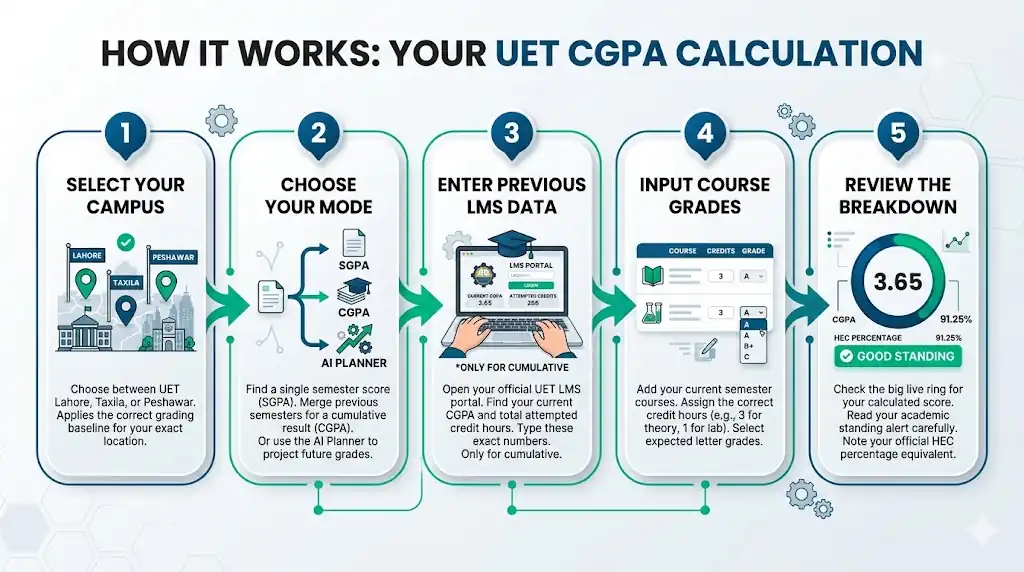
Choose Your University
Select UET Lahore, UET Taxila, or UET Peshawar based on your transcript or LMS record. This choice loads the grade-point values used by that university. Picking the wrong option may slightly change your SGPA or updated CGPA.
Pick a Calculation Mode
Use Semester SGPA for one term or Cumulative mode to update an existing CGPA. Percentage mode gives a planning estimate. The Target CGPA Planner finds the SGPA needed over your entered future credits.
Enter Your Academic Values
Add each course grade and its credit hours for an SGPA calculation. Cumulative mode also needs your current CGPA and attempted credits. Target planning requires your current score, completed credits, desired CGPA, and planned semester credits.
Review Every Course Row
Complete every course row you start. Untouched default rows stay ignored. W, I, and IP add no GPA-bearing credits, while WF counts at 0.00 points. Missing grades or invalid credit values stop the calculation.
Read the Final Result
The calculator matches grades with your selected university scale and weights them by credit hours. It then shows the SGPA, updated CGPA, quality points, included credits, or required target score. Review any warning before using the result for planning.
Quick Example to Test
Try these sample values:
- University: UET Taxila
- Calculation mode: Semester SGPA
- Course 1: 3 credits, A−
- Course 2: 4 credits, B
- Course 3: 3 credits, C+
- Course 4: 2 credits, W
- Result: 3.00 SGPA
The calculator counts 30.00 quality points across 10 GPA-bearing credits. The W course stays excluded, so it does not change the result. The estimated percentage reference is 75.00%.
How Accurate Is the UET CGPA Calculator?
The UET CGPA Calculator follows credit-weighted GPA logic and the grade scales configured for UET Lahore, Taxila, and Peshawar. It gives a reliable estimate when your selected university, grades, and credits match your academic record. The tool cannot verify LMS data, repeat-course rules, or official academic standing.
Key Features & Benefits
- Loads the grade-point scale linked to your selected UET university.
- Weights every GPA-bearing course using its entered credit hours.
- Keeps semester SGPA separate from your updated cumulative CGPA.
- Excludes W, I, and IP while counting WF at 0.00 points.
- Checks whether your target CGPA is reachable within the planned credits.
Technical Process
Input Check
The system checks CGPA limits, credit ranges, selected grades, and incomplete course rows.
Scale Match
Your university choice sets the grade points used for each selected letter grade.
Result Output
The system returns the relevant score, included credits, quality points, and planning message for the chosen mode.
How the UET CGPA Formula Works (Complete Breakdown)
The UET CGPA Calculator uses credit-weighted grade points. Each course earns quality points based on its grade and credit hours. The tool adds those values, then divides by total GPA-bearing credits. Cumulative mode also includes the quality points and credits from your earlier academic record.
Course Quality Points
Course Quality Points = Credit Hours × Grade Points
This formula measures the value earned from one course. A high-credit course has more effect on your GPA than a low-credit course with the same grade.
Semester SGPA
SGPA = Σ(Course Credit Hours × Course Grade Points) ÷ Σ(GPA-Bearing Course Credit Hours)
The calculator adds the quality points from all included semester courses. It divides that total by the GPA-bearing credit hours entered.
W, I, and IP are excluded from both totals. WF counts as 0.00 grade points.
Previous Quality Points
Previous Quality Points = Current CGPA × Previous Attempted Credits
Cumulative mode rebuilds the value behind your current CGPA. This lets the calculator combine your old academic record with the new semester.
Updated CGPA
					Updated CGPA =
(Previous Quality Points + Current Semester Quality Points)
÷
(Previous Attempted Credits + Current GPA-Bearing Credits)
This formula combines your earlier record with the courses entered for the new semester. The result shows the estimated CGPA after both sets of credits are included.
Estimated Percentage
Estimated Percentage = CGPA × 25
This formula creates the percentage reference shown by the calculator. It does not recover your original marks.
Important: This is the calculator’s percentage estimate. It is not a universal official HEC or UET conversion.
Required Next-Semester SGPA
Required SGPA = [ Target CGPA × (Completed Credits + Next-Semester Credits) - Current CGPA × Completed Credits ] ÷ Next-Semester Credits
The Target CGPA Planner calculates how many future quality points are needed. It then converts that requirement into the SGPA needed across the planned credits.
A result above 4.00 means the target is not reachable within that credit load. A result at or below 0.00 means the target is already protected under the entered values.
Maximum Possible CGPA
Maximum Possible CGPA = [ Current CGPA × Completed Credits + 4.00 × Next-Semester Credits ] ÷ (Completed Credits + Next-Semester Credits)
This formula assumes a perfect 4.00 SGPA in the next semester. It shows the highest cumulative result possible with the credits entered.
What Do the Formula Variables Mean?
The variables represent the grades, credits, and academic history used in each calculation. Using the correct attempted credits matters because they control how much a new semester can change your cumulative score.
| Variable | Meaning |
|---|---|
| SGPA | Semester Grade Point Average for the entered GPA-bearing courses. |
| CGPA | Cumulative Grade Point Average across the combined academic record. |
| CH | Credit hours assigned to a course. |
| GP | Grade points linked to the selected letter grade. |
| QP | Quality points earned by multiplying credit hours by grade points. |
| Current CGPA | Your cumulative score before adding the new semester. |
| Previous CGPA | Another label for the CGPA held before the current calculation. |
| Attempted Credits | Earlier credits already represented by your current CGPA. |
| Completed Credits | Credits used as the existing base in the Target CGPA Planner. |
| Current Semester QP | Total quality points from the new GPA-bearing courses. |
| Current GPA-Bearing Credits | New credits included in the SGPA or updated CGPA calculation. |
| Next-Semester Credits | Future credits entered in the Target CGPA Planner. |
| Target CGPA | The cumulative grade point average you want to reach. |
| Required SGPA | The future semester average needed to reach the target CGPA. |
| 4.00 | The highest SGPA accepted by the calculator. |
| Σ | Add all included course values together. |
Note: W, I, and IP are excluded from GPA-bearing credits and quality points. WF counts at 0.00 grade points.
Another UET CGPA Calculation (Step-by-Step)
This example shows how the UET CGPA Calculator combines an existing academic record with new semester grades. It uses the UET Lahore grade-point scale and excludes the incomplete course from GPA-bearing credits.
Given:
- University: UET Lahore
- Current CGPA: 2.68
- Previous Attempted Credits: 54
- Course 1: 3 credits, A− at 3.70
- Course 2: 4 credits, B+ at 3.30
- Course 3: 3 credits, B at 3.00
- Course 4: 2 credits, C+ at 2.30
- Course 5: 3 credits, I status
Calculation:
					Previous Quality Points = 2.68 × 54
Previous Quality Points = 144.72

Course 1 Quality Points = 3 × 3.70 = 11.10
Course 2 Quality Points = 4 × 3.30 = 13.20
Course 3 Quality Points = 3 × 3.00 = 9.00
Course 4 Quality Points = 2 × 2.30 = 4.60

Current Semester Quality Points = 37.90
Current GPA-Bearing Credits = 12

Updated CGPA =
(144.72 + 37.90) ÷ (54 + 12)

Updated CGPA =
182.62 ÷ 66

Updated CGPA = 2.7669
Displayed CGPA = 2.77

Estimated Percentage =
2.7669 × 25

Estimated Percentage = 69.17%
The I status adds no quality points or GPA-bearing credits. The new semester SGPA is 3.16, which is higher than the previous 2.68 CGPA.
Result:
- Previous CGPA: 2.68
- Current Semester SGPA: 3.16
- Updated CGPA: 2.77
- Total GPA-Bearing Credits: 66
- Total Quality Points: 182.62
- Estimated Percentage Reference: 69.17%
Meaning:
The stronger semester raises the cumulative score from 2.68 to 2.77. The increase stays moderate because the earlier 54 credits carry more weight than the new 12 credits.
The percentage is a planning estimate only. It does not replace an official transcript or equivalence result.
Which UET University Should You Select?
Choose the university shown on your transcript or UET LMS record before entering grades. The calculator uses one weighted formula, but the grade-point values differ. UET Lahore uses 3.70-style decimals, while Taxila and Peshawar use 3.67-style values in the current calculator setup.
| University | Scale | Key Grade Points | Status Handling | Select This When |
|---|---|---|---|---|
| UET Lahore | Lahore Scale | A− 3.70, B+ 3.30, C+ 2.30, D+ 1.30 | W, I, and IP excluded. WF counts as 0.00. | Your transcript or LMS record shows UET Lahore. |
| UET Taxila | Taxila Scale | A− 3.67, B+ 3.33, C+ 2.33, D+ 1.33 | W, I, and IP excluded. WF counts as 0.00. | You are enrolled at UET Taxila. |
| UET Peshawar | Peshawar Scale | A− 3.67, B+ 3.33, C+ 2.33, D+ 1.33 | W, I, and IP excluded. WF counts as 0.00. | Your academic record shows UET Peshawar. |
Heads-up: This table matches the calculator’s current grade settings. Rules may vary by program, admission batch, or regulation year. Check your latest official handbook or academic record.
How Do You Calculate UET CGPA?
Calculate UET CGPA by multiplying each grade point by its course credits. Add the quality points, then divide by total GPA-bearing credits. Cumulative mode also includes your previous CGPA and attempted credits. Select Lahore, Taxila, or Peshawar before entering grades.
What Is the UET Lahore SGPA With an A, B−, C+, and WF?
This example shows how a failed-withdrawal status affects a semester result.
Input
- University: UET Lahore
- Calculation mode: Semester SGPA
- Course 1: 3 credits, A at 4.00
- Course 2: 4 credits, B− at 2.70
- Course 3: 3 credits, C+ at 2.30
- Course 4: 2 credits, WF at 0.00
Process
Course 1 Quality Points = 3 × 4.00 = 12.00
Course 2 Quality Points = 4 × 2.70 = 10.80
Course 3 Quality Points = 3 × 2.30 = 6.90
Course 4 Quality Points = 2 × 0.00 = 0.00
Total Quality Points = 29.70
GPA-Bearing Credits = 12
Semester SGPA = 29.70 ÷ 12
Semester SGPA = 2.475
Result
- Displayed SGPA: 2.48
- Quality points: 29.70
- GPA-bearing credits: 12
- Estimated percentage reference: 61.88%
Meaning
The WF course counts at 0.00 points and lowers the semester average. A W, I, or IP status would stay excluded instead.
How Much Can a Strong Semester Raise a UET Taxila CGPA?
This example combines an existing CGPA with stronger new grades.
Input
- University: UET Taxila
- Calculation mode: Cumulative
- Current CGPA: 2.35
- Previous attempted credits: 48
- Course 1: 4 credits, A at 4.00
- Course 2: 3 credits, A− at 3.67
- Course 3: 4 credits, B+ at 3.33
- Course 4: 3 credits, B at 3.00
Process
Previous Quality Points = 2.35 × 48
Previous Quality Points = 112.80
Course 1 Quality Points = 4 × 4.00 = 16.00
Course 2 Quality Points = 3 × 3.67 = 11.01
Course 3 Quality Points = 4 × 3.33 = 13.32
Course 4 Quality Points = 3 × 3.00 = 9.00
Current Semester Quality Points = 49.33
Current GPA-Bearing Credits = 14
Updated CGPA =
(112.80 + 49.33) ÷ (48 + 14)
Updated CGPA =
162.13 ÷ 62
Updated CGPA = 2.615
Result
- Previous CGPA: 2.35
- Current semester SGPA: 3.52
- Updated CGPA: 2.62
- Total GPA-bearing credits: 62
- Total quality points: 162.13
- Estimated percentage reference: 65.38%
Meaning
The strong semester raises the CGPA from 2.35 to 2.62. Earlier credits still limit how far one semester can move the cumulative score.
What Does a 2.20 UET CGPA Show as a Percentage?
This example answers a common CGPA-to-percentage question.
Input
- Calculation mode: Percentage Estimate
- Entered CGPA: 2.20
Process
Estimated Percentage = 2.20 × 25
Estimated Percentage = 55.00%
Result
- Input CGPA: 2.20
- Estimated percentage reference: 55.00%
Meaning
The calculator displays 55.00% as a planning estimate. It is not an official UET percentage, transcript conversion, or HEC equivalence.
What SGPA Is Needed to Raise a 3.05 CGPA to 3.10?
This example checks whether a target is reachable within one semester.
Input
- Calculation mode: Target CGPA Planner
- Current CGPA: 3.05
- Completed credits: 96
- Target CGPA: 3.10
- Next-semester credits: 18
Process
Required SGPA =
[
3.10 × (96 + 18)
–
3.05 × 96
]
÷ 18
Required SGPA =
(353.40 – 292.80) ÷ 18
Required SGPA =
60.60 ÷ 18
Required SGPA = 3.3667
Maximum possible CGPA:
Maximum Possible CGPA =
[
3.05 × 96
+
4.00 × 18
]
÷
(96 + 18)
Maximum Possible CGPA =
364.80 ÷ 114
Maximum Possible CGPA = 3.20
Result
- Required next-semester SGPA: 3.37
- Target CGPA: 3.10
- Maximum possible CGPA: 3.20
- Planner status: Required SGPA
Meaning
A 3.10 CGPA is reachable within the planned 18 credits. The student needs about a 3.37 semester SGPA under the entered assumptions.
What Should You Check Before Using Your Own Grades?
Match the university with your transcript or UET LMS record. Enter attempted credits already represented by your current CGPA, not only passed courses.
Keep these rules in mind:
- UET Lahore uses different decimal grade points from Taxila and Peshawar.
- Higher-credit courses affect the result more.
- W, I, and IP stay excluded.
- WF counts at 0.00 points.
- Percentage results are estimates only.
- Repeat-course rules may change the official result.
You Might Also Find These Helpful
GPA 18
Will your grades get you into TUM? Use our German GPA Calculator to convert your CGPA or percentage instantly. Find your exact DAAD equivalent…
Try calculatorUse the High School GPA Calculator to check weighted and unweighted GPA, include honors or AP classes, track cumulative GPA, and see what GPA…
Try calculatorIIUI CGPA Calculator estimates GPA and cumulative CGPA from IIUI grades, marks, and credit hours. Use it as an IIUI GPA calculator on a…
Try calculatorStop guessing! Use our updated Karachi University CGPA Calculator to instantly check your semester score, avoid probation, and catch scrutiny grade bumps now.
Try calculatorUse the NUST CGPA Calculator to estimate semester GPA, updated CGPA, quality points and HEC percentage range from your NUST grades and credit hours.
Try calculatorWorried about a low LMS score? Use our live UAF CGPA Calculator to instantly predict your exact GPA, plan retakes to avoid probation, and…
Try calculatorUCP CGPA Calculator estimates semester GPA and CGPA from UCP grades and credit hours. Check grade points, grading scale, and your calculated result.
Try calculatorUMT CGPA Calculator estimates semester GPA, updated CGPA, and the SGPA needed for your target using UMT grade points and credit hours. Check your…
Try calculatorStop guessing your academic rank. Use our Unweighted GPA Calculator to instantly convert percentages to a 4.0 scale, check your rigor, and set exact…
Try calculatorUOG CGPA Calculator estimates semester GPA, updated CGPA, program benchmarks, and the SGPA needed to reach your target using credits, marks, or grade points.
Try calculatorCalculate UOL GPA, SGPA and CGPA using the University of Lahore grade scale. Enter courses or paste supported grade and credit-hour data from SAP/SIS.
Try calculatorUse our weighted GPA calculator to check your 5.0 scale GPA, compare weighted vs unweighted GPA, and see how AP or Honors classes raise…
Try calculatorFrequently Asked Questions (FAQs)
Why does my calculated CGPA differ from the UET LMS?
A result may differ because the LMS can apply batch rules, repeated-course changes, rounding, or corrected grades. It may also use a different attempted-credit total. Compare every grade and credit with your latest transcript before treating the calculator result as final.
How should I enter a repeated course in the UET CGPA Calculator?
Use the grade and credit total currently represented in your official CGPA record. Do not enter both attempts unless your university counts both. Repeat-course rules differ across UET institutions, so check which grade replaces or stays beside the earlier result.
Should I enter attempted credits or only passed credits?
Enter the earlier credit total already included in your current CGPA. This may include failed courses if they still affect the academic record. Using only passed credits can overstate the effect of your new semester and produce a different cumulative result.
Why does one strong semester change my CGPA so little?
Earlier credits create a larger academic base. A new semester carries less weight when many credits have already been completed. Raising a CGPA from 3.00 after 100 credits usually takes more work than raising the same score after 20 credits.
Can a UET CGPA exceed 4.00 or accept a 7.6 CGPA?
No. This UET CGPA Calculator accepts values from 0.00 to 4.00. A+ and A both carry 4.00 points in the configured scales. A 7.6 CGPA normally belongs to a 10-point system and cannot be entered directly.
Questions?
We had love to hear from you! Whether you are reporting an issue, suggesting a new calculator, or exploring collaboration opportunities — we are here to help. Every message helps us make 100calc smarter, faster, and more helpful for everyone.
Why People Trust 100calc
At 100calc.com, we focus on accuracy, speed, and trust. Every calculator we create is designed to give reliable, instant, and easy-to-understand results you can truly depend on.