
Stock Split Calculator: Adjust Your Shares, Price & Cost Basis
A stock split adjusts your total share count and individual trading price while keeping your overall investment value perfectly intact. Our tool uses standard corporate finance formulas to calculate your new share price, total holdings, and adjusted tax cost basis instantly.
Need to check an old portfolio? This tool functions perfectly as a historical stock split calculator. Enter your original pre-split share count and purchase price from your old brokerage statements to see exactly how past splits reshaped your wealth over time.
Logging into your brokerage app and seeing your share count plummet causes instant panic. Many retail investors assume their fractional shares vanished or that they lost money overnight during a reverse split. Corporate actions often hide these leftover share fractions behind a temporary settlement delay and complex market mathematics.
Our stock split calculator reveals exactly where your equity went. Enter your current price, share count, and the exact split ratio. The system outputs your new adjusted market price instantly. It also detects unholdable fractional shares and calculates the exact cash liquidation payout your broker owes you.
Quick Facts
- Best for: Retail investors and dividend trackers.
- Key output: Adjusted share price and fractional cash payouts.
- Asset modes: Forward splits and reverse splits.
- Updated Jun 17, 2026
- Reviewed by 100Calc Research Team
Corporate Action & Equity Engine
Stock Split Calculator
Calculate your exact post-split share price, total quantity, and adjusted dividend yield. Instantly see your fractional share cash payout for reverse splits.
Increases your share count and proportionally lowers the price per share.
New Price Per Share
New Share Total:
Total Equity Retained
How do I calculate a stock split?
Is it better to buy before or after a stock split?
What is the 7% rule for selling stocks?
Is a 10% for one stock split good?
Explore More Calculators
Gross returns are a massive trap. Most investors ignore hidden fees and inflation. Uncover your exact net profit with our return on investment calculator.
Try calculatorHigh dividends often mask decaying stock prices. Use our expected capital gains yield calculator to isolate true growth and avoid risky value traps.
Try calculatorCalculate your exact adjusted basis with this free cost basis calculator. Track stock DRIPs, crypto DCA, and real estate depreciation to lower taxes.
Try calculatorRelated Tools People Use Next
What Your Stock Split Result Means
The calculated outcome reveals your exact financial standing after a corporate action. It breaks down your new share price and total holdings. Your overall investment value stays completely balanced and secure.
Understanding Your Result
Your post-split share total shows the exact number of whole shares you own. The new price reflects the adjusted market value per share the moment the split executes. Total portfolio equity remains identical before and after the event.
Brokerages do not issue partial shares. Any leftover fraction instantly becomes a direct cash payout deposited into your account. You lose no actual wealth during this mathematical adjustment.
Is Your Result Good or Bad?
A forward split is usually a highly positive sign. Companies lower their stock price to attract new retail buyers. This signals strong internal business growth.
A reverse split usually carries heavy negative weight. Struggling companies artificially inflate their share price to avoid getting kicked off a major stock exchange. Neither action changes the underlying financial health of the business.
What You Should Do Next
Update your stop-loss limit orders immediately. Old trading triggers tied to pre-split prices will fail or execute at the wrong time.
Check your brokerage account for hidden cash payouts. Ensure your fraction liquidation settled properly if you underwent an odd reverse split.
Review the actual company fundamentals. Do not buy more stock just because the new adjusted price looks cheaper on your screen.
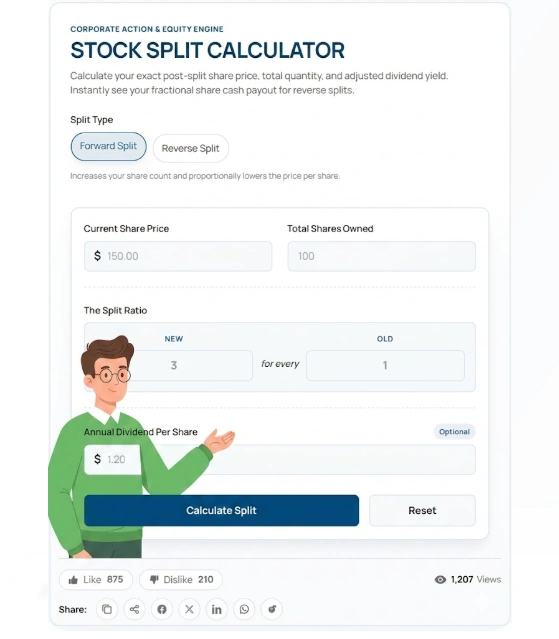
A Quick Example to Test
Let us test a reverse split scenario for a struggling penny stock.
Input:
- Split Type: Reverse Split
- Current Share Price: $2.00
- Total Shares Owned: 155
- The Split Ratio: 1 for 20
- Annual Dividend Per Share: $0.00
The calculator will process your exact result.
Result:
New Price Per Share: $40.00
New Share Total: 7
Original Portfolio Value: $310.00
Post-Split Value: $280.00
Cash-in-Lieu Payout: $30.00
Meaning:
The company consolidated the shares to raise the trading price. The investor receives 7 whole shares trading at $40 each. The leftover fraction converts into a $30 cash payout. The total $310 equity stays perfectly intact.
Which Corporate Action Mode Should You Select?
Companies manipulate their outstanding shares for two very different strategic reasons. You must choose the correct corporate action mode below before calculating your final numbers. Selecting the wrong event type will completely distort your post-split share count and your new market price.
| Mode | Mathematical Action | Share Price Impact | Real-World Purpose | Risk Level |
|---|---|---|---|---|
| Forward Split | Multiplies Shares | Lowers the individual trading price. | Attracts smaller retail investors and boosts options volume. | Low Risk. Indicates business growth. |
| Reverse Split | Consolidates Shares | Raises the individual trading price. | Prevents the company from facing exchange delisting penalties. | High Risk. Often triggers cash liquidations. |
| Fractional Split | Odd Multiplier | Moderate adjustment in both directions. | Fine-tunes capital structure without massive market disruption. | Medium Risk. Monitor dividend adjustments. |
Heads-up: The calculator assumes standard market execution logic. Always check your official brokerage statement for final settlement figures.
How to Use the Stock Split Calculator
Our corporate action engine breaks down complex share adjustments instantly. Follow these instructions to calculate your exact new equity and track hidden cash payouts.
Select Your Split Direction
Choose a forward split to lower a high share price. Pick a reverse split if the company is merging shares to boost the price. The calculator uses this choice to determine the exact multiplier needed for your portfolio.
Enter Your Pre-Split Holdings
Type in your current share price and total number of whole shares. The system multiplies these two numbers behind the scenes. This establishes your original baseline portfolio value before any corporate math alters your account.
Define the Split Ratio
Input the exact corporate ratio announced by the board. Enter a format like three for one for a standard forward growth split. The engine divides the new number by the old number to lock in your math multiplier.
Add Your Annual Dividend
Provide your current yearly dividend payout per share. This field remains completely optional. The calculator divides this dollar amount by your split multiplier. Your total yield percentage stays perfectly balanced against the newly adjusted share price.
Review Your Adjusted Equity
Check your post-split share count and updated market price. Look closely at the cash payout output. The system automatically isolates any leftover decimal fractions and liquidates them at the new price to simulate real brokerage behavior.
What result should you expect when a $1,200 tech stock splits 10-for-1?
This is a massive high-growth example that helps you test the calculator’s forward split engine and dividend adjustment tracking. It perfectly mirrors the real-world corporate actions recently executed in the semiconductor industry.
Use these inputs in the calculator:
Split Type: Forward Split
Current Share Price: 1200
Total Shares Owned: 15
The Split Ratio (New for Old): 10 for 1
Annual Dividend Per Share: 4.00
Expected output:
New Price Per Share: $120.00
New Share Total: 150
Original Portfolio Value: $18,000.00
Post-Split Value (in Shares): $18,000.00
Adjusted Dividend Per Share: $0.40
Status: VERIFIED
Expected interpretation:
The mathematical multiplier of 10 successfully converts the expensive tech stock into 150 highly accessible shares at the new $120 price point. The total $18,000 portfolio equity and the proportional dividend yield remain 100% secure and unchanged.
How do you calculate a stock split?
To calculate a stock split, divide the new share ratio by the old ratio to find your core multiplier. Multiply your current share total by this number to get your updated quantity. Finally, divide your original purchase price by the exact same multiplier to find your new adjusted trading price.
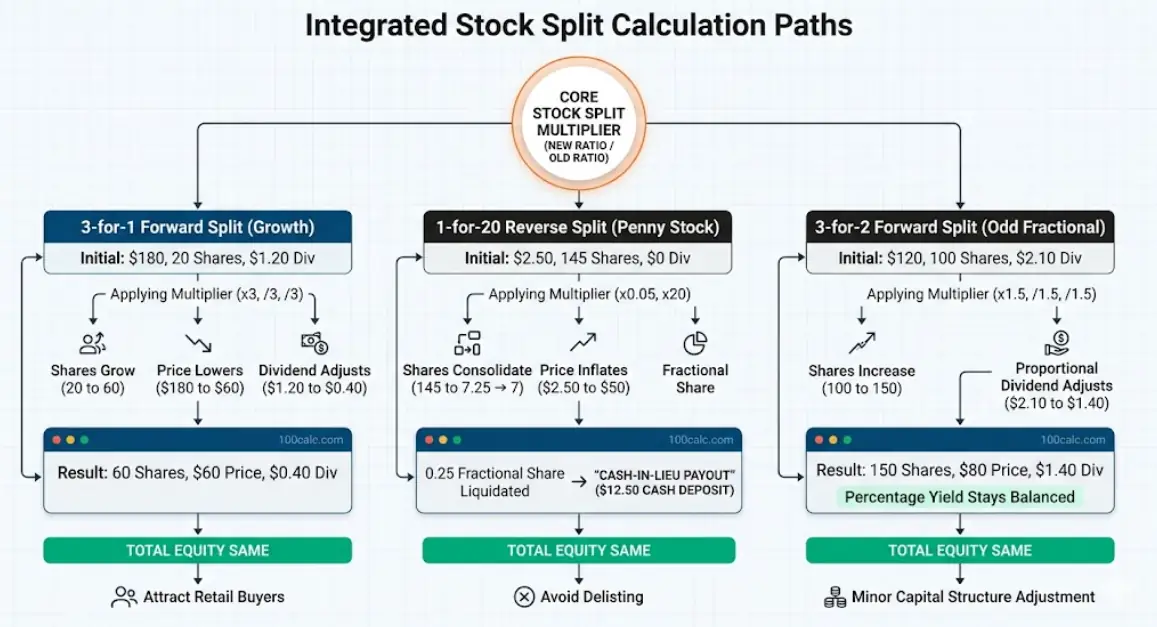
How to calculate stock split 3 for 1
To calculate a 3-for-1 stock split, multiply your current number of shares by 3, and divide your current share price by 3. Your total investment value will not change.
Use these inputs in the calculator:
Split Type: Forward Split
Current Share Price: $150.00
Total Shares Owned: 100
Split Ratio: 3 for 1
- Annual Dividend: $1.20
Process:
The multiplier is 3. The system multiplies your 100 shares by 3 to reach 300 shares. It then divides your $150 price by 3 to hit the new $50 price point.
Result:
- New Price Per Share: $50.00
- New Share Total: 300
- Adjusted Dividend: $0.40
- Total Equity: $15,000.00
Meaning:
You now own three times as many shares at one-third of the original price. Your total $15,000 investment value remains exactly the same.
How do I calculate a 1-for-20 reverse split on an Adani Power penny stock?
This example mirrors common, messy corporate actions where struggling companies merge shares to artificially inflate their trading price and avoid delisting.
Use these inputs in the calculator:
- Split Type: Reverse Split
- Current Share Price: $2.50
- Total Shares Owned: 145
- Split Ratio: 1 for 20
- Annual Dividend: $0.00
Process:
The multiplier is 0.05. The system applies this to your 145 shares, giving you 7.25 shares. It then multiplies your $2.50 price by 20 to hit the new $50 price point.
Result:
- New Price Per Share: $50.00
- New Share Total: 7
- Cash-in-Lieu Payout: $12.50
- Total Stock Equity: $350.00
Meaning:
Brokerages cannot hold the 0.25 fractional share. They liquidate it instantly at the new $50 market price and deposit the $12.50 straight into your cash balance.
How does a 3-for-2 split affect my dividend payout on Disney stock?
Companies use odd fractional forward splits like 3-for-2 or 5-for-4 to make minor adjustments to their capital structure without dropping their share price too drastically.
Use these inputs in the calculator:
- Split Type: Forward Split
- Current Share Price: $120.00
- Total Shares Owned: 100
- Split Ratio: 3 for 2
- Annual Dividend: $2.10
Process:
The multiplier is 1.5. The system multiplies your 100 shares by 1.5 to reach 150 shares. It divides the $120 price by 1.5 to reach $80. It also divides your $2.10 dividend by 1.5.
Result:
- New Price Per Share: $80.00
- New Share Total: 150
- Adjusted Dividend: $1.40
- Total Equity: $12,000.00
Meaning:
Your total share count increased by fifty percent. The company adjusted your yearly dividend payout proportionally so your overall percentage yield stays perfectly balanced.
A Quick Rule Before Testing Your Portfolio
Always confirm the exact ratio announced by the corporate board before calculating. Use your actual pre-split share count directly from your official brokerage statement. Remember that total portfolio equity never changes during these events. Plug your current numbers into the tool now to instantly find your adjusted cost basis and locate any hidden cash payouts.
Accuracy Behind the Stock Split Calculator
Basic online formulas often fail to handle fractional shares during complex corporate events. Our system mirrors live brokerage liquidation logic perfectly. It isolates partial shares instantly and calculates your exact cash payout. You get true bank-level accuracy for even the most extreme reverse splits.
Key Features & Benefits
- Detects and isolates fractional share anomalies instantly to match live markets.
- Calculates precise cash-in-lieu payouts to mirror real brokerage behavior.
- Adjusts historical dividend yields accurately against your new share counts.
- Reconciles total portfolio equity completely to ensure zero wealth loss.
- Supports extreme reverse split ratios commonly used to avoid exchange delisting.
Technical Process
Data Capture
Records your pre-split share count, market price, and the exact corporate ratio.
Core Calculation
Applies the mathematical multiplier and separates whole shares from leftover fractions.
Result Generation
Displays your adjusted share price alongside your retained equity and cash payout.
How the Stock Split Formula Works (Complete Breakdown)
Our stock split calculator uses precise corporate finance math to adjust your portfolio values. It divides your trading price while multiplying your share count instantly. By understanding these core equations, you can accurately track your adjusted tax cost basis and verify complex fractional cash payouts yourself.
The Standard Split Equations
					Split Multiplier = New Ratio / Old Ratio
New Share Count = Total Shares × Split Multiplier
New Share Price = Current Price / Split Multiplier
Adjusted Cost Basis = Original Purchase Price / Split Multiplier
Cash in Lieu = Fractional Amount × New Share Price
What This Formula Does
This math isolates the exact decimal driving the corporate action. It ensures your total portfolio equity remains perfectly balanced. The system multiplies your shares and divides your price by the exact same number. It also updates your historical purchase price so you can calculate future capital gains taxes without guessing.
Demystifying the Corporate Action Variables
Every variable connects directly to the raw data on your official brokerage statement. Knowing what these financial terms mean helps you catch platform errors quickly.
Split Multiplier
The central decimal used to execute all underlying math. A standard four-for-one forward split creates a multiplier of four. The calculation engine uses this specific number to scale your quantity and price simultaneously.
New Share Price
The active dollar amount a single share costs right after the market opens. Lowering this metric artificially makes expensive tech stocks look much more affordable to everyday retail buyers without changing the market capitalization.
New Share Count
The updated total of whole shares sitting in your account. Brokerages strip away leftover fractions during complex reverse splits. You only retain whole tradable units in your active portfolio.
Adjusted Cost Basis
Your new average purchase price used strictly for tax reporting. You must divide your original buying price by the split multiplier. If you bought shares at different times, you must adjust the cost basis for each individual “lot” separately.
Cash in Lieu Payout
The cash your broker deposits to compensate for liquidated partial shares during odd reverse splits. Warning: Many brokerages charge mandatory reorganization fees during involuntary corporate actions. This fee is deducted directly from your cash payout.
Another Example Calculation (Step-by-Step)
Let us see how the stock split calculator works using a real scenario. This helps you understand how the multiplier affects your final share count and your tax basis. The calculation follows the exact logic used by major trading platforms.
Given:
- Total Shares Owned = 155
- Current Share Price = $2.00
- Original Cost Basis = $1.50
- Split Ratio = 1 for 10
Calculation:
					Split Multiplier = 1 / 10 = 0.10
Raw New Shares = 155 × 0.10 = 15.5
New Share Price = 2.00 / 0.10 = $20.00
Adjusted Cost Basis = 1.50 / 0.10 = $15.00
Whole Shares = 15
Fractional Amount = 0.5
Cash Payout = 0.5 × 20.00 = $10.00
The system processes your 155 shares against the 0.10 multiplier, giving you 15.5 shares. Since brokers cannot issue half shares, the system strips the 0.5 fraction and liquidates it at the new $20 share price.
Result:
- New Share Count: 15
- New Share Price: $20.00
- Adjusted Cost Basis: $15.00
- Cash Payout: $10.00
Meaning:
The reverse split consolidated your penny stock. You now own 15 whole shares trading at $20 each. Your broker instantly liquidates the remaining half-share into a $10 cash deposit. Your new tax cost basis is $15 per share, allowing you to accurately track your $5 per share profit margin.
What is a Stock Split?
A stock split is a corporate action that changes the total number of outstanding shares. The company adjusts the individual share price to keep the overall market value identical. It alters how the stock is sliced without changing the size of the business.
Think of a company as a large pizza. If you cut it into four huge slices, each piece costs a lot of money. Cutting that same pie into eight smaller slices keeps the total value identical. Each new piece just becomes cheaper to buy.
Retail brands often use this strategy to attract everyday buyers. A stock trading at three thousand dollars locks out average investors. Lowering that price down to three hundred dollars helps normal people buy in. The business gains more shareholders.
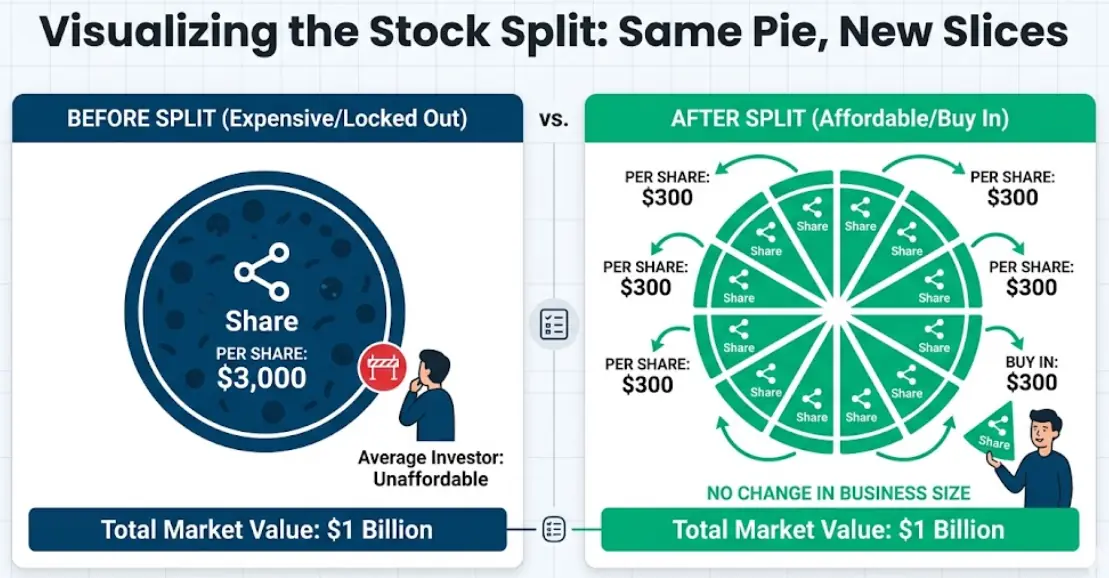
Why this matters
Corporate actions rarely impact underlying financial health. You should evaluate actual business fundamentals instead of buying just because the new price looks cheap.
Stock Split Result Benchmarks Explained
Your ratio from the stock split calculator reveals the exact strategy behind the corporate decision. High-growth tech companies use different numbers than struggling businesses facing exchange penalties. This quick breakdown helps you evaluate the new market structure and decide your next investment move.
| Range | Label | USA Markets | India Markets | Notes |
|---|---|---|---|---|
| 2-for-1 to 10-for-1 | Forward Growth | Highly common on NASDAQ to attract retail traders. | Frequent on NSE to boost retail participation. | Total equity is safe. Update limit orders. |
| 1-for-2 to 1-for-5 | Mild Reverse | Used to correct moderate share price drops. | Helps stabilize falling stock prices. | Monitor company fundamentals closely. |
| 1-for-10 to 1-for-50 | Extreme Reverse | Prevents NYSE or NASDAQ delisting. | Avoids penal action from BSE or NSE. | High risk. Watch for fractional cash payouts. |
Heads-up: Corporate actions never change the underlying market cap. Always research the company before making trading decisions based on price alone.
Interpretation
A forward action signals strong financial health and market confidence. The board wants smaller buyers to afford the stock easily. Any reverse action usually acts as a massive red flag. Failing companies force their stock price upward simply to meet the minimum requirements of major exchanges. You must evaluate the underlying business health rather than just looking at the cheaper new price tag.
Pro Tip
Check your open trading orders before the split date. Brokers usually cancel old limit orders automatically to protect you from buying or selling at the wrong adjusted price. Set fresh alerts based on your newly calculated ranges.
What to Do After Using the Stock Split Calculator
Your calculated post-split metrics should immediately drive your next portfolio moves. Corporate actions disrupt automated trading setups and create hidden cash events. Use the insights below to adjust your strategy based on the specific type of split your stock just underwent.
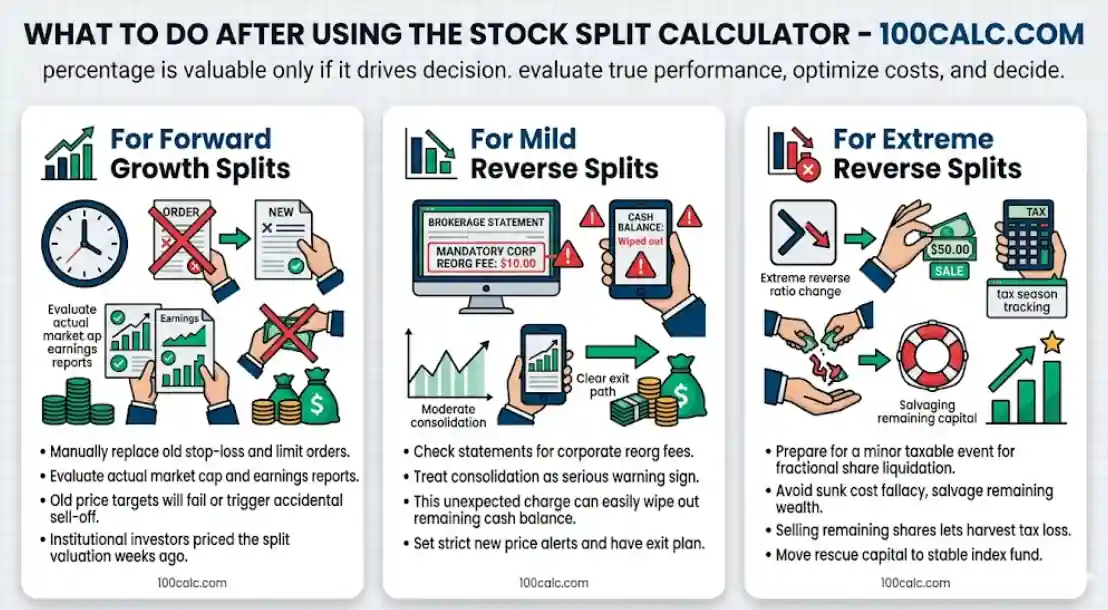
For Forward Growth Splits
Review your automated trading rules immediately. You must manually cancel and replace your old stop-loss and limit orders. Old price targets will either fail to execute or trigger a massive accidental sell-off at the wrong time.
Do not blindly buy more shares just because the price looks cheaper today. Evaluate the actual market cap and upcoming earnings reports. Institutional investors already priced the split into the current valuation weeks ago.
For Mild Reverse Splits
Check your recent brokerage statements for hidden corporate reorganization fees. Many trading platforms charge a mandatory fee when processing reverse actions. This unexpected charge can easily wipe out your remaining cash balance on smaller penny stock accounts.
Treat this moderate consolidation as a serious warning sign. Set strict new price alerts based on the newly adjusted market value. The corporate board is trying to stabilize the chart, so you need a clear exit plan if the downward trend continues.
For Extreme Reverse Splits
Prepare for a minor taxable event if your broker liquidated a fractional share. The cash payout you received is treated as a standard stock sale by the IRS. Track this specific dollar amount so you report it correctly during tax season.
Avoid the sunk cost fallacy if the company continues to lose value after an extreme ratio change. Selling your remaining shares now lets you harvest the tax loss to offset other portfolio gains. Moving that rescued capital into a stable index fund protects your remaining wealth.
You Might Also Find These Helpful
Investment 3
No tools published here yet.
Related Tools People Use Next
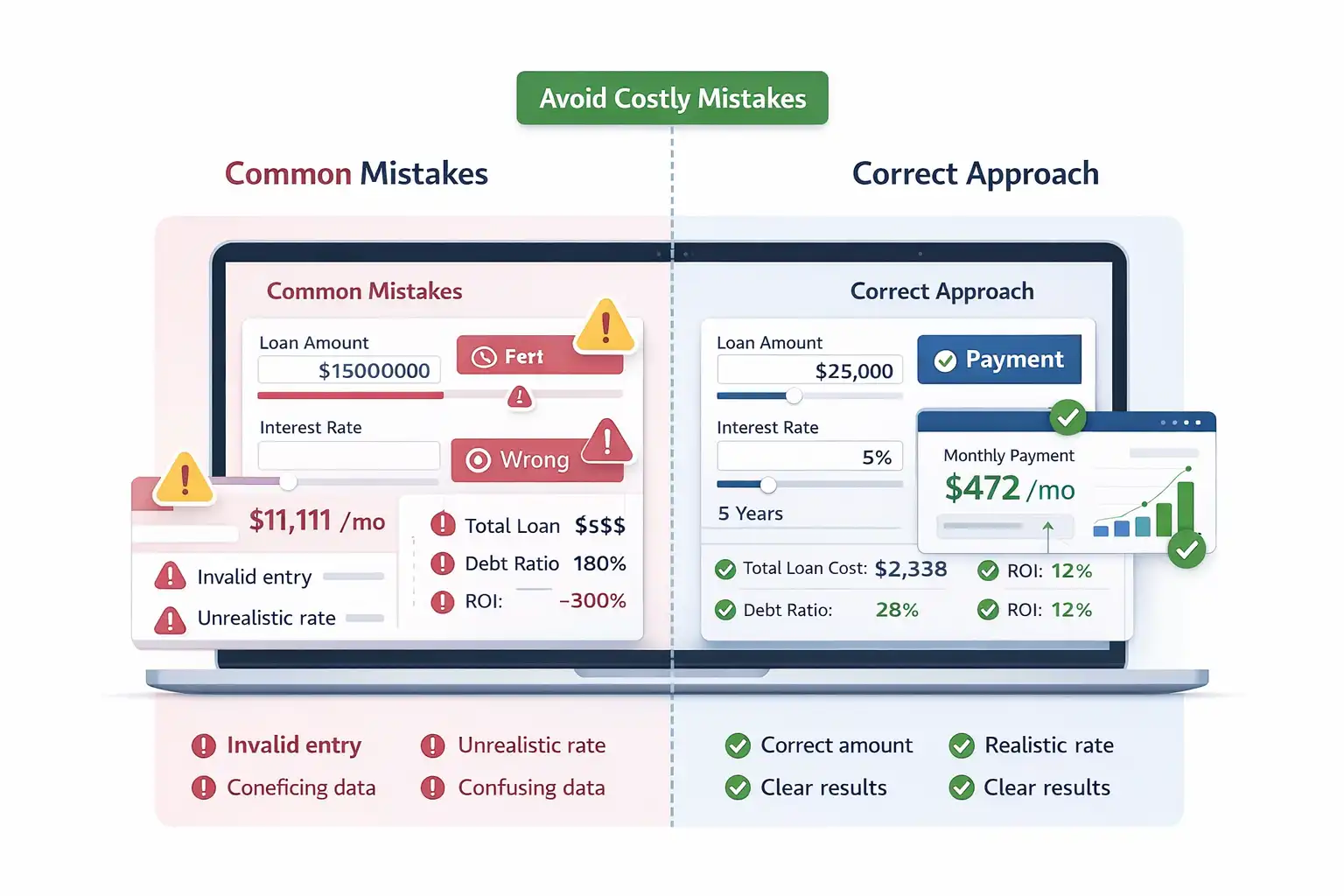
Common Mistakes When Calculating Stock Splits
Investors often panic or miscalculate their total wealth during major corporate actions. Simple input errors or misunderstanding how trading platforms process these events can lead to bad financial decisions. Review these frequent portfolio pitfalls to ensure your math matches reality perfectly.
- Panicking over a temporary portfolio drop before your broker officially settles the new shares.
- Forgetting to cancel open limit orders which triggers accidental trades at the old price.
- Thinking your dividend yield dropped when the payout simply adjusted to match the new ratio.
- Buying shares right before the execution date hoping for an immediate short-term profit jump.
- Entering the corporate record date price instead of the actual execution date market price.
Frequently Asked Questions (FAQs)
Why do companies still split stocks if fractional investing is widely available?
While retail apps allow fractional buying, standard options contracts still require bundles of exactly 100 whole shares. A forward split lowers the individual share price, making the options market much more accessible and highly liquid for everyday retail traders.
Lower share prices also help major exchange-traded funds (ETFs) maintain their required portfolio weightings more accurately without leaving uninvested cash.
What happens to my options contracts if a stock splits?
The Options Clearing Corporation automatically adjusts your strike price and contract multiplier. For example, holding one call option at a $100 strike during a two-for-one split leaves you with two distinct contracts, but the new strike price instantly drops to $50.
Your total contract equity and market exposure remain perfectly balanced before and after the corporate action.
Can I trade or sell fractional shares directly on the open stock exchange?
No. You cannot register as a partial shareholder or trade decimal fractions directly on public exchanges like the NYSE or NASDAQ. Fractional shares exist entirely on your brokerage’s internal ledger, and the broker must facilitate your trade internally.
Are there hidden brokerage fees associated with reverse stock splits?
Yes. Many major trading platforms charge a mandatory reorganization fee when processing involuntary corporate actions like reverse splits. This unexpected charge typically ranges from twenty to forty dollars and can easily wipe out your fractional cash-in-lieu payout.
Always check your broker’s specific fee schedule if you hold volatile penny stocks facing extreme consolidation.
Does a stock split change the Price-to-Earnings (P/E) ratio?
No. A corporate split has zero mathematical impact on a company’s Price-to-Earnings ratio. While the individual share price drops significantly, the company’s earnings per share (EPS) drops by the exact same multiplier, keeping the underlying valuation metric completely identical.
If I own fractional shares during a forward split, do they multiply too?
Yes. During a standard forward split, brokerages multiply your fractional shares exactly like your whole shares. If you currently own 1.5 shares during a standard two-for-one split event, the math simply converts your holdings into exactly 3 whole shares post-split.
Who actually owns the stock when I hold a fractional share?
Your brokerage legally owns the whole physical share and holds it securely in their master institutional account. They simply divide the financial value mathematically and allocate that specific percentage directly to your retail portfolio, passing on proportional dividends and capital gains.
Will a reverse stock split prevent a company from going bankrupt?
No. A reverse split only artificially inflates the individual trading price to prevent the stock from being delisted by major exchanges. It does not generate new capital, pay off corporate debt, or fix the underlying fundamental business problems.
What is the difference between the record date and execution date?
The record date is the official cutoff day chosen by the corporate board; you must legally own the stock on this date to be eligible for the split. The execution date (or ex-date) happens later and is the actual day the stock begins trading on the open market at the new, mathematically adjusted split price.
Questions?
We had love to hear from you! Whether you are reporting an issue, suggesting a new calculator, or exploring collaboration opportunities — we are here to help. Every message helps us make 100calc smarter, faster, and more helpful for everyone.
Why People Trust 100calc
At 100calc.com, we focus on accuracy, speed, and trust. Every calculator we create is designed to give reliable, instant, and easy-to-understand results you can truly depend on.