
COMSATS CGPA Calculator: Is Your Target Still Reachable?
Quick Facts
- Calculate semester SGPA from grade points and credit hours.
- Add new course results to your current cumulative CGPA.
- Check required Final marks using the 25 + 25 + 50 setup.
- Find the future GPA needed for a target CGPA.
- Use manual points when CU Online or your transcript differs.
- Updated Jul 24, 2026
COMSATS CGPA Calculator (CUI)
Calculate COMSATS SGPA and CGPA, predict required Final marks, or plan the GPA needed for a target CGPA using the selected CUI grade points.
Campus selection appears on your result. It does not change grade points, credit weighting, or the calculation method.
Enter your Sessionals and Mids out of 25 to predict the exact marks needed out of 50 in your Final Exam.
Enter your current CGPA, the credit hours already represented by it, and your planned future credits. The calculator finds the future GPA needed to reach your target.
Your CUI Score
Planning estimate for COMSATS University Islamabad. Campus selection does not change the calculation.
Academic Breakdown
How is COMSATS SGPA calculated from credit hours and grade points?
Multiply each course grade point by its credit hours. Add the quality points, then divide by total semester credits. The calculator updates this answer with your entered COMSATS course data.
Does a higher-credit course affect COMSATS GPA more?
Yes. A four-credit course carries more weight than a two-credit course because SGPA and CGPA use credit-weighted grade points rather than a simple grade average.
Which grade points should I enter in the CUI GPA calculator?
Use the listed CUI grade points or select Manual Input when your CU Online record or transcript shows a different point value. The academic record remains the final source.
What Your COMSATS SGPA, CGPA, or Target Result Means
Your result shows the academic outcome produced by the values you entered. Its meaning changes with the selected mode. Semester SGPA measures one term. Updated CGPA includes your earlier record. Finals Predictor shows required exam marks. Target mode checks whether a future cumulative goal is mathematically possible.
Understanding Your Result
Your result reflects the calculation mode and academic values you entered. It may show a semester SGPA, updated cumulative CGPA, required Final marks, or the future GPA needed for a target.
Check the supporting details before judging the main number. Credit hours, quality points, completed credits, and planned credits explain why the result changed. These values also help you spot an incorrect entry before comparing the estimate with CU Online or your transcript.
Semester SGPA
Your semester SGPA covers only the completed course rows entered in the calculator. It does not include any previous semester.
Each course affects the result based on its credit hours. A four-credit course carries twice the weight of a two-credit course with the same grade.
An F contributes 0.00 grade points but still adds its entered credits to the calculation. This can lower the semester result sharply.
The calculator displays the final SGPA to two decimal places. It also shows total credits and quality points so you can check what shaped the score.
Updated CGPA
An updated CGPA combines your current cumulative record with the new semester courses.
The result depends on:
- Your current CGPA
- Previous CGPA-bearing credits
- New course grade points
- New semester credit hours
A strong semester may raise CGPA only slightly when many credits are already completed. Earlier credits carry more weight because they already form most of the cumulative record.
The academic breakdown also shows the new semester SGPA. Compare it with your current CGPA to understand whether the new term raises or lowers the cumulative result.
Finals Predictor
The Finals Predictor shows how many marks you need in a Final exam worth 50 marks.
Results fall into three outcomes:
- Already Reached: Your sessional and midterm total already meets the selected grade threshold.
- Reachable: You need between 0.1 and 50 marks in the Final.
- Not Reachable: The required score exceeds the 50 marks available.
This mode assumes 25 marks for sessionals, 25 for mids, and 50 for the Final. Check your course outline when the assessment structure differs.
Target CGPA
Target mode shows the average GPA needed across your planned future credit hours.
It also calculates the highest cumulative score possible if you earn a 4.00 GPA across every planned credit.
The target status means:
- Target Protected: Your current record already supports the entered goal.
- Target Reachable: The required future GPA falls between 0.01 and 4.00.
- Target Not Reachable: The required GPA exceeds the 4.00 limit.
Adding more planned credits can make some targets reachable because the improvement has more academic weight. It also means maintaining the required average for a longer period.

Is Your COMSATS Result Good or Bad?
A higher result is not always enough to judge your position. Compare it with your current CGPA, personal target, completed credits, and program requirements.
A semester GPA above your current CGPA normally raises the cumulative result. A lower semester GPA normally pulls it down. The size of that change depends on the credit hours involved.
For target planning, the required GPA gives clearer guidance:
- A requirement below 3.00 may offer more flexibility.
- A result between 3.00 and 3.49 needs consistent grades.
- A result from 3.50 to 4.00 leaves less room for weak courses.
- A requirement above 4.00 cannot be reached within the entered plan.
These ranges describe planning difficulty. They do not confirm official COMSATS academic standing.
What You Should Do Next
- Compare the entered credits with the total shown in CU Online.
- Check whether your semester GPA sits above or below your current CGPA.
- Review high-credit courses before setting grade targets.
- Try a longer credit plan when the required GPA exceeds 4.00.
- Confirm the 25 + 25 + 50 setup before using the Finals result.
- Use Manual Input when your transcript shows different grade points.
Treat status labels as planning guidance. They do not officially confirm probation, honor roll, graduation, scholarships, degree completion, or dean’s list placement.
How Can One Semester Change a COMSATS CGPA?
A student has a current CGPA of 3.10 across 48 CGPA-bearing credits.
The new semester includes:
- Programming: 3 credits, A− at 3.66
- Database Systems: 4 credits, B at 3.00
- Calculus: 3 credits, C+ at 2.33
- Communication Skills: 2 credits, B+ at 3.33
The entered courses produce 36.63 quality points across 12 credits.
The calculator returns:
- New semester SGPA: 3.05
- Updated CGPA: 3.09
- Combined credits: 60
- Combined quality points: 185.43
The cumulative score falls by only 0.01. The semester SGPA is slightly below the starting CGPA, but the earlier 48 credits limit the size of the change.
Explore More Calculators
Use the CGPA Calculator to calculate CGPA from GPA or SGPA, convert CGPA to percentage or 4.0 GPA, and plan your target CGPA. Works…
Try calculatorCalculate your GPA instantly using 4.0, percentage, or university scales. Accurate results with credits, conversions, and global GPA comparison.
Try calculatorApplying to Germany? Use our free CGPA to German Grade Calculator. Convert your 10.0 or 4.0 scale instantly to see if you meet the…
Try calculatorUse this college GPA calculator to check semester, cumulative, and major GPA fast. Add grades, credits, retakes, and pass failed courses in one place.
Try calculatorWorried about your grades? Use the FAST CGPA Calculator to instantly check your SGPA, simulate F-grade replacements, and avoid academic probation today!
Try calculatorWill your grades get you into TUM? Use our German GPA Calculator to convert your CGPA or percentage instantly. Find your exact DAAD equivalent…
Try calculatorHow Do I Use the COMSATS CGPA Calculator?
Choose the result you need, enter the matching academic values, and check the point scale before calculating. The tool applies a different process for semester SGPA, updated CGPA, Final marks, and target planning.
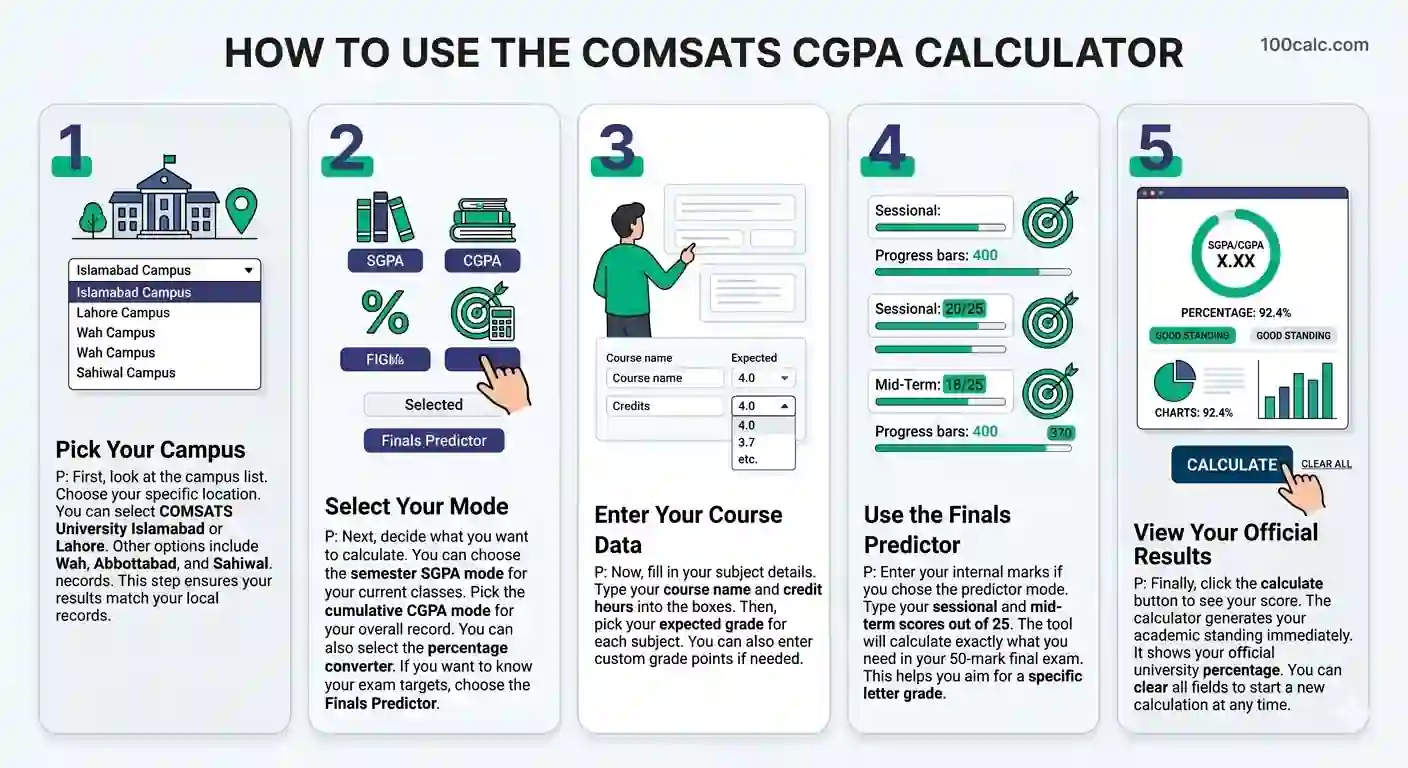
Which Calculation Mode Should I Choose?
Select Semester SGPA for one term or Cumulative CGPA for an updated overall result. Use Finals Predictor to check required exam marks, or choose Target CGPA to find the future GPA needed across your planned credit hours.
What Academic Details Should I Enter?
Add each course grade and credit hours for an SGPA result. Cumulative mode also needs your current CGPA and previous CGPA-bearing credits, while Finals Predictor and Target CGPA request their own marks, goals, and future credit values.
Which CUI Grade Points Should I Use?
Match each course with the grade points listed in the calculator. Select Manual Input when CU Online or your transcript shows another value, but keep that entry between 0.00 and 4.00. Raw course marks are not converted automatically in SGPA mode.
How Does the Calculator Process My Entries?
Select Calculate CUI Result after completing the required fields. The calculator checks the values, weights every course by its credit hours, and runs the logic for your chosen mode. Invalid CGPA values, nonpositive credits, and manual points outside the scale are rejected.
What Should I Check in the Result Breakdown?
Review the main score with the values that produced it. Depending on the mode, the breakdown shows total credits, quality points, new semester SGPA, required Final marks, future GPA, maximum possible CGPA, or target reachability. The campus choice labels the result but does not change it.
Can I Test the COMSATS Finals Predictor?
Try this:
- Mode: Finals Predictor
- Subject: Data Structures
- Sessionals: 17.5 out of 25
- Mids: 15 out of 25
- Target grade: B, which starts at 71 marks
Calculation:
Current internal marks:
17.5 + 15 = 32.5
Required Final marks:
71 − 32.5 = 38.5
Result:
You need 38.5 out of 50 in the Final to reach the selected B-grade target. The result is reachable because the required score stays within the 50 marks available.
How Accurate Is the COMSATS CGPA Calculator System?
The COMSATS CGPA Calculator uses separate calculation rules for SGPA, cumulative CGPA, Final marks, and target planning. It checks each value before processing and applies credit weighting where needed. Results remain planning estimates, so CU Online and your transcript should guide official academic decisions.
Key Features & Benefits
- Weights every course using its grade points and credit hours.
- Keeps semester SGPA separate from the cumulative CGPA record.
- Supports manual grade points from 0.00 to 4.00.
- Checks whether a target stays within the 4.00 GPA limit.
- Shows required Final marks for every completed subject row.
Technical Process
Input Capture
The system reads completed course, credit, CGPA, marks, or target fields. It ignores unfinished rows that do not contain enough information for a valid result.
Logic Processing
Valid entries pass through the matching mode. Credit-based modes weight course points, while planning modes compare entered totals with fixed limits and targets.
Result Output
The calculator displays the main result with supporting totals and status details. Dynamic questions explain the selected mode without changing the calculated value.
How the COMSATS CGPA Calculator Formula Works (Complete Breakdown)
The COMSATS CGPA Calculator uses credit-weighted grade points for SGPA and CGPA. Separate formulas calculate required Final marks and future GPA targets. Each equation uses the values entered in the tool, including course credits, current CGPA, internal marks, and planned credits. No general CGPA-to-percentage formula is applied.
What Formulas Does the Calculator Use?
Course Quality Points = Credit Hours × Grade Points Semester SGPA = Total Semester Quality Points ÷ Total Semester Credit Hours Previous Quality Points = Current CGPA × Previous CGPA-Bearing Credits New Semester SGPA = New Semester Quality Points ÷ New Semester Credits Updated CGPA = [(Current CGPA × Previous CGPA-Bearing Credits) + New Semester Quality Points] ÷ (Previous CGPA-Bearing Credits + New Semester Credits) Current Internal Marks = Sessional Marks + Midterm Marks Required Final Marks = Target Grade Total - Current Internal Marks Required Future GPA = [Target CGPA × (Completed Credits + Planned Credits) - (Current CGPA × Completed Credits)] ÷ Planned Credits Maximum Possible CGPA = [(Current CGPA × Completed Credits) + (4.00 × Planned Credits)] ÷ (Completed Credits + Planned Credits)
How Does the Semester SGPA Formula Work?
Each course earns quality points based on its grade and credit hours. The calculator adds those points and divides them by the semester’s total credits.
A four-credit course carries more weight than a two-credit course. This makes the result a weighted GPA rather than a simple grade average.
How Is an Updated COMSATS CGPA Calculated?
The cumulative formula rebuilds the quality points behind your current CGPA. It then combines them with the new semester’s points and credits.
Earlier semesters keep their academic weight. A new semester with fewer credits may change the cumulative result only slightly.
How Does the Finals Predictor Calculate Required Marks?
The calculator adds sessional and midterm marks to find the current internal total. It subtracts that number from the marks required for the selected target grade.
A result above 50 is not reachable within the assumed Final exam. A result at or below zero means the target total has already been reached.
How Does the Target CGPA Formula Work?
Target mode finds the average GPA needed across the planned future credits. It compares the required result with the calculator’s 4.00 maximum.
The tool also calculates the highest possible CGPA under the same plan. This maximum assumes a perfect 4.00 across every planned credit.
What Do the Formula Variables Mean?
- Credit Hours: The academic weight assigned to one course.
- Grade Points: The numerical value linked to the selected letter grade.
- Quality Points: Credit hours multiplied by grade points for one course.
- Semester Quality Points: The combined quality points from all valid course rows.
- Semester Credits: The total credits included in the semester calculation.
- Current CGPA: The cumulative GPA shown before adding new courses.
- Previous CGPA-Bearing Credits: Credits already represented by the current CGPA.
- Previous Quality Points: The points carried forward from the earlier academic record.
- New Semester SGPA: The weighted GPA from the newly entered courses.
- Sessional Marks: Current internal marks entered out of 25.
- Midterm Marks: Midterm score entered out of 25.
- Current Internal Marks: Sessionals and mids added together.
- Target Grade Total: The overall course score needed for the chosen grade.
- Completed Credits: Existing credits used by the Target CGPA mode.
- Planned Credits: Future credits included in the target plan.
- Target CGPA: The cumulative result the student wants to reach.
- Required Future GPA: The average needed across the planned credits.
- Maximum Possible CGPA: The highest result possible with a future 4.00 GPA.
| Letter Grade | Grade Points |
|---|---|
| A | 4.00 |
| A− | 3.66 |
| B+ | 3.33 |
| B | 3.00 |
| B− | 2.66 |
| C+ | 2.33 |
| C | 2.00 |
| C− | 1.66 |
| D+ | 1.33 |
| D | 1.00 |
| F | 0.00 |
Transcript check: Select Manual Input when CU Online or your transcript shows another grade-point value. Manual entries must stay between 0.00 and 4.00.
| Target Grade | Target Course Total |
|---|---|
| A | 85 marks |
| A− | 80 marks |
| B+ | 75 marks |
| B | 71 marks |
| B− | 68 marks |
| C+ | 64 marks |
| C | 61 marks |
| C− | 58 marks |
| D+ | 54 marks |
| D | 50 marks |
Assessment check: These targets use the calculator’s fixed 25 + 25 + 50 setup. Confirm your course outline when the marks distribution differs.
Another COMSATS CGPA Calculation (Step-by-Step)
Let’s add a new semester to an existing COMSATS CGPA. This example shows how previous credits can limit the effect of one stronger semester.
Given:
- Current CGPA: 3.12
- Previous CGPA-Bearing Credits: 54
New Semester Courses:
- Artificial Intelligence: 3 credits, A−, 3.66 points
- Computer Networks: 4 credits, B+, 3.33 points
- Statistics: 3 credits, B, 3.00 points
- Professional Ethics: 2 credits, C+, 2.33 points
Calculation:
Artificial Intelligence Quality Points = 3 × 3.66 = 10.98 Computer Networks Quality Points = 4 × 3.33 = 13.32 Statistics Quality Points = 3 × 3.00 = 9.00 Professional Ethics Quality Points = 2 × 2.33 = 4.66 New Semester Quality Points = 10.98 + 13.32 + 9.00 + 4.66 = 37.96 New Semester Credits = 3 + 4 + 3 + 2 = 12 New Semester SGPA = 37.96 ÷ 12 = 3.16 Previous Quality Points = 3.12 × 54 = 168.48 Updated CGPA = (168.48 + 37.96) ÷ (54 + 12) Updated CGPA = 206.44 ÷ 66 = 3.13
Result:
- New Semester SGPA: 3.16
- Updated CGPA: 3.13
- Combined Credit Hours: 66
- Combined Quality Points: 206.44
Meaning:
The semester SGPA is slightly higher than the previous 3.12 CGPA. This raises the cumulative result to 3.13.
The change is small because 54 earlier credits already carry most of the academic weight. One semester has less impact when many CGPA-bearing credits are already completed.
How Do You Calculate COMSATS CGPA?
To calculate COMSATS CGPA, multiply each course grade point by its credit hours. Add the quality points and divide by total credits. For an updated CGPA, combine earlier quality points with the new semester. The examples below also show Final marks and target planning.
What Is the SGPA for a 13-Credit COMSATS Semester?
A BSCS student wants to calculate the semester GPA for five courses.
Input
- Operating Systems: 4 credits, A−, 3.66 grade points
- Discrete Structures: 3 credits, B+, 3.33 grade points
- Technical Writing: 2 credits, A, 4.00 grade points
- Linear Algebra: 3 credits, B−, 2.66 grade points
- Programming Lab: 1 credit, B, 3.00 grade points
Process
Operating Systems = 4 × 3.66 = 14.64
Discrete Structures = 3 × 3.33 = 9.99
Technical Writing = 2 × 4.00 = 8.00
Linear Algebra = 3 × 2.66 = 7.98
Programming Lab = 1 × 3.00 = 3.00
Total Quality Points = 43.61
Total Credits = 13
Semester SGPA = 43.61 ÷ 13 = 3.35
Result
- Semester SGPA: 3.35
- Total credits: 13
- Total quality points: 43.61
Meaning
The four-credit Operating Systems course has the strongest effect. Its A− adds more quality points than the lower-credit courses.
How Can a Strong Semester Raise a 2.92 COMSATS CGPA?
A student has completed 72 CGPA-bearing credits. The new 15-credit semester performs better than the earlier cumulative record.
Input
- Current CGPA: 2.92
- Previous CGPA-bearing credits: 72
- Software Engineering: 4 credits, B+, 3.33 grade points
- Artificial Intelligence: 3 credits, A−, 3.66 grade points
- Probability: 3 credits, B, 3.00 grade points
- Human-Computer Interaction: 3 credits, A, 4.00 grade points
- Professional Ethics: 2 credits, B−, 2.66 grade points
Process
New Semester Quality Points = 50.62
New Semester Credits = 15
New Semester SGPA = 50.62 ÷ 15 = 3.37
Previous Quality Points = 2.92 × 72 = 210.24
Updated CGPA = (210.24 + 50.62) ÷ (72 + 15)
Updated CGPA = 260.86 ÷ 87 = 3.00
Result
- New semester SGPA: 3.37
- Updated CGPA: 3.00
- Combined credits: 87
- Combined quality points: 260.86
Meaning
The 3.37 semester raises the CGPA from 2.92 to 3.00. The earlier 72 credits limit how quickly the cumulative result changes.
How Many Final Marks Are Needed for an A− at COMSATS?
A student wants an A− under the calculator’s fixed 25 + 25 + 50 assessment setup.
Input
- Subject: Computer Networks
- Sessional marks: 20 out of 25
- Midterm marks: 18.5 out of 25
- Target grade: A−
- Target course total: 80 marks
Process
Current Internal Marks = 20 + 18.5 = 38.5
Required Final Marks = 80 – 38.5 = 41.5
Result
- Required Final marks: 41.5 out of 50
- Target grade: A−
- Status: Reachable
Meaning
The student must score 41.5 in the Final to reach 80 total marks. The target remains possible because the required score stays below 50.
Can a 2.70 CGPA Reach 3.10 in 15 Credits?
A student wants to know whether 15 more credits provide enough room to reach a 3.10 cumulative result.
Input
- Current CGPA: 2.70
- Completed CGPA-bearing credits: 90
- Target CGPA: 3.10
- Planned future credits: 15
Process
Current Quality Points = 2.70 × 90 = 243.00
Target Quality Points = 3.10 × (90 + 15) = 325.50
Remaining Quality Points Needed = 325.50 – 243.00 = 82.50
Required Future GPA = 82.50 ÷ 15 = 5.50
Maximum Possible CGPA = (243.00 + 4.00 × 15) ÷ 105
Maximum Possible CGPA = 303.00 ÷ 105 = 2.89
Result
- Required future GPA: 5.50
- Maximum possible CGPA: 2.89
- Target CGPA: 3.10
- Status: Target Not Reachable
Meaning
A 5.50 GPA exceeds the 4.00 limit. Even a perfect future GPA would raise the cumulative result only to 2.89 within 15 credits.
What Should You Check Before Entering Your Own Grades?
Use the grade points and CGPA-bearing credits shown on CU Online or your transcript. Check your course outline before using Finals Predictor, since its result assumes 25 sessional marks, 25 midterm marks, and a 50-mark Final.
What Do COMSATS CGPA Calculator Results Mean by Range?
The COMSATS CGPA Calculator compares your required future GPA with the 4.00 limit. These ranges show whether your target is already protected, still possible, or outside the entered credit plan. Use the result to adjust your GPA goal, future credits, or expected course grades.
| Required Future GPA | Label | Planning Meaning | COMSATS Context | What to Do |
|---|---|---|---|---|
| 0.00 | Target Protected | Your current record already supports the entered target. | No positive future GPA is needed under this credit plan. | Confirm your credits, then consider a higher target. |
| 0.01–4.00 | Target Reachable | Your target is mathematically possible within the planned credits. | A result near 4.00 leaves little room for weak course grades. | Compare the required GPA with realistic semester results. |
| Above 4.00 | Not Reachable | The required GPA exceeds the calculator’s maximum limit. | The entered target cannot be reached within those future credits. | Add more planned credits or choose a lower target CGPA. |
Heads-up: These ranges explain mathematical target reachability. They do not confirm probation, graduation, honor roll, scholarships, or dean’s list status.
Interpretation
A reachable result does not mean the target will be easy. Required GPAs closer to 4.00 demand stronger and more consistent grades. A result above 4.00 means the current target and credit plan do not work together.
Pro Tip
Test the same target with several future credit totals. More planned credits may lower the average GPA needed, but you must maintain that result across a longer study period.
You Might Also Find These Helpful
GPA 18
Use the High School GPA Calculator to check weighted and unweighted GPA, include honors or AP classes, track cumulative GPA, and see what GPA…
Try calculatorDon't risk academic probation! Use our accurate IIUI CGPA Calculator to map your marks on the 0.50 scale and find your exact percentage instantly.…
Try calculatorStop guessing! Use our updated Karachi University CGPA Calculator to instantly check your semester score, avoid probation, and catch scrutiny grade bumps now.
Try calculatorUse our NUST CGPA Calculator to master the relative grading curve! Instantly calculate SGPA, check HEC percentage, and predict OHT survival marks. Try it…
Try calculatorWorried about a low LMS score? Use our live UAF CGPA Calculator to instantly predict your exact GPA, plan retakes to avoid probation, and…
Try calculatorIs your GPA safe? Use the official UCP CGPA Calculator to check probation risks instantly. Accurate, fast, and secure. Verify your university grades today!
Try calculatorUse the UET CGPA Calculator for Lahore, Taxila, or Peshawar. Check SGPA, updated CGPA, percentage estimate, and the score needed before results arrive.
Try calculatorCalculate your exact score with the 100% accurate UMT CGPA Calculator. Check your true academic standing, avoid probation, and plan your next semester.
Try calculatorStop guessing your academic rank. Use our Unweighted GPA Calculator to instantly convert percentages to a 4.0 scale, check your rigor, and set exact…
Try calculatorStop typing courses manually! Use the exact UOG CGPA Calculator. Paste your CMS transcript directly, predict expected marks, and avoid probation right now.
Try calculatorCalculate UOL GPA, SGPA and CGPA using the University of Lahore grade scale. Enter courses or paste supported grade and credit-hour data from SAP/SIS.
Try calculatorUse our weighted GPA calculator to check your 5.0 scale GPA, compare weighted vs unweighted GPA, and see how AP or Honors classes raise…
Try calculatorFrequently Asked Questions (FAQs)
Can I calculate my first-semester COMSATS CGPA?
Yes. Use Semester SGPA mode and enter every CGPA-bearing course from your first semester. Since no earlier semester exists, your first SGPA and CGPA should represent the same academic record. Compare the calculated score with CU Online once official grades appear.
Can I calculate COMSATS CGPA from semester GPAs only?
Not accurately without each semester’s credit hours. A semester with 18 credits carries more weight than one with 12 credits. Use your current CGPA and total CGPA-bearing credits, then add the new semester courses. A simple average of semester GPAs may produce the wrong result.
How should I enter a repeated or improved course?
Use the course attempt and credit treatment shown in your latest official record. The calculator cannot detect repeated courses or remove an older grade automatically. Update your current CGPA and CGPA-bearing credits after any official replacement, then enter only the courses needed for the new calculation.
How do I enter COMSATS theory and lab courses?
Enter theory and lab as separate course rows when CU Online lists separate grades and credit hours. If they appear as one combined course, use the combined record. Do not split credits based on an estimate, since that can change the weighted semester GPA.
Can the COMSATS GPA calculator calculate GPA from marks?
No. Semester SGPA mode uses letter grades or manual grade points, not raw marks. Check the grade and point value shown on your transcript or CU Online. Finals Predictor accepts internal marks, but it only calculates the Final score needed for a selected grade target.
Why does my calculator result differ from CU Online?
Differences often come from incorrect credit totals, rounded CGPA values, repeated courses, non-GPA courses, or a different grade-point value. Check every entered course against your latest record. CU Online may also apply academic rules that this planning tool cannot identify automatically.
Does the calculator convert COMSATS CGPA to percentage?
No. The calculator does not apply a general CGPA-to-percentage formula because different institutions may request different conversion or equivalence methods. Use the percentage rule provided by the receiving university, employer, or scholarship body. Request an official document when formal proof is required.
Can I use this calculator for COMSATS BSCS or BSSE?
Yes, when your program uses the same 4.00 grade-point scale and the entered values match your record. The calculation works from grade points and CGPA-bearing credits, not the program name. Always use transcript values when a department applies a different course or grade treatment.
Questions?
We had love to hear from you! Whether you are reporting an issue, suggesting a new calculator, or exploring collaboration opportunities — we are here to help. Every message helps us make 100calc smarter, faster, and more helpful for everyone.
Why People Trust 100calc
At 100calc.com, we focus on accuracy, speed, and trust. Every calculator we create is designed to give reliable, instant, and easy-to-understand results you can truly depend on.