
Return on Investment Calculator: Uncover Your True Net Profit
This return on investment calculator reveals your exact net profit and annualized growth rate. Users simply choose an asset category. Enter your initial cash. Add the final value and any ongoing expenses. Our system handles the complex math. You get a clear picture of your actual financial performance instantly.
Gross yield is a massive trap. High returns look amazing until you factor in holding time. Many investors think they beat the market. Hidden broker fees and real estate vacancy periods often destroy margins. Did inflation secretly eat your purchasing power?
Stop relying on flawed estimates. Discover exactly how hard your money works. The tool compares real profit against standard market benchmarks. Learn if your asset is truly growing your wealth.
Quick Facts
- Best for: Real estate, stocks, and business tracking.
- Key output: Annualized ROI and exact net profit.
- Asset modes: Simple, crypto, real estate, and solar.
- Updated Jun 16, 2026
- Reviewed by 100Calc Research Team
Investment Analysis & CAGR Engine
Return on Investment (ROI) Calculator
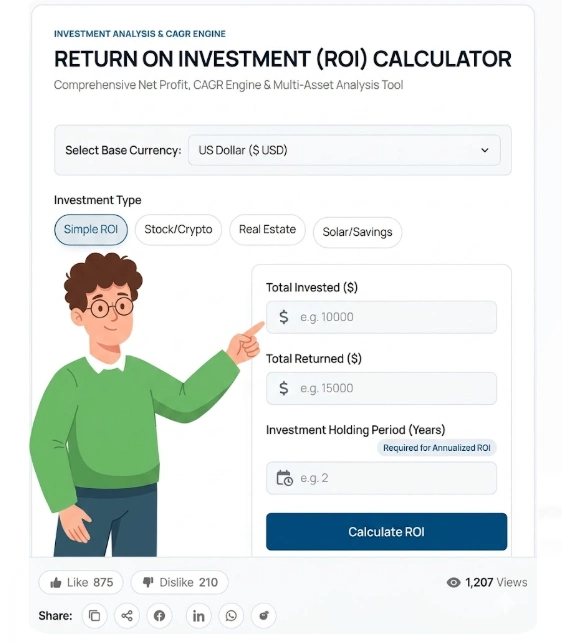
Calculate your exact net profit, total ROI, and annualized return. Select your specific asset type below for a tailored financial breakdown.
Total Return on Investment
%
Investment Breakdown
Is a 7% return on investment good?
How much will $10,000 invested be worth in 30 years?
What if I invested $1000 in S&P 500 10 years ago?
How do I calculate my ROI?
Explore More Calculators
High dividends often mask decaying stock prices. Use our expected capital gains yield calculator to isolate true growth and avoid risky value traps.
Try calculatorCalculate your exact adjusted basis with this free cost basis calculator. Track stock DRIPs, crypto DCA, and real estate depreciation to lower taxes.
Try calculatorUse our free Stock Split Calculator to find your exact post-split share price, total holdings, and tax cost basis. Calculate fractional cash payouts instantly.
Try calculatorExplore Related Tools
Which Investment System Matches Your Asset?
Different investments require completely different math. A standard stock formula fails if you use it for a rental property with a mortgage. Crypto trades include hidden gas fees. Solar panels focus purely on breakeven timelines. Choose the correct calculator model below to get an accurate number.
| System Mode | Asset Profile | Key Inputs Required | What It Calculates | Notes |
|---|---|---|---|---|
| Simple & Stocks | Standard | Initial capital, dividends, final sale price. | Total net profit and true annualized yield. | Perfect for basic index funds or cash purchases. |
| Crypto | Trading | Token cost, network gas fees, staking yields. | Exact profit after hidden blockchain expenses. | Prevents overestimating gross trading margins. |
| Real Estate | Leveraged | Cash down payment, monthly rent, property taxes. | Cash-on-cash return and equity generation. | Never use the total property price for calculations. |
| Solar & Business | Savings | Installation cost, monthly utility or labor savings. | Exact financial breakeven and payback timeline. | Measures money saved instead of new cash earned. |
Heads-up: Always calculate return on investment based on your actual cash invested out-of-pocket, not the total gross value of the asset.
What Your Return on Investment Means
Your final numbers reveal the exact profit generated from your initial cash. The calculator delivers absolute return and an annualized growth rate. This stops you from confusing a massive gross payout with actual financial efficiency.
Understanding Your Result
Absolute return shows the total percentage of money gained. It ignores the time it took to earn that cash. A massive 60% total profit looks amazing on paper.
That number loses its value if it took ten years to achieve. Annualized ROI solves this problem completely. It breaks your total profit down into a yearly speed limit.
This yearly percentage lets you compare different assets perfectly. You can match a fast tech stock flip directly against a thirty-year real estate hold.
Is Your Result Good or Bad?
Compare your annualized rate directly against a standard index fund. Acknowledge if your active trading strategy is actually beating passive market returns.
Audit your hidden expenses immediately. High broker fees and surprise property taxes destroy profit margins quickly. Lowering these operating costs will instantly boost your final net profit.
Review your holding period strategy. Selling an asset too fast can trigger heavy capital gains taxes. Waiting a few extra months might drop you into a cheaper tax bracket and save your money.
A Quick Example to Test
Let’s say an investor wants to evaluate a simple stock portfolio.
Input:
- Initial Capital = $10,000
- Current Value = $13,000
- Dividends = $400
- Broker Fees = $100
- Holding Period = 3 years
The calculator will process your exact cash flow and factor in the three-year timeline.
Result:
Net Profit = $3,300.
Total ROI = 32.67%.
Annualized ROI = 9.88%.
Meaning:
The investor grew their initial cash by exactly 9.88% each year. Since a standard index fund yields around 8% to 10% annually, this portfolio represents a solid return that successfully beats inflation and builds real wealth over time.
How to Use the Return on Investment Calculator
This tool transforms raw financial numbers into clear profit metrics. It removes the guesswork from tracking asset performance. You only need a few basic details to uncover your true annualized growth rate.
Select Your Asset Category
Choose the correct investment mode first. The system offers options for simple tracking, crypto trading, real estate, or solar savings. This choice adjusts the underlying formula. It ensures the calculator deducts the right hidden fees for your specific asset.
Enter Your Starting Capital
Add the exact amount of cash you invested initially. Real estate users must input their cash down payment here, not the total property price. Include any upfront costs associated with acquiring the asset.
Add Your Current Value
Type in the final sale price or the current market value of your asset. You must also include any generated income in this step. Add your stock dividends or total rental income collected during the holding period.
Factor In Hidden Expenses
Enter all ongoing costs tied to your investment. Crypto users should add gas fees and broker charges. Real estate investors must include flat mortgage payments, property taxes, and expected vacancy periods. The system uses these to find true net profit.
Set Your Holding Period
Input the total time you owned the asset. Choose years, months, or days from the dropdown menu. The calculator converts this time frame into decimal years automatically. It uses this number to calculate your exact annualized return.
What result should you expect when your initial capital is £10,000, the final value is £12,000, ongoing fees are £200, and the holding period is 2 years?
This is a mid-range example that helps test the calculator in another regional market. It also fits readers looking for a practical return on investment calculator example.
Use these inputs in the calculator:
Select Market: UK (£)
Investment Mode: Simple
Initial Capital: 10000
Current Value: 12000
Fees: 200
Holding Period: 2 Years
Expected output:
Net Profit: £1,800.00
Total ROI: 17.64%
Annualized ROI: 8.46%
Region: GB
Status: VERIFIED
Final Result:
USA wins Wheat. UK wins Cloth.
Expected interpretation:
The investment generated a true annualized return of 8.46% after deducting all hidden fees. This safely beats standard inflation and represents a solid wealth-building asset over the two-year period.
Accuracy and Method Behind the ROI Calculator
Most online tools operate as a black box and hide their math. Our engine uses standard financial-grade formulas with complete transparency. It separates your actual cash flow from phantom equity. You receive bank-level accuracy instantly so you can make smarter investment decisions.
Key Features & Benefits
- Applies time-weighted math to calculate precise annual growth rates.
- Isolates true cash-on-cash return for complex real estate deals.
- Deducts hidden broker and gas fees automatically for crypto trades.
- Reveals exact breakeven timelines for solar and business upgrades.
- Uses dynamic visual rings to show exactly where your money goes.
Technical Process
Cost Aggregation
Combines your base capital with all associated fees to find the true total expense.
Revenue Mapping
Adds your final asset sale price and any generated dividend income into one figure.
Time Normalization
Converts your holding period into decimal years to calculate the exact annualized growth rate.
How the Return on Investment Formula Works (Complete Breakdown)
The Return on Investment Calculator uses strict financial math to reveal your exact net profit and yearly growth rate. It takes your total revenue and subtracts your total costs. By breaking the formulas into basic and annualized versions, you get a completely transparent view of your actual financial performance.
What is the best formula for ROI?
Total ROI = [(Income - Investment) / Investment] × 100
The numerator (Income minus Investment) calculates the direct financial benefits obtained from the project. The denominator represents your total upfront expenses. In business and marketing, your operating expenses are often used interchangeably as your initial investment.
The Net Profit Shortcut
If you already know your exact profit after deducting all expenses, you can use a much simpler variation. This is the core logic our calculator uses behind the scenes:
Total ROI = (Net Profit / Total Cost) × 100
How to Calculate Annualized ROI
Basic ROI ignores how long it took to earn the profit. To find your true yearly growth rate, you must factor in the time value of money. The annualized equation applies compounding logic to calculate your exact yearly speed.
Annualized ROI = [(Total Revenue / Total Cost) ^ (1 / Years Held)] - 1
What Each Variable Means
Each value in this formula connects directly to your calculator inputs. These are not abstract terms. They represent your real-world financial data.
Net Profit
This is the final result of your cash flow. It shows the absolute cash you earned after paying for everything. Users usually read it as the true money left over before calculating the final percentage.
Total Cost (Investment)
This means total upfront and ongoing expenses. It includes initial capital, broker fees, property taxes, or marketing spend. The calculator divides your profit by this total number.
Total Revenue (Income)
This means the gross incoming cash. It is the total sum of your final sale price, collected rent, or total sales generated by a campaign. The calculator uses this to determine your raw net profit.
Years Held
This means your total holding period. It is the exact amount of time your capital remained locked in the asset. The calculator converts months or days into decimal years to find your annualized speed.
How to Calculate ROI in Excel
If you are building your own ROI calculator Excel template or tracking real estate returns in Google Sheets, the spreadsheet math is incredibly simple. You do not need complex financial functions to find your basic total return.
=((Final Value - Initial Cost) / Initial Cost) * 100
For example
if your initial cost is in cell A2 and your final value is in cell B2, you simply type =((B2-A2)/A2)*100 into your target cell to instantly see your exact percentage growth.
Another Example Calculation (Step-by-Step)
Let’s walk through a fresh example using real numbers for a simple stock purchase.
Given:
- Total Cost (Investment + Fees): $8,000
- Total Revenue (Sale Price + Dividends): $10,000
- Years Held: 2 Years
Calculation:
					Net Profit = $10,000 - $8,000
Net Profit = $2,000

Total ROI = ($2,000 / $8,000) × 100
Total ROI = 25%

Annualized ROI = [($10,000 / $8,000) ^ (1 / 2)] - 1
Annualized ROI = 11.80%
Result:
Total ROI = 25%
Annualized ROI = 11.80%
Meaning:
This result shows the asset generated a total 25% return. However, because it took two years to achieve, the actual yearly growth speed is 11.80%. If standard index funds average 8% per year, this investment successfully beat the market and protected your purchasing power.
What is Return on Investment (ROI)?
Return on investment is a financial metric that measures how much profit you generated compared to your original cost. It is expressed as a percentage. This metric shows whether a business decision, stock purchase, or real estate deal actually made or lost money.
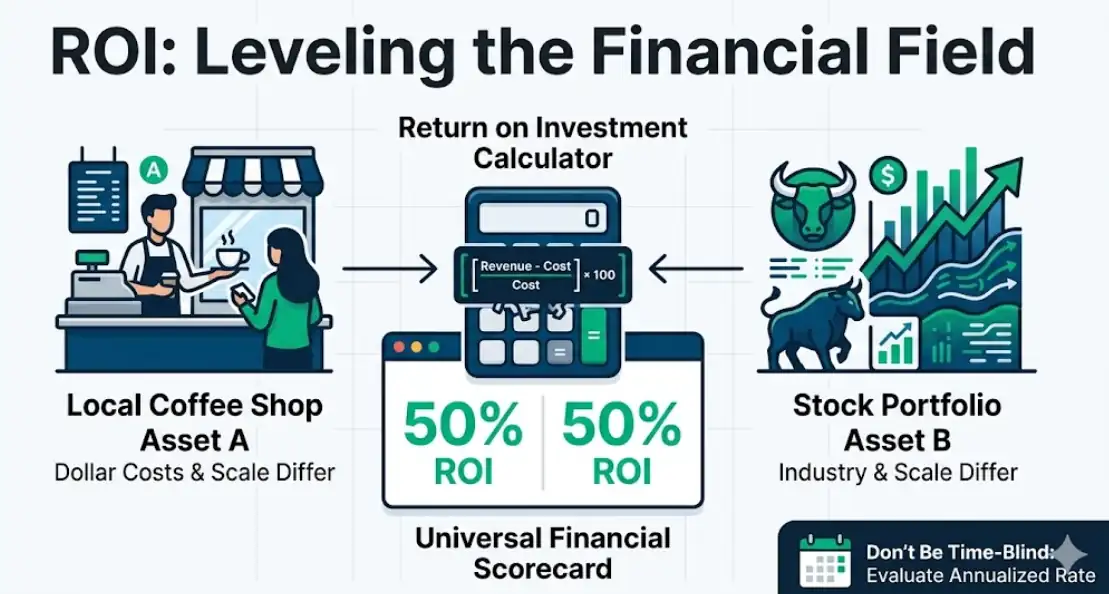
This percentage allows you to compare completely different assets on a level playing field. You cannot easily compare the raw dollar profit of a small coffee shop against a massive stock portfolio. Their upfront costs and operational scales differ entirely. The calculation translates those unique numbers into a universal scorecard.
Imagine spending $3,000 on new automation software for your business. Over a year, it saves your team 100 hours of labor valued at $5,000. Your net profit is $2,000. The asset yielded a 66.7% return. You can now compare that percentage against a standard index fund to see which strategy actually grew your wealth faster.
Why this matters
Standard calculation models are completely “time blind.” A 50% return looks incredible until you realize it took 12 years to achieve. Always evaluate the annualized rate to see if your profit is actually beating current inflation trends.
How do you calculate return on investment?
Subtract your total costs from your total revenue to find your exact net profit. Next, divide that net profit by your initial investment and multiply by 100. Always use an annualized formula to reveal your true yearly growth rate based on your exact holding period.
How do you calculate ROI on a home renovation?
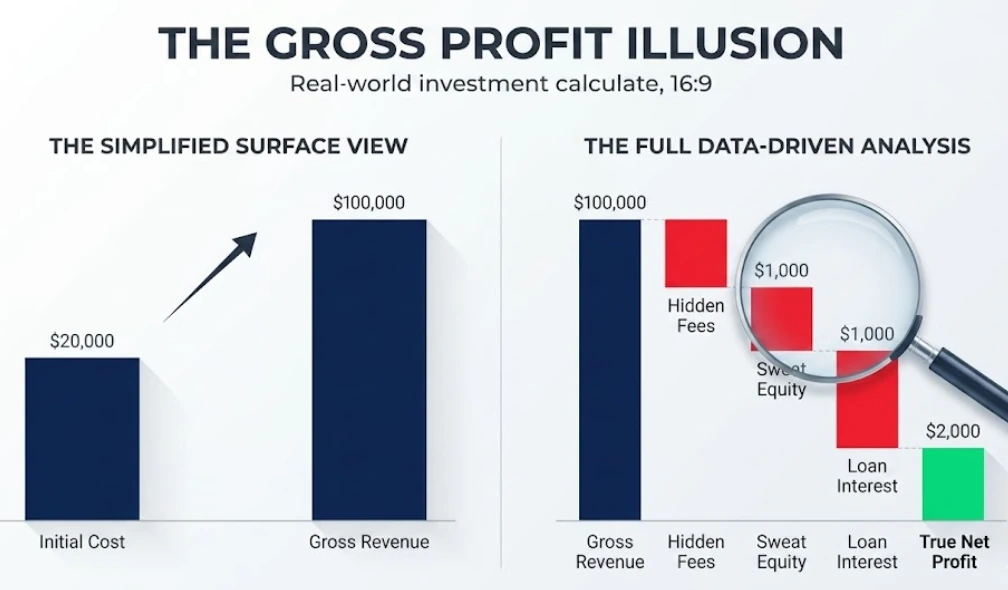
A homeowner uses a Home Equity Line of Credit (HELOC) to finish their basement and rent it out as an apartment.
Use these inputs in the calculator:
- Initial Capital (Renovation Cost): $30,000
- Current Value (Added Property Equity): $40,000
- Rent Collected: $12,000
- Fees (HELOC Interest): $2,000
- Time: 1 Year
Process:
- Total cost is $32,000.
- Total revenue combines the new equity and rent for $52,000.
- Net profit equals $20,000.
Result:
- Total ROI: 62.50%
- Annualized ROI: 62.50%
Meaning:
The renovation pays off immediately because it generates both passive cash flow and instant property value.
What is the ROI of buying automation software?
A small business buys an artificial intelligence tool to replace manual data entry tasks.
Use these inputs in the calculator:
- Initial Capital (Software Cost): $5,000
- Fees (Setup & Training): $1,000
- Current Value (Labor Hours Saved): 240 hours
- Rent/Dividends (Hourly Employee Wage): $30/hour
- Time: 1 Year
Process:
- Total cost equals $6,000.
- Total revenue translates to $7,200 in saved wages (240 hours × $30).
- Net profit is $1,200.
Result:
- Total ROI: 20.00%
- Annualized ROI: 20.00%
Meaning:
The software fully covers its own purchase price and generates an extra 20% in labor savings during the first twelve months.
How do you calculate real ROI for index funds?
An investor puts money into an S&P 500 index fund but wants to account for internal fund fees.
Use these inputs in the calculator:
- Initial Capital: $10,000
- Current Value: $12,500
- Dividends Earned: $300
- Fees (Expense Ratios): $50
- Time: 2 Years
Process:
- Total cost is $10,050.
- Total revenue hits $12,800.
- Net profit equals $2,750.
Result:
- Total ROI: 27.36%
- Annualized ROI: 12.85%
Meaning:
The investor comfortably beats standard inflation rates. Their money is working hard even after the hidden management fees are deducted.
Quick rule to remember
Look closely at your hidden expenses before trusting a gross profit number. Sweat equity, HELOC interest, and fund fees change your margins completely. Once you identify all your costs, enter your own numbers into the tool above to see your exact financial reality.
Return on Investment Result Benchmarks Explained
Your annualized return percentage helps you judge if an asset is actually worth your time and risk. It removes the illusion of large gross profits. Use the table below to compare your yearly growth rate against real-world economic standards and inflation benchmarks.
| Range (Annualized) | Label | Meaning | Standard Benchmark | Notes |
|---|---|---|---|---|
| > 20% | Aggressive | Highly profitable financial performance. | Outpaces top-performing hedge funds. | Carries a high risk of losing original capital. |
| 11–20% | High Growth | Excellent yearly growth rate. | Beats standard S&P 500 averages easily. | Common target for active real estate investors. |
| 6–10% | Solid Return | Reliable and steady asset growth. | Matches historical stock market returns. | Ideal for long-term passive investing. |
| 0–5% | Low Yield | Below average financial performance. | Often trails behind annual inflation rates. | Your money is secretly losing purchasing power. |
| < 0% | Capital Loss | You are actively losing money. | Fails all investment benchmarks completely. | Pause strategy and re-evaluate hidden costs. |
Heads-up: Always compare assets using the annualized rate. A 40% total return means nothing if it took a decade to earn.
Interpretation
Earning a positive return is the absolute minimum goal for any investment. However, true wealth building requires you to beat inflation. If your annualized return falls below 5%, your money is losing value in the real world. Hitting the 7% to 10% range means you are matching standard index funds. Moving above 15% requires active management and usually involves much higher financial risk.
Pro Tip
Look closely at opportunity costs. If your stressful house flip only generated an 8% annualized return, you could have earned the exact same money by passively investing in an index fund with zero manual labor.
What to Do After Using the Return on Investment Calculator
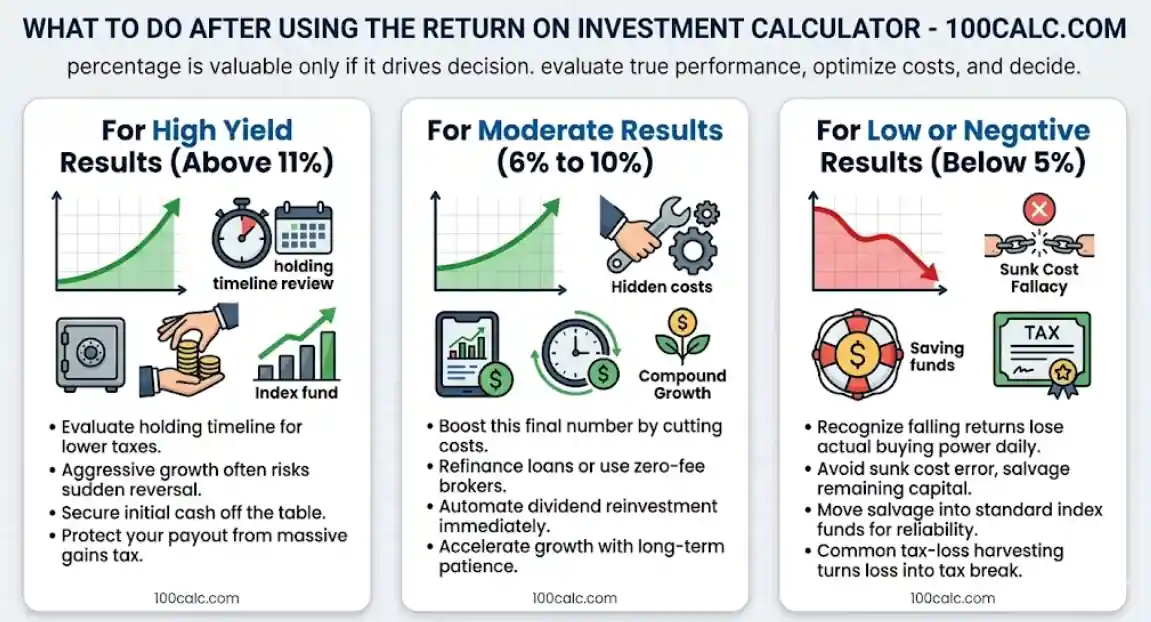
Your calculated percentage is only valuable if it drives a financial decision. The next step is to evaluate your asset’s true performance, optimize your hidden costs, and decide whether to hold or sell. Use the insights below to adjust your strategy based on your exact annualized growth rate.
For High Yield Results (Above 11%)
High returns often trigger massive capital gains taxes if you sell too quickly. Review your holding timeline to see if waiting a few extra months drops you into a cheaper long-term tax bracket. Protecting your final payout from the government is just as important as earning it.
Aggressive growth usually carries a very high risk of a sudden market reversal. Consider taking your initial cash investment off the table and letting only the profits continue to grow. Moving those secured gains into safer index funds protects your new wealth from sudden crashes.
For Moderate Results (6% to 10%)
This range matches standard historical market returns perfectly. You can often boost this final number simply by aggressively cutting your hidden operating costs. Refinancing a high-interest real estate loan or moving to a stock broker with zero trading fees will instantly increase your net margin.
A solid return requires long-term patience rather than constant active trading. Set up automatic dividend reinvestment immediately to accelerate your compound growth. Let the asset work quietly in the background while you focus your daily energy on acquiring new capital.
For Low or Negative Results (Below 5%)
Falling below current inflation rates means your money is losing actual buying power every single day. Do not fall victim to the sunk cost error by holding a failing asset forever in hopes it recovers. Selling now allows you to rescue your remaining capital and move it into a standard index fund that yields a reliable 8%.
You can actually use a negative return to your advantage during tax season. Selling a losing investment allows you to offset the taxes you owe on your highly profitable assets. This common tax-loss harvesting strategy turns a bad financial play into a valuable tax deduction.
You Might Also Find These Helpful
Investment 3
No tools published here yet.
Related Tools People Use Next
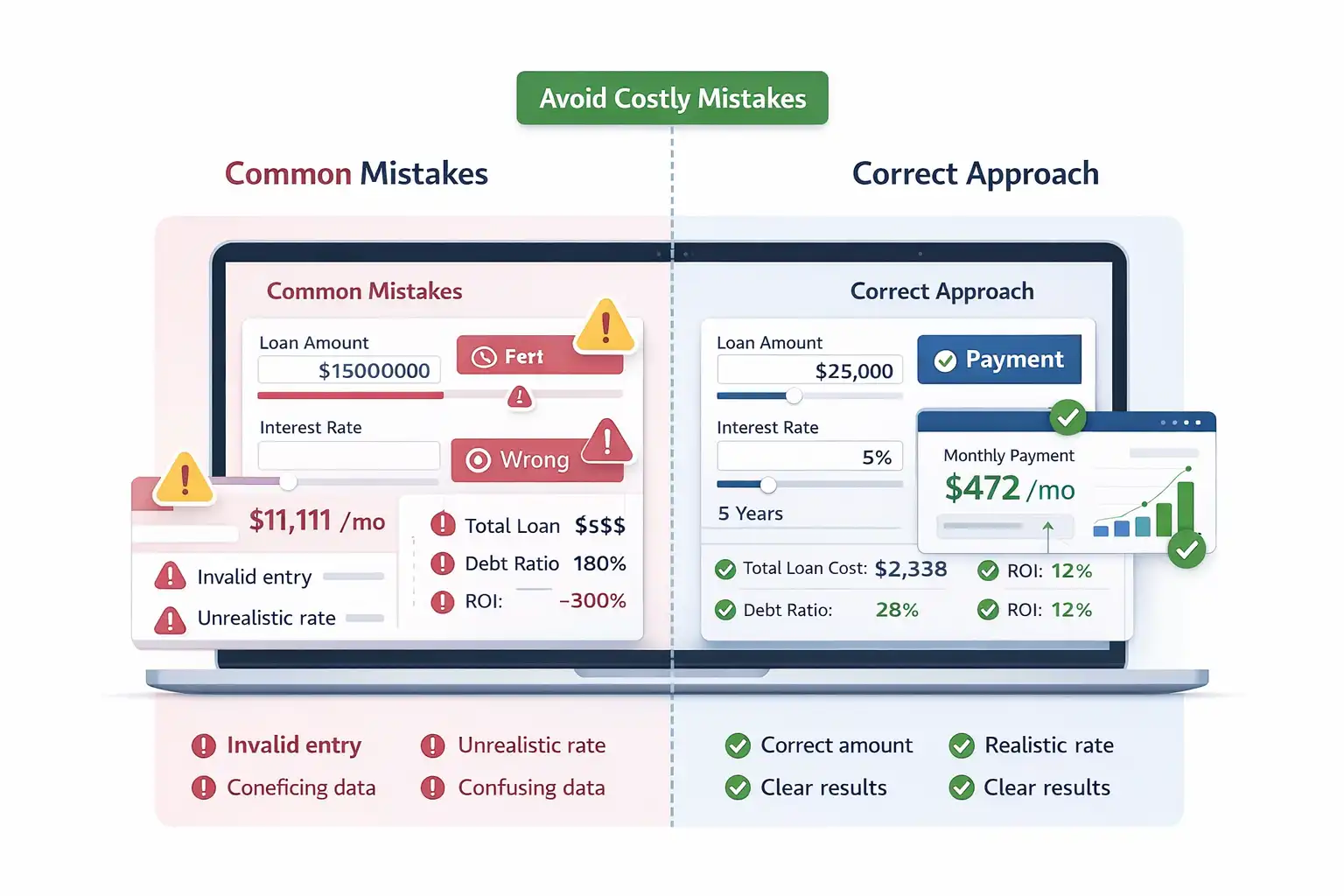
Common Mistakes When Calculating Return on Investment
Many investors input the wrong variables and severely overestimate their actual financial growth. Small math errors in your initial data will completely destroy the final percentage. Review these frequent calculation errors below to ensure your final numbers reflect absolute reality.
- Dividing real estate profit by the total property price instead of your actual cash down payment.
- Ignoring the monetary value of personal labor hours when tracking small business project returns.
- Using top-line gross revenue instead of true net profit to determine your final percentage.
- Comparing a multi-year total return directly against a one-year market benchmark without annualizing it.
- Confusing the exact breakeven payback timeline with actual wealth generation in solar or software upgrades.
Frequently Asked Questions (FAQs)
How do I calculate ROI if I add money every month?
Standard ROI formulas only work for a single upfront investment. You must use a time-weighted return or an internal rate of return calculation if you make continuous monthly deposits. These advanced methods adjust your profit percentages accurately based on exactly when new cash enters your portfolio.
What is the difference between ROI and profit?
Profit is the raw dollar amount you earned after subtracting your expenses from your revenue. Return on investment is a percentage that compares that profit against your initial cost. Profit shows your total cash gained, while ROI measures how efficiently your money worked to generate it.
How do I calculate the ROI of my personal time or labor?
Assign a realistic hourly wage to your personal labor first. Multiply that wage by the total hours you spent on the project, and add it to your total upfront costs. This “sweat equity” expense reveals your true financial return instead of just your raw cash margins.
Does return on investment account for inflation and taxes?
No. Standard calculations only show your nominal return. This number completely ignores changing economic factors and government taxes. You must subtract the current inflation rate and your estimated capital gains tax from your annualized percentage to find your true buying power.
What is the difference between ROI and Return on Equity (ROE)?
Return on investment divides your profit by the initial cash you spent to acquire the asset. Return on equity divides your annual profit by the total current equity you hold in the property. Real estate investors use ROE to decide if they should sell a house or keep renting it.
Are unrealized gains considered part of my ROI?
Subtract your total advertising costs from the total sales generated by the campaign. Divide that net profit by the total marketing costs to find your percentage. Always use the gross profit of those sales rather than raw top-line revenue to get an accurate business metric.
How do you calculate marketing ROI for a small business?
Subtract your total advertising costs from the total sales generated by the campaign. Divide that net profit by the total marketing costs to find your percentage. Always use the gross profit of those sales rather than raw top-line revenue to get an accurate business metric.
How does reinvesting dividends affect my total ROI?
Reinvesting your payouts triggers compound financial growth. You automatically buy more shares of the asset instead of holding idle cash. Those new shares then generate their own dividends. This snowball effect drastically increases your total return over time compared to cashing out quarterly.
What is a 40% ROI?
A 40% return means you earned $40 in pure profit for every $100 you originally invested. It indicates a highly successful financial move. You must always check your holding period. Earning 40% over one year is incredible, but earning it over ten years falls below average market standards.
Is a 100% ROI good?
Yes. A 100% return means you exactly doubled your initial investment. You successfully recovered your original capital and made an equal amount in pure profit. Investors usually target this major milestone using high-growth stocks, business scaling, or leveraged real estate over a long time horizon.
What is a good ROI ratio?
A good ratio depends entirely on your chosen asset class. Stock market index funds historically average a 7% to 10% annual return. Active real estate investors usually look for 8% to 12% cash-on-cash returns to justify their manual labor, maintenance costs, and market risk.
How do you calculate ROI in a company?
Divide the net income of the business by its total assets to find its basic corporate return. To measure a specific internal project, subtract the project costs from the new sales it generated. Divide that remaining profit by the initial project costs to find your percentage.
How can I get a 100% ROI quickly?
Doubling your money quickly requires taking on extreme financial risk. Short-term 100% returns usually come from volatile crypto trading, speculative penny stocks, or highly leveraged options contracts. Safer assets like standard index funds typically take seven to ten years to reach a 100% total return through compounding.
What is the 15 * 15 * 15 rule in mutual funds?
The 15x15x15 strategy shows that investing ₹15,000 monthly for 15 straight years at an expected 15% annual return yields roughly ₹1 crore. This framework highlights the raw power of compounding interest, proving that steady, automated contributions build massive wealth without needing a large initial lump sum.
Questions?
We had love to hear from you! Whether you are reporting an issue, suggesting a new calculator, or exploring collaboration opportunities — we are here to help. Every message helps us make 100calc smarter, faster, and more helpful for everyone.
Why People Trust 100calc
At 100calc.com, we focus on accuracy, speed, and trust. Every calculator we create is designed to give reliable, instant, and easy-to-understand results you can truly depend on.