
Grams To Calories Calculator
The Grams To Calories Calculator converts your macronutrients into precise energy data. The tool uses the standard Atwater system to calculate calories from Protein, carbohydrates, and fats. Most generic tools only accept grams. However, our calculator supports pounds and grams for maximum flexibility. Consequently, you can track your nutrition intake accurately.
Counting calories helps you manage weight effectively. Knowing the energy density of your food is critical. Fat packs more than double the energy of Protein or carbs. Our calculator visualizes these differences instantly. It creates a clear percentage breakdown. Therefore, you can balance your diet for muscle gain or fat loss with precision.
- Updated Feb 10, 2026
Grams To Calories Calculator: Convert Grams to Calories Fast
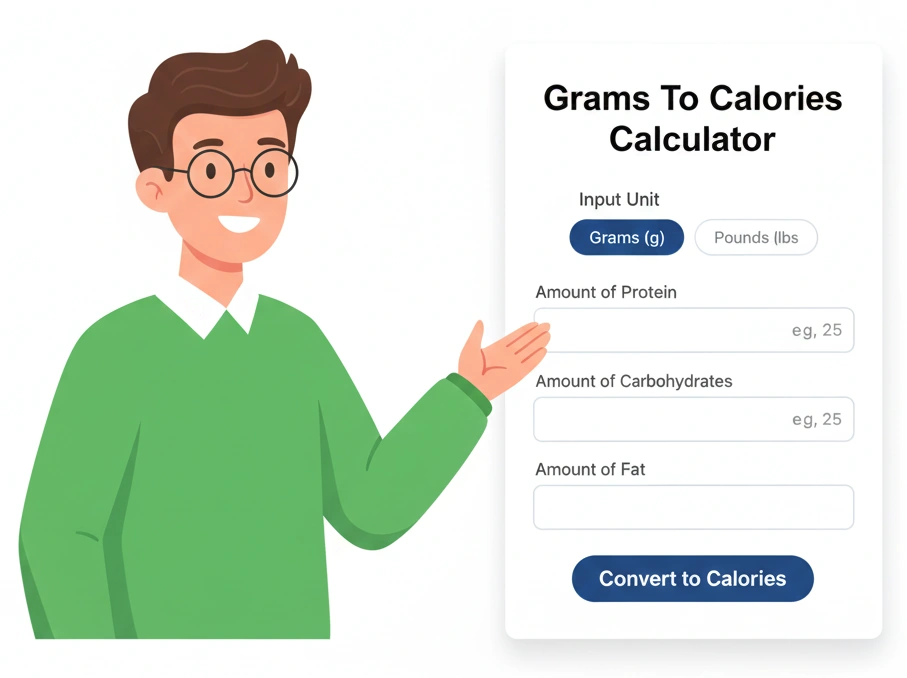
Grams (g) or Pounds (lbs). Amount in selected unit. Amount in selected unit. Amount in selected unit. Total Calories, Visual Macro Bar, Calorie Breakdown per Macro.
What Your Grams To Calories Result Means
The result displays the total energy potential of your food. The number represents the fuel your body receives from specific nutrients. We output the result in Kilocalories (Kcal). Nutrition labels use Kcal as the standard unit globally. Therefore, matching your result to packaged food data is accurate and straightforward.
Macronutrient density drives the total count significantly. Fat contains only 9 calories per gram. 4 calories per gram only contain Protein and carbs. Consequently, a high-fat meal produces a much higher calorie total than a high-protein meal of the same weight. Understanding this density helps you control portion sizes without feeling deprived.
Tracking these numbers helps you manage your weight effectively. A surplus of energy leads to weight gain over time. Conversely, a deficit leads to weight loss. Converting grams to calories removes the guesswork from dieting. You see exactly where your energy comes from. Therefore, you can make smarter food choices instantly.
Quick example to check the math
Input: 25g Protein, 50g Carbs, 10g Fat.
Calculated Output:390 Calories.
Analysis: Fat contributes 90 calories. Carbs contribute 200 calories. Protein contributes 100 calories. Consequently, carbohydrates provide the majority of energy in this specific example.
Explore More Calculators
Use our Pregnancy Chance Calculator to estimate your odds. Enter your cycle day, age, and method. Find out if you are in the high-risk…
Try calculatorUse our Steps to Calories Calculator to convert steps to calories instantly. This walking calorie calculator adjusts for height and speed to ensure accuracy.
Try calculatorCalculate odds with the Chance of Twins Calculator. Enter maternal age and history. Find your probability instantly. See if you will conceive multiples now.
Try calculatorFind out exactly when you conceived. Our free Conception Calculator uses your Due Date, LMP, or Ultrasound to estimate your fertilization date and fertile…
Try calculatorUse our Conception Date Due Date Calculator to find your baby's arrival date. Enter your conception or intercourse date for clinical 40-week results.
Try calculatorUse our Cycling Calorie Calculator to estimate your energy burn. Get accurate results based on weight, speed, and bike type for your fitness goals.
Try calculatorHow to Use the Grams To Calories Calculator
You can get precise results by following these five steps. Our tool converts your macros instantly. Follow the instructions below to ensure accuracy.
Select Input Unit
First, choose your measurement unit. Click "Grams (g)" or "Pounds (lbs)" at the top. Most food labels use grams. However, bulk prep recipes might use pounds. Selecting the correct unit prevents massive calculation errors.
Enter Protein Amount
Next, input your protein data. Locate the "Amount of Protein" field. Enter the number from your food label or scale. Protein helps muscle repair and growth, which is essential for recovery.
Enter Carbohydrates
Then, add your carb count. Find the "Amount of Carbohydrates" field. Enter the total grams listed on your package. Carbs provide your body with its primary fuel source.
Enter Fat Amount
Afterward, enter your fat content. Fill in the "Amount of Fat" field. Be precise with fat numbers. Fat is calorie-dense. Therefore, small input changes affect the final result significantly.
Calculate Energy
Finally, generate your report. Click the "Convert to Calories" button. You will see the total Kcal count immediately. The tool also generates a colored bar showing the percentage split between the three nutrients.
Example for testing
Try these sample numbers:
- Unit: Grams
- Protein: 30
- Carbs: 40
- Fat: 15
Result →You have approx. 415 Calories.
Now, enter your own numbers and check your meal stats.
How the Grams To Calories Formula Works (Complete Breakdown)
Mastering your diet requires understanding the math. The formula connects nutrient weight directly to energy output. You can see precisely why fats pack such a high energy density. We use the Atwater General Factor System. Consequently, the results align perfectly with FDA and USDA standards.
The Energy Formulas
We believe in complete transparency. Our calculator uses specific constants for each nutrient.
Formula:
					1. Protein Calculation:

Calories = Protein (g) x 4

The body extracts 4 calories of energy for every gram of ProteinProteinProtein.
2. Carbohydrate Calculation:

Calories = Carbs (g) x 4

Carbohydrates provide the primary fuel source at 4 calories per gram.
3. Fat Calculation:

Calories = Fat(g) x 9

Fat is the most energy-dense nutrient at 9 calories per gram.
4. Total Energy:

Total Kcal = Protein Cals + Carb Cals + Fat Cals
Example:
					If you eat a meal with 25g of Protein, 50g of Carbs, and 10g of fat:
25g x 4 = 100 kcal (Protein)
50g x 4 = 200 kcal (Carbs)
10g x 9 = 90 kcal (Fat)
100 + 200 + 90 = 390 Total Calories
Your total energy is 390 Calories. Nutritionists consider this a balanced moderate meal.
Micro Note:
The 4-4-9 rule refers to the Atwater system constants. It states that ProteinProteinProtein provides 4 kcal/g, carbs provide 4 kcal/g, and fat provides 9 kcal/g. Nutrition labeling bodies worldwide use this simple rule to estimate energy intake.
Key Inputs Used in the Grams To Calories Calculator
Every energy calculation depends on three specific inputs. These inputs help you measure your intake accurately. You can plan your diet effectively by entering real numbers for protein, carbs, and fat.
Protein Amount
Protein builds muscle structure. Your body extracts 4 calories from every gram. It shares the same energy density as carbohydrates. However, digesting ProteinProteinProtein requires more metabolic effort compared to other nutrients.
Carbohydrate Amount
Carbs serve as your primary fuel. They also provide 4 calories per gram. Glucose from carbs powers your brain and muscles during workouts. Timing your carb intake prevents excess storage as fat.
Fat Amount
Fat acts as your energy reserve. It provides 9 calories per gram. Consequently, it holds more than twice the energy of ProteinProteinProtein. Small amounts of fat increase your total calorie count rapidly.
Another Example Calculation (Step-by-Step)
Let’s see how the math works for a balanced meal. The breakdown highlights the impact of fat density.
Given:
- Protein: 40g
- Carbs: 40g
- Fat: 20g
Calculation:
					First, calculate Protein energy.
40g x 4 = 160 kcal
Next, calculate Carb energy.
40g x 4 = 160 kcal
Then, calculate Fat energy.
20g x 9 = 180 kcal
Result:
Total Energy: 160 + 160 + 180 = 500 Kcal
Fat Percentage: 36%
Meaning:
Fat makes up only 20% of the total weight (20g out of 100g). However, it provides 36% of the total calories. Therefore, controlling fat intake controls calories most efficiently.
Result Benchmarks and Diet Types
Your macro ratio defines your diet type. Nutritionists categorize diets based on these percentages. The table below helps you evaluate your meal composition.
| Diet Type | Protein % | Carbs % | Fat % | Why It Matters |
|---|---|---|---|---|
| Balanced | 20–30% | 45–55% | 25–30% | Standard health guideline. |
| Low Carb | 40–50% | 10–20% | 30–40% | Weight Loss focus. |
| Keto | 15–20% | 5% | 70–75% | Fat Burning mode. |
| High Perf | 25% | 60% | 15% | Endurance training fuel. |
Note: Percentages are approximate ranges. Individual needs vary based on activity level and metabolism.
Interpretation
The calculator uses the Atwater system constants. Scientists established these values to standardize nutrition labeling. Your result confirms exactly how much energy your body will process from the inputs. Therefore, you can use this data to stay within your daily caloric budget. Accuracy here prevents overeating hidden calories.
Pro Tip:
Focus on the macro ratio for your specific goal. Athletes often aim for high carbs for fuel. Weight loss plans usually prioritize Protein for satiety. Using the visual bar helps you align every meal with your broader strategy. Adjusting fats is the fastest way to lower total calories.
Tips & Planning Based on Your Result
You can optimize your nutrition easily. Follow these expert tips to get the best results. Minor adjustments to your macros yield significant changes.
Prioritize Protein
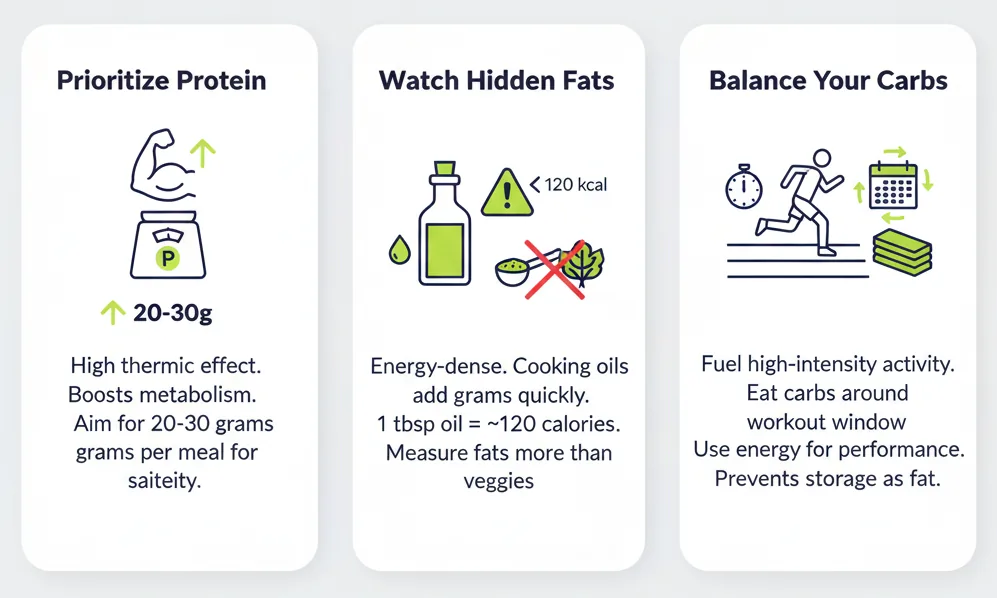
Protein has a high thermic effect. Your body burns more energy to dissolve Protein than fat or carbs. Increasing protein intake boosts metabolism slightly. Therefore, aim for at least 20-30 grams per meal for satiety.
Watch Hidden Fats
Fat is energy-dense. Cooking oils and dressings add grams quickly. A single tablespoon of oil adds roughly 120 calories. Consequently, measuring fats is more important than measuring veggies. Use the calculator to audit your sauces.
Balance Your Carbs
Carbs fuel high-intensity activity. Eat the majority of your carbs around your Exercise window. Your body uses the energy immediately for performance. Therefore, timing your carb intake prevents excess storage as fat.
You Might Also Find These Helpful
Health 17
Calculate hCG doubling time instantly. Enter two test results. See if your levels are rising normally. Check pregnancy progress now in the hCG Calculator.
Try calculatorCalculate implantation window instantly. Enter last period date. Find peak probability. See when to take a pregnancy test in the Implantation Calculator.
Try calculatorUse our IUI Due Date Calculator to find your exact due date and safe pregnancy test day. Get clinical 40-week results based on your…
Try calculatorUse our IVF Due Date Calculator to find your exact twin pregnancy timeline. Enter your transfer date to get 40-week and 37-week dates instantly.
Try calculatorUse our Keto-Mojo GKI Calculator to find your metabolic state. Get accurate results based on glucose and ketone levels for your health goals today.
Try calculatorEstimate loss probability instantly. Enter age and week. See how a heartbeat lowers risk. Check your success rate now in the Miscarriage Risk Calculator.
Try calculatorUse our Reverse Diet Calculator to plan your metabolic recovery. Get a custom weekly calorie schedule to eat more food without gaining fat today.
Try calculatorFind your conception date with our Reverse Due Date Calculator. Enter your due date to reconstruct your pregnancy timeline and fertile window instantly.
Try calculatorUse our Rucking Calories Calculator for 100% accurate results. Track your burn based on weight, pack load, and pace. Plan your fitness hike now.
Try calculatorUse our expert Snowboard Size Calculator to find your ideal board length and waist width. Get custom results based on weight and boot size…
Try calculatorConvert steps to miles instantly with our calculator. This steps to distance converter uses your height and gender for precise walking distance results.
Try calculatorExplore Related Tools
Common Mistakes to Avoid When Calculating
You can get the most accurate results by avoiding these errors. Small details often change the calculation significantly. Pay attention to the following points.
- Confusing Raw vs. Cooked: Confusing raw and cooked weights creates huge errors. Meat loses water during cooking. Consequently, 100g of raw chicken has different stats than 100g of cooked chicken. Always weigh your food raw for the best accuracy.
- Ignoring Fiber: Fiber counts as a carbohydrate. However, your body cannot fully digest it. Some methods subtract fiber calories to find "Net Carbs." Our calculator uses the standard total carb count for consistency.
- Forgetting Cooking Oil: Cooking oil adds pure fat grams instantly. Forgetting to log the oil in the pan skews your results. A single tablespoon adds over 100 calories. Therefore, always measure cooking fats precisely.
- Using Volume Instead of Weight: Using volume measurements leads to inaccuracy. A "cup" of oats varies significantly in density. A food scale provides exact gram data every time. Consequently, weigh your food instead of using measuring cups.
- Overlooking Alcohol: Alcohol contains 7 kcal/g. It is neither a carb nor a fat. Ignoring drinks leads to underestimating your daily intake significantly. You must track these calories separately.

Frequently Asked Questions (FAQs)
How many calories are in 1 gram?
The calorie count depends entirely on the nutrient. 1 gram of carbohydrate contains 4 calories. 1 gram of Protein also contains 4 calories. However, 1 gram of fat carries 9 calories. Alcohol contains 7 calories per gram. Therefore, knowing the nutrient type is critical.
How to calculate grams to calories?
You calculate energy by multiplying the weight by the Atwater factor. Multiply protein grams by 4. Multiply carbohydrate grams by 4. Multiply fat grams by 9. Finally, add these three numbers together to get the total caloric value.
Is 100 grams 100 calories?
No, 100 grams rarely equals 100 calories. For example, 100 grams of pure sugar (carbs) equals 400 calories. 100 grams of oil (fat) equals 900 calories. Only foods with high water content, like certain vegetables, might have fewer calories than their weight in grams.
How many grams are 600 calories?
The answer depends on the food source. If you eat pure Protein or carbs, 600 calories equals 150 grams. If you eat pure fat, 600 calories equals only 67 grams. Fat is much more energy-dense than other nutrients.
Why do fiber calories sometimes not count?
Insoluble fiber passes through the body without complete digestion. Therefore, many keto and low-carb dieters subtract fiber grams from the total. This calculation yields “Net Carbs.” However, standard FDA labels typically include fiber in the total calorie count.
What is the 4-4-9 rule?
The 4-4-9 rule refers to the Atwater system constants. It states that Protein provides 4 kcal/g, carbs provide 4 kcal/g, and fat provides 9 kcal/g. Nutritionists use this simple rule to estimate energy intake quickly.
Questions?
We had love to hear from you! Whether you are reporting an issue, suggesting a new calculator, or exploring collaboration opportunities — we are here to help. Every message helps us make 100calc smarter, faster, and more helpful for everyone.
Why People Trust 100calc
At 100calc.com, we focus on accuracy, speed, and trust. Every calculator we create is designed to give reliable, instant, and easy-to-understand results you can truly depend on.