
NUST CGPA Calculator: GPA, Relative Curve & HEC Converter
Calculating your exact CGPA at the National University of Sciences and Technology (NUST) is frustrating because generic calculators completely ignore the university’s strict 0.50 grading interval. This dedicated NUST CGPA calculator solves that problem by enforcing the actual grading scale (A=4.0, B+=3.5, B=3.0) to give you accurate results and keep you safe from credit-hour probation.
Beyond standard SGPA and cumulative math, this tool features a relative grading curve predictor to estimate your letter grade based on class averages. It also includes an OHT survival mode to calculate the exact final marks you need, and a built-in HEC converter to change your NUST CGPA to a percentage effortlessly.
- Updated Mar 25, 2026
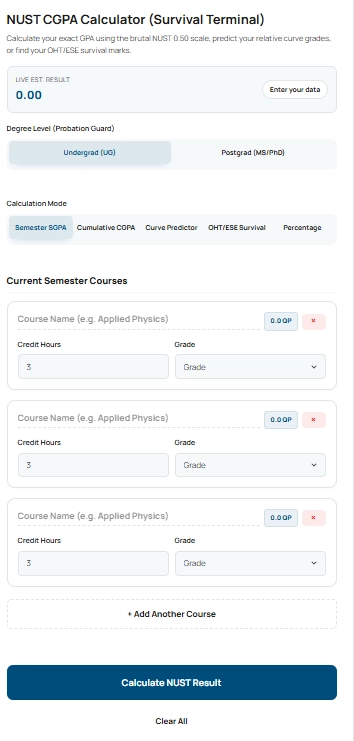
NUST CGPA Calculator (Survival Terminal)
Calculate your exact GPA using the brutal NUST 0.50 scale, predict your relative curve grades, or find your OHT/ESE survival marks.
Predict your final letter grade based on class performance (Z-Score Estimation).
Input your mid-semester performance to see exactly what you need in your ESE (Finals) out of 50 to secure a specific absolute mark.
Maps your NUST score using the strict HEC conversion guidelines.
Your NUST Score
Calculated via the NUST 0.50 Grading Scale.
Academic Breakdown
Is there a NUST GPA calculator app or online tool?
There is no need to download clunky applications. Our native nust gpa calculator app is an optimized, web-based nust gpa calculator online tool that works instantly on your phone and enforces the strict 0.50 NUST grading scale (A=4.0, B+=3.5, B=3.0).
How total CGPA is calculated and how is CGPA calculated at NUST?
If you are wondering how we calculate cgpa formula at NUST, it is the sum of your Quality Points (Grade Value × Credit Hours) divided by your Total Credit Hours. However, NUST relies heavily on relative grading, meaning your final letter grade is heavily influenced by the class average.
How to use the NUST OHT and ESE calculator?
NUST course evaluation is typically divided into Sessionals/Quizzes (20%), OHT-1 (15%), OHT-2 (15%), and ESE (50%). Our survival mode lets you input your mid-semester marks to predict exactly what you need in the Final End Semester Exam to secure your target grade.
How does the NUST CGPA to percentage calculator work?
Our nust cgpa to percentage calculator uses the official Higher Education Commission piecewise conversion formula to generate your exact academic percentage. (Note: While some search for a cgpa calculator niu or cgpa calculator nyu, this engine is tailored strictly to NUST Pakistan grading policy, though the manual override feature allows anyone to use it).
Official NUST Grading System Explained
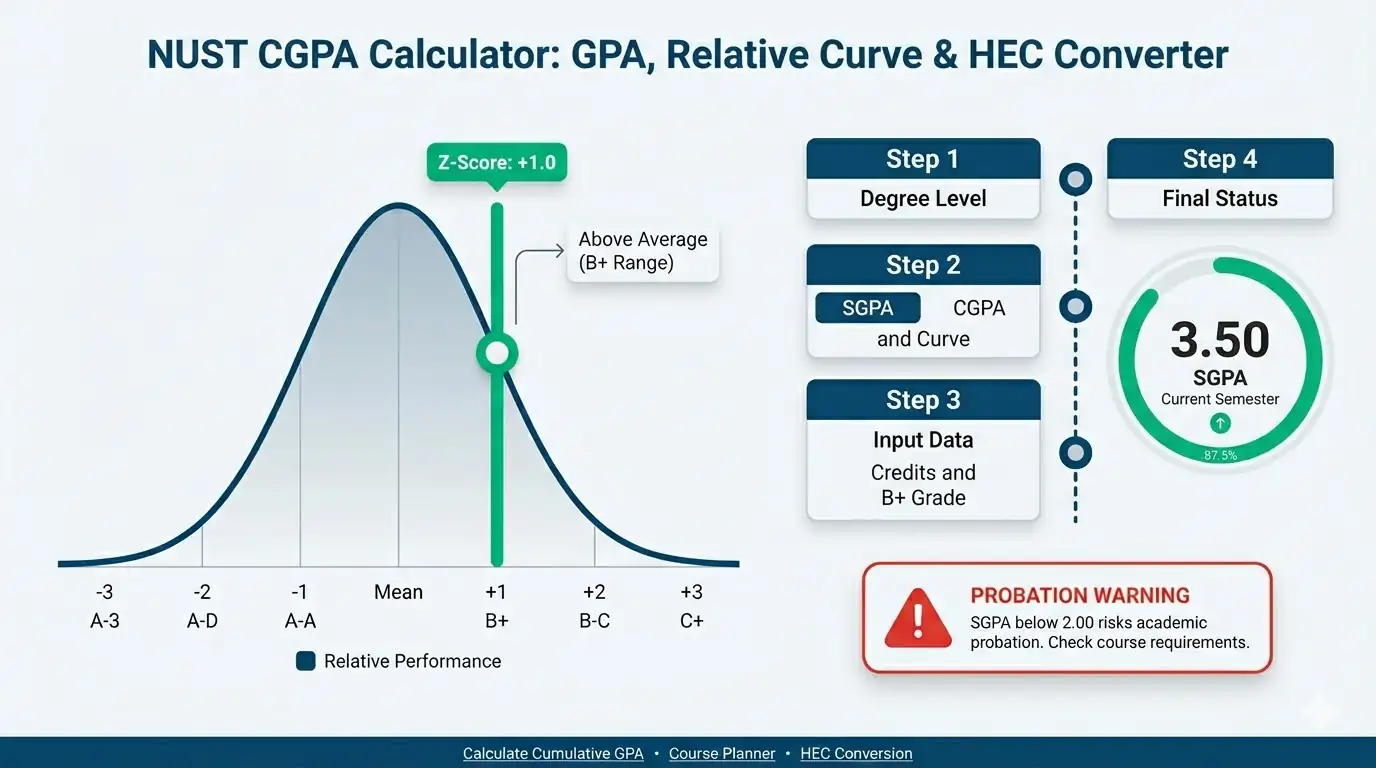
Every university follows unique academic rules. Specifically, the National University of Sciences and Technology uses a highly competitive relative grading system rather than absolute percentages. This official NUST grading system determines your final letter grade based on the class average and standard deviations (Z-score). Furthermore, it assigns specific quality points strictly on a 0.50 interval scale. Therefore, you can use the table below to check how your relative performance translates into actual grades. Consequently, understanding these exact rules helps you survive the curve and plan your semester better.
| Relative Curve (Z-Score) | Letter Grade | Grade Point (QP) | Status / Remarks | System Used |
|---|---|---|---|---|
| ≥ +1.5 SD | A | 4.00 | Outstanding | Relative Grading |
| +1.0 to +1.49 SD | B+ | 3.50 | Very Good | Relative Grading |
| +0.5 to +0.99 SD | B | 3.00 | Good | Relative Grading |
| 0.0 to +0.49 SD | C+ | 2.50 | Average | Relative Grading |
| -0.5 to -0.01 SD | C | 2.00 | Satisfactory | Relative Grading |
| -1.5 to -0.51 SD | D+ / D | 1.50 / 1.00 | Marginal (UG Only) | Relative Grading |
| Below -1.5 SD | F | 0.00 | Fail | Relative/Absolute |
Important Note: This table reflects the official NUST hybrid grading system. Unlike traditional block grading, NUST relies heavily on relative performance (the bell curve). Your final letter grade is dictated by how many standard deviations (SD) you are above or below the class average. Note: Postgraduate programs (MS/PhD) do not award 'D' grades.
The Relative Grading Curve (Z-Score)
The National University of Sciences and Technology uses a strict relative grading curve. Therefore, your performance depends heavily on your classmates. Your raw absolute marks do not determine your final letter grade directly. Instead, the class average usually sets the baseline for a ‘C+’ or ‘B’ grade. Consequently, you must score above the class mean to secure top grades and survive the semester.
How NUST Quality Points Work
Your relative letter grade translates directly into official quality points. Next, the university uses these points to calculate your semester score. An A grade gives you exactly 4.00 points, while a B grade gives you 3.00 points. If you are wondering how to calculate CGPA out of 4, you must multiply these grade points by your course credit hours. Ultimately, this math decides your official academic standing.
The Strict 0.50 Interval Scale
Unlike generic colleges, the NUST GPA system does not use minor decimals like 3.67 or 2.67. Instead, it relies entirely on a strict 0.50 interval scale. For example, your quality points will always be 4.00, 3.50, 3.00, 2.50, or 2.00. Therefore, missing a grade boundary by a single standard deviation drops your GPA significantly. Every single internal mark helps you push past the next interval.
Minimum Degree Requirements & Probation
You must understand the university probation rules clearly to avoid academic delays. First, undergraduate students need a minimum 2.00 CGPA to maintain a clear standing. If your score drops below this, the university places you on probation. As a result, the CMS portal restricts your next semester registration to a maximum of 12 credit hours. Meanwhile, postgraduate students face stricter rules and must maintain a 3.00 CGPA to graduate successfully.
What Your NUST CGPA Calculator Result Means
Your NUST CGPA calculator results show more than a simple number. They explain your current academic standing clearly. This section helps you understand your total quality points, relative curve predictions, and HEC percentage. Use it to make smarter study decisions.
What Clear Standing Means
A clear standing shows you meet the minimum university requirements. Undergraduates need a 2.00 score. Postgraduates need a 2.50 score. Therefore, you can register for a full 18 credit course load. However, dropping below this limit triggers a probation warning. Then, the university restricts you to only 12 credit hours.
What Your Z-Score Means
The nust grading system depends heavily on class performance. A positive Z-score shows you performed above average. For example, a +1.0 score usually secures a B+ grade. This number reflects your actual rank among peers. Therefore, it matters much more than your raw absolute marks.
Why HEC Percentage Matters
The calculator converts your NUST score into an official percentage. It uses the strict HEC piecewise formula for accuracy. For instance, a 3.50 CGPA translates to roughly 80 percent. You need this precise number for international scholarships. Consequently, our nust cgpa to percentage tool makes job and degree applications much easier.
Test the NUST CGPA Calculator With Real Examples
Use the examples below to test the calculator. Enter the values exactly as shown. You can change them later to match your own nust gpa calculator needs.
Example 1: Calculating Semester GPA Check Your Standing
Use this to test: Main Calculator Inputs
- Degree Level: Undergrad
- Calculation Mode: Semester SGPA
- Course 1: 3 Credits, Grade B+ (3.50)
- Course 2: 3 Credits, Grade A (4.00)
- Course 3: 3 Credits, Grade B (3.00)
What you should see:
- Semester SGPA around 3.50.
- Total Quality Points exactly 31.50.
- Result shows a Clear Standing status.
Example 2: Predicting Your Relative Grade Check Your Curve
Use this to test: Curve Predictor Feature
- Calculation Mode: Curve Predictor
- Your Total Marks: 78
- Class Average: 65
- Standard Deviation: 10
What you should see:
- Z-Score exactly at +1.30.
- Estimated relative grade shows B+.
- Result reflects your position above the class average.
Explore More Calculators
Use the CGPA Calculator to calculate CGPA from GPA or SGPA, convert CGPA to percentage or 4.0 GPA, and plan your target CGPA. Works…
Try calculatorCalculate your GPA instantly using 4.0, percentage, or university scales. Accurate results with credits, conversions, and global GPA comparison.
Try calculatorApplying to Germany? Use our free CGPA to German Grade Calculator. Convert your 10.0 or 4.0 scale instantly to see if you meet the…
Try calculatorUse this college GPA calculator to check semester, cumulative, and major GPA fast. Add grades, credits, retakes, and pass failed courses in one place.
Try calculatorDon't risk academic probation! Use the exact COMSATS CGPA calculator for 100% accurate grading. Predict final exam marks and convert GPA to percentage now.
Try calculatorWorried about your grades? Use the FAST CGPA Calculator to instantly check your SGPA, simulate F-grade replacements, and avoid academic probation today!
Try calculatorHow to Use the NUST CGPA Calculator
Follow these simple steps to calculate your exact university score. This tool enforces the official academic rules automatically.
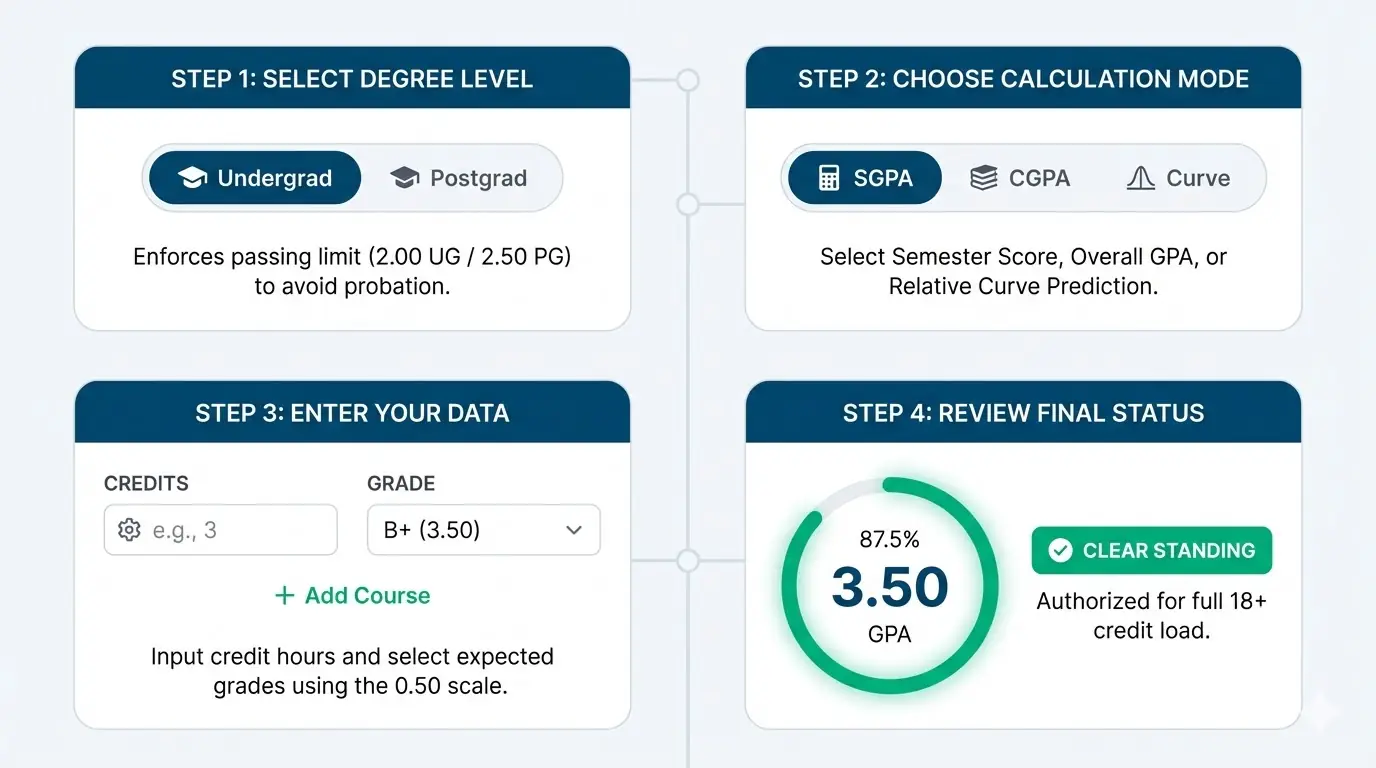
Select Your Degree Level
First, choose either the Undergraduate or Postgraduate option. This step sets the correct academic probation rules for your profile. It also disables the 'D' grade for master's students automatically.
Choose a Calculation Mode
Next, pick your required tool from the top menu. You can select Semester SGPA or Cumulative CGPA. You also have options for the Curve Predictor, OHT Survival, or HEC Percentage mode.
Enter Your Course Data
Now, type in your specific subject details. Enter the credit hours for each course. Then, select your expected letter grade from the dropdown menu. The tool only allows official 0.50 scale grades like A, B+, or C+.
Input Curve Predictor Details
You might want to predict your relative grade instead. If so, switch to the curve mode. Enter your total marks. Next, type in the class average and the standard deviation. The system will calculate your exact Z-score instantly.
Check Your Final Dashboard
Finally, view the interactive results panel. You will see your total earned quality points and your overall GPA. The dashboard also displays a clear standing or probation warning based on your final score.
Quick Formula Used
Quality Points = Course Credit Hours x Grade Value.
Final GPA Score = Total Quality Points / Total Credit Hours.
Z-Score Curve = (Your Total Marks – Class Average) / Standard Deviation.
Why This Process Is Accurate:
- First, grades become points. The tool converts your expected letter grades into exact numeric values. Specifically, it uses the strict 0.50 interval scale to ensure accuracy.
- Second, weight is applied. We multiply your precise grade value by the specific course credit hours. Consequently, a major subject impacts your final score much more than a minor lab.
- Third, your history is included. The calculator adds your past performance for a true cumulative result. Furthermore, it applies the correct rules based on your degree level.
- Finally, our math matches the university. The logic follows the official academic handbook exactly.
Overall, this method mirrors the official campus software perfectly. Therefore, it calculates your true academic standing without any errors.
NUST CGPA Calculator Formula Explained (Complete Breakdown)
This section explains exactly how our NUST CGPA calculator processes your academic data. It reveals the exact math behind your semester score and relative curve predictions. We calculate your true standing using the official rules of the National University of Sciences and Technology. Therefore, this helps you understand where your final numbers come from.
First, we calculate your total quality points. Next, we divide them by your total credit hours. Furthermore, we apply standard deviation formulas for the curve predictor.
The Core GPA Formula
This formula powers the main calculation engine. It converts your course grades into a final academic score.
Formula:
Final SGPA = Total Quality Points / Total Credit Hours
This specific formula relies on strict variables. Each variable comes directly from your input or official university standards.
Variable 1: Quality Points
First, we determine the exact numeric value of your letter grade. The university uses a strict 0.50 interval scale. For example, an A grade equals 4.00 points. Meanwhile, a B+ grade equals 3.50 points.
Variable 2: Credit Hours
Next, we look at the weight of your course. Most subjects carry three or four credit hours. We multiply your grade quality points by these credit hours. Consequently, a core subject impacts your final score heavily.
Variable 3: OHT and ESE
Your total subject marks depend on internal and external exams. OHT stands for Open House Test. These act as your midterm exams. ESE stands for End Semester Exam. This is your final exam out of 50 marks.
Variable 4: Z-Score (The Curve)
Finally, the curve predictor uses a specific statistical formula.
Z-Score = (Your Marks - Class Average) / Standard Deviation
This formula finds your exact position in the class. As a result, it predicts your relative letter grade accurately.
Example Calculation You Can Test
Use these exact inputs to test the NUST CGPA calculator logic. We show the math step by step. Therefore, you can see exactly how your grades turn into final scores.
Example 1: Calculating Your Semester Score (SGPA)
Given:
- Course 1: 3 Credits, Grade A (4.00)
- Course 2: 3 Credits, Grade B+ (3.50)
- Course 3: 3 Credits, Grade B (3.00)
Calculation:
					First, multiply the credits by the grade points.

Course 1: 3 x 4.00 = 12.00 QP.

Course 2: 3 x 3.50 = 10.50 QP.

Course 3: 3 x 3.00 = 9.00 QP.

Next, add all the quality points together. The total equals 31.50 QP.
Finally, divide this total by your total 9 credit hours.
31.50 / 9 = 3.50 SGPA.
Result:
Your estimated semester score is exactly 3.50. You should see this clear standing result in the dashboard.
Why This Formula Matters
This formula calculates your score using the official university grading rules. Specifically, it uses the exact NUST relative curves and the strict 0.50 intervals. It reflects your true academic standing accurately. Because of this, your NUST CGPA calculator results match the official CMS portal perfectly. Therefore, you now have a highly reliable baseline before planning your next semester courses.
Understanding Your NUST CGPA Benchmarks
Your calculator results show much more than just a simple number. They help you understand your exact academic standing. Students and faculty at the National University of Sciences and Technology use these specific benchmarks for different needs. Here is a quick breakdown to help you read your results accurately. Consequently, you will understand the official university grading standards much better.
| NUST Letter Grade | Quality Points (QP) | Z-Score Estimation (Relative) | Status / Meaning |
|---|---|---|---|
| A | 4.00 | ≥ +1.5 | Excellent |
| B+ | 3.50 | +1.0 to +1.49 | Very Good |
| B | 3.00 | +0.5 to +0.99 | Good |
| C+ | 2.50 | 0.0 to +0.49 | Average |
| C | 2.00 | -0.5 to -0.01 | Satisfactory (UG Min) |
| D+ / D | 1.50 / 1.00 | -1.5 to -0.51 | Probation Risk |
Important: This table reflects the official NUST grading scale. Postgraduate (MS/PhD) students do not receive "D" grades and face probation if their CGPA drops below 2.50.
How to Interpret Your NUST Academic Score
A CGPA above 3.50 is generally an excellent result at the National University of Sciences and Technology. This high number proves you can easily handle the competitive relative grading system. Many top employers and international scholarship programs expect a highly competitive score. However, a score between 3.00 and 3.49 is also very good. This range shows solid academic performance across your semesters. Consequently, you remain a strong candidate for master’s programs and great jobs.
Why Your Course Balance Matters
Sometimes, taking too many difficult engineering courses in one semester hurts your score. Getting low grades in hard subjects drops your overall baseline. Therefore, you must find a healthy balance between core subjects and easier electives. You can use our NUST CGPA calculator to check this balance before registering for classes. Furthermore, if your current score drops too low, you should prioritize retakes. Protecting your academic baseline is always the smartest strategy to avoid the 12-credit-hour probation cap.
Pro Tip for Career and Scholarships
Always check specific graduation and job rules in Pakistan. For example, most government and private organizations use the official HEC conversion method. First, they map your 4.00 scale score to a percentage. Therefore, your final standing might look different on their specific forms. You must use a nust cgpa to percentage calculator to plan your applications around these rules. Ultimately, this careful planning prevents nasty surprises during the job hunting or scholarship application season.
You Might Also Find These Helpful
GPA 18
Will your grades get you into TUM? Use our German GPA Calculator to convert your CGPA or percentage instantly. Find your exact DAAD equivalent…
Try calculatorUse the High School GPA Calculator to check weighted and unweighted GPA, include honors or AP classes, track cumulative GPA, and see what GPA…
Try calculatorDon't risk academic probation! Use our accurate IIUI CGPA Calculator to map your marks on the 0.50 scale and find your exact percentage instantly.…
Try calculatorStop guessing! Use our updated Karachi University CGPA Calculator to instantly check your semester score, avoid probation, and catch scrutiny grade bumps now.
Try calculatorWorried about a low LMS score? Use our live UAF CGPA Calculator to instantly predict your exact GPA, plan retakes to avoid probation, and…
Try calculatorIs your GPA safe? Use the official UCP CGPA Calculator to check probation risks instantly. Accurate, fast, and secure. Verify your university grades today!
Try calculatorStop guessing your grades! Use our UET CGPA Calculator to instantly check your academic standing, convert to HEC percentage, and avoid probation risks today.
Try calculatorCalculate your exact score with the 100% accurate UMT CGPA Calculator. Check your true academic standing, avoid probation, and plan your next semester.
Try calculatorStop guessing your academic rank. Use our Unweighted GPA Calculator to instantly convert percentages to a 4.0 scale, check your rigor, and set exact…
Try calculatorStop typing courses manually! Use the exact UOG CGPA Calculator. Paste your CMS transcript directly, predict expected marks, and avoid probation right now.
Try calculatorStop guessing your grades. Instead, use the exact UOL CGPA Calculator today. Paste your SAP results instantly. Check your probation risk right now!
Try calculatorUse our weighted GPA calculator to check your 5.0 scale GPA, compare weighted vs unweighted GPA, and see how AP or Honors classes raise…
Try calculatorFrequently Asked Questions (FAQs)
How is CGPA calculated at NUST?
To calculate your CGPA at the National University of Sciences and Technology, you must multiply each course grade point by its credit hours to find the quality points. Then, divide the sum of all quality points by the total number of credit hours completed across all semesters.
This mathematical process ensures your final score reflects the weight of every subject. Our automated tool follows this official formula precisely to prevent any manual calculation errors during your degree.
What is a good GPA in NUST?
A CGPA of 3.50 or higher is considered excellent and usually places you among the top students in your department. Most students aim for at least a 3.00 to stay competitive for high-paying jobs and international master’s degree scholarships after graduation.
Maintaining a high score is challenging due to the competitive relative grading system. However, staying above the class average consistently will help you secure a strong position on the final bell curve.
Does NUST use relative or absolute grading?
The National University of Sciences and Technology primarily uses a relative grading system to evaluate student performance. This means your final letter grade depends on the class average and the standard deviation. Your rank among your peers is more important than your raw absolute marks.
Instructors use a Z-score formula to set grade boundaries for each specific course. Consequently, if the paper is difficult for everyone, you can still get an A grade with lower absolute marks.
What is the NUST probation rule for CGPA?
The university enforces a strict probation rule if your cumulative score drops below a specific limit. Undergraduate students must maintain at least a 2.00 CGPA. If you fall below this, you are placed on academic probation, and your next semester registration is capped at 12 credit hours.
Postgraduate students face even tougher standards and must keep their scores above the required threshold to avoid withdrawal. Monitoring your standing with a reliable calculator helps you stay safe from these registration restrictions.
How can I convert NUST CGPA to percentage?
You can convert your score using the official HEC piecewise formula designed for Pakistani universities. This method maps your 4.00 scale GPA to a percentage based on specific brackets. For example, a 3.63 CGPA typically maps to roughly 90 percent on your official transcript.
Most government jobs and foreign university applications require this conversion. Our built-in percentage tool applies these official piecewise rules automatically to give you an accurate result for your applications.
How many credit hours are required for NUST?
The total credit hours required depend on your specific degree program at the university. Most engineering and computing bachelor’s degrees require between 130 to 140 credit hours over eight semesters. Each semester usually consists of 15 to 18 credit hours for students with clear standing.
Students on probation face a reduced limit to help them focus on improving their grades. You should always check your specific department handbook to see the exact credit requirements for your graduation.
Questions?
We had love to hear from you! Whether you are reporting an issue, suggesting a new calculator, or exploring collaboration opportunities — we are here to help. Every message helps us make 100calc smarter, faster, and more helpful for everyone.
Why People Trust 100calc
At 100calc.com, we focus on accuracy, speed, and trust. Every calculator we create is designed to give reliable, instant, and easy-to-understand results you can truly depend on.