
Mean Sac Diameter Calculator in mm/cm: Gestational Age by Sac Size
A mean sac diameter calculator estimates gestational age from the size of the gestational sac seen on an early pregnancy ultrasound. It can also estimate your due date, evaluate sac growth between scans, and compare ultrasound findings with important pregnancy milestones.
An empty sac can be normal at one stage and concerning at another. A yolk sac may be expected while an embryo is not. Size alone rarely tells the full story.
Enter your ultrasound measurements to calculate mean sac diameter, estimate how many weeks pregnant you may be, check expected findings for that stage, and see whether growth appears consistent with early pregnancy development.
Quick Facts
- Calculates gestational age using the MSD + 30 days method
- Accepts measurements in millimeters or centimeters
- Estimates your expected due date
- Tracks growth rate between two ultrasound scans
- Uses established early pregnancy ultrasound milestones
- Identifies when findings may need follow-up evaluation
- Updated Jul 1, 2026
- Reviewed by 100Calc Research Team
Clinical Early Pregnancy Tool
Mean Sac Diameter (MSD) Calculator
Estimate early gestational age from sac measurements, check growth between two scans, and compare ultrasound findings with expected early pregnancy milestones. Results are educational and should be reviewed with your clinician.
Gestational Age
Estimated Due Date
--A rough estimate from sac size only. CRL or provider dating is preferred once the embryo is measurable.
Clinical Assessment
Viability analysis will appear here.
What to expect next:
- A Yolk Sac is typically visible when the MSD reaches 13mm.
- A Fetal Pole must be visible when the MSD reaches 25mm.
Growth Velocity Tracker
Clinical evaluation of growth speed.
What should be visible at this sac size?
Your dynamic answer will appear here.
How is Mean Sac Diameter calculated by radiologists?
Your static educational answer will appear here.
Explore More Calculators
Use the Chinese Gender Calculator for a traditional boy-or-girl prediction from lunar age and conception month. Enter conception date, due date, or LMP.
Try calculatorUse this fetal growth calculator to check baby weight percentile from ultrasound data in grams, kg, or cm and see what the result means…
Try calculatorMissed a birth control pill? Check pregnancy risk, protection status, backup contraception needs, and what to do next with our missed pill calculator.
Try calculatorUse our Pregnancy Chance Calculator to estimate your odds. Enter your cycle day, age, and method. Find out if you are in the high-risk…
Try calculatorUse our pregnancy due date calculator to find your exact Baby Due date. IVF, conception, ovulation, and ultrasound methods with weeks and timeline.
Try calculatorUse this Pregnancy Risk Calculator to check age, BMI, health history, bleeding, and twins. See if closer prenatal monitoring may be worth asking about.
Try calculator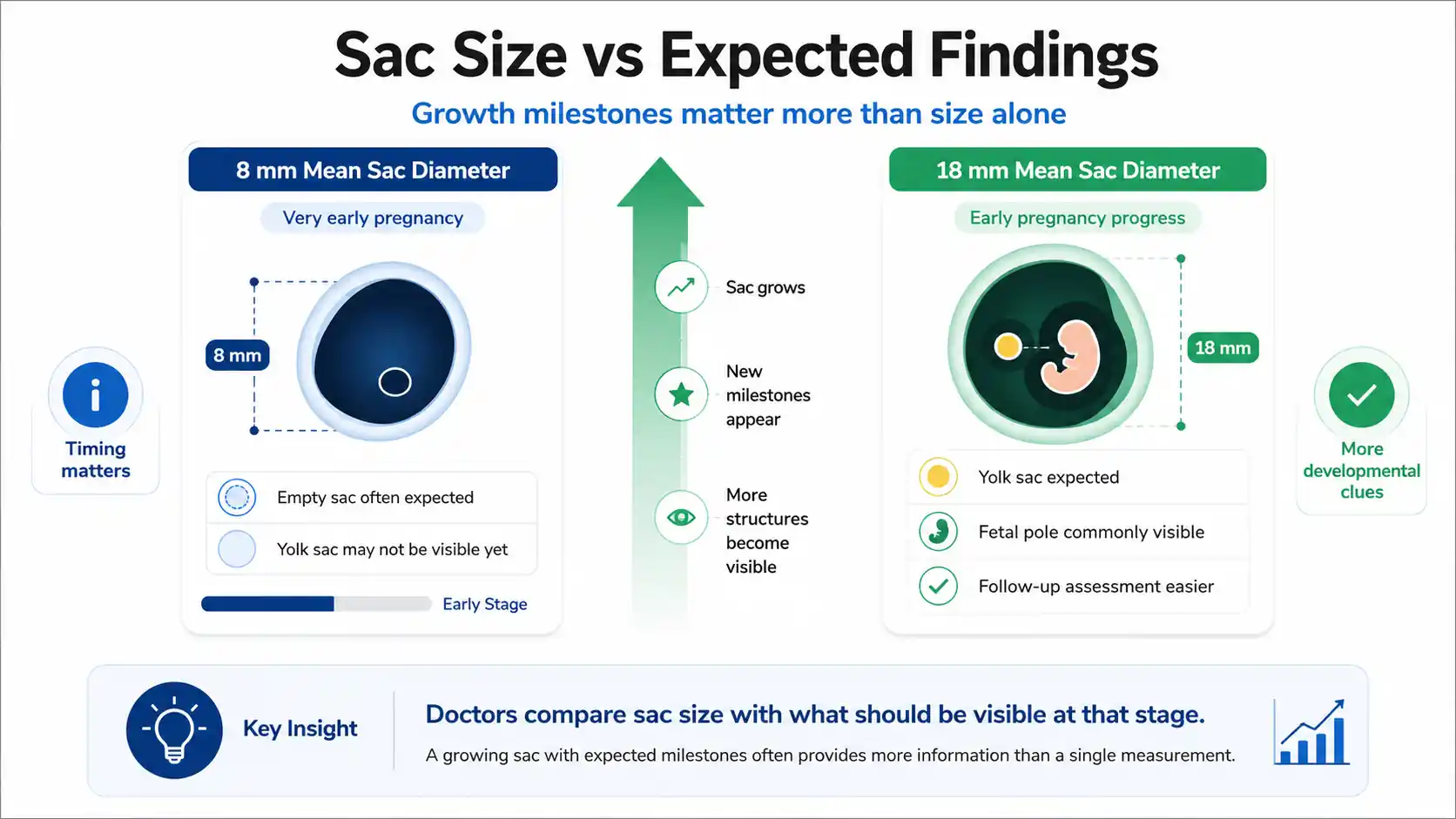
Micro Insight
Many people focus on the sac size alone. The more important question is whether the ultrasound findings match that size. A sac that is growing normally and showing expected milestones often provides more information than a single measurement by itself.
What Is Mean Sac Diameter in Early Pregnancy?
The gestational sac is usually the first structure seen during an early pregnancy scan. Mean sac diameter is also called mean gestational sac diameter, and both terms refer to the average size of the gestational sac. It appears before the embryo becomes visible. As the pregnancy develops, the sac grows steadily and provides important clues about timing and progression.
On an early pregnancy ultrasound, a transvaginal ultrasound may show the gestational sac, yolk sac, or fetal pole earlier than an abdominal ultrasound.
A pregnancy measuring 18 mm and a pregnancy measuring 8 mm are expected to show different ultrasound findings. Larger sacs should reveal more developmental milestones. This helps healthcare providers decide whether growth appears consistent with expectations or if another scan may be needed.
Mean sac diameter is most useful during the earliest weeks of pregnancy. Once an embryo can be measured, crown-rump length becomes the preferred method for pregnancy dating because it is usually more accurate.
What Your Mean Sac Diameter Result Means
Your mean sac diameter (MSD) result estimates how far an early pregnancy has progressed based on the size of the gestational sac seen on ultrasound. The result helps estimate gestational age, identify expected developmental milestones, and determine whether ultrasound findings match the stage of pregnancy.
Understanding Your Result
Mean sac diameter is the average size of the gestational sac. This sac is often the first structure visible during early pregnancy ultrasound.
A larger sac usually means the pregnancy is further along. The calculator uses sac size to estimate gestational age in weeks and days. It also compares the sac size with expected findings such as a yolk sac, fetal pole, or heartbeat.
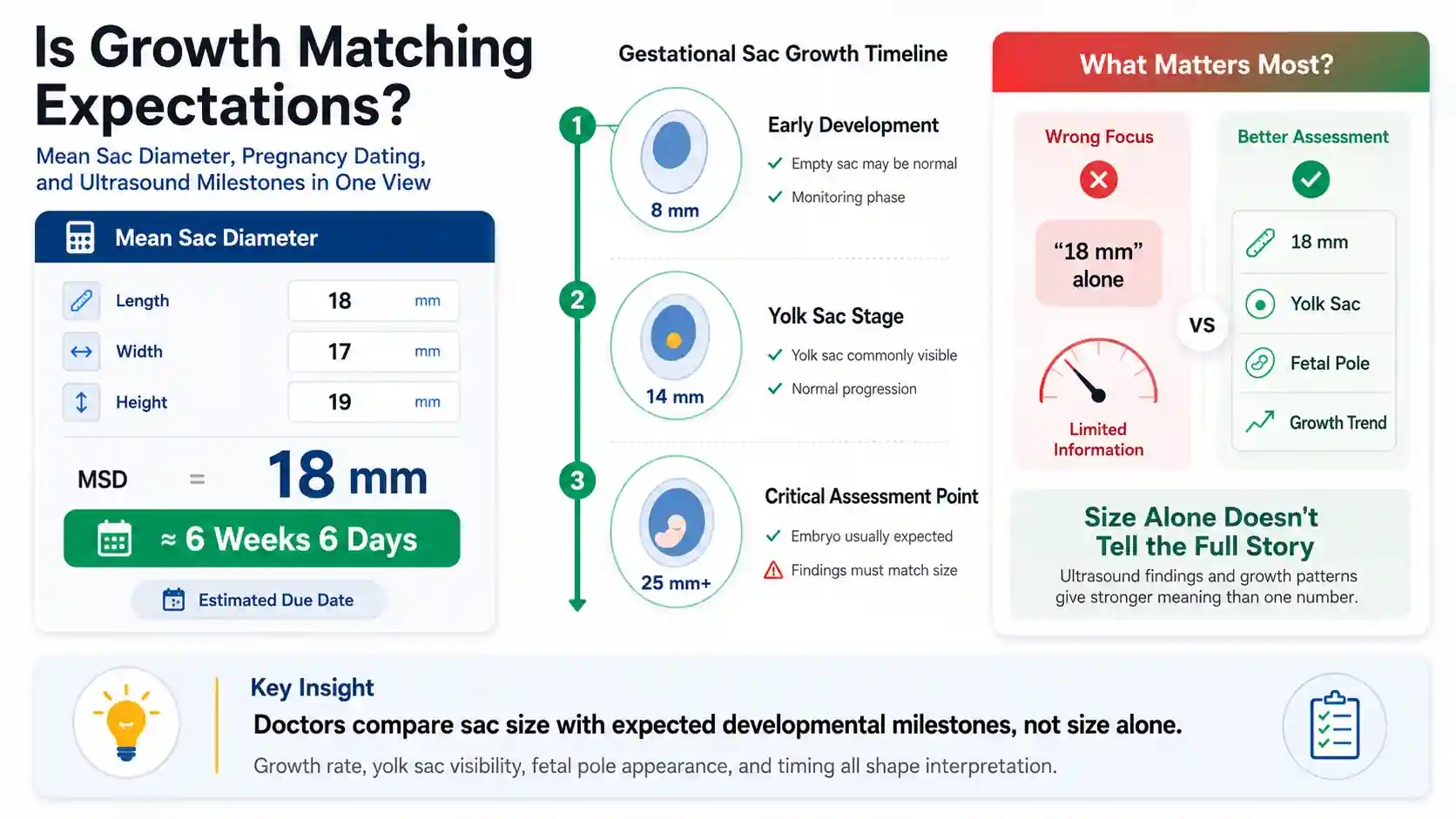
Matching ultrasound findings to sac size is often more important than the measurement alone. A normal result depends on both growth and what can be seen inside the sac.
Is Your Result Good or Bad?
There is no single “good” or “bad” MSD value. The meaning depends on the stage of pregnancy and the ultrasound findings.
- Small sacs in very early pregnancy may still appear empty and be completely normal.
- Mid-range sac sizes often show a yolk sac.
- Larger sacs are expected to show more developmental structures.
- An empty sac at a larger size may require medical evaluation or a repeat scan.
Many healthcare providers pay close attention when the mean sac diameter reaches about 25 mm. At that stage, an embryo is normally expected to be visible. Findings that do not match the sac size may lead to follow-up imaging.
What You Should Do Next
Compare the estimated gestational age with your known pregnancy dates.
Review whether the ultrasound findings match the sac size.
Check growth between scans if you have previous measurements.
Discuss unexpected findings with your healthcare provider.
Follow any recommendation for a repeat ultrasound if growth or visibility remains uncertain.
Quick Example to Test
Input Values
- Scan Date: July 15, 2026
- Mean Sac Diameter: 20 mm
- Ultrasound Finding: Yolk Sac Visible
Calculator Result
- Estimated Gestational Age: 7 weeks 1 day
- Estimated Due Date: March 4, 2027
Interpretation
A 20 mm sac usually represents an early pregnancy that is progressing beyond the earliest stages. Seeing a yolk sac at this size is generally consistent with expected development. Healthcare providers may look for a fetal pole or other milestones depending on the full clinical picture and scan quality.
Which Is More Accurate for Early Pregnancy Dating, MSD or CRL?
CRL is usually more accurate than MSD once the embryo can be measured clearly. A mean sac diameter calculator is most useful before CRL is available, when the gestational sac is visible but the embryo is still too small or unclear.
What does MSD measure on an early ultrasound?
MSD measures the average size of the gestational sac seen on an early pregnancy ultrasound. It helps estimate early gestational age before the embryo can be measured.
- MSD means mean sac diameter.
- It uses the gestational sac size.
- It is most useful in very early pregnancy.
- It helps compare sac size with expected findings.
- It does not measure the embryo.
What does CRL measure once the embryo is visible?
CRL measures the embryo from the top of the head to the bottom of the body. Once this measurement is clear, providers usually trust CRL more than MSD for pregnancy dating.
- CRL means crown-rump length.
- It measures the embryo, not the sac.
- It is used after the fetal pole is visible.
- It gives a stronger due date estimate.
- It often replaces MSD for dating decisions.
When should MSD matter more than CRL?
MSD matters more when the ultrasound shows a gestational sac but no measurable embryo yet. In that early stage, the calculator can estimate timing and check whether scan findings match the sac size.
Use MSD when:
- The scan shows only a gestational sac.
- The embryo is not visible yet.
- CRL is not listed on the ultrasound report.
- The goal is early scan interpretation.
- You are checking expected milestones like yolk sac or fetal pole visibility.
When should CRL matter more than MSD?
CRL should matter more once the embryo can be measured clearly. At that point, sac size becomes less useful for dating because the embryo measurement gives better timing information.
Trust CRL more when:
- A fetal pole is visible.
- The report includes a CRL value.
- Your provider gives a CRL-based gestational age.
- MSD and CRL results do not match.
- You need a more reliable due date estimate.
How should you read a mean sac diameter calculator result if CRL is available?
Use the mean sac diameter calculator result as early scan context, not as the final dating answer. If your ultrasound report includes CRL, your provider will usually use CRL or clinical dating instead of MSD alone.
| Measurement | What It Measures | Best Used When | Calculator Role | Dating Strength |
|---|---|---|---|---|
| MSD | Average size of the gestational sac. | Before the embryo is clearly measurable. | Used by this calculator to estimate gestational age, due date, scan milestones, and growth speed. | Early Estimate |
| CRL | Length of the embryo from crown to rump. | Once the fetal pole or embryo can be measured clearly. | Not used as an input in this calculator. CRL should guide dating once available on the ultrasound report. | Preferred Dating |
Heads-up: MSD is useful for early scan context, especially before the embryo is measurable. Once CRL is available, provider dating or CRL-based dating should usually take priority over MSD alone.
What is the quick rule for MSD vs CRL?
MSD helps before the embryo is measurable. CRL becomes the preferred dating measurement once the embryo is visible and clear enough to measure.
A mean sac diameter calculator can help explain early scan timing. It should not replace CRL dating, IVF transfer dating, or your provider’s ultrasound report.
How to Use the Mean Sac Diameter Calculator
This calculator works by turning early ultrasound measurements into gestational age, due date, and viability insights. You enter scan details, and the system processes sac size and clinical findings in the background. It follows standard medical ultrasound logic to give fast and structured pregnancy dating results.
Enter Your Ultrasound Scan Date
Start by adding the date of your ultrasound scan. This date becomes the base point for all calculations. The system uses it to align sac measurements with pregnancy timing. Without an accurate scan date, gestational age and due date estimates can shift slightly and reduce result precision.
Enter Mean Sac Diameter or Three Measurements
Add either the final mean sac diameter or the three sac measurements. If you enter length, width, and height, the calculator averages them to form MSD. This step ensures accurate sac size input since early pregnancy sacs are often measured in multiple directions during ultrasound.
Select Measurement Unit
Choose whether your values are in millimeters or centimeters. If centimeters are selected, the system converts them into millimeters before calculation. This keeps all pregnancy dating consistent since gestational age formulas rely on millimeter-based sac measurements for accurate early growth estimation. This makes the calculator work as a mean sac diameter calculator in mm and a mean sac diameter calculator in cm without changing the formula.
Choose Ultrasound Finding
Select what was seen during the scan, such as empty sac, yolk sac, fetal pole, or heartbeat. This selection helps the calculator compare sac size with expected development stages. It supports viability assessment using standard ultrasound thresholds used in early pregnancy evaluation.
Review Your Results
The calculator processes all inputs to estimate gestational age, due date, and pregnancy viability status. You see how far the pregnancy has progressed and whether findings match expected development. This helps you understand if growth looks normal or if follow-up ultrasound timing may be needed.
Quick Example to Test
Inputs
- Mean Sac Diameter: 14 mm
- Measurement Unit: Millimeters
- Current Scan Date: July 1, 2026
- Ultrasound Finding: Yolk Sac Visible
Result
- Estimated Gestational Age: 6 weeks 2 days
- Estimated Due Date: February 22, 2027
- Clinical Assessment: Normal Progression
- Growth Tracking: Not used in single-scan mode
What Happened
The calculator added 30 days to the 14 mm MSD, giving an estimated pregnancy age of 44 days. Seeing a yolk sac at this sac size can fit expected early development, but the result should still be reviewed with the ultrasound report and your healthcare provider.
How the Mean Sac Diameter Calculator System Works
The Mean Sac Diameter calculator uses standard early pregnancy ultrasound principles to estimate gestational age, due date, and pregnancy progression. It follows clinically used MSD-based formulas and SRU milestone thresholds. The system is designed to give consistent, structured results based on sac measurements and ultrasound findings, reducing manual interpretation errors.
Users often ask if this calculator is accurate or medically reliable. The system is built on widely used ultrasound dating logic where sac size is directly linked to early gestational development. It applies the same MSD formulas and milestone ranges used in early obstetric assessments, which makes results consistent and interpretable in clinical context.
Key Features & Benefits
- Calculates mean sac diameter from single or three ultrasound measurements for flexible input options
- Converts millimeters and centimeters automatically to prevent manual conversion errors
- Estimates gestational age using MSD-based pregnancy dating logic used in early ultrasound practice
- Tracks growth between scans to identify normal or slow developmental patterns
- Interprets ultrasound findings using SRU milestone thresholds for early pregnancy assessment
Technical Process
Measurement Input
The system collects either a final MSD value or three sac dimensions. It validates the data and converts all inputs into a consistent unit before processing.
Clinical Calculation
The calculator applies the MSD plus 30 days formula to estimate gestational age. It then breaks results into weeks and days for clear pregnancy dating output.
Milestone Evaluation
Sac size and ultrasound findings are compared with SRU-based thresholds. The system identifies expected development stages and highlights normal or concerning patterns based on clinical ranges.
How the Mean Sac Diameter Calculator Formula Works (Complete Breakdown)
The mean sac diameter calculator uses your gestational sac measurement to estimate early pregnancy age, due date, scan milestones, and growth speed. It works with either a final MSD value or three sac measurements. The formula is simple, but the result depends on size, unit, scan date, and what was seen on ultrasound.
Mean Sac Diameter Formula:
The mean sac diameter formula finds the average size of the gestational sac from three ultrasound measurements. If your report already shows the final MSD, the calculator uses that number directly. If not, it adds length, width, and height, then divides the total by 3.
					Mean Sac Diameter = (Length + Width + Height) ÷ 3

Gestational Age Days = round(Mean Sac Diameter in mm + 30)

Estimated Due Date = Current Scan Date - Gestational Age Days + 280 days

Growth Velocity = (Current MSD - Previous MSD) ÷ Days Between Scans
What This Formula Does
This formula finds the average size of the gestational sac. That average is called the mean sac diameter, or MSD.
After that, the calculator turns MSD into early gestational age. It adds 30 days to the MSD in millimeters, rounds the result, and converts it into weeks and days.
For two-scan tracking, it also checks how fast the sac grew between scans.
Variables Used in the Calculator
- Length → One ultrasound measurement of the gestational sac. This is used only when you enter three sac measurements instead of a final MSD value.
- Width → The second sac measurement from the ultrasound report. It helps calculate the average sac size when the final MSD is not already given.
- Height → The third sac measurement. The calculator adds it with length and width, then divides the total by 3.
- Final MSD → The mean sac diameter already listed on your ultrasound report. If you enter this value, the calculator uses it directly and skips the three-measurement average.
- MSD in mm → The calculator runs the main logic in millimeters. If you enter centimeters, it converts cm to mm before calculating the result.
- Current Scan Date → The date of your latest ultrasound. This date is used to estimate the due date from the MSD-based gestational age.
- Gestational Age Days → The estimated pregnancy age in days. The calculator finds this by adding 30 to the MSD in mm, then rounding the answer.
- Previous MSD → The sac size from an earlier scan. This is used only in two-scan mode to measure growth speed.
- Days Between Scans → The number of days between the previous scan and current scan. The calculator uses this to find growth per day.
- Growth Velocity → The sac growth rate in mm per day. A result of 1.0 mm/day or higher is marked as normal growth in this calculator.
Another Example Calculation (Step-by-Step)
This example shows how the mean sac diameter formula works with real ultrasound measurements. It uses length, width, and height to find the average sac size. Then the calculator estimates gestational age, due date, and scan status from that MSD value.
Given:
- Length = 12 mm
- Width = 11 mm
- Height = 13 mm
- Current Scan Date = July 1, 2026
- Visual Finding = Empty Sac
Calculation:
					Mean Sac Diameter = (12 + 11 + 13) ÷ 3
Mean Sac Diameter = 36 ÷ 3
Mean Sac Diameter = 12 mm

Gestational Age Days = round(12 + 30)
Gestational Age Days = 42 days

42 days = 6 weeks + 0 days

Estimated Due Date = July 1, 2026 - 42 days + 280 days
Estimated Due Date = February 24, 2027
Result:
- Mean Sac Diameter: 12 mm
- Gestational Age: 6 weeks + 0 days
- Estimated Due Date: February 24, 2027
- Scan Status: Normal Early Development
Meaning:
At 12 mm, an empty sac can still fit early pregnancy timing in this calculator. Once the sac reaches higher ranges, the visible findings matter more. A yolk sac and fetal pole become important scan milestones.
How do you calculate Mean Sac Diameter?
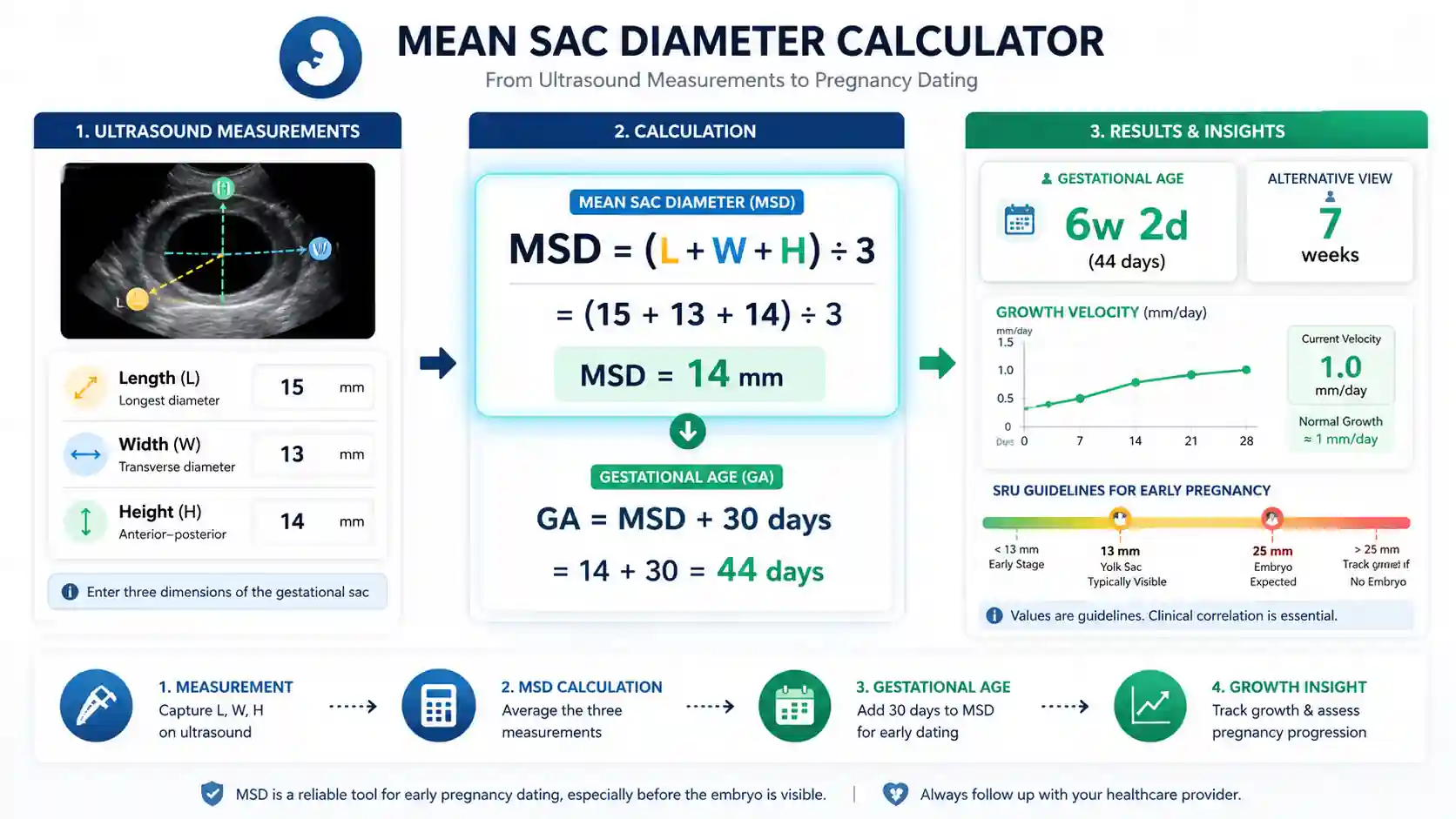
Mean Sac Diameter (MSD) is calculated by averaging the three ultrasound measurements of the gestational sac: length, width, and height. The formula is MSD = (L + W + H) ÷ 3. Gestational age is then estimated using MSD + 30, which converts sac size into early pregnancy days
What is the Mean Sac Diameter at 6 weeks?
This example shows how early pregnancy dating works using a single scan measurement.
Input:
- Length = 15 mm
- Width = 13 mm
- Height = 14 mm
Process:
- MSD = (15 + 13 + 14) ÷ 3
- MSD = 14 mm
- Gestational Age = 14 + 30 = 44 days
- 44 days = 6 weeks 2 days
Result:
- MSD: 14 mm
- Gestational Age: 6 weeks 2 days
- Finding: Normal early progression
Meaning:
This result matches typical early ultrasound findings. Around 6 weeks, sac size usually falls between 10 mm and 18 mm. A result in this range often indicates normal development when combined with expected scan findings like yolk sac visibility.
How does Mean Sac Diameter change gestational age?
This example shows how sac size directly affects pregnancy dating.
Input:
- Length = 20 mm
- Width = 18 mm
- Height = 19 mm
Process:
- MSD = (20 + 18 + 19) ÷ 3
- MSD = 19 mm
- Gestational Age = 19 + 30 = 49 days
- 49 days = 7 weeks
Result:
- MSD: 19 mm
- Gestational Age: 7 weeks
- EDD moves slightly earlier based on dating
Meaning:
A higher MSD usually means a later gestational stage. Around 7 weeks, sac size often increases into the 18–25 mm range. This helps align ultrasound findings with expected pregnancy milestones.
How accurate is growth tracking between two scans?
This example shows how the calculator evaluates growth over time.
Input:
- Previous MSD = 10 mm
- Current MSD = 17 mm
- Time gap = 7 days
Process:
- Growth = 17 − 10 = 7 mm
- Growth Velocity = 7 ÷ 7 = 1.0 mm/day
Result:
- Growth Velocity: 1.0 mm/day
- Status: Normal growth
Meaning:
Around 1 mm per day is considered typical early sac growth. Values close to this range usually indicate healthy progression. Lower values may suggest slower development and may require follow-up scanning.
What does a small or large MSD mean in early pregnancy?
This example helps interpret borderline measurements.
Input:
- MSD = 11 mm
- Finding = Empty sac
Process:
- GA = 11 + 30 = 41 days
- 41 days ≈ 5 weeks 6 days
- Compared with SRU thresholds
Result:
- Gestational Age: 5 weeks 6 days
- Interpretation: Possibly early ormal stage
Meaning:
Under 13 mm can still be normal in very early pregnancy. Timing matters more than a single scan. A follow-up ultrasound is often used to confirm development like yolk sac appearance or growth progression.
Quick Rules to Remember
You can test your own ultrasound values directly in the calculator. Enter sac measurements, and the system instantly converts them into gestational age and growth insights. Normal early growth usually sits around 1 mm per day, and MSD increases steadily as pregnancy progresses.
Mean Sac Diameter Result Benchmarks Explained
Mean Sac Diameter (MSD) result benchmarks help you understand if early pregnancy measurements fall within expected ranges. These ranges are based on ultrasound milestones used in early obstetric assessment. By comparing your result with standard MSD and growth values, you can quickly see if development looks normal, early, or needs follow-up.
| MSD Range | Label | USA Guideline | Global Ultrasound Context | Notes |
|---|---|---|---|---|
| Under 13 mm | Early Stage | Common in very early pregnancy scans before 6 weeks. | Often shows empty gestational sac without yolk sac yet. | Usually normal if scan is early. Follow-up recommended for confirmation. |
| 13–24.9 mm | Developing | Yolk sac typically expected in most clinical guidelines. | Early embryo structures may begin to appear. | Empty sac at this stage may need repeat ultrasound for clarity. |
| 25 mm or larger | Critical Check | Embryo should be visible according to SRU criteria. | Absence of embryo is considered abnormal in most cases. | Requires medical evaluation based on SRU diagnostic thresholds. |
| Fetal pole visible | Progressing | Normal early fetal development stage around 6–7 weeks. | Embryo formation confirms advancing pregnancy stage. | Growth monitoring continues to confirm viability. |
| Heartbeat visible | Viability Confirmed | Strong indicator of ongoing viable pregnancy. | Most reliable sign of normal embryonic development. | Routine follow-up still recommended for continued monitoring. |
| Growth Velocity | Category | Meaning |
|---|---|---|
| ≥ 1.0 mm/day | Normal Growth | Matches expected early pregnancy sac development pattern. |
| < 1.0 mm/day | Slow Growth | May indicate delayed development and needs follow-up scan. |
Heads-up: MSD benchmarks follow common early pregnancy ultrasound guidelines. Interpretation depends on scan timing and should always be confirmed with follow-up imaging when needed.
Interpretation
These MSD benchmarks help you quickly understand early pregnancy progress. Lower values often reflect very early stages, while mid-range values show expected development like yolk sac formation. Higher values without expected structures may need closer evaluation based on clinical guidelines.
Pro Tip
Early scans are timing-sensitive. A repeat ultrasound after 5–7 days often gives a much clearer picture than a single MSD reading.
How to Improve Your Mean Sac Diameter Calculator Result
Using a mean sac diameter calculator helps you understand early pregnancy development, but the result alone is not the final answer. What matters most is how the measurement fits with ultrasound findings, timing, and growth patterns. These insights help you decide whether follow-up scans or reassurance is needed.
For Normal Early Progression Results (Under 13 mm or Expected Findings)
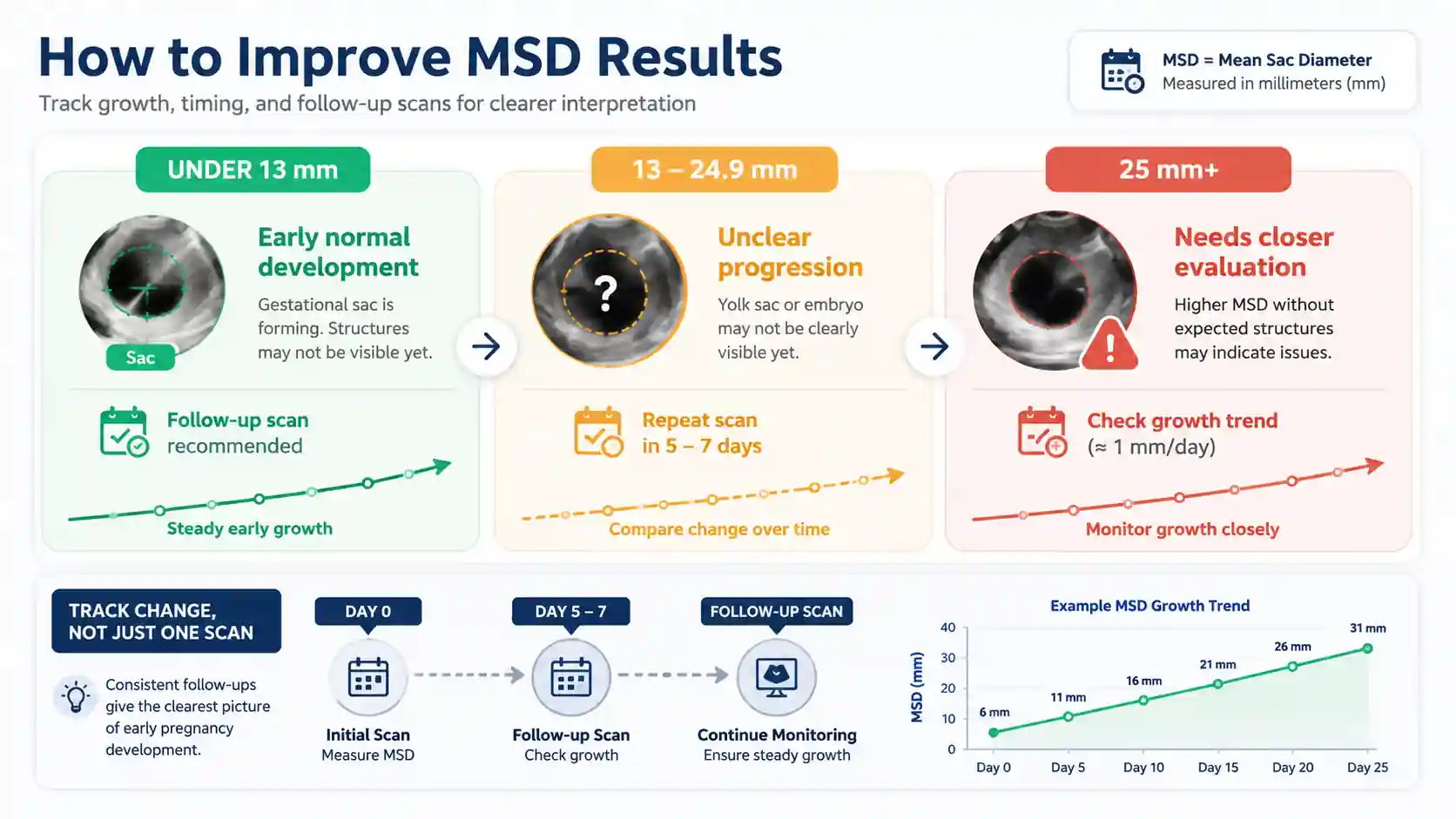
When the MSD result is in the early normal range, it usually matches very early pregnancy development. This often means the gestational sac is still forming and may not yet show advanced structures.
In this stage, the best step is to avoid over-interpreting a single scan. Follow-up ultrasound after a short interval gives a clearer picture of development. You should also compare findings with expected timing, since early pregnancy can vary by several days. Keeping track of symptoms and scheduling the next scan helps confirm steady progression.
For Borderline Results (13–24.9 mm or Unclear Findings)
This range often creates confusion because it sits between early normal development and expected structural visibility. It is common for users of a mean sac diameter calculator to fall into this category when a yolk sac is not clearly seen yet.
The key action here is follow-up imaging rather than assumptions. A repeat scan in 5 to 7 days helps confirm whether growth is progressing as expected. It also helps to compare MSD change over time instead of relying on a single value. If results remain unclear, clinicians usually focus more on trend growth than one measurement.
For Concerning Results (25 mm or Larger or Slow Growth)
When MSD reaches higher values without expected developmental signs, it requires closer evaluation. This range is important because it may indicate delayed or abnormal progression when combined with missing expected structures.
The most useful step is to schedule a prompt follow-up scan for confirmation. Growth tracking becomes essential here, especially checking if MSD is increasing around 1 mm per day. If growth is slow or inconsistent, doctors often reassess viability using additional ultrasound markers. Avoid drawing conclusions from one measurement alone, since timing differences can still affect interpretation.
Pro Tip
The most reliable approach is tracking change over time instead of focusing on one MSD result. A mean sac diameter calculator becomes most useful when you compare multiple scans, not single readings. Consistent follow-ups give a clearer and more accurate picture of early pregnancy development.
You Might Also Find These Helpful
Pregnancy & Fertility 45
One Time Pregnancy Calculator estimates pregnancy odds from one encounter, plus fertile window timing, test date, due date, and 21-day testing guidance.
Try calculatorUse the AMH Calculator to convert ng/mL or pmol/L, compare your result with age-based data, and see what it may mean for IVF, fertility,…
Try calculatorUse the Baby Eye Color Calculator with parents, grandparents, or sibling context to compare Brown, Green/Hazel, and Blue/Grey model estimates instantly.
Try calculatorBasal Body Temperature Calculator checks reading conditions and analyzes your temperature pattern for a sustained shift that may be consistent with ovulation.
Try calculatorBPD gestational age calculator: estimate fetal age from BPD, compare your week, check normal BPD ranges, and understand ahead or behind results.
Try calculatorCalculate odds with the Chance of Twins Calculator. Enter maternal age and history. Find your probability instantly. See if you will conceive multiples now.
Try calculatorFind out exactly when you conceived. Our free Conception Calculator uses your Due Date, LMP, or Ultrasound to estimate your fertilization date and fertile…
Try calculatorUse our Conception Date Due Date Calculator to find your baby's arrival date. Enter your conception or intercourse date for clinical 40-week results.
Try calculatorContraceptive effectiveness calculator to compare birth control methods, typical vs perfect use, backup protection, and 5-year pregnancy risk.
Try calculatorUse this CRL calculator to estimate gestational age and due date from crown-rump length in mm or cm. Compare CRL, LMP, and IVF dating…
Try calculatorEstimate your monthly and 12-month pregnancy odds by age, partner age, and cycle dates. See your fertile window and when to seek fertility help.
Try calculatorUse this fundal height calculator to compare your cm measurement by week, check growth range, estimate baby weight, and know when to ask about…
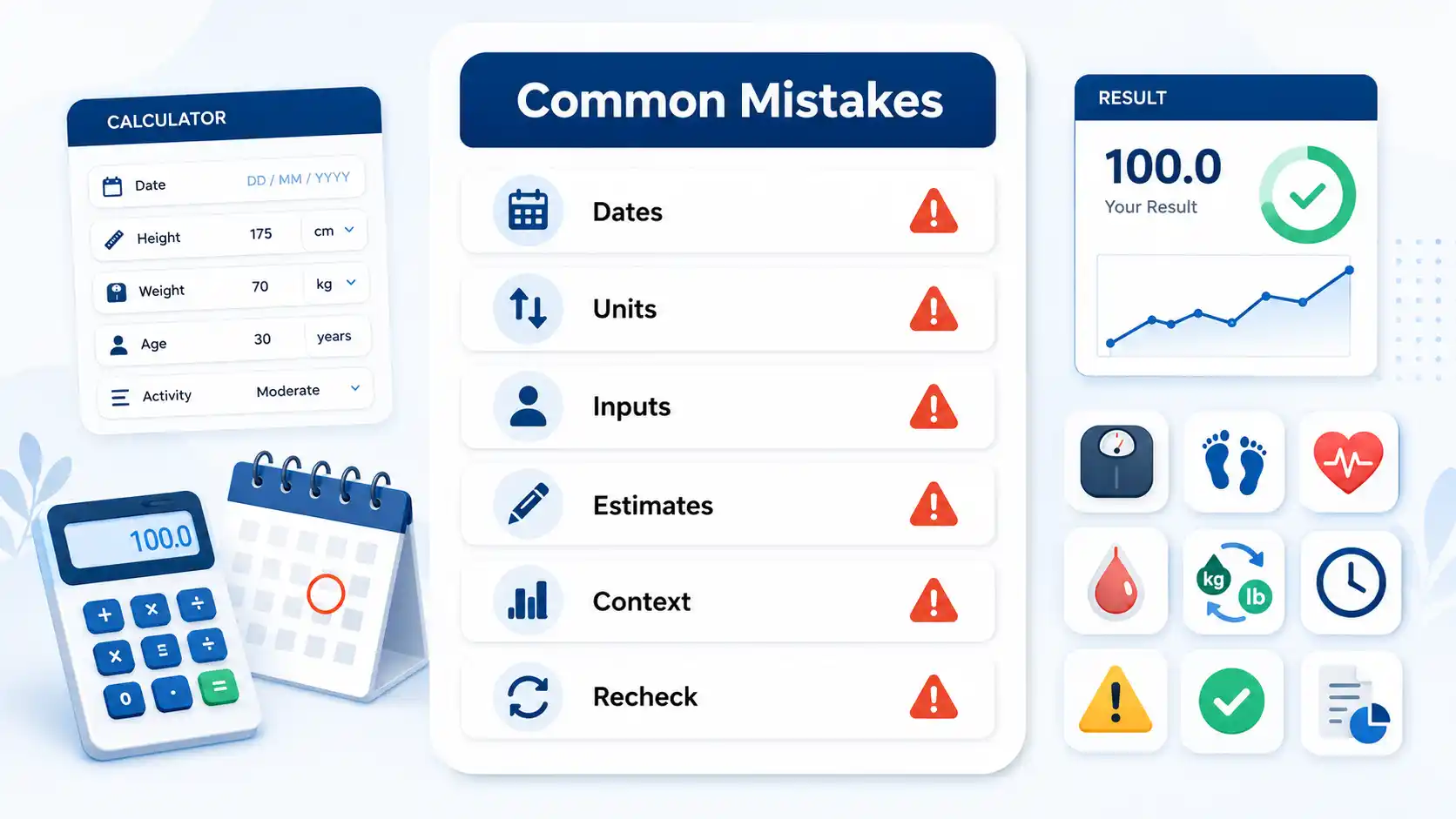
Try calculatorCommon Mean Sac Diameter Calculation Mistakes
Common mistakes when using a mean sac diameter calculator usually come from incorrect measurements and misunderstanding ultrasound timing. Small input errors can change early pregnancy interpretation. These issues often lead to confusion about gestational sac growth, viability, and expected development patterns on follow-up scans.
- Mixing millimeters and centimeters when entering gestational sac measurements in the calculator
- Measuring only part of the gestational sac instead of full inner diameter on ultrasound
- Comparing results from transvaginal scans with abdominal ultrasound measurements
- Assuming a single mean sac diameter scan confirms pregnancy viability or outcomes
- Using MSD values after crown rump length measurements are available for dating
Frequently Asked Questions (FAQs)
What is mean sac diameter in pregnancy?
Mean sac diameter is the average measurement of the gestational sac seen in early pregnancy ultrasound. It helps estimate early development before the embryo is visible. Doctors use it to track growth and compare it with expected pregnancy timing for better early assessment.
How is mean sac diameter calculated?
Mean sac diameter is calculated by adding the length, width, and height of the gestational sac and dividing the total by three. This gives an average size used in early pregnancy tracking. It helps standardize measurements across different ultrasound views for better consistency.
What is the mean sac diameter at 5 weeks?
At around 5 weeks of pregnancy, mean sac diameter is usually small, often between 2 and 5 mm. This stage varies widely depending on implantation timing. Early growth can differ by several days, so small size changes are still considered normal in most cases.
What is the mean sac diameter at 6 weeks?
At 6 weeks, mean sac diameter commonly ranges from about 10 to 15 mm. Growth patterns depend on early implantation timing and scan accuracy. Doctors compare this value with follow-up scans to confirm steady development rather than relying on one reading alone.
How do you estimate gestational age from mean sac diameter?
Gestational age can be estimated using a simple rule where mean sac diameter in millimeters is added to 30. This gives an approximate pregnancy age in days. It is mainly used in early pregnancy before embryo measurements become available for more accurate dating.
What does an empty gestational sac mean?
An empty gestational sac may simply mean the pregnancy is too early for the embryo to be visible. In some cases, it requires follow-up scans to confirm normal development. Timing plays a major role, so a repeat ultrasound is usually recommended.
What does a 25 mm gestational sac without an embryo mean?
A gestational sac measuring 25 mm or more without a visible embryo may need medical review. This size is a key threshold where doctors usually check for abnormal or delayed development. However, follow-up imaging is essential before making any final conclusion.
Is growth of 1 mm per day normal?
Early gestational sacs often grow close to 1 mm per day, but variation is common. Growth depends on individual pregnancy timing and measurement accuracy. Doctors look at overall trend across scans rather than expecting exact daily increases in all cases.
Which is more accurate, MSD or CRL?
Crown-rump length becomes more accurate than mean sac diameter once the embryo is visible. MSD is mainly used in very early pregnancy before fetal structures appear. After that stage, CRL provides a more precise method for dating and tracking growth.
Can IVF pregnancies use a mean sac diameter calculator?
Yes, IVF pregnancies can use mean sac diameter calculators, but they are usually dated using embryo transfer information first. MSD is still helpful for checking early sac growth and confirming development patterns alongside scheduled fertility clinic scans and monitoring.
How accurate is a mean sac diameter calculator?
A mean sac diameter calculator gives an estimate, not a final diagnosis. Accuracy depends on ultrasound quality, timing, and measurement technique. It works best in early pregnancy before embryo visibility, but follow-up scans are always needed for confirmation.
Can mean sac diameter predict baby gender?
No, mean sac diameter cannot predict baby gender. MSD only measures the average size of the gestational sac during early pregnancy. It helps estimate timing, sac growth, and expected ultrasound milestones, not fetal sex or chromosome pattern.
Gender cannot be confirmed from sac size, sac shape, or MSD growth.
Should IVF dating use MSD or embryo transfer date?
IVF pregnancies should usually be dated from embryo transfer details first. MSD can help explain early scan findings, but it should not override transfer-based dating, clinic dating, or the gestational age provided by your fertility team.
Use MSD as scan context, not the main IVF dating method.
What does 4 mm mean sac diameter mean?
A 4 mm mean sac diameter equals about 4 weeks and 6 days in this calculator. At this size, an empty sac can still fit very early pregnancy timing because the yolk sac or embryo may not be visible yet.
A repeat scan may give a clearer picture.
What does 10 mm mean sac diameter mean?
A 10 mm mean sac diameter equals about 5 weeks and 5 days in this calculator. An empty sac may still be early, but providers often look closely for early signs like a yolk sac as the sac grows.
Timing, scan type, and follow-up matter here.
Is an empty sac normal at 5 weeks?
Yes, an empty sac can be normal at 5 weeks, especially if ovulation happened later than expected or the scan was done very early. A gestational sac may appear before the yolk sac or embryo becomes clear.
One early scan should not be overread without follow-up.
Questions?
We had love to hear from you! Whether you are reporting an issue, suggesting a new calculator, or exploring collaboration opportunities — we are here to help. Every message helps us make 100calc smarter, faster, and more helpful for everyone.
Why People Trust 100calc
At 100calc.com, we focus on accuracy, speed, and trust. Every calculator we create is designed to give reliable, instant, and easy-to-understand results you can truly depend on.