
hCG Doubling Time Calculator: Is Your Beta Rise Fast, Slow, or Safe?
The hCG doubling time calculator shows how fast your beta hCG level rises between two blood tests. It calculates your doubling time, 48-hour increase, and growth trend in plain English.
Enter your first and second beta hCG results below. The tool compares your numbers with common early pregnancy rise patterns, but it does not replace medical advice or ultrasound review.
Quick Facts
- Normal early rise: 48 to 72 hours
- Expected slowdown: Starts at 1,200 mIU/mL
- Minimum 48-hour increase: 35% to 60%
- Ultrasound threshold: 1,500 to 2,000 mIU/mL
- Updated Jun 12, 2026
- Reviewed by 100Calc Research Team
Pregnancy & Fertility Calculator
hCG Doubling Time Calculator
Calculate your Beta hCG doubling time and 48-hour percentage increase. Check if your hormone levels are rising normally for early pregnancy or after an IVF embryo transfer.
Use this if you know exactly how many hours passed between your blood draws (e.g., 48).
What you need to enter
You will need the results from two separate Beta hCG blood tests and the amount of time that passed between them.
hCG Doubling Time
—
Your doubling time meaning will appear here.
Rise assessment
Your personalized hCG rise summary will appear here after calculation.
Your next target (Prediction)
To maintain your current trajectory, your next test predictor will appear here.
Medical baseline note
Your doubling time is calculated based on standard early pregnancy math.
Quick answer
A direct, snippet-style answer based on your inputs will appear here.
Is my 48-hour increase normal?
Your first dynamic answer will appear here after calculation.
Why did my hCG doubling time change?
Your second dynamic answer will appear here after calculation.
What does hCG doubling time tell you?
hCG doubling time tells you how many hours it takes for your beta hCG level to double. Doctors use this trend to watch early pregnancy progress before an ultrasound can show clear details.
Your result shows how fast your body produces pregnancy hormones. Doctors use this rate to monitor early pregnancy health before an ultrasound can see anything.
Understanding Your Result
The calculator gives you a specific time in hours. This number reveals exactly how long it takes for your beta hCG level to multiply by two.
Early in pregnancy, this speed acts as a vital health indicator. A steady pace suggests the embryo is developing as expected.
Is Your Result Good or Bad?
A good result depends entirely on your starting number. If your first test is under 1,200 mIU/mL, a healthy doubling time falls between 30 and 72 hours.
Once your levels rise above 1,200 mIU/mL, growth naturally slows down. A doubling time of 80 hours starting at 2,000 mIU/mL is a normal slowdown. The math changes as your baseline increases.
Dropping levels or completely flat numbers fall outside the expected range. You should share these results with your healthcare provider immediately.
If Your Levels Are Dropping
If your second test is lower than your first, the calculator measures your halving time. A dropping number typically means the pregnancy is not viable, which may indicate a chemical pregnancy or an early loss. Please share these results with your doctor immediately for clear medical guidance.
What You Should Do Next
- Compare your exact doubling time to standard medical benchmarks.
- Share your 48-hour percentage increase with your doctor during your next visit.
- Schedule an early ultrasound if your levels have crossed 1,500 mIU/mL.
- Stop tracking your numbers daily to prevent unnecessary anxiety.
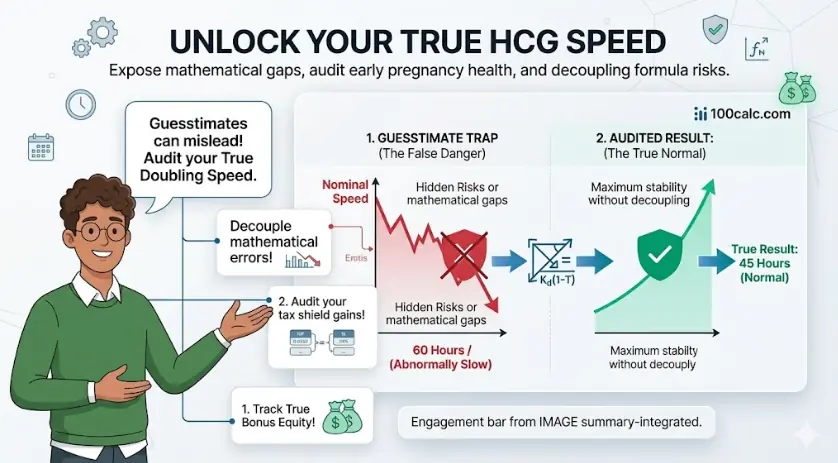
A Quick Example to Test
Let’s say you take two blood tests on different days. Enter these exact dates into the calculator above.
Input:
- First test: 200 mIU/mL on Monday at 8:00 AM.
- Second test: 420 mIU/mL on Wednesday at 10:00 AM.
- The calculator finds the exact 50-hour difference.
Result:
Doubling time: 46.8 hours. Status: Normal Rise.
Meaning:
Your hormone levels are multiplying safely within the standard early window. You can comfortably wait for your doctor to schedule an early transvaginal ultrasound.
When should I call a doctor about hCG results?
Call your doctor right away if you have severe one-sided pelvic pain, shoulder pain, heavy bleeding, dizziness, fainting, or falling hCG levels. A calculator can show a trend, but urgent symptoms need medical care.
What is Beta hCG?
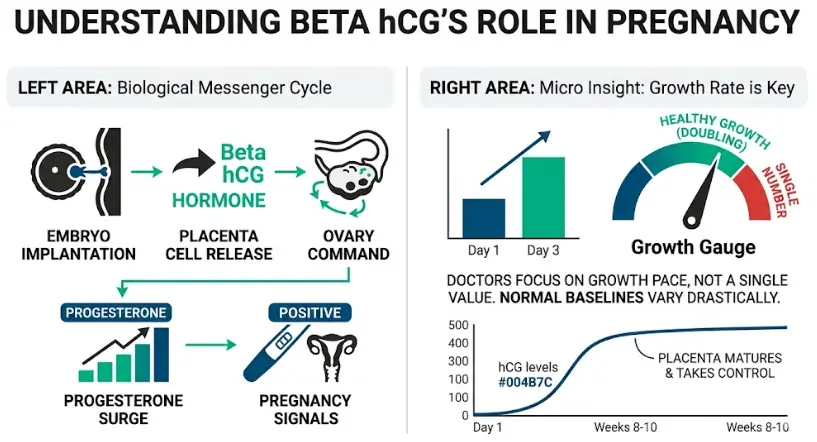
Beta hCG (Human Chorionic Gonadotropin) is the main hormone your body makes during early pregnancy. Cells in the growing placenta release it right after a fertilized egg connects to the uterine wall. Its primary job is to thicken the uterine lining and stop your menstrual cycle.
A new embryo requires a massive surge of support to survive. Beta hCG acts as a crucial chemical messenger. It commands your ovaries to produce large amounts of progesterone. This specific hormone surge triggers the positive result on your home pregnancy tests and blood work.
The placenta eventually matures enough to manage hormone production directly. This major shift usually happens around the eighth or tenth week. Your body no longer needs extreme hCG spikes once the placenta takes control. Hormone growth naturally slows down and levels off for the rest of your pregnancy.
Micro Insight
A single hCG number means almost nothing on its own. Normal baselines vary drastically between different people. Doctors only care about the speed of growth between two separate blood draws. This specific pace reveals early pregnancy health before anything appears on an ultrasound.
Explore More Calculators
Use the Chinese Gender Calculator for a traditional boy-or-girl prediction from lunar age and conception month. Enter conception date, due date, or LMP.
Try calculatorUse this fetal growth calculator to check baby weight percentile from ultrasound data in grams, kg, or cm and see what the result means…
Try calculatorEnter gestational sac measurements in mm or cm to calculate mean sac diameter, estimate early gestational age, compare week-by-week milestones, and see when follow-up…
Try calculatorMissed a birth control pill? Check pregnancy risk, protection status, backup contraception needs, and what to do next with our missed pill calculator.
Try calculatorUse our Pregnancy Chance Calculator to estimate your odds. Enter your cycle day, age, and method. Find out if you are in the high-risk…
Try calculatorUse our pregnancy due date calculator to find your exact Baby Due date. IVF, conception, ovulation, and ultrasound methods with weeks and timeline.
Try calculatorhCG Doubling Time Chart by Starting Level
hCG doubling time changes as your starting beta hCG level gets higher. Lower beta hCG levels often rise faster, while levels above 1,200–1,500 mIU/mL usually slow down. That is why a “normal hCG doubling time” depends on your baseline number, not just the number of hours.
Use this hCG doubling time chart to compare your 48-hour rise with common early pregnancy benchmarks. It helps explain why a beta hCG rise may look slower after 1,200 mIU/mL, 1,500 mIU/mL, or higher.
| Starting Level | Label | Expected 48-Hour Rise | What It Means | Notes |
|---|---|---|---|---|
| Under 1,500 mIU/mL | Fast Early Rise | About 49% or more. | Early beta hCG levels often rise quickly at this stage. | Use two recent blood tests to track your normal hCG doubling time. |
| 1,500–3,000 mIU/mL | Slowing Rise | About 40% or more. | Beta hCG rise may start slowing as the starting level gets higher. | This helps explain hCG doubling time after 1,200–1,500 mIU/mL. |
| Over 3,000 mIU/mL | Expected Slowdown | About 33% or more. | A longer doubling time can still fit the expected pattern at higher levels. | Ultrasound may become more useful than repeat hCG math. |
| Over 6,000 mIU/mL | Use Context | Often much slower. | hCG doubling math becomes less reliable once levels are very high. | Review ultrasound findings, symptoms, and your provider’s guidance. |
Heads-up: This hCG doubling time chart is a guide, not a diagnosis. A slow beta hCG rise, falling level, pain, bleeding, or pregnancy of unknown location should be reviewed by a healthcare provider.
How to Use the hCG Doubling Time Calculator
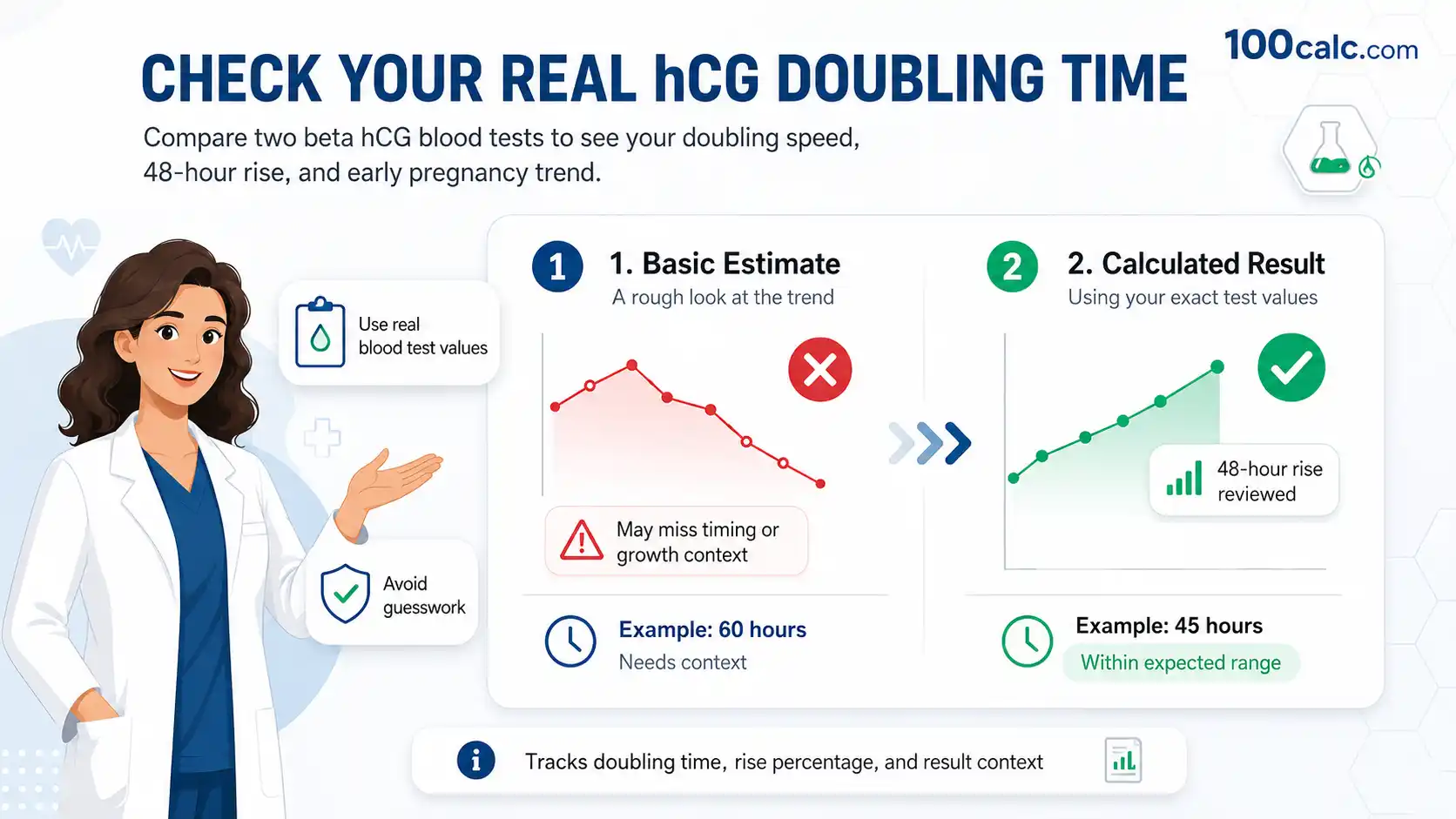
This tool measures your pregnancy hormone growth speed quickly. You only need two quantitative blood test results. The system runs the exponential math for you instantly. Follow these five simple instructions to get your assessment.
Gather Your Blood Test Results
Find the official paperwork from your lab visits. You need two separate quantitative beta measurements. Make sure both tests used the exact same measurement unit before starting.
Enter Your Starting Level
Type your earliest hormone number into the first box. The system uses this baseline to set normal growth expectations. It automatically adjusts if this number is already high.
Input Your Follow-Up Level
Add the result from your most recent blood draw. The calculator compares this second number against your baseline. It checks if the levels are multiplying correctly or dropping.
Choose Your Time Format
Select how much time passed between the two tests. You can type the total hours directly. You can also pick specific dates and times for a precise calculation.
Review Your Growth Assessment
Look at your final calculation right away. The system displays your exact doubling speed and a clear status badge. It tells you if the pace looks completely normal.
How do you calculate hCG doubling time from blood tests?
Read the results from your two laboratory tests. The system uses a logarithmic formula to find the exact growth rate between these two points. Patients often struggle with the math when the time between tests is not exactly 48 hours.
Use these inputs in the calculator:
- First test: 400 mIU/mL
- Second test: 850 mIU/mL
- Time passed: 52 hours
Process:
The system divides the second value by the first and applies natural logarithms to find the rate.
Final Result:
Doubling time is 47.8 hours.
Meaning:
The hormone levels are rising at a healthy pace. The doubling speed safely falls within the expected 48 to 72-hour early pregnancy window. You can confidently wait for your next doctor appointment.
How the hCG Doubling Time Formula Works (Complete Breakdown)
This calculator uses logarithmic math to track your exact pregnancy hormone growth. It divides the time passed by the natural log of your two test results. The final number reveals your current doubling speed.
What is the hCG doubling time formula?
The medical formula uses natural logarithms to find your exact hormone growth speed. You multiply the hours passed by the natural log of two. Then, you divide that result by the natural log of your second test divided by your first test.
Doubling Time = [Time × ln(2)] ÷ ln(hCG2 / hCG1)
This equation calculates the exact hours it takes for your hormone levels to multiply by two. It removes the guesswork from early pregnancy tracking. Doctors rely on this specific math to map your growth trajectory accurately.
What Each Variable Means
Every value below connects directly to your lab results. These specific numbers determine exactly how fast your body produces early pregnancy support.
Time
This is the total hours passed between your first and second blood draws. Accurate timing remains critical for the math to work correctly.
ln (Natural Logarithm)
This represents a standard mathematical function. Biologists use it to measure natural exponential growth curves in the human body.
hCG1
This shows the exact numerical result of your first quantitative beta test. It serves as the starting baseline for your personal growth chart.
hCG2
This represents the result of your follow-up blood draw. The equation compares this newer number against your baseline to find the exact rate of change.
Another Example Calculation (Step-by-Step)
Let’s see how the formula works using a real clinical scenario. This helps you understand how the math handles different time gaps between tests.
Given:
- hCG1 = 400 mIU/mL
- hCG2 = 1,100 mIU/mL
- Time = 72 hours
Calculation:
					Doubling Time = (72 × 0.693) ÷ ln(1,100 / 400)
Doubling Time = 49.896 ÷ 1.011 = 49.3
Result:
- Doubling Time: 49.3 hours
Meaning:
Your levels are doubling every 49.3 hours. This represents a healthy rise for early pregnancy. The math confirms your hormone production stays on track.
You Might Also Find These Helpful
Pregnancy & Fertility 45
Use this Pregnancy Risk Calculator to check age, BMI, health history, bleeding, and twins. See if closer prenatal monitoring may be worth asking about.
Try calculatorOne Time Pregnancy Calculator estimates pregnancy odds from one encounter, plus fertile window timing, test date, due date, and 21-day testing guidance.
Try calculatorUse the AMH Calculator to convert ng/mL or pmol/L, compare your result with age-based data, and see what it may mean for IVF, fertility,…
Try calculatorUse the Baby Eye Color Calculator with parents, grandparents, or sibling context to compare Brown, Green/Hazel, and Blue/Grey model estimates instantly.
Try calculatorBasal Body Temperature Calculator checks reading conditions and analyzes your temperature pattern for a sustained shift that may be consistent with ovulation.
Try calculatorBPD gestational age calculator: estimate fetal age from BPD, compare your week, check normal BPD ranges, and understand ahead or behind results.
Try calculatorCalculate odds with the Chance of Twins Calculator. Enter maternal age and history. Find your probability instantly. See if you will conceive multiples now.
Try calculatorFind out exactly when you conceived. Our free Conception Calculator uses your Due Date, LMP, or Ultrasound to estimate your fertilization date and fertile…
Try calculatorUse our Conception Date Due Date Calculator to find your baby's arrival date. Enter your conception or intercourse date for clinical 40-week results.
Try calculatorContraceptive effectiveness calculator to compare birth control methods, typical vs perfect use, backup protection, and 5-year pregnancy risk.
Try calculatorUse this CRL calculator to estimate gestational age and due date from crown-rump length in mm or cm. Compare CRL, LMP, and IVF dating…
Try calculatorEstimate your monthly and 12-month pregnancy odds by age, partner age, and cycle dates. See your fertile window and when to seek fertility help.
Try calculatorCommon Mistakes When Using the hCG Doubling Time Calculator
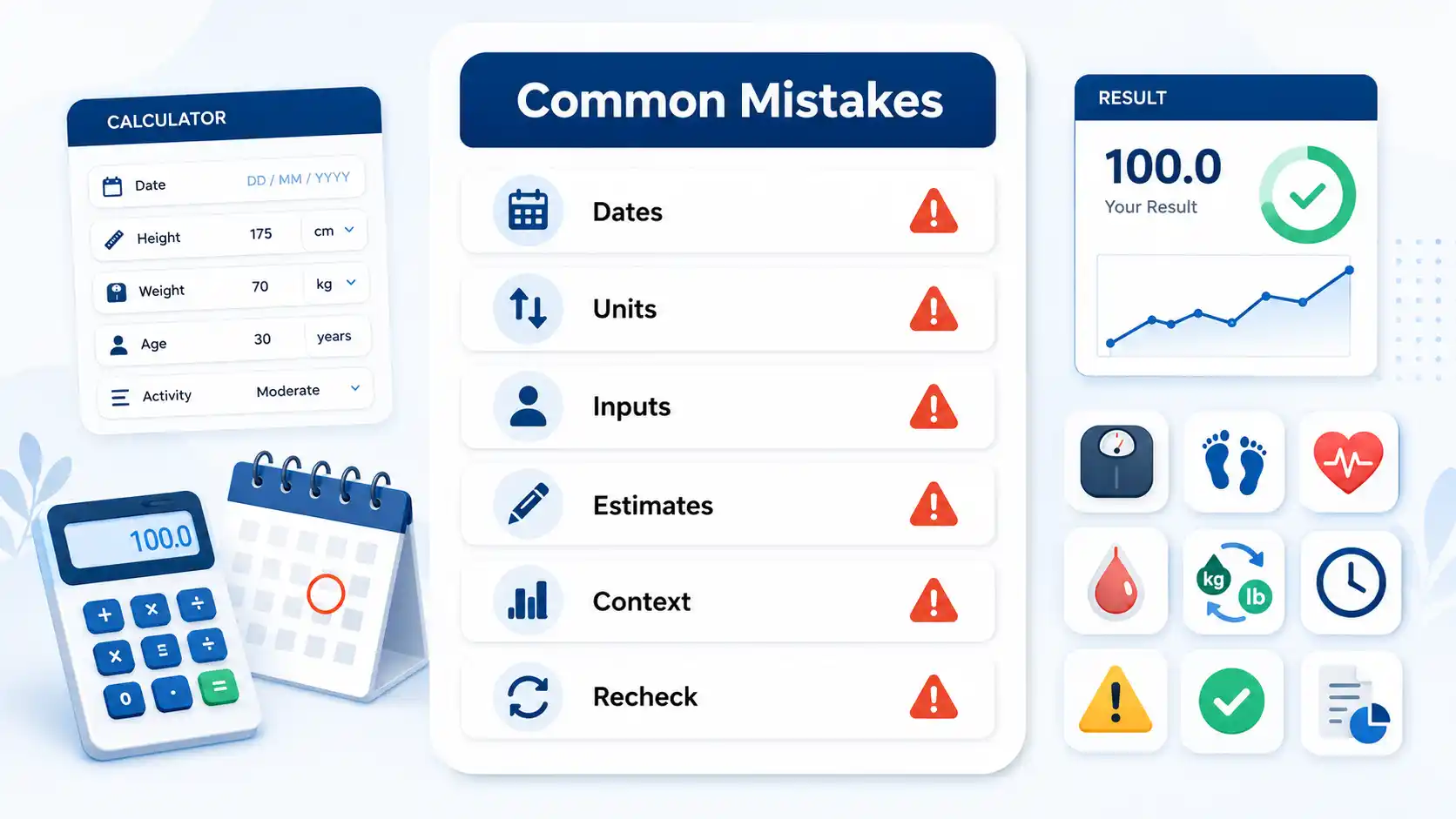
Many users enter accurate numbers but still panic over the results due to simple input errors. Understanding exactly what data to use prevents unnecessary anxiety. Avoid these common mistakes to ensure your calculated growth speed reflects your true pregnancy health.
- Comparing results from two different laboratories instead of using the same testing facility.
- Entering home urine test thresholds rather than exact quantitative beta blood test results.
- Panicking over a slower doubling time when your baseline already exceeds 1,200 mIU/mL.
- Using an old test from last week instead of your two most recent consecutive blood draws.
- Testing too soon after an IVF trigger shot before the artificial hormones clear your system.
Medical Disclaimer
This tool offers educational information only. It is not a substitute for professional medical diagnosis, advice, or treatment. Always consult your doctor or a talented healthcare expert regarding any health concerns. Do not ignore or delay professional medical help based on information or results generated by this site.
Frequently Asked Questions (FAQs)
What is a normal hCG doubling time?
Early pregnancy levels usually double every 48 to 72 hours when your baseline sits under 1,200 mIU/mL. Growth naturally slows down as your numbers climb higher. This speed shows your body is producing enough hormones to support a developing embryo.
Does a fast doubling time mean twins?
Sometimes. Multiples often trigger higher hormone levels and faster growth rates. A very quick doubling time occasionally points to twins.
Many healthy single pregnancies also show rapid early rises. Only an early ultrasound can confirm if you are carrying multiples.
Is a 48-hour doubling time expected after IVF?
Yes. Frozen embryo transfers and standard IVF follow the exact same early hormone rules as natural conceptions. Doctors look for a similar 48 to 72-hour doubling window.
You should measure this rate starting from your first official beta blood test after the transfer.
Why is my doubling time slowing down?
Hormone production naturally decelerates once your levels pass 1,200 mIU/mL. A slower pace at this stage is completely normal and expected.
Doctors switch to ultrasound imaging instead of math because numbers become less reliable indicators of health as pregnancy advances.
Does a slow doubling time mean a miscarriage?
Not always. Many perfectly healthy pregnancies experience slower initial rises. A sluggish pace does prompt doctors to monitor you closer to rule out complications.
You should always consult your healthcare provider before assuming the worst about your test results.
Which timeframe is best if I have three or more hCG tests?
Always calculate your doubling time using your two most recent consecutive blood tests. Using a longer window across multiple older tests can mask recent changes in your hormone growth speed.
Your doctor will base medical decisions entirely on your most recent 48-hour to 72-hour interval.
Is hCG higher at 5 weeks with a boy or girl?
hCG level is not a reliable way to tell if the baby is a boy or girl. Early hCG varies widely from pregnancy to pregnancy, so sex prediction should not be based on beta hCG doubling time.
Can I use home pregnancy tests to track my doubling time?
No. Home urine tests only detect the presence of the hormone above a certain threshold. They cannot provide precise numerical values.
You must use official quantitative beta hCG blood tests from a laboratory to calculate an accurate doubling time.
Does a very low starting hCG level mean my pregnancy will fail?
Not necessarily. A low initial number simply means you might have ovulated or implanted later than expected. The speed of the rise matters much more than the starting number.
As long as your levels double within the expected early window, a low baseline is usually fine.
What if my hCG is rising but not doubling?
A slow rise that fails to double can sometimes happen in a healthy pregnancy. However, doctors monitor slow rises closely to rule out an ectopic pregnancy. Once your levels are high enough, your doctor will rely on a transvaginal ultrasound to check for a gestational sac rather than relying on blood math.
Can hCG doubling time diagnose ectopic pregnancy?
No. hCG doubling time can raise concern, but it cannot diagnose ectopic pregnancy by itself. Doctors use symptoms, serial beta hCG tests, and ultrasound together.
Does IVF change hCG doubling time?
IVF pregnancies are usually tracked with the same beta hCG rise patterns after the first official beta test. If you used an hCG trigger shot, ask your clinic when the trigger should clear before reading early numbers.
What hCG level is least likely to miscarry?
No single hCG level can prove that miscarriage risk is low. Doctors look at the rise pattern, symptoms, gestational age, ultrasound findings, and whether the pregnancy is in the uterus.
Can hCG doubling time tell if I’m having twins?
No, hCG doubling time cannot confirm twins. Some twin pregnancies have higher or faster-rising hCG, but many single pregnancies can rise quickly too. Ultrasound is the reliable way to confirm twins.
Why are hCG doubling time answers on Reddit so different?
Reddit answers often feel different because people compare different starting hCG levels, test timings, labs, and pregnancy stages. Your own doubling time should be calculated from your two blood tests, then reviewed with your doctor if the rise looks slow, flat, or unclear.
Does hCG double every 48 hours at 5 weeks?
hCG may double close to every 48 hours around 5 weeks, but it depends on your starting level. Once beta hCG gets higher, the rise often slows, so a 48-hour doubling pattern is not required for every healthy early pregnancy.
Questions?
We had love to hear from you! Whether you are reporting an issue, suggesting a new calculator, or exploring collaboration opportunities — we are here to help. Every message helps us make 100calc smarter, faster, and more helpful for everyone.
Why People Trust 100calc
At 100calc.com, we focus on accuracy, speed, and trust. Every calculator we create is designed to give reliable, instant, and easy-to-understand results you can truly depend on.