
Contraceptive Effectiveness Calculator: Check Your Birth Control Protection
A contraceptive effectiveness calculator estimates how well your birth control works based on the method you use, how consistently you use it, and whether you add a backup method. It calculates your annual protection percentage, failure rate, and estimated 5-year pregnancy risk using real-world effectiveness data.
Many people hear that birth control is “99% effective” and assume the number applies to everyone. It does not. Missing pills, inconsistent condom use, and different methods can change protection levels more than expected. Small habits can create a large difference over time.
This calculator shows how effective your current contraceptive method may be, whether adding condoms improves protection, how long your method takes to become effective, and what your long-term pregnancy risk could look like if your habits stay the same.
Quick Facts
- Compares typical use and perfect use birth control effectiveness.
- Calculates annual contraceptive effectiveness and failure rates.
- Shows the impact of adding condoms or withdrawal as backup protection.
- Estimates the chance of at least one unintended pregnancy over 5 years.
- Includes pills, IUDs, implants, condoms, patches, rings, shots, and withdrawal.
- Updated Jul 2, 2026
- Reviewed by 100Calc Research Team
Interactive Risk Analyzer
Contraceptive Effectiveness Calculator
Select your birth control method, adjust for your real-world usage habits, and see exactly how combining methods mathematically impacts your protection against pregnancy.
Compounded Protection Score
—
Your clinical effectiveness description will appear here.
When is it effective?
--
5-Year Cumulative Risk
Chance of accidental pregnancy over 5 years if these habits remain identical.
Global Context: Contraceptive Prevalence
Usage rates vary globally. In Pakistan, the contraceptive prevalence rate was approximately 34% in 2021. Your selected method correlates with specific demographic choices—for instance, contraceptive pills remain highly utilized in urban centers like Karachi, while LARCs are gaining traction elsewhere.
How is contraception effectiveness calculated?
Your dynamic answer will appear here.
How many pills until birth control is effective?
Your second dynamic answer will appear here.
Medical note: This calculator estimates birth control effectiveness based on yearly failure rates. It cannot tell you if you are pregnant after missed pills, unprotected sex, a late shot, or a broken condom. Emergency contraception may be time-sensitive, so speak with a healthcare provider or pharmacist as soon as possible if a recent method failure happened.
Explore More Calculators
Use the Chinese Gender Calculator for a traditional boy-or-girl prediction from lunar age and conception month. Enter conception date, due date, or LMP.
Try calculatorUse this fetal growth calculator to check baby weight percentile from ultrasound data in grams, kg, or cm and see what the result means…
Try calculatorEnter gestational sac measurements in mm or cm to calculate mean sac diameter, estimate early gestational age, compare week-by-week milestones, and see when follow-up…
Try calculatorMissed a birth control pill? Check pregnancy risk, protection status, backup contraception needs, and what to do next with our missed pill calculator.
Try calculatorUse our Pregnancy Chance Calculator to estimate your odds. Enter your cycle day, age, and method. Find out if you are in the high-risk…
Try calculatorUse our pregnancy due date calculator to find your exact Baby Due date. IVF, conception, ovulation, and ultrasound methods with weeks and timeline.
Try calculator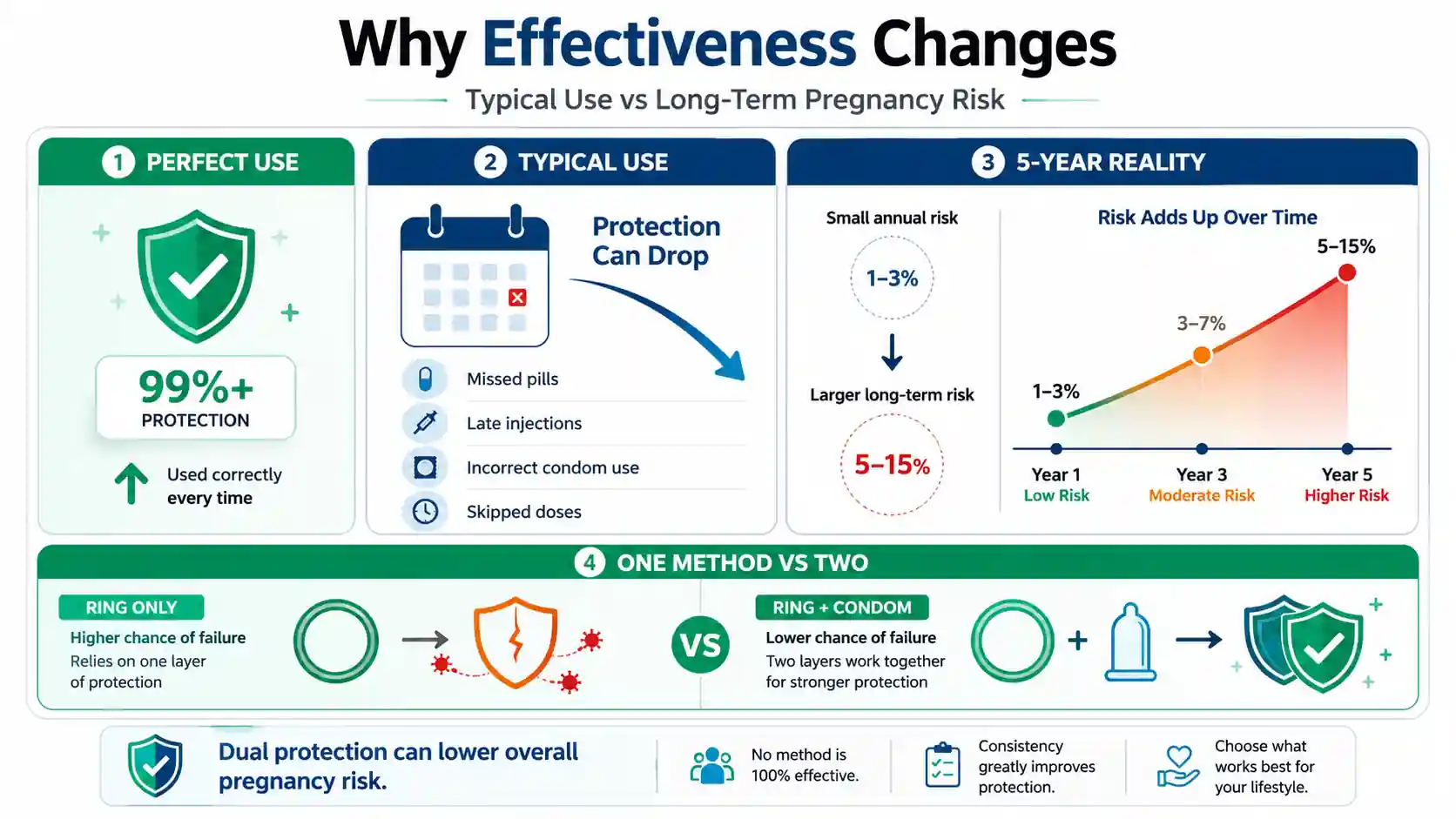
Micro Insight
Annual effectiveness tells only part of the story. Long-term pregnancy risk often drives better decisions. A small yearly failure rate can become much more meaningful over several years, which is why comparing both effectiveness and cumulative risk gives a clearer picture of birth control reliability.
What Is Contraceptive Effectiveness?
Many people see a birth control method listed as “99% effective” and assume everyone gets the same result. Real-life use is different. Missed pills, delayed injections, incorrect condom use, and skipped doses can lower protection.
This is why health organizations report both perfect-use and typical-use effectiveness rates. Perfect use assumes the method is used correctly every time. Typical use reflects everyday habits and mistakes. The gap between these numbers can be small for IUDs and implants but much larger for pills, patches, rings, and condoms.
Dual protection can also change effectiveness. A person using a contraceptive ring and condoms may have a lower pregnancy risk than someone relying on one method alone. Combining methods reduces the chance that both fail during the same year.
What Your Contraceptive Effectiveness Result Means
Your contraceptive effectiveness result estimates how well your current birth control approach may prevent pregnancy over one year based on the method selected, your consistency of use, and any backup protection. A higher percentage means a lower annual chance of pregnancy, but no method provides zero risk.
Understanding Your Result
The effectiveness percentage shows your estimated protection against pregnancy during a typical year.
A result of 95% means there is about a 5% annual failure rate. A result of 99% means about a 1% annual failure rate. Small percentage differences can have a meaningful impact over time.
Many people focus only on the effectiveness number. Long-term pregnancy risk often gives a clearer picture because risk can accumulate across several years.
Is Your Result Good or Bad?
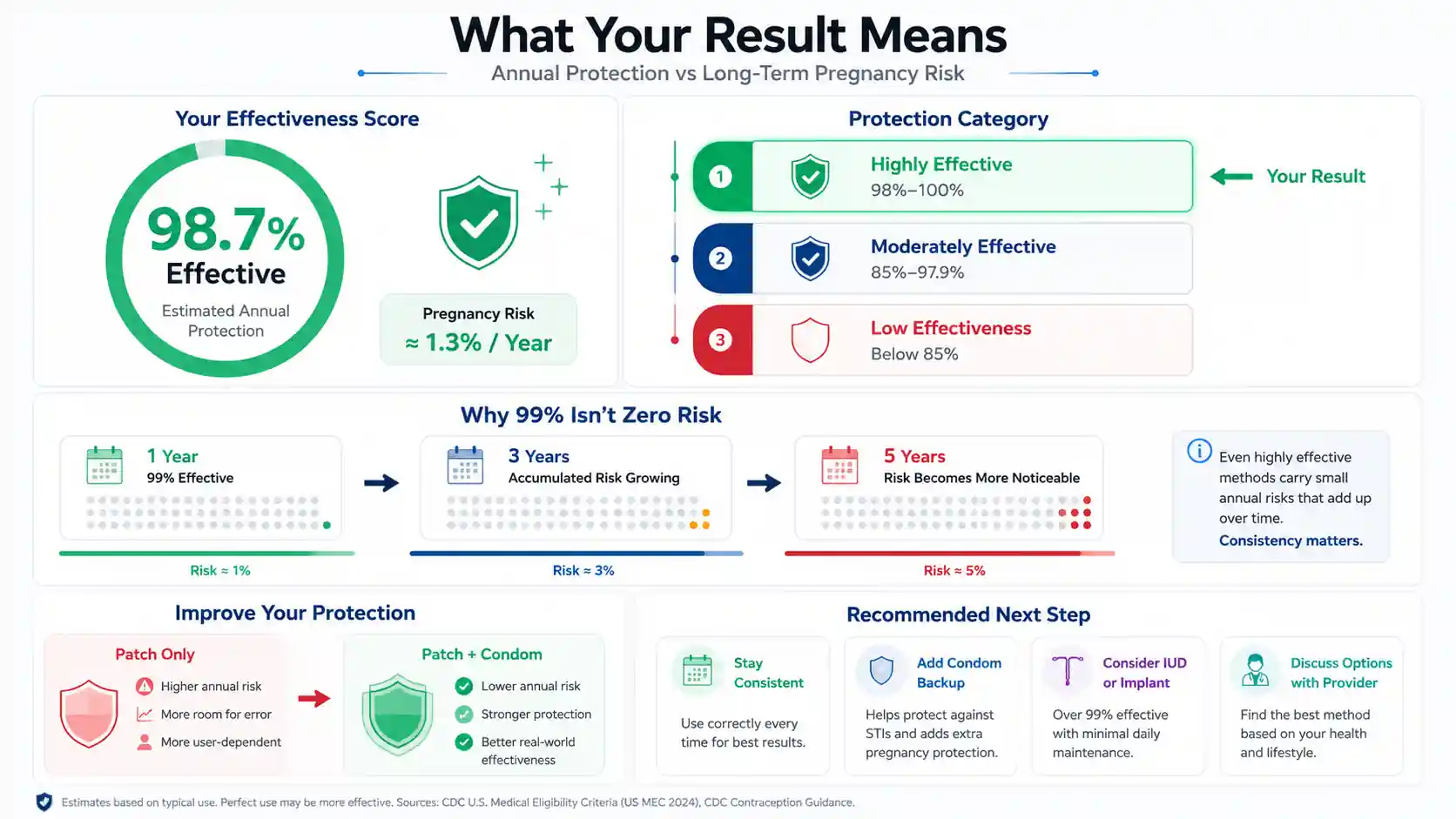
The calculator places results into three protection categories:
Highly Effective (98% to 100%)
Pregnancy risk is low. This range is common with implants, IUDs, and some dual-method combinations.
Moderately Effective (85% to 97.9%)
Protection is still strong, but missed doses, late injections, or inconsistent use can increase risk.
Low Effectiveness (Below 85%)
Pregnancy risk remains meaningful. Improving consistency or adding backup protection may help reduce risk.
A 99% effective method is not risk-free. Roughly 1 pregnancy per 100 users may still occur each year. Over several years, that risk becomes more noticeable.
What You Should Do Next
Continue your current method if the result matches your pregnancy prevention goals.
Improve consistency if missed pills, delayed shots, or skipped doses are common.
Add condom backup if you want stronger combined protection.
Consider an IUD or implant if preventing pregnancy is a top priority.
Discuss options with a healthcare provider if you want a more effective method.
Quick Example to Test
Patch + Condom Backup
Settings
- Primary Method: Patch
- Adherence: 75%
- Backup Method: Male Condom
Estimated Result
- Effectiveness: 99.7%
- Protection Category: Highly Effective
- Annual Pregnancy Risk: About 0.3%
- 5-Year Pregnancy Risk: About 1.3%
What It Means
This result suggests strong protection. At 75% adherence, the patch’s adjusted yearly failure risk is about 2.0%. Adding condom backup lowers the final annual pregnancy risk to about 0.3%. Long-term risk remains present, but it stays low if the same habits continue.
How to Use the Contraceptive Effectiveness Calculator
Use this contraceptive effectiveness calculator by selecting your birth control method, setting how closely you follow the method, and adding backup protection if you use it. The calculator then estimates your yearly protection score, timing note, and 5-year pregnancy risk.
Choose Your Primary Birth Control Method
Select the method you use most. This may be the pill, mini-pill, shot, patch, ring, condom, withdrawal, implant, hormonal IUD, or copper IUD. Each method has its own typical-use and perfect-use failure rate. The calculator uses those rates as the base for your result.
Set Your Real Use Level
Move the usage slider based on how closely you follow the method. Lower settings reflect missed pills, late use, broken routines, or inconsistent condom use. Higher settings reflect near-perfect use. For IUDs and implants, the calculator hides this slider because daily habits do not change the result much.
Add Backup Protection If Used
Choose a backup method only if you use one in real life. The calculator supports condoms and withdrawal as backup options. It does not let you count the same method twice. That means condom plus condom or withdrawal plus withdrawal will not be treated as extra protection.
Review Your Protection Score
After you calculate, the tool shows your estimated effectiveness percentage. This number means yearly protection based on the method, use level, and backup choice. A higher score means lower estimated pregnancy risk. The result also places your setup into a high, moderate, or low effectiveness tier.
Check the 5-Year Risk
The calculator also shows a 5-year cumulative pregnancy risk. This number helps you see how small yearly risks can build over time. It assumes your method and habits stay the same for 5 years. Use this result to compare your current setup with stronger or simpler options.
Quick Example to Test
Use this example to see how the calculator handles real use, not perfect use.
Input
- Primary method: Vaginal ring
- Usage habits: 70%
- Backup method: None
Process
The calculator starts with the ring’s typical failure rate of 7.0% and perfect-use failure rate of 0.3%. At 70% usage, the adjusted annual failure rate becomes 2.31%. Since no backup method is selected, the calculator keeps that same failure rate.
Result
- Effectiveness: 97.7%
- 5-year pregnancy risk: 11.0%
- Protection tier: Moderately Effective
Meaning
This result shows strong protection, but not top-tier protection. Better routine timing or a backup method would lower the long-term pregnancy risk.
How the Contraceptive Effectiveness Calculator System Works
This calculator uses published contraceptive failure data and real-world usage patterns to estimate protection more accurately than static charts. It adjusts results based on adherence and backup methods. The goal is to reflect everyday behavior, not ideal conditions, so users can understand real pregnancy risk and make safer, informed birth control decisions.
Key Features & Benefits
- Uses published perfect-use and typical-use failure rates for real-world accuracy
- Adjusts effectiveness based on user adherence and consistency levels
- Combines primary and backup methods to model dual protection correctly
- Projects long-term pregnancy risk over multiple years for better planning
- Converts technical data into simple protection categories for quick decisions
Technical Process
Method Mapping
The system identifies the selected contraceptive method and assigns validated failure rates from clinical data sources used in reproductive health research.
Behavior Modeling
User adherence is applied to shift results between typical and perfect use, reflecting real-life consistency instead of ideal conditions.
Risk Engine Output
The calculator runs a combined risk model to generate effectiveness score, protection tier, and long-term pregnancy risk in a single result output layer.
How the Contraceptive Effectiveness Calculator Formula Works (Complete Breakdown)
The contraceptive effectiveness calculator formula estimates your yearly protection by adjusting a method’s failure rate for real use. It compares typical use with perfect use, adds backup protection when selected, then converts the final pregnancy risk into an effectiveness percentage and 5-year risk.
Formula
Adjusted Failure Rate = Typical Failure Rate - ((Typical Failure Rate - Perfect Failure Rate) * (Adherence / 100)) Final Annual Failure Decimal = (Adjusted Failure Rate / 100) * Backup Failure Multiplier Effectiveness % = 100 - (Final Annual Failure Decimal * 100) 5-Year Risk % = (1 - (1 - Final Annual Failure Decimal)^5) * 100
What These Formulas Do
This formula starts with the real-world failure rate for your selected birth control method. It lowers that rate when your use is closer to perfect. If you add a backup method, it multiplies both risks together. The final answer shows estimated protection and long-term pregnancy risk.
Key Variables That Affect Your Result
These variables control how the calculator moves from a general birth control effectiveness rate to a more personal estimate. Each one changes the final protection score, annual failure risk, and 5-year pregnancy risk in a different way.
Typical Failure Rate
Typical failure rate means how often a method fails in normal life. It includes missed pills, late use, condom mistakes, schedule gaps, and other common errors. This number is higher than perfect use because real routines are not always exact.
Perfect Failure Rate
Perfect failure rate means the method is used exactly as directed every time. This is the best-case failure rate. It does not mean zero risk. Even strong methods can still have a very small chance of pregnancy.
Adherence
Adherence means how closely your real use matches perfect use. The calculator uses a 0 to 100 scale. A lower setting moves the result closer to typical use. A higher setting moves it closer to perfect use.
Backup Failure Multiplier
Backup failure multiplier adjusts the result when condoms or withdrawal are used with the main method. No backup uses a multiplier of 1.0. Male condoms use 0.13. Withdrawal uses 0.22. The calculator does not count the same method twice.
Final Annual Failure Decimal
Final annual failure decimal is the yearly pregnancy risk after the main method and backup method are combined. The calculator uses this decimal to create both the effectiveness score and the 5-year cumulative risk.
Another Example Calculation (Step-by-Step)
This example shows how the calculator handles a combined pill user who is mostly consistent and also uses condoms as backup.
Given:
- Primary Method = Combined Pill
- Typical Failure Rate = 7.0%
- Perfect Failure Rate = 0.3%
- Adherence = 90%
- Backup Method = Male Condoms
- Backup Failure Multiplier = 0.13
Calculation:
Adjusted Failure Rate = 7.0 - ((7.0 - 0.3) * (90 / 100)) Adjusted Failure Rate = 7.0 - (6.7 * 0.90) Adjusted Failure Rate = 0.97% Final Annual Failure Decimal = (0.97 / 100) * 0.13 Final Annual Failure Decimal = 0.001261 Effectiveness % = 100 - (0.001261 * 100) Effectiveness % = 99.8739%
Result:
- Effectiveness = 99.9%
- 5-Year Risk = 0.6%
- Protection Tier = Highly Effective
Meaning:
This result is high because the pill is used close to perfectly and condoms add backup protection. The 5-year risk stays low, but it is not zero. Small yearly risks can still build over time.
How do you calculate contraceptive effectiveness?
Contraceptive effectiveness is calculated by finding the yearly failure rate, adjusting it for real use, then subtracting that risk from 100. If backup protection is used, the calculator multiplies both failure risks. It also estimates 5-year pregnancy risk from the annual failure rate.
How effective is the combined pill if you forget sometimes?
This example fits someone who takes the pill most days, but not perfectly.
Input
- Primary method: Combined pill
- Perfect failure rate: 0.3%
- Typical failure rate: 7.0%
- Usage habits: 50%
- Backup method: None
Process
- Adjusted failure = 7.0 – ((7.0 – 0.3) × 0.50)
- Adjusted failure = 3.65%
- Backup multiplier = 1.0
- Final annual failure = 3.65%
- Effectiveness = 100 – 3.65
Result
- Effectiveness: 96.3%
- 5-year pregnancy risk: 17.0%
- Protection tier: Moderately Effective
Meaning
The pill still offers solid protection, but missed or late pills raise the long-term pregnancy risk.
How much does backup help with the mini-pill?
This example fits someone using the mini-pill and withdrawal as backup.
Input
- Primary method: Mini-pill
- Perfect failure rate: 0.3%
- Typical failure rate: 7.0%
- Usage habits: 80%
- Backup method: Withdrawal
Process
- Adjusted failure = 7.0 – ((7.0 – 0.3) × 0.80)
- Adjusted failure = 1.64%
- Backup multiplier = 0.22
- Final annual failure = 0.3608%
- Effectiveness = 100 – 0.3608
Result
- Effectiveness: 99.6%
- 5-year pregnancy risk: 1.8%
- Protection tier: Highly Effective
Meaning
Backup lowers the pregnancy risk a lot, but this still depends on using both methods consistently.
How effective is the Depo shot with condom backup?
This example fits someone who gets the shot close to schedule and also uses condoms.
Input
- Primary method: Depo shot
- Perfect failure rate: 0.2%
- Typical failure rate: 4.0%
- Usage habits: 90%
- Backup method: Male condoms
Process
- Adjusted failure = 4.0 – ((4.0 – 0.2) × 0.90)
- Adjusted failure = 0.58%
- Backup multiplier = 0.13
- Final annual failure = 0.0754%
- Effectiveness = 100 – 0.0754
Result
- Effectiveness: 99.92%
- 5-year pregnancy risk: 0.4%
- Protection tier: Highly Effective
Meaning
This is a strong result because the shot has a low failure rate, and condoms add another layer of protection.
What is the pregnancy risk with condoms alone?
This example fits someone who uses condoms, but not perfectly every time.
Input
- Primary method: Male condoms
- Perfect failure rate: 2.0%
- Typical failure rate: 13.0%
- Usage habits: 60%
- Backup method: None
Process
- Adjusted failure = 13.0 – ((13.0 – 2.0) × 0.60)
- Adjusted failure = 6.4%
- Backup multiplier = 1.0
- Final annual failure = 6.4%
- Effectiveness = 100 – 6.4
Result
- Effectiveness: 93.6%
- 5-year pregnancy risk: 28.2%
- Protection tier: Moderately Effective
Meaning
Condoms can work well, but inconsistent use raises the long-term risk fast.
Quick Rules to Remember
Higher consistency means lower pregnancy risk. Backup protection can lower risk even more, but it must be a different method. The calculator blocks condom plus condom and withdrawal plus withdrawal because doubling the same method does not create a real second layer of protection.
Contraceptive Effectiveness Result Benchmarks Explained
Contraceptive effectiveness result benchmarks help you understand how safe your birth control method is in real life. These ranges show whether your result means strong protection, moderate protection, or higher pregnancy risk. It helps you compare your outcome with global standards and decide if your current method is enough or needs improvement.
| Range | Category | USA Guideline | India Guideline | Notes |
|---|---|---|---|---|
| 98–100% | Highly Effective | Considered top-tier protection in clinical guidelines and family planning programs. | Recommended for long-term contraception programs and low-maintenance methods. | Very low pregnancy risk. Includes IUDs, implants, and perfect dual-method use. |
| 85–97.9% | Moderately Effective | Acceptable in most healthcare guidance but depends heavily on correct usage. | Common for pills, shots, and typical-use methods in real-world settings. | Works well but user consistency strongly affects protection. |
| Below 85% | Low Effectiveness | Higher failure risk. Often not recommended as sole protection method. | Seen in traditional or inconsistent methods without strong backup use. | Higher pregnancy risk remains. Backup or stronger method advised. |
Heads-up: Real effectiveness depends on correct and consistent use. Always confirm with healthcare guidance if pregnancy prevention is critical for your situation.
Interpretation
These benchmarks show where your result stands in real-world terms. High percentages mean strong protection with very low pregnancy risk. Mid-range results depend on how consistently the method is used. Lower results show that user behavior or method choice may not provide enough protection alone.
Pro Tip
If your result is below 85%, consider improving consistency or adding a backup method like condoms. For results under 95%, switching to a long-acting option like an IUD or implant can significantly reduce long-term risk.
What to Do After Using the Contraceptive Effectiveness Calculator
Your contraceptive effectiveness result shows how well your current birth control setup protects you from pregnancy in real life. The next step is not guessing. It is acting based on your risk level. Small changes in consistency or method choice can significantly improve protection and reduce long-term pregnancy risk.
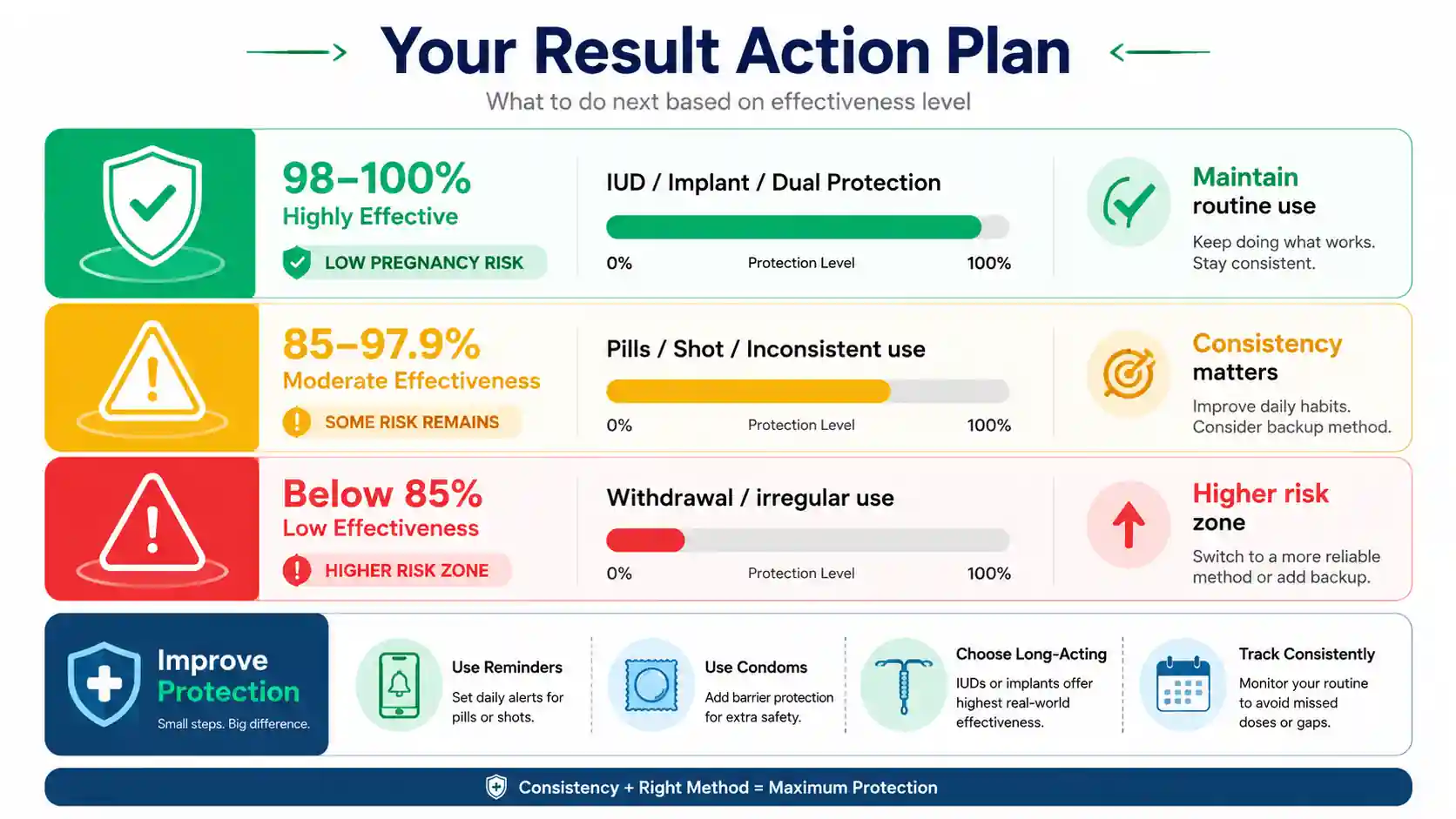
For Highly Effective Results (98–100%)
A highly effective result means your method is working very well with very low pregnancy risk. This is common with IUDs, implants, or perfect dual protection use.
Keep your current method stable without switching unnecessarily. For daily methods like pills, maintain consistent timing because small mistakes still affect long-term safety. If using dual protection, continue both methods during higher-risk periods like missed pills or illness.
Most users in this range only need routine check-ins, not changes.
For Moderately Effective Results (85–97.9%)
This range shows good protection, but real-world behavior still affects your risk. It often reflects pills, shots, or inconsistent use patterns.
Focus on improving consistency first. Take pills at the same time daily. Avoid missed doses or late timing. If you rely on a single method, adding condoms can significantly reduce failure risk.
This is also the range where small upgrades create the biggest improvement in safety.
For Low Effectiveness Results (Below 85%)
A low effectiveness result means your current method alone may not provide enough protection. This is common with withdrawal or inconsistent condom use.
Avoid relying on timing or guesswork. Use a backup method every time. Consider switching to a more reliable option like pills with better adherence or long-acting methods such as IUDs or implants.
Track your usage habits closely. Even small improvements in consistency can reduce risk quickly
Pro Tip
Real improvement comes from consistency, not complexity. Using reminders, pairing methods, or choosing long-acting contraception reduces human error. If your result stays below 90%, it usually signals a need to upgrade method reliability, not just adjust behavior.
You Might Also Find These Helpful
Pregnancy & Fertility 45
Use this Pregnancy Risk Calculator to check age, BMI, health history, bleeding, and twins. See if closer prenatal monitoring may be worth asking about.
Try calculatorOne Time Pregnancy Calculator estimates pregnancy odds from one encounter, plus fertile window timing, test date, due date, and 21-day testing guidance.
Try calculatorUse the AMH Calculator to convert ng/mL or pmol/L, compare your result with age-based data, and see what it may mean for IVF, fertility,…
Try calculatorUse the Baby Eye Color Calculator with parents, grandparents, or sibling context to compare Brown, Green/Hazel, and Blue/Grey model estimates instantly.
Try calculatorBasal Body Temperature Calculator checks reading conditions and analyzes your temperature pattern for a sustained shift that may be consistent with ovulation.
Try calculatorBPD gestational age calculator: estimate fetal age from BPD, compare your week, check normal BPD ranges, and understand ahead or behind results.
Try calculatorCalculate odds with the Chance of Twins Calculator. Enter maternal age and history. Find your probability instantly. See if you will conceive multiples now.
Try calculatorFind out exactly when you conceived. Our free Conception Calculator uses your Due Date, LMP, or Ultrasound to estimate your fertilization date and fertile…
Try calculatorUse our Conception Date Due Date Calculator to find your baby's arrival date. Enter your conception or intercourse date for clinical 40-week results.
Try calculatorUse this CRL calculator to estimate gestational age and due date from crown-rump length in mm or cm. Compare CRL, LMP, and IVF dating…
Try calculatorEstimate your monthly and 12-month pregnancy odds by age, partner age, and cycle dates. See your fertile window and when to seek fertility help.
Try calculatorUse this fundal height calculator to compare your cm measurement by week, check growth range, estimate baby weight, and know when to ask about…
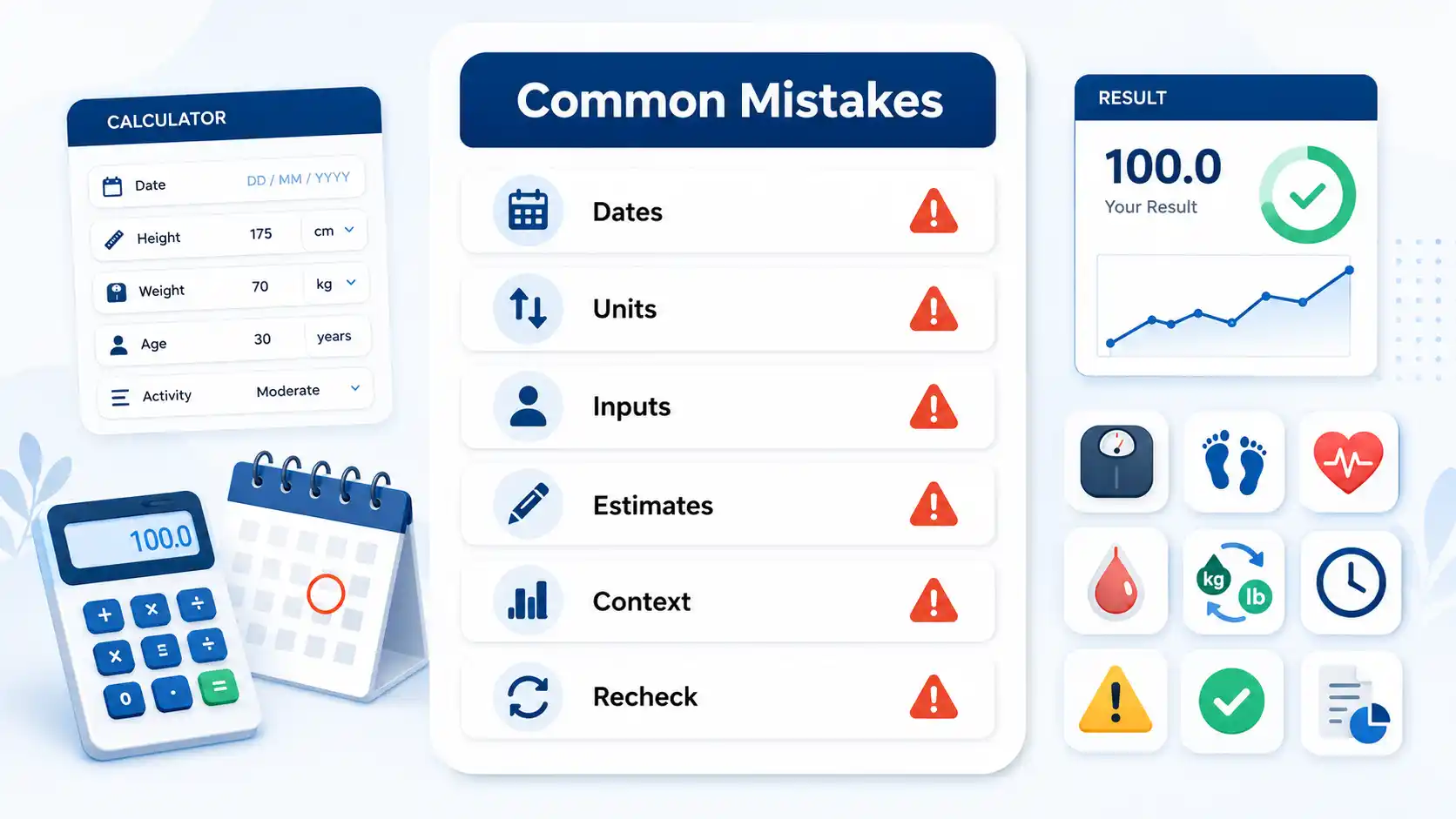
Try calculatorCommon Mistakes When Using the Contraceptive Effectiveness Calculator
Many users get slightly incorrect results because they misunderstand how the contraceptive effectiveness calculator works. Most errors come from wrong input selection, confusion about adherence, or misreading risk values. These mistakes can change how you interpret pregnancy risk and may lead to false confidence or unnecessary worry.
Common mistakes using contraceptive effectiveness calculator often come from misunderstanding how real-world use, adherence, and backup methods affect results. Small input errors can change effectiveness percentage and five-year risk. Knowing these mistakes helps you get more accurate pregnancy prevention estimates and better decisions about contraception.
- Selecting the wrong contraceptive method such as confusing pill, IUD, or condom inputs
- Entering incorrect adherence level by overestimating real-life consistency of use
- Assuming perfect-use effectiveness applies instead of real-world typical-use rates
- Ignoring how backup methods like condoms reduce combined failure rate
- Misreading five-year risk as annual risk or confusing it with effectiveness percentage
Can GLP-1 Medicines Affect Birth Control?
GLP-1 medicines can matter if you use oral birth control. Some weight loss and diabetes drugs may slow stomach emptying or cause vomiting. That can affect how birth control pills are absorbed. This contraceptive effectiveness calculator does not adjust results for medication interactions.
Tirzepatide and Oral Birth Control
Tirzepatide is used in medicines such as Mounjaro and Zepbound. It may reduce how well oral hormonal birth control is absorbed, mainly after starting treatment or raising the dose. People using pills may need a non-oral method or condom backup during that window.
Vomiting, Diarrhea, and Pill Absorption
Birth control pills need time to absorb after you take them. Vomiting or severe diarrhea can lower protection, even if the pill was taken on time. This can happen with GLP-1 side effects or any stomach illness. The calculator does not measure that risk.
Non-Oral Methods Are Different
IUDs, implants, shots, patches, rings, and condoms do not depend on pill absorption in the stomach. A GLP-1 medicine may not affect these methods the same way. Your result may still be strong, but your full medical situation matters.
What to Do If This Applies to You
Check with a healthcare provider or pharmacist if you take GLP-1 medicine and use birth control pills. Ask whether you need backup protection, a non-oral method, or a timing change. This is important after starting tirzepatide, increasing the dose, or having vomiting or diarrhea.
Frequently Asked Questions (FAQs)
How effective is birth control with typical use?
Typical-use birth control effectiveness shows how a method works in real life. It includes missed pills, late shots, broken condoms, and other normal mistakes. This is why typical-use rates are often lower than perfect-use rates, especially for pills, condoms, patches, and rings.
The calculator uses typical use as the low end of the usage slider.
How effective is birth control with perfect use?
Perfect-use birth control effectiveness means the method is used exactly as directed every time. It shows the best-case protection level. Perfect use does not mean zero risk. It only means the method is used with no missed doses, timing mistakes, or incorrect use.
Most people fall somewhere between typical use and perfect use.
Can GLP-1 medicines affect birth control pills?
Some GLP-1 medicines may affect oral birth control because they can slow stomach emptying or cause vomiting. Tirzepatide has the clearest warning for reduced pill absorption. This calculator does not adjust results for GLP-1 use, vomiting, diarrhea, or medicine interactions.
Ask a pharmacist or healthcare provider about backup protection.
What should I do if I missed a birth control pill?
If you missed a pill, follow the instructions for your exact pill type. Combination pills and mini-pills have different rules. This calculator cannot judge missed-pill timing or recent pregnancy risk. If you had unprotected sex, emergency contraception may be time-sensitive.
Use the calculator only for general yearly effectiveness estimates.
Does this calculator replace UKMEC?
No. This calculator does not replace UKMEC. It estimates pregnancy prevention risk from method effectiveness, consistency, and backup use. UKMEC checks whether a contraceptive method is medically suitable based on health conditions, medicines, age, smoking, migraines, and other clinical factors.
Use UKMEC-style guidance for medical eligibility questions.
Do condoms protect against STIs?
Condoms can help reduce the risk of many sexually transmitted infections when used correctly. Most other birth control methods only help prevent pregnancy. Pills, IUDs, implants, shots, patches, and rings do not protect against STIs.
This is why condoms may still matter even with strong pregnancy protection.
How long until the combined pill is effective?
The combined pill may be effective right away if started during the correct early part of your period. If started at another time, many people need 7 days of active pills before full protection. The calculator shows this timing note in the result.
Use backup during any unprotected starting window.
How long until the mini pill is effective?
The mini-pill often takes about 48 hours to become effective when not started during the right cycle window. Timing matters more with mini-pills because late pills can lower protection faster. The calculator includes this timing note after you select the mini-pill.
Check your pill leaflet for exact missed-pill rules.
What does 5-year pregnancy risk mean?
Five-year pregnancy risk estimates the chance of at least one unintended pregnancy over 5 years if your method and habits stay the same. It can look higher than yearly risk because small annual risks build over time.
This number helps compare long-term protection, not one-time pregnancy risk.
Is 99% effective the same as zero risk?
No. A 99% effective method still has about a 1% yearly failure risk. That means pregnancy is unlikely, but still possible. Over several years, that small risk can add up if the same method and habits continue.
The calculator shows both yearly protection and 5-year risk for this reason.
Can this calculator tell me if I am pregnant after a condom broke?
No. This calculator cannot tell if you are pregnant after a condom broke, missed pills, late shots, or unprotected sex. It only estimates general birth control effectiveness from yearly failure rates.
If a recent method failure happened, emergency contraception or pregnancy testing guidance may matter more.
Why do IUDs and implants not use the adherence slider?
IUDs and implants do not depend on daily use after placement. That is why the calculator treats them as fixed high-effectiveness methods and hides the adherence slider. User behavior has much less impact than it does with pills, condoms, patches, or rings.
Placement timing and medical fit still matter.
Questions?
We had love to hear from you! Whether you are reporting an issue, suggesting a new calculator, or exploring collaboration opportunities — we are here to help. Every message helps us make 100calc smarter, faster, and more helpful for everyone.
Why People Trust 100calc
At 100calc.com, we focus on accuracy, speed, and trust. Every calculator we create is designed to give reliable, instant, and easy-to-understand results you can truly depend on.