
Half Birthday Calculator – Find Your 6-Month Date
Use the Half Birthday Calculator to find the date six months after your birthday and see how long you have until your next half birthday.
Enter your date of birth to get your half-birthday date instantly, along with a countdown in months, weeks, and days. You can also use the calculator for a baby’s 6-month milestone or to plan a half-birthday celebration when the original birthday falls at an inconvenient time of year.
The calculator uses the standard six-calendar-month method and automatically handles shorter months and leap years.
Quick Facts
- Half-Year Age Thresholds: Some U.S. rules use ages that include a half year. For example, California allows eligible applicants under 18 to apply for an instruction permit beginning at age 15½, while federal IRA rules commonly use age 59½ when determining whether the additional tax on early distributions may apply.
- The Fixed-Day Method: A 182.5-day interval represents half of a 365-day common year. A leap year contains 366 days, so its mathematical halfway point is 183 days.
- The Short-Month Fix: If the same day doesn't exist six months later, the calculator uses the last valid day of that month. For example, August 31 becomes February 28 in a common year or February 29 in a leap year.
- The Zodiac Comparison: In common Western astrology, a date about six months after your birthday generally falls in the zodiac season opposite your birth sign.
- Updated Aug 11, 2026
- Reviewed by 100Calc Research Team
Milestone & Celebration Tools
Half Birthday Calculator
Calculate your exact half-birthday, get a live countdown to your next un-birthday celebration, and discover your 6-month milestones or half-zodiac sign.
Next Half Birthday
Countdown to Celebration
Your Half-Zodiac
If my birthday is [Date], when is my half birthday?
How many days until my next half birthday?
What happens at a half birthday?
How do you calculate your half birthday?
Explore More Calculators
Use our Birthday Calculator. Enter your date of birth to find your current age, next birthday date, days until your birthday, weekday, and days…
Try calculatorUse this age difference calculator to compare birthdays, ages, or birth years. See who is older and get the exact gap in years, months,…
Try calculatorThink you know your age? The Days Old Calculator counts calendar days from birth to today or any date, plus weeks, months, leap days,…
Try calculatorWhen is your diamond birthday? Use our Diamond Birthday Calculator to find the exact date when your age matches the last two digits of…
Try calculator1 billion seconds calculator shows your exact milestone date and age in seconds. See if you’ve reached it or how close you are now.
Try calculatorUse our 10000 Days Old Calculator to find your exact 10,000-day birthday, check days old now, and see your age in years and months.
Try calculatorWhich Calculation Method Should You Use?
You can find your true half birthday using two distinct mathematical rules. Choosing the correct calculation method depends on whether you need a casual calendar date or strict daily precision. Review the standards below to pick the best logic for your specific goal.
| Calculation Method | Rule Type | How It Works | Common Use Case | Best For |
|---|---|---|---|---|
| Standard (+6 Months) | Calendar Rule | Adds exactly 6 calendar months to your birth date. | U.S. government age rules (e.g., age 59.5 for IRAs). | Casual parties, kids, and general celebrations. |
| Exact (+182.5 Days) | Mathematical Rule | Adds exactly half a year in literal days (182 or 183 days). | Highly accurate chronological age tracking. | Math lovers and strict pediatric baby milestones. |
| Edge Case Correction | System Fix | Shifts impossible dates to the last valid calendar day. | Birthdays falling on August 31 or in leap years. | Preventing calculation errors like February 30. |
Heads-up: The U.S. government relies on the Standard 6-month calendar rule for legal milestones, regardless of varying month lengths.
What Your Target Date Means
Your result shows the exact day you hit the six-month mark. This date represents a true midpoint in your personal year. For adults, it reveals your opposite astrological sign. For parents, it highlights a major jump in infant development.
Understanding Your Result
The generated date gives you a precise un-birthday. Standard calendar math simply swaps the month and keeps the day identical. The exact calculation method counts 182 or 183 literal days forward to give you absolute mathematical accuracy.
Knowing this specific day helps you plan ahead. It gives winter babies a chance to celebrate outdoors in warm weather. It also keeps pediatric checkups on a strict timeline so parents never miss a milestone.
Is Your Result Good or Bad?
Calendar dates are rarely good or bad by themselves. You must look at how useful the date is for your specific goal.
A great result lands on a weekend during a mild season. A less ideal result falls on another major public holiday. If your new celebration date lands on July 4th, you might still struggle to gather friends for a party.
What You Should Do Next
- Check your schedule: See if the target date falls on a weekend so you can easily host a gathering.
- Book a doctor visit: Parents should use this exact date to schedule a six-month pediatric wellness check.
- Baby-proof your home: Infants often start rolling over and crawling near this specific timeline.
- Read your half-zodiac: Look up the traits of your opposite astrological sign to see how it balances your main personality.
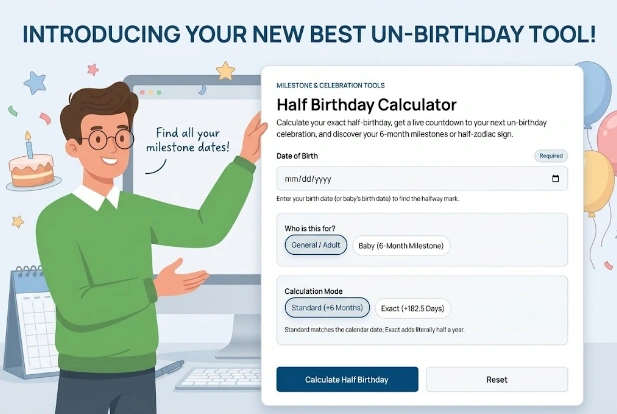
A Quick Example to Test
- Enter October 10 as the birth date.
- Select the baby profile and choose the standard calculation mode.
- The system outputs April 10 as your target date.
This tells you exactly when the baby reaches six months old. Spring weather in April makes it easy to host a small outdoor gathering. The parents now know exactly when to start introducing solid foods.
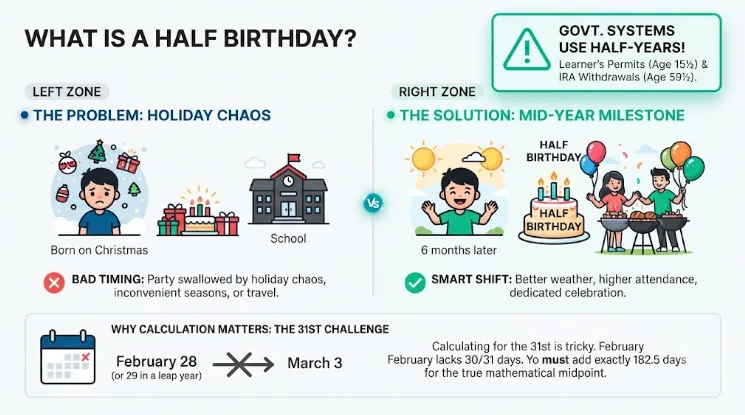
Why this matters:
Calculating this date gets tricky if you were born on the 31st. Since February lacks 30 or 31 days, a direct calendar match is impossible. You must add exactly 182.5 days to find the true mathematical midpoint.
What is a half birthday?
A half birthday is commonly treated as the date six calendar months after your birthday, marking the halfway point between annual birthday celebrations. It falls six months after your actual date of birth. Families use this mid-year milestone to host alternative celebrations if a real birthday lands on major holidays or during inconvenient seasons.
The tradition gained popularity to fix bad timing. A child born on Christmas rarely gets a dedicated party. Family members travel often. School friends stay home. The special day gets swallowed by holiday chaos.
Shifting the event solves this problem entirely. Someone born on December 25 can throw an outdoor barbecue on June 25 instead. This guarantees better weather and higher attendance.
Adults embrace the trend for practical reasons. Government systems often rely on half-years, such as issuing learner’s permits at age 15½ or allowing IRA withdrawals at 59½. Others simply treat the six-month mark as a personal check-in to review yearly goals.
How the Half Birthday System Works Behind the Scenes
Calendar math breaks down easily during leap years and short months. Our tool uses smart date tracking algorithms to guarantee perfect accuracy. It prevents impossible outputs like February 30th. You can rely on this engine to calculate exact milestones and handle complex calendar shifts flawlessly.
Key Features & Benefits
- Accounts for leap year variations automatically without manual adjustments.
- Fixes months ending in 28, 30, or 31 days to prevent date errors.
- Switches calculation rules seamlessly between adult milestones and baby tracking.
- Provides a live day-by-day countdown using real-time timezone data.
- Calculates exact days alive to deliver precise astrological insights.
Technical Process
Date Parsing
The system reads your exact birth date and verifies the calendar year structure.
Offset Application
It moves the timeline forward using either six calendar months or a fixed 182.5-day interval.
Error Correction
The engine forces invalid calendar dates to roll back to the closest valid day.
When Is My Half Birthday?
Your half birthday is usually six calendar months after your birthday. For example, if your birthday is January 15, your half birthday is July 15. If you were born on October 15, your half birthday is April 15.
Enter your date of birth in the Half Birthday Calculator above to find your next half-birthday date and see how many days are left.
If the same day does not exist six months later, use the last valid day of the target month. For example, an August 31 birthday becomes February 28 in a common year or February 29 in a leap year.
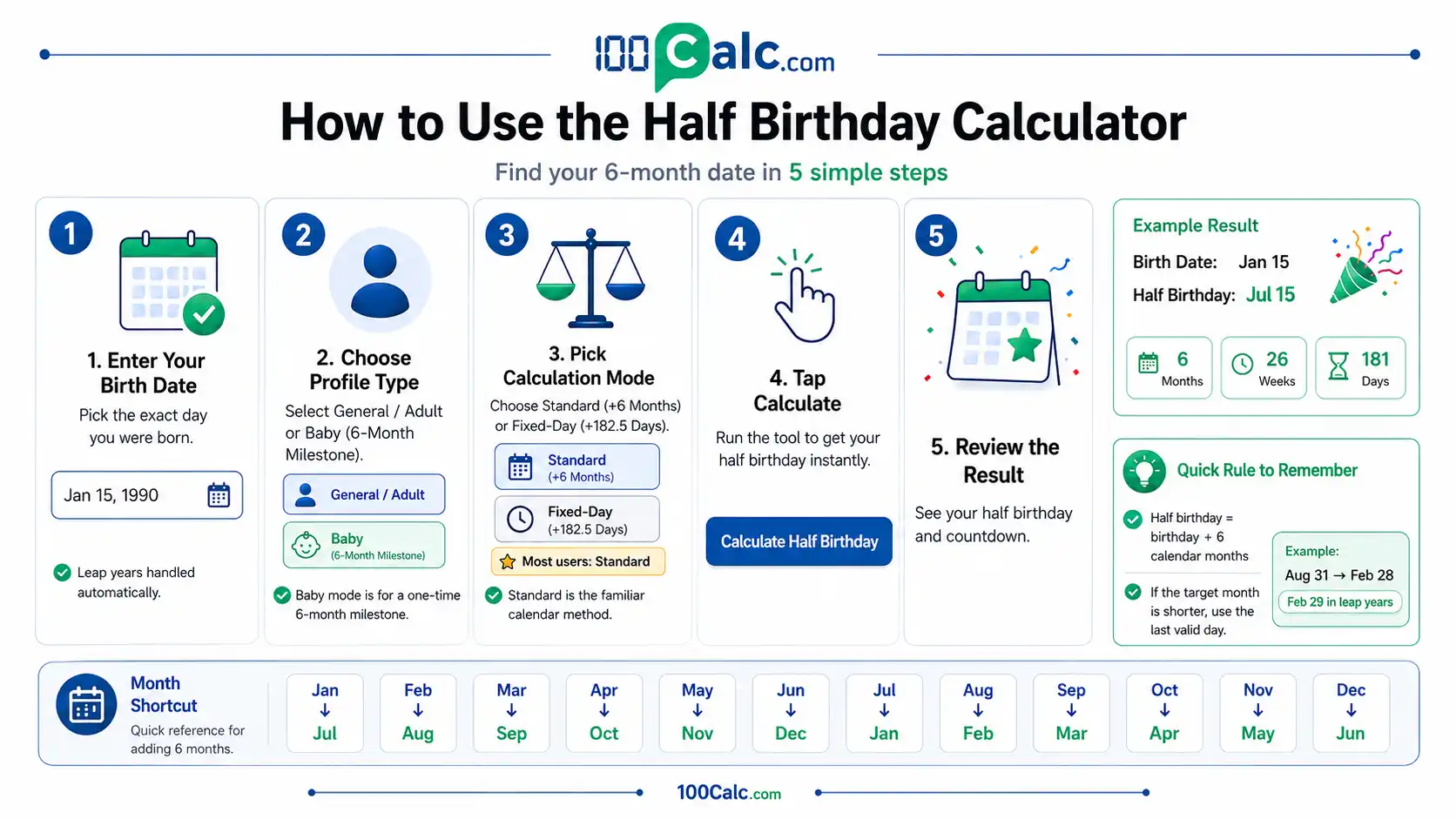
| Birth Month | Half Birthday Month | Example |
|---|---|---|
| January | July | Jan 15 → Jul 15 |
| February | August | Feb 14 → Aug 14 |
| March | September | Mar 10 → Sep 10 |
| April | October | Apr 20 → Oct 20 |
| May | November | May 5 → Nov 5 |
| June | December | Jun 21 → Dec 21 |
| July | January | Jul 4 → Jan 4 |
| August | February | Aug 10 → Feb 10 |
| September | March | Sep 15 → Mar 15 |
| October | April | Oct 15 → Apr 15 |
| November | May | Nov 11 → May 11 |
| December | June | Dec 25 → Jun 25 |
How to Use the Half Birthday Calculator
This tool takes your birth date and applies precise calendar math to find your exact six-month mark. Follow these five steps to find your next un-birthday celebration.
Enter Your Birth Date
Open the calendar tool and input the exact day of your birth. The system uses this baseline to project dates into the future. It automatically accounts for leap years. It also adjusts for months ending on the 28th, 30th, or 31st.
Select a Profile Type
Choose whether you are calculating a recurring adult date or a single infant milestone. The adult option looks forward to find your next upcoming celebration. The baby option calculates a one-time pediatric timeline. This setting ensures the output matches your specific goal.
Choose a Calculation Mode
Decide how you want to calculate the date. Standard mode adds six calendar months to your birth date, keeping the same day whenever that date exists in the target month. Fixed-Day mode uses a 182.5-day interval based on half of a 365-day year. For most half-birthday dates and age milestones, the six-calendar-month method is the more familiar choice.
Run the Calculation
Push the calculate button to process your inputs. The tool instantly applies your chosen math rule against your birth date. It corrects any impossible calendar dates automatically. Your calculated half-birthday date appears immediately at the top of the results screen.
Review Your Data
Scroll through the results to see your live countdown tracker. It breaks down your remaining wait time into months, weeks, and days. For general or adult calculations, the results also include a zodiac comparison based on common Western astrology. Parents using the baby option will instead see information about typical 6-month developmental milestones.
How do you calculate a summer half birthday for a winter baby?
Parents often struggle with December birthdays because of heavy holiday travel. To fix this, you can shift the celebration to the summer. This is where people often miscalculate leap years and short months.
This classic scenario tracks a Christmas baby. Families want a warm-weather party but struggle with the exact date shift.
Use these inputs in the calculator:
- Birth Date: December 25
- Profile Type: General / Adult
- Calculation Mode: Standard (+6 Months)
Process:
The formula takes the twelfth month of the year and adds exactly six calendar months. It then locks in the 25th day to generate the new target date.
Final Result:
Your Target Date is June 25.
Meaning:
You can host an outdoor summer pool party on June 25. This avoids all winter holiday scheduling conflicts and guarantees better weather for the celebration.
How the Half Birthday Formula Works (Complete Breakdown)
Calculating your true un-birthday requires one of two mathematical approaches. The half birthday calculator formula either shifts your birth month forward by six slots or adds exactly 182.5 days. This simple equation gives you the precise midpoint of your personal year so you never guess the date.
The Core Half Birthday Equation
This equation uses basic addition to find your exact six-month mark. It takes your starting calendar date and applies your chosen math rule to generate the final result.
Formula:
					Standard Method:
Target Month = Birth Month + 6
Target Day = Minimum(Birth Day, Max Days in Target Month)

Fixed-Day Method:
Target Date = Birth Date + 182.5 Days

182.5 days represents half of a 365-day common year.

Countdown:
Days Remaining = Target Date - Current Date
This formula handles the irregularities of our calendar system. Adding six months keeps your celebration on the same numerical day in most cases. When your birth day exceeds the number of days in the target month, the equation caps the date at the final valid day.
The Fixed-Day method avoids differences in calendar-month length by applying a constant 182.5-day interval. This interval represents half of a 365-day common year, so it should be treated as an alternative calculation method rather than a universally exact definition of six months.
Key Variables in the Half Birthday Equation
Each value below connects directly to your calculator inputs. These specific numbers represent the exact data points required to calculate your true six-month milestone accurately.
Birth Month
The calendar month you were born, numbered from 1 to 12. This serves as the primary base for the standard shift.
Birth Day
The exact numerical day you were born. The system preserves this number unless the destination month is too short.
Calculation Mode
The rule chosen to process the timeline. Standard relies on calendar months, while exact utilizes literal 24-hour day increments.
Target Date
The resulting date produced by the equation. It represents your official mid-year celebration or infant growth mark.
Another Example Calculation (Step-by-Step)
Let us look at how the formula handles a birth date on the 31st during a standard 30-day target month.
Given:
Birth Date: October 31
Calculation Mode: Standard (+6 Months)
Calculation:
					Birth Month: October (Month 10)
Target Month: 10 + 6 = 16 -> Month 4 (April)
Target Day: Minimum(31, Max Days in April) = Minimum(31, 30) = 30
Resulting Date: April 30
Result:
Target Date: April 30
Adjustment: Shifted from Day 31 to Day 30
Meaning:
April only has 30 days. The formula automatically corrects the impossible date of April 31st down to April 30th, keeping your celebration on the final day of the month.
Half Birthday Result Benchmarks Explained
Your calculated half birthday holds different meanings depending on your current stage of life. Parents use this exact date for health tracking. Adults and students use it for social planning. Review the table below to see how to use your specific milestone.
| Age Group | Focus Area | Main Purpose | Common Use Case | Recommended Action |
|---|---|---|---|---|
| Baby (6 Months) | Health | Pediatric development tracking. | Starting solid foods or sitting up. | Book a 6-month doctor visit. |
| School Age | Social | Alternative celebration date. | Shifting winter birthdays to summer. | Host a warm-weather party. |
| Adult | Personal | Personal milestone tracking. | Finding opposite half-zodiac signs. | Review yearly personal goals. |
Heads-up: Infant developmental milestones vary by child. Always consult your pediatrician regarding specific health timelines.
Interpretation
The way you use your half birthday changes over time. A six-month infant marker is strictly practical for health and physical growth. Once a child enters school, the date becomes a social tool to fix bad birthday timing. For adults, it acts as a fun excuse to celebrate or a quiet moment to reflect on the year.
Pro Tip:
If you plan to host a half-party for a child, send invitations early. Make sure you clearly state that it is a half-birthday celebration. This helps set casual expectations so guests know expensive gifts are not required.
How do you calculate a half birthday?
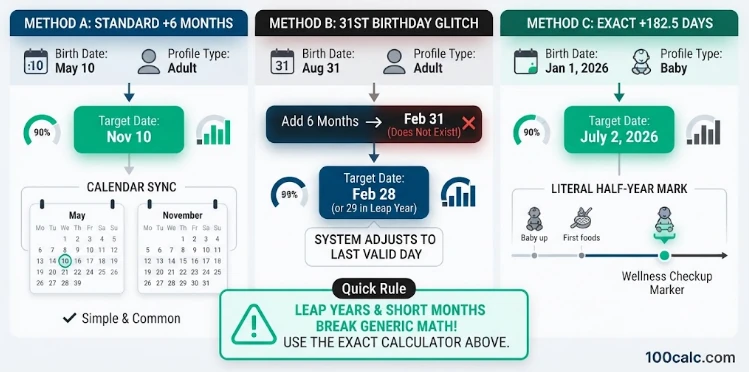
Calculate your half birthday by adding exactly six calendar months to your birth date. If your birthday is May 10, your half birthday becomes November 10. For strict scientific precision, you can also calculate the date by adding exactly 182.5 days to your starting calendar day.
What is the half birthday for a Christmas baby?
Many families struggle to host parties for children born in late December. Friends travel, and the actual birthday gets lost in the holiday rush.
Use these inputs in the calculator:
- Birth Date: December 25
- Profile Type: General / Adult
- Calculation Mode: Standard (+6 Months)
Process:
The system takes the twelfth calendar month and adds six months to reach June. The 25th day remains identical.
Result:
Your Target Date is June 25.
Meaning:
You can safely throw an outdoor summer party. This avoids the chaotic winter holiday season entirely and ensures your friends can actually attend the celebration.
How do you calculate a half birthday for August 31?
People born on the 31st often face a strange math glitch. Adding six months directly creates a fake calendar date that confuses basic calculators.
Use these inputs in the calculator:
- Birth Date: August 31
- Profile Type: General / Adult
- Calculation Mode: Standard (+6 Months)
Process:
Adding six months to August brings you to February. Since February 31 does not exist, the system automatically forces the result to the last valid day of February.
Result:
Your Target Date is February 28 (or February 29 in a leap year).
Meaning:
Your true half birthday adapts to the strict calendar limits. You do not lose your mid-year celebration just because you were born on the 31st.
When is the exact 6-month milestone for a New Year's baby?
Parents tracking infant development often want precise mathematical timelines rather than a generic calendar bump.
Use these inputs in the calculator:
- Birth Date: January 1, 2026
- Profile Type: Baby (6-Month Milestone)
- Calculation Mode: Exact (+182.5 Days)
Process:
Instead of adding six calendar months, the exact formula counts forward by 182.5 days. This finds the literal half-year mark regardless of how many days each passing month contains.
Result:
Your Target Date is July 2, 2026.
Meaning:
The baby hits a major pediatric growth marker on this specific day. Parents can use this exact timeline to schedule the six-month wellness checkup and watch for physical milestones.
Quick rule to remember
Calendar math always breaks down during leap years and short months. Do not guess your date if you were born on the 29th, 30th, or 31st. Enter your exact details into the tool above to generate a flawless target date and start your live countdown.
What to Do After Calculating Your Half Birthday
Your calculated date gives you a clear target, but the next step is up to you. Many people miss the benefits of a mid-year check-in because they forget to actually plan for it. Use these practical insights to turn your new date into a meaningful action.
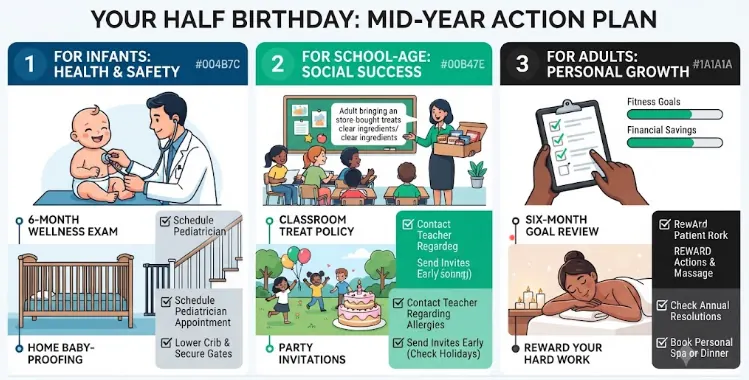
For Infant Health Milestones
Schedule your six-month pediatric wellness exam right away. Doctors use this specific timeline to check physical growth charts and administer standard immunizations. Write the exact date on your calendar so you do not miss the narrow appointment window.
Start baby-proofing your home before sudden mobility changes occur. Infants typically begin rolling over and attempting to sit up near this exact marker. Lower the crib mattress to prevent dangerous falls and install safety gates near staircases immediately.
For School-Age Social Celebrations
Contact the classroom teacher a week before the target date. Ask about the current school policy regarding outside food and severe allergy restrictions. Bring store-bought treats with clear ingredient labels instead of homemade baked goods to ensure compliance with classroom safety rules.
Send party invitations early if the new date falls near a three-day weekend. You shifted the celebration to improve attendance, but public holidays still cause scheduling conflicts. Keep the party theme focused on a literal half concept to make the event memorable without replacing the real birthday.
For Adult Personal Milestones
Treat this day as a strict six-month review for your annual resolutions. Check your progress on fitness goals, financial savings, or career targets. This quiet mid-year pause gives you enough time to correct bad habits before the calendar year officially ends.
Explore your opposite astrological sign to understand your complementary personality traits. Astrologers view the half-birthday as a unique period of extreme contrast and personal balance. Book a quiet dinner or schedule a massage to reward your hard work over the past six months.
You Might Also Find These Helpful
Birthday 16
Use our free 9 3/4 Birthday Calculator to find the exact date your child turns 9 years and 9 months. Plan the perfect wizard-themed…
Try calculatorYou can use our free crown birthday calculator to find your golden date. First, enter your exact birth date. Next, discover your special celebration…
Try calculatorCalculate your 60-year milestone instantly. Our Diamond Jubilee Calculator provides precise dates for 60th birthdays or anniversaries with 100% accuracy.
Try calculatorUse our free Emerald Jubilee Calculator to find the exact date you turn 55. Discover the meaning of this green-themed milestone today.
Try calculatorUse our free Golden Birthday Calculator to find your special, once-in-a-lifetime date. Discover your Golden Age and get tips for a gold-themed party.
Try calculatorUse our Leap Year Age Calculator to find your exact age, real leap birthdays, and whether Feb 28 or March 1 counts on common…
Try calculatorUse our Platinum Birthday Calculator to find your reversed-age milestone date, platinum birthday age, and whether it already passed or is still ahead.
Try calculatorStop guessing fractional dates. Use our exact quarter birthday calculator to instantly find your 1/4 and 3/4 milestones for infant tracking or anniversaries.
Try calculatorTurning 25? Use the Silver Birthday Calculator to track your quarter-century milestone. Get the exact countdown in days, hours, and minutes for your big…
Try calculatorTwin Flame Calculator checks names and birthdays to reveal your match score, bond type, life path signs, and whether the pull feels real or…
Try calculatorWhy Your Half Birthday Result May Be Incorrect
Calculating your un-birthday seems simple, but calendar irregularities easily cause timeline errors. Many people end up celebrating on the wrong day because they ignore leap years or varying month lengths. Review these frequent mistakes to ensure your target date remains perfectly accurate.
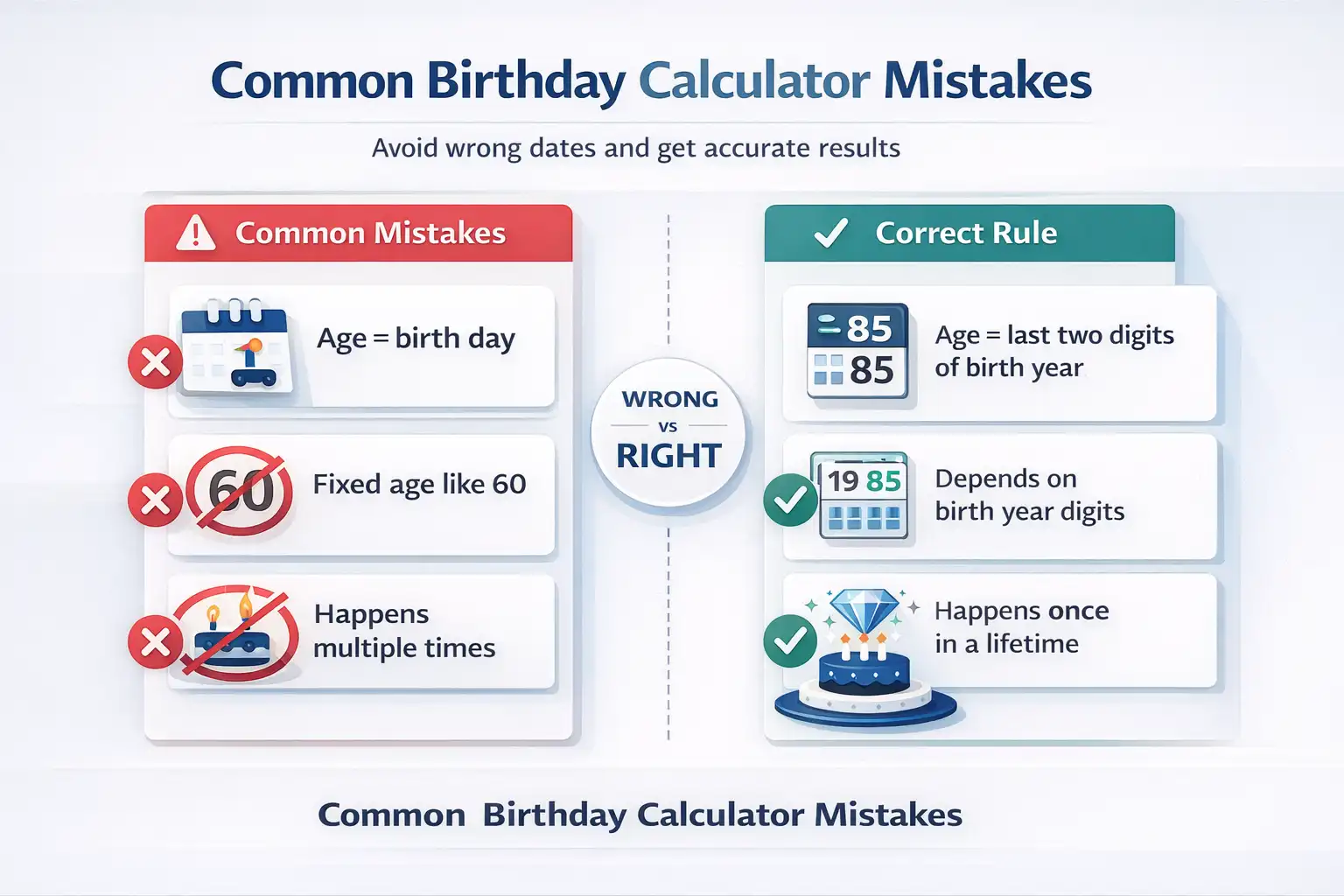
- Assuming six calendar months always equals exactly 180 days.
- Forgetting that leap years shift the target date for late February and August birthdays.
- Guessing that an August 31st birthday pushes the half birthday into early March.
- Confusing a three-month quarter birthday with the official six-month milestone.
- Counting exactly 24 weeks for an infant milestone instead of using a true six-month calendar shift.
Frequently Asked Questions (FAQs)
What is a 1/2 birthday?
A half birthday is commonly treated as the date six calendar months after your birthday, marking the halfway point between annual birthday celebrations. Many families celebrate it to avoid holiday conflicts or summer-break scheduling problems.
If my birthday is August 31, when is my half birthday?
Your half birthday is February 28 in a common year, and February 29 in a leap year. Adding six calendar months gives you February 31, which does not exist, so the date automatically shifts to the last valid day of February.
What happens if my birthday is February 29 (leap day)?
If you were born on February 29, your half birthday is August 29 using the standard six-calendar-month method. In this calculator’s General/Adult mode, the recurring half-birthday date remains August 29 because the tool preserves the original birth day when moving six calendar months forward.
How many days are in half a year?
Half of a 365-day common year is 182.5 days, while half of a 366-day leap year is 183 days. However, a calendar-based half birthday is usually calculated by adding six calendar months to the birth date, so the actual number of days between the birthday and half birthday varies depending on the months involved.
What happens at a baby's 6-month half birthday?
Around 6 months, many babies reach new developmental milestones. Common six-month milestones include rolling from tummy to back, pushing up with straight arms during tummy time, and leaning on their hands for support while sitting.
Babies may also begin solid foods around this age when developmentally ready. Development varies from baby to baby, so parents should discuss any concerns with their child’s doctor.
How do people traditionally celebrate a half birthday?
Many families embrace a literal “half” theme for the party. Parents often buy exactly half of a birthday cake, sing only the first half of the birthday song, or make a half-paper crown. It keeps the event fun without overshadowing the real birthday.
Are half-year ages used for legal or financial milestones?
Yes. Some legal and financial rules use ages that include a half year. In California, an applicant under 18 must be at least 15½ to apply for an instruction permit. Federal IRA rules also use age 59½: distributions taken before that age are generally considered early distributions and may be subject to an additional 10% tax unless an exception applies.
Should you bring a gift to a half birthday party?
Most people treat these events as casual hangouts rather than formal gift-giving occasions. A small token or a card is usually enough. Hosts should clearly state their expectations on the party invitations so guests do not feel pressured to buy expensive presents.
How old are you on your half birthday?
On your half birthday, you are six months past your most recent full birthday. For example, if you turned 10 on your birthday, you are 10½ years old on your half birthday. This is sometimes described as your half-birthday age or half age.
Questions?
We had love to hear from you! Whether you are reporting an issue, suggesting a new calculator, or exploring collaboration opportunities — we are here to help. Every message helps us make 100calc smarter, faster, and more helpful for everyone.
Why People Trust 100calc
At 100calc.com, we focus on accuracy, speed, and trust. Every calculator we create is designed to give reliable, instant, and easy-to-understand results you can truly depend on.