
Days Old Calculator: How Many Calendar Days Have You Lived?
The Days Old Calculator finds how many whole calendar days have passed between your date of birth and today or another date you choose. It uses the actual date interval, so leap days and different month lengths are handled by calendar math instead of a flat yearly estimate. The main result is your total calendar days old.
Think your age in years tells the whole story? It hides the day-by-day number. Enter your birth date to see total days, calendar age in years, months, and days, completed months and weeks, leap days crossed, and your key day milestone dates.
Quick Facts
- Date range: Birth date to today or a custom date
- Main result: Total whole calendar days old
- Age breakdown: Years, months, and days
- Also shows: Completed calendar months, weeks, and leap days crossed
- Milestones: 1,000, 5,000, 15,000, and 20,000 days
- Updated Sep 5, 2026
- Reviewed by 100Calc Research Team
Age & Chronological Tools
Days Old Calculator
Calculate your age in calendar days from your date of birth to today or any custom date, plus completed weeks, calendar months, leap days, and milestone dates.
Calculate your total calendar days from birth up to today.
What you need to enter first
Enter your date of birth below to calculate your age in calendar days.
Total Days Old
Your Day Milestones
Age Context
How to count days old?
How many days old is 50?
How many days old is 80?
How old is 24 in days?
Explore More Calculators
Use our Birthday Calculator. Enter your date of birth to find your current age, next birthday date, days until your birthday, weekday, and days…
Try calculatorUse this age difference calculator to compare birthdays, ages, or birth years. See who is older and get the exact gap in years, months,…
Try calculatorWhen is your diamond birthday? Use our Diamond Birthday Calculator to find the exact date when your age matches the last two digits of…
Try calculator1 billion seconds calculator shows your exact milestone date and age in seconds. See if you’ve reached it or how close you are now.
Try calculatorUse our 10000 Days Old Calculator to find your exact 10,000-day birthday, check days old now, and see your age in years and months.
Try calculatorUse our free 9 3/4 Birthday Calculator to find the exact date your child turns 9 years and 9 months. Plan the perfect wizard-themed…
Try calculator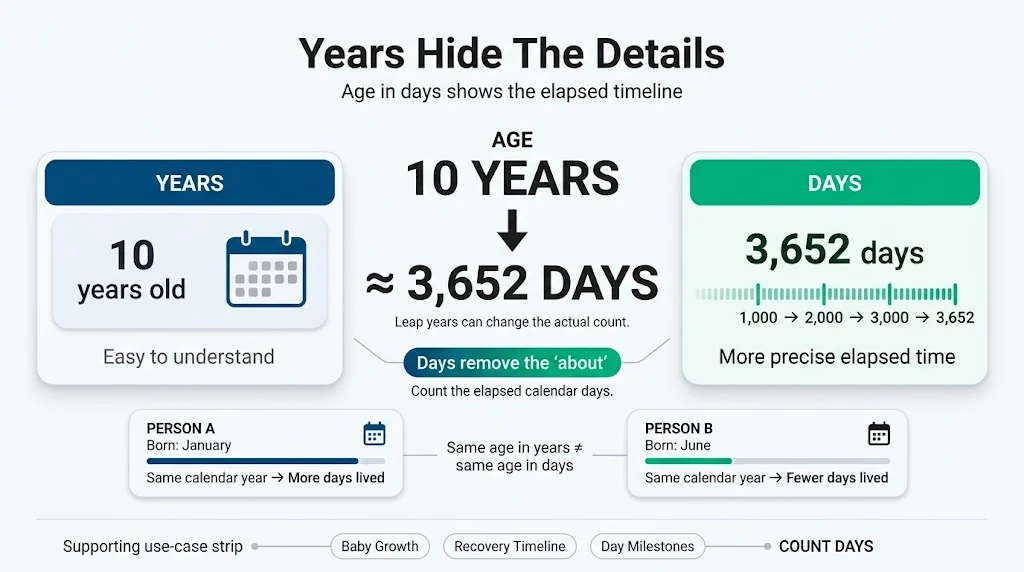
Micro Insight
Use age in days when the exact calendar gap matters, such as a milestone or past-date comparison. Use years and months for everyday age. If the numbers look different, check the unit before assuming one is wrong.
What Is Age in Days?
Age in days is the number of whole calendar days between your birth date and a chosen date. Unlike years or months, a day is a fixed unit of time. Each calendar day counts once, including February 29 when a leap day falls within that date span.
Years and months are useful for everyday age, but they hide smaller differences. Months can contain 28, 29, 30, or 31 days. A week always contains seven days, so these age units will not always line up neatly.
A baby born on April 10, 2026 is 52 days old on June 1, 2026. That same span can also be described as 1 calendar month and 22 days. Both describe the same age, just in different units.
What Does Your Days Old Result Actually Mean?
Your days old result is the number of whole calendar-day intervals between your birth date and the selected comparison date. It tells you how far apart those two dates are in days.
This number is not a health score, biological age, or legal age. Birth time is not used. If the birth date and comparison date are the same, the result is 0 days old.
How Should You Read the Main Day Count?
A result of 9,722 days old means 9,722 complete calendar-day intervals separate the two dates.
Do not read that as exactly 9,722 × 24 hours of life. The calculator uses dates, not your birth time or the current time of day.
There is no good, bad, high, or low result. A larger number simply means the selected date is farther from the birth date.
What Does Calendar Age in Years, Months, and Days Mean?
A result such as 26Y / 7M / 13D means:
- 26 completed calendar years
- 7 more completed calendar months
- 13 remaining calendar days
This breakdown follows the calendar. It is not created by dividing total days by 365 or months by 30.
That difference matters because years and months do not all contain the same number of days.
What Do Completed Calendar Months Mean?
Completed calendar months count how many full month-to-month periods have passed since the birth date.
A result of 319 months does not mean the calculator divided 9,722 by 30. Calendar months can contain 28, 29, 30, or 31 days.
This value is useful when months make more sense than years, such as tracking a young child’s age.
What Does Total Weeks Old Mean?
The weeks result shows completed whole weeks within your total day count.
If someone is 29 days old:
29 days = 4 completed weeks + 1 extra day
The weeks card displays 4 weeks. That remaining day stays part of the main day total.
What Does Leap Days Crossed Mean?
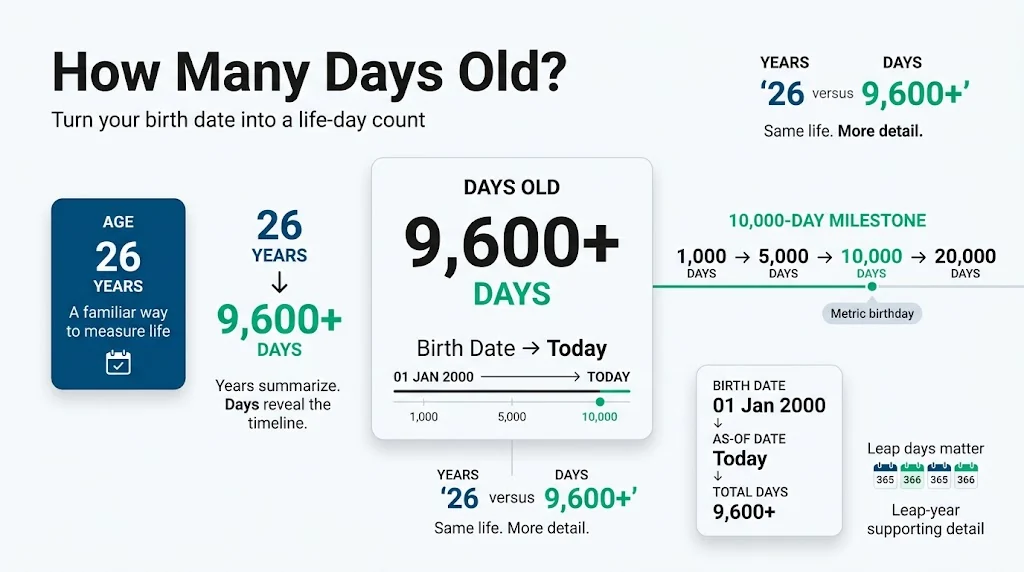
Leap days crossed tells you how many February 29 dates fall inside the elapsed date interval.
If the result shows 7 leap days crossed, those seven extra calendar dates are already included in the total days old.
Do not add them again. They explain part of why simple age × 365 estimates can differ from calendar-based results.
What Does the Progress Ring Mean?
The progress ring shows your position inside the current 1,000-day block. It does not measure how much of your life is complete.
At 9,722 days old, the active block runs from 9,000 to 10,000 days.
722 ÷ 1,000 = 72.2%
The calculator displays about 72% to 10k days.
Once the total reaches exactly 10,000 days, a new 1,000-day block begins. The ring resets to 0% toward 11,000 days.
Reaching 10,000 days is often treated as a personal or “metric birthday” milestone, which explains why users commonly track that number separately.
Is Your Days Old Result Good or Bad?
A days old result has no healthy, unhealthy, normal, or abnormal range. It is a measurement of elapsed calendar time.
The useful comparison is your milestone position. Someone at 9,722 days is 278 days away from 10,000. Someone at 10,000 has already reached that milestone.
What Should You Do Next?
Check that your birth date and comparison date are correct before saving the result.
Use the main day count when you need an exact calendar interval. Use the years, months, and days breakdown when you want a familiar age format.
If a round-number milestone is close, note its date. A result near 10,000 days is also a useful reason to check the dedicated 10,000-day milestone tool.
Quick Example to Test
Enter these values in Days Old on Specific Date mode:
- Date of birth: January 19, 2000
- Comparison date: September 1, 2026
The result is:
- Total Days Old: 9,722
- Calendar Age: 26Y / 7M / 13D
- Completed Calendar Months: 319
- Completed Weeks: 1,388
- Leap Days Crossed: 7
- Badge: Four-Digit Day Count
- Progress Ring: 72% to 10k days
This means 9,722 complete calendar-day intervals separate the two dates. The person is also 278 days short of the 10,000-day milestone.
Using the same birth date with June 6, 2027 produces 10,000 days old. The badge changes to Five-Digit Day Count, and the ring restarts at 0% toward 11,000 days.
How to Use the Days Old Calculator
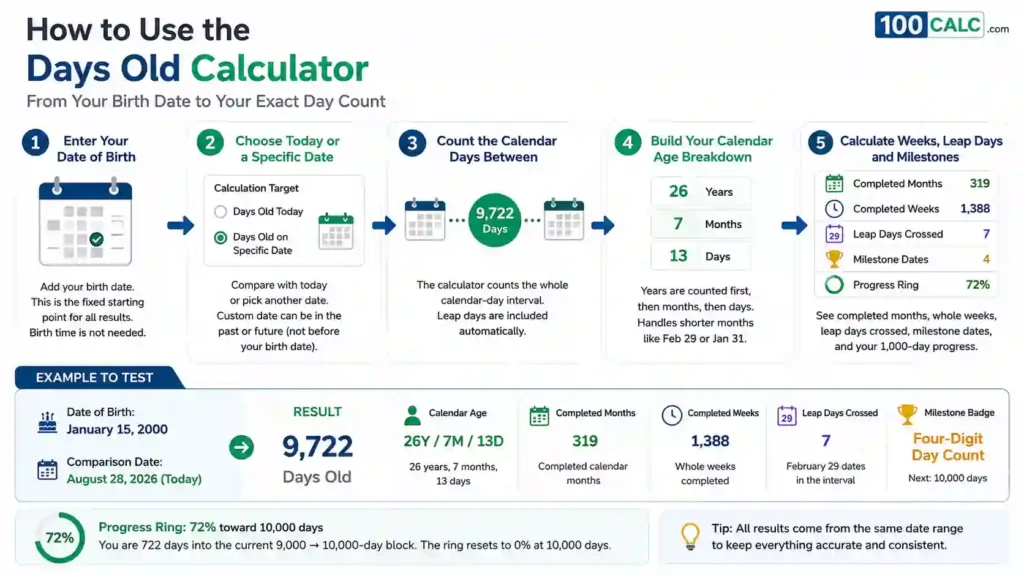
The Days Old Calculator starts with your birth date and compares it with today or another date you choose. It counts the whole calendar-day gap, then builds the related age breakdown. Calendar months, completed weeks, leap days, milestone dates, and thousand-day progress come from that same date range.
Enter Your Date of Birth
Add the calendar date you were born. This becomes the fixed starting point for every result the calculator creates.The date must be valid and cannot be left blank. Birth time is not needed because the calculation works with calendar dates rather than hours or minutes.
Choose Today or a Specific Date
Select Days Old Today to compare your birth date with your current calendar date. Choose Days Old on Specific Date to use another endpoint.A custom date may be in the past or future. It cannot come before your birth date. Matching both dates is allowed and returns 0 days old.
Count the Calendar Days Between Both Dates
The calculator measures the whole calendar-day interval between your birth date and selected endpoint. That number becomes your main total days old result.Leap days are naturally included when they fall inside that interval. The calculation does not estimate years as 365 or 365.25 days.
Build Your Calendar Age Breakdown
Your calendar age is worked out separately from the main day count. Complete years are counted first. Complete calendar months come after those years, followed by the remaining days.If a matching day does not exist in a month, the calculator uses that month's final valid date. This matters for dates such as February 29 or January 31.
Calculate Weeks, Leap Days, and Milestones
The same date range creates the supporting results. You see completed calendar months, whole weeks, and the number of February 29 dates crossed.Fixed day counts create your 1,000, 5,000, 15,000, and 20,000-day milestone dates. The progress ring shows where your current total sits inside its active 1,000-day block.
Quick Example to Test
Try these values in the calculator:
- Calculation Target: Days Old Today
- Date of Birth: January 15, 2000
- Comparison Date: August 28, 2026
Result:
Your total age is 9,722 calendar days.
The calculator also shows:
- Calendar Age: 26Y / 7M / 13D
- Completed Calendar Months: 319
- Completed Weeks: 1,388
- Leap Days Crossed: 7
- Day Count: Four-Digit Day Count
- Progress Ring: 72% toward 10,000 days
In plain words, 9,722 whole calendar days separate January 15, 2000 and August 28, 2026. The 72% ring means you are 722 days into the current 9,000 to 10,000-day block. It is not a percentage of your life.
These values match the calculator’s current date logic and output rules.
Accuracy and Method Behind the Days Old Calculator
The Days Old Calculator uses validated calendar dates and a fixed date-handling system. It treats dates as calendar points, handles leap days and uneven month lengths, and applies the same rules to past, present, and future dates. This keeps each result consistent with the selected birth date and comparison date.
Key Features & Benefits
- Calendar-Based Counting: Uses real calendar dates instead of average year lengths.
- Strict Date Validation: Rejects missing, invalid, or impossible calendar dates.
- Leap Day Handling: Accounts for February 29 when it falls within the date span.
- Month-End Consistency: Uses the month's final valid date when needed.
- Flexible Date Comparison: Supports today, past dates, and future dates with one method.
Technical Process
Input Capture
Birth and comparison dates are checked before any age calculation begins.
Date Processing
Validated dates are normalized and processed with consistent calendar rules.
Result Output
One date range powers the day count and all supporting age details.
How the Days Old Calculator Formula Works (Complete Breakdown)
The Days Old Calculator uses the difference between two normalized calendar dates. Your birth date is the starting point. Today or a custom date becomes the endpoint. The main result counts completed calendar days. Separate calendar rules then build the years, months, weeks, leap-day count, progress ring, and milestone dates.
Primary Days Old Formula
Formula:
					Total Days Old =
floor(
  (Comparison Date - Date of Birth)
  / 86,400,000
)
The calculator converts both dates into comparable calendar points before subtraction. One full day contains 86,400,000 milliseconds.
The floor step keeps completed days only. A birth date compared with itself returns 0. The following calendar date returns 1.
Why Not Multiply Your Age by 365 or 365.25?
Multiplying years by 365 gives an estimate. It can miss February 29 dates.
Using 365.25 improves a long-term estimate, but it still does not describe one person’s actual date interval. Your birth month, birth day, comparison date, and leap days all affect the final count.
This calculator avoids that shortcut. It compares the two calendar dates directly.
How Are Calendar Years, Months, and Days Calculated?
The Y / M / D result uses calendar anniversaries rather than dividing total days.
					Completed Years =
largest number of full calendar years
that does not pass the comparison date

Completed Months =
largest number of full calendar months
after those years
that does not pass the comparison date

Remaining Days =
Comparison Date - Calendar Month Anchor
A date is kept on the same day of the month when possible.
If that day does not exist, the final valid day is used. February 29 becomes February 28 in a non-leap year under this calculator’s calendar convention.
How Are Completed Calendar Months Calculated?
					Completed Calendar Months =
(Completed Years × 12)
+ Remaining Completed Months
This value counts full calendar months.
It does not divide the total day count by 30. A calendar month may contain 28, 29, 30, or 31 days.
How Are Completed Weeks Calculated?
					Completed Weeks =
floor(Total Days Old / 7)
Only full seven-day periods appear in the weeks result.
A total of 32 days returns 4 completed weeks. The remaining 4 days stay part of the main day count.
How Are Leap Days Counted?
The calculator checks each February 29 inside the selected date interval.
					Count February 29 when:

February 29 >= Date of Birth

and

February 29 < Comparison Date
A leap year normally occurs every four years. Century years only qualify when divisible by 400.
The leap-day count is informational. Those days are already included in Total Days Old.
How Is the Next 1,000-Day Progress Calculated?
The progress ring tracks your position inside the current 1,000-day block.
					Next Tier =
(floor(Total Days Old / 1,000) + 1)
× 1,000
Progress Within Tier =
Total Days Old mod 1,000
Progress % =
(Progress Within Tier / 1,000)
× 100
The displayed value removes the decimal:
					Displayed Progress % =
floor(Progress %)
A result of 11,421 days is 421 days into the 11,000 to 12,000 block. The ring shows 42% toward 12k days.
How Are Day Milestone Dates Calculated?
Each milestone starts from the date of birth.
					Milestone Date =
Date of Birth + Milestone Days
The current calculator creates dates for:
					1,000 days
5,000 days
15,000 days
20,000 days
These are fixed day offsets. They are not estimated from years.
Key Values Behind the Formula
Date of Birth
Date of Birth, or DOB, is the starting calendar date. Every day count, calendar-age value, leap-day check, and milestone date begins here. Birth time is not collected, so the calculation measures calendar-day age rather than hours or minutes since birth.
Comparison Date
The Comparison Date is the endpoint. Today mode uses the user’s current calendar date. Custom mode uses the date entered by the user. It may be in the past or future, but it cannot be earlier than the birth date.
Total Days Old
Total Days Old is the number of completed calendar-day intervals between the two dates. This is the main result. Leap days and different month lengths are already reflected because the calculator compares actual dates rather than converting age from an average year.
Completed Years
Y means completed calendar years. The calculator finds the largest whole-year anniversary that does not pass the comparison date. This keeps the calendar-age result tied to real anniversaries instead of estimating years from the total number of days.
Completed Months
M means the extra completed calendar months after full years are counted. The calculator moves month by month from the year anniversary. If the original day does not exist in a shorter month, it uses that month’s final valid date.
Remaining Days
D means the calendar days left after completed years and months have been removed. These days finish the Y / M / D age breakdown and are separate from the main total day count.
Leap Days
Leap Days counts February 29 dates inside the calculator’s defined interval. The number helps explain why two spans with similar year lengths may contain different total days. It is not added to the main result again.
Tier
Tier means the current 1,000-day progress block. A person at 11,421 days sits inside the 11,000 to 12,000 block. The remainder, 421 days, controls the percentage shown in the progress ring.
Another Example Calculation
Let’s test a new date pair that has not been used earlier.
Given
					Date of Birth = July 4, 1995
Comparison Date = October 10, 2026
Calculation
					Date Difference =
986,774,400,000 milliseconds
Total Days Old =
floor(
  986,774,400,000
  / 86,400,000
)

Total Days Old =
11,421 days
Completed Years = 31

July 4, 1995
to
July 4, 2026
= 31 years
Completed Months = 3

July 4, 2026
to
October 4, 2026
= 3 months
Remaining Days = 6

October 4, 2026
to
October 10, 2026
= 6 days
(31 × 12) + 3
= 375 months
floor(11,421 / 7)
= 1,631 weeks
1996
2000
2004
2008
2012
2016
2020
2024

= 8 leap days
11,421 mod 1,000
= 421
421 / 1,000 × 100
= 42.1%
42% toward 12k days
Result
					Total Days Old = 11,421

Calendar Age = 31Y / 3M / 6D

Completed Calendar Months = 375

Completed Weeks = 1,631

Leap Days Crossed = 8

Day Count = Five-Digit Day Count

Progress Ring = 42% toward 12k days
Meaning
The two dates are 11,421 whole calendar days apart. The calendar-age view expresses the same date span as 31 years, 3 months, and 6 days.
The supporting values use that same date range. They do not replace or alter the main day count.
How Do You Calculate Days Old?
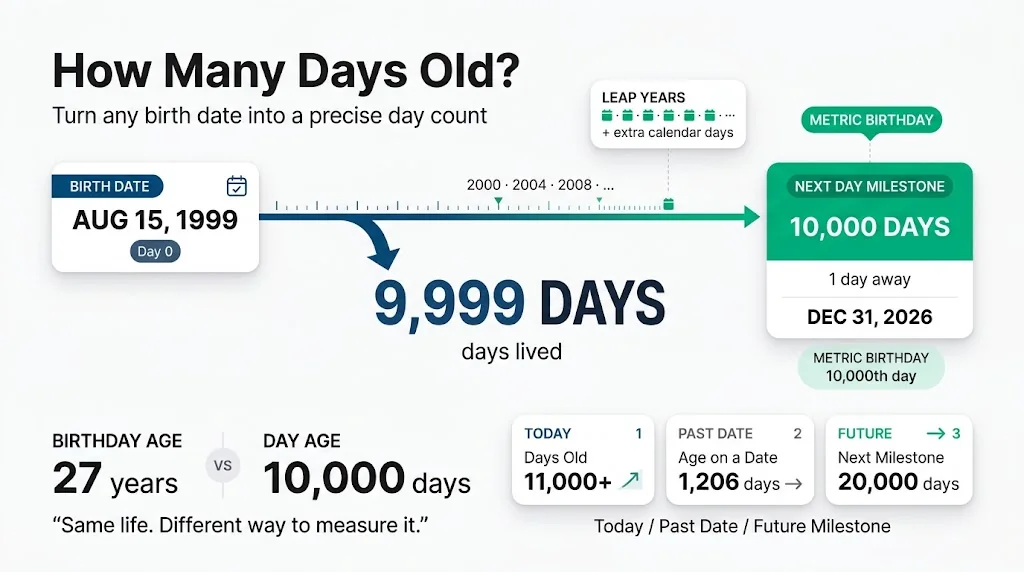
To calculate how many days old someone is, compare the date of birth with today or another chosen date. The number of whole calendar days between those dates is the age in days. Leap days count naturally when February 29 falls inside the selected date range.
How Old Is a Baby at 100 Days?
A 100-day age check is useful when parents track an early birthday milestone.
Input
- Date of Birth: May 21, 2026
- Comparison Date: August 29, 2026
Process
May 21 to August 29 contains 100 whole calendar days.
The calendar breakdown reaches 3 complete months, with 8 days remaining.
Result
- Total Days Old: 100 days
- Calendar Age: 0Y / 3M / 8D
- Completed Calendar Months: 3
- Completed Weeks: 14
- Leap Days Crossed: 0
- Day Count: Under 1,000 Days
- Progress Ring: 10% toward 1,000 days
Meaning
The baby is 100 calendar days old on August 29, 2026. The month view shows the same span as 3 months and 8 days.
When Do You Turn 1,000 Days Old?
A 1,000-day birthday is a simple milestone that falls before age three.
Input
- Date of Birth: December 4, 2023
- Comparison Date: August 30, 2026
Process
The date interval reaches exactly 1,000 calendar days on August 30, 2026.
That same span contains 2 completed years, 8 completed months, and 26 remaining days.
Result
- Total Days Old: 1,000 days
- Calendar Age: 2Y / 8M / 26D
- Completed Calendar Months: 32
- Completed Weeks: 142
- Leap Days Crossed: 1
- Day Count: Four-Digit Day Count
- Progress Ring: 0% toward 2,000 days
Meaning
August 30, 2026 marks exactly 1,000 calendar days from the birth date. The progress ring resets because a new 1,000-day block begins.
How Many Days Old Is Someone Born on February 29?
A leap-day birthday shows why calendar rules matter when age is viewed in years and days.
Input
- Date of Birth: February 29, 2000
- Comparison Date: February 28, 2025
Process
The calculator’s month-end rule uses February 28 for the 2025 calendar anniversary because February 29 does not exist that year.
The full date interval contains 9,131 calendar days.
Result
- Total Days Old: 9,131 days
- Calendar Age: 25Y / 0M / 0D
- Completed Calendar Months: 300
- Completed Weeks: 1,30
- Leap Days Crossed: 7
- Day Count: Four-Digit Day Count
- Progress Ring: 13% toward 10,000 days
Meaning
Under this calculator’s calendar convention, February 28, 2025 completes 25 calendar years from February 29, 2000. This is a calculation rule, not a universal legal birthday rule.
When Do You Reach 20,000 Days Old?
Twenty thousand days is a larger day-based birthday milestone.
Input
- Date of Birth: November 27, 1971
- Comparison Date: August 30, 2026
Process
Adding 20,000 whole calendar days to November 27, 1971 lands on August 30, 2026.
The calendar-age view reaches 54 years, 9 months, and 3 days.
Result
- Total Days Old: 20,000 days
- Calendar Age: 54Y / 9M / 3D
- Completed Calendar Months: 657
- Completed Weeks: 2,857
- Leap Days Crossed: 14
- Day Count: Five-Digit Day Count
- Progress Ring: 0% toward 21,000 days
Meaning
August 30, 2026 is the exact 20,000-day milestone for this birth date. The progress ring starts a fresh block toward 21,000 days.
Use Your Own Dates
Your result depends on the birth date and comparison date you choose. Enter your own dates to check total calendar days, calendar age, completed weeks and months, leap days, and upcoming day milestones.
What Your Days Old Calculator Result Means by Range
A Days Old Calculator result is not good, bad, high, or low. It only shows how many whole calendar days separate two dates. These ranges match the calculator’s own result labels and help you understand the size of your day count and which milestone dates matter next.
| Range | Calculator Label | What It Means | Milestone Context | What to Do |
|---|---|---|---|---|
| 0–999 days | Under 1,000 Days | Your total is still below a four-digit day count. | 1,000 days is the first milestone shown by the calculator. | Check the 1,000-day date if that milestone is approaching. |
| 1,000–9,999 days | Four-Digit Day Count | Your age in days now contains four digits. | The calculator can show 1,000 and 5,000-day milestone dates. | Use the milestone dates to see which round-day marker comes next. |
| 10,000+ days | Five-Digit Day Count | Your total has reached at least five digits in calendar days. | The calculator also tracks 15,000 and 20,000-day milestones. | Check your next displayed milestone and current 1,000-day progress. |
Heads-up: These are neutral day-count ranges, not health, legal, or life-stage ratings. A higher number is not better or worse.
Interpretation
The labels change only when the total day count crosses a number threshold. Under 1,000 Days, Four-Digit Day Count, and Five-Digit Day Count do not judge your age.
Use the main number for the date interval. Use the milestone dates and progress ring for extra context.
Pro Tip
Treat the badge as a quick size label, not a score. Your exact day count and milestone dates are the useful parts when planning a personal day-based anniversary.
What Should You Do With Your Days Old Result?
Your Days Old Calculator result is a time marker, not a score to improve. The useful part is what you do with it. Save an upcoming milestone, check your age on another important date, or confirm an official cutoff with the organization that sets the rule.
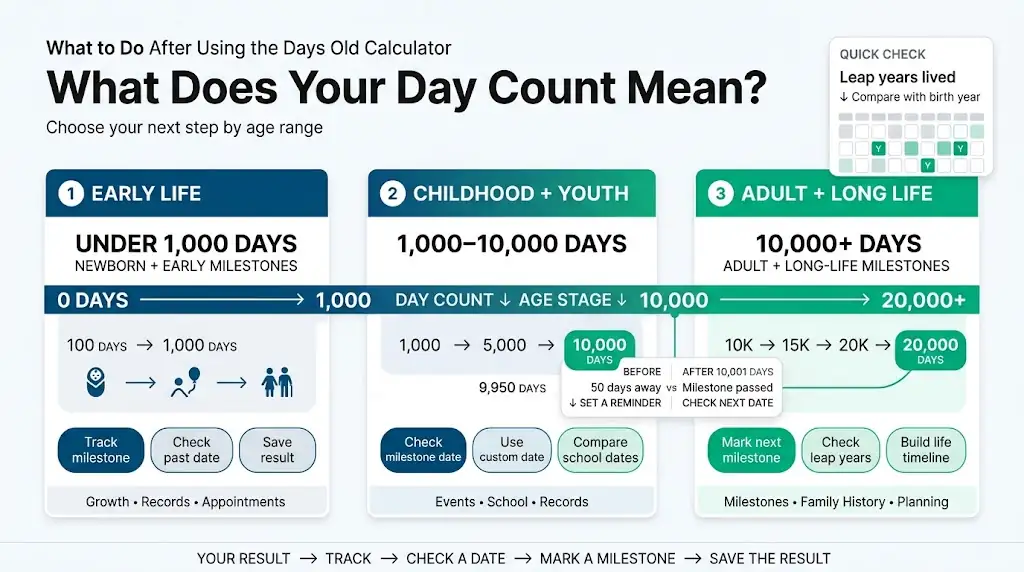
If Your Result Is Under 1,000 Days
Check the 1,000-day milestone date shown in your results. Save it if the date matters to you or your family. Custom mode can also check the child’s age on a past appointment, birthday event, or future date without changing the original birth date.
If Your Result Is 1,000 to 9,999 Days
Look at your 5,000-day milestone and current 1,000-day progress. If you are interested in reaching 10,000 days, use the dedicated 10,000 Days Old Calculator to find that date and track how far away it is.
Custom mode is useful for checking your age on a graduation, wedding, family milestone, or another important date.
If Your Result Is 10,000 Days or More
Use the 15,000 and 20,000-day dates to find your next larger milestone. A custom comparison date can also show how old you were during an important event or how old you will be on a future anniversary.
If the result affects school, sports, government, or legal eligibility, check the official cutoff rule. A calendar-day count can confirm the date gap, but the organization decides which age rule applies.
You Might Also Find These Helpful
Birthday 16
You can use our free crown birthday calculator to find your golden date. First, enter your exact birth date. Next, discover your special celebration…
Try calculatorCalculate your 60-year milestone instantly. Our Diamond Jubilee Calculator provides precise dates for 60th birthdays or anniversaries with 100% accuracy.
Try calculatorUse our free Emerald Jubilee Calculator to find the exact date you turn 55. Discover the meaning of this green-themed milestone today.
Try calculatorUse our free Golden Birthday Calculator to find your special, once-in-a-lifetime date. Discover your Golden Age and get tips for a gold-themed party.
Try calculatorHalf Birthday Calculator finds the date six months after your birthday and shows your next half birthday, countdown, and baby 6-month milestone.
Try calculatorUse our Leap Year Age Calculator to find your exact age, real leap birthdays, and whether Feb 28 or March 1 counts on common…
Try calculatorUse our Platinum Birthday Calculator to find your reversed-age milestone date, platinum birthday age, and whether it already passed or is still ahead.
Try calculatorStop guessing fractional dates. Use our exact quarter birthday calculator to instantly find your 1/4 and 3/4 milestones for infant tracking or anniversaries.
Try calculatorTurning 25? Use the Silver Birthday Calculator to track your quarter-century milestone. Get the exact countdown in days, hours, and minutes for your big…
Try calculatorTwin Flame Calculator checks names and birthdays to reveal your match score, bond type, life path signs, and whether the pull feels real or…
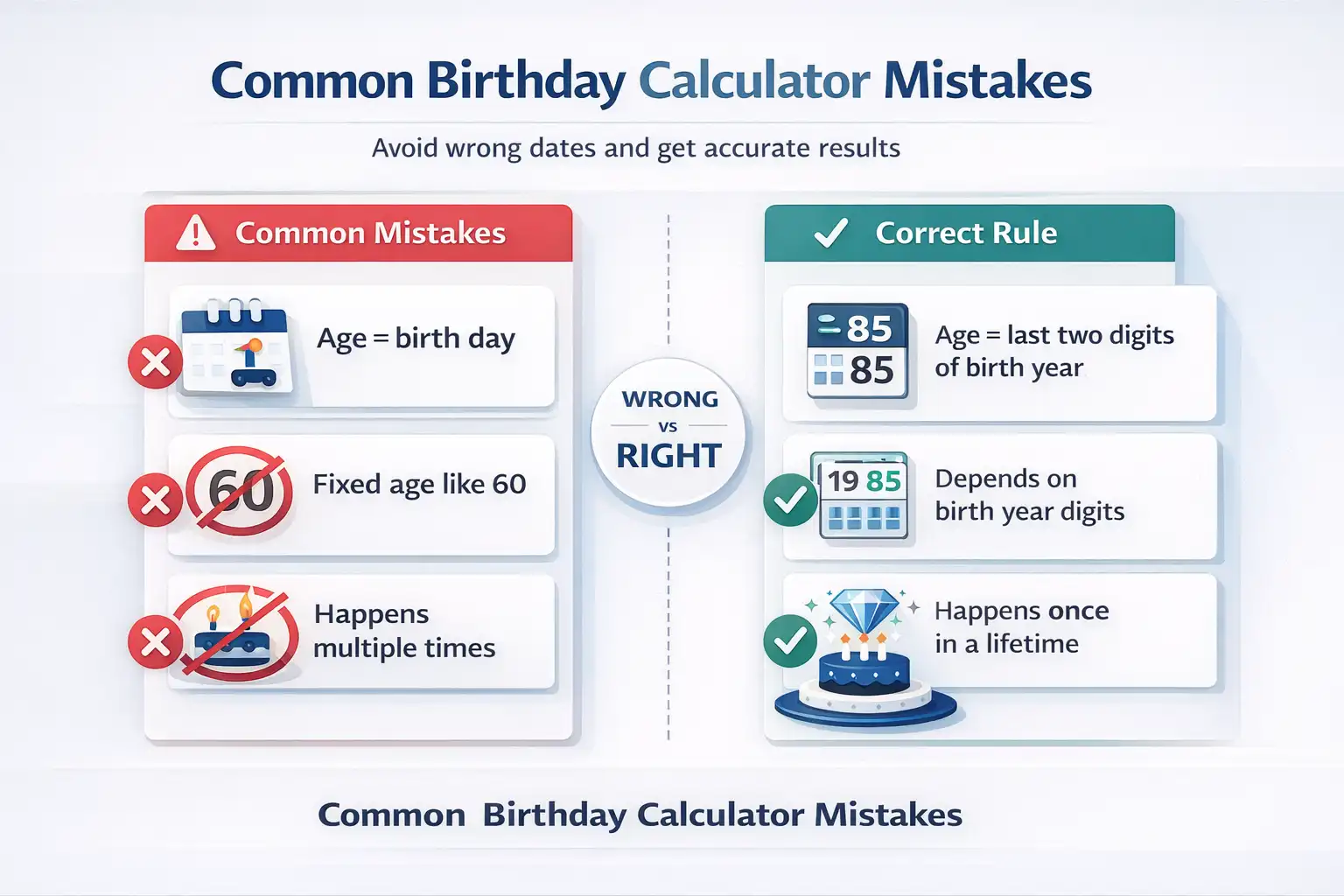
Try calculatorCommon Mistakes When Using the Days Old Calculator
A Days Old Calculator can look wrong when calendar days are treated like fixed years or months. Most confusion comes from using rough conversions, misreading supporting results, or mixing different date questions. Avoid these five mistakes when checking your age in days or comparing results.
- Multiplying age by 365: This ignores leap days and the days passed since your most recent birthday.
- Treating 365.25 as an exact answer: It is an average-year estimate, not your actual birth-date-to-comparison-date interval.
- Dividing total days by 30 for months: Calendar months contain 28, 29, 30, or 31 days.
- Reading the progress ring as life progress: It only tracks your position inside the current 1,000-day block.
- Confusing days old with days ago: Days old starts from your birth date, while days ago counts backward from another reference date.
Frequently Asked Questions (FAQs)
How do I calculate how many days old I am in Excel?
If your birth date is in cell A1, use =TODAY()-A1 to find your current age in days. You can also use =DAYS(TODAY(),A1). Excel stores dates as serial numbers, so subtracting two valid dates returns the number of calendar days between them.
Can I calculate days old if I only know my age in years?
Not exactly. Knowing that someone is 24 or 50 years old does not reveal their full day count. The result also depends on the birth month, birth day, comparison date, and leap days crossed. A full date of birth is needed for a calendar-based answer.
How many days old is someone at 24, 50, or 80 years old?
A rough estimate is 8,766 days at 24, 18,262 days at 50, and 29,219 days at 80. Your actual total can differ because leap days depend on the exact birth date and comparison date. Use a full birth date when you need the calendar-day count.
Does my birth date count as day 0 or day 1?
In this calculator, your birth date is day 0 because zero whole calendar days have passed yet. The following calendar date makes you 1 day old. An inclusive event count may label the birth date as the first day, but that is a different counting method.
Does birth time change how many days old I am?
Birth time does not change this calculator’s result because it uses calendar dates rather than timestamps. Someone born at 2:00 AM and someone born at 10:00 PM on the same date receive the same day count when compared with the same calendar date.
Is 10,000 days old exactly 27 years and 4 months?
No. 10,000 days is a fixed number of calendar days, while years and months have different lengths. It is roughly 27.4 years, but the calendar age on that milestone depends on the birth date. Use the dedicated 10,000 Days Old Calculator to find the milestone date.
Does a days old result include weekends and holidays?
Yes. Age in days uses calendar days, so Saturdays, Sundays, holidays, and leap days all count when they fall inside the date interval. It is not a business-day calculation and does not remove weekends or public holidays from your total.
Questions?
We had love to hear from you! Whether you are reporting an issue, suggesting a new calculator, or exploring collaboration opportunities — we are here to help. Every message helps us make 100calc smarter, faster, and more helpful for everyone.
Why People Trust 100calc
At 100calc.com, we focus on accuracy, speed, and trust. Every calculator we create is designed to give reliable, instant, and easy-to-understand results you can truly depend on.