
Reverse Due Date Calculator
The Reverse Due Date Calculator pinpoints the exact day your pregnancy began. It works backward from your Estimated Due Date. Doctors usually date pregnancy from your last period. However, actual conception happens roughly two weeks later. Therefore, you need to reverse the math to find the biological start date. Enter your date below to see the result.
The tool instantly reconstructs your entire timeline. It identifies your specific Conception Date. Additionally, it calculates your fertile “Intercourse Window” and the likely date of implantation. You can use your doctor’s date or ultrasound results. Consequently, you will understand the sequence of events that led to your baby. Use this data to clarify your pregnancy history.
- Updated Jun 13, 2026
Reverse Due Date Calculator: Reconstruct Your Timeline
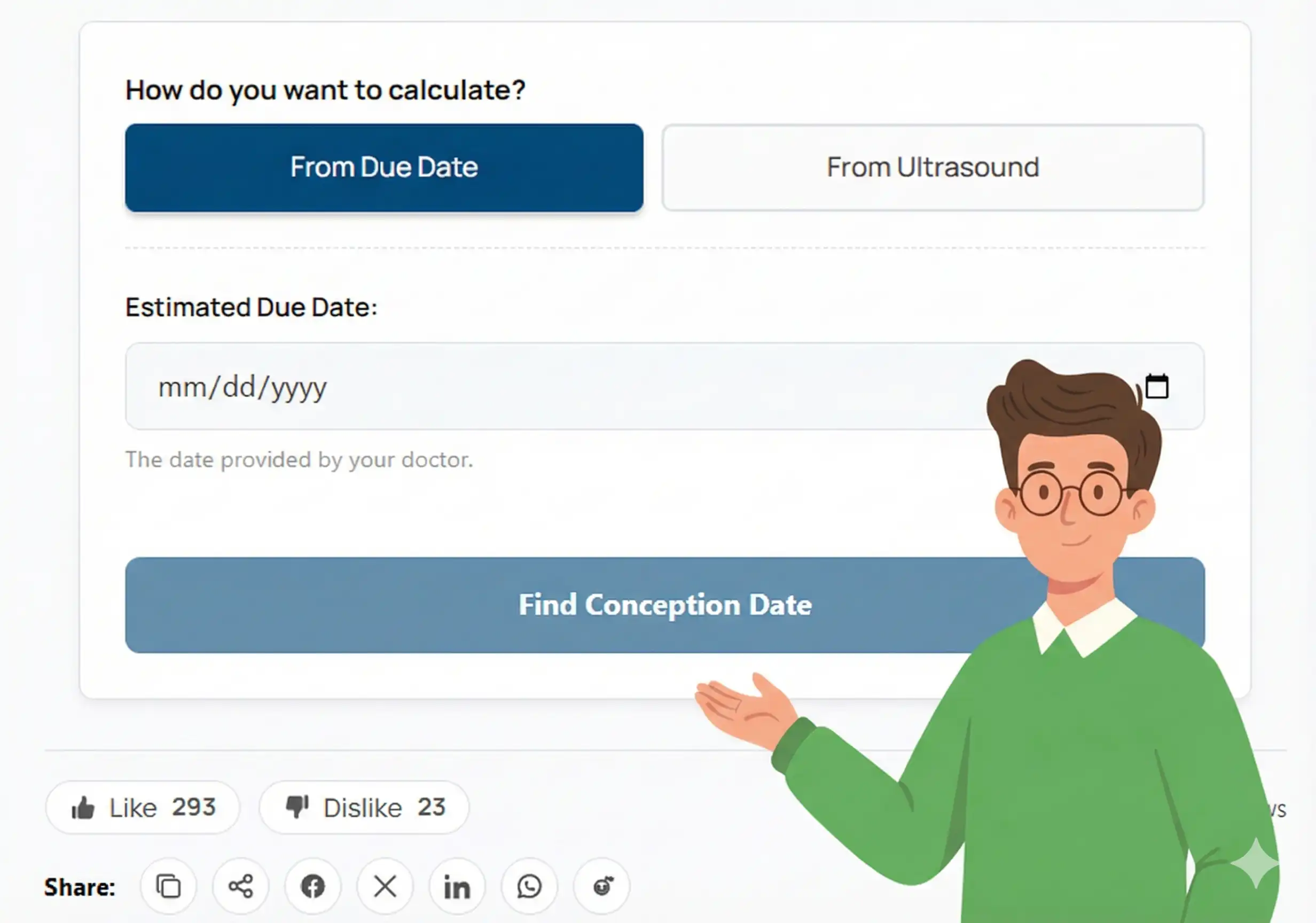
Select your calculation method to begin. You can use the Due Date provided by your doctor. Alternatively, use data from a recent Ultrasound scan for high precision.
The date provided by your doctor.
CONCEPTION DATE
INTERCOURSE WINDOW
📅 Your Pregnancy Timeline (Reconstructed)
Calculation Based On:
- Method: --
- Input Date: --
*Calculated using the standard medical rule of 266 days from conception to birth.
How to Read Your Timeline
The calculator generates a “Reconstructed Timeline.” It maps out the four key biological events of your early pregnancy. The tool provides more than just a single date. You can see the whole sequence of events below.
The Reconstructed Timeline
Biological life begins well before you get a positive test. The timeline visualizes that hidden period. It tracks the journey from intercourse to ovulation. Then, it shows the path to implantation.
Conception vs. Intercourse
Sperm can survive inside the body for five days. Therefore, you likely had sex before the actual conception date. The result highlights that specific five-day window. Sexual activity during that time led to the pregnancy. Conception marks the moment the sperm finally meets the egg.
Implantation Date
The embryo moves through the fallopian tube. It attaches to the uterine wall about nine days after conception. Doctors call that event Implantation. Some women feel slight cramping or see light spotting on that day.
Baby Details
The tool uses the due date to predict fun facts. It identifies the likely Zodiac sign. Additionally, the calculator determines the birth season. You can see if your baby will arrive in Spring, Summer, Autumn, or Winter.
Quick example to check the math
Suppose your doctor gives you a due date of December 25. The calculator instantly performs the reverse math.
Next, it uses the standard gestation constant: December 25 – 266days = April 4
If your result is April 4, you likely conceived on that specific day. Additionally, the tool identifies your intercourse window. After subtracting five days for sperm survival, your fertile range is March 30 to April 4. Consequently, sexual activity during those dates led to the pregnancy.
Explore More Calculators
Use the Chinese Gender Calculator for a traditional boy-or-girl prediction from lunar age and conception month. Enter conception date, due date, or LMP.
Try calculatorUse this fetal growth calculator to check baby weight percentile from ultrasound data in grams, kg, or cm and see what the result means…
Try calculatorEnter gestational sac measurements in mm or cm to calculate mean sac diameter, estimate early gestational age, compare week-by-week milestones, and see when follow-up…
Try calculatorMissed a birth control pill? Check pregnancy risk, protection status, backup contraception needs, and what to do next with our missed pill calculator.
Try calculatorUse our Pregnancy Chance Calculator to estimate your odds. Enter your cycle day, age, and method. Find out if you are in the high-risk…
Try calculatorUse our pregnancy due date calculator to find your exact Baby Due date. IVF, conception, ovulation, and ultrasound methods with weeks and timeline.
Try calculatorHow to Use the Reverse Calculator
Reconstructing your dates takes less than a minute. Follow these steps to ensure accuracy.
Choose Your Source
Decide which information to use first. Select "From Due Date" if you rely on a doctor's estimate. Alternatively, choose "From Ultrasound" if you have a recent scan report.
Enter Your Data
Type the correct date into the field. Be precise when using the Ultrasound method. Enter exactly how many weeks and days the doctor measured. Accuracy ensures the math works correctly.
Click Calculate
Press the button to process your numbers. The tool applies the reverse formula instantly. It subtracts the standard gestation time from your input.
Review the History
Look at the vertical timeline below the cards. It displays what happened and when it occurred. You can see the complete chronological order of your pregnancy events.
Example for testing
Try these sample numbers:
Method: Due Date
Input Date: September 15, 2026
Result → Your likely Conception Date is December 23, 2025. The tool shows an Intercourse Window from December 18 to December 23. You were likely in your Implantation phase around January 1, 2026.
Now, enter your own numbers and check how close you are to your goal.
How the Reverse Due Date Formula Works (Complete Breakdown)
Understanding the math helps you verify your timeline. The formula provides a clear picture of when the pregnancy started. It uses standard medical constants to find the hidden conception date. The logic follows global obstetrics guidelines. Therefore, it remains accurate and practical for every expectant mother.
The Reverse Conception Formula
The calculation works backward from the final date. Medical science states that human gestation lasts 266 days from the moment of conception. The formula is simple and effective. It works for due dates provided by any doctor or clinic.
Formula:
Conception Date = Due Date - 266 Days
The formula starts with the Estimated Due Date. Then, it subtracts the standard gestation period of 38 weeks. The result pinpoints the exact date of fertilization.
Example:
If your Due Date is December 25th. (December 25) - 266 Days = April 4.
Your conception date is April 4. That is the biological start of the pregnancy.
Micro Note:
Doctors often use the “Last Period” method, which adds 280 days. However, the “Reverse” method uses 266 days to find the actual biological start.
Key Inputs Used in the Calculator
Every calculation depends on specific medical inputs. These inputs help accurately measure the timeline. You enter the actual dates from your doctor’s report or scan report. Consequently, you get a precise reconstruction of the past events. The method mirrors the logic used by radiologists and OB-GYNs.
Estimated Due Date (EDD)
The doctor provides this date. It serves as the anchor for the entire calculation. For example, a Due Date of January 1 sets the finish line. The calculator counts backward from there to find the starting line. Accuracy here ensures the result matches your medical records.
Ultrasound Measurements
Ultrasounds measure the baby’s physical size. The Crown-Rump Length (CRL) is the gold standard for dating. The tool uses the “Weeks and Days” from your report to determine the exact age of the fetus. This input often provides a better estimate than calendar dates.
Sperm Survival Factor
Sperm can live for five days. This biological fact defines the “Intercourse Window.” We subtract five days from the conception date. That range represents the fertile time. Knowing this helps you identify the possible dates of intercourse.
Another Example Calculation (Step-by-Step)
Let’s see how the calculator works using an Ultrasound example. This breakdown helps you understand the precision of scan-based dating. The calculation follows the same logic used by radiologists to update your files.
Given:
- Scan Date: October 1
- Result: 8 Weeks 0 Days Pregnant
- Goal: Find the Conception Date
Calculation:
					First, we find the number of days the pregnancy has existed. 8 Weeks x 7 Days = 56 Days
Next, we subtract 56 days from the Scan Date to find the Clinical Start Date. Then, we add 14 days to find the Conception Date. Clinical Start = August 6 Conception = August 20
Result:
- Conception Date: August 20
- Intercourse Window: August 15 – August 20
- Status: Confirmed by Scan
Meaning:
The baby started growing roughly two weeks after the clinical start date. Therefore, conception happened around August 20. You likely had sex between August 15 and August 20. The scan measurement confirms the timeline is accurate.
Result Benchmarks and Ranges
Your conception estimate is more than just a date. It helps you understand your biological timeline. It also clarifies what actions occurred during your fertile window. Medical experts in the U.S. and around the world follow similar dating rules. However, the accuracy of the result depends on your data source. Use this quick breakdown to evaluate your score and verify your plan.
| Data Source | Accuracy | Margin of Error |
|---|---|---|
| First Trimester Scan | Excellent |
+/- 5 Days
Most reliable method. |
| Doctor's Due Date | Very Good |
+/- 7 Days
Standard clinical use. |
| 20-Week Scan | Good |
+/- 10 Days
Harder to measure size. |
| Patient Memory | Low |
Variable
Depends on cycle regularity. |
Note: Ultrasound measurements taken before 13 weeks provide the "Gold Standard" for dating.
Interpretation
Relying on a First Trimester Scan offers the best accuracy for dating. Doctors trust these measurements more than calendar dates. However, a standard Due Date works well for most pregnancies. The margin of error grows as the pregnancy progresses. Therefore, early scans provide the strongest evidence for specific conception dating.
Pro Tip:
Constantly update your calculation after your 12-week scan. The doctor often adjusts the date based on the baby’s size. That new date acts as your most accurate anchor. Use the latest date to find the actual start of your timeline.
Tips & Planning Based on Your Result Using Your Timeline Effectively
The timeline helps you answer questions about the past. It clarifies exactly when key events happened. Follow these tips to interpret the dates correctly.
Understanding Implantation Spotting
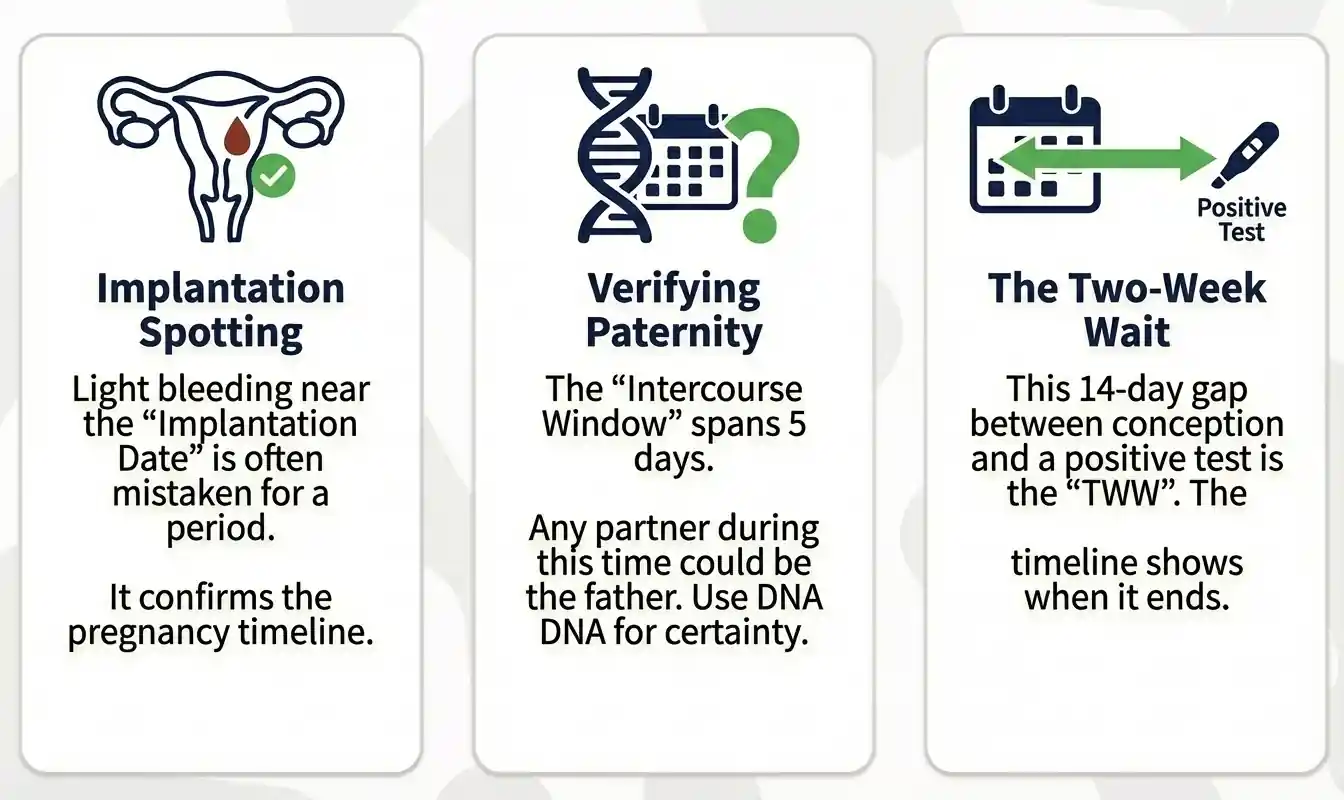
Look at the “Implantation Date” on your result card. Did you notice light bleeding around that time? Many women mistake the symptom for a light period. Knowing the date helps you confirm the timeline. It proves the bleeding was actually pregnancy-related.
Verifying Paternity
Check the “Intercourse Window” carefully. The five-day range covers the entire lifespan of sperm. Any partner you were with during those specific days could be the father. However, remember that ovulation dates can shift. Always use DNA testing for total certainty.
The "Two-Week Wait"
The timeline shows a gap between “Conception” and “First Positive Test.” That period typically lasts 14 days. Doctors call the gap the Two-Week Wait (TWW). The calculator shows you exactly when that wait ended.
You Might Also Find These Helpful
Pregnancy & Fertility 45
Use this Pregnancy Risk Calculator to check age, BMI, health history, bleeding, and twins. See if closer prenatal monitoring may be worth asking about.
Try calculatorOne Time Pregnancy Calculator estimates pregnancy odds from one encounter, plus fertile window timing, test date, due date, and 21-day testing guidance.
Try calculatorUse the AMH Calculator to convert ng/mL or pmol/L, compare your result with age-based data, and see what it may mean for IVF, fertility,…
Try calculatorUse the Baby Eye Color Calculator with parents, grandparents, or sibling context to compare Brown, Green/Hazel, and Blue/Grey model estimates instantly.
Try calculatorBasal Body Temperature Calculator checks reading conditions and analyzes your temperature pattern for a sustained shift that may be consistent with ovulation.
Try calculatorBPD gestational age calculator: estimate fetal age from BPD, compare your week, check normal BPD ranges, and understand ahead or behind results.
Try calculatorCalculate odds with the Chance of Twins Calculator. Enter maternal age and history. Find your probability instantly. See if you will conceive multiples now.
Try calculatorFind out exactly when you conceived. Our free Conception Calculator uses your Due Date, LMP, or Ultrasound to estimate your fertilization date and fertile…
Try calculatorUse our Conception Date Due Date Calculator to find your baby's arrival date. Enter your conception or intercourse date for clinical 40-week results.
Try calculatorContraceptive effectiveness calculator to compare birth control methods, typical vs perfect use, backup protection, and 5-year pregnancy risk.
Try calculatorUse this CRL calculator to estimate gestational age and due date from crown-rump length in mm or cm. Compare CRL, LMP, and IVF dating…
Try calculatorEstimate your monthly and 12-month pregnancy odds by age, partner age, and cycle dates. See your fertile window and when to seek fertility help.
Try calculatorCommon Mistakes to Avoid When Calculating
Reverse dating seems simple. However, minor errors can lead to confusion. Avoid these common pitfalls when using the calculator.
- Confusing the Ages: Do not confuse the two types of age. Gestational Age measures from your last period. Conversely, Fetal Age measures from the moment of conception. The two numbers usually differ by two weeks.
- Entering the Wrong Year: Check the year you entered. You might accidentally enter the current year. However, due dates often fall in the next calendar year. A wrong year breaks the calculation completely.
- Ignoring Sperm Life: Do not assume conception happened instantly. You might think it occurred during sex. However, it usually happens days later. Sperm waits for the egg to release.
Frequently Asked Questions (FAQs)
How to calculate due date backwards?
You can easily find the conception date. Simply subtract 266 days from your estimated due date. The number 266 represents the standard human gestation period. Our tool handles the math for you instantly.
Can my conception date be wrong by 2 weeks?
Yes. Doctors date pregnancy from your last period. That date is usually two weeks before actual conception. Therefore, your “medical date” will always appear two weeks older than your “biological date.”
When was the baby conceived?
Conception happens when sperm fertilizes the egg. This event occurs roughly 14 days after your period starts. Use our calculator to find the specific 24-hour window based on your due date.
Why use a reverse due date calculator?
You might want to know the exact day the pregnancy started. The reverse method provides clarity on your timeline. It helps you verify paternity or understand key milestones, such as implantation.
Can I get pregnant 5 days before ovulation?
Yes. Sperm can live inside the female body for up to five days. You might have sex on Monday and conceive on Friday. The “Intercourse Window” on our calculator accounts for this survival time.
Is the due date always 100% accurate?
No. Only about 5% of babies arrive on their exact due date. The date is an estimation. However, early ultrasounds provide the most accurate prediction of the final date.
Does the calculator work for irregular periods?
Yes. The reverse method is perfect for irregular cycles. It relies on the final birth date rather than your menstrual history. Consequently, it ignores cycle length and focuses on the baby’s arrival.
Questions?
We had love to hear from you! Whether you are reporting an issue, suggesting a new calculator, or exploring collaboration opportunities — we are here to help. Every message helps us make 100calc smarter, faster, and more helpful for everyone.
Why People Trust 100calc
At 100calc.com, we focus on accuracy, speed, and trust. Every calculator we create is designed to give reliable, instant, and easy-to-understand results you can truly depend on.