
AMH Calculator: Is Your Result Low, High, or Age-Typical?
The AMH Calculator converts your lab result between ng/mL and pmol/L, then compares it with your age when the test was taken. It shows a broad 100Calc AMH band and, for ages 18 to 45, where your result sits within a published age-reference cohort. It does not turn AMH into a pregnancy chance, egg-quality score, or exact menopause age.
AMH changes with age. So the same number can look very different at 28 and 40. A result that seems low on a generic chart may still sit within your age cohort’s middle 50%. Enter your lab value to see both units, broad AMH context, age comparison, and guidance for fertility, IVF, low AMH, or PCOS concerns.
Quick Facts
- Units: Converts AMH between ng/mL and pmol/L.
- Age: Use your age when the blood test was taken.
- Age comparison: Published cohort data are available for ages 18 to 45.
- Two result layers: Broad AMH context plus age-specific comparison.
- Limits: AMH does not measure egg quality or exact pregnancy chance.
- Updated Aug 25, 2026
- Reviewed by 100Calc Research Team
AMH Calculator
Check your AMH level by age
Enter your age when the AMH test was taken and the AMH result from your lab report. This calculator converts the value, shows a 100Calc educational AMH band, compares it with a published age-reference cohort when available, and gives a clear next step.
Your result
Your AMH result appears here
—
ng/mL
100Calc educational AMH band
Very lowLowMid-rangeHigher
—
—
—
—
How it compares with your age
What to do next
Quick questions your result answers
Important: AMH gives ovarian reserve and ovarian-response context. It does not measure egg quality, count every egg you have left, diagnose infertility or PCOS, predict your exact chance of pregnancy, or calculate your exact menopause age. Your laboratory's assay-specific reference interval and your clinical context take priority over this educational comparison.
AMH result ready
View your result
Explore More Calculators
Chinese Gender Calculator Featured
Use the Chinese Gender Calculator for a traditional boy-or-girl prediction from lunar age and conception month. Enter conception date, due date, or LMP.
Try calculatorFetal Growth Calculator Featured
Use this fetal growth calculator to check baby weight percentile from ultrasound data in grams, kg, or cm and see what the result means…
Try calculatorMean Sac Diameter Calculator Featured
Enter gestational sac measurements in mm or cm to calculate mean sac diameter, estimate early gestational age, compare week-by-week milestones, and see when follow-up…
Try calculatorMissed Pill Calculator Featured
Missed a birth control pill? Check pregnancy risk, protection status, backup contraception needs, and what to do next with our missed pill calculator.
Try calculatorPregnancy Chance Calculator Featured
Use our Pregnancy Chance Calculator to estimate your odds. Enter your cycle day, age, and method. Find out if you are in the high-risk…
Try calculatorPregnancy Due Date Calculator Featured
Use our pregnancy due date calculator to find your exact Baby Due date. IVF, conception, ovulation, and ultrasound methods with weeks and timeline.
Try calculator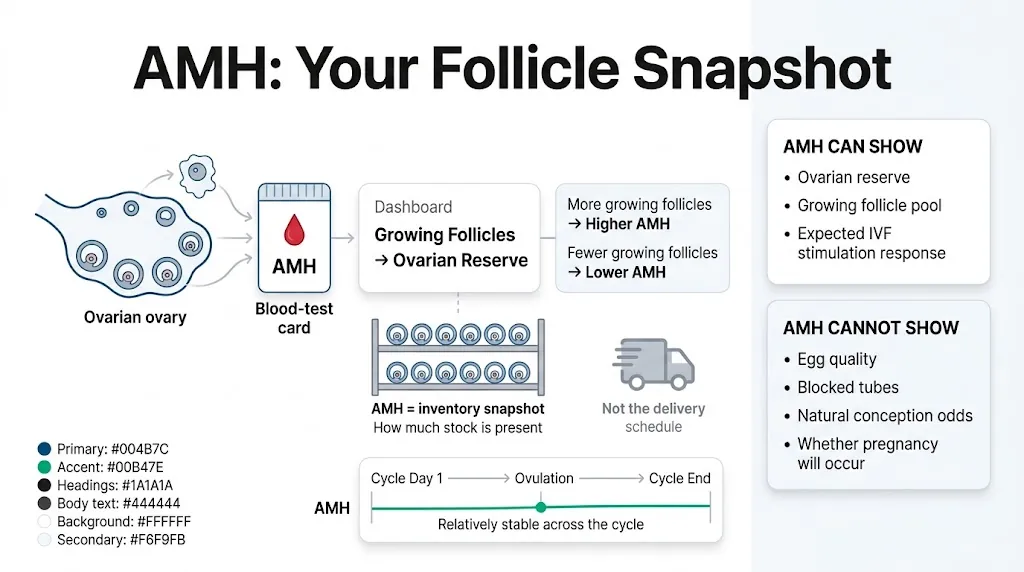
Micro Insight
AMH is relatively stable across the menstrual cycle compared with hormones such as FSH and estradiol, although some variation can occur. This makes it useful for ovarian-reserve assessment and IVF planning. It is still a reserve marker, not a fertility verdict.
What Is AMH?
AMH stands for anti-Müllerian hormone. Cells around small growing follicles in the ovaries produce it. The amount measured in your blood reflects the size of this active follicle pool, which is why AMH is used as a marker of ovarian reserve.
AMH does not count every egg remaining in your ovaries. It also cannot measure egg quality or tell you whether pregnancy will happen naturally.
Two people with the same AMH can still have very different fertility outlooks. Age, ovulation, fallopian tubes, sperm factors, and medical history also matter.
What Does Your AMH Calculator Result Mean?
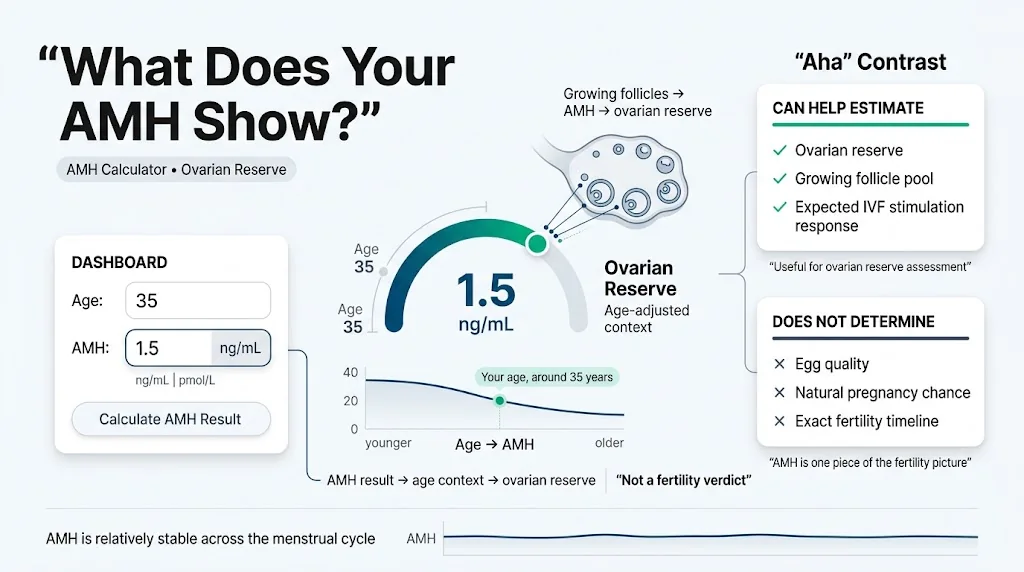
Your result gives you two separate comparisons. One places your AMH in a broad 100Calc educational band. The other compares it with the middle 50% of a published age cohort when age data are available.
These results answer different questions. Read them together rather than treating either one as a fertility verdict.
What Does Your AMH Number Mean?
AMH gives context about your ovarian follicle pool and expected response to ovarian stimulation. In general, lower AMH is linked with fewer responsive follicles. Higher AMH often points to a stronger response.
The number does not tell you:
- exactly how many eggs remain
- whether your eggs are healthy
- your chance of natural pregnancy this month
- your IVF live-birth chance
- when menopause will happen
Age still matters. So do ovulation, sperm factors, fallopian tubes, medical history, and other fertility findings.
What Does the 100Calc AMH Band Mean?
The calculator places your converted AMH value into one of four broad bands:
- Very low: Below 0.4 ng/mL
- Low: 0.4 to 0.99 ng/mL
- Mid-range: 1.0 to 3.0 ng/mL
- Higher: Above 3.0 ng/mL
These are 100Calc educational bands. They are not universal lab ranges or diagnostic cutoffs.
Your own laboratory may use different reference values. Its assay-specific range and your clinical history take priority.
How Does Your AMH Compare With Your Age?
For ages 18 to 45, the calculator also compares your AMH with a published reference cohort for your exact age at testing.
Your result can appear as:
- Below cohort middle 50%: Your AMH is below that age’s 25th percentile.
- Within cohort middle 50%: Your AMH falls between the 25th and 75th percentiles.
- Above cohort middle 50%: Your AMH is above that age’s 75th percentile.
The calculator uses the exact age row. It does not estimate values between ages or extend the dataset beyond age 45.
If you were 46 to 55 when tested, you still get unit conversion and broad AMH context. An age-cohort comparison is not shown.
Why Can the Two Results Look Different?
A broad AMH band and an age comparison measure different things. That means they do not always give the same-looking label.
Someone can have Low AMH context while still sitting within the middle 50% for her age. That is not a contradiction.
Age 30 With AMH of 2.4 ng/mL
A test result of 2.4 ng/mL converts to about 17.14 pmol/L.
The calculator shows:
- Broad result: Mid-range AMH context
- Age-30 median: 2.6 ng/mL
- Age-30 middle 50%: 1.1 to 4.4 ng/mL
- Age comparison: Within cohort middle 50%
So, is a 2.4 AMH level normal? The safer answer is that 2.4 falls in 100Calc’s mid-range band and within this selected age-30 cohort’s middle 50%. It should not be called universally normal for every person or lab.
Age 40 With AMH of 0.5 ng/mL
At age 40, an AMH result of 0.5 ng/mL falls in the calculator’s Low AMH context.
The age comparison shows:
- Age-40 median: 0.4 ng/mL
- Age-40 middle 50%: 0.1 to 1.2 ng/mL
- Age comparison: Within cohort middle 50%
The broad label says low, yet the value sits within the selected age cohort’s middle 50%. This shows why age changes how an AMH result should be read.
Is a Low AMH Result Bad?
A low AMH result can point to a smaller follicular pool or a lower expected response to ovarian stimulation. It does not mean you are infertile or have no chance of becoming pregnant naturally.
What matters next depends on your goal. If you are trying to conceive or planning IVF, discuss the result alongside your age, cycle history, antral follicle count, and other fertility findings.
Do not make a major fertility decision from the AMH number alone.
Is a Higher AMH Result Better?
Not always. Higher AMH can suggest a stronger ovarian response, but more is not automatically better.
Higher levels can also occur with PCOS. AMH alone cannot diagnose it. During IVF, a strong ovarian response may also affect medication planning and the risk of excessive stimulation.
If your AMH is much higher than expected for your age, review it with your clinician alongside cycle regularity, ultrasound findings, and your lab’s own reference range.
How to Use the AMH Calculator
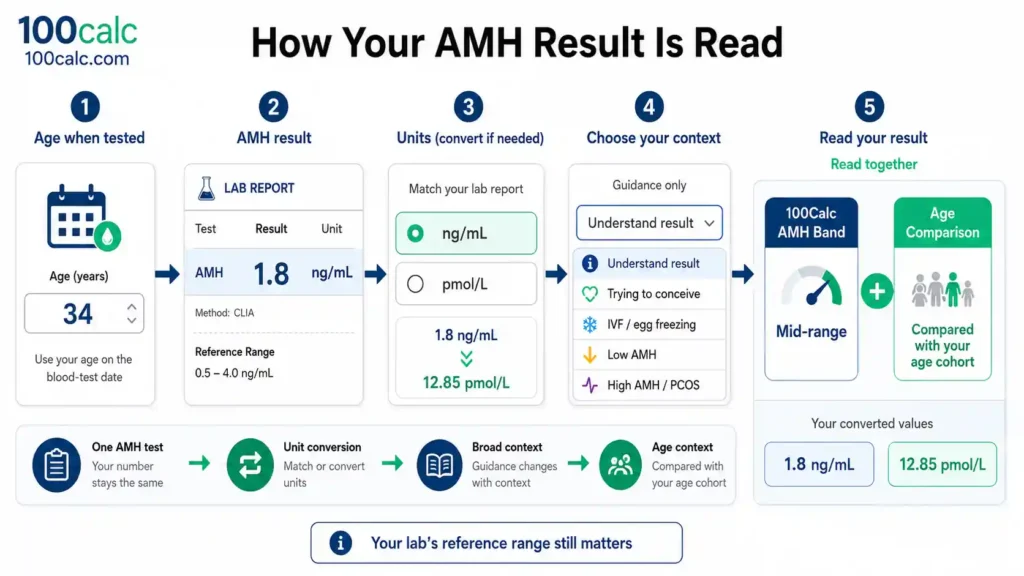
Use the AMH Calculator with the details from the same blood test. Enter your age at testing, copy the AMH value, match the unit, and choose why you are checking it. The calculator converts your result, assigns its educational band, checks age-reference data when available, and builds guidance around your goal.
Enter Your Age at Testing
Enter the age you were when the AMH blood sample was taken. Do not use your current age if the test is older. The calculator uses this age for its cohort comparison. Published age-reference data are available through age 45. Older users still receive conversion and broad AMH context.
Add Your AMH Result
Copy the AMH number exactly as it appears on your lab report. Do not convert or round it yourself. The calculator keeps the reported value as the starting point, then creates the matching value in the other unit before applying its educational AMH band.
Match the Lab Unit
Select ng/mL or pmol/L to match the unit printed beside your result. This choice tells the calculator how to read the number before conversion. Using the wrong unit can completely change the result, so check the laboratory report rather than guessing from the size of the number.
Choose Why You Are Checking AMH
Pick the reason that best matches your situation. Options cover general understanding, trying to conceive, IVF or egg freezing, low AMH concerns, and high AMH or PCOS concerns. This choice only changes the educational guidance. It does not alter your AMH value, band, or age comparison.
Read Both Result Comparisons
Review your AMH in both units, the 100Calc educational band, and the age-cohort comparison when available. These are separate results. The calculator also shows the cohort median, middle 50% range, and guidance linked to your goal. Your laboratory's own reference interval still takes priority.
Quick Example to Test
Try these sample values in the AMH Calculator:
- Age when AMH was tested: 32
- AMH Result: 1.4
- Unit on Report: ng/mL
- Main Reason: Planning IVF or egg freezing
Result:
Your AMH is 1.40 ng/mL, which converts to about 10.00 pmol/L.
The calculator places this result in the Mid-range AMH context.
For age 32, the selected reference cohort has a median of 1.9 ng/mL and a middle 50% range of 0.8 to 3.7 ng/mL. Your 1.4 ng/mL result falls within the cohort middle 50%.
For IVF planning, this gives useful ovarian-response context. It does not predict egg quality, pregnancy chance, or IVF success on its own.
Now enter the age from your own test date and the exact AMH value from your lab report to compare your result.
Advertisement
How Accurate Is the AMH Calculator?
The AMH Calculator uses fixed conversion rules and published age-specific reference data. It keeps broad AMH bands separate from age comparison, which helps avoid misleading labels. Age matching uses exact published rows where available. Your laboratory’s own assay-specific reference range still takes priority over the calculator’s educational context.
Key Features & Benefits
- Converts both AMH units: Shows matching values in ng/mL and pmol/L using the fixed 7.14 conversion factor.
- Uses age at testing: Compares the result with your age when the blood sample was taken.
- Matches published age rows: Uses exact reference data for each supported age from 18 through 45.
- Separates two result layers: Keeps the broad AMH band apart from the age-specific cohort comparison.
- Adapts guidance by goal: Changes the educational guidance without changing your AMH value or classification.
Technical Process
Convert Units
The system standardizes the entered AMH result into both supported units before applying any comparison or classification.
Match Age
For supported ages, the system loads the published median and middle 50% reference values for that exact age.
Apply Context
The system assigns the broad AMH band, checks the age cohort, then adds guidance based on the selected goal.
How the AMH Calculator Formula Works (Complete Breakdown)
The AMH Calculator formula does more than convert units. It converts ng/mL and pmol/L, applies a broad 100Calc AMH band, then checks age-specific reference data when available. These calculations stay separate, so a broad AMH category does not replace the comparison for your age.
AMH Conversion Formula
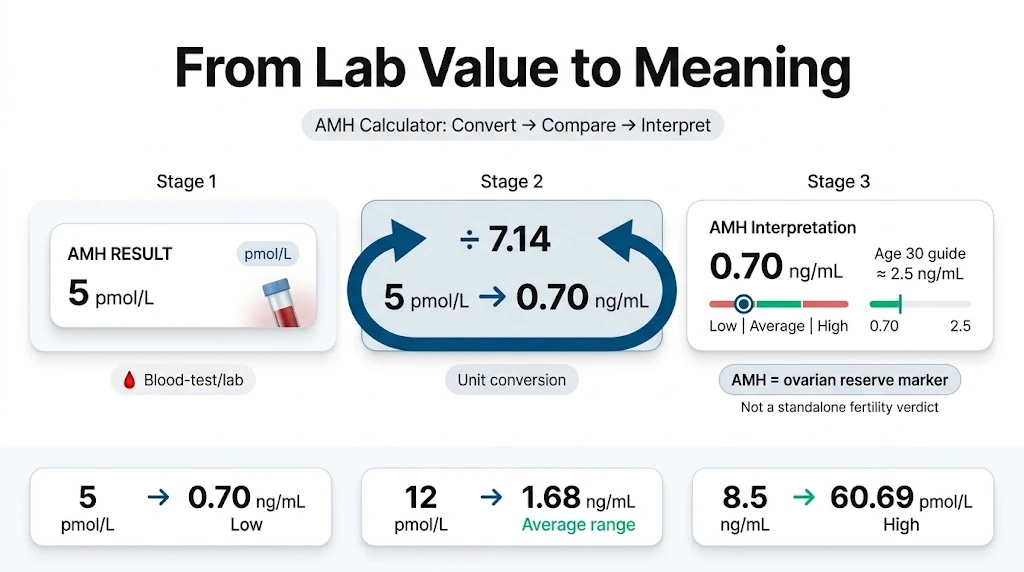
AMH reports commonly use ng/mL or pmol/L. The calculator converts the entered result into both units using a fixed factor of 7.14.
ng/mL to pmol/L
AMH (pmol/L) = AMH (ng/mL) × 7.14
This converts an AMH result from nanograms per milliliter into picomoles per liter.
pmol/L to ng/mL
AMH (ng/mL) = AMH (pmol/L) ÷ 7.14
This converts a pmol/L result back into ng/mL.
The calculator keeps both values visible. This helps when your lab report and another reference use different units.
How the Calculator Assigns an AMH Band
After conversion, the calculator uses the ng/mL value to assign one broad educational category.
					AMH < 0.4 ng/mL
= Very low AMH context

AMH ≥ 0.4 and < 1.0 ng/mL
= Low AMH context

AMH ≥ 1.0 and ≤ 3.0 ng/mL
= Mid-range AMH context

AMH > 3.0 ng/mL
= Higher AMH context
The four categories are 100Calc educational bands. They are not universal laboratory ranges, fertility scores, or diagnostic cutoffs.
Your own lab range and age comparison remain separate.
How the Age Comparison Works
For ages 18 through 45, the calculator looks up the published reference row for the user’s exact age at testing.
Each row contains three values:
- Median
- Q1, or 25th percentile
- Q3, or 75th percentile
The age comparison follows this exact logic:
					AMH < Q1
= Below cohort middle 50%

AMH ≥ Q1 and ≤ Q3
= Within cohort middle 50%

AMH > Q3
= Above cohort middle 50%
The calculator does not estimate a new value between ages. A user aged 34 is matched with the age-34 row.
The selected dataset provides age-specific medians and 25th and 75th percentiles from ages 18 through 45.
What Happens After Age 45?
Ages 46 through 55 can still use the AMH Calculator.
The result still includes:
- AMH in ng/mL
- AMH in pmol/L
- 100Calc educational band
- goal-based guidance
The age result changes to:
Age cohort not available
The calculator does not extend the published age values beyond 45. This prevents it from creating an age benchmark that does not exist in the selected dataset.
What Do the Formula Variables Mean?
Each variable controls a different part of the AMH calculation. Some values come directly from your lab report, while others come from the calculator’s age-reference data.
Knowing what each term means helps you understand why the calculator can show a broad AMH band and a different age-based comparison at the same time.
AMH
AMH means anti-Müllerian hormone. In this formula, it is the numeric result taken from the user’s laboratory report. The calculator reads that value together with its unit before conversion and comparison.
ng/mL
ng/mL means nanograms per milliliter. The calculator uses the ng/mL value for its broad educational AMH band and age-reference comparison.
pmol/L
pmol/L means picomoles per liter. If the lab reports AMH in this unit, the calculator divides the value by 7.14 to create the matching ng/mL result.
7.14
7.14 is the fixed unit-conversion factor used by the calculator. One ng/mL corresponds to 7.14 pmol/L in its conversion logic.
Age at Test
Age at test is the completed age when the blood sample was taken. It determines which age-reference row the calculator uses. Current age should not replace the test-age value for an older AMH result.
Median
The median is the middle AMH value for that exact age in the selected reference cohort. It gives context but does not create the category by itself.
Q1
Q1 is the 25th percentile for that age. A result below Q1 receives the label Below cohort middle 50%.
Q3
Q3 is the 75th percentile for that age. A result above Q3 receives the label Above cohort middle 50%.
Main Goal
Main Goal describes why the user is checking AMH. It changes the educational guidance shown after calculation. It does not change the AMH value, unit conversion, broad band, or age comparison.
How the Result Meter Works
The result meter is a category marker, not an AMH percentile or fertility score.
Each broad band has one fixed visual position:
					Very low = 12.5%
Low = 37.5%
Mid-range = 62.5%
Higher = 87.5%
The percentage only controls where the marker appears on the graphic.
A result of 3.1 ng/mL and 10 ng/mL both appear at 87.5% because both fall in the Higher AMH context. The meter does not mean either result is at the 87.5th percentile.
How Do You Calculate an AMH Result?
An AMH blood level is measured by a laboratory, not calculated from age or symptoms. The AMH Calculator converts the reported value between ng/mL and pmol/L, assigns its broad educational band, then compares it with published age-reference data when your test age is 18 to 45.
What Does 19 pmol/L AMH Mean at Age 33?
This example shows how a pmol/L lab result is converted and checked against age data.
Input
- Age when tested: 33
- AMH result: 19
- Unit: pmol/L
- Main reason: Understand my AMH result
Process
19 ÷ 7.14 = 2.66 ng/mL
The converted value of 2.66 ng/mL falls between 1.0 and 3.0 ng/mL.
At age 33, the calculator uses:
Cohort median: 1.9 ng/mL
Middle 50%: 0.7 to 3.5 ng/mL
Result
- AMH: 2.66 ng/mL
- Converted value: 19 pmol/L
- 100Calc band: Mid-range AMH context
- Age comparison: Within cohort middle 50%
Meaning
The broad result is mid-range, and the value also sits within the selected age-33 cohort’s middle 50%.
What Does an AMH of 5.29 ng/mL Mean at Age 38?
A higher AMH result can look very different once age is included.
Input
- Age when tested: 38
- AMH result: 5.29
- Unit: ng/mL
- Main reason: Worried about high AMH or PCOS
Process
5.29 × 7.14 = 37.77 pmol/L
The calculator displays the converted value as about 37.8 pmol/L.
At age 38, the reference data are:
Cohort median: 0.6 ng/mL
Middle 50%: 0.2 to 1.5 ng/mL
Since 5.29 ng/mL is above 3.0, it enters the Higher AMH band. It also sits above the age-38 cohort’s 75th percentile.
Result
- AMH: 5.29 ng/mL
- Converted value: 37.8 pmol/L
- 100Calc band: Higher AMH context
- Age comparison: Above cohort middle 50%
Meaning
This is a higher AMH result in both comparisons. The calculator gives PCOS-related context, but it does not diagnose PCOS from AMH alone.
Is 0.2 AMH Very Low at Age 45?
This case shows why a broad AMH label should not be read without age context.
Input
- Age when tested: 45
- AMH result: 0.2
- Unit: ng/mL
- Main reason: Worried about low AMH
Process
0.2 × 7.14 = 1.428 pmol/L
The calculator displays about 1.43 pmol/L.
Because 0.2 ng/mL is below 0.4, its broad label is Very low AMH context.
At age 45, the calculator uses:
Cohort median: 0.1 ng/mL
Middle 50%: 0.05 to 0.3 ng/mL
The value of 0.2 ng/mL falls inside that middle 50% range.
Result
- AMH: 0.20 ng/mL
- Converted value: 1.43 pmol/L
- 100Calc band: Very low AMH context
- Age comparison: Within cohort middle 50%
Meaning
The broad band says very low, yet the age comparison sits within the selected cohort’s middle 50%. This is why both results matter.
What Does 30 pmol/L AMH Mean at Age 28 for Egg Freezing?
This example combines AMH conversion, age context, and an egg-freezing goal.
Input
- Age when tested: 28
- AMH result: 30
- Unit: pmol/L
- Main reason: Planning IVF or egg freezing
Process
30 ÷ 7.14 = 4.20 ng/mL
A converted result of 4.20 ng/mL is above the calculator’s 3.0 ng/mL threshold for the Higher AMH band.
At age 28, the reference values are:
Cohort median: 2.8 ng/mL
Middle 50%: 1.5 to 5.1 ng/mL
The result still falls within that age-specific middle 50%.
Result
- AMH: 4.20 ng/mL
- Converted value: 30 pmol/L
- 100Calc band: Higher AMH context
- Age comparison: Within cohort middle 50%
Meaning
The broad band is higher, but the value remains within the selected age-28 cohort’s middle 50%. For egg freezing or IVF, the calculator uses this result for ovarian-response guidance, not success prediction.
Quick Rules to Remember
AMH results make more sense when the number, unit, and age at testing are read together. A broad Low, Mid-range, or Higher label may differ from the age comparison without either result being wrong.
Use the exact value and unit from your lab report. Treat the calculator’s bands as educational context, and give your laboratory’s own reference range priority.
Advertisement
AMH Calculator Result Benchmarks and Ranges
The AMH Calculator uses four broad educational bands to give your lab value quick context. These bands are only one part of the result. Age at testing and your laboratory’s own reference interval can change how the same AMH number should be understood.
| Range | 100Calc Band | Equivalent pmol/L | What It Means | What to Check |
|---|---|---|---|---|
| Below 0.40 ng/mL | Very Low | Below 2.86 pmol/L | Lower ovarian-reserve and ovarian-response context. | Read it with your age, lab range, and fertility goal. It does not prove infertility. |
| 0.40 to <1.00 ng/mL | Low | 2.86 to <7.14 pmol/L | Lower broad AMH context, but age can change how the result looks. | Check the age comparison and your laboratory's own reference interval. |
| 1.00–3.00 ng/mL | Mid-Range | 7.14–21.42 pmol/L | Middle broad AMH band used by the calculator. | Do not treat this as a universal normal range. Compare it with age and lab context. |
| Above 3.00 ng/mL | Higher | Above 21.42 pmol/L | Higher ovarian-response context. More AMH is not automatically better fertility. | Review age context, lab range, and PCOS or IVF concerns when relevant. |
Heads-up: These are 100Calc educational bands, not universal clinical cutoffs. Your age at testing, laboratory assay, and lab reference interval can change how the same AMH result should be read.
Interpretation
Use this table to identify your broad AMH band, then check the age comparison shown by the calculator. For ages 18 to 45, your result may also appear below, within, or above the selected cohort’s middle 50%.
Those two labels can differ without being wrong. A lower broad AMH band may still sit within the middle 50% for your age.
Pro Tip
Do not judge an AMH result from the broad band alone. Read three things together: your AMH band, your age comparison, and the reference interval printed on your original lab report.
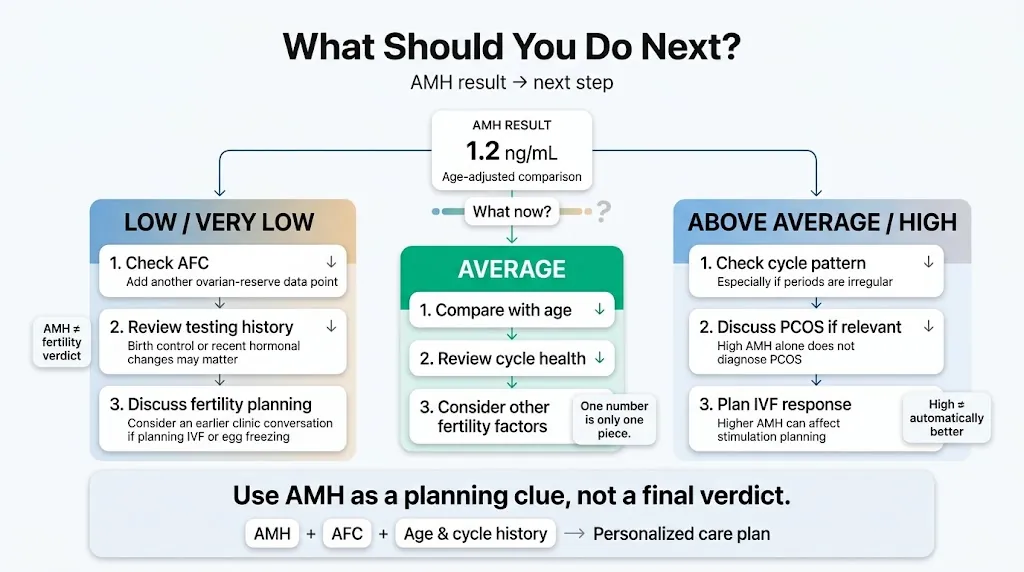
What Should You Do After Checking Your AMH?
Read your broad AMH band and age comparison together. A Low or Very Low broad result may still fall within the middle 50% for your age. Keep the original lab report too, since assay methods and reference intervals can differ.
Match the Result to Your Goal
If you are trying naturally, do not treat AMH as a pregnancy percentage. For IVF or egg freezing, use it as ovarian-response context. Higher AMH may matter for PCOS or excessive stimulation risk, while low AMH alone does not prove infertility.
What to Do Next
Review your AMH value, age at testing, lab range, cycle history, and family-building plans together. If the result affects pregnancy timing, IVF, egg freezing, or PCOS concerns, discuss the full picture with a qualified fertility clinician rather than making decisions from one AMH number.
You Might Also Find These Helpful
Pregnancy & Fertility 45
Pregnancy Risk Calculator Featured
Use this Pregnancy Risk Calculator to check age, BMI, health history, bleeding, and twins. See if closer prenatal monitoring may be worth asking about.
Try calculatorOne Time Pregnancy Calculator
One Time Pregnancy Calculator estimates pregnancy odds from one encounter, plus fertile window timing, test date, due date, and 21-day testing guidance.
Try calculatorBaby Eye Color Calculator
Use the Baby Eye Color Calculator with parents, grandparents, or sibling context to compare Brown, Green/Hazel, and Blue/Grey model estimates instantly.
Try calculatorBasal Body Temperature Calculator
Basal Body Temperature Calculator checks reading conditions and analyzes your temperature pattern for a sustained shift that may be consistent with ovulation.
Try calculatorBPD Gestational Age Calculator
BPD gestational age calculator: estimate fetal age from BPD, compare your week, check normal BPD ranges, and understand ahead or behind results.
Try calculatorChance of Twins Calculator
Calculate odds with the Chance of Twins Calculator. Enter maternal age and history. Find your probability instantly. See if you will conceive multiples now.
Try calculatorConception Calculator
Find out exactly when you conceived. Our free Conception Calculator uses your Due Date, LMP, or Ultrasound to estimate your fertilization date and fertile…
Try calculatorConception Date Due Date Calculator
Use our Conception Date Due Date Calculator to find your baby's arrival date. Enter your conception or intercourse date for clinical 40-week results.
Try calculatorContraceptive Effectiveness Calculator
Contraceptive effectiveness calculator to compare birth control methods, typical vs perfect use, backup protection, and 5-year pregnancy risk.
Try calculatorCRL Calculator
Use this CRL calculator to estimate gestational age and due date from crown-rump length in mm or cm. Compare CRL, LMP, and IVF dating…
Try calculatorFertility Calculator by Age
Estimate your monthly and 12-month pregnancy odds by age, partner age, and cycle dates. See your fertile window and when to seek fertility help.
Try calculatorFundal Height Calculator
Use this fundal height calculator to compare your cm measurement by week, check growth range, estimate baby weight, and know when to ask about…
Try calculatorCommon Mistakes When Using the AMH Calculator
Small input errors change how your AMH result reads, sometimes by a wide margin. Most confusion comes down to units, timing, or reading too much into one number. Here’s what trips people up most.
- Entering a pmol/L value as ng/mL, which turns a normal result into one that looks alarmingly high
- Treating AMH as a pregnancy predictor instead of an ovarian reserve marker
- Interpreting AMH without noting current or recent hormonal contraception, which can lower measured AMH in some people
- Comparing results from two different labs without checking if they used the same assay
- Assuming a high AMH result is automatically good news, even with irregular cycles
Advertisement
Frequently Asked Questions (FAQs)
Can I use the AMH Calculator if my test was taken during my period?
Yes. AMH usually changes much less across the menstrual cycle than hormones such as FSH or estradiol. An AMH blood test can generally be taken during your period or another cycle day. Enter the result, unit, and age you were when the sample was collected.
Why did my AMH change between two blood tests?
AMH results can move up or down between tests. Normal biological variation, different laboratory assays, hormonal medications, and testing conditions can contribute. A higher repeat value does not automatically mean ovarian reserve increased. Large changes are worth reviewing with the laboratory or fertility clinician.
Can I compare AMH results from two different laboratories?
You can enter either result into the AMH Calculator, but avoid treating the difference as a precise change in ovarian reserve. Laboratories may use different AMH assays and reference intervals. When monitoring AMH over time, results from the same laboratory and testing method are easier to compare.
Can AMH increase after a low result?
The measured AMH number can increase on a later blood test, even though ovarian reserve normally declines with age. Test variation, laboratory methods, hormonal contraception, and other factors can affect the measurement. A higher reading should not be treated as proof that more eggs were gained.
Why does the AMH Calculator differ from my lab's reference range?
The calculator uses its own educational bands plus a selected age-reference cohort. Your laboratory may use another assay, population, or reference interval. That can produce different-looking classifications. Use the calculator for added context, while giving the reference range on your original laboratory report priority.
Questions?
We had love to hear from you! Whether you are reporting an issue, suggesting a new calculator, or exploring collaboration opportunities — we are here to help. Every message helps us make 100calc smarter, faster, and more helpful for everyone.
Why People Trust 100calc
At 100calc.com, we focus on accuracy, speed, and trust. Every calculator we create is designed to give reliable, instant, and easy-to-understand results you can truly depend on.