
CRL Calculator: Gestational Age and Due Date from Crown-Rump Length
A CRL calculator estimates gestational age and due date from your baby’s crown-rump length measured during ultrasound. Enter the CRL in mm or cm and the scan date. The calculator converts the measurement into weeks and days using clinical formulas. It can also compare ultrasound dating with LMP and IVF dates.
Many parents worry when ultrasound dates do not match their last period. Small differences are common. Bigger gaps may change the official due date. A CRL measurement between 6 and 14 weeks usually gives the most accurate dating.
This tool helps you find how many weeks pregnant you are, estimate your due date, compare ultrasound and LMP results, and understand whether your baby’s growth follows expected first-trimester ranges. It also highlights the 11 to 14 week Nub Theory window when CRL falls between 45 and 84 mm.
Quick Facts
- Calculates gestational age from CRL in mm or cm.
- Estimates due date using ultrasound measurements.
- Supports Robinson, FMF, and Intergrowth formulas.
- Compares ultrasound dates with LMP using ACOG rules.
- Includes IVF pregnancy mode.
- Updated Jul 4, 2026
- Reviewed by 100Calc Research Team
Clinical First-Trimester Analyzer
CRL & Gestational Age Calculator
Enter your Crown-Rump Length (CRL) measurement to calculate your exact Gestational Age and Due Date (EDD). Compare it against your LMP or IVF dates to find your official clinical timeline.
Gestational Age
Ultrasound Due Date
--Calculated precisely from your CRL measurement.
Clinical Variance Report
Variance report will appear here.
Can CRL Show Baby Sex?
Ultrasound NoteYour CRL is inside the early ultrasound window where some providers may look at the genital tubercle, often called Nub Theory. CRL itself does not show whether the baby is a boy or girl. It only helps estimate gestational age.
- CRL result: Use this measurement for pregnancy dating, not baby sex prediction.
- Nub Theory: This depends on the angle seen on the ultrasound image, not the CRL number alone.
- More reliable options: Later anatomy ultrasound or genetic screening can give clearer sex information.
This card is only a cautious note. Ask your doctor or sonographer before relying on any early sex prediction.
Can CRL tell if the baby is a boy or girl?
Your dynamic answer will appear here.
How is my due date calculated from this measurement?
Your second dynamic answer will appear here.
Medical note: This CRL calculator gives an estimated pregnancy age and due date based on the information you enter. It is not a verified medical result, diagnosis, or replacement for your ultrasound report. Always confirm your CRL result, due date, and pregnancy timeline with your doctor or sonographer.
Explore More Calculators
Use the Chinese Gender Calculator for a traditional boy-or-girl prediction from lunar age and conception month. Enter conception date, due date, or LMP.
Try calculatorUse this fetal growth calculator to check baby weight percentile from ultrasound data in grams, kg, or cm and see what the result means…
Try calculatorEnter gestational sac measurements in mm or cm to calculate mean sac diameter, estimate early gestational age, compare week-by-week milestones, and see when follow-up…
Try calculatorMissed a birth control pill? Check pregnancy risk, protection status, backup contraception needs, and what to do next with our missed pill calculator.
Try calculatorUse our Pregnancy Chance Calculator to estimate your odds. Enter your cycle day, age, and method. Find out if you are in the high-risk…
Try calculatorUse our pregnancy due date calculator to find your exact Baby Due date. IVF, conception, ovulation, and ultrasound methods with weeks and timeline.
Try calculator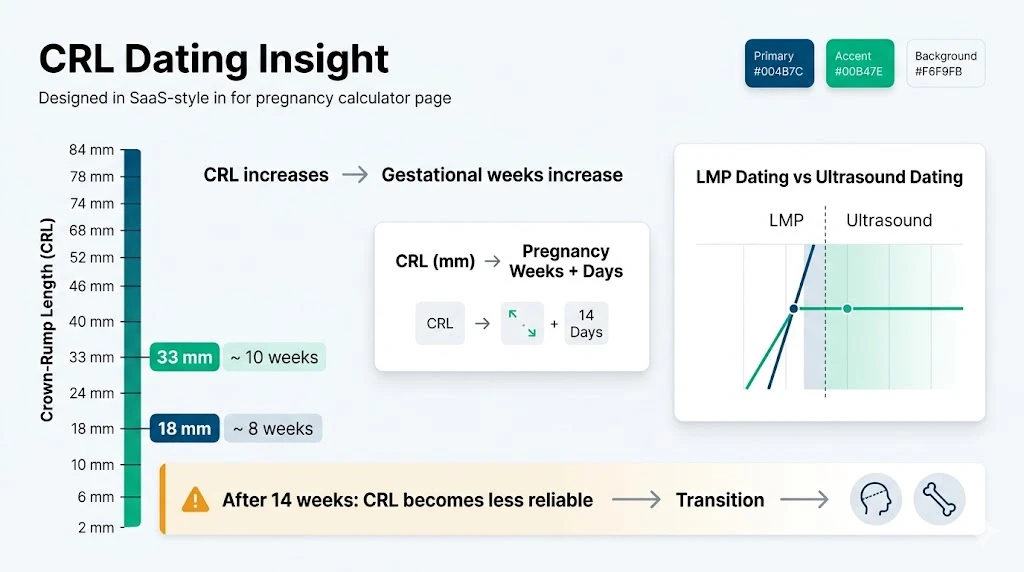
Micro Insight
CRL matters because accurate dating affects prenatal care, screening tests, and due date planning. Small differences are common. Large differences may lead your doctor to adjust the pregnancy timeline.
What Is Crown Rump Length in Pregnancy?
CRL gives doctors a simple way to measure early fetal development. It focuses on the baby’s length rather than weight or head size. That makes it one of the most reliable measurements during the first trimester.
A baby with a CRL of about 18 mm usually measures close to 8 weeks. Around 33 mm often matches 10 weeks. Growth varies slightly between pregnancies, so small differences are normal.
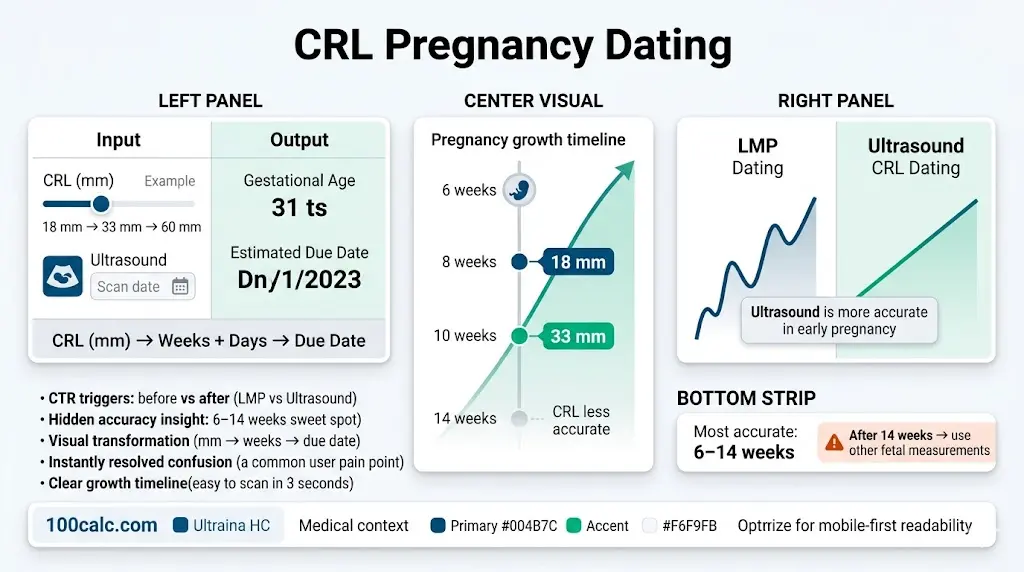
Many parents worry when ultrasound dates differ from their last period. Ovulation timing can shift by several days. Because of this, early ultrasound dating often gives a better estimate of pregnancy age than menstrual dates alone.
Researchers and doctors stop relying on CRL after about 14 weeks. Later scans use other measurements such as head circumference and femur length because babies begin growing at different rates.
What Your Gestational Age from CRL Means
This result shows how far along the pregnancy is based on Crown Rump Length (CRL) measured in early ultrasound. It converts the baby’s length into gestational age in weeks and days. It also helps estimate the expected due date with higher accuracy in the first trimester.
Understanding Your Result
CRL measures the baby from head to bottom. Early pregnancy growth follows a predictable pattern, so even small length changes adjust the pregnancy age.
This number tells how far the pregnancy has progressed, not just the calendar date of the last period. It matters because early ultrasound dating is often more accurate than cycle-based estimates
Is Your Result Good or Bad?
Most CRL-based results fall within a normal early pregnancy range. In most cases, differences of up to 5 to 7 days from your expected date are considered normal.
A slightly higher or lower value does not mean a problem. It usually reflects late ovulation or natural variation in early growth.
A large mismatch may lead doctors to adjust the official due date after repeat scans.
What You Should Do Next
If the CRL result matches your expected timeline, continue routine prenatal care.
If there is a small difference, note the updated gestational age for future scans.
If the difference is larger, confirm the due date during your next ultrasound.
Keep the 11 to 13 week scan schedule for more accurate growth checks and early screening.
Quick Example to Test
CRL shows 9 weeks 4 days.
This means early first-trimester growth is on track. The embryo size matches normal development for this stage. The estimated due date may shift slightly if menstrual dates were unclear.
How to Use the CRL Pregnancy Dating Calculator
This calculator turns your ultrasound data into pregnancy age and due date. It uses Crown-Rump Length (CRL) along with scan date and medical formulas to estimate gestational age. The process is simple and focuses on accurate first-trimester dating used in clinical practice.
Enter Your Ultrasound Date
Start by selecting the exact date of your ultrasound scan. The calculator uses this as the reference point for all timing. It measures how many days have passed or remain based on CRL growth patterns and standard pregnancy dating rules.
Add Your CRL Measurement
Enter the Crown-Rump Length from your ultrasound report. This is the baby’s length from head to bottom. Values are usually given in millimeters, but you can switch to centimeters. The calculator automatically converts units before processing.
Select Measurement Unit
Choose whether your CRL value is in mm or cm. This step avoids errors in calculation. Even a small unit mistake can shift the pregnancy age by several days. The system standardizes everything into millimeters for accurate clinical comparison.
Choose Calculation Mode or Formula
Pick a calculation method like Robinson, FMF, or Intergrowth. These formulas estimate gestational age based on CRL growth curves. Each method is used in medical settings and may produce slightly different but clinically valid results.
View Gestational Age and Due Date
The calculator processes all inputs and shows pregnancy age in weeks and days. It also estimates your due date based on 280-day pregnancy length. The result reflects early ultrasound accuracy and may adjust LMP-based dating if differences are found.
Quick Example to Test
Inputs
- Ultrasound date: August 10, 2026
- CRL: 52 mm
- Unit: mm
- Formula: FMF
Result
- Gestational age: 11 weeks + 5 days
- Estimated due date: February 24, 2027
What happened
The calculator converted CRL into fetal age using FMF growth curves. It then added remaining pregnancy days to estimate the due date. The result aligns with normal first-trimester development range.
Accuracy and Method Behind the CRL Pregnancy Dating Calculator System
Recent user discussions on pregnancy forums and PAA results show a common concern: how accurate CRL-based dating really is compared to LMP. Most medical sources agree that first-trimester ultrasound is the most reliable method. This calculator follows clinical regression models used in early pregnancy scans to estimate gestational age and due date with high consistency during weeks 6 to 14.
Key Features & Benefits
- Uses clinically validated CRL growth models for early pregnancy dating accuracy
- Supports mm and cm input with automatic unit correction to avoid measurement errors
- Compares ultrasound dating with LMP using ACOG discrepancy thresholds
- Includes IVF logic to keep embryo transfer dates medically consistent
- Works best in the 6 to 14 week window where CRL measurement is most stable
Technical Process
Input Capture
The system collects ultrasound date and CRL measurement, then standardizes values into millimeters. It also checks optional inputs like LMP or IVF data for comparison mode activation.
Growth Calculation
Clinical regression formulas process CRL to estimate gestational age in days. The model applies medical growth curves used in early pregnancy ultrasound interpretation.
Result Output
The system converts results into weeks, days, and estimated due date. It also adds clinical comparison logic when LMP or IVF data is present for consistency checks.
What Is a Normal CRL by Week From 6 to 14 Weeks?
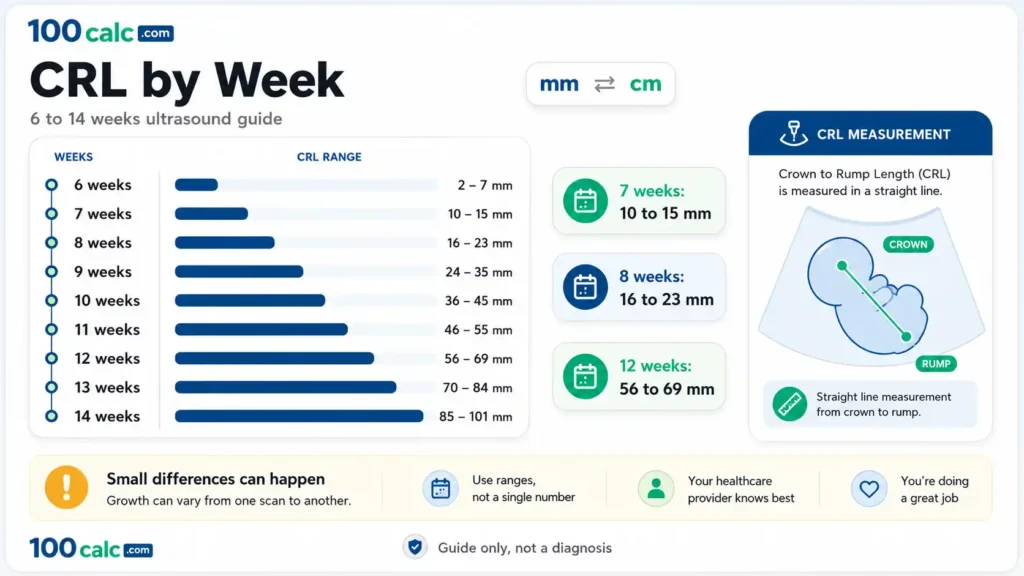
A normal CRL by week shows the usual crown-rump length range seen during early pregnancy ultrasound. This chart helps you compare your CRL in mm or cm before using the CRL calculator for a more exact gestational age and due date estimate.
How do I read a normal CRL chart by week?
Find your pregnancy week, then compare your CRL value with the range in the table. A value near the range usually fits that stage, but your scan date and formula choice can shift the final result by a few days.
| Pregnancy Week | Typical CRL in mm | Typical CRL in cm | What It Usually Means |
|---|---|---|---|
| 6 weeks | 2 to 9 mm | 0.2 to 0.9 cm | Very early visible growth. A repeat scan may give a clearer date. |
| 7 weeks | 10 to 15 mm | 1.0 to 1.5 cm | Early dating is improving. Small date shifts can still happen. |
| 8 weeks | 16 to 23 mm | 1.6 to 2.3 cm | CRL often gives a stronger age estimate than an unclear LMP. |
| 9 weeks | 24 to 32 mm | 2.4 to 3.2 cm | Due date estimates become more stable around this stage. |
| 10 weeks | 33 to 43 mm | 3.3 to 4.3 cm | This is a strong window for first-trimester ultrasound dating. |
| 11 weeks | 44 to 55 mm | 4.4 to 5.5 cm | CRL can help confirm timing for early screening scans. |
| 12 weeks | 56 to 69 mm | 5.6 to 6.9 cm | Many dating and NT screening appointments happen near this stage. |
| 13 weeks | 70 to 84 mm | 7.0 to 8.4 cm | This is near the upper CRL range used by this calculator. |
| 14 weeks | Around 84 mm or higher | Around 8.4 cm or higher | CRL becomes less useful, and doctors may use other fetal measurements. |
Heads-up: CRL ranges are guide values. Small differences can happen because of scan angle, fetal position, formula choice, or ovulation timing. Always use your ultrasound report and clinician review for medical decisions.
What is a normal CRL at 7 weeks?
A normal CRL at 7 weeks is often around 10 to 15 mm. This equals about 1.0 to 1.5 cm on an ultrasound report.
- A slightly lower or higher value can still happen.
- Late ovulation can make LMP dating look ahead of ultrasound dating.
- A follow-up scan may help if the date gap is large.
What is a normal CRL at 8 weeks?
A normal CRL at 8 weeks is often around 16 to 23 mm. This equals about 1.6 to 2.3 cm.
- This is still early pregnancy.
- Small measurement changes can shift the result by several days.
- The calculator gives a more exact estimate because it uses the scan date.
What is a normal CRL at 12 weeks?
A normal CRL at 12 weeks is often around 56 to 69 mm. This equals about 5.6 to 6.9 cm.
- This is a common window for dating and early screening.
- CRL is still useful for gestational age.
- Your ultrasound report should guide final medical interpretation.
Why can my CRL be slightly different from the chart?
CRL can differ because ovulation may not match the assumed LMP date. Scan angle, fetal position, image quality, and formula choice can also change the estimated age by a few days.
Common reasons include:
- Late ovulation
- Irregular periods
- Unclear LMP date
- Different CRL formulas
- Small ultrasound measurement variation
- Scan taken near a week boundary
When should I ask my doctor about my CRL result?
Ask your doctor if your CRL is far outside the expected range for your scan date. A small difference is common, but a large gap may need review with your ultrasound report, heartbeat findings, LMP date, or IVF transfer date.
This chart is a guide only. It does not diagnose a problem, confirm baby sex, or replace clinical advice.
How the CRL Calculator Formula Works (Complete Breakdown)
The CRL calculator uses crown-rump length to estimate gestational age and due date from an early ultrasound. It converts the CRL value into millimeters, applies the selected dating formula, then turns the result into weeks, days, and an ultrasound-based estimated due date.
Formula:
CRL in mm = CRL in cm × 10 Robinson & Fleming: Gestational Age in Days = round((8.052 × √CRL(mm)) + 23.73) Fetal Medicine Foundation: Gestational Age in Days = round(40.9041 + (3.21585 × CRL(mm)^0.5) + (0.348956 × CRL(mm))) Intergrowth-21st: Gestational Age in Days = round((CRL(mm) × 1.037) + 43.8) Weeks = floor(Gestational Age in Days ÷ 7) Days = Gestational Age in Days % 7 Ultrasound EDD = Scan Date + (280 - Gestational Age in Days) LMP EDD = LMP Date + 280 days IVF EDD = Transfer Date - (14 + Embryo Age) + 280 days
What These Formulas Do
This formula turns a CRL measurement into an estimated pregnancy age. The calculator rounds the age to the nearest full day, then shows it as weeks and days.
After that, it uses the scan date to estimate the due date. If LMP or IVF mode is selected, it compares those dates with the ultrasound result.
What Each Formula Variable Means
- CRL → Crown-rump length. This is the ultrasound measurement from the top of the baby’s head to the bottom of the rump. The calculator uses this value in millimeters.
- CRL in cm → The same measurement entered in centimeters. If the user selects cm, the calculator multiplies the number by 10 before using the formula.
- Gestational Age in Days → The estimated pregnancy age on the ultrasound date. This is the main number behind the week and day result.
- Scan Date → The date the ultrasound was done. The calculator uses this date to count forward to the estimated due date.
- Ultrasound EDD → The estimated due date based on CRL and scan date. This is the due date shown in the main result card.
- LMP Date → The first day of the last menstrual period. In ACOG Check mode, this creates an LMP-based due date for comparison.
- LMP EDD → The due date based on the last menstrual period. The calculator compares this with the ultrasound due date.
- Difference in Days → The gap between the ultrasound due date and the LMP due date. If the gap is above the calculator’s threshold, the ultrasound date is shown as the official estimate.
- Embryo Age → The embryo stage used in IVF mode. The calculator supports Day 3 and Day 5 transfer values.
- Transfer Date → The embryo transfer date in IVF mode. This helps create an IVF-based due date for comparison.
Another Example Calculation (Step-by-Step)
This example shows how the CRL calculator estimates pregnancy age and due date from one early ultrasound measurement. It uses the same Robinson & Fleming formula selected by default in the calculator.
Given:
- CRL = 3.2 cm
- Unit = cm
- Scan Date = September 15, 2026
- Formula = Robinson & Fleming
Calculation:
The calculator changes 3.2 cm into millimeters.
CRL in mm = 3.2 × 10 CRL in mm = 32 mm Gestational Age = round((8.052 × √32) + 23.73) √32 = 5.6569 Gestational Age = round((8.052 × 5.6569) + 23.73) Gestational Age = round(45.54 + 23.73) Gestational Age = round(69.27) Gestational Age = 69 days
Now convert days into weeks.
69 ÷ 7 = 9 weeks + 6 days
Now calculate the ultrasound due date.
Ultrasound EDD = September 15, 2026 + (280 - 69 days) Ultrasound EDD = September 15, 2026 + 211 days Ultrasound EDD = April 14, 2027
Result:
- Gestational Age: 9 weeks + 6 days
- Ultrasound Due Date: April 14, 2027
Meaning:
A CRL of 3.2 cm equals 32 mm. With the Robinson & Fleming formula, this matches about 9 weeks and 6 days of pregnancy on the scan date. The due date is an estimate, not a final medical decision.
How do you calculate gestational age from CRL?
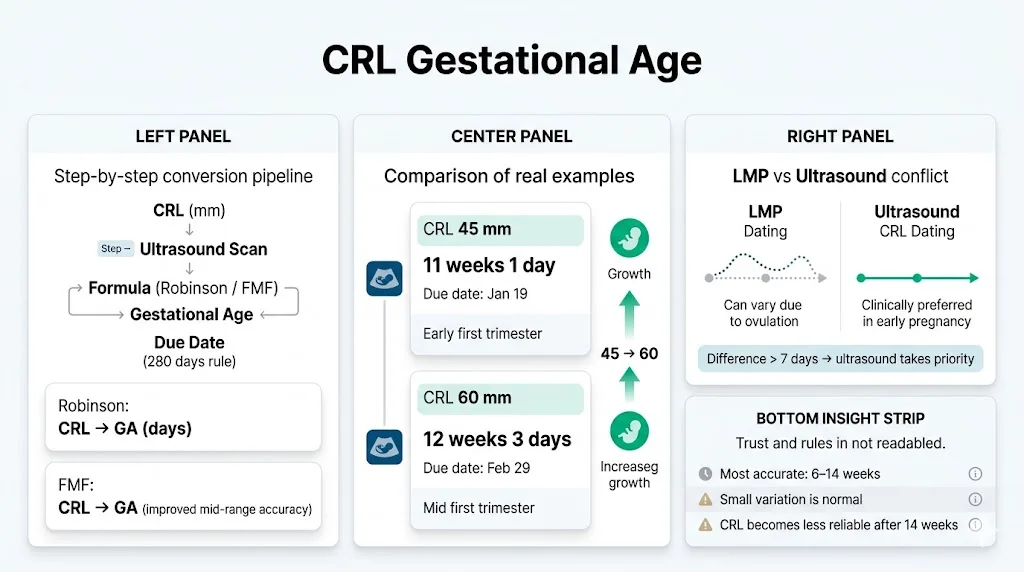
Gestational age from CRL is calculated by measuring the embryo’s crown-rump length on ultrasound and applying clinical regression formulas. These formulas convert CRL into days of pregnancy, then into weeks. The due date is estimated by subtracting gestational age from 280 days, which represents a full-term pregnancy timeline.
What is the gestational age for CRL 45 mm at 11 weeks?
A CRL of 45 mm usually corresponds to early second month pregnancy. The calculator uses the Robinson formula to convert this measurement into gestational age. It then estimates how many days remain until the standard 280-day pregnancy cycle completes to determine the due date.
Input
- CRL: 45 mm
- Ultrasound date: July 1
- Formula: Robinson & Fleming
Process
- √45 = 6.708
- GA = (8.052 × 6.708) + 23.73
- GA = 77.74 days ≈ 78 days
- 78 days = 11 weeks 1 day
- Due date = January 19
Result
- Gestational age: 11 weeks 1 day
- Due date: January 19
Meaning
This result shows normal early fetal growth. CRL is within expected range, so dating is reliable. Small variation of a few days is normal in ultrasound-based pregnancy tracking.
What is the gestational age for CRL 60 mm?
Given:
- CRL = 60 mm
- Scan Date = August 20, 2026
- Formula = Fetal Medicine Foundation
Calculation:
- Gestational Age = round(40.9041 + (3.21585 × 60^0.5) + (0.348956 × 60))
- Gestational Age = round(86.74)
- Gestational Age = 87 days
Convert to weeks and days:
87 days = 12 weeks + 3 days
Due date calculation:
- Ultrasound EDD = August 20, 2026 + (280 – 87 days)
- Ultrasound EDD = August 20, 2026 + 193 days
- Ultrasound EDD = March 1, 2027
Result:
- Gestational Age: 12 weeks + 3 days
- Ultrasound Due Date: March 1, 2027
Meaning:
A CRL of 60 mm using the FMF formula matches about 12 weeks and 3 days on the ultrasound date. Since 2027 is not a leap year, the correct due date is March 1, 2027.
What happens if LMP and ultrasound dates differ?
This case happens often in real pregnancy scans. The calculator compares LMP-based dating with CRL-based ultrasound dating using ACOG rules. If the difference crosses a safe threshold, ultrasound dating becomes the official reference.
Input
- LMP vs ultrasound difference: 9 days
- CRL-based gestational age: varies
Process
- Difference checked against ACOG limit
- Over 7 days difference after 9 weeks
- Ultrasound dating takes priority
Result
- Due date updated based on CRL
- Final gestational age follows ultrasound
Meaning
This adjustment improves accuracy. LMP can shift due to late ovulation. CRL-based ultrasound dating is more precise in early pregnancy.
Quick Rules to Remember
CRL is most accurate between 6 and 14 weeks. Small differences between scan and LMP are normal. Larger gaps usually mean ovulation happened later than expected. The calculator uses medical standards to adjust dating automatically so results match real clinical practice.
CRL Pregnancy Dating Result Benchmarks Explained
CRL result benchmarks help you understand whether your gestational age and pregnancy stage are early, normal, or advanced. The CRL pregnancy dating calculator uses ultrasound-based ranges to classify fetal growth. These ranges make it easier to compare your result with typical clinical patterns used in early pregnancy scans.
| CRL Range | Label | USA Guideline | Global Clinical Reference | Notes |
|---|---|---|---|---|
| 2–10 mm | Early Stage | Typical 6–7 weeks ultrasound range in early scans | First visible embryonic growth phase | Very early pregnancy. Dating accuracy improves with follow-up scan |
| 11–25 mm | Normal First Trimester | Common 7–9 weeks range used for official dating | Standard CRL-based gestational confirmation range | Most accurate window for pregnancy dating decisions |
| 26–44 mm | Rapid Growth Phase | Usually 9–11 weeks in routine ultrasound reports | Fast fetal development stage before second trimester | Small differences may adjust due date slightly |
| 45–84 mm | Nub Theory Window | About 11–14 weeks in clinical practice | Peak CRL measurement window for early anatomy scan | Best stage for dating accuracy and early screening |
| Above 84 mm | Less Accurate | 14+ weeks, switch to BPD or HC measurements | Second trimester growth tracking phase | CRL becomes less reliable for dating after this point |
Heads-up: CRL accuracy is highest in the first trimester. After 14 weeks, doctors usually rely on head and abdominal measurements instead of CRL for dating.
Interpretation
Most users fall in the 11–25 mm or 26–44 mm range, which represents normal early pregnancy growth. If your result is within 45–84 mm, it means you are in the key ultrasound window where dating and early screening are most accurate. Above 84 mm, CRL is no longer the primary method for pregnancy dating.
Pro Tip
If your CRL is near a range boundary, don’t worry about small differences. Even a 1–2 mm variation can shift results by several days. Follow-up scans give the most reliable final dating.
How to Improve Your CRL Calculator Result (Next Steps Guide)
Your CRL calculator result helps you understand how far the pregnancy has progressed and whether growth matches expected patterns. The next step is acting on that information. Depending on your range, you may only need reassurance or a closer clinical review. These insights help you respond correctly without confusion or unnecessary stress.
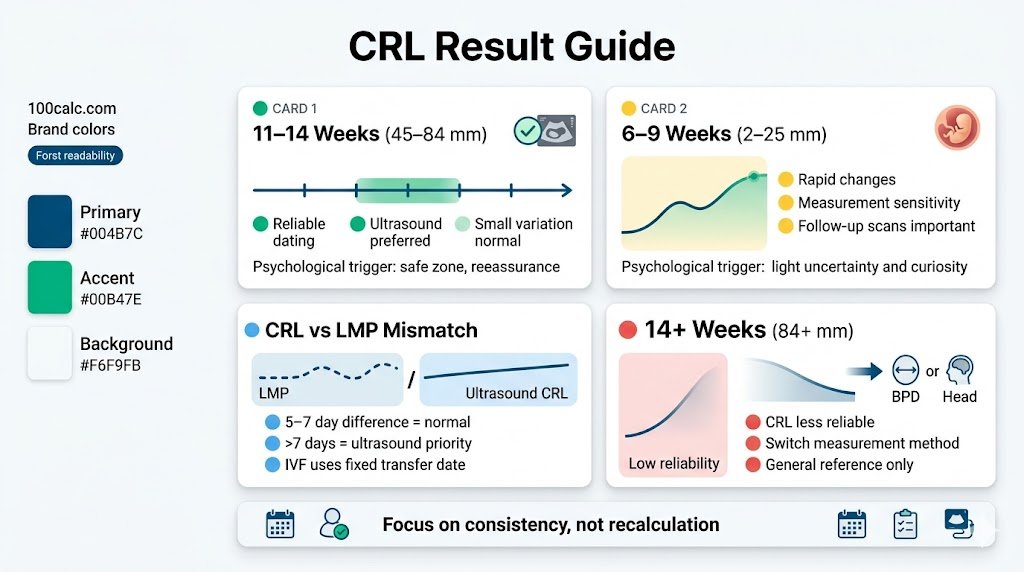
For High Accuracy Results (11–14 weeks, CRL 45–84 mm range)
Results in this range usually show normal first-trimester growth and reliable dating. This is also the most stable CRL window for due date estimation.
At this stage, keep ultrasound timing consistent and avoid re-checking dates too often unless your provider suggests it. If LMP and ultrasound differ slightly, trust the ultrasound more because CRL accuracy is highest here. For IVF pregnancies, always follow transfer-based dating instead of ultrasound shifts.
Small variations are normal and do not usually require action unless advised by a clinician.
For Early Pregnancy Results (6–9 weeks, CRL 2–25 mm range)
This range reflects early development where small measurement changes can shift results more noticeably. Dating is still reliable, but minor differences between scans are common.
Make sure CRL is entered correctly in millimeters or centimeters to avoid errors. Keep follow-up scans as scheduled because growth confirmation is important at this stage. If LMP and scan dates differ, follow ACOG rules where ultrasound becomes more reliable after a certain threshold.
Consistency in tracking matters more than adjusting expectations too often.
For Mixed or Discrepant Results (CRL vs LMP or IVF mismatch)
When ultrasound dating does not match LMP or IVF timing, the system highlights a possible discrepancy. This is common in irregular cycles or late ovulation.
If the difference is small, usually under 5–7 days, no change is needed. Larger gaps may require using ultrasound-based dating as the primary reference. In IVF cases, always prioritize embryo transfer timing since it is medically fixed.
Avoid recalculating repeatedly. Focus on confirmed clinical guidance instead.
For Late or Reduced Reliability Range (Above 84 mm or 14+ weeks)
At this stage, CRL becomes less accurate for dating because fetal growth shifts to other measurements like BPD or head circumference. The calculator still provides an estimate, but clinical reliance decreases.
If your result falls here, consider it a general reference rather than a precise dating tool. Doctors typically switch to second-trimester measurements for accuracy. No need for frequent CRL recalculations after this point.
A single confirmed ultrasound is more reliable than repeated estimations.
You Might Also Find These Helpful
Pregnancy & Fertility 45
Use this Pregnancy Risk Calculator to check age, BMI, health history, bleeding, and twins. See if closer prenatal monitoring may be worth asking about.
Try calculatorOne Time Pregnancy Calculator estimates pregnancy odds from one encounter, plus fertile window timing, test date, due date, and 21-day testing guidance.
Try calculatorUse the AMH Calculator to convert ng/mL or pmol/L, compare your result with age-based data, and see what it may mean for IVF, fertility,…
Try calculatorUse the Baby Eye Color Calculator with parents, grandparents, or sibling context to compare Brown, Green/Hazel, and Blue/Grey model estimates instantly.
Try calculatorBasal Body Temperature Calculator checks reading conditions and analyzes your temperature pattern for a sustained shift that may be consistent with ovulation.
Try calculatorBPD gestational age calculator: estimate fetal age from BPD, compare your week, check normal BPD ranges, and understand ahead or behind results.
Try calculatorCalculate odds with the Chance of Twins Calculator. Enter maternal age and history. Find your probability instantly. See if you will conceive multiples now.
Try calculatorFind out exactly when you conceived. Our free Conception Calculator uses your Due Date, LMP, or Ultrasound to estimate your fertilization date and fertile…
Try calculatorUse our Conception Date Due Date Calculator to find your baby's arrival date. Enter your conception or intercourse date for clinical 40-week results.
Try calculatorContraceptive effectiveness calculator to compare birth control methods, typical vs perfect use, backup protection, and 5-year pregnancy risk.
Try calculatorEstimate your monthly and 12-month pregnancy odds by age, partner age, and cycle dates. See your fertile window and when to seek fertility help.
Try calculatorUse this fundal height calculator to compare your cm measurement by week, check growth range, estimate baby weight, and know when to ask about…
Try calculatorCommon Mistakes When Using the CRL Calculator
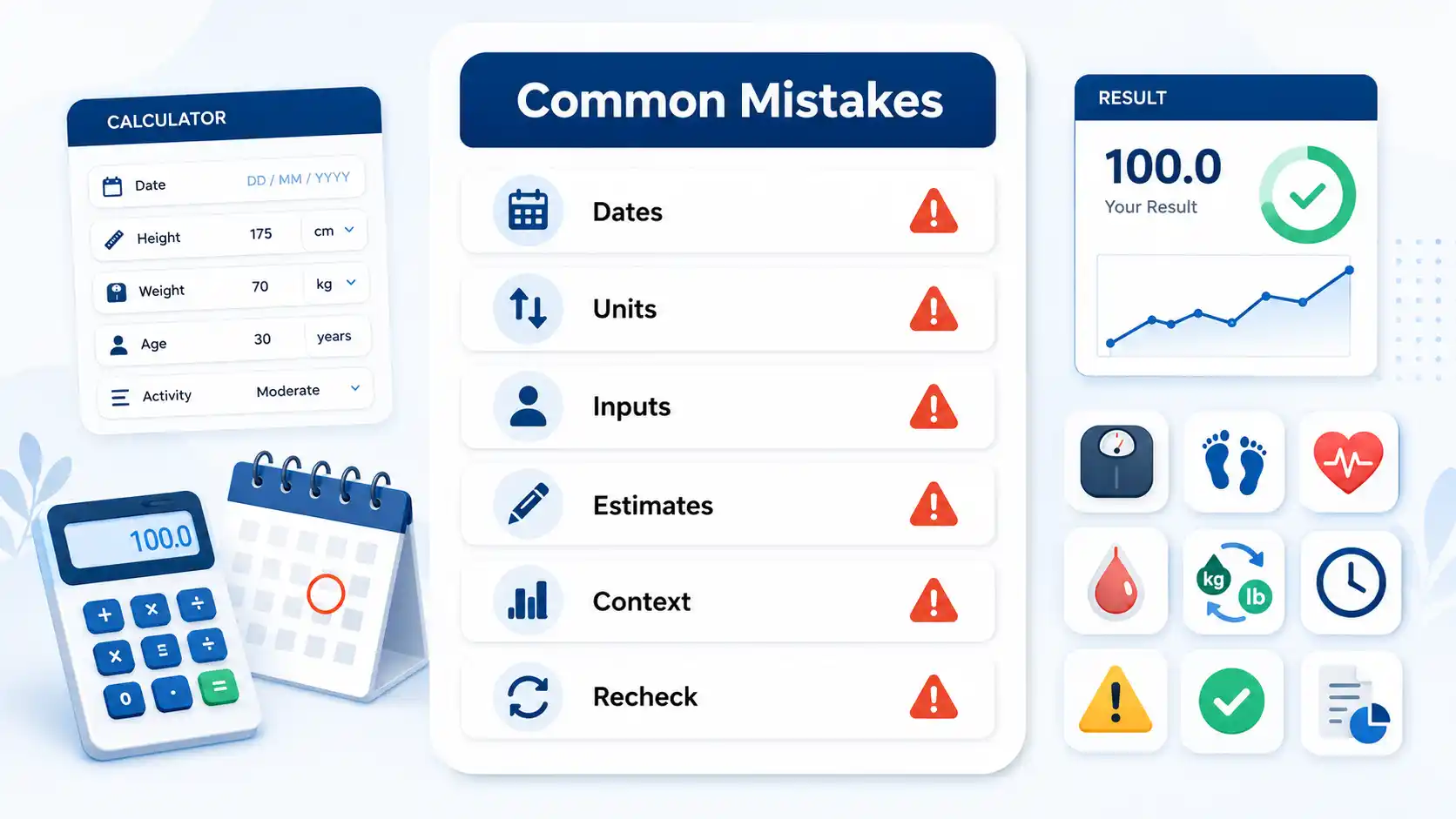
Many users get slightly off results because of simple input errors or confusion between medical terms. CRL-based pregnancy dating is highly accurate, but only when values and timing are entered correctly. Small mistakes like unit mix-ups or wrong scan dates can shift results and create confusion about weeks and due dates.
- Mixing up millimeters and centimeters when entering CRL values
- Entering incorrect adherence level by overestimating real-life consistency of use
- Using CRL measurements above 84 mm for early pregnancy dating
- Entering an incorrect ultrasound scan date instead of the actual test date
- Confusing gestational age with conception age during interpretation
- Assuming the estimated due date is exact rather than a clinical approximation
Frequently Asked Questions (FAQs)
What is a CRL calculator?
A CRL calculator estimates gestational age and due date using crown-rump length measured during an early ultrasound. It converts embryo size into pregnancy weeks and expected delivery timing. This helps doctors and users understand early pregnancy progress more accurately than LMP-based dating.
How is CRL measured during an ultrasound?
CRL is measured from the top of the embryo’s head to its bottom using ultrasound imaging. It is taken in a straight line and recorded in millimeters. This measurement is most accurate in early pregnancy when the fetus is small and clearly visible.
Is CRL based on last menstrual period (LMP)?
CRL is not based on LMP. It comes directly from ultrasound measurements of embryo size. LMP only estimates pregnancy timing based on cycle dates, while CRL provides biological growth data, which is usually more accurate in early pregnancy dating.
What CRL value is normal at 7 weeks?
At 7 weeks, CRL is usually between 7 mm and 10 mm depending on fetal growth variation. Small differences are normal because early development can vary slightly from pregnancy to pregnancy. Doctors use this range to confirm expected growth patterns.
Can CRL tell if it’s a boy or girl?
CRL cannot determine the baby’s sex. It only measures size and growth during early pregnancy. Gender prediction requires later ultrasound signs like Nub Theory or genetic testing. CRL is strictly used for dating and developmental tracking, not sex identification.
What CRL value matches 12 weeks of pregnancy?
At around 12 weeks, CRL is typically between 55 mm and 65 mm. This range helps confirm normal fetal growth and estimate a reliable due date. Small variations are common and usually not a concern if overall growth is consistent.
Why can CRL and LMP dates be different?
CRL and LMP dates often differ because ovulation does not always happen on day 14 of the cycle. Ultrasound measures actual growth, while LMP estimates timing. Small differences are normal, and CRL is usually considered more accurate in early pregnancy dating.
Does CRL change the due date?
Yes, CRL can adjust the estimated due date if ultrasound timing differs from LMP. Doctors often rely on CRL in early pregnancy because it reflects actual fetal growth. The due date is still an estimate and may slightly change with later scans.
Questions?
We had love to hear from you! Whether you are reporting an issue, suggesting a new calculator, or exploring collaboration opportunities — we are here to help. Every message helps us make 100calc smarter, faster, and more helpful for everyone.
Why People Trust 100calc
At 100calc.com, we focus on accuracy, speed, and trust. Every calculator we create is designed to give reliable, instant, and easy-to-understand results you can truly depend on.