
One Time Pregnancy Calculator: Pregnancy Odds From One Encounter
The One Time Pregnancy Calculator estimates the chance of pregnancy from one encounter. It uses your last menstrual period, cycle length, encounter date, and age range. The tool estimates ovulation, checks how close the encounter was to your fertile window, then shows your odds, test dates, possible due date, and pregnancy timeline if conception happened.
One date can change the answer. Sex on ovulation day is not the same as sex two days late. If your period is coming, your app guessed wrong, or the condom failed, the timing matters more than the story.
Enter your dates to see a clear percentage, early test date, missed-period test date, EDD, and how many days pregnant you may be. Treat it as an estimate, not proof. A pregnancy test gives the answer.
Quick Facts
- Highest possible one-time odds: 33%, on ovulation day or the day before
- Sperm survives up to 5 days inside the body
- The egg survives only 12 to 24 hours after release
- One day of bad timing can drop your odds by more than half
- Age lowers baseline odds gradually, starting around the mid-30s
- Updated Sep 26, 2026
- Reviewed by 100Calc Research Team
Conception Probability & Dating
One Time Pregnancy Calculator
Estimate your one-time pregnancy chance by percentage from a single encounter. See your conception probability, fertile window timing, earliest pregnancy test date, estimated due date, and how many days pregnant you may be if conception happened.
One-Time Conception Probability
--%
Your statistical probability based on timing and age will appear here.
The Biological Breakdown
Sperm survival and ovulation timing data will appear here to explain your percentage.
"If Pregnant" Gestational Timeline
If this single encounter resulted in conception, here is your exact pregnancy timeline based on standard LMP calculation.
Next Steps & Testing Plan
Short answer
A direct answer based on your inputs will appear here.
What are the odds you get pregnant from one time?
Your dynamic probability answer regarding sperm survival and ovulation timing will appear here.
How is pregnancy calculated if I only had intercourse once?
Your dynamic explanation regarding standard LMP dating versus single-encounter dating will appear here.
Important: This calculator estimates pregnancy chance from the dates you enter, but it cannot confirm or rule out pregnancy and should not be used as medical advice. If the encounter was unprotected, the condom broke, withdrawal failed, or contraception was missed, use our Pregnancy After Unprotected Intercourse Calculator to check how the timing relates to ovulation, whether emergency contraception may still be time-sensitive, and when to take a pregnancy test. Some emergency-contraception options can be used up to 5 days after unprotected sex, depending on the method, timing, and individual circumstances. If pregnancy prevention matters, seek advice from a pharmacist, doctor, or sexual-health service as soon as possible rather than relying on a pregnancy-risk estimate alone.
Explore More Calculators
Use the Chinese Gender Calculator for a traditional boy-or-girl prediction from lunar age and conception month. Enter conception date, due date, or LMP.
Try calculatorUse this fetal growth calculator to check baby weight percentile from ultrasound data in grams, kg, or cm and see what the result means…
Try calculatorEnter gestational sac measurements in mm or cm to calculate mean sac diameter, estimate early gestational age, compare week-by-week milestones, and see when follow-up…
Try calculatorMissed a birth control pill? Check pregnancy risk, protection status, backup contraception needs, and what to do next with our missed pill calculator.
Try calculatorUse our Pregnancy Chance Calculator to estimate your odds. Enter your cycle day, age, and method. Find out if you are in the high-risk…
Try calculatorUse our pregnancy due date calculator to find your exact Baby Due date. IVF, conception, ovulation, and ultrasound methods with weeks and timeline.
Try calculatorUse this Pregnancy Risk Calculator to check age, BMI, health history, bleeding, and twins. See if closer prenatal monitoring may be worth asking about.
Try calculatorUse the AMH Calculator to convert ng/mL or pmol/L, compare your result with age-based data, and see what it may mean for IVF, fertility,…
Try calculatorUse the Baby Eye Color Calculator with parents, grandparents, or sibling context to compare Brown, Green/Hazel, and Blue/Grey model estimates instantly.
Try calculatorBasal Body Temperature Calculator checks reading conditions and analyzes your temperature pattern for a sustained shift that may be consistent with ovulation.
Try calculatorBPD gestational age calculator: estimate fetal age from BPD, compare your week, check normal BPD ranges, and understand ahead or behind results.
Try calculatorCalculate odds with the Chance of Twins Calculator. Enter maternal age and history. Find your probability instantly. See if you will conceive multiples now.
Try calculator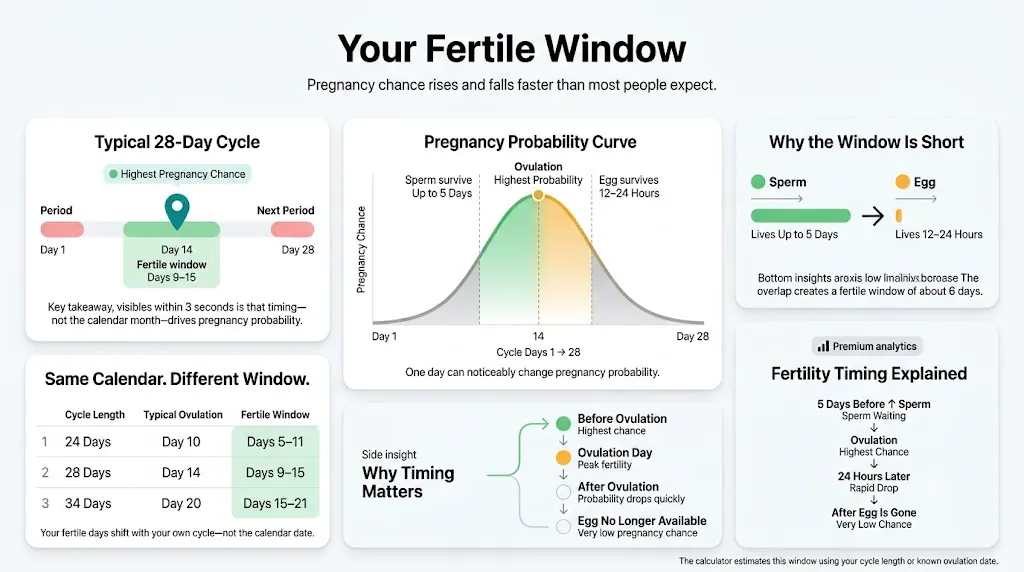
Micro Insight
Odds don’t drop evenly across these days. They rise sharply near ovulation, then fall off fast once the egg is gone. That’s why one day of timing can swing a result more than age, health, or anything else entered into the calculator.
What Is a Fertile Window?
Most people assume pregnancy risk is spread evenly across the month. It isn’t. Out of a full 28 to 30 day cycle, only around six or seven days carry any real chance of conception.
Here’s why the window is so narrow. Sperm can survive inside the body for up to five days, waiting for an egg. The egg itself only lasts around 12 to 24 hours after release. That mismatch is what shapes the entire window.
Think of it like catching a flight with a five-day boarding period but a one-day departure. Arrive early and you can still make it. Arrive even one day late, and the gate has already closed. That’s the biological reality behind every percentage this calculator shows.
Cycle length shifts where this window falls. A 24-day cycle and a 34-day cycle won’t share the same fertile days, even if both started counting from day one. Ovulation timing, not the calendar date, is what actually sets the window.
What Your Conception Chance Means
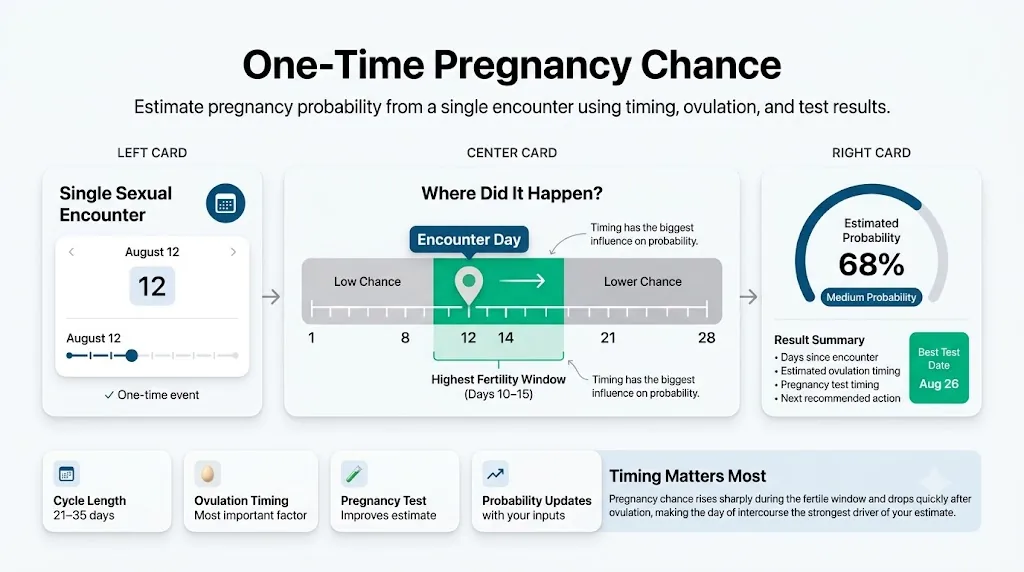
Your percentage is not a prediction. It is a timing score, built from where your encounter fell against ovulation and your age bracket.
Understanding Your Result
This number mainly reflects how close your encounter landed to the fertile window. Age adjusts the estimate, and real-life factors like irregular ovulation, emergency contraception, or uncertain dates can change the actual risk.
A high percentage means your timing overlapped with the days sperm and egg were both viable. A low percentage means that overlap was thin or missing. Age then adjusts the final number up or down, since fertility shifts gradually with age.
Is Your Result Good or Bad?
There’s no universal “good” score here. Context decides that.
Anything from 20% to 33% sits in the peak range this model produces. That’s the ceiling for a single encounter, not a guarantee.
Results between 5% and 19% still fall inside the fertile window, just further from the peak. Under 5% means timing landed near the edges, where sperm survival is doing most of the work.
A 0% result means the encounter fell outside the six to seven day window entirely. Pregnancy from that specific encounter is not likely, based on timing alone.
What You Should Do Next
- Above 20%: Test on the date the calculator shows. Testing earlier risks a false negative, even with strong odds.
- 5% to 19%: Watch for early symptoms and stick to the missed-period test date for the clearest read.
- Under 5%: Low odds from this encounter don’t rule out pregnancy from a different cycle event. Track your next period date closely.
- Any result: If your period is late past the date shown, test again regardless of your percentage. Cycles shift, and real ovulation doesn’t always match the estimate.
Example: One-Time Pregnancy Chance After Ovulation
Inputs:
- LMP: May 5
- Average Cycle Length: 30 days
- One-Time Encounter Date: May 22
- Age Range: 30 to 34
Calculation:
- Next Expected Period = May 5 + 30 days
- Next Expected Period = June 4
- Estimated Ovulation Day = June 4 – 14 days
- Estimated Ovulation Day = May 21
- Encounter Timing = May 22 – May 21
- Encounter Timing = 1 day after estimated ovulation
- Base Probability = 11%
- Age Adjustment for 30 to 34 = 0.85
- Final Pregnancy Chance = 11 × 0.85
- Final Pregnancy Chance = 9.35%
Displayed Result:
- Estimated One-Time Pregnancy Chance: 9%
Meaning:
This result falls in the moderate range used by the calculator, not the low single-digit range. The encounter happened one day after estimated ovulation, when the egg may already be breaking down. That lowers the chance compared with sex on ovulation day or the day before.
A 9% result does not confirm pregnancy, and it does not rule it out either. It means this one encounter had possible but reduced timing. The best next step is to test on the missed-period date shown by the calculator. If the period date is unclear, wait at least 21 days after the encounter before testing.
How to Use the One Time Pregnancy Calculator
The calculator turns four inputs into a real conception score. Here’s what happens at each step, and why it matters.
Set Your Cycle Start
Add the first day of your last period. This date anchors the whole calculation. Ovulation, the fertile window, and your entire timeline all get built from this one point.
Add Your Cycle Length
Enter your average cycle length, between 21 and 45 days. The calculator uses this to project when your next period would start, then works backward to estimate ovulation.
Pick the Encounter Date
Choose the exact date of the single encounter you're checking. This is the number that matters most. The gap between this date and your ovulation day drives your entire result.
Select Your Age Range
Pick the bracket that fits you. Fertility odds shift gradually with age, so this adjusts your final percentage up or down based on real research ranges.
Get Your Full Result
Hit calculate. The tool measures how many days your encounter fell from ovulation, checks that gap against clinical odds, then applies your age adjustment. If timing landed in the fertile window, you also get a due date, implantation window, and exact test dates.
Quick Example: Implantation Window From LMP
Try this: last period April 3, cycle length 27 days, encounter April 17, age under 25.
Ovulation lands around April 16, one day before the encounter. That puts the offset at plus one day, right at the edge of the fertile window. Odds sit in the moderate range here, since the egg’s short lifespan starts working against the timing.
Run those numbers and the calculator also shows a suggested test date, based on 10 days past ovulation. That’s the checkpoint worth watching, not the calendar date of the encounter itself.
How the One Time Pregnancy Calculator Gets Its Accuracy
This tool doesn’t guess. It uses the Wilcox fertility window model, real clinical data mapping conception odds to each day relative to ovulation, layered with age based fertility multipliers from established reproductive research. Your result reflects population level science, applied to your exact timing.
Key Features & Benefits
- Day-by-day odds, not a flat monthly average
- Age-adjusted probability, not one-size-fits-all
- Automatic due date and trimester timeline if conception is likely
- Exact test-day recommendations, no guesswork
- Built on peer-reviewed fertility window data
Technical Process
Find Ovulation
Works out your likely ovulation day using your period date and cycle length.
Score Timing
Measures the gap between your encounter and ovulation, checks it against clinical odds.
Adjust for Age
Applies an age-based multiplier since fertility shifts gradually over time.
How the One Time Pregnancy Calculator Formula Works (Complete Breakdown)
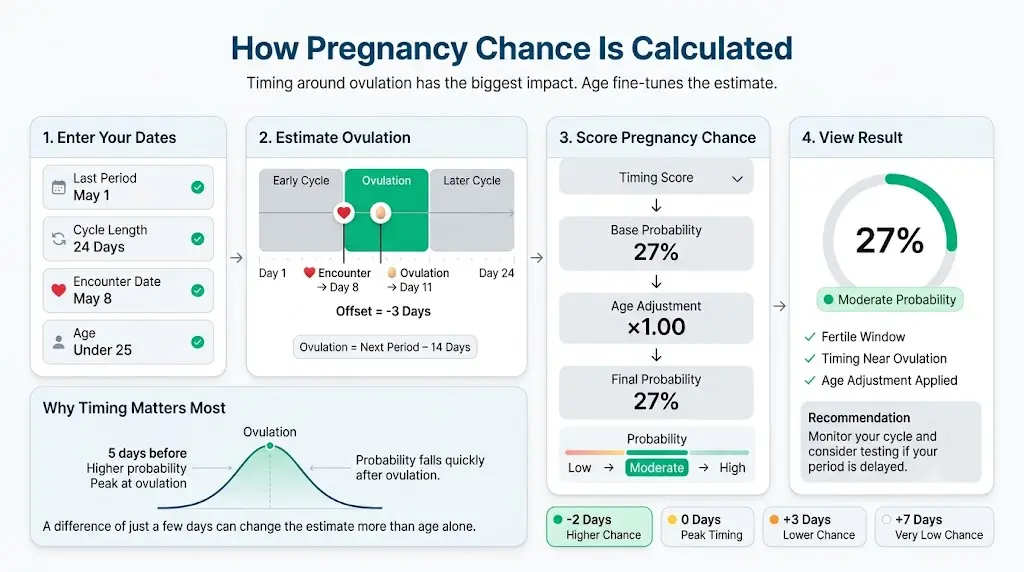
The calculator finds your likely ovulation day, then measures how far your encounter fell from it. That gap gets scored against real fertility data, and your age adjusts the final number. Here’s the exact math behind your result.
One Time Pregnancy Calculator Formula
Formula:
					Ovulation Day = (LMP + Cycle Length) - 14 Days
Offset = Encounter Date - Ovulation Day
Base Probability = Wilcox Table Value for Offset
Final Probability = Base Probability x Age Multiplier
What These Formulas Do
The math works backward from your next expected period to find ovulation. Once ovulation is set, the calculator checks how many days your encounter fell before or after it.
That gap decides your base odds, pulled from real fertility research. Age then trims or holds that number, since fertility shifts gradually over time.
Understanding the Formula Variables
LMP (Last Menstrual Period)
The first day of your most recent period. Every other date in this calculator, ovulation, due date, test day, counts forward from this single point.
Cycle Length
Your average number of days from one period to the next. The calculator accepts 21 to 45 days, which covers short, average, and longer natural cycles.
Offset
The number of days between your encounter and ovulation. A negative number means the encounter happened before ovulation. A positive number means it happened after.
Base Probability
The clinical odds tied to your exact offset, pulled from fertility window research. This ranges from 10% five days before ovulation up to 33% right at ovulation.
Age Multiplier
A adjustment factor based on your age bracket, running from 1.00 under age 25 down to 0.40 at 40 and older. This reflects gradual, natural shifts in fertility over time.
Another Example Calculation (Step-by-Step)
Let’s run the formula with a different set of numbers. This shows how a shorter cycle and an older age bracket both pull the result down.
Given:
- Last Period Date: February 10
- Cycle Length: 25 Days
- Encounter Date: February 21
- Age Range: 35-39
Calculation:
					Next Period = Feb 10 + 25 Days = March 7
Ovulation Day = March 7 - 14 Days = Feb 21
Offset = Feb 21 - Feb 21 = 0 Days
Base Probability = 33%
Age Multiplier (35-39) = 0.65
Final Probability = 33 x 0.65 = 21%
Result:
- Offset: 0 Days (Ovulation Day)
- Final Probability: 21%
- Status: Moderate to High Range
Meaning:
This encounter landed right on ovulation day, the strongest timing this model recognizes. A shorter 25 day cycle pushed ovulation earlier in the month compared to a standard 28 day cycle.
The age multiplier trimmed the base 33% down to 21%, showing how perfect timing still gets balanced against natural age-related fertility decline. This result sits in the moderate to high range, worth testing on the calculator’s suggested date rather than guessing early.
How Do You Calculate One Time Pregnancy Chances?
You calculate it by comparing your encounter date to your estimated ovulation day. The calculator adds your cycle length to your last period date to find ovulation, checks how many days apart your encounter fell, then adjusts the odds for your age. That gap decides everything.
Can you get pregnant from sex right after your period ends?
This is one of the most common one time pregnancy questions, especially with shorter cycles.
Input
- Last Period Date: May 1
- Cycle Length: 24 days
- Encounter Date: May 8
- Age Range: Under 25
Process
- Next Period = May 1 + 24 Days = May 25
- Ovulation Day = May 25 – 14 Days = May 11
- Offset = May 8 – May 11 = -3 Days
- Base Probability = 27%
- Age Multiplier = 1.00
- Final Probability = 27 x 1.00 = 27%
Result
- Final Probability: 27%
- Status: Moderate to High Range
Meaning
A short 24 day cycle pushes ovulation closer to the end of your period than most people expect. Sex right after your period can still fall inside the fertile window if your cycle runs short.
What are the odds of getting pregnant a few days before your period is due?
A lot of people assume this stretch of the cycle is safe. The math usually says otherwise.
Input
- Last Period Date: April 1
- Cycle Length: 21 days
- Encounter Date: April 19
- Age Range: 25-29
Process
- Next Period = April 1 + 21 Days = April 22
- Ovulation Day = April 22 – 14 Days = April 8
- Offset = April 19 – April 8 = +11 Days
- Base Probability = 0% (Outside Fertile Window)
- Final Probability = 0%
Result
- Final Probability: 0%
- Status: Outside Fertile Window
Meaning
Eleven days past ovulation is far outside the range where sperm and egg can meet. Sex right before your period lands well past the fertile window in most cycles, which is why odds drop to zero here.
What if your cycle is long or irregular?
People with long or unpredictable cycles often assume the standard fertile window rules don’t apply to them.
Input
- Last Period Date: January 1
- Cycle Length: 40 days
- Encounter Date: January 20
- Age Range: 30-34
Process
- Next Period = January 1 + 40 Days = February 10
- Ovulation Day = February 10 – 14 Days = January 27
- Offset = January 20 – January 27 = -7 Days
- Final Probability = 1% (Extended Survival Edge Case)
Result
- Final Probability: 1%
- Status: Low Probability, Edge of Sperm Survival
Meaning
Seven days before ovulation sits right at the outer edge of how long sperm can survive. The odds are low but not zero, which is why long or irregular cycles still carry some risk even a week out from ovulation.
Do the odds change for a one time encounter in your late 30s?
Age comes up constantly in one time pregnancy searches, especially past 35.
Input
- Last Period Date: October 1
- Cycle Length: 28 days
- Encounter Date: October 13
- Age Range: 35-39
Process
- Next Period = October 1 + 28 Days = October 29
- Ovulation Day = October 29 – 14 Days = October 15
- Offset = October 13 – October 15 = -2 Days
- Base Probability = 31%
- Age Multiplier = 0.65
- Final Probability = 31 x 0.65 = 20%
Result
- Final Probability: 20%
- Status: Moderate Range
Meaning
Two days before ovulation is strong timing on paper. The age multiplier still trims a third off the base odds, showing how age and timing work together, not separately.
Quick Rules to Remember
These examples follow the same math your calculator runs. Enter your own last period date, cycle length, encounter date, and age to get a matching breakdown for your exact situation. Cycle length shifts everything, so a short or long cycle can move your fertile window earlier or later than the standard mid-cycle assumption.
One Time Pregnancy Calculator Result Benchmarks Explained
Your percentage only means something once you know where it falls. These ranges turn a raw number into a clear answer, using the same fertility window data that powers the one time pregnancy calculator. Here’s how to read your result.
| Range | Label | What It Means | Timing Context | Notes |
|---|---|---|---|---|
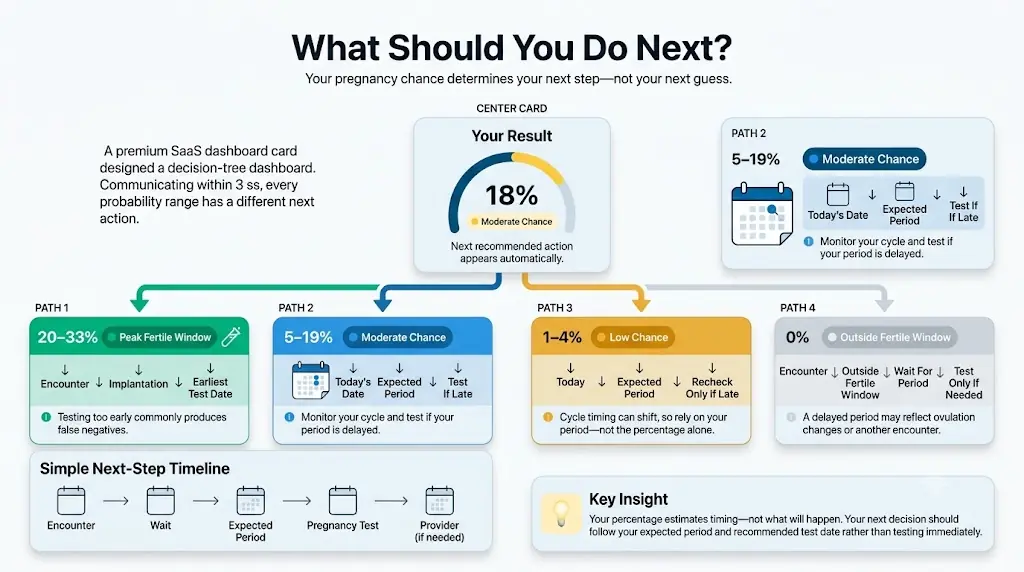
| 20%–33% | Peak Fertile Window | Encounter landed on or right before ovulation, the highest odds this model shows. | Day of ovulation or the day just before it. | Test on the date the calculator recommends for the clearest read. |
| 5%–19% | Moderate Chance | Timing fell inside the fertile window, but not at the peak day. | 2 to 4 days before ovulation, or age lowered a higher base odds. | Watch for early symptoms and stick to the missed-period test date. |
| 1%–4% | Low Probability | Encounter sat near the outer edge of sperm survival range. | 5 to 7 days before ovulation. | Conception is unlikely but not ruled out. Track your next period closely. |
| 0% | Outside Fertile Window | Timing fell outside the 6 to 7 day conception window entirely. | More than a week before ovulation, or after the egg's 24 hour lifespan. | Pregnancy from this specific encounter is not likely based on timing. |
Heads-up: These ranges reflect population-level fertility research, not personal test results. Cycle irregularities can shift real ovulation timing.
Interpretation
A result above 20% means your encounter lined up closely with ovulation, the tightest window biology allows for conception. Anything between 5% and 19% still counts as fertile window timing, just further from the peak day. Once you drop under 5%, timing did most of the damage, usually because the encounter landed near the edge of how long sperm can survive. A flat 0% simply means the math places your encounter outside the six to seven day window where conception is possible.
Pro Tip
Don’t judge your odds by the percentage alone. Check your suggested test date too. A moderate result paired with the right test timing gives a far more reliable answer than testing early on a high result.
What to Do After Using the One Time Pregnancy Calculator
Your result points to one of three next steps: wait, test, or watch for a delayed period. What you do depends on where your percentage landed and how close your test date is. Here’s how to act on each outcome without guessing.
For Peak Fertile Window Results (20% to 33%)
Testing early is the biggest mistake here. Even with strong timing, hCG needs days to build up after implantation, so a test taken too soon almost always comes back negative regardless of what actually happened. Stick to the earliest test date the calculator shows, not the day after your encounter.
Watch for early signs instead of testing daily. Mild cramping, breast tenderness, or fatigue can show up before a test would catch anything. If your period arrives on schedule, that’s a clear answer on its own. If it doesn’t, wait for the missed-period test date for the most reliable read.
For Moderate Chance Results (5% to 19%)
A moderate result still deserves the same patience as a high one. Age or slightly earlier timing lowered your odds, but the fertile window was still in play. Don’t dismiss symptoms just because the number looks average.
Track your cycle closely over the next two weeks. If your period is even a few days late past the date the calculator projects, that’s worth testing regardless of your original percentage. A moderate score means watch closely, not ignore.
For Low Probability Results (1% to 4%)
A low number reflects timing near the edge of the fertile window, not a guarantee of anything. Real cycles shift. Stress, illness, travel, or a longer luteal phase can push ovulation later than expected, which changes the actual timing without you knowing it happened.
If your period shows up on time, this result played out as expected. If it’s late, don’t rely on the percentage alone. Test at the missed-period date shown, since a low score from one calculation doesn’t override what your body is actually doing.
For 0% or Outside Fertile Window Results
A 0% result means the math places your encounter outside the window where conception is possible from that specific date. That’s still useful information, not a dismissal.
If your period comes on schedule, this result holds up. If it’s late anyway, something else shifted your cycle this month, and pregnancy from a different encounter or a delayed ovulation could still be the cause. Testing at the missed-period date settles it either way, no matter what the original percentage showed.
You Might Also Find These Helpful
Pregnancy & Fertility 45
Find out exactly when you conceived. Our free Conception Calculator uses your Due Date, LMP, or Ultrasound to estimate your fertilization date and fertile…
Try calculatorUse our Conception Date Due Date Calculator to find your baby's arrival date. Enter your conception or intercourse date for clinical 40-week results.
Try calculatorContraceptive effectiveness calculator to compare birth control methods, typical vs perfect use, backup protection, and 5-year pregnancy risk.
Try calculatorUse this CRL calculator to estimate gestational age and due date from crown-rump length in mm or cm. Compare CRL, LMP, and IVF dating…
Try calculatorEstimate your monthly and 12-month pregnancy odds by age, partner age, and cycle dates. See your fertile window and when to seek fertility help.
Try calculatorUse this fundal height calculator to compare your cm measurement by week, check growth range, estimate baby weight, and know when to ask about…
Try calculatorUse the Gestational Age Calculator to find your pregnancy week from LMP, due date, ultrasound, or IVF. See your EDD, trimester, month, and days…
Try calculatorPanicking over your hCG levels? Use our hCG 48-Hour Calculator to compare your exact beta rise against the ACOG 35% minimum viability benchmark instantly.
Try calculatorCalculate hCG doubling time instantly. Enter two test results. See if your levels are rising normally. Check pregnancy progress now in the hCG Calculator.
Try calculatorCheck your beta hCG rise with this hCG doubling time calculator. Enter two blood tests to see doubling time, 48-hour increase, and early trend…
Try calculatorConfused by your beta hCG levels? Use our hcg gestational age calculator to estimate your pregnancy weeks, verify IVF dates, and check ultrasound milestones.
Try calculatorConfused by your early pregnancy blood test? Use our hCG range calculator to instantly check if your beta levels match standard singleton or twin…
Try calculatorUse our implantation bleeding calculator to find your implantation window, test date, and due date. See if spotting fits implantation or a period.
Try calculatorCalculate implantation window instantly. Enter last period date. Find peak probability. See when to take a pregnancy test in the Implantation Calculator.
Try calculatorUse our IUI Due Date Calculator to find your exact due date and safe pregnancy test day. Get clinical 40-week results based on your…
Try calculatorIUI Success Rate Calculator estimates pregnancy chance using age, infertility profile, pre-wash TPMSC and optional AMH, with a 1–3 cycle projection.
Try calculatorUse our IVF Due Date Calculator to find your exact twin pregnancy timeline. Enter your transfer date to get 40-week and 37-week dates instantly.
Try calculatorUse our Late Period Probability Calculator to check how many days late you are, when to test or retest, and what your result timing…
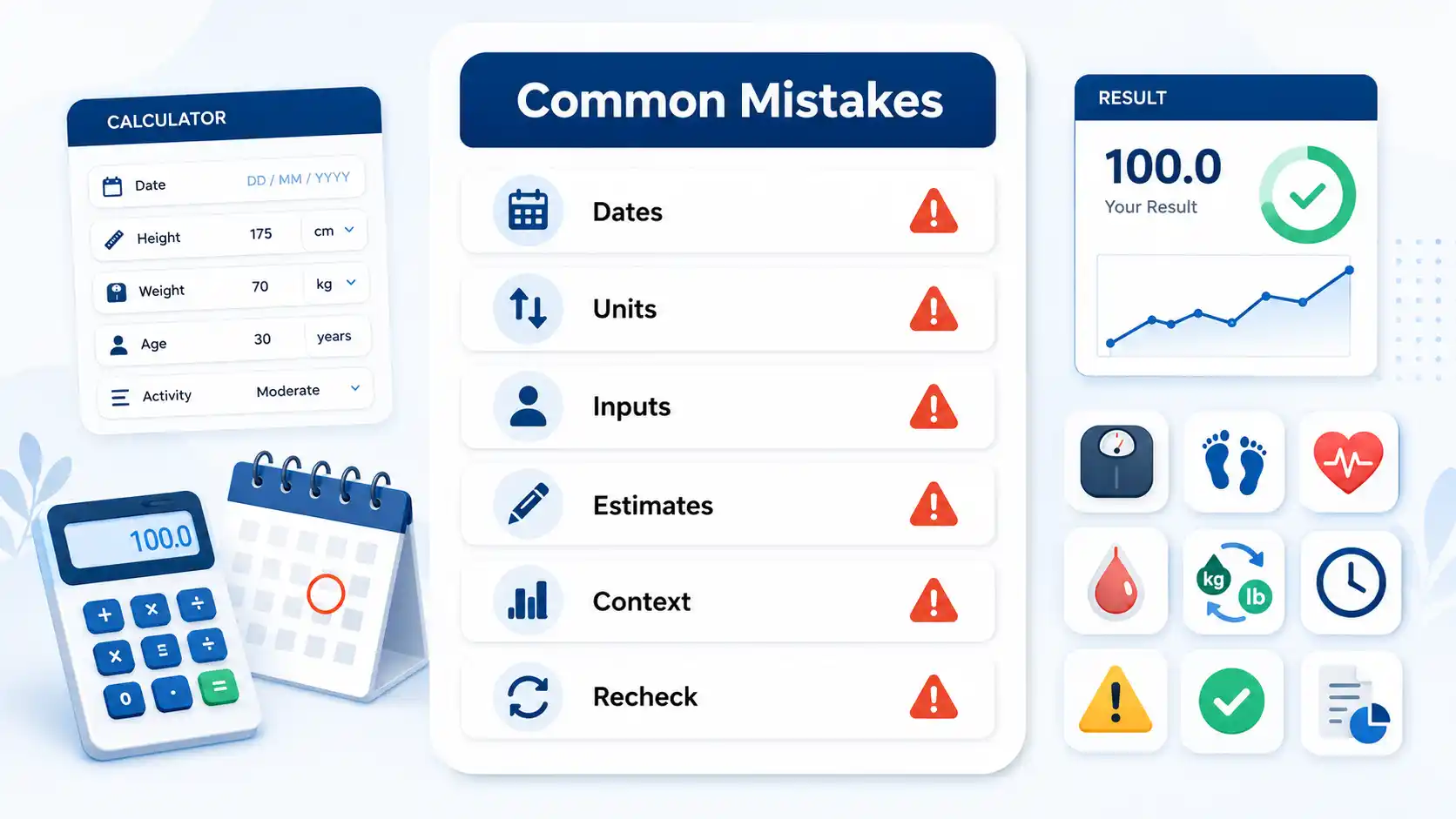
Try calculatorCommon Mistakes When Using the One Time Pregnancy Calculator
Small input errors can throw off your entire result. Since this calculator runs on exact dates and cycle timing, even a minor mistake shifts your ovulation estimate and skews your percentage. Here’s what trips people up most often.
- Guessing cycle length instead of tracking it, since even a 3-day error shifts ovulation and skews your percentage
- Testing right after the encounter, when hCG isn't detectable until days after implantation
- Assuming a 0% result means pregnancy is impossible, when cycles vary and ovulation doesn't always land where predicted
- Confusing your actual LMP with the calculator's adjusted dating, which re-anchors to ovulation instead of your real period date
- Ignoring the age multiplier and comparing your result directly to someone else's, since identical timing produces different odds by age
Frequently Asked Questions (FAQs)
What are the odds of getting pregnant from one time?
Odds depend entirely on timing. On or just before ovulation, odds run 20% to 33%. Outside the fertile window, odds drop near 0%. Sperm survives up to 5 days, so timing before ovulation still counts toward your final result.
Can you get pregnant from one time unprotected sex?
Yes. A single encounter during the fertile window can result in pregnancy. Odds peak the day before ovulation and on ovulation day itself, then drop sharply once the egg’s short lifespan has passed.
How many days after unprotected sex can I test?
Earliest reliable testing sits around 10 days past ovulation. Testing at your missed period date gives the most accurate result, since hCG levels need real time to build to detectable levels.
How is pregnancy calculated if I only had sex once?
The calculator pins ovulation using your cycle data, then measures how many days your encounter fell before or after that day. This sets your exact odds and full pregnancy timeline in one step.
Does age affect one time pregnancy chances?
Yes. Fertility declines gradually starting in the mid-30s. Two people with identical timing can get different odds if their ages differ, since the calculator applies a separate age-based adjustment on top of timing.
What is the highest chance of pregnancy from one encounter?
Around 33%, when the encounter happens the day before or on the day of ovulation. No single encounter carries a guaranteed outcome, even at peak fertile timing.
Can I get pregnant right after my period ends?
It’s less likely but possible with short cycles. Sperm can survive long enough to meet an early released egg if ovulation lands close to the end of your period.
How accurate is a one time pregnancy calculator?
It reflects population level fertility research, not a personal diagnosis. Your actual outcome depends on individual biology a calculator can’t measure, so treat the percentage as a guide, not a guarantee.
Can you get pregnant from precum during a one time encounter?
Yes, though the risk is low. Pre-ejaculate can carry small amounts of live sperm in some men. If it lands inside the fertile window this calculator measures, conception is possible even without full ejaculation.
Does taking Plan B after a one time encounter change these odds?
Yes, significantly. Emergency contraception taken within 72 to 120 hours can delay or block ovulation, lowering your actual risk far below what this calculator shows, since the tool doesn’t factor in medication.
What if I don't know my exact ovulation day?
You can still get a useful estimate. The calculator projects ovulation from your last period and average cycle length. Confirmed ovulation tracking through LH strips or temperature charting gives a tighter, more accurate result.
Questions?
We had love to hear from you! Whether you are reporting an issue, suggesting a new calculator, or exploring collaboration opportunities — we are here to help. Every message helps us make 100calc smarter, faster, and more helpful for everyone.
Why People Trust 100calc
At 100calc.com, we focus on accuracy, speed, and trust. Every calculator we create is designed to give reliable, instant, and easy-to-understand results you can truly depend on.