
IVF Due Date Calculator
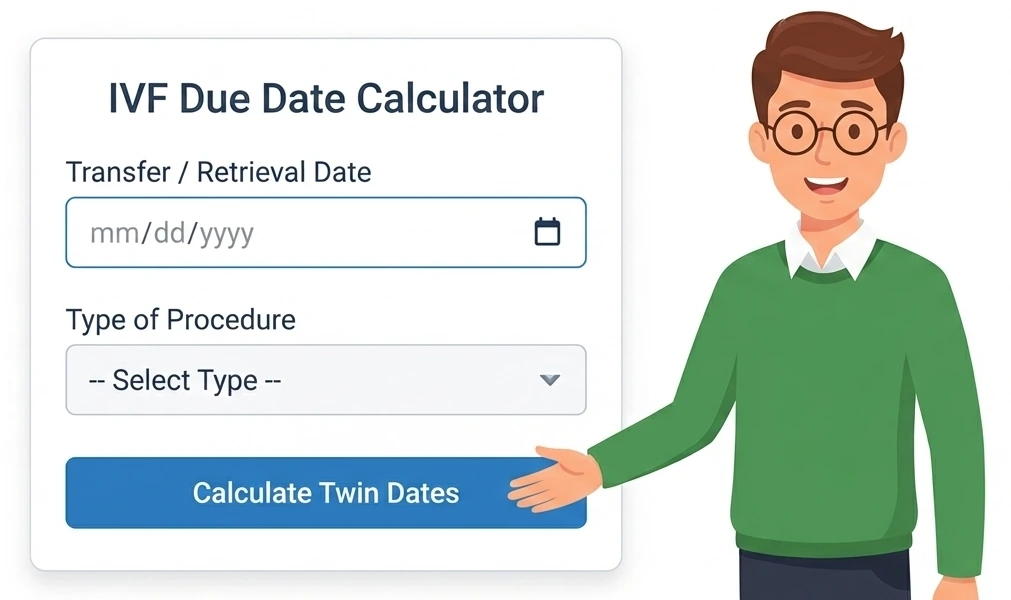
The IVF Due Date Calculator provides the most accurate timeline for your pregnancy milestones. Unlike natural dating, IVF uses the exact moment of embryo transfer. You can find your official 40-week date and your likely 37-week twin arrival. Select your procedure type and enter your transfer date below to get results instantly.
Accuracy matters when you are planning for two babies. Most twins arrive earlier than single babies. Therefore, you need a specific plan for their arrival. The tool adjusts your timeline based on embryo age. It works for Day 5 blastocysts or Day 3 transfers. Consequently, you can prepare your home with clinical precision. Start your journey with the correct dates today.
- Updated Jun 13, 2026
IVF Due Date Calculator: Precision Dating for Twins
Choose the specific embryo age from your transfer. Select “Day 5 Blastocyst” for most modern IVF treatments. Choose “Day 3 Cleavage” or “Egg Retrieval” based on your clinic report. Pick the exact calendar day your doctor performed the procedure. Accuracy here ensures your results match your clinical records. Press the button to see your primary and secondary dates instantly.
Day 5 (Blastocyst) is the most common for IVF.
OFFICIAL DUE DATE
LIKELY ARRIVAL
📅 Twin Planning Timeline
Calculation Details:
- Transfer: --
- Date: --
- Current Status: --
*Standard IVF dating + ACOG guidelines for multiple gestation. Consult your specialist.
HOW TO READ YOUR IVF TWIN RESULTS
The calculator provides a detailed look at your pregnancy path. It highlights why twin milestones differ from single pregnancies. Understanding these dates helps you set realistic expectations for your delivery.
The 40 vs. 37 Week Gap
Most pregnancy trackers focus on the 40-week mark. That date represents the standard for a single baby. However, carrying twins puts more demand on your body. Consequently, your “realistic” goal is shorter than the official one. The 40-week date remains on your medical records. Meanwhile, the 37-week date acts as your target for a safe delivery.
Why 37 Weeks is the Goal
Medical experts consider 37 weeks “Full Term” for twins. Professional guidelines from groups like ACOG suggest this timing is safer for multiples. Babies usually have well-developed lungs by this stage. Therefore, many doctors schedule deliveries between 37 and 38 weeks. Reaching this milestone reduces the risk of complications. It also helps your babies avoid a long stay in the nursery.
Understanding Your Current Status
Look at the “Current Status” line in your result summary. This string tells you exactly how many weeks and days pregnant you are today. The calculator finds this by creating a “virtual” last period date. Since IVF dates are exact, this status is highly accurate. Use this number when you talk to your medical team. It ensures everyone uses the exact timeline for your care.
Quick example to check the math
Suppose your clinic performs a Day 5 Blastocyst transfer on May 10. The calculator instantly applies the medical adjustment for embryo age.
Next, it uses the precision IVF formula:
May 10 + 261 days = January 26
If your official date is January 26, the tool then finds your “Twin Goal.” It subtracts 21 days to reach the 37-week milestone.
January 26 – 21 days = January 5
Consequently, you should have your hospital bag ready by early January. This math ensures you stay ahead of the typical arrival window for multiples. The logic remains consistent across all fertility clinics in the U.S. and abroad.
Explore More Calculators
Use the Chinese Gender Calculator for a traditional boy-or-girl prediction from lunar age and conception month. Enter conception date, due date, or LMP.
Try calculatorUse this fetal growth calculator to check baby weight percentile from ultrasound data in grams, kg, or cm and see what the result means…
Try calculatorEnter gestational sac measurements in mm or cm to calculate mean sac diameter, estimate early gestational age, compare week-by-week milestones, and see when follow-up…
Try calculatorMissed a birth control pill? Check pregnancy risk, protection status, backup contraception needs, and what to do next with our missed pill calculator.
Try calculatorUse our Pregnancy Chance Calculator to estimate your odds. Enter your cycle day, age, and method. Find out if you are in the high-risk…
Try calculatorUse our pregnancy due date calculator to find your exact Baby Due date. IVF, conception, ovulation, and ultrasound methods with weeks and timeline.
Try calculatorHow to Use the IVF Due Date Calculator
Using the IVF Due Date Calculator takes only a few seconds. You get clinical results based on your specific fertility treatment. Follow these simple steps to find your milestones.
Select Your Procedure
Choose the specific type of transfer your clinic performed. You can choose between a Day 5 Blastocyst transfer and a Day 3 Cleavage transfer. Additionally, you can select the Egg Retrieval date if your transfer has not happened yet. Selecting the correct type is vital for accuracy.
Input Your Transfer Date
Enter the exact calendar day of your procedure. Use the date provided in your medical paperwork. The tool uses this specific day to start the calculation. Accuracy here ensures your timeline matches your doctor's files perfectly.
Understand the Process Logic
The tool applies a precise medical formula once you click calculate. It starts with the standard 266-day gestation period. Then, it subtracts the age of the embryo from that total. Consequently, your result accounts for the time the baby spent in the lab.
Review Your Twin Timeline
Look at the results to find your custom planning dates. Focus on the 36-week and 37-week markers. Use these dates to set a deadline for your hospital bag. Most twin parents aim to finish all preparations by the 36-week mark. Therefore, you will be ready if your babies arrive early.
Example for testing
Try these sample numbers:
Try these sample numbers to understand how the IVF timeline shifts. You can use these figures to verify the accuracy of the IVF Due Date Calculator.
Transfer Date: June 10
Procedure Type: Day 5 Blastocyst
Twin Target: 37 Weeks
Result → Your Official Due Date is February 26. However, your Realistic Twin Goal is February 5. The tool also identifies that you will hit the 36-week marker on January 29.
Now, enter your own numbers and check how close you are to your goal.
How the IVF Due Date Formula Works (Complete Breakdown)
Understanding how your due date is calculated helps you plan your pregnancy with confidence. The formula gives you a clear picture of your milestones. It uses exact clinical data rather than rough estimates. The logic follows real-world medical policies used in fertility clinics. Therefore, the result is accurate and practical for every IVF patient.
The IVF Due Date Formula
The due date formula shows when your babies will likely arrive based on your transfer day. The calculation is precise and works for different embryo ages. Fertility experts use the same method worldwide to set official dates.
Formula:
Official Due Date = Transfer Date + (266 - Embryo Age)
The formula starts with your transfer date. Next, it adjusts for the age of the embryo. For a Day 5 transfer, the tool adds 261 days to your date. This math accounts for the five days the baby already grown in the lab.
Example:
If you had a Day 5 transfer on October 1st. (October 1) + 261 Days = June 19.
Your official 40-week due date is June 19. This date serves as the medical anchor for your entire pregnancy.
Micro Note:
Most singleton pregnancies aim for 40 weeks. However, medical guidelines for twins often set the goal at 37 weeks. Reaching 37 weeks ensures your babies are safe and fully developed.
Key Inputs Used in the IVF Calculator
Every IVF calculation depends on three simple inputs. These inputs help you measure your current progress and plan for your target arrival. You enter real numbers from your clinic report to get accurate results instantly. Doctors and specialists use this same method to track fetal growth and eligibility for delivery.
Transfer Date
Your transfer date is the exact day the doctor placed the embryo into your uterus. A transfer on October 1 sets the base for all calculations. The date represents the biological start of the pregnancy inside your body. Accuracy here is vital for your clinical records.
Embryo Age
Embryos are usually transferred on Day 3 or Day 5. A Day 5 blastocyst is more developed than a Day 3 cleavage embryo. Therefore, the tool must subtract those extra days from the standard timeline. Knowing the embryo age ensures your due date reflects the actual age of the fetus.
Procedure Type
The procedure type identifies whether you used fresh or frozen embryos. It also covers egg retrieval dates. Many U.S. clinics use the retrieval date as the “Fertilization Day.” Selecting the correct procedure helps the calculator apply the right math for your situation.
Another Example Calculation (Step-by-Step)
Let’s see how the IVF calculator works using a real-world twin scenario. This will help you understand how each number affects your final timeline. The calculation follows the same logic used by hospitals and birth centers.
Given:
- Transfer Date: March 10
- Embryo Age: Day 5 (Blastocyst)
- Twin Target: 37 Weeks
Calculation:
					First, the tool finds the official 40-week date. March 10 + 261 Days = November 26
Next, the tool calculates the 37-week "Twin Term" milestone. November 26 - 21 Days = November 5
Result:
- Official Due Date: November 26
- Realistic Twin Arrival: November 5
- Planning Goal: Have everything ready by late October.
Meaning:
With a March transfer, your official date is in late November. However, carrying twins means you should target early November for delivery. Moving your goal up by three weeks helps you stay prepared. Most twin parents consider reaching the 37-week mark a significant success for baby health.
Result Benchmarks and Ranges
Your doubling time is not just a number. It helps you understand your pregnancy health. It tells you if the hormone is rising fast enough. Doctors use these same benchmarks to monitor safety. The expected speed changes as your level increases. Here is a quick breakdown to help you evaluate your score.
| Data Source | Accuracy | Margin of Error |
|---|---|---|
| IVF Transfer Date | Gold Standard |
+/- 0 Days
Most precise medical method. |
| Early Ultrasound (6-8w) | Excellent |
+/- 3 Days
Used to confirm IVF growth. |
| Natural LMP | Variable |
+/- 7 to 10 Days
Depends on cycle memory. |
Note: IVF dating removes the guesswork found in natural conception. Consequently, your clinical timeline is extremely reliable.
Interpretation
Reaching the 37-week milestone is the primary goal for most twin pregnancies. This range offers the best balance for baby health and development. Maintaining a steady schedule with your specialist ensures you stay on track. Consistent monitoring improves outcomes and provides parents with peace of mind.
Pro Tip:
Finalize your birth plan before you reach 34 weeks. Twins often choose their own arrival time. Having your preferences ready early reduces stress during the final month. Focus on rest and hydration as you approach the 36-week marker.
Tips & Planning Based on Your Result
Planning for twins requires extra preparation. You should use your results to set specific deadlines for your home and hospital needs. These insights help you stay ahead of the unique timeline for multiples.
The 36-Week Preparation Marker
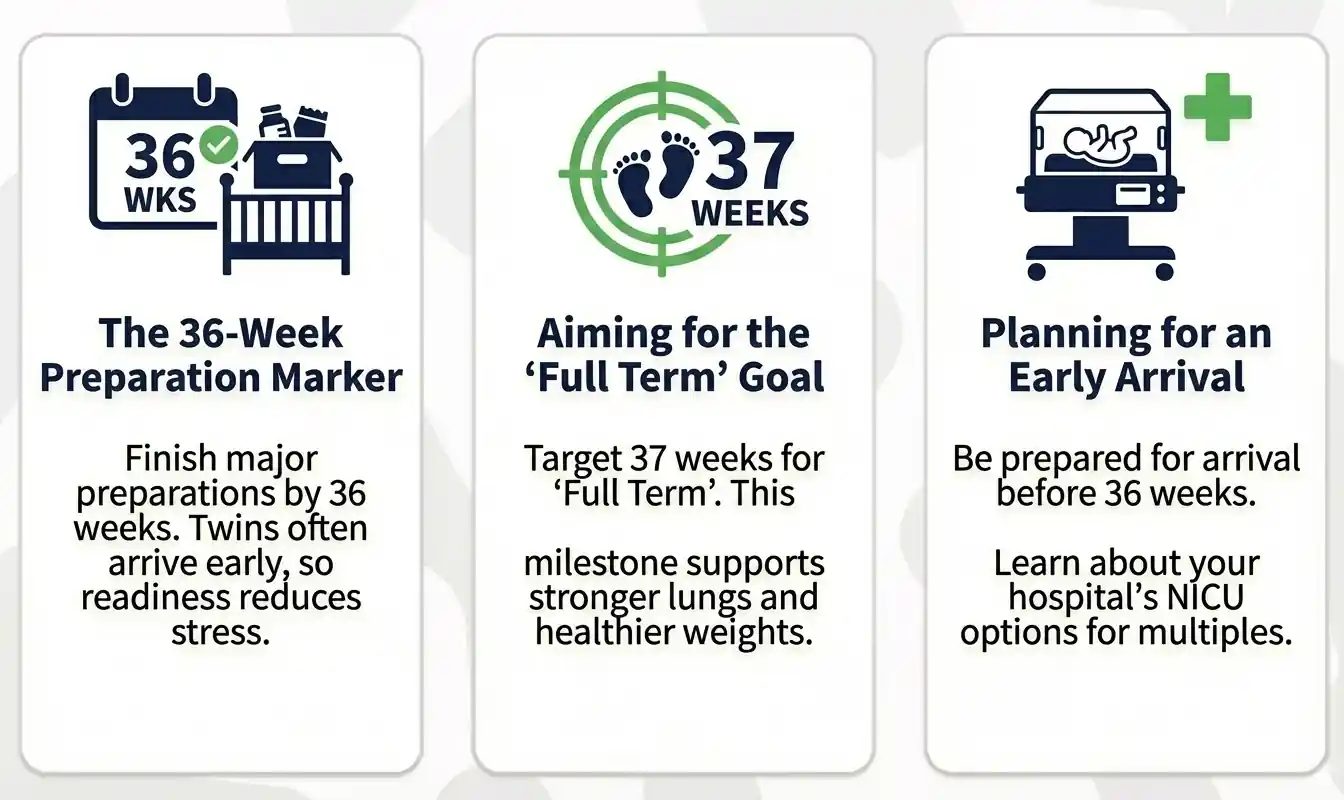
Twin parents often finish their nursery by the 36-week mark. You should complete your major preparations by this date. Most multiples arrive much earlier than single babies. Consequently, having your home ready early reduces significant stress. Use the IVF Due Date Calculator to track this specific milestone. You will feel more relaxed once your baby gear is fully assembled.
Aiming for the "Full Term" Goal
Target the 37-week milestone for your delivery. Doctors consider 37 weeks as “Full Term” for a twin pregnancy. Reaching this stage helps your babies develop stronger lungs and healthier weights. Furthermore, it leads to better medical outcomes for both infants. You should discuss this target date with your fertility specialist. Every extra day inside the womb helps your babies grow stronger for the real world.
Planning for an Early Arrival
Some twins arrive even before the 36-week marker. You should prepare for a possible stay in the neonatal intensive care unit. Early arrivals are very common with multiple pregnancies. Therefore, learning about your hospital’s nursery options is a smart move. You can ask your medical team about their specific care capabilities for multiples. Being informed helps you stay calm and focused during the birth process.
You Might Also Find These Helpful
Pregnancy & Fertility 45
Use this Pregnancy Risk Calculator to check age, BMI, health history, bleeding, and twins. See if closer prenatal monitoring may be worth asking about.
Try calculatorOne Time Pregnancy Calculator estimates pregnancy odds from one encounter, plus fertile window timing, test date, due date, and 21-day testing guidance.
Try calculatorUse the AMH Calculator to convert ng/mL or pmol/L, compare your result with age-based data, and see what it may mean for IVF, fertility,…
Try calculatorUse the Baby Eye Color Calculator with parents, grandparents, or sibling context to compare Brown, Green/Hazel, and Blue/Grey model estimates instantly.
Try calculatorBasal Body Temperature Calculator checks reading conditions and analyzes your temperature pattern for a sustained shift that may be consistent with ovulation.
Try calculatorBPD gestational age calculator: estimate fetal age from BPD, compare your week, check normal BPD ranges, and understand ahead or behind results.
Try calculatorCalculate odds with the Chance of Twins Calculator. Enter maternal age and history. Find your probability instantly. See if you will conceive multiples now.
Try calculatorFind out exactly when you conceived. Our free Conception Calculator uses your Due Date, LMP, or Ultrasound to estimate your fertilization date and fertile…
Try calculatorUse our Conception Date Due Date Calculator to find your baby's arrival date. Enter your conception or intercourse date for clinical 40-week results.
Try calculatorContraceptive effectiveness calculator to compare birth control methods, typical vs perfect use, backup protection, and 5-year pregnancy risk.
Try calculatorUse this CRL calculator to estimate gestational age and due date from crown-rump length in mm or cm. Compare CRL, LMP, and IVF dating…
Try calculatorEstimate your monthly and 12-month pregnancy odds by age, partner age, and cycle dates. See your fertile window and when to seek fertility help.
Try calculatorCommon Mistakes to Avoid When Calculating
Calculating dates for multiples involves specific medical logic. You should avoid these common errors to keep your timeline accurate. Small mistakes can lead to confusion during your final weeks of pregnancy.
- Selecting the Wrong Transfer Type: You might choose the wrong embryo age by mistake. For example, some people use Day 5 logic for a Day 3 transfer. However, these two methods use different math steps. Selecting the wrong type causes your results to be off by two days. Always verify your clinic report before you use the IVF Due Date Calculator.
- Confusing Retrieval with Transfer: Do not mix up the egg retrieval date and the transfer date. These two medical events happen on different days. Specifically, the tool relies on the exact date of the event you choose. Entering the transfer date in the retrieval box will show the wrong milestones. Consequently, you might prepare for your babies on the wrong weekend.
- Ignoring the "Twin Term" Goal: You should not plan to work until the 40-week official date. Most multiples arrive much sooner than a single baby. Therefore, your body will need to slow down much earlier. You might find it hard to stay active after the 34-week mark. Plan your maternity leave based on the 37-week twin goal instead.
Frequently Asked Questions (FAQs)
How accurate is the IVF due date?
The date is extremely precise. Since the clinic knows the exact second of fertilization, there is no guesswork. This accuracy is much higher than natural dating methods. Therefore, your clinical timeline remains the gold standard for your care.
Why are twins born earlier than singletons?
Carrying two babies puts more pressure on the uterus. This extra weight often triggers labor sooner than a single pregnancy. Consequently, doctors aim for a 37-week delivery goal. Reaching this milestone ensures the babies are healthy and ready.
Does a Day 5 transfer change my due date?
Yes. A Day 5 embryo is more developed than a Day 3 embryo. The IVF Due Date Calculator subtracts those extra days from the total timeline. This adjustment ensures your 40-week mark is biologically correct. Always select the right embryo age for the best results.
What is the "Full Term" for IVF twins?
Medical experts consider 37 weeks as full term for multiples. Reaching this date helps infants avoid breathing issues after birth. Furthermore, it allows for better birth weights. Most specialists schedule deliveries around this specific time.
Can I calculate my due date from egg retrieval?
Yes. Egg retrieval marks the biological beginning of the pregnancy. Simply select the “Retrieval” option in our tool. The math adds exactly 266 days to that specific date. This method works perfectly for patients before their transfer happens.
Is the IVF due date ever changed by ultrasound?
Ultrasounds measure the baby’s physical size. However, doctors rarely change an IVF due date based on growth. The transfer date is a fixed medical fact. Consequently, it remains the most reliable anchor for your entire pregnancy journey.
When should I finish my twin nursery?
You should aim to finish the nursery by the 36-week mark. Twins often arrive unexpectedly before their official due date. Therefore, having your home ready early reduces late-pregnancy stress. Use our timeline to set your final preparation deadlines.
Questions?
We had love to hear from you! Whether you are reporting an issue, suggesting a new calculator, or exploring collaboration opportunities — we are here to help. Every message helps us make 100calc smarter, faster, and more helpful for everyone.
Why People Trust 100calc
At 100calc.com, we focus on accuracy, speed, and trust. Every calculator we create is designed to give reliable, instant, and easy-to-understand results you can truly depend on.