
Implantation Bleeding Calculator: Is It Implantation or Your Period?
An implantation bleeding calculator estimates when implantation may happen, when to take a pregnancy test, and whether your spotting pattern is more consistent with implantation bleeding or a menstrual period. It uses your last period, ovulation date, or IVF transfer date to predict your implantation window, test date, and estimated due date.
Light spotting can create a lot of uncertainty. Many people ask the same questions. Is this implantation bleeding or my period? Did I test too early? Should I wait a few more days? Timing matters as much as symptoms.
Enter your dates and spotting details to see your likely implantation window, compare common implantation bleeding symptoms, and find the best time to test for pregnancy. The calculator also estimates your due date if pregnancy occurs.
Quick Facts
- Implantation usually occurs 6 to 12 days after ovulation.
- Pregnancy tests are often more reliable around 14 days past ovulation (14 DPO).
- Brown or light pink spotting is more common with implantation.
- Heavy bleeding and clots are more consistent with a period.
- IVF transfer dates can be used for implantation timing estimates.
- Updated Jul 2, 2026
- Reviewed by 100Calc Research Team
Early Pregnancy Decoder
Implantation Bleeding Calculator
Calculate your exact implantation window, find your optimal pregnancy test date, or analyze your current spotting symptoms to see if they match clinical guidelines.
Symptom Analysis
—
Your clinical symptom description will appear here.
Your Biological Timeline
Based on your inputs, here is the projected timeline for early pregnancy development and hCG hormone rise.
Why wait to test?
Implantation happens between 6 and 12 Days Past Ovulation (DPO). Your body does not start producing hCG (the pregnancy hormone) until after the egg fully embeds. Taking a test before -- highly increases your risk of a false negative.
Estimated Due Date (EDD)
--If implantation is successful this cycle, this is your projected delivery date based on a standard 280-day gestation.
Is my spotting implantation or my period?
Your dynamic answer will appear here.
When exactly will implantation happen?
Your second dynamic answer will appear here.
Explore More Calculators
Use the Chinese Gender Calculator for a traditional boy-or-girl prediction from lunar age and conception month. Enter conception date, due date, or LMP.
Try calculatorUse this fetal growth calculator to check baby weight percentile from ultrasound data in grams, kg, or cm and see what the result means…
Try calculatorEnter gestational sac measurements in mm or cm to calculate mean sac diameter, estimate early gestational age, compare week-by-week milestones, and see when follow-up…
Try calculatorMissed a birth control pill? Check pregnancy risk, protection status, backup contraception needs, and what to do next with our missed pill calculator.
Try calculatorUse our Pregnancy Chance Calculator to estimate your odds. Enter your cycle day, age, and method. Find out if you are in the high-risk…
Try calculatorUse our pregnancy due date calculator to find your exact Baby Due date. IVF, conception, ovulation, and ultrasound methods with weeks and timeline.
Try calculator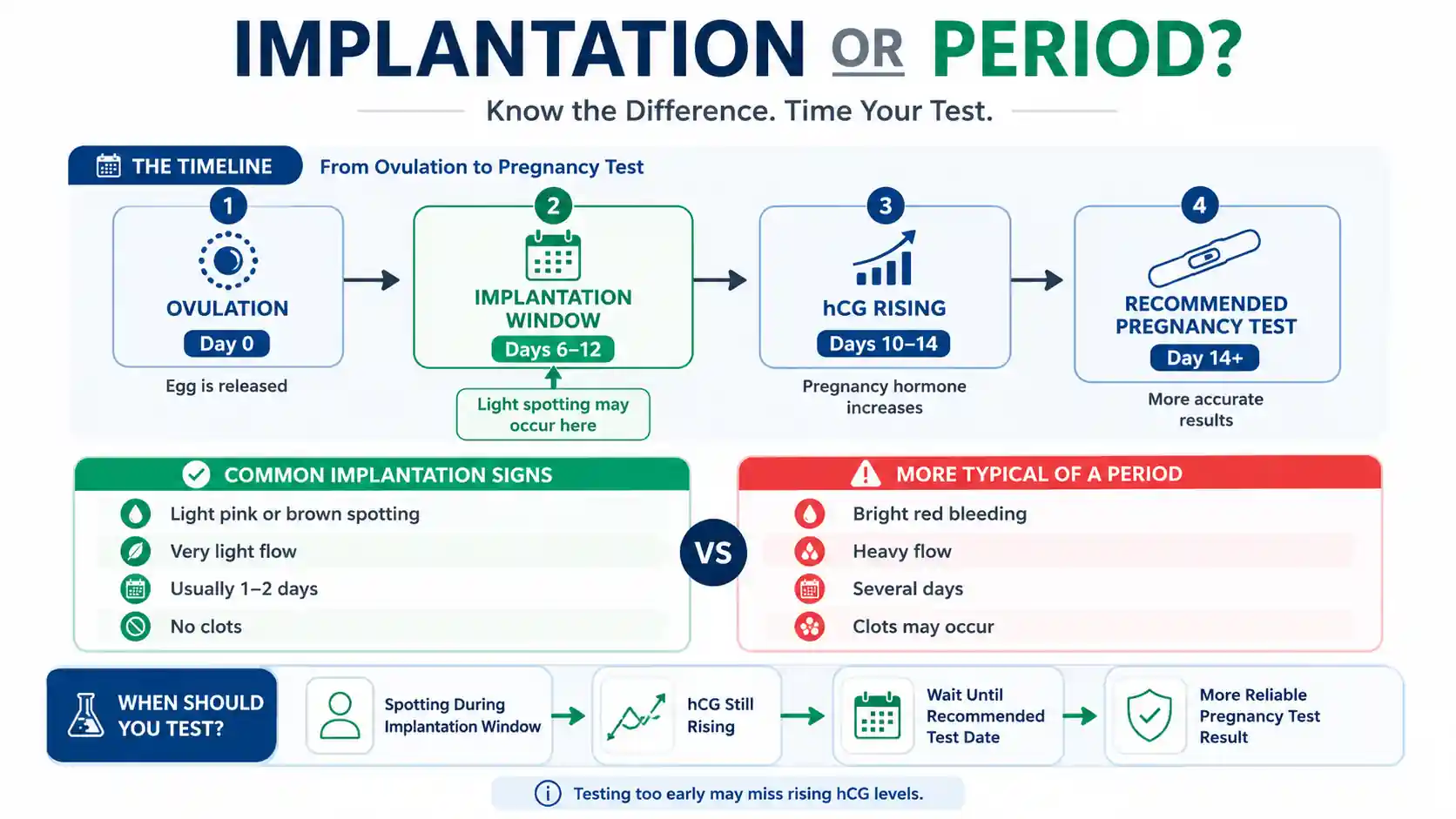
Micro Insight
This implantation bleeding calculator combines fertility tracking, cycle timing, and symptom analysis to estimate your implantation window and recommended pregnancy test date. Home pregnancy tests become more accurate as hCG continues to rise over the next few days. Waiting until the recommended test date often gives a more reliable result.
What Is Implantation Bleeding?
Implantation normally happens during the luteal phase, which is the second half of the menstrual cycle after ovulation. This is also when progesterone rises to help prepare the uterus for a possible pregnancy.
After fertilization, a fertilized egg develops into a blastocyst as it travels through the fallopian tube toward the uterus. Once it reaches the uterine lining, embryo implantation begins, which may cause light spotting in some pregnancies. This process may disturb tiny blood vessels in the uterine lining. A small amount of spotting can occur during this stage.
Many people mistake implantation bleeding for an early period. The timing often causes confusion because it can happen close to an expected menstrual cycle. Early pregnancy spotting caused by implantation is usually lighter, shorter, and less likely to contain clots than a menstrual period.
A person who ovulated on June 1 may notice light brown spotting around June 7 to June 13. That timing falls within the common implantation window. A heavy flow lasting several days would be less typical of implantation.
What Does Your Implantation Bleeding Result Mean?
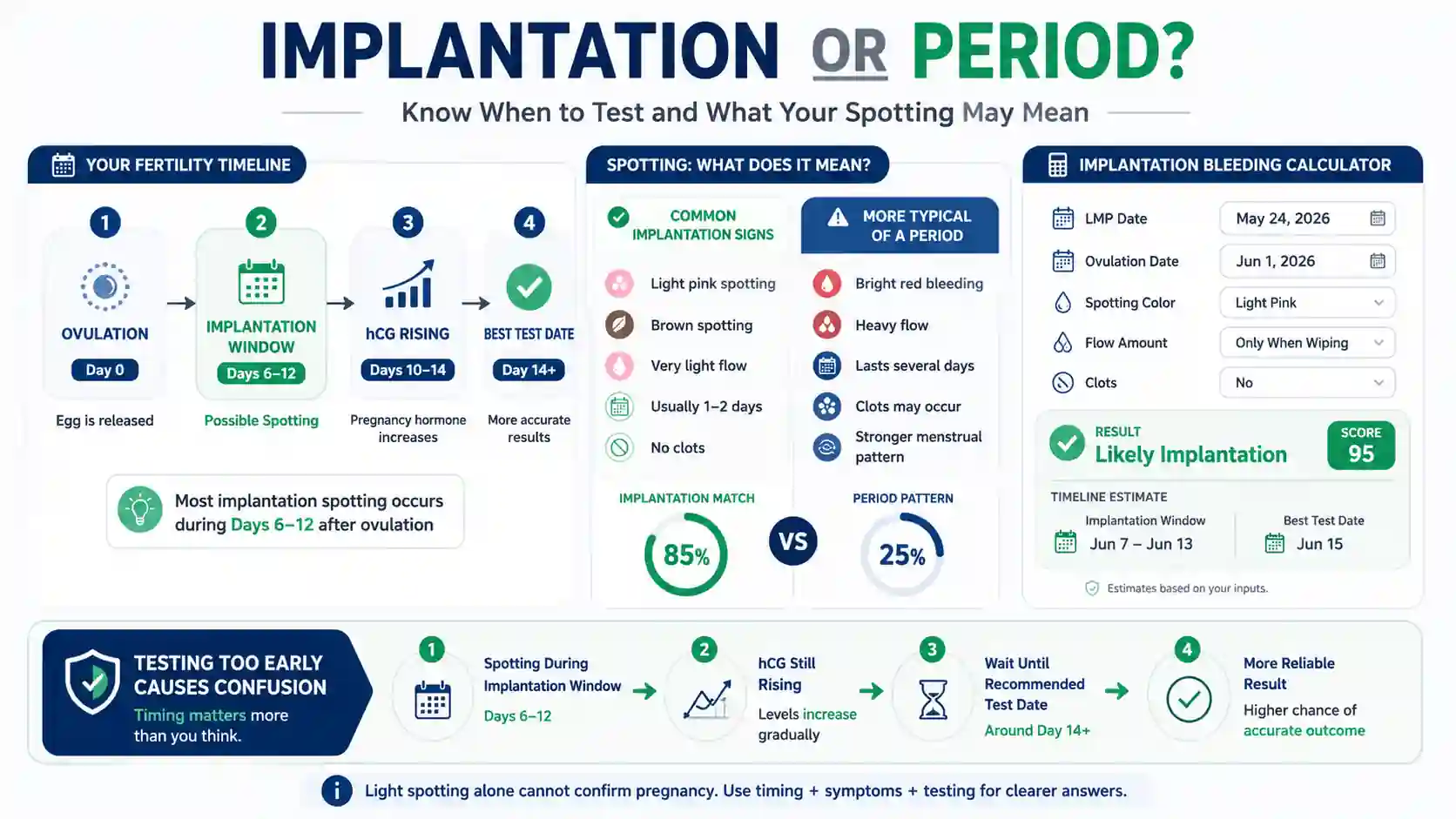
Your implantation bleeding result combines two independent checks. First, the calculator estimates your implantation window using your LMP, ovulation date, or IVF transfer date. Second, it compares your spotting color, flow, and clotting with the calculator’s symptom score to show whether your symptoms are more consistent with implantation bleeding or a menstrual period.
This result does not confirm pregnancy. It shows how closely your symptoms match common implantation bleeding patterns and helps you decide whether to test now or wait.
Understanding Your Result
The implantation window is the period when a fertilized egg may attach to the uterine lining. Most implantation events occur about 6 to 12 days after ovulation.
Your symptom score compares your reported spotting against patterns commonly linked to implantation bleeding.
High Implantation Match
A high score usually includes:
- Brown or light pink spotting
- Very light flow
- No clots
- Symptoms occurring within the implantation window
These signs are more consistent with implantation spotting than a menstrual period.
Borderline or Unsure Match
A middle-range score means the signs are mixed.
Light spotting may fit implantation bleeding, but some symptoms may also resemble an early period. Timing becomes especially important in this range.
Likely Menstruation
A low score often includes:
- Bright red bleeding
- Heavy flow
- Clots present
- Symptoms outside the implantation window
This pattern is more commonly linked to menstruation than implantation.
Symptom Score Guide
70–95: Likely Implantation
40–69: Borderline or Unclear
5–39: More Likely Menstruation
The score compares your reported symptoms with common implantation bleeding patterns. It cannot confirm pregnancy on its own.
Is Your Result Good or Bad?
There is no “good” or “bad” result.
A high implantation match means your symptoms look more similar to implantation bleeding. It does not guarantee pregnancy.
A borderline result means more time and observation may be needed.
A likely menstruation result suggests a period is more probable based on the information entered.
Timing often matters more than symptoms alone. Light spotting outside the implantation window may not be implantation bleeding. Brown spotting during the expected implantation period carries more significance.
What You Should Do Next
Compare your spotting date with the implantation window shown in your results.
Wait until the recommended pregnancy test date if possible.
Monitor changes in bleeding color and flow.
Seek medical advice if bleeding becomes heavy, painful, or concerning.
Testing too early is one of the most common reasons for false-negative pregnancy tests. Implantation must occur before hCG levels begin rising enough for reliable detection.
Quick Example to Test
Inputs
- Tracking Method: LMP
- First Day of Last Period: July 5, 2026
- Cycle Length: 30 Days
- Spotting Color: Light Pink
- Flow Amount: Pantyliner
- Clots: No
Result
- Implantation Window: July 27 to August 2
- Symptom Match: Borderline Match
Meaning
Light pink spotting with no clots can fit common implantation bleeding patterns. If the spotting occurs during the estimated implantation window, waiting until the suggested pregnancy test date may provide a more reliable result than testing immediately.
Am I Pregnant or Is It My Period?
Many people search for a period or implantation bleeding calculator when they are unsure whether light bleeding is the start of menstruation or an early pregnancy sign.
Spotting before your period can feel confusing because early pregnancy signs and PMS can look almost the same. The implantation bleeding calculator helps you compare timing, color, flow, clots, and test date so you can decide whether your spotting looks more like implantation or a period.
How can I tell if spotting is implantation bleeding or my period?
Implantation bleeding is usually light pink or brown spotting that happens around 6 to 12 days after ovulation. A period is more likely if bleeding gets heavier, turns bright red, lasts several days, or includes clots. Use these signs as a quick check:
| Sign | More Like Implantation | More Like Period |
|---|---|---|
| Timing | Usually 6 to 12 days after ovulation. | Usually near your expected period date. |
| Color | Light pink, brown, or dark brown spotting. | Bright red or deeper red bleeding. |
| Flow | Light spots, wiping only, or pantyliner level. | Steady flow that needs a pad or tampon. |
| Clots | Clots are usually not present. | Clots may appear with normal period bleeding. |
| Duration | Often a few hours to 1 or 2 days. | Often lasts 3 to 7 days. |
| Cramps | Mild cramps or barely noticeable discomfort. | Stronger cramps or pain that increases. |
| Pattern | Stays light or stops quickly. | Gets heavier over time. |
Heads-up: Spotting alone cannot confirm pregnancy. Use the calculator timing, watch the flow pattern, and take a pregnancy test on the recommended date.
What signs make pregnancy more possible?
Pregnancy is more possible when spotting fits your implantation window and stays very light. A missed period and a positive pregnancy test are much stronger signs than spotting alone.
Signs that may support early pregnancy include:
- Spotting during the implantation window
- Light pink or brown discharge
- No clots or tissue
- Very mild cramps
- Bleeding that stops quickly
- Period does not start after spotting
- Positive pregnancy test after the recommended test date
Spotting alone does not prove pregnancy. Many people have no implantation bleeding at all.
What signs make a period more likely?
A period is more likely when bleeding becomes heavier instead of stopping. Bright red blood, clots, stronger cramps, and normal period-like flow usually do not match typical implantation spotting.
Watch for these period-like signs:
- Bleeding fills a pad or tampon
- Flow gets stronger after a few hours
- Clots appear
- Cramps feel like your normal period
- Bleeding lasts more than 2 days
- Your period starts on its usual schedule
If your result says “likely menstruation,” the spotting pattern is closer to a normal cycle than implantation.
When should I take a pregnancy test if I am unsure?
Take a pregnancy test on the calculator’s recommended test date, usually around 14 days after ovulation. Testing too early can show a negative result even if implantation has already happened.
For better accuracy:
- Use first-morning urine
- Wait until your missed period if possible
- Retest in 48 hours if the first test is negative
- Track whether spotting stops or turns into normal flow
- Use a blood test if your provider recommends one
The best move is simple. Do not judge by spotting alone. Match the timing, watch the flow, and test on the right date.
How to Use the Implantation Bleeding Calculator
This implantation bleeding calculator helps you turn simple date inputs and symptom details into a clear pregnancy timeline. It shows ovulation timing, implantation window, and the best test date. If you choose analyze mode, it also checks spotting signs to estimate whether symptoms look like implantation or a period.
Tracking Method Selection
Start by selecting how your cycle is tracked. The calculator supports LMP, known ovulation, or IVF transfer dates. This choice changes how the system calculates ovulation. LMP uses cycle length math, while ovulation and IVF methods use fixed biological offsets to build a more accurate timeline.
Enter Your Main Date
Add the key date linked to your method. This could be the first day of your last period, ovulation date, or embryo transfer date. The calculator converts this into an estimated ovulation point when needed. This becomes the base for all pregnancy timeline calculations.
Add Cycle Length if Using LMP
If you select LMP, enter your cycle length. Normal range is 21 to 45 days. The system uses this value to estimate ovulation by subtracting 14 days from the cycle length. A longer or shorter cycle shifts all future dates, including implantation and test timing.
Enter Spotting Details in Analyze Mode
If you switch to symptom analysis, you enter spotting color, flow level, and whether clots are present. The calculator assigns a score starting from 50 and adjusts it based on these inputs. This helps match your symptoms against typical implantation or menstrual patterns.
View Your Implantation Timeline and Test Guidance
After processing inputs, the calculator generates ovulation date, implantation window, and best test date. In analyze mode, it also shows a match score and classification. The final result helps you decide whether to wait, test now, or monitor symptoms longer
Quick Example: Implantation Window From LMP
Input
- Tracking Method: First Day of Last Period (LMP)
- LMP: July 5, 2026
- Cycle Length: 28 days
Result
- Estimated Ovulation: July 19, 2026
- Implantation Window: July 25 to July 31, 2026
- Best Pregnancy Test Date: August 2, 2026
- Estimated Due Date: April 11, 2027
What This Means
The calculator estimates when implantation is most likely to happen based on your cycle. If light pink or brown spotting appears between July 25 and July 31, it falls within the expected implantation window. Waiting until August 2 gives a better chance of getting an accurate home pregnancy test result.
How the Implantation Bleeding Calculator System Works
This implantation bleeding calculator uses evidence-based reproductive timing models combined with symptom pattern analysis. It estimates ovulation, implantation window, and pregnancy test timing using standard DPO calculations. It also evaluates spotting details using a scoring system that reflects common clinical patterns seen in implantation and menstrual bleeding cases.
Key Features & Benefits
- The implantation bleeding calculator by LMP estimates ovulation from the first day of your last menstrual period and average cycle length.
- Calculates ovulation and implantation window using standard 6 to 12 DPO biological range
- Predicts best pregnancy test date based on realistic hCG detection timing
- Uses symptom scoring to compare spotting patterns with implantation vs period signals
- Provides structured interpretation to help users decide when to test or wait
Technical Process
Timeline Mapping
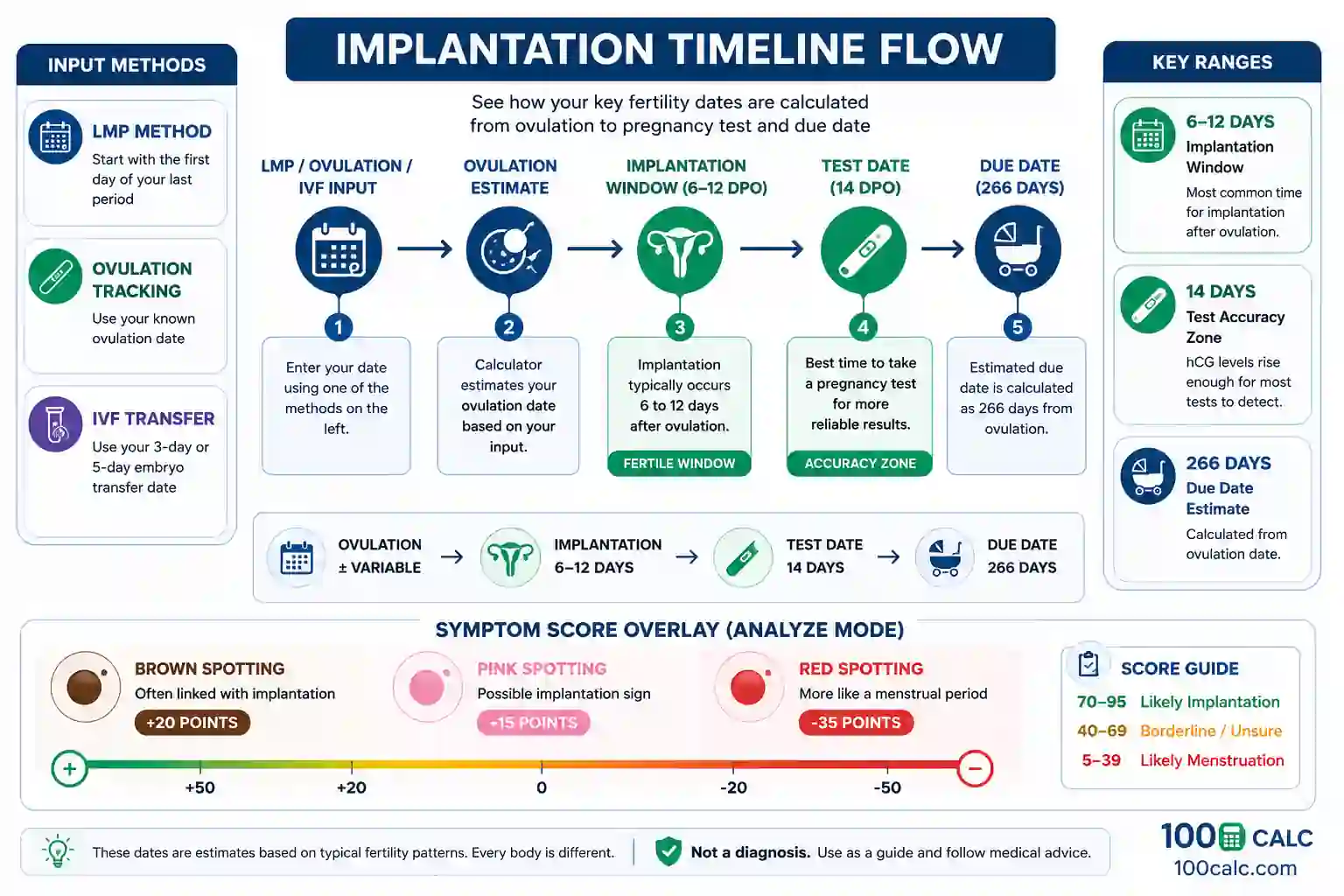
The system converts user inputs like LMP, ovulation date, or IVF transfer into an estimated ovulation baseline. From there, it builds a full fertility timeline including implantation window and testing date using fixed biological offsets.
Implantation Projection
Once ovulation is identified, the calculator projects implantation between 6 and 12 days post ovulation. This range reflects typical embryo attachment timing used in fertility tracking models and helps set realistic testing expectations.
Symptom Analysis
The calculator starts with a neutral score of 50 and then adjusts it using spotting color, flow, and clot information. Positive implantation signs increase the score, while period-like signs reduce it before the final classification is shown.
How the Implantation Bleeding Calculator Formula Works (Complete Breakdown)
The Implantation Bleeding Calculator estimates when embryo implantation may occur by calculating your ovulation date first. It then predicts your implantation window, recommended pregnancy test date, and estimated due date using established fertility timing instead of guessing from symptoms alone.
Implantation Bleeding Calculator Formula
The Implantation Bleeding Calculator Formula estimates your ovulation date first, then calculates your likely implantation window, recommended pregnancy test date, and estimated due date. It follows established fertility timing patterns based on your LMP, ovulation date, or IVF transfer instead of using symptoms alone.
Formula:
Ovulation Date = LMP + (Cycle Length − 14) Implantation Start = Ovulation Date + 6 Days Implantation End = Ovulation Date + 12 Days Recommended Test Date = Ovulation Date + 14 Days Estimated Due Date (EDD) = Ovulation Date + 266 Days
What Does This Formula Do?
The calculator follows the natural order of early pregnancy. It estimates when ovulation likely happened, predicts when a fertilized egg may implant into the uterine lining, recommends a better day for a home pregnancy test, and estimates your due date if pregnancy occurs.
When symptom analysis is selected, the timeline is combined with your spotting pattern to show whether your symptoms are more consistent with implantation bleeding or a menstrual period.
What Does Each Formula Variable Mean?
Every formula variable represents one piece of information used to build your pregnancy timeline. Understanding these inputs makes it easier to see how the calculator estimates ovulation, implantation timing, pregnancy testing, and your expected due date.
Last Menstrual Period (LMP)
The Last Menstrual Period (LMP) is the first day of your most recent menstrual cycle. When the exact ovulation date is unknown, it serves as the starting point for estimating your fertility timeline and pregnancy dates.
Cycle Length
Cycle Length is the number of days from the first day of one period to the first day of the next. A shorter cycle usually shifts ovulation earlier, while a longer cycle moves it later.
Ovulation Date
The Ovulation Date is the estimated day an egg is released from the ovary. Every later calculation, including implantation timing, pregnancy testing, and due date estimation, is based on this date.
Implantation Window
The Implantation Window is the estimated period when a blastocyst may attach to the uterine lining. Most pregnancies implant about 6 to 12 days past ovulation (DPO), although the exact day varies from person to person.
Recommended Test Date
The Recommended Test Date is the earliest day most home pregnancy tests are more likely to detect the hCG hormone. Testing before this date increases the chance of a false-negative result.
Estimated Due Date (EDD)
The Estimated Due Date (EDD) predicts your baby’s expected delivery date by adding 266 days to the estimated ovulation or conception date. This is an estimate and may change after an ultrasound.
Another Example Calculation (Step-by-Step)
This example shows how the Implantation Bleeding Calculator estimates the complete pregnancy timeline using the LMP method. The same calculation process is used unless you choose an ovulation date or IVF transfer instead.
Given:
- Tracking Method = LMP
- First Day of Last Menstrual Period = August 4, 2026
- Average Cycle Length = 29 Days
Calculation:
Ovulation Date = August 4 + (29 − 14) = August 19, 2026 Implantation Window Start = August 19 + 6 = August 25, 2026 End = August 19 + 12 = August 31, 2026 Recommended Test Date = August 19 + 14 = September 2, 2026 Estimated Due Date = August 19 + 266 = May 12, 2027
Result:
- Estimated Ovulation Date: August 19, 2026
- Implantation Window: August 25 to August 31, 2026
- Recommended Pregnancy Test Date: September 2, 2026
- Estimated Due Date: May 12, 2027
Meaning:
This timeline shows when implantation is most likely to happen based on your cycle. If light spotting occurs during this window, waiting until the recommended test date usually provides a more reliable home pregnancy test result than testing immediately.
How Do You Calculate Implantation Bleeding with a Calculator?
Implantation bleeding is calculated by first estimating ovulation from your cycle method, then mapping key fertility milestones. The calculator uses LMP, ovulation, or IVF transfer data to find ovulation. After that, it adds 6–12 days for implantation and 14 days for a reliable pregnancy test window. It also estimates due date from ovulation.
What Is An Example Of Implantation Bleeding Calculation Using LMP?
A common case where a user tracks pregnancy from their last period.
Input:
- LMP: March 1, 2026
- Cycle Length: 28 days
Process:
- Ovulation = March 1 + (28 − 14) = March 15
- Implantation Window = March 21 to March 27
- Test Date = March 29
Result:
- Ovulation: March 15, 2026
- Implantation Window: March 21–27, 2026
- Test Date: March 29, 2026
Meaning:
This shows a normal cycle timeline. Implantation usually happens about one week after ovulation. Testing before March 29 may give a false negative because hCG levels are still low.
How Does Implantation Timing Look After Ovulation Tracking?
This example is used when ovulation date is already known.
Input:
- Ovulation Date: April 10, 2026
Process:
- Implantation Start = April 16
- Implantation End = April 22
- Test Date = April 24
Result:
- Implantation Window: April 16–22, 2026
- Pregnancy Test Date: April 24, 2026
- Due Date Estimate: January 1, 2027
Meaning:
This timeline reflects a direct ovulation-based method. Implantation typically falls between 6 and 12 days after ovulation, which is the most accurate biological range used in fertility tracking.
How Does IVF Implantation Calculation Work?
IVF users need adjusted timing because fertilization is already controlled.
Input:
- IVF Type: 5-Day Transfer
- Transfer Date: May 5, 2026
Process:
- Ovulation Equivalent = May 5 − 5 days = April 30
- Implantation Window = May 6 to May 12
- Test Date = May 14
Result:
- Ovulation Equivalent: April 30, 2026
- Implantation Window: May 6–12, 2026
- Test Date: May 14, 2026
Meaning:
IVF shifts the ovulation reference point backward. A 5-day embryo already represents early development, so implantation timing is calculated from that adjusted ovulation equivalent.
What Happens If Spotting Symptoms are Included In Calculation?
This example shows how symptom scoring changes interpretation.
Input:
- Ovulation Date: April 10, 2026
- Spotting Color: Brown
- Flow: Pantyliner
- Clots: No
Process:
- Base Score = 50
- Brown Spotting = +20 → 70
- Pantyliner Flow = +5 → 75
- No Clots = +10 → 85
Result:
- Final Score: 85/100
- Classification: Likely Implantation
- Implantation Window: April 16–22, 2026
Meaning:
Light brown spotting with no clots often matches implantation patterns. The high score suggests symptoms are more aligned with early pregnancy changes than a menstrual period.
Quick Rules to Remember
These examples show how the calculator works in real situations. You can enter your own LMP, ovulation, or IVF date and get the same timeline. The key pattern is simple. Ovulation first, then implantation in 6–12 days, and testing after 14 days for best accuracy.
Implantation Bleeding Calculator Result Benchmarks Explained
Implantation bleeding calculator results help you understand whether your symptom score matches implantation, a borderline pattern, or a likely period. These ranges are based on fertility tracking patterns like 6–12 DPO implantation timing and symptom matching logic. They help you quickly interpret your score and decide whether to test or wait.
| Range | Label | USA Guideline | India Guideline | Notes |
|---|---|---|---|---|
| 70–95 | Likely Implantation | Common fertility guidance considers light spotting with low symptoms as early implantation pattern. | Often aligned with early pregnancy monitoring advice in fertility tracking cases. | High match to implantation signs like light color and no clots. |
| 40–69 | Borderline | Mixed symptom patterns are often treated as unclear and require retesting after 48–72 hours. | Usually advised as uncertain bleeding, monitor cycle before confirming. | Could be early implantation or pre-period spotting. |
| 5–39 | Likely Menstruation | Heavier flow and clot presence typically aligns with menstrual cycle patterns. | Commonly interpreted as period onset in clinical tracking. | Low match with implantation due to stronger bleeding signs. |
Heads-up: These ranges are based on symptom pattern matching, not a medical diagnosis. Always confirm with a pregnancy test after the recommended test date.
Interpretation
These ranges help you understand what your score means in real life. Higher scores usually match light implantation patterns, while lower scores often reflect a normal menstrual cycle. The middle range stays uncertain because early pregnancy and pre-period symptoms can look very similar.
Pro Tip
If your result is in the borderline range, wait at least 48 hours before testing again. Implantation and hCG levels change quickly, and timing can affect accuracy.
What Should You Do After Using the Implantation Bleeding Calculator?
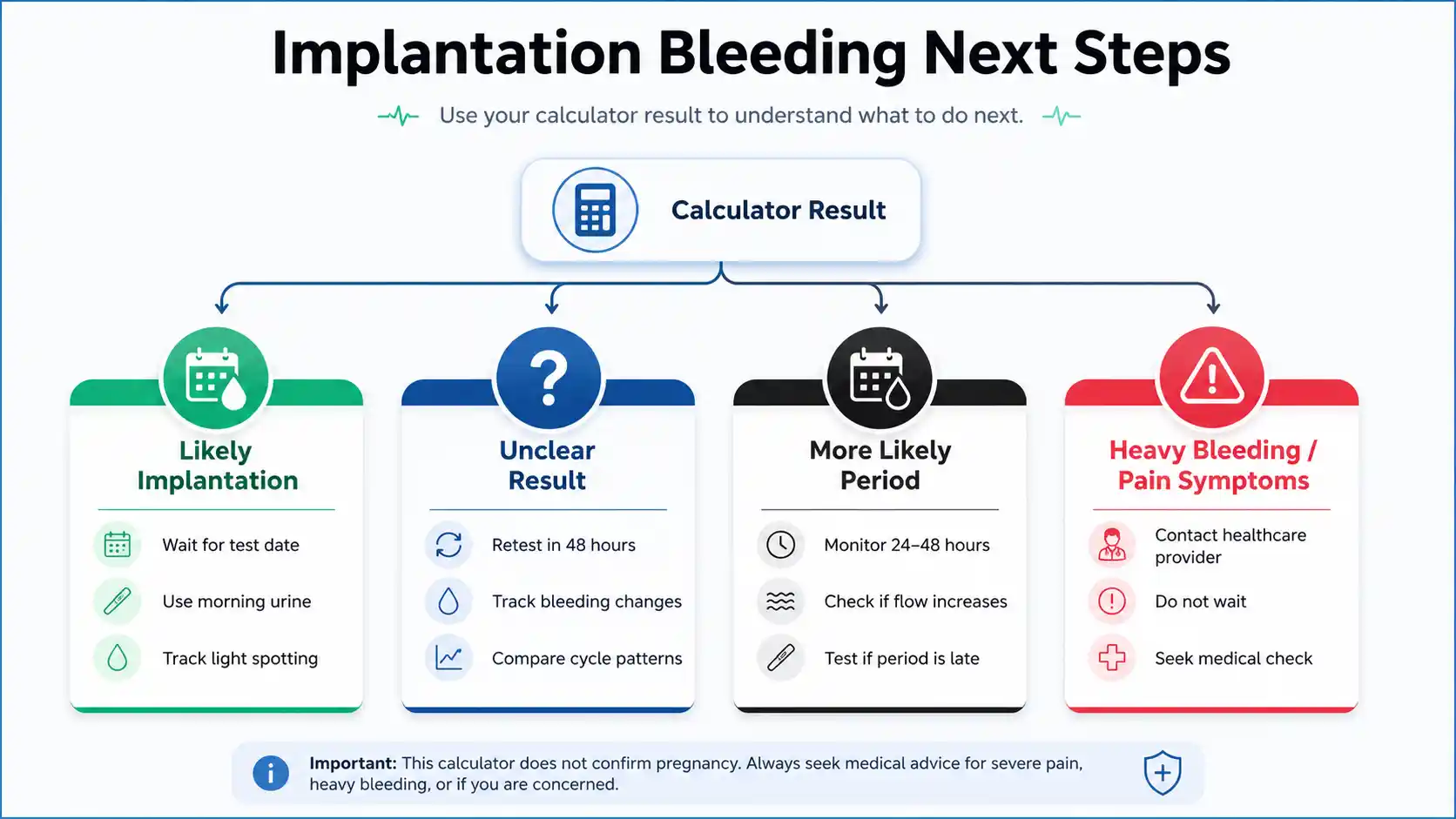
The implantation bleeding calculator helps you understand whether spotting is more likely linked to early pregnancy changes or an upcoming period. It does not confirm pregnancy. Your next steps depend on timing, symptom pattern, and when you plan to test. The goal is simple. Track changes, test at the right time, and respond if symptoms shift.
For Likely Implantation Bleeding Result
A likely result suggests your timing and spotting pattern may match early implantation changes. This often appears as light spotting with mild symptoms before a missed period. It is still too early for certainty.
Wait until your recommended test date before taking a pregnancy test. Use first-morning urine for the most accurate result. Keep track of spotting color and flow since implantation bleeding usually stays light and short. Avoid testing too early because it can give a false negative even when pregnancy has started.
For Unclear Result
An unclear result means the pattern does not clearly match implantation bleeding or a normal period. This is common when timing is close or symptoms overlap.
Focus on tracking changes over the next few days. Retest in 48 hours if your first test is negative. Watch whether spotting becomes heavier or stops completely. Implantation bleeding usually does not increase in flow. A period often becomes heavier and more consistent. Your test timing matters more than symptoms alone in this range.
For More Likely Period Result
A more likely period result suggests the spotting pattern and timing look closer to menstrual bleeding. This often includes a steady flow, darker color, or increasing cramps.
Track flow for the next 24 to 48 hours. If bleeding becomes similar to your usual period, pregnancy is less likely this cycle. Still take a pregnancy test if your period is late. Hormone changes can sometimes delay bleeding patterns, so testing confirms the final result instead of guessing based on symptoms.
For Heavy Bleeding or Pain Symptoms
Heavy bleeding or strong pain does not fit typical implantation bleeding patterns. This needs attention even if the calculator result suggests low concern.
Contact a healthcare provider if bleeding becomes heavy, pain increases, or symptoms feel unusual for your cycle. Do not wait for your next test date if symptoms worsen. Most early checks include a pregnancy test and symptom review to rule out complications and confirm what is happening.
You Might Also Find These Helpful
Pregnancy & Fertility 45
Use this Pregnancy Risk Calculator to check age, BMI, health history, bleeding, and twins. See if closer prenatal monitoring may be worth asking about.
Try calculatorOne Time Pregnancy Calculator estimates pregnancy odds from one encounter, plus fertile window timing, test date, due date, and 21-day testing guidance.
Try calculatorUse the AMH Calculator to convert ng/mL or pmol/L, compare your result with age-based data, and see what it may mean for IVF, fertility,…
Try calculatorUse the Baby Eye Color Calculator with parents, grandparents, or sibling context to compare Brown, Green/Hazel, and Blue/Grey model estimates instantly.
Try calculatorBasal Body Temperature Calculator checks reading conditions and analyzes your temperature pattern for a sustained shift that may be consistent with ovulation.
Try calculatorBPD gestational age calculator: estimate fetal age from BPD, compare your week, check normal BPD ranges, and understand ahead or behind results.
Try calculatorCalculate odds with the Chance of Twins Calculator. Enter maternal age and history. Find your probability instantly. See if you will conceive multiples now.
Try calculatorFind out exactly when you conceived. Our free Conception Calculator uses your Due Date, LMP, or Ultrasound to estimate your fertilization date and fertile…
Try calculatorUse our Conception Date Due Date Calculator to find your baby's arrival date. Enter your conception or intercourse date for clinical 40-week results.
Try calculatorContraceptive effectiveness calculator to compare birth control methods, typical vs perfect use, backup protection, and 5-year pregnancy risk.
Try calculatorUse this CRL calculator to estimate gestational age and due date from crown-rump length in mm or cm. Compare CRL, LMP, and IVF dating…
Try calculatorEstimate your monthly and 12-month pregnancy odds by age, partner age, and cycle dates. See your fertile window and when to seek fertility help.
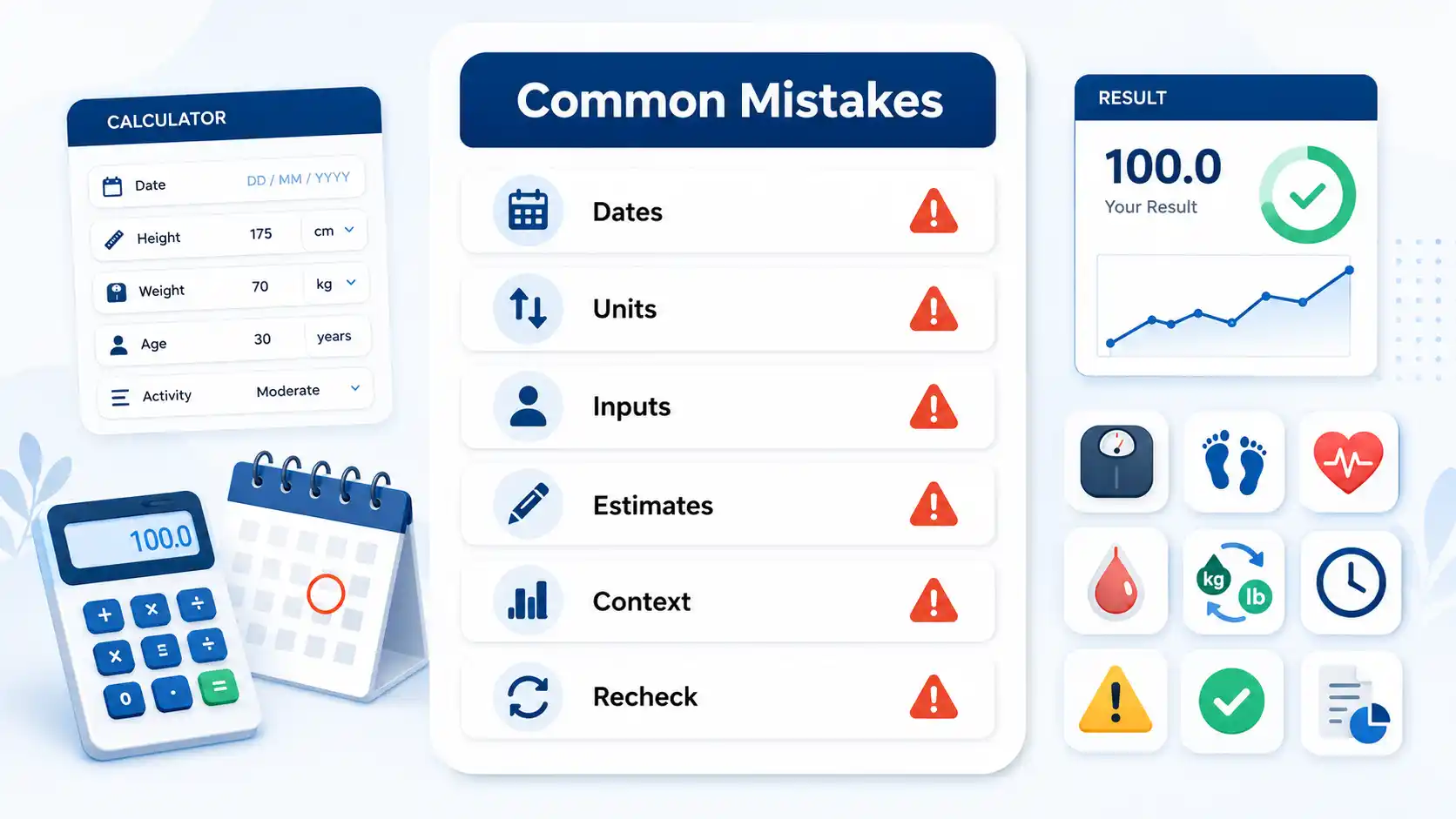
Try calculatorCommon Mistakes When Using the Implantation Bleeding Calculator
Many users misread early pregnancy spotting because symptoms overlap with normal cycle changes. Implantation bleeding and period bleeding often look similar, especially when timing is close. Most errors come from wrong input timing, mixing cycle events, or testing too early, which leads to confusing or inaccurate results.
- Confusing ovulation spotting with implantation bleeding due to similar light spotting timing
- Entering period start date instead of ovulation or cycle mid-point data
- Taking a pregnancy test before implantation window is complete
- Assuming all spotting means implantation without checking flow and duration patterns
- Ignoring heavy bleeding or clotting signs that indicate a normal period or other condition
Frequently Asked Questions (FAQs)
Can implantation bleeding happen before 6 DPO?
Implantation bleeding before 6 days past ovulation is very unlikely because a fertilized egg usually needs several days to reach and attach to the uterine lining. Bleeding earlier than this is more likely related to ovulation or another cause.
Implantation almost always follows ovulation by at least several days.
Can implantation bleeding happen after a missed period?
Yes, but it is uncommon. Implantation usually happens before your expected period. If bleeding begins after a missed period, it is more likely caused by hormonal changes, early pregnancy bleeding, or another condition that needs evaluation.
Timing after ovulation is often the best clue.
Does implantation bleeding always happen before a positive pregnancy test?
Yes, implantation must happen before your body starts producing enough hCG for a positive pregnancy test. Most home tests become more reliable only after hormone levels have had time to increase.
Implantation comes first. Detectable hCG follows afterward.
Can stress change implantation bleeding timing?
Stress can delay ovulation and change your menstrual cycle, which also shifts the expected implantation window. It does not directly cause implantation bleeding, but it can make predicting fertile dates more difficult.
A later ovulation means later implantation timing.
Does every pregnancy have implantation bleeding?
No. Many healthy pregnancies develop without any implantation bleeding at all. Some people notice light spotting, while many never experience any visible bleeding during implantation.
No spotting does not mean pregnancy is less likely.
Can an implantation bleeding calculator predict pregnancy?
No. An implantation bleeding calculator estimates your implantation window, pregnancy test date, and due date based on your cycle information. It cannot diagnose pregnancy or replace a home pregnancy test or medical evaluation.
The calculator estimates timing, not pregnancy itself.
Can I use the implantation bleeding calculator with irregular periods?
Yes. The calculator works best when you know your ovulation date or use fertility tracking. If your cycles vary each month, an ovulation-based calculation is usually more accurate than relying only on your last menstrual period.
Known ovulation gives the most reliable timeline for irregular cycles.
When should I take a pregnancy test after implantation bleeding?
Wait until your recommended test date, usually around 14 days after ovulation or after your missed period. Testing immediately after implantation bleeding can produce a false-negative because hCG may still be too low for detection.
Waiting a few extra days usually gives a more reliable result.
Can I take a pregnancy test on the same day I notice light bleeding?
Usually, no. If the bleeding is related to implantation, your body may not have produced enough hCG for a home pregnancy test to detect pregnancy accurately.
Testing too early increases the chance of a false-negative result.
How long should I wait before checking?
Most people get the most reliable result by testing around 14 DPO or after a missed period. Some early-detection tests work sooner, but accuracy improves as hCG levels continue to rise.
Your calculator result helps estimate the best testing day.
Why do early pregnancy tests often show a negative result?
A negative result can happen because hCG has not reached detectable levels yet, even if implantation has already occurred. Later ovulation, late implantation, or diluted urine can also affect the result.
Retesting after 48 hours often provides a clearer answer.
What gives the most reliable pregnancy test result?
For the highest accuracy, use first-morning urine, follow the test instructions, and avoid drinking large amounts of fluid beforehand. If your period has not started, repeat the test after two days if the first result is negative.
Small timing changes can make a big difference in accuracy.
When should I stop waiting and speak with a healthcare provider?
Contact a healthcare provider if you have heavy bleeding, severe pelvic pain, dizziness, passing clots or tissue, or repeated negative tests with no period. Those symptoms need medical evaluation instead of home monitoring.
Do not rely only on home testing when symptoms become concerning.
What is the smartest next step after implantation bleeding?
Use the implantation bleeding calculator to estimate your implantation window and recommended pregnancy test date before testing. Matching your cycle with the correct timing is more accurate than relying on symptoms alone.
Good timing is usually more helpful than testing early.
Questions?
We had love to hear from you! Whether you are reporting an issue, suggesting a new calculator, or exploring collaboration opportunities — we are here to help. Every message helps us make 100calc smarter, faster, and more helpful for everyone.
Why People Trust 100calc
At 100calc.com, we focus on accuracy, speed, and trust. Every calculator we create is designed to give reliable, instant, and easy-to-understand results you can truly depend on.