
Nuchal Translucency Calculator: Is Your NT Measurement Within the Normal Range?
A nuchal translucency calculator estimates whether your baby’s NT measurement is expected for its size during the first-trimester screening window. It uses Crown-Rump Length (CRL) and Nuchal Translucency (NT) measurements to calculate the expected NT value, NT percentile, and Multiple of the Median (MoM). Comprehensive screening can also include maternal age and nasal bone findings to estimate how ultrasound markers may affect risk. NT screening is performed when CRL is between 45 mm and 84 mm, which is usually 11 weeks to 13 weeks 6 days.
Many parents search after seeing a number on an ultrasound report. A result of 2.2 mm, 2.8 mm, 3.0 mm, or 3.5 mm can feel confusing. The measurement alone does not tell the full story. NT naturally changes as a baby grows. A value that seems high at one CRL may be normal at another. That is why this calculator compares your NT measurement with the expected value for your baby’s size instead of using a single cutoff.
Enter your CRL and NT measurement to see your MoM score, percentile, screening category, and recommended next steps. If you use comprehensive mode, the calculator also estimates how maternal age and nasal bone findings may change the background screening risk. Remember that this is a screening tool, not a diagnostic test. An increased NT can occur in healthy pregnancies, while diagnostic testing is needed to confirm or rule out a condition.
Quick Facts
- Valid screening range: CRL 45 mm to 84 mm
- Typical scan timing: 11 weeks to 13 weeks 6 days
- Calculates NT percentile and MoM score
- NT of 3.5 mm or greater is a key screening threshold
- Comprehensive mode includes maternal age and nasal bone status
- Screening assessment only. Not a diagnosis.
- Updated Jul 7, 2026
- Reviewed by 100Calc Research Team
First-Trimester NT Scan Estimate
Nuchal Translucency Calculator
Calculate your baby's NT percentile and Multiple of the Median (MoM) based on strict Fetal Medicine Foundation (FMF) guidelines, and assess early chromosomal risk factors.
Screening Status
Calculating statistical median...
FMF Clinical Metrics
Estimated Risk Adjustment
Your dynamic risk adjustment text will appear here.
Recommended Next Steps
Clinical guidance pathway will populate here based on your specific screening results.
Is this NT measurement normal?
Your dynamic answer will appear here.
Why does the calculator ask about the Nasal Bone?
Your static educational answer will appear here.
Medical warning: This nuchal translucency calculator is for educational screening support only. It cannot diagnose or rule out Down syndrome, trisomy 18, trisomy 13, heart defects, or any other fetal condition. Always review your NT, CRL, nasal bone, blood test, and NIPT results with your doctor, midwife, genetic counselor, or maternal-fetal medicine specialist.
Explore More Calculators
Use this fetal growth calculator to check baby weight percentile from ultrasound data in grams, kg, or cm and see what the result means…
Try calculatorEnter gestational sac measurements in mm or cm to calculate mean sac diameter, estimate early gestational age, compare week-by-week milestones, and see when follow-up…
Try calculatorMissed a birth control pill? Check pregnancy risk, protection status, backup contraception needs, and what to do next with our missed pill calculator.
Try calculatorUse our Pregnancy Chance Calculator to estimate your odds. Enter your cycle day, age, and method. Find out if you are in the high-risk…
Try calculatorUse our pregnancy due date calculator to find your exact Baby Due date. IVF, conception, ovulation, and ultrasound methods with weeks and timeline.
Try calculatorUse this Pregnancy Risk Calculator to check age, BMI, health history, bleeding, and twins. See if closer prenatal monitoring may be worth asking about.
Try calculator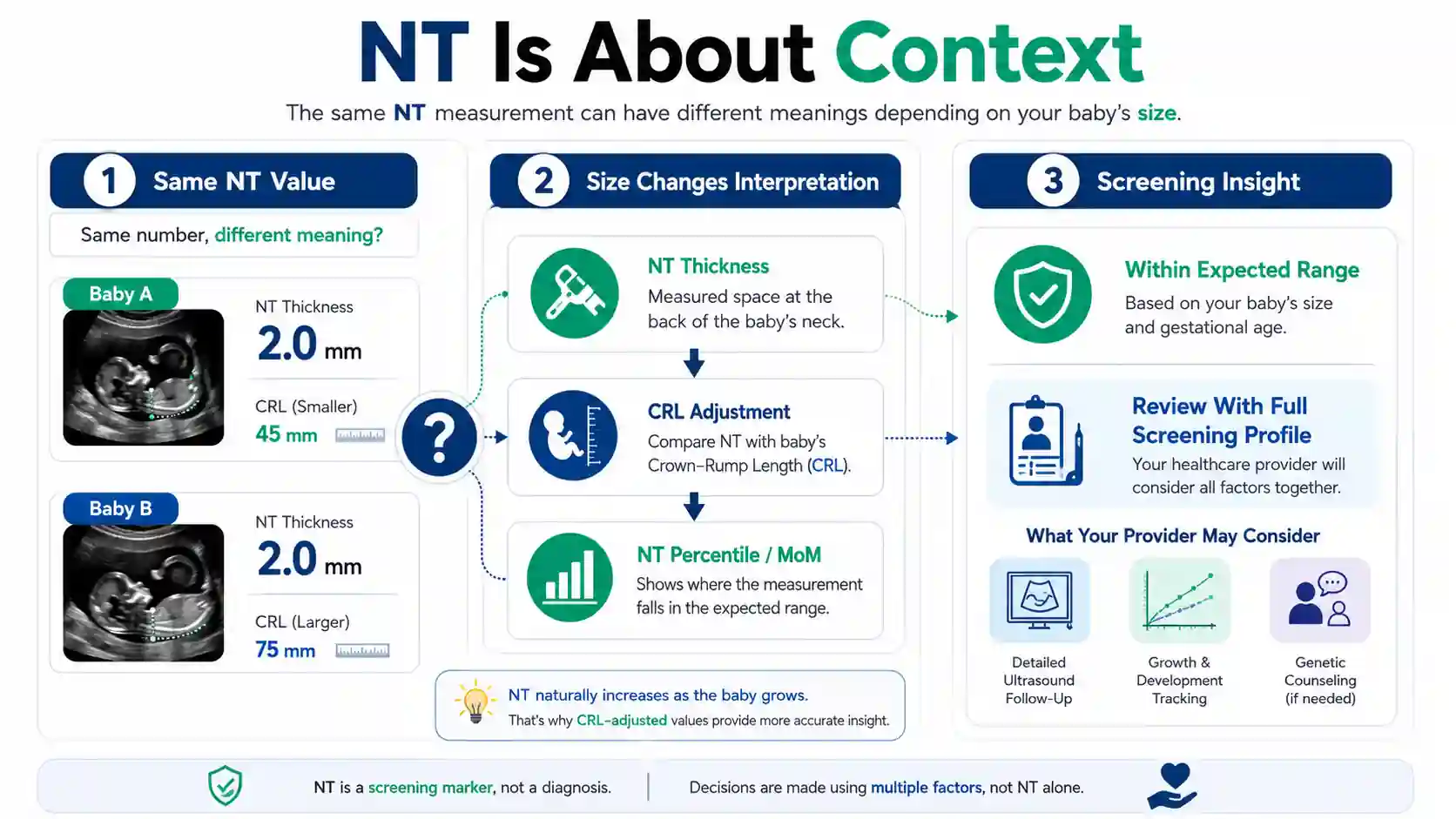
Micro Insight
An NT measurement is a screening marker, not a diagnosis. The key decision is whether the result falls within the expected range for the baby’s size. If the value is higher than expected, healthcare providers often discuss options such as noninvasive prenatal testing, detailed ultrasound follow-up, or genetic counseling.
What Is Nuchal Translucency?
During early fetal development, a small amount of fluid collects under the skin at the back of the neck. Ultrasound specialists measure this space as part of first-trimester screening. The measurement naturally changes as the baby grows, which is why doctors compare it with the baby’s crown-rump length rather than using a single number for every pregnancy.
A baby with an NT measurement of 2.0 mm may be completely normal at one crown-rump length, while the same value can have a different meaning at another size. This is why modern screening methods use percentiles, centiles, and Multiple of the Median (MoM) values to compare the measurement with expected ranges.
Many parents search for a “normal NT value” after an ultrasound report. The real question is whether the measurement is expected for the baby’s size and gestational age. That comparison provides a more accurate assessment than looking at the NT number alone.
What Your Nuchal Translucency Result Means
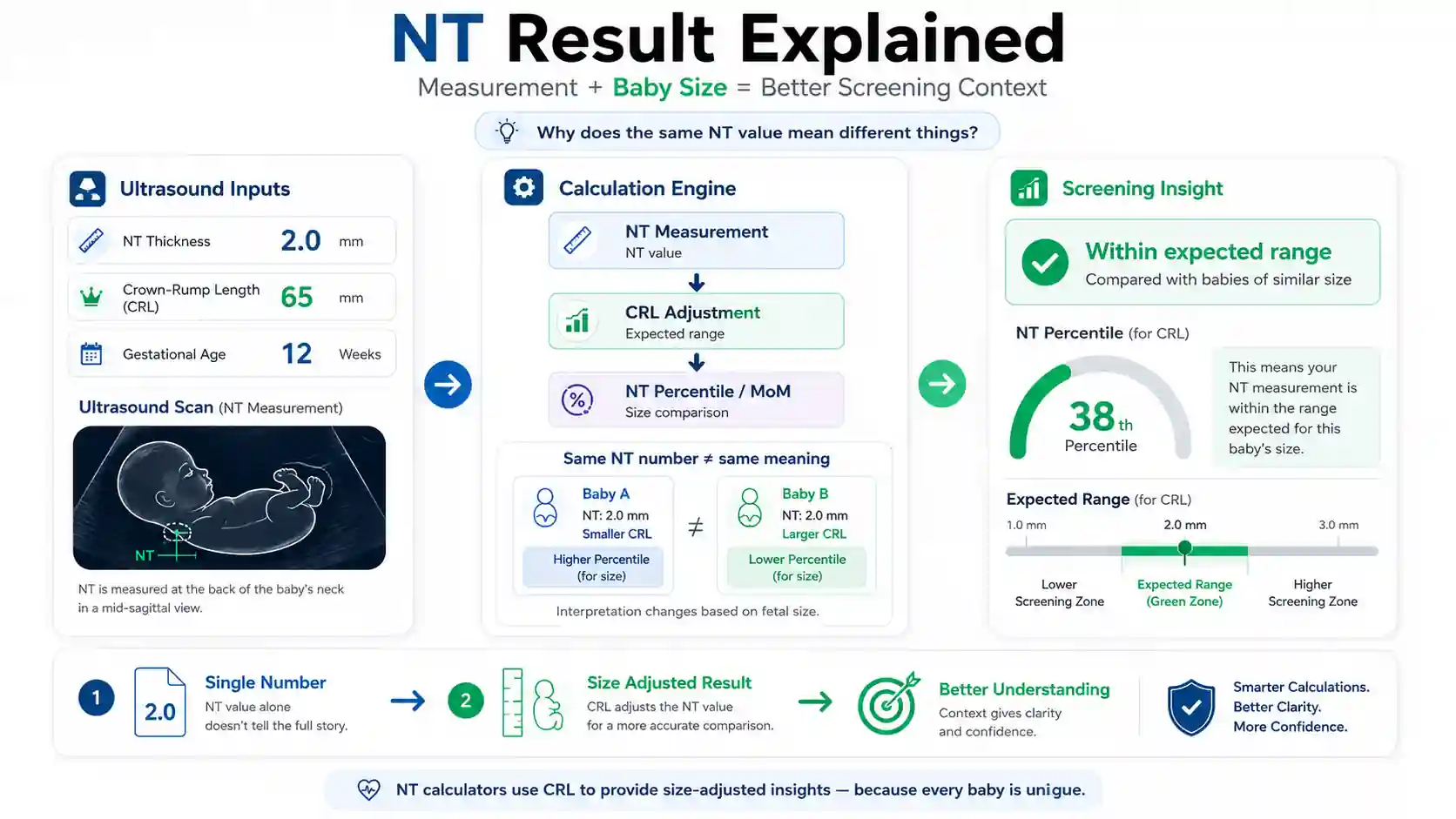
Your result shows how your baby’s nuchal translucency measurement compares with the expected value for its crown-rump length (CRL). The calculator evaluates the NT measurement, calculates the Multiple of the Median (MoM), and places the result into a clinical risk category.
A normal result usually means the NT measurement is close to the expected range for the baby’s size. A higher result may indicate the need for more screening or follow-up testing.
Understanding Your Result
The most important number is the MoM score.
A MoM of 1.0 means the NT measurement matches the expected median for that CRL. Values below 1.5 are usually reassuring. Higher values mean the measurement is larger than expected for the baby’s size.
The calculator also assigns a percentile range. A higher percentile means the NT measurement is larger than most babies with the same CRL. Percentiles help place the measurement into context but do not diagnose any condition.
If you use Comprehensive Mode, the calculator also estimates how maternal age and nasal bone findings may change the background screening risk.
Is Your Result Good or Bad?
Results are best interpreted by looking at both NT measurement and MoM.
Result Pattern General Interpretation
MoM below 1.5 and NT below 3.5 mm Usually within the expected range
MoM 1.5 to 1.99 Borderline result that may need closer review
MoM 2.0 or higher Higher than expected for fetal size
NT 3.5 mm or greater Common clinical threshold for increased screening concern
A higher NT measurement does not mean a baby has a chromosomal condition. Many pregnancies with elevated NT measurements have healthy outcomes. The result simply changes the statistical risk and may lead to further evaluation.
What You Should Do Next
Review the result alongside your ultrasound report.
Confirm the CRL was measured between 45 mm and 84 mm.
Discuss elevated or borderline results with your healthcare provider.
Consider additional screening such as NIPT if recommended.
Follow any advice for repeat ultrasound scans or specialist assessment.
Screening results guide decisions. Diagnostic tests provide more definite answers when needed.
Quick Example to Test
Suppose your ultrasound report shows:
- CRL: 75 mm
- NT: 2.1 mm
The expected NT for a CRL of 75 mm is about 1.71 mm.
MoM = 2.1 ÷ 1.71 = 1.23
Result:
- MoM: 1.23
- Screening Status: Low Risk (Normal)
- Percentile: Below the 95th percentile
This result suggests the NT measurement is slightly above the median but still within the typical range for the baby’s size. Routine prenatal care is usually appropriate unless other screening findings suggest a higher risk.
How to Use the Nuchal Translucency Calculator
This nuchal translucency calculator compares your baby’s NT measurement with the expected value for its Crown-Rump Length (CRL). It can estimate the NT percentile, calculate the MoM score, classify the screening result, and provide risk-adjusted guidance when maternal age and nasal bone findings are included.
Choose Your Assessment Type
Select either Basic NT Percentile or Comprehensive Screen. Basic mode focuses on CRL and NT measurements only. Comprehensive mode adds maternal age and nasal bone findings to estimate how ultrasound results may change background screening risk.
Enter the Crown-Rump Length (CRL)
Add the baby's CRL from the ultrasound report in millimeters. Valid measurements range from 45 mm to 84 mm. This range matches the usual first-trimester NT screening window and allows the calculator to determine the expected NT value.
Enter the NT Measurement
Type the nuchal translucency measurement from the scan report. The calculator compares this value with the expected NT for the baby's size. It then calculates the MoM score and determines where the measurement falls within percentile categories
Add Maternal Age and Nasal Bone Findings
Comprehensive mode includes maternal age and nasal bone status. Choose whether the nasal bone is present, absent or not assessed. These details help adjust the background screening risk and create a more detailed risk estimate.
Review Your Screening Results
Results appear instantly after calculation. The calculator shows the expected median NT, MoM score, percentile category, screening status, and recommended clinical pathway. Comprehensive mode also displays background age risk and the adjusted ultrasound risk ratio.
Quick Example to Test
Sample Inputs
- Assessment Type: Basic NT Percentile
- CRL: 72 mm
- NT: 2.0 mm
Result
- Expected NT: About 1.66 mm
- MoM Score: About 1.20
- Screening Status: Low Risk (Normal)
- Percentile Category: Below the 95th Percentile
What Happened
The calculator compared the measured NT with the expected value for a CRL of 72 mm. Because the NT remained well below the major 3.5 mm threshold and the MoM stayed under 1.5, the result was classified as low risk within the expected screening range.
How the Nuchal Translucency Calculator Works
NT measurements naturally rise as a baby grows during the first trimester. This nuchal translucency calculator adjusts results using fetal size rather than relying on a single fixed cutoff. The system combines CRL-based NT assessment, MoM scoring, and optional risk modifiers to provide a consistent screening interpretation within the accepted NT screening window.
Key Features & Benefits
- Calculates NT percentile instantly using fetal size adjusted assessment
- Generates MoM scores automatically for easier result comparison
- Uses CRL-based interpretation instead of fixed NT thresholds alone
- Includes maternal age risk estimates in Comprehensive Screen mode
Technical Process
NT Modeling
Calculates the expected NT value from the baby's Crown-Rump Length measurement.
MoM Analysis
Compares measured NT with expected NT to determine relative screening status.
Risk Adjustment
Compares calculated results with expected benchmarks and highlights meaningful differences.
What Does an NT of 3.0 to 3.4 mm Mean?
An NT measurement between 3.0 mm and 3.4 mm often sits in a borderline range. It is not the same as a diagnosis. It also should not be ignored. The main question is how that number compares with the baby’s CRL, gestational age, nasal bone finding, and any blood or NIPT result.
Why 3.0 to 3.4 mm Can Feel Confusing
Many parents see 3.0 mm, 3.1 mm, 3.2 mm, or 3.4 mm on the ultrasound report and panic.
That reaction is normal.
This range can be hard to understand because it is not always labeled the same way. One clinic may call it borderline. Another may call it mildly increased. Some reports may only say that the result needs follow-up.
A nuchal translucency calculator helps by comparing the NT measurement with the expected value for the baby’s crown-rump length. That CRL-based comparison is more useful than looking at the NT number alone.
Borderline NT vs High NT
| NT Measurement | General Meaning | What It Usually Means |
|---|---|---|
| Below 3.0 mm | Expected Range | Usually reassuring when CRL and other markers look normal. |
| 3.0 to 3.4 mm | Borderline | Needs review with the full screening report. |
| 3.5 mm or higher | Increased NT | Often leads to closer follow-up or more testing. |
Heads-up: A borderline NT result does not mean something is wrong with the baby. It means the measurement is close enough to the higher range that your provider may want to review the full screening picture.
Why CRL Still Matters
NT changes as the baby grows.
A 3.0 mm NT at one CRL may not carry the same meaning as 3.0 mm at another CRL. This is why the calculator uses crown-rump length, expected NT, MoM score, and percentile category.
The MoM score gives better context. A result near the expected median is usually more reassuring. A higher MoM means the NT is larger than expected for that baby’s size.
What Usually Happens Next?
If your NT falls between 3.0 mm and 3.4 mm, your provider may suggest one or more follow-up steps:
- Review the ultrasound image quality
- Check the exact CRL and gestational age
- Look at the nasal bone finding
- Compare the result with blood screening
- Discuss NIPT if it has not been done
- Consider a detailed ultrasound follow-up
- Refer you to a genetic counselor if other markers are present
The next step depends on the full screening result. NT alone does not give the final answer.
Simple Way to Think About It
An NT of 3.0 to 3.4 mm is a “pay attention” result, not a confirmed problem.
It means your provider may want more information before calling the screening result reassuring or concerning. If the NT is 3.5 mm or higher, the result usually moves into a stronger follow-up category.
How the Nuchal Translucency Formula Works (Complete Breakdown)
How the Nuchal Translucency Formula Works (Complete Breakdown)
The Nuchal Translucency Calculator evaluates whether an NT measurement is expected for a baby’s size during the first-trimester screening window. It uses Crown-Rump Length (CRL) to estimate the expected NT value, then compares the actual ultrasound measurement against that expectation using a Multiple of the Median (MoM) score.
Formula 1:Expected NT
Expected NT = (0.0191 × CRL) + 0.2824
Formula 2:MOM
MoM = NT ÷ Expected NT
What These Formulas Do
The first formula predicts the NT measurement that would normally be expected for a baby with a specific Crown-Rump Length. Since NT naturally increases as the fetus grows, CRL must be considered before judging whether a measurement is high or low.
The second formula calculates the Multiple of the Median, commonly called MoM. This score shows how the measured NT compares with the expected NT. A MoM near 1.0 means the measurement is close to average for that fetal size.
Understanding the Formula Variables
NT
NT stands for Nuchal Translucency. It is the fluid-filled space measured at the back of the baby’s neck during a first-trimester ultrasound. The calculator uses this value as the primary screening measurement when assessing percentile and risk category.
CRL
CRL means Crown-Rump Length. This measurement represents the baby’s length from the top of the head to the bottom of the torso. It helps determine fetal size and allows NT measurements to be interpreted against the correct growth stage.
Expected NT
Expected NT is the predicted NT value for a baby with a specific CRL. The calculator generates this number automatically using the CRL-based model. It serves as the comparison point for percentile assessment and MoM calculation.
MOM
MoM stands for Multiple of the Median. It compares the actual NT measurement with the expected NT value. A result close to 1.0 is generally near average, while higher values indicate the NT measurement is above the expected range.
NB
NB means nasal bone. It refers to whether the nasal bone was seen during the first-trimester ultrasound. This finding can add screening context when reviewed with NT, CRL, maternal age, and other results.
Another Example Calculation (Step-by-Step)
A simple example helps show how the calculator processes ultrasound measurements. The values below follow the same calculation method used by the tool.
Given:
- CRL = 70 mm
- NT = 2.0 mm
Calculation:
					Expected NT = (0.0191 × 70) + 0.2824

Expected NT = 1.337 + 0.2824

Expected NT = 1.6194 mm
					MoM = 2.0 ÷ 1.6194

MoM = 1.24
Result:
Expected NT: 1.62 mm
MoM Score: 1.24
Screening Status: Low Risk (Normal)
Percentile Category: Below 95th Percentile
Meaning:
The NT measurement is slightly higher than the expected median for this fetal size but remains within the typical screening range. Since the MoM stays below common elevated thresholds, the result falls into the normal screening category and does not suggest increased risk based on NT alone.
How do you calculate Nuchal Translucency percentile and risk?
A Nuchal Translucency calculator estimates whether an NT measurement is expected for a baby’s size by comparing the measured NT value with the predicted NT for the baby’s Crown-Rump Length (CRL). It then calculates a Multiple of the Median (MoM), assigns a percentile category, and determines whether the result falls into a low risk, borderline, or increased risk screening group.
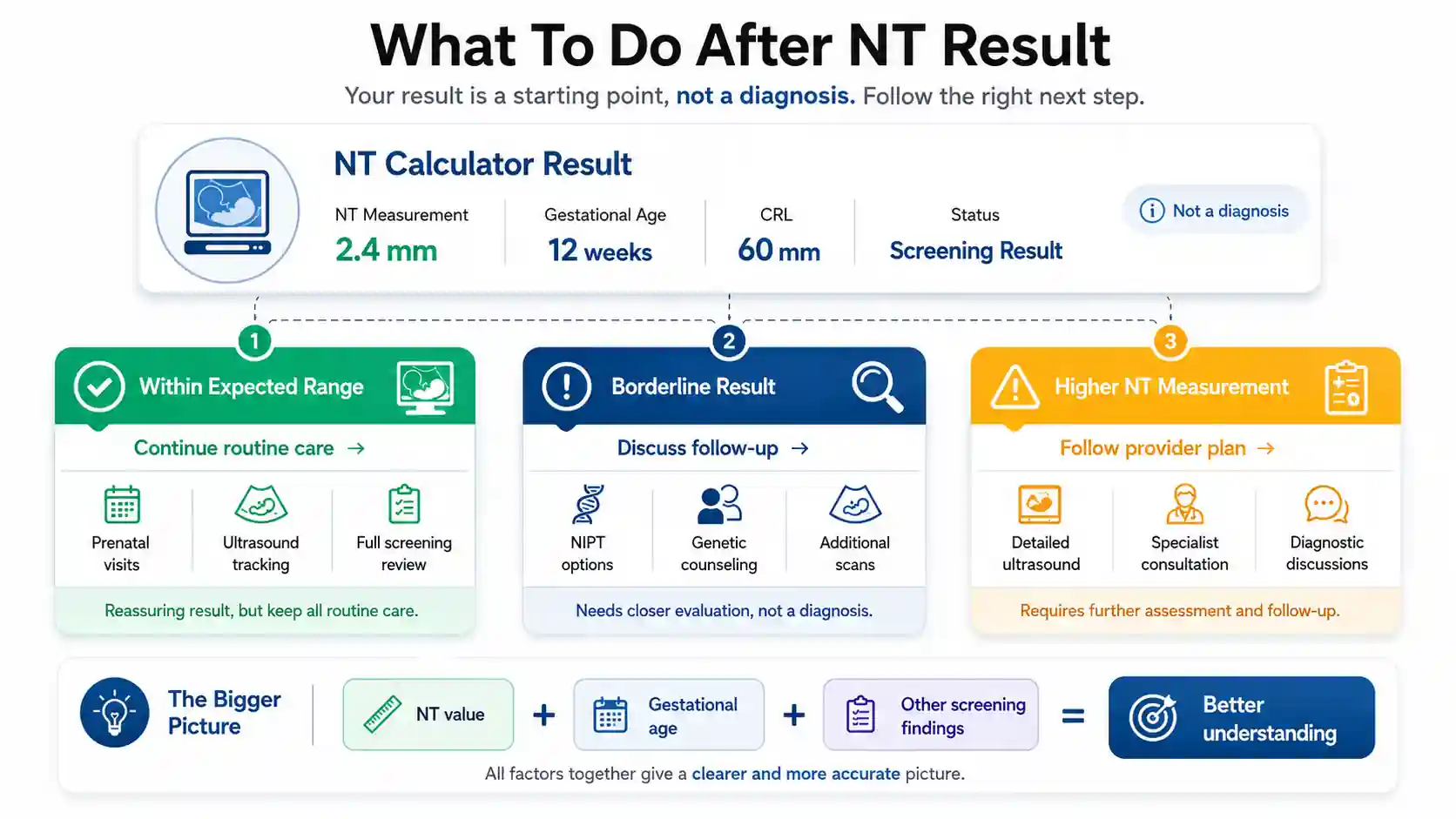
What is a typical NT measurement at 12 weeks?
This is one of the most common first-trimester screening questions.
Input
- CRL = 65 mm
- NT = 1.8 mm
Process
- Expected NT is calculated from the CRL.
- The calculator compares the measured NT with the expected value.
- A MoM score is generated automatically.
Result
- Expected NT = 1.52 mm
- MoM = 1.18
- Screening Status = Low Risk (Normal)
Meaning
The NT measurement is close to the expected value for fetal size and falls within the typical screening range.
Is an NT measurement of 3.5 mm considered high risk?
Many parents search this after receiving an ultrasound report with an elevated NT finding.
Input
- CRL = 65 mm
- NT = 3.5 mm
- Maternal Age = 38
- Nasal Bone = Absent
Process
- Expected NT is calculated from CRL.
- The MoM score is generated.
- Maternal age risk and nasal bone findings are included.
- Ultrasound likelihood factors adjust the background risk estimate.
Result
- Expected NT = 1.52 mm
- MoM = 2.30
- Screening Status = Increased Risk
- Adjusted Risk = 1:2
Meaning
A high NT measurement combined with an absent nasal bone significantly increases the screening risk estimate and usually leads to discussion of further testing options.
What happens when NT is higher than expected but below the high-risk threshold?
Some ultrasound reports show values that are elevated without reaching the major clinical cutoff.
Input
- CRL = 70 mm
- NT = 2.6 mm
Process
- Expected NT is calculated from fetal size.
- The calculator measures how far the NT differs from the expected value.
- Risk categories are assigned using MoM thresholds.
Result
- Expected NT = 1.62 mm
- MoM = 1.60
- Screening Status = Borderline
Meaning
The NT measurement is higher than expected for that CRL. Many providers recommend reviewing additional screening options such as NIPT to gather more information.
Can a normal NT result still need additional screening?
A common concern is whether a reassuring NT measurement completely rules out chromosomal conditions.
Input
- CRL = 75 mm
- NT = 1.9 mm
- Maternal Age = 40
- Nasal Bone = Present
Process
- NT is compared with the expected value for fetal size.
- Age-related background risk is calculated separately.
- Nasal bone findings help refine the screening estimate.
Result
- Expected NT = 1.71 mm
- MoM = 1.11
- Screening Status = Low Risk (Normal)
Meaning
The ultrasound findings are reassuring. Age-related factors may still influence overall screening decisions, which is why NT results are often reviewed alongside other screening methods.
Quick Rules to Remember
NT measurements should always be interpreted in relation to fetal size. A larger baby naturally has a higher expected NT value than a smaller baby. The MoM score helps standardize that comparison. Low-risk results are common, while borderline and increased-risk findings often lead to additional screening rather than an immediate diagnosis. This calculator is designed for the first-trimester CRL range of 45 mm to 84 mm and provides a screening estimate, not a diagnostic result.
Nuchal Translucency (NT) Result Benchmarks Explained
Your nuchal translucency (NT) result shows how the baby’s neck fluid measurement compares with expected screening ranges. The benchmark helps you understand if your NT measurement is within a typical range or needs further review based on MoM values and millimeter measurements.
| Range | Label | USA Guideline | India Guideline | Notes |
|---|---|---|---|---|
| MoM < 0.8 | Below Average | Lower than the typical NT range for gestational age. | Usually reviewed with other first-trimester screening results. | Low values alone usually do not indicate a problem. |
| MoM 0.8–1.1 | Median Range | Close to the expected NT measurement range. | Generally considered within common screening limits. | Matches typical values for many pregnancies. |
| MoM 1.1–1.49 | Normal | Above average but below common higher-risk thresholds. | Usually interpreted with maternal age and screening factors. | Often monitored as part of combined screening. |
| MoM 1.5–1.99 | Borderline | Higher than expected and may need closer evaluation. | Doctors may compare with ultrasound and blood markers. | Review the complete screening picture. |
| MoM ≥ 2.0 | Increased Risk | Above expected NT thresholds used in screening. | Usually requires medical review and follow-up planning. | Discuss results with a healthcare provider. |
| NT ≥ 3.5 mm | Increased Risk | Common referral threshold for further assessment. | May require additional evaluation based on overall findings. | Consider specialist review and follow-up tests. |
Heads-up: NT results are screening measurements, not a diagnosis. Your healthcare provider interprets the result with gestational age, ultrasound findings, and other screening factors.
Interpretation
A nuchal translucency result in the median or normal range usually matches expected first-trimester measurements. Higher NT values may need more review, especially when the measurement reaches common referral levels like 3.5 mm or higher. A single NT result does not confirm a condition.
Pro Tip
Keep your ultrasound report details together, including gestational age and NT measurement. Doctors get a clearer picture when they review the full screening profile instead of one number alone.
What to Do After Using the Nuchal Translucency Calculator
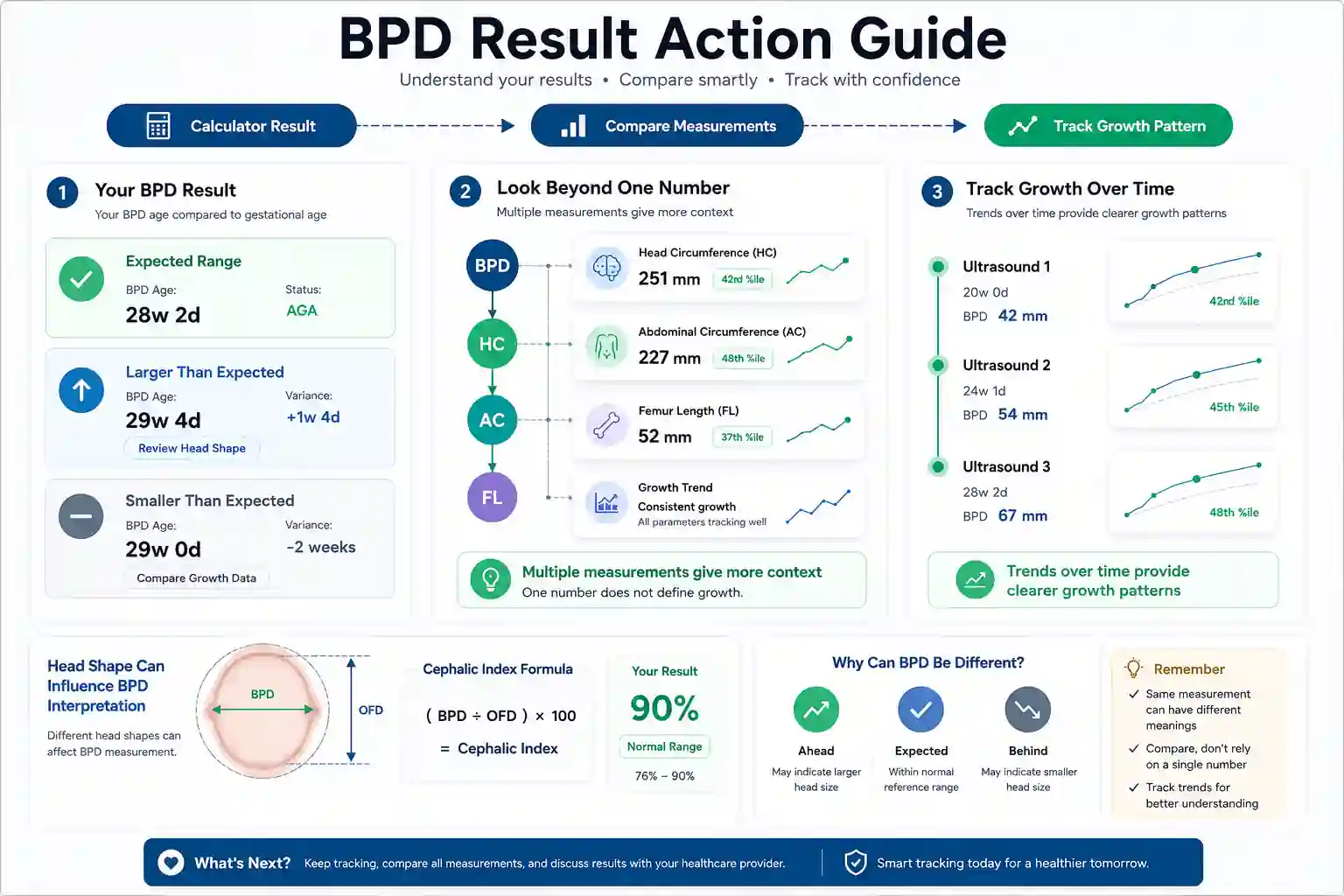
A nuchal translucency calculator helps estimate whether an NT measurement falls within expected screening ranges. Your result is a starting point, not a final answer. The right next step depends on the NT value, gestational age, and other ultrasound or screening findings.
For NT Results Within the Expected Range
A normal NT result usually means the measurement matches common screening ranges for the baby’s development stage. This is a reassuring finding, but it does not replace complete prenatal screening.
Continue routine prenatal visits and keep your ultrasound records available. Future scans help show whether growth and development continue normally.
Compare NT with the full first-trimester screening picture. This may include maternal age, ultrasound findings, and blood screening results such as PAPP-A and free beta-hCG.
Avoid focusing on the NT number alone. A normal measurement lowers concern for some conditions but does not screen for every possible issue.
For Borderline NT Results
A higher NT result does not mean a diagnosis. It means the measurement needs closer evaluation because it may be linked with a higher chance of certain chromosomal or structural findings.
Discuss follow-up options with your healthcare provider. Common next steps may include additional ultrasound review, genetic counseling, or screening options such as non-invasive prenatal testing (NIPT).
Ask about a detailed anatomy scan or specialist consultation if recommended. These steps help check development more closely.
Avoid comparing your result with online examples alone. NT interpretation depends on gestational age, ultrasound quality, and your complete medical information.
For NT Measurements Above 3.5 mm
An NT measurement of 3.5 mm or higher is often treated as a level that needs further assessment. It does not confirm a problem, but it usually leads to more detailed review.
Follow your provider’s recommended testing plan. This may include specialist ultrasound, genetic counseling, or diagnostic testing discussions.
Bring your ultrasound report to every appointment. Details such as crown-rump length, NT measurement, and other markers help specialists interpret the result accurately.
Focus on the next evaluation step instead of the number alone. Many pregnancies with increased NT measurements continue with normal outcomes after further assessment.
Pro Tip
Use the nuchal translucency calculator to understand your screening result, not to diagnose a condition. The most useful approach is tracking the complete picture: NT value, gestational age, ultrasound findings, and recommended follow-up care.
You Might Also Find These Helpful
Pregnancy & Fertility 31
BPD gestational age calculator: estimate fetal age from BPD, compare your week, check normal BPD ranges, and understand ahead or behind results.
Try calculatorCalculate odds with the Chance of Twins Calculator. Enter maternal age and history. Find your probability instantly. See if you will conceive multiples now.
Try calculatorFind out exactly when you conceived. Our free Conception Calculator uses your Due Date, LMP, or Ultrasound to estimate your fertilization date and fertile…
Try calculatorUse our Conception Date Due Date Calculator to find your baby's arrival date. Enter your conception or intercourse date for clinical 40-week results.
Try calculatorContraceptive effectiveness calculator to compare birth control methods, typical vs perfect use, backup protection, and 5-year pregnancy risk.
Try calculatorUse this CRL calculator to estimate gestational age and due date from crown-rump length in mm or cm. Compare CRL, LMP, and IVF dating…
Try calculatorEstimate your monthly and 12-month pregnancy odds by age, partner age, and cycle dates. See your fertile window and when to seek fertility help.
Try calculatorUse this fundal height calculator to compare your cm measurement by week, check growth range, estimate baby weight, and know when to ask about…
Try calculatorPanicking over your hCG levels? Use our hCG 48-Hour Calculator to compare your exact beta rise against the ACOG 35% minimum viability benchmark instantly.
Try calculatorCalculate hCG doubling time instantly. Enter two test results. See if your levels are rising normally. Check pregnancy progress now in the hCG Calculator.
Try calculatorCheck your beta hCG rise with this hCG doubling time calculator. Enter two blood tests to see doubling time, 48-hour increase, and early trend…
Try calculatorConfused by your beta hCG levels? Use our hcg gestational age calculator to estimate your pregnancy weeks, verify IVF dates, and check ultrasound milestones.
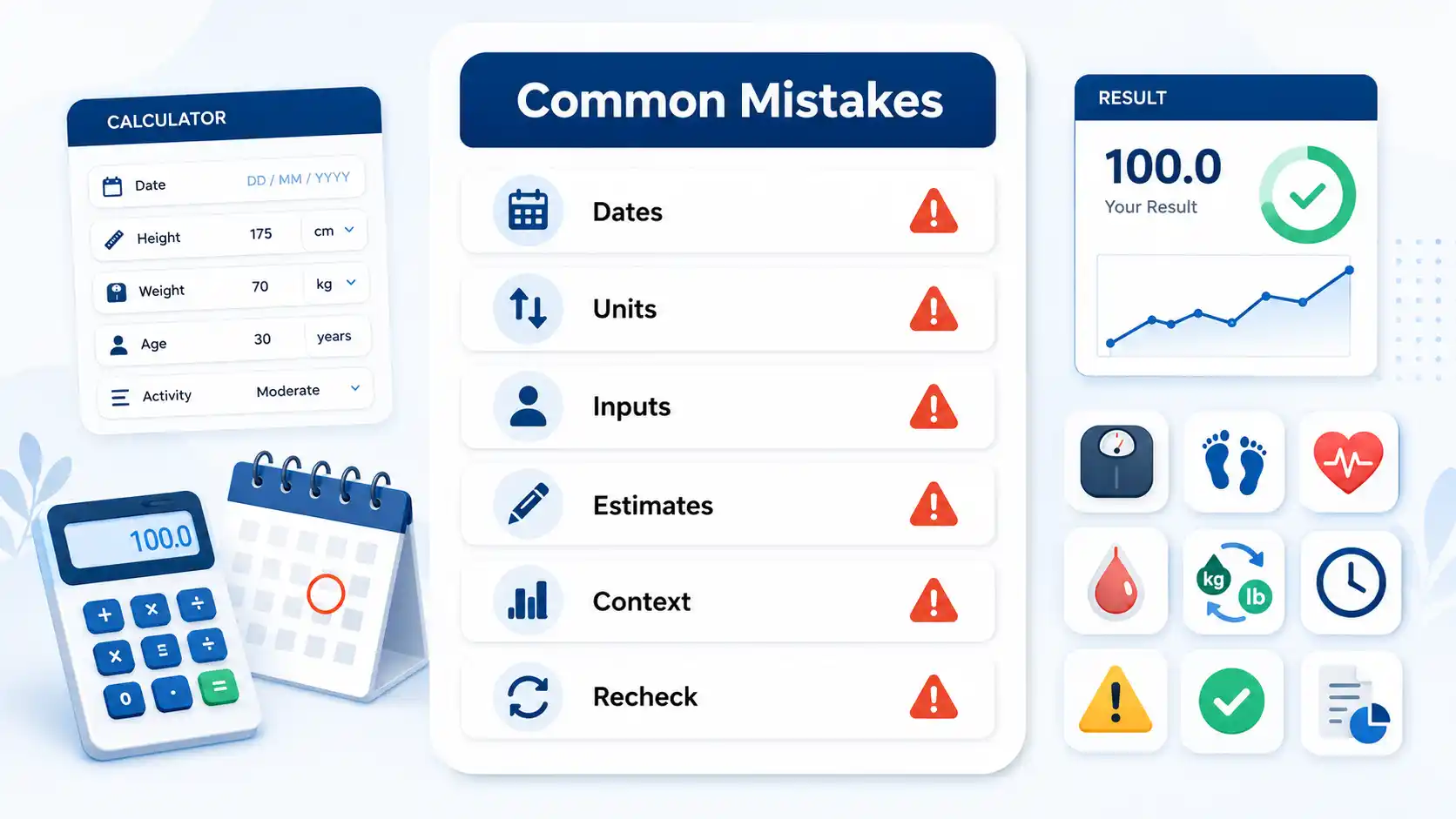
Try calculatorCommon Mistakes When Using the Nuchal Translucency Calculator
A nuchal translucency calculator depends on accurate ultrasound inputs, especially the crown-rump length (CRL), NT measurement, and gestational age. Small input errors can change the result and create confusion when comparing NT values with screening ranges or risk assessments.
- Entering CRL values outside the valid 45–84 mm first-trimester measurement range.
- Using second-trimester nuchal fold measurements instead of first-trimester NT values.
- Comparing NT measurements without considering the matching CRL or gestational age.
- Assuming an NT percentile result confirms or rules out a diagnosis.
- Confusing NT thickness measurements with risk ratios such as MoM values.
Frequently Asked Questions (FAQs)
What is a normal nuchal translucency measurement at 12 weeks?
A normal nuchal translucency measurement at 12 weeks is often below 3.0 to 3.5 mm, depending on the baby’s crown-rump length (CRL). NT values are adjusted for fetal size because the expected range changes as the baby grows.
A lower NT value does not guarantee a healthy outcome, but it is generally considered a reassuring screening finding.
How much nuchal translucency is considered high risk?
A nuchal translucency measurement of 3.5 mm or higher is commonly considered an increased-risk screening result. This level does not confirm a condition. It means doctors may recommend more detailed evaluation.
Follow-up options can include additional ultrasound, genetic counseling, NIPT, or diagnostic testing based on the complete screening picture.
Does nuchal translucency increase with gestational age?
Yes, nuchal translucency normally increases as the fetus grows. This is why NT results are interpreted using crown-rump length (CRL) instead of comparing every measurement against one fixed number.
A calculator adjusts the result based on fetal size to provide a more meaningful comparison with expected values.
What is NT MoM in a nuchal translucency calculator?
NT MoM means multiples of the median. It compares your baby’s NT measurement with the expected median NT value for the same crown-rump length.
A MoM value helps show whether the measurement is lower, close to average, or higher than expected for that fetal size.
Why does the nuchal translucency calculator ask for maternal age?
Maternal age affects the baseline chance of chromosomal conditions and is used in combined first-trimester screening calculations.
The age factor does not change the NT measurement itself. It helps place the screening result into a broader risk estimate.
Why is the nasal bone included in NT screening?
The nasal bone is included because its appearance can affect combined screening risk estimates. A visible nasal bone is usually considered a reassuring marker during first-trimester ultrasound.
An absent or smaller nasal bone may lead healthcare providers to review other screening results more closely.
Can a normal NT result still mean Down syndrome?
Yes. A normal nuchal translucency result can still occur in pregnancies affected by Down syndrome or other conditions.
NT is a screening marker, not a diagnostic test. Doctors combine NT with other factors such as blood tests, ultrasound findings, and genetic screening.
What happens if my NT measurement is 3.5 mm or higher?
An NT measurement of 3.5 mm or higher usually leads to a closer review with your healthcare provider. The next steps depend on your overall screening results and ultrasound findings.
Possible discussions may include NIPT, genetic counseling, fetal echocardiography, CVS, or amniocentesis.
Can the nuchal translucency calculator diagnose a chromosomal condition?
No. A nuchal translucency calculator cannot diagnose chromosomal conditions. It only estimates how an NT measurement compares with expected screening ranges.
A healthcare provider uses the calculator result along with ultrasound findings, blood tests, and diagnostic options when needed.
Why does the calculator need crown-rump length (CRL)?
The calculator needs CRL because NT changes with fetal growth. A measurement that appears high for one fetal size may be normal for another.
Using CRL creates a more accurate comparison by matching the NT value with the baby’s development stage.
Can NT values vary between ultrasound machines?
Yes. NT measurements can vary slightly based on image quality, fetal position, and measurement technique.
For the most reliable result, NT should be measured by trained providers using proper first-trimester ultrasound methods. Small differences do not always indicate a meaningful change.
Questions?
We had love to hear from you! Whether you are reporting an issue, suggesting a new calculator, or exploring collaboration opportunities — we are here to help. Every message helps us make 100calc smarter, faster, and more helpful for everyone.
Why People Trust 100calc
At 100calc.com, we focus on accuracy, speed, and trust. Every calculator we create is designed to give reliable, instant, and easy-to-understand results you can truly depend on.